
MS in Water Resources Engineering Abroad: Eligibility, Fees, Top Universities and Careers
Water is the infrastructure that every other kind of infrastructure depends on. Cities need safe drinking water, farms need reliable irrigation, rivers need flood defences, and coastlines need protection from rising seas. An MS in Water Resources Engineering trains you to design, model, manage and protect the systems that move, store, treat and distribute water. If you enjoy mathematics, fluid mechanics and fieldwork in roughly equal measure, and you want a career where your calculations end up as dams, canals, treatment plants and flood maps that people rely on every day, this is one of the most purposeful engineering specialisations you can choose.
Water resources engineering sits at the meeting point of civil engineering, environmental engineering and hydrology. Unlike a general civil engineering degree, which spreads across structures, transport and geotechnics, this specialisation goes deep on one resource: water in all its forms. You will study how rainfall becomes river flow, how groundwater moves through aquifers, how reservoirs are operated, how floods are predicted, and how water quality is protected. You will also learn the software and the statistics that turn those physical processes into designs a client, a regulator or a government can approve and fund.
This guide explains the degree in full: what you study, who it suits, what universities ask for, what it costs, where to study it, what careers it leads to, and what the official salary data actually says. It is written for international students planning 2026 or 2027 entry. Figures change every year, so wherever a number appears it carries its source and year, and you should always confirm fees and entry requirements on the official university page before you apply.
At a Glance: MS in Water Resources Engineering
| Feature | Typical position |
|---|---|
| Degree level | Master of Science (MS, MSc or MEng depending on country and institution) |
| Typical duration | 1 year full-time in the UK; 1.5 to 2 years in the USA, Canada and Australia; 2 years in much of continental Europe |
| Usual entry degree | Bachelor’s in civil, environmental, agricultural or a closely related engineering discipline |
| Core subjects | Hydrology, hydraulics, groundwater, water quality, flood modelling, water resources systems, GIS and remote sensing |
| Key software | HEC-RAS, HEC-HMS, SWMM, MODFLOW, ArcGIS or QGIS, and programming in Python or MATLAB |
| Common capstone | Research thesis, industry design project, or a modelling study based on a real catchment |
| Who it suits | Students strong in mathematics and fluid mechanics who want fieldwork, modelling and public-interest projects |
What Is Water Resources Engineering?
Water resources engineering is the branch of engineering concerned with the planning, design and management of water systems. Its scope is deliberately broad, because water itself crosses boundaries. The same graduate might work on urban drainage one year, a reservoir operating rule the next, and a coastal flood defence after that. The unifying skill is the ability to quantify water: how much there is, where it goes, how fast it moves, what it carries with it, and what happens when there is too much or too little of it.
Three questions organise almost everything in the field. First, how much water is available, and how reliable is that supply across wet years and dry years? Second, how do we move, store and treat that water safely and affordably? Third, how do we protect people, property and ecosystems from water when it becomes a hazard, whether as a flood, a storm surge or contamination? A master’s degree teaches you to answer all three with data, models and engineering judgement, rather than with rules of thumb.
The field matters more now than it did a generation ago, for reasons that are easy to list and hard to argue with. Populations are growing in cities that already strain their water supplies. Agriculture, which uses the largest share of freshwater in most countries, faces both drought and flood risk. Climate change is shifting rainfall patterns, so historical records alone no longer describe future risk. Ageing dams, levees and pipe networks need assessment and renewal. Governments and utilities are therefore hiring people who can combine classical hydraulics with modern data, remote sensing and climate projections. That combination is exactly what this master’s degree is designed to produce.
It is worth distinguishing water resources engineering from its neighbours. Environmental engineering overlaps heavily, especially on water treatment and water quality, but ranges more widely across air, soil and waste. Civil engineering is the parent discipline: water resources is one of its major branches, alongside structures, transport and geotechnics. Hydrology is the science of water movement; water resources engineering is the application of that science to design and management decisions. If you like the science but also want to build things and make operational decisions, the engineering degree is the right home.
What You Study: Curriculum and Core Subjects
Most programmes begin with a core that every water engineer needs, then branch into electives that let you specialise. The core usually includes surface hydrology, open-channel hydraulics, groundwater hydrology, water quality engineering, and water resources systems analysis. Around that core sit methods courses in statistics, numerical modelling, geographic information systems and remote sensing. Many programmes add a course on water policy, economics or environmental law, because water decisions are rarely purely technical: allocation between cities, farms and ecosystems is a negotiated, regulated outcome.
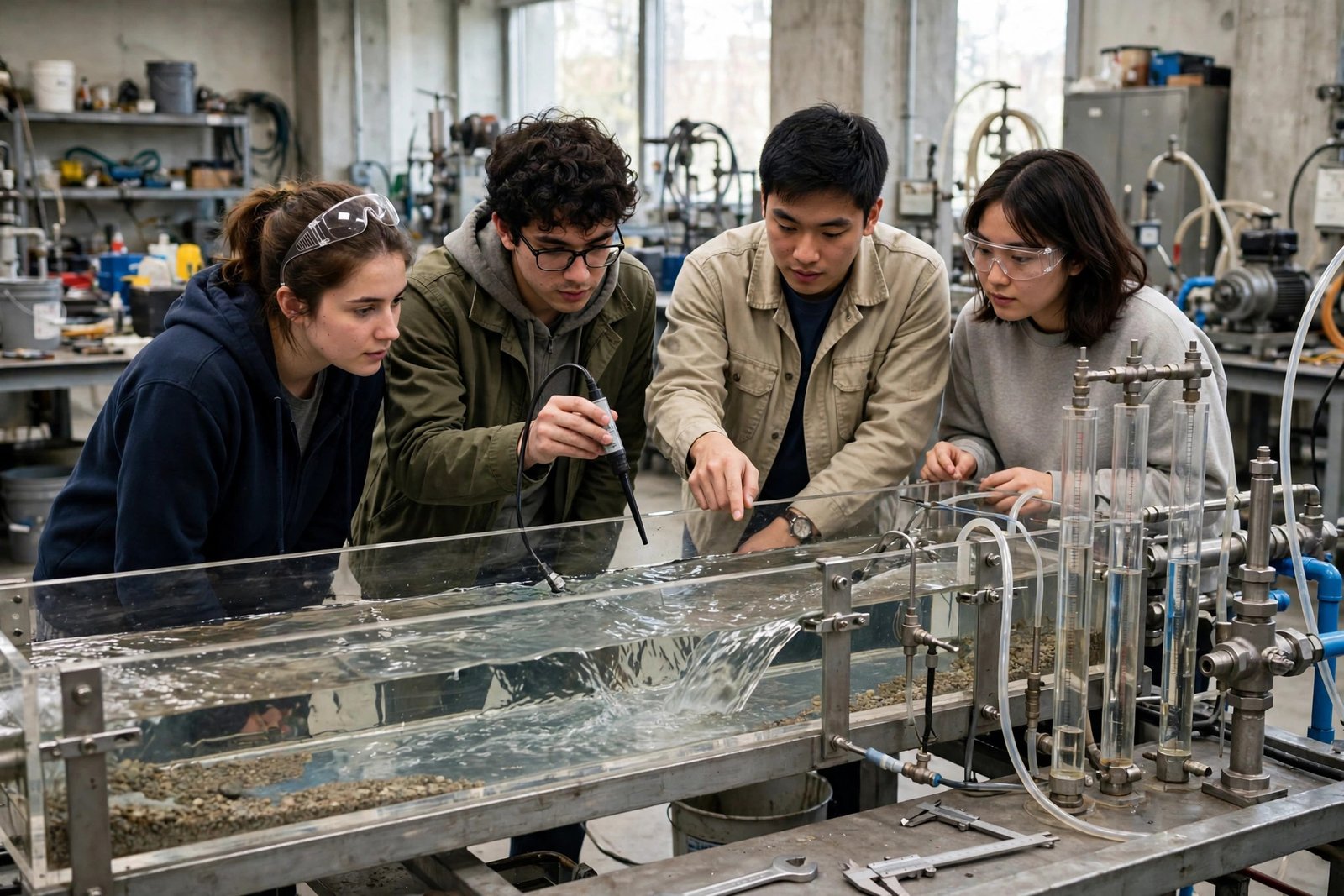
Surface hydrology teaches you to turn rainfall data into river flow estimates, including the flood flows that structures must survive. You will learn rainfall-runoff modelling, flood frequency analysis, and how to work with the uncertainty that comes from short records and changing climates. Open-channel hydraulics covers flow in rivers, canals and culverts, including the gradually varied flow calculations behind backwater profiles and the design of spillways and energy dissipators. These are the courses where a mistake has visible consequences, and they are taught accordingly, with laboratory flumes, field measurements and worked design problems.
Groundwater hydrology deals with the water you cannot see. You will study aquifer properties, well hydraulics, contaminant transport and the modelling tools, such as MODFLOW, that predict how pumping in one place affects water levels and water quality somewhere else. In many countries groundwater is the fastest-growing source of supply and the hardest to regulate, so this expertise is in demand with water utilities, mining companies and environmental consultancies. Water quality courses cover the chemistry and biology of natural waters, the design of treatment processes, and the standards that treated water must meet before it reaches a tap or a river.
Water resources systems analysis is the course that ties the rest together. It treats a river basin as a system of reservoirs, demands, inflows and constraints, and teaches optimisation and simulation methods for operating that system. You will learn to balance competing objectives, such as hydropower revenue, irrigation supply, flood safety and ecological flow, and to explain trade-offs to non-engineers. This systems perspective is what distinguishes a master’s graduate from someone who can only run a single model: employers pay for judgement across a whole basin, not just competence with one piece of software.
Electives let you lean towards the career you want. Flood risk management and coastal engineering suit students aiming at defence and resilience work. Irrigation and drainage engineering suits those heading for agricultural water management. Urban water systems, including stormwater management and water-sensitive urban design, suit city-focused careers. Hydroinformatics and data-driven modelling suit students who enjoy programming and machine learning. Climate adaptation and integrated water resources management suit students aiming at government, development banks and international organisations. Choose electives after looking at job adverts in your target country, not before: the market tells you which combination is actually hired.
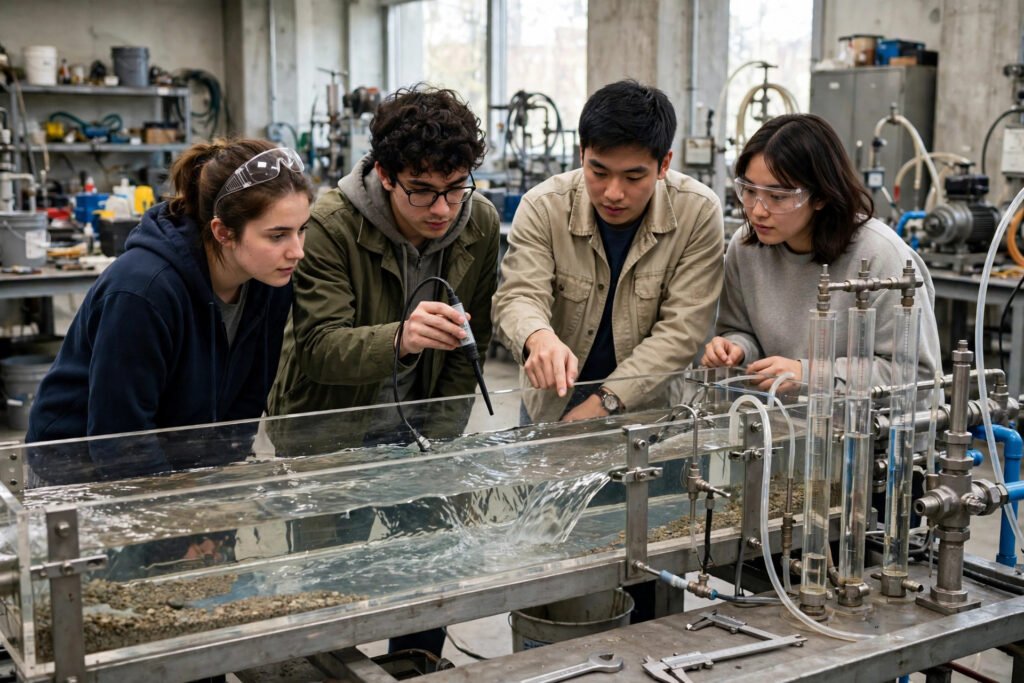
Practical work is a large part of a good programme. Expect laboratory sessions with flumes and flow measurement, field trips to reservoirs, treatment plants and gauging stations, and a substantial project in which you model a real catchment or design a real component. The best programmes have industry partners who supply data and problems, and some include an internship or placement semester. When you compare programmes, ask specifically about fieldwork, software training and the thesis: a programme that only lectures about modelling, without letting you build and defend a model, is a weaker preparation for employment.
Eligibility and Entry Requirements
Entry requirements differ by country and by institution, but the pattern is consistent. Universities want evidence that you can handle graduate-level mathematics, fluid mechanics and data analysis, and that your undergraduate degree covered the prerequisites. A bachelor’s degree in civil engineering is the most direct route. Environmental engineering, agricultural engineering, mechanical engineering with a fluids background, and sometimes geology or physical geography with strong quantitative training are also commonly accepted, sometimes with bridging courses.
Grades matter, and they are assessed in local terms. United States programmes typically ask for a GPA around 3.0 on a 4.0 scale for competitive programmes, with stronger programmes expecting more. United Kingdom programmes commonly ask for a 2:1 honours degree or its international equivalent. Canadian and Australian programmes usually specify a minimum average in the final years of undergraduate study, and German programmes apply their own grade conversion. If your grades sit below a published threshold, relevant work experience, a strong quantitative record in later years, or a good score in a standardised test can sometimes compensate, but do not assume it: email the admissions office with your transcript before you pay an application fee.
English language requirements are standard for international applicants. Most programmes ask for IELTS 6.5 overall with no band below 6.0, or a TOEFL equivalent, although some competitive programmes ask for 7.0. Requirements vary, and some universities waive them for applicants who studied in English. Check the programme page, not a general university page, because departmental requirements can be higher than the university minimum. If you need a pre-sessional English course, factor its cost and timing into your plan early, since it can shift your start date by a term.
Standardised tests are less universal than they once were. Many United States programmes have made the GRE optional or removed it entirely, while some still require or recommend it, particularly for funded places. Where the GRE is optional, a strong quantitative score can still strengthen an application from a less well-known undergraduate institution. Letters of recommendation, usually two or three, should come from academics who taught you quantitative or design courses, or from employers who supervised engineering work. A statement of purpose that names a specific water problem, a catchment or a technique you want to work on will always read better than a generic statement about loving water and wanting to help people.
Work experience is valued but rarely mandatory for taught master’s programmes. Research master’s programmes and funded positions may prefer applicants with internship or project experience, and some professional programmes are designed for practising engineers returning to study. If you have worked on water projects, describe your role precisely: the model you ran, the data you handled, the design decision you contributed to. Admissions tutors read hundreds of statements; concrete detail is what they remember.
Tuition Fees and Living Costs
Tuition fees for international students vary so widely by country, institution and programme that a single average would mislead more than it informs. As a general pattern, public universities in Germany and several other continental European countries charge little or no tuition, with students paying semester contributions and living costs instead, while the United Kingdom, the United States, Canada and Australia charge substantial international tuition. Within each country, research-intensive universities and programmes in expensive cities cost more than others. Always use the programme’s own fee page for the intake you are applying to, and confirm whether the quoted fee is per year or for the whole programme.
Living costs and visa financial requirements are easier to pin down, because governments publish them. In the United Kingdom, the student visa maintenance requirement is GBP 1,529 per month in London and GBP 1,171 per month outside London. In Germany, the blocked account requirement is EUR 11,904 for a year. In Australia, the published living cost figure for a student visa is AUD 29,710 per year. In Canada, the proof-of-funds requirement for a single applicant outside Quebec has been CAD 22,895, rising to CAD 23,448 under the updated figure. These are government figures for visa purposes, not budgets: your actual spending depends on city, housing and lifestyle, and you should build your own budget with a calculator rather than trusting a single number.
| Cost item | Published figure (check year and basis) | What it means for you |
|---|---|---|
| UK student visa maintenance, London | GBP 1,529 per month | Funds you must show for the visa; actual London living costs are often higher |
| UK student visa maintenance, outside London | GBP 1,171 per month | Visa funds requirement outside London |
| Germany blocked account | EUR 11,904 per year | Money held in a blocked account to cover living costs |
| Australia student living costs | AUD 29,710 per year | Published figure used in visa financial assessment |
| Canada proof of funds, single applicant | CAD 22,895 rising to CAD 23,448 | Minimum funds to show, excluding tuition and travel |
| Tuition | Varies widely by country and institution | Confirm on the official programme page for your intake |
Budgeting well means separating three things: tuition, the funds you must show for a visa, and the money you will actually spend month to month. Use the tuition fee calculator and the cost of living calculator on StudyGraduate to test combinations of country, city and programme length, then compare the result against the official figures above. Add fieldwork costs, software licences where not provided, and travel to field sites, which water programmes incur more than most. Also check whether your programme offers a placement or internship semester: paid placements exist in some countries and can change the economics of a two-year degree considerably, but do not assume paid work, and never budget on the assumption of part-time earnings that a visa may restrict.
Top Universities and Countries for Water Resources Engineering
Choosing a country is, in practice, choosing a water problem. The Netherlands is the obvious example: a country largely below sea level, with centuries of flood defence, delta management and water governance expertise, and programmes taught in English that draw students from every delta region in the world. Germany offers strong hydraulics and hydrology research, low or no tuition at public universities, and a large water technology industry. The United States offers scale and variety, from arid-region water management in the west to flood and stormwater work in the east, and some of the most widely used modelling software in the field was developed there. The United Kingdom offers one-year master’s degrees, which suit students who want to return to work quickly, and strong programmes in hydrology, flood risk and water management. Canada combines strong research in cold-region hydrology and water quality with post-study work options, and Australia combines expertise in drought, irrigation and urban water with a large water industry of its own.
Within those countries, look for programmes with named strengths rather than famous names alone. A programme embedded in a civil and environmental engineering department with its own hydraulics laboratory, field sites and research groups in hydrology will serve you better than a generic environmental programme that happens to offer one water module. Check the staff pages: are there professors publishing on the topics you care about, and do they supervise master’s theses? Check the thesis titles from recent years, which many departments publish. Check whether the programme is accredited or recognised by the relevant professional body in that country, since accreditation can matter for later professional registration. And check the cohort: a programme that recruits internationally will give you a network across the river basins of the world, which is a genuine career asset in this field.
For a broader comparison, browse the Courses and Programs directory and the universities directory, and compare programmes side by side with the university comparison tool. If your undergraduate degree is in civil engineering, the Bachelor of Engineering programme profile is a useful reference for how your background maps onto graduate specialisations. Shortlist three to five programmes across at least two countries, and apply to more than one: funding and admission outcomes vary, and a second offer is the best negotiating position you can have.
Careers and Salaries in Water Resources Engineering
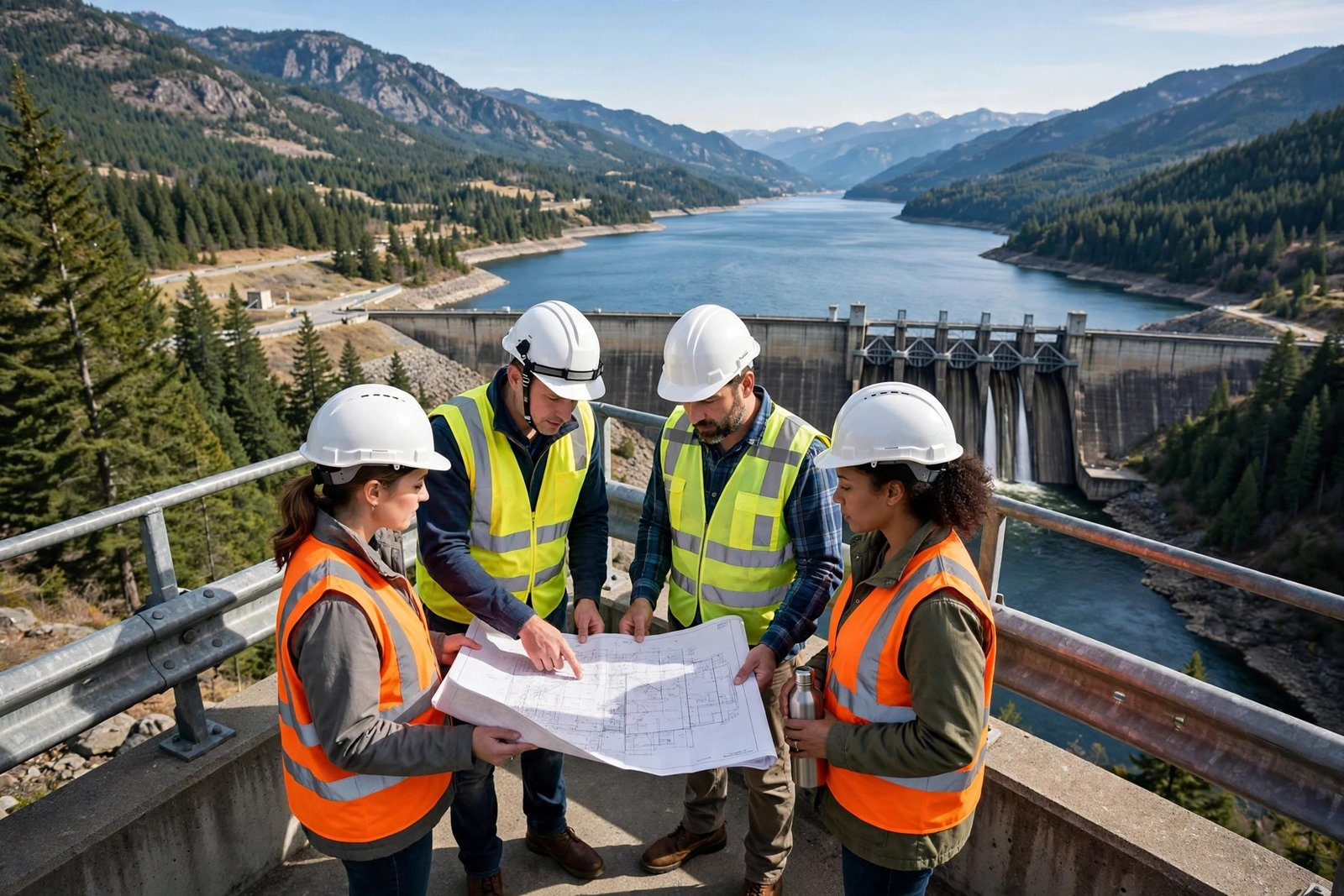
Graduates work for engineering consultancies, water utilities, government water agencies, regulators, irrigation and drainage authorities, hydropower operators, mining and energy companies, insurers and reinsurers concerned with flood risk, and international development organisations. Job titles include water resources engineer, hydrologist, hydraulic modeller, flood risk engineer, drainage engineer, water supply engineer, groundwater modeller and catchment manager. Early-career work is usually modelling, design calculations, data analysis and site investigation under senior supervision. With experience, engineers move into project management, specialist modelling roles, or advisory work on policy and investment decisions.
Salary data for this specialisation needs care, because most official statistics report by occupation rather than by degree. Water resources engineers in the United States are generally counted among civil engineers or environmental engineers in Bureau of Labor Statistics data. The BLS Occupational Outlook Handbook reports a median annual wage of $100,840 for civil engineers in May 2025, and $107,110 for environmental engineers in May 2025. The same BLS overview reports a median of $99,520 in May 2025 for architecture and engineering occupations as a group, compared with $50,980 for all occupations. These are medians across all experience levels and all employers: graduates start below the median, senior and specialist engineers earn above it, and location and sector move the figure substantially. In Australia, Jobs and Skills Australia data, based on the Australian Bureau of Statistics Survey of Employee Earnings and Hours for May 2025, puts median full-time earnings for civil engineering professionals at AUD 115,300 per year. That figure covers the whole occupation group, including junior entrants, and experienced roles commonly pay above it.
| Role or occupation group | Official median (source and year) | Notes |
|---|---|---|
| Civil engineers, USA | $100,840 per year (BLS, May 2025) | Closest BLS group for most water resources engineers |
| Environmental engineers, USA | $107,110 per year (BLS, May 2025) | Closest BLS group for water quality and treatment roles |
| Architecture and engineering occupations, USA | $99,520 per year (BLS, May 2025) | Group median, versus $50,980 for all occupations |
| Civil engineering professionals, Australia | AUD 115,300 per year (Jobs and Skills Australia / ABS, May 2025) | Median full-time earnings, whole occupation group |
Demand for water engineers is driven by investment, not fashion. Utilities must renew ageing networks, cities must manage stormwater and flooding, and governments must plan for drought and climate change. That work is funded through public budgets and regulated utility spending, which makes it steadier than some technology-driven fields, but also slower to surge. The strongest career strategy is to combine the degree with a portable skill: advanced modelling, programming, GIS, or professional registration. Engineers who can build a defensible flood model, explain it to a non-technical client, and stand behind it in a regulatory process are hired in every market. Consider professional registration early: in the United States the path runs through the Fundamentals of Engineering and Professional Engineer examinations, in the United Kingdom through Incorporated and Chartered Engineer status, and in Australia through Engineers Australia and, in Queensland, statutory registration. Requirements differ, so check the regulator in the country where you intend to work.
Post-study work options differ by country and change frequently, so treat any summary as a starting point, not a promise. The United Kingdom’s Graduate Route, the United States’ Optional Practical Training, Canada’s Post-Graduation Work Permit and Australia’s Temporary Graduate visa all allow graduates a period of work after study, with conditions that depend on programme, institution and timing. Note that the United Kingdom has announced that the Graduate Route will shorten to 18 months from 1 January 2027; that is an announced change, not yet the current rule, and you should check the position at the time you apply. Use the visa requirement checker and the career path explorer to map options, and confirm the details with the official immigration authority of the country concerned.
Scholarships for Water Resources Engineering
Funding for water engineering master’s degrees comes from several directions, and the best approach is to apply in parallel. Universities offer merit scholarships and departmental awards, often decided automatically from your application or through a short separate form. Governments offer the best-known schemes for international students, including large national scholarship programmes in the United Kingdom, the United States, Australia and Germany, each with its own eligibility rules, deadlines and service expectations. Development-focused scholarships, including those aimed at water, sanitation and climate adaptation, are particularly relevant to this field, because funders understand that water expertise is a development priority in many countries. Industry and utility scholarships exist too, sometimes tied to a placement or a return-of-service commitment.
Start with the scholarships directory and the scholarship finder tool, then read the official pages of every scheme you shortlist. Note the difference between a scholarship that covers tuition only and one that covers tuition plus living costs, and note whether a scheme requires you to return home after study, which may conflict with post-study work plans. Deadlines for major government scholarships often fall a year before entry, well ahead of university application deadlines, so build your timeline backwards from the earliest scholarship deadline, not from the university deadline. Keep a spreadsheet of schemes, deadlines, documents and referees, and reuse a strong core application rather than rewriting from scratch each time.
How to Choose the Right Programme
A good shortlist answers five questions. First, does the curriculum cover the modelling and field skills employers in your target country actually hire for? Second, does the programme include a substantial project or thesis, ideally with real data? Third, is the total cost, including living costs and visa funds, affordable without assuming income you do not yet have? Fourth, does the country offer a realistic post-study route if you want one, and do you meet its conditions? Fifth, does the programme’s alumni network reach the employers and countries where you want to work? A programme that scores well on all five is rare; a programme that scores well on the first three is a sound choice.
Also weigh the length of the degree honestly. A one-year programme returns you to earning sooner and costs less overall, but leaves less time for an internship, a deep thesis or a change of specialisation. A two-year programme costs more but allows a placement semester, a research assistantship, or a second specialisation. For students changing fields, the longer programme is usually the safer investment. For practising engineers adding a specialisation, the shorter programme often makes more sense. There is no universally right answer; there is only the answer that fits your finances, your experience and your timeline.
Frequently Asked Questions
Do I need a civil engineering degree to apply for an MS in Water Resources Engineering?
Not always, but it is the most direct route. Most programmes accept civil and environmental engineering degrees, and many accept agricultural, mechanical or related engineering degrees with relevant mathematics and fluids content. Degrees in geology, geography or environmental science are sometimes accepted with bridging courses. Check the programme’s prerequisite list against your transcript before applying.
Is water resources engineering a good career for international students?
It is a steady, public-interest career with demand from utilities, consultancies and government agencies in most countries. Salaries compare well with other engineering occupations in official data, as shown above. Employment depends on local licensing, language and work-permit rules, so research the country where you intend to work, not just the country where you study.
How long does the degree take?
Typically one year full-time in the United Kingdom, 1.5 to 2 years in the United States, Canada and Australia, and two years in much of continental Europe. Part-time and online options exist but take longer and may affect post-study work eligibility, so check the conditions before choosing them.
What software should I learn before starting?
HEC-RAS and HEC-HMS for river and rainfall-runoff modelling, SWMM for urban drainage, MODFLOW for groundwater, and ArcGIS or QGIS for spatial analysis are the most widely used. Python is increasingly expected for data analysis and automation. Free tutorials exist for all of these, and arriving with basic familiarity will make the first term much easier.
Can I work in flood risk management with this degree?
Yes. Flood risk is one of the largest employment areas for water resources graduates, covering flood modelling, defence design, flood mapping, insurance and resilience planning. Electives in flood risk, coastal engineering and GIS will strengthen your position for these roles.
Do I need professional registration after graduation?
Not immediately, but it matters for senior and sign-off roles. In the United States the Professional Engineer licence, in the United Kingdom Chartered Engineer status, and in Australia Engineers Australia membership and state registration where required, all improve employability and earning power over time. Start the process early, since it typically requires supervised experience after graduation.
What is the difference between water resources engineering and environmental engineering?
Water resources engineering focuses on the quantity, movement, storage and management of water. Environmental engineering covers water quality and treatment but also air, soil and waste. The two overlap substantially, and many programmes and employers treat them as neighbouring specialisations within civil and environmental engineering.
Sources and Verification
- U.S. Bureau of Labor Statistics, Occupational Outlook Handbook: Architecture and Engineering Occupations (median pay figures for civil engineers, environmental engineers and the occupation group, May 2025).
- U.S. Bureau of Labor Statistics, Occupational Outlook Handbook: Management Occupations (construction and engineering management context).
- Jobs and Skills Australia, civil engineering professionals, median full-time earnings based on the Australian Bureau of Statistics Survey of Employee Earnings and Hours, May 2025.
- Government visa and financial requirement figures for the United Kingdom, Germany, Australia and Canada, as summarised in the StudyGraduate programme briefs and to be rechecked against the official immigration pages at the time of application.
Figures change yearly. Confirm fees, entry requirements, scholarship deadlines and visa rules on the official university and government pages before you apply. StudyGraduate is an information portal, not an agency: it never promises admission, jobs, salaries or visa or permanent residence outcomes.