

MS in Textile Engineering Abroad: Eligibility, Fees, Top Universities and Careers
Textile engineering is the engineering discipline behind almost everything you wear, sit on, sleep under and increasingly drive, fly and heal with. It covers the science and manufacture of fibres, yarns, fabrics and finished textile products, from cotton spinning and synthetic polymer extrusion to weaving, knitting, dyeing, finishing, technical textiles for aerospace, automotive and medical use, and the fast-growing field of smart and sustainable textiles. An MS in Textile Engineering abroad suits graduates who want a career that combines materials science, mechanical and chemical engineering, design and manufacturing — and who want to work in one of the world’s largest manufacturing industries, with production centred in Asia but research, design and technical-textile leadership spread across Europe, North America and beyond.
This guide explains what the degree covers, who should apply, what universities abroad require, what it costs, where the strongest programmes are, what graduates earn according to official statistics, and how to fund your studies. It is written for international students planning 2026 or 2027 entry. Where no official textile-specific salary exists, this guide says so plainly and uses the nearest official occupation instead of inventing a number. Fees and entry rules change every year, so confirm every detail on the official university page before you apply.
What is an MS in Textile Engineering?
Textile engineering begins with the fibre and ends with the product. Fibres may be natural — cotton, wool, silk, flax — or manufactured, including polyester, nylon, aramids and carbon fibre, and increasingly they include recycled and bio-based fibres. Textile engineers turn fibres into yarns by spinning, yarns into fabrics by weaving, knitting, braiding or nonwoven processes, and fabrics into finished products by dyeing, printing, coating and finishing. They also design the machinery, control the processes, test the products and manage the factories where all of this happens. At master’s level, the emphasis shifts from operating processes to understanding, optimising and inventing them: polymer science, textile mechanics, process modelling, colour science, quality engineering and product development.
Programmes carry several titles: MS or MSc in Textile Engineering, Textile Technology, Textile Science and Engineering, and sometimes Materials Science and Engineering with a textiles specialisation. The last of these is common in the United Kingdom, where textiles sits inside materials departments — the University of Manchester, for example, teaches Materials Science and Engineering with Textile Technology, building on a long history in the field. When you search for programmes, look for all of these titles, and read the module list rather than trusting the degree name: a programme called “textile technology” may be highly practical and manufacturing-focused, while one called “textile science” may lean toward research in fibres and polymers.
Typical durations are one year in the United Kingdom, one to two years in Europe, Canada and Australia, and around two years in the United States, where textile programmes are fewer and often sit within materials, chemical or mechanical engineering departments. Some programmes offer a professional track with an industry project or placement, and others a research track with a thesis. A growing number offer specialisations in technical textiles, sustainable textiles, textile chemistry or smart textiles, reflecting where the industry’s growth and research funding actually are.
Who is this degree for? It suits textile engineering and textile technology graduates who want to specialise or move into technical, managerial or research roles; materials, chemical, mechanical and industrial engineering graduates who want to enter the textile and apparel industry; and fashion and apparel graduates with strong technical preparation who want the engineering depth that design degrees do not provide. It suits students who enjoy applied science and manufacturing, and who are comfortable with the idea that their career may involve factory floors as well as laboratories and design studios. It is less suited to students whose interest is purely in fashion design, for whom a design master’s is the better route.
At a glance
| Feature | Typical position |
|---|---|
| Degree level | Postgraduate master’s (MS, MSc, MEng or equivalent) |
| Typical duration | 1 year (UK) to 2 years (USA, Europe, Canada, Australia) |
| Entry qualification | Bachelor’s in textile engineering, materials, chemical, mechanical or industrial engineering, or a related field |
| Core subjects | Fibre science, yarn and fabric manufacture, textile chemistry, dyeing and finishing, textile mechanics, quality control, technical textiles |
| Key facilities | Spinning, weaving and knitting laboratories, dyeing and finishing labs, textile testing laboratories, polymer and materials labs |
| Typical capstone | Industry project, product development project, or research thesis |
| Main employers | Textile and apparel manufacturers, technical textile producers, chemical and dye suppliers, machinery makers, retailers’ technical teams, testing and certification bodies, research institutes |
What you study: curriculum and specialisations
The core curriculum of an MS in Textile Engineering covers the full production chain. Fibre science examines the structure and properties of natural and manufactured fibres and how those properties determine yarn and fabric behaviour. Yarn manufacture covers spinning systems, yarn structure and quality. Fabric manufacture covers weaving, knitting, braiding and nonwoven technologies, and the mechanics of fabric formation. Textile chemistry covers dyeing, printing, finishing and coating, including colour measurement and fastness testing. Textile mechanics and physics covers the stresses, strains and failure modes of yarns and fabrics. Quality and testing covers the standard test methods used across the industry and the statistics behind them. Around this core sit manufacturing management, supply chain, sustainability and product development modules.
Specialisations reflect the industry’s real divisions. Technical textiles is the fastest-growing and highest-value area: textiles for automotive interiors and composites, aerospace, construction, geotextiles, filtration, protective clothing and medical implants and dressings. Sustainable textiles covers recycled fibres, bio-based polymers, waterless dyeing, chemical management and circular product design — an area where regulation in Europe is driving rapid change and genuine employer demand. Textile chemistry specialises in dyes, finishes and coatings, including functional finishes such as flame retardancy, water repellency and antimicrobial treatments. Smart textiles covers conductive fibres, sensors woven into fabric, and wearable electronics, an area that sits close to research and suits students aiming for a PhD or a research career. Apparel engineering and product development suits students aiming at retailers and brands, where the work combines technical specification, fit, sourcing and quality assurance.
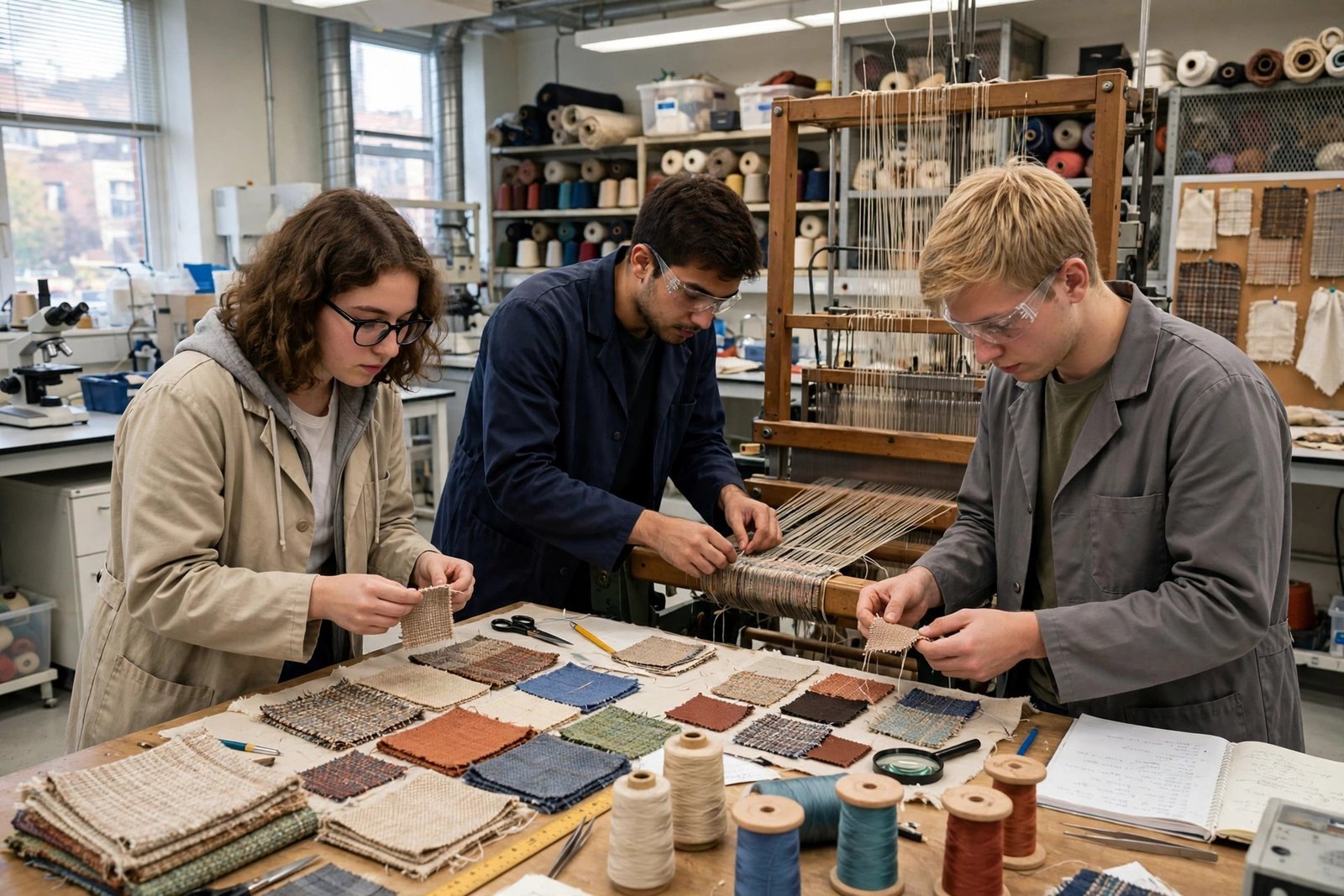
Practical work is a strength of the degree and a reason to choose a department with real laboratories. Expect to spin, weave and knit in teaching laboratories, to dye and finish fabric and measure the results, to test fibres and fabrics to international standards, and to develop a product from fibre selection to finished sample. Many programmes include an industry project or placement with a manufacturer, a chemical supplier or a retailer’s technical team, and that project often becomes the graduate’s first job interview. When you compare programmes, ask which laboratories students actually use, whether the department runs pilot-scale machinery or only bench equipment, and whether recent projects were carried out with industry partners. A department whose students test on industrial-scale equipment will prepare you better than one whose students only read about it.
Research students should look at faculty strengths in the same way as in any engineering field. Textile departments are often small, and a department may be world-class in nonwovens and ordinary in apparel, or the reverse. If you hope to continue to a PhD, choose a programme with a thesis track and supervisors in your area, and treat the master’s dissertation as the start of a doctoral project. If you plan to enter industry, a coursework programme with a strong applied project and a placement may be the faster route to employment.
Eligibility and entry requirements
Entry requirements for textile engineering master’s programmes are more flexible than for some engineering fields, because the industry itself draws from several disciplines. The table below summarises the usual position; always confirm the requirement for your chosen programme, as departments vary.
| Destination | Academic requirement | English requirement (typical) | Notes |
|---|---|---|---|
| United Kingdom | Upper second-class honours (2:1) or equivalent in textile, materials, chemical, mechanical or a related engineering subject | IELTS typically 6.5 overall, with no band below 6.0 | One-year programmes; textiles often sits within materials departments |
| United States | Four-year bachelor’s in textile, materials, chemical or mechanical engineering; GPA typically 3.0/4.0 or above for competitive programmes | TOEFL or IELTS as set by the university; GRE required by some programmes | Fewer dedicated programmes; often within materials or chemical engineering departments |
| Germany and Europe | Bachelor’s in textile, materials, chemical or mechanical engineering; some programmes taught in English, others in the local language | IELTS or TOEFL for English-taught programmes | Low or no tuition at many public universities; strong technical textile industries in Germany |
| Canada | Four-year bachelor’s in a related engineering field; research programmes usually require a supervisor’s agreement | IELTS or TOEFL as set by the university | Strengths in materials and polymer research; smaller dedicated textile provision |
| Bangladesh, India, Turkey, China | Bachelor’s in textile engineering or a related field | Varies; English-taught options exist at some institutions | Major manufacturing centres; strong for students aiming at production and sourcing careers |
A strong textile engineering application shows three things. The first is technical preparation: grades in materials, chemistry, mechanics and mathematics, and any laboratory or manufacturing experience. The second is industry awareness: an internship in a mill, a dyehouse, a testing laboratory or a retailer’s technical team, described with the processes and products you actually worked on. The third is a statement of purpose that names a specialisation — technical textiles, sustainability, textile chemistry or product development — and explains why that university’s laboratories and faculty match it. Departments that teach textiles are small and proud of their specialisms; a statement that could have been sent to any engineering department will not impress them.
Students from fashion, design or business backgrounds can sometimes enter, particularly into product development or apparel engineering tracks, but they should expect to demonstrate technical preparation — chemistry, materials or mathematics modules, or relevant industry experience — and they should ask the programme coordinator before applying. Conversely, engineering graduates without any textile background are usually welcome, and the first semester of most programmes is designed to bring them up to speed on fibres and fabric formation. If your transcript is not in English, arrange certified translations early, and check whether the university requires a credential evaluation.
Tuition and living costs
Tuition for textile engineering master’s programmes varies by country and institution in the usual way, and international fees in the United Kingdom, the United States, Canada and Australia are substantial. European public universities often charge low or no tuition, which can make a German or other European programme much cheaper overall. No single average figure is honest, so take the official fee from each programme page, confirm whether it is per year or for the whole programme, and check for additional charges for laboratory materials, field visits or placement modules. Textile programmes sometimes charge for materials used in practical projects, and it is worth asking whether that cost is included.
For living costs and visa finance, the official government figures below are the ones to plan around.
| Destination | Official living / visa finance figure | Basis |
|---|---|---|
| United Kingdom | GBP 1,529 per month in London; GBP 1,171 per month outside London | Student visa maintenance requirement, current figure |
| Germany | EUR 11,904 per year | Blocked account amount for the student visa (2026 figure) |
| Australia | AUD 29,710 per year | Student visa living-cost requirement (October 2026 figure) |
| Canada | CAD 23,448 (raised from CAD 22,895) | Proof-of-funds requirement for living expenses, updated figure |
Funding for textile engineering comes from universities, governments, industry and professional bodies. University merit scholarships are the most common source for international students. Government scholarships in the main destinations fund priority science and engineering subjects, and materials-related programmes usually qualify. Industry funding is a distinctive feature of this field: textile manufacturers, chemical and dye companies, machinery makers and retailers sponsor bursaries, placements and research projects, particularly in countries with large textile industries. Professional bodies in textiles and materials also run student awards that are smaller but much less competitive. Begin the funding search at the same time as the programme search, because industry and government awards often close months before the intake. The scholarships directory, the scholarship finder tool, the tuition fee calculator and the cost of living calculator will help you build a complete budget.
Top universities and countries for textile engineering
The geography of textile engineering follows the geography of the industry, but not exactly. Manufacturing is concentrated in Asia — China, India, Bangladesh, Vietnam, Turkey and Pakistan are among the largest producers — and universities in those countries offer deep, practical programmes close to factories, which suits students aiming at production, sourcing and quality careers. Research and technical-textile leadership is concentrated in Europe, where Germany, the United Kingdom and other countries host specialist institutes, machinery makers and technical-textile producers. The United States has fewer dedicated textile schools than it once did, but the remaining programmes are strong in materials, nonwovens and technical textiles and are closely linked to industry. The United Kingdom’s Manchester tradition in textiles, now carried within its materials department, remains a reference point for textile technology teaching.
Choosing a country therefore depends on the career you want. If you want to work in production management or sourcing in Asia, studying near the factories has obvious advantages: placements, language, networks and first-hand knowledge of how mills actually run. If you want to work in technical textiles, research or sustainability regulation, a European or North American programme may serve you better, because that is where much of the research funding and regulatory change originates. If you want to work for a global brand or retailer, either route can work, provided your programme includes product development, testing and quality content and a placement with a brand or supplier.
Compare programmes on laboratories, industry links and graduate outcomes rather than on general university reputation. Does the department run spinning, weaving, knitting and dyeing laboratories at a realistic scale? Does it collaborate with manufacturers, chemical suppliers or testing bodies? Where do its graduates work, and does the department publish that information? Use the universities directory, the rankings pages and the university comparison tool to organise your shortlist, and browse the Courses and Programs directory for related materials and engineering programmes. Shortlist four to six programmes across at least two countries, and record each programme’s director, deadline, fee, scholarship deadlines and placement arrangements.
Careers and salaries
Textile engineering graduates work across a broader range of roles than many engineering graduates realise. Production and process engineers run spinning, weaving, knitting, dyeing and finishing operations. Product development engineers design new fabrics and products for apparel, home textiles and technical applications. Quality and compliance engineers manage testing, standards and chemical compliance for manufacturers and retailers. Technical sales and application engineers support chemical, dye and machinery suppliers. Research engineers work in institutes and corporate laboratories on fibres, nonwovens, composites and smart textiles. Sustainability engineers manage water, energy, chemicals and circularity in textile production — a role that barely existed a decade ago and is now a recognised career path. A master’s degree accelerates entry into technical, product development and research roles, and into management, where the combination of process knowledge and analytical skill is valued.
Salary data for textile engineering requires honesty about what official statistics actually publish. No major statistical agency publishes a standalone “textile engineer” occupation with a median wage, because textile engineers are counted within broader engineering and materials occupations. This guide therefore uses the nearest official figures and labels them as such, rather than inventing a textile-specific salary. The figures below are the right anchors, and they should be read with the caveat that textile pay varies sharply by country, sector and role: production roles in Asia pay differently from technical-textile roles in Europe, and retail technical roles pay differently again.
| Occupation / measure | Figure | Source and year |
|---|---|---|
| Materials engineers, median annual wage, USA | USD 112,860 | US Bureau of Labor Statistics, Occupational Outlook Handbook, May 2025 (nearest official occupation to textile/materials engineering) |
| Materials and Technology graduates, median salary, UK, 15 months after graduation | GBP 30,000 | UK Longitudinal Education Outcomes (LEO), Department for Education data published August 2024 (all Materials and Technology graduates, not textile-specific) |
| Materials and Technology graduates, median salary, UK, 3 years after graduation | GBP 32,000 | UK Longitudinal Education Outcomes (LEO), Department for Education data published August 2024 |
| Materials and Technology graduates, median salary, UK, 5 years after graduation | GBP 40,000 | UK Longitudinal Education Outcomes (LEO), Department for Education data published August 2024 |
The UK figures deserve a careful reading. They cover all Materials and Technology graduates, including textile technology graduates, and they show the typical early-career pattern: modest starting pay that rises with experience, reaching a median of GBP 40,000 five years after graduation. They are undergraduate-graduate figures, so a master’s graduate with a specialisation in technical textiles or sustainability may reasonably expect to do better, but no official source supports a precise premium, and this guide does not invent one. The American materials engineer median, USD 112,860 in May 2025, reflects a broader, higher-paid occupation that includes aerospace and electronics materials work; textile engineers within that group will typically earn less than the median in production roles and more in specialist technical roles. Use these figures to set expectations, not to promise an outcome, and research pay for your target country and sector before you commit.
Post-study work routes follow the standard pattern: the UK Graduate Route (currently two years for master’s graduates, with an announced shortening to 18 months for applications from 1 January 2027 — announced rules differ from current rules, so check for your intake), Canada’s post-graduation work permit of up to three years for eligible master’s graduates, Australia’s Temporary Graduate visa, and US Optional Practical Training with a possible STEM extension for eligible programmes. None guarantees employment or permanent residence, and textile careers are unusually global: many graduates build their careers across two or three countries, following manufacturing, brands and research funding as they move.
Scholarships for textile engineering
Scholarships for textile engineering come from universities, governments, industry and professional bodies. University merit awards are the most common source. Government awards in the main destinations fund international students in science and engineering, and materials-related programmes usually qualify. Industry awards are a particular feature of this field: manufacturers, chemical companies, machinery makers and retailers fund students, often with a placement attached, and industry associations in textiles run bursaries and prizes that attract few applicants relative to their value. If you are from a textile-producing country, also check your home government’s scholarship schemes, several of which fund textile and manufacturing subjects specifically.
Apply for the smaller awards as well as the headline ones. A partial university scholarship plus an industry bursary plus a departmental assistantship often adds up to more than a single prestigious award that you may not win. Keep a tracker of deadlines and documents, ask referees early, and use the career path explorer to confirm that the specialisation you are funding leads to the career you want.
How to choose and apply: a practical timeline
Start twelve to eighteen months before your intended intake. In the first three months, research programmes and laboratories, confirm eligibility, and sit your English test if needed. In the next three months, finalise your shortlist, contact coordinators about any eligibility or language questions, and secure referees. Apply six to twelve months before entry, and run scholarship applications in parallel because their deadlines are often earlier. After an offer, arrange funding, accommodation and your visa, and use the months before departure to prepare: revise polymer and fibre science, learn a textile testing standard or two, and follow the sustainability regulation that is reshaping the industry, particularly in Europe. Arriving with that knowledge will set you apart from day one.
When offers arrive, compare them on substance: the module list against your specialisation, the scale and realism of the laboratories, placement and graduate employment records, total cost, and the visa and post-study position in that country. Talk to current students and recent graduates if the department can connect you; they will tell you how much practical work really happens, how the placement system works, and where graduates actually went. A programme that fits your specialisation and gives you real laboratory and industry experience is worth more than a famous name with no looms and no placements.
Frequently asked questions
Do I need a textile bachelor’s to apply?
Not necessarily. Textile engineering is the ideal background, but materials, chemical, mechanical and industrial engineering graduates are commonly admitted. Fashion or business graduates may be admitted to product development tracks if they can show technical preparation or relevant industry experience. Ask the coordinator before applying.
Is textile engineering a good career choice?
It is a large, global industry with real demand in technical textiles, sustainability and product development, but it is also an industry undergoing rapid change from automation and regulation. Graduates with engineering depth, sustainability knowledge and a specialisation in technical textiles are better placed than generalists, and the career rewards mobility and practical experience.
What do textile engineers earn?
No official agency publishes a standalone textile engineer median. The nearest official figures are USD 112,860 for materials engineers in the United States in May 2025 (US Bureau of Labor Statistics) and, in the United Kingdom, LEO medians for all Materials and Technology graduates of GBP 30,000 at 15 months, GBP 32,000 at three years and GBP 40,000 at five years after graduation (Department for Education, August 2024). Actual pay varies by country, sector and role.
Should I study near the factories or near the research?
It depends on your career. Studying in a manufacturing centre suits production, sourcing and quality careers. Studying in a research centre suits technical textiles, sustainability and research careers. Many successful graduates do one of each across their bachelor’s and master’s degrees.
What is the difference between textile engineering and fashion design?
Textile engineering is about fibres, processes, materials and manufacturing; fashion design is about aesthetics, silhouette and collections. They overlap in product development, but the master’s degrees, skills and employers are different. Choose engineering if you want to make and improve textiles, design if you want to design garments.
Is sustainability really a career, or just a module?
It is a real and growing career path. Chemical management, water and energy efficiency, recycled materials and circular product design are now dedicated roles in manufacturers, brands and testing bodies, driven substantially by European regulation. A specialisation in sustainable textiles is a credible career choice, not a marketing label.
Can I work abroad after graduating?
Post-study work routes exist in the main destinations — the UK Graduate Route, Canada’s post-graduation work permit, Australia’s Temporary Graduate visa and US Optional Practical Training — but rules and durations change and none guarantees permanent residence. Textile careers are global, so plan for mobility rather than a single destination.
Sources and verification
- US Bureau of Labor Statistics, Occupational Outlook Handbook — Materials Engineers: median annual wage USD 112,860 in May 2025, used here as the nearest official occupation to textile/materials engineering; no standalone textile engineer occupation is published.
- UK Longitudinal Education Outcomes (LEO), Department for Education data published August 2024 — median salaries for all UK Materials and Technology graduates: GBP 30,000 at 15 months, GBP 32,000 at three years, GBP 40,000 at five years after graduation; not textile-specific.
- University of Manchester / UCAS course summary: Materials Science and Engineering with Textile Technology — textiles taught within the Department of Materials, with specialist options in advanced textiles manufacturing, performance enhancement and technical textiles.
- UK Home Office student visa maintenance figures: GBP 1,529 per month in London and GBP 1,171 per month outside London.
- German student visa blocked account requirement: EUR 11,904 per year (2026).
- Australian student visa living-cost requirement: AUD 29,710 per year (October 2026).
- Canadian proof-of-funds requirement: CAD 23,448, raised from CAD 22,895.
Figures change yearly — confirm fees and requirements on the official university page before you apply. StudyGraduate is an information portal, not an agency, and this guide never promises admission, jobs, salaries or visa or permanent residence outcomes. Verify every figure against its official source, and choose the programme whose laboratories, specialisation and industry links match the career you actually want.