
MS in Control Systems Engineering Abroad: Eligibility, Fees, Top Universities and Careers
An MS in Control Systems Engineering abroad is a graduate degree for students who want to make machines, processes and networks behave predictably. Control engineers design the feedback loops that keep a robot arm on its path, a chemical reactor at a safe temperature, a power grid in balance, an aircraft stable in turbulence and a factory line running without constant human intervention. The work is mathematical, but it is also deeply practical: a controller that works in simulation and fails on real hardware is not a good controller. If you enjoy mathematics, programming and seeing abstract ideas tested against physical systems, this degree is a strong choice.
This guide explains what control systems engineering covers, who it suits, what universities usually ask for, what it costs, where to study it, and what careers follow. It is written for international applicants planning 2026 or 2027 entry. Fees, deadlines and visa rules change every year, so confirm current figures on the official university or government page before you apply. StudyGraduate is an information portal, not an agency, and nothing here promises admission, a job, a salary or a visa outcome.

At a glance
| Item | What to expect |
|---|---|
| Degree level | Master of Science, usually following a bachelor’s degree in electrical, electronics, mechanical, mechatronics, aerospace, chemical engineering, computer engineering or applied mathematics |
| Typical duration | One to two years full time, depending on country, thesis requirements and internship or co-op terms |
| Core subjects | Linear and nonlinear control, digital control, state-space methods, system identification, robotics, embedded systems, signal processing and optimisation |
| Best suited to | Students who like mathematics, modelling, programming and laboratory testing, and who enjoy debugging systems where hardware, software and physics interact |
| Common degree names | MS Control Systems Engineering, MSc Control Engineering, MS Robotics and Control, MSc Systems and Control, MS Automation and Control |
| Typical next steps | Controls engineer, automation engineer, robotics engineer, embedded systems engineer, process control engineer, or doctoral study |
What is control systems engineering?
Control systems engineering studies how to influence a dynamic system so that it behaves as intended, despite disturbances, measurement noise and modelling errors. A thermostat is a simple feedback controller. A modern industrial example is far more complex: hundreds of sensors, actuators, safety interlocks and software layers must work together, and a failure in one part must not cause a dangerous failure in the whole system. Control engineers therefore learn to model systems with differential equations and state-space representations, to analyse stability and robustness, to design controllers, and to test them on hardware.
The field overlaps with several neighbouring disciplines, and applicants should understand those overlaps before choosing a programme. Electrical and electronics engineering provides the circuits, sensors, power electronics and signal processing that controllers rely on. Mechanical engineering provides the dynamics of robots, vehicles and machines. Computer engineering provides embedded hardware and real-time software. Applied mathematics provides optimisation, estimation and learning theory. A control systems programme draws on all of these, but its centre of gravity is the design and validation of feedback systems, not general circuit design or general software development. Students who mainly want to build mobile applications or design integrated circuits should look at other programmes; students who want to make physical systems move, regulate and coordinate themselves are in the right place.
Automation has made control skills more valuable, not less. Factories, warehouses, energy systems, vehicles, medical devices and buildings all use more sensing, actuation and software than they did a decade ago. That growth creates demand for engineers who can integrate those layers safely. It also raises expectations: modern control engineers are expected to understand cybersecurity for industrial systems, functional safety standards, data handling and human-machine interaction, in addition to classical control theory. A good master’s programme will teach both the enduring mathematics and the current industrial tools, and it will give you laboratory time to learn where theory and practice diverge.
What you study
Most programmes begin with a core in modelling and control theory. Linear systems theory, state feedback, observers, frequency-domain design, digital control and sampled-data systems form the foundation. Students then study estimation and identification: how to infer the state of a system from noisy measurements, how to build a model from experimental data, and how to handle uncertainty. Nonlinear control, adaptive control, robust control and model predictive control follow, often with applications in robotics, aerospace, automotive systems, power systems or process industries.
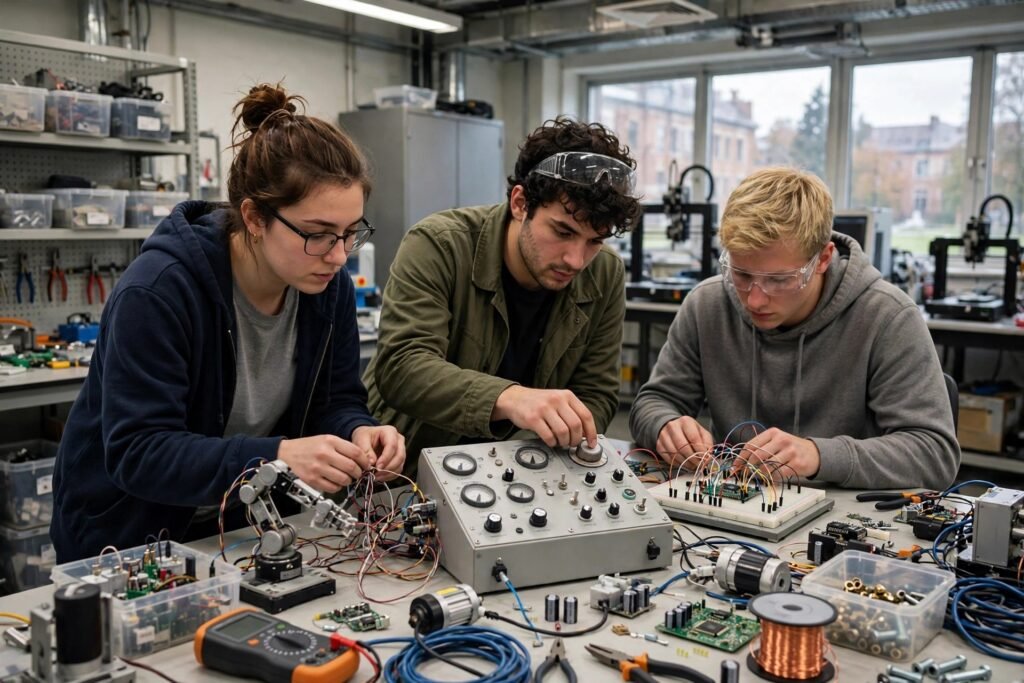
Laboratory work is essential. Expect exercises with motors, inverted pendulums, robotic arms, programmable logic controllers, industrial networks and hardware-in-the-loop simulation. You will learn to tune a controller on real equipment, to recognise actuator saturation, sensor delay and friction, and to document tests so that another engineer can reproduce them. Many programmes include a substantial project or thesis in which you design, implement and validate a complete control system, sometimes with an industry partner. That project is often the most important part of your portfolio when you apply for jobs, so choose a problem that demonstrates integration, testing and safety thinking, not only simulation.
Software and industrial tools form a second spine. Students commonly use MATLAB and Simulink, Python for data analysis and modelling, and tools for programmable logic controllers, supervisory control and data acquisition, and industrial communication protocols. Embedded programming, real-time operating systems and version control also appear in many curricula. Employers in automation value engineers who can read a piping and instrumentation diagram, understand a control narrative, configure a controller, commission a loop on site and write a clear test report. Academic depth matters, but so does the ability to work safely in a plant or laboratory.
Electives let you specialise. Robotics electives emphasise kinematics, dynamics, motion planning and perception. Process-control electives emphasise chemical and energy processes, safety instrumented systems and advanced process control. Power-systems electives emphasise grid stability, renewable integration and energy storage control. Automotive and aerospace electives emphasise guidance, navigation, vehicle dynamics and flight control. Artificial intelligence electives emphasise learning-based control, but a strong programme will also teach when learning methods are appropriate and when a well-understood classical controller is safer and more maintainable. Choose electives by the industry you want to enter, not by which titles sound most fashionable.
Eligibility and entry requirements
Most departments ask for a bachelor’s degree in electrical, electronics, mechanical, mechatronics, aerospace, chemical or computer engineering, or in applied mathematics or physics with substantial engineering content. Strong preparation in linear algebra, differential equations, signals and systems, and programming is expected. Applicants from pure computer science or pure mathematics can be admitted, but they may need to complete prerequisites in circuits, dynamics or control fundamentals. Check whether those prerequisites extend the programme or must be completed before arrival.
English-language requirements vary by country and institution, and the programme page is the authoritative source. In the United Kingdom, Australia and Canada, universities publish minimum IELTS or TOEFL scores for each programme. In the United States, requirements vary and some departments waive tests for applicants who studied in English. In Germany, the Netherlands and Scandinavia, many control and automation programmes are taught in English, but internships, part-time work and daily life may still benefit from local-language skills. Do not assume that an English-taught degree means that every employer in that country works in English.
Standardised tests follow a mixed pattern. Some United States programmes still require or recommend the GRE, others have made it optional or removed it, and European programmes rarely require it. A strong quantitative score can help a borderline application, but it does not replace a relevant bachelor’s degree, strong mathematics grades or a convincing project portfolio. Your statement of purpose should name a control problem you have worked on, the tools you used, what failed and what you learned, and the specialisation you want to pursue. References from supervisors who saw your laboratory or project work carry more weight than generic character references.
Work experience helps, especially for professional master’s programmes. Experience with programmable logic controllers, robotics, embedded systems, industrial commissioning, process plants or automotive testing strengthens an application and gives you concrete examples for interviews. If you do not have industry experience, a final-year project, a robotics competition, an open-source control project or a research assistantship can demonstrate the same qualities: modelling, implementation, testing and persistence when hardware behaves unexpectedly.
| Country | Typical entry pattern | Points to check |
|---|---|---|
| United States | Bachelor’s in engineering or related field; transcripts, statement, references; GRE often optional | Check ABET background for licensure routes and research versus professional tracks |
| United Kingdom | Upper second-class honours degree or equivalent in engineering, mathematics or a related subject | One-year taught MSc formats are common; check laboratory and industry project options |
| Canada | Four-year bachelor’s in engineering or related field; thesis programmes may need a supervisor | Contact potential supervisors early for research-based programmes |
| Germany | Relevant bachelor’s degree; many English-taught automation and control programmes | Check subject-match assessment, deadlines and blocked-account rules |
| Netherlands and Scandinavia | Relevant bachelor’s degree; strong mathematics preparation expected | Check systems-and-control specialisations within electrical or mechanical engineering degrees |
Tuition and living costs
Tuition depends mainly on country and institution type. Public universities in parts of continental Europe charge low or no tuition for many programmes, although semester contributions and living costs still apply. Universities in the United States, the United Kingdom, Canada and Australia generally charge international tuition at a higher rate, and laboratory-intensive programmes can carry additional fees. Compare the total cost of the whole degree, including living costs and any extra term for an internship or thesis, rather than the first year’s headline fee alone.
Living costs vary by city, and control students should also budget for a capable laptop, software licences where the university does not provide them, and travel to industrial sites or conferences. Build a full budget covering tuition, accommodation, food, transport, health insurance, books, visa fees and a contingency for currency movement. The tuition fee calculator and the cost of living calculator can help you compare scenarios, but the university’s published fee schedule remains authoritative.
For visa planning, government maintenance figures are useful minimums, not comfortable budgets. For the United Kingdom, the Student visa maintenance requirement is GBP 1,529 per month in London and GBP 1,171 per month outside London, rising to GBP 1,570 and GBP 1,203 respectively for applications on or after 30 November 2026. For Germany, the blocked account requirement is EUR 11,904 for 2026. For Australia, the financial requirement commonly cited is AUD 29,710 for living costs. For Canada, the proof-of-funds figure for a single applicant outside Quebec moved from CAD 22,895 to CAD 23,448. Confirm the current figure on the official immigration page for your intake.
Funding options include university merit scholarships, government scholarships, industry-sponsored projects and, for research programmes, assistantships. Research assistantships in the United States and Canada can be particularly valuable because they may cover tuition and provide a stipend, but they are competitive and tied to a supervisor’s project. Taught-programme scholarships are more often partial. Search early through the scholarships directory and the scholarship finder, and note whether an award renews in a second year.
Top universities and countries
The United States offers deep strength in control, robotics and automation, with large electrical, mechanical and aerospace departments, strong industry links and extensive laboratory facilities. Germany is strong in automation, automotive control, industrial robotics and manufacturing, with close ties between universities and industrial employers. The Netherlands and Sweden offer strong systems-and-control research within electrical and mechanical engineering, often in English. The United Kingdom offers intensive one-year taught programmes in control, robotics and automation, which suit students who want to enter industry quickly. Switzerland, France and Italy also offer strong control and robotics programmes, although language and programme structure vary and should be checked individually.
Canada offers strengths in robotics, aerospace control and process control, alongside post-graduation work options that many international students value. Australia offers strengths in mining automation, agricultural robotics, energy systems and field robotics, with large test sites and industry partnerships. In Asia, strong control, robotics and automation research exists in several countries, but programme titles, language and recognition differ, so compare curricula rather than assuming equivalence from a degree name.
When comparing departments, look at the laboratories, the robots and process rigs available to master’s students, the industry partners for projects, and the recent destinations of graduates. Accreditation matters in some contexts: in the United States, ABET accreditation is the recognised standard for engineering programmes, and in Australia, Engineers Australia accreditation plays a similar role. In the United Kingdom, professional recognition through engineering institutions can matter for later chartered status. Use the universities directory and the Courses and Programs directory to compare profiles, and verify shortlisted programmes on their official pages. The university comparison tool can help you weigh cost, duration and specialisation side by side.

Careers and salaries
Control systems graduates work as controls engineers, automation engineers, robotics engineers, process control engineers, embedded systems engineers, systems engineers and commissioning engineers. Employers include manufacturers, system integrators, automotive and aerospace companies, energy and utility companies, chemical and pharmaceutical firms, robotics companies, building-automation firms and consulting companies. Some graduates move into technical sales, project engineering or product management after gaining site experience, while others pursue doctoral research in robotics, autonomous systems or advanced control theory.
An important honesty point: the United States Bureau of Labor Statistics does not publish a single standalone occupation called controls engineer. Employers classify controls roles under electrical engineering, electronics engineering, industrial engineering, mechanical engineering or a broader engineering category, depending on the job. The closest national benchmark is therefore electrical and electronics engineers. The Bureau of Labor Statistics reports that the median annual wage for electrical and electronics engineers was USD 125,040 in May 2025. It projects employment for electrical and electronics engineers to grow by 8 percent from 2025 to 2035, much faster than the average for all occupations, with about 16,300 openings projected each year on average over the decade. Within that group, electrical engineers are projected to grow by 10 percent and electronics engineers, except computer, by 4 percent over the same period.
That benchmark should be used carefully. A controls engineer in a semiconductor plant, a pharmaceutical plant, an automotive supplier and a system-integration firm may have different duties, travel, on-call expectations and pay, even with the same degree. Industry, location, experience, security requirements, software depth and responsibility for safety-critical systems all move pay. Do not treat a national median as an entry-level salary, and do not convert it into another currency and present it as local pay. For other countries, use the equivalent official source, such as national statistics or a government job outlook service.
| Role or benchmark | Official figure | Source and year |
|---|---|---|
| Electrical and electronics engineers, United States, median annual wage | USD 125,040 | U.S. Bureau of Labor Statistics, May 2025 |
| Electrical and electronics engineers, United States, projected growth | 8 percent, 2025 to 2035 | U.S. Bureau of Labor Statistics projection |
| Electrical engineers, United States, projected growth | 10 percent, 2025 to 2035 | U.S. Bureau of Labor Statistics projection |
| Electronics engineers, except computer, United States, projected growth | 4 percent, 2025 to 2035 | U.S. Bureau of Labor Statistics projection |
| Controls engineer as a standalone BLS occupation | Not published as a single occupation; use the electrical and electronics benchmark with care | U.S. Bureau of Labor Statistics occupational structure |
Long-term prospects favour engineers who combine theory with commissioning experience. Simulation skills are common; engineers who can also wire, configure, test, document and hand over a real system are rarer and more valuable. Safety thinking is equally important: a control engineer must understand failure modes, interlocks, alarms, cybersecurity risks and the consequences of a wrong control action. Graduates who build a portfolio showing modelling, implementation, testing and safety analysis will be better placed than graduates whose portfolio contains only simulations.
Scholarships for this field
Scholarships for control systems engineering come from universities, governments, foundations and industry. University merit awards for international master’s students are the most common starting point, sometimes awarded automatically and sometimes through a separate application. Government scholarships often prioritise engineering, automation, energy and digital technology. Industry bodies and companies sometimes sponsor students in automation, robotics or energy, occasionally linked to an internship or project. Research-based applicants should ask supervisors about funded projects, which may cover tuition and provide a stipend but require a specific research match.
Keep a careful record of deadlines, because scholarship deadlines often fall months before programme deadlines, and some awards require a separate essay, portfolio or reference. Check whether an award can be combined with other funding and whether it renews in a second year. The scholarship finder, the scholarships directory and the career path explorer can help you match funding and roles to your specialisation.
How to choose a programme
Start with the industry you want to enter. If you want factory automation, prioritise programmable logic controllers, industrial networks, safety systems and commissioning experience. If you want robotics, prioritise dynamics, motion planning, perception and laboratory robots. If you want process control, prioritise process dynamics, advanced process control and safety instrumented systems. If you want energy or aerospace, prioritise grid, vehicle or flight dynamics and the relevant standards. Then check total cost, duration, thesis versus coursework, internship availability, laboratory access for master’s students, and post-study work rules.
Ask departments focused questions: which laboratories can master’s students actually use, what industry projects ran last year, what software and hardware platforms are taught, and where recent graduates work. Ask current students about supervision, workload and support. Check the rankings directory for context, but remember that rankings describe universities as a whole, not a single control group, and they should never be the only reason to choose a programme.
Plan for life after graduation with official information. In the United States, Optional Practical Training rules and employer sponsorship vary and should be checked on official government pages. In the United Kingdom, the Graduate Route currently allows eligible graduates to stay and work for a period after study, while an announced change would shorten that period to 18 months from 1 January 2027; treat that change as announced, not current, until it takes effect. In Canada, post-graduation work permit rules depend on programme length and institution eligibility. In Australia, post-study work rights depend on qualification level and location. None of these rules guarantees an outcome, and they can change between application and graduation.
Frequently asked questions
Is control systems engineering the same as electrical engineering?
No, although they overlap. Electrical engineering is broader and covers circuits, power, communications and electronics. Control systems engineering focuses on modelling, feedback design, estimation and validation of dynamic systems, drawing on electrical, mechanical, computer and mathematical methods.
Do I need a robotics background to apply?
No. A relevant engineering or applied-mathematics background with strong linear algebra, differential equations and programming is usually sufficient. Robotics experience helps, especially for robotics specialisations, but many programmes teach robotics from the control perspective.
Is there a standalone BLS salary for controls engineers?
No. The United States Bureau of Labor Statistics does not publish controls engineer as a single occupation. The closest benchmark is electrical and electronics engineers, reported at a median annual wage of USD 125,040 in May 2025. Use that figure as context, not as a promised salary for a controls role.
How long does the degree take abroad?
Typically one to two years full time. One-year taught programmes are common in the United Kingdom. Two-year programmes, including a thesis or internship, are common in the United States, Canada, Germany and Australia.
Is the GRE required?
It depends on the programme. Many programmes have made it optional or removed it, while others still require or recommend it. Check each programme page rather than assuming a single rule.
What programming skills should I have before starting?
Comfort with at least one programming language, basic data handling and version control is a good foundation. Familiarity with MATLAB or Python is helpful in many programmes, and embedded programming experience is valuable for automation and robotics tracks, but exact expectations vary by department.
Can I work in automation without a control degree?
Some automation roles are open to electrical, mechanical or mechatronics graduates, but a control specialisation gives you deeper training in stability, robustness, estimation and safety, which matters for complex or safety-critical systems and for senior design roles.
Should I choose a thesis or a coursework master’s?
Choose a thesis if you may pursue doctoral study or research roles. Choose coursework plus an industry project if you want to enter industry quickly and prefer applied, team-based work. Both routes can lead to strong careers when the project demonstrates real implementation and testing.
Sources and verification
Sources consulted for this guide include the U.S. Bureau of Labor Statistics Occupational Outlook Handbook for electrical and electronics engineers, ABET accreditation information for engineering programmes, and official government maintenance and funding figures summarised in the StudyGraduate guides brief, including United Kingdom Student visa maintenance rates, the German blocked account figure for 2026, the Australian living-cost figure and the Canadian proof-of-funds figure. External sources: BLS Electrical and Electronics Engineers and ABET.
Figures change yearly. Confirm tuition, entry requirements, deadlines and visa rules on the official university and government pages for your intake before you apply. StudyGraduate is an information portal, not an agency, and never promises admission, jobs, salaries or visa or permanent-residence outcomes.