
MS in Agricultural Engineering Abroad: Eligibility, Fees, Top Universities and Careers
An MS in Agricultural Engineering abroad is a graduate degree for students who want to solve practical problems in food production, water use, farm machinery, rural infrastructure and the environment. It sits at the meeting point of mechanical engineering, civil and environmental engineering, biology and data science. Graduates do not only work on farms. They design irrigation systems, develop precision-farming tools, improve post-harvest storage, test agricultural machinery, model soil and water systems, and help food companies reduce waste and energy use. If you enjoy mathematics and physics, but you also want your work to be visible in fields, factories and communities, this is a degree worth serious consideration.
This guide explains what the degree covers, who it suits, what universities usually ask for, what it costs, where to study it, and what careers follow. It is written for international applicants planning 2026 or 2027 entry. Fees, deadlines and visa rules change every year, so treat every figure here as a starting point and confirm the current figure on the official university or government page before you apply. StudyGraduate is an information portal, not an agency, and nothing here promises admission, a job, a salary or a visa outcome.
At a glance
| Item | What to expect |
|---|---|
| Degree level | Master of Science, usually following a bachelor’s degree in agricultural, mechanical, civil, environmental or biological engineering, or a closely related science subject |
| Typical duration | One to two years full time, depending on the country, whether a thesis is required, and whether an internship or co-op term is included |
| Core subjects | Soil and water engineering, irrigation and drainage, farm machinery, precision agriculture, post-harvest technology, structures, environmental engineering and data analysis |
| Best suited to | Students who like applied mathematics, fieldwork, machinery, sensors and sustainability, and who are comfortable working both outdoors and in a laboratory or office |
| Common degree names | MS Agricultural Engineering, MSc Agricultural Engineering, MS Biological and Agricultural Engineering, MSc Precision Agriculture, MS Biosystems Engineering |
| Typical next steps | Agricultural engineer, irrigation engineer, precision agriculture specialist, machinery design engineer, research engineer, or doctoral study |
What is agricultural engineering?
Agricultural engineering applies engineering design to biological systems. A civil engineer might design a bridge; an agricultural engineer might design the drainage system that keeps the land beside it productive, or the controlled-environment structure that lets crops grow through winter. A mechanical engineer might design an engine; an agricultural engineer adapts engines, transmissions and implements to the dust, slopes, moisture and seasonal workloads of farm work. The discipline has always been practical, but it has become much more digital in the last decade. Modern programmes therefore combine traditional subjects such as fluid mechanics, soil mechanics and thermodynamics with geographic information systems, remote sensing, sensor networks, automation and data analysis.
Students should not confuse agricultural engineering with agricultural science alone. Agricultural science focuses more on crops, animals, soils and agronomy. Agricultural engineering focuses on the systems around them: how water moves, how machines are built and tested, how buildings and storage are designed, how energy is used, and how large amounts of field data become decisions. Many graduates work in teams with agronomists, soil scientists, veterinarians, food technologists and software engineers, and the ability to explain engineering choices to non-engineers is a real professional asset.
The field also has a strong sustainability dimension. Irrigation engineers work on using less water per tonne of food produced. Machinery engineers work on reducing soil compaction and fuel use. Post-harvest engineers work on storage and transport systems that reduce losses between harvest and sale. Environmental engineers in agriculture work on runoff, nutrient management, waste treatment and renewable energy on farms, including biogas and solar pumping. Applicants who care about climate adaptation, food security and rural livelihoods will find that this degree connects those concerns to concrete technical work rather than to general discussion alone.
What you study
Curricula vary, but most MS programmes share a recognisable spine. Early modules usually strengthen engineering mathematics, statistics and research methods, then move into specialisation. A programme in soil and water engineering will emphasise hydrology, irrigation design, drainage, watershed management and water quality. A machinery track will emphasise machine design, power and traction, instrumentation, robotics and testing. A biosystems or food-engineering track will emphasise heat and mass transfer, drying, storage, processing and packaging. A precision-agriculture track will emphasise global navigation satellite systems, remote sensing, geographic information systems, variable-rate application and farm data platforms.
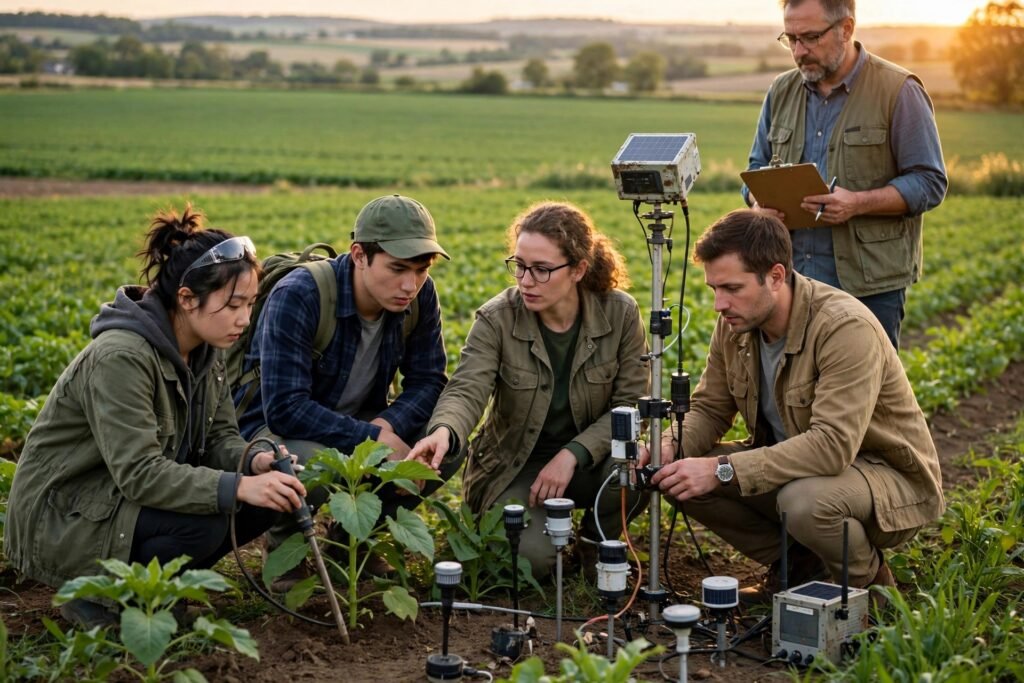
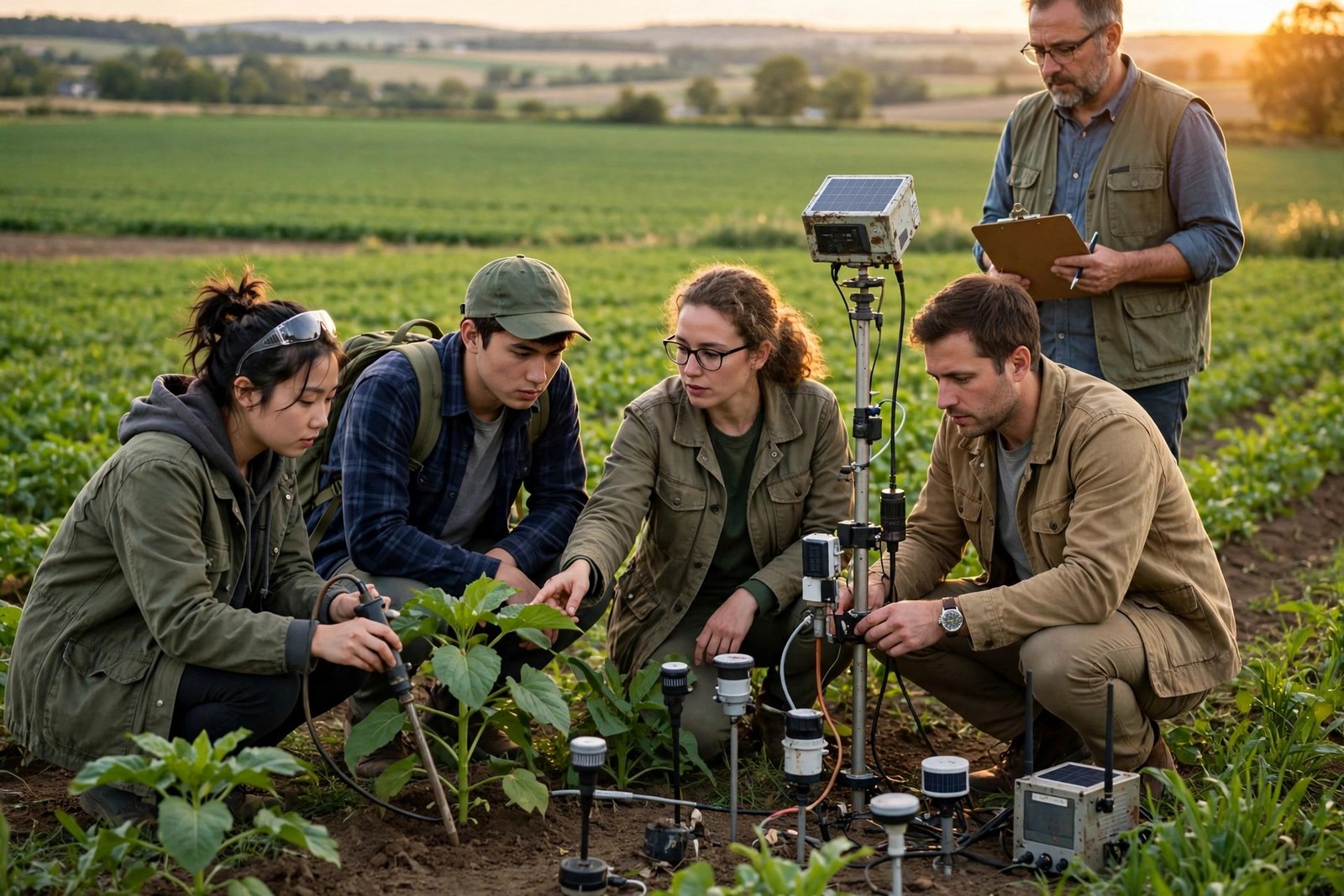
Laboratory and fieldwork matter more here than in many engineering master’s degrees. Expect soil and water laboratories, machinery workshops, instrumentation exercises, field measurements and site visits. Many programmes include a capstone design project or a research thesis. A thesis suits students who may later apply for doctoral study or research roles. A coursework-plus-project route suits students who want to move quickly into industry and who prefer a defined design problem with an industry or university partner. Neither route is inherently better; the right choice depends on your career goal, and you should ask each department what its graduates actually do next.
Software skills are now part of the core, not an optional extra. Geographic information system software, statistical programming, computer-aided design, simulation tools and, increasingly, machine-learning methods for image and sensor data all appear in modern programmes. Students who arrive with basic programming experience and a willingness to learn data handling will adapt faster. Equally important are professional skills: technical writing, project management, safety assessment, cost estimation and working to standards. Employers repeatedly value engineers who can document a design, defend a cost estimate and hand over a system that other people can operate and maintain.
Electives let you shape the degree. Useful combinations include agricultural engineering with environmental management, with food processing, with robotics and automation, or with business and supply-chain subjects. If you hope to work in a particular country after graduation, look for modules on that country’s standards, water regulation, machinery safety or environmental law, and for internships that put you in contact with local employers. A degree title alone rarely decides a career; the project, the internship and the skills you can demonstrate usually matter more.
Eligibility and entry requirements
Most universities ask for a bachelor’s degree in engineering or a closely related field, with strong grades in mathematics, physics and engineering fundamentals. Applicants from agricultural science, environmental science or a general science degree are sometimes admitted, but they may need to complete prerequisite modules in mechanics, fluid mechanics, thermodynamics or engineering mathematics. Some departments publish a list of required undergraduate subjects; if your degree does not cover them, ask before you apply whether you can take bridging courses and whether that extends the programme.
English-language requirements differ by country and institution. In the United Kingdom, Australia and Canada, universities typically publish minimum scores for tests such as IELTS or TOEFL on each programme page. In the United States, requirements vary widely, and some departments waive tests for applicants who studied in English. In Germany and the Netherlands, many master’s programmes are taught in English, but you should check whether a separate language requirement applies to daily life, internships or part-time work, even when the degree itself is in English. Always use the programme page, not a general university page, because requirements differ between departments.
Standardised tests are less universal than they once were. Many programmes in the United States have made the GRE optional or have removed it, while others still require or recommend it, especially for research-track admission or funding. Some European programmes do not ask for the GRE at all and judge applicants mainly on transcripts, motivation, references and relevant experience. If a test is optional, a strong score can still help a borderline application, but it rarely compensates for weak mathematics preparation or a poorly written statement of purpose.
Your statement of purpose should be specific. Admissions tutors read many general essays about loving nature or wanting to feed the world. A stronger essay names a problem you have worked on, a project you completed, a skill you developed, and a specialisation you want to pursue, and it explains why that department’s laboratories, field sites or research groups fit that plan. References should come from people who can comment on your engineering or research ability, not only on your character. Work experience in farming, irrigation, machinery, food processing or environmental projects strengthens an application, especially for professional master’s programmes.
| Country | Typical entry pattern | Points to check |
|---|---|---|
| United States | Bachelor’s in engineering or related field; transcripts, statement, references; GRE often optional | ABET-accredited background helps for licensure routes; check thesis versus non-thesis options |
| United Kingdom | Upper second-class honours degree or equivalent in engineering or a related subject | One-year taught MSc formats are common; check fieldwork and placement options |
| Canada | Four-year bachelor’s in engineering or related field; research-based programmes may need a supervisor | For thesis programmes, contact potential supervisors before applying |
| Australia | Bachelor’s in engineering or related discipline; some programmes require an engineering background for advanced entry | Check Engineers Australia accreditation and professional-year or internship options |
| Germany and the Netherlands | Relevant bachelor’s degree; many English-taught programmes; academic records assessed for subject match | Check application deadlines, which can be much earlier than in other countries, and blocked-account rules for Germany |
Tuition and living costs
Tuition varies far more by country and institution type than by subject. Public universities in parts of continental Europe charge low or no tuition for many programmes, although semester contributions and living costs still apply. Universities in the United States, the United Kingdom, Canada and Australia generally charge international tuition at a higher rate than domestic tuition, and the total depends on programme length, laboratory fees and location. A one-year programme can look cheaper than a two-year programme until living costs, travel and lost earnings are included, so compare the total cost of the whole degree, not only the first year’s fee.
Living costs also vary sharply by city. Capital cities and major technology hubs are usually more expensive than smaller university towns, and fieldwork can add travel, clothing and equipment costs. Before you choose, build a full budget that includes tuition, accommodation, food, transport, health insurance, books and software, fieldwork travel, visa fees and a contingency for currency changes. The tuition fee calculator and the cost of living calculator on StudyGraduate can help you compare scenarios, but they do not replace the university’s published fee schedule.
Government maintenance figures give a useful reality check for visa planning, even though they are minimums rather than comfortable budgets. For the United Kingdom, the Student visa maintenance requirement is GBP 1,529 per month in London and GBP 1,171 per month outside London, with a rise to GBP 1,570 and GBP 1,203 respectively for applications on or after 30 November 2026. For Germany, the blocked account requirement is EUR 11,904 for 2026. For Australia, the financial requirement commonly cited is AUD 29,710 for living costs. For Canada, the proof-of-funds figure for a single applicant outside Quebec moved from CAD 22,895 to CAD 23,448. These figures change, so confirm the current requirement on the official immigration page for your intake before you rely on them.
Funding can change the calculation completely. Research-based master’s programmes sometimes offer assistantships, tuition waivers or stipends, especially in the United States and Canada, but these are competitive and often tied to a supervisor’s project. Taught programmes more commonly offer partial merit scholarships, early-payment discounts or country-specific awards. Explore the scholarships directory and the scholarship finder early, because many deadlines fall months before the programme deadline. Do not pay an agent who promises a scholarship or admission in exchange for a fee; genuine scholarships are published by universities, governments and foundations.
Top universities and countries
Choosing a country first, then a department, usually works better than choosing a famous university name first. The United States has a deep tradition in agricultural and biological engineering, with strong programmes at land-grant universities where engineering departments work closely with agricultural experiment stations, extension services and machinery manufacturers. The Netherlands is strong in precision agriculture, greenhouse technology, water management and food systems, and many programmes are taught in English. Germany combines engineering strength with relatively low public-university tuition and strong machinery and environmental industries. Australia offers strengths in dryland farming, irrigation, soil science and agricultural robotics, with large field sites and close links to export agriculture. Canada offers strengths in prairie agriculture, cold-climate engineering, water resources and food processing, alongside post-graduation work options that many international students value.
The United Kingdom offers intensive one-year taught master’s degrees in agricultural engineering, precision agriculture and related fields, which suit students who want to return to work quickly. Ireland and several Scandinavian countries also offer relevant environmental and biosystems programmes. In Asia, strong agricultural engineering and biosystems research exists in countries with large agricultural sectors, although language, programme structure and recognition differ, so check each programme individually rather than assuming a degree title means the same curriculum everywhere.
When you compare departments, look beyond league tables. Check the laboratories, field stations and industry partners; read recent staff research; look at the thesis and capstone projects of recent graduates; and ask what proportion of graduates work in agricultural engineering roles versus general engineering roles. Accreditation also matters. In the United States, ABET accreditation is the recognised standard for engineering programmes, and a programme accredited by the Engineering Accreditation Commission of ABET signals that it meets established criteria for agricultural engineering. In Australia, Engineers Australia accreditation plays a similar role. In the United Kingdom, professional recognition through engineering institutions can matter for later chartered status. Browse the universities directory and the Courses and Programs directory to compare profiles, then verify shortlisted programmes on their official pages.
Careers and salaries
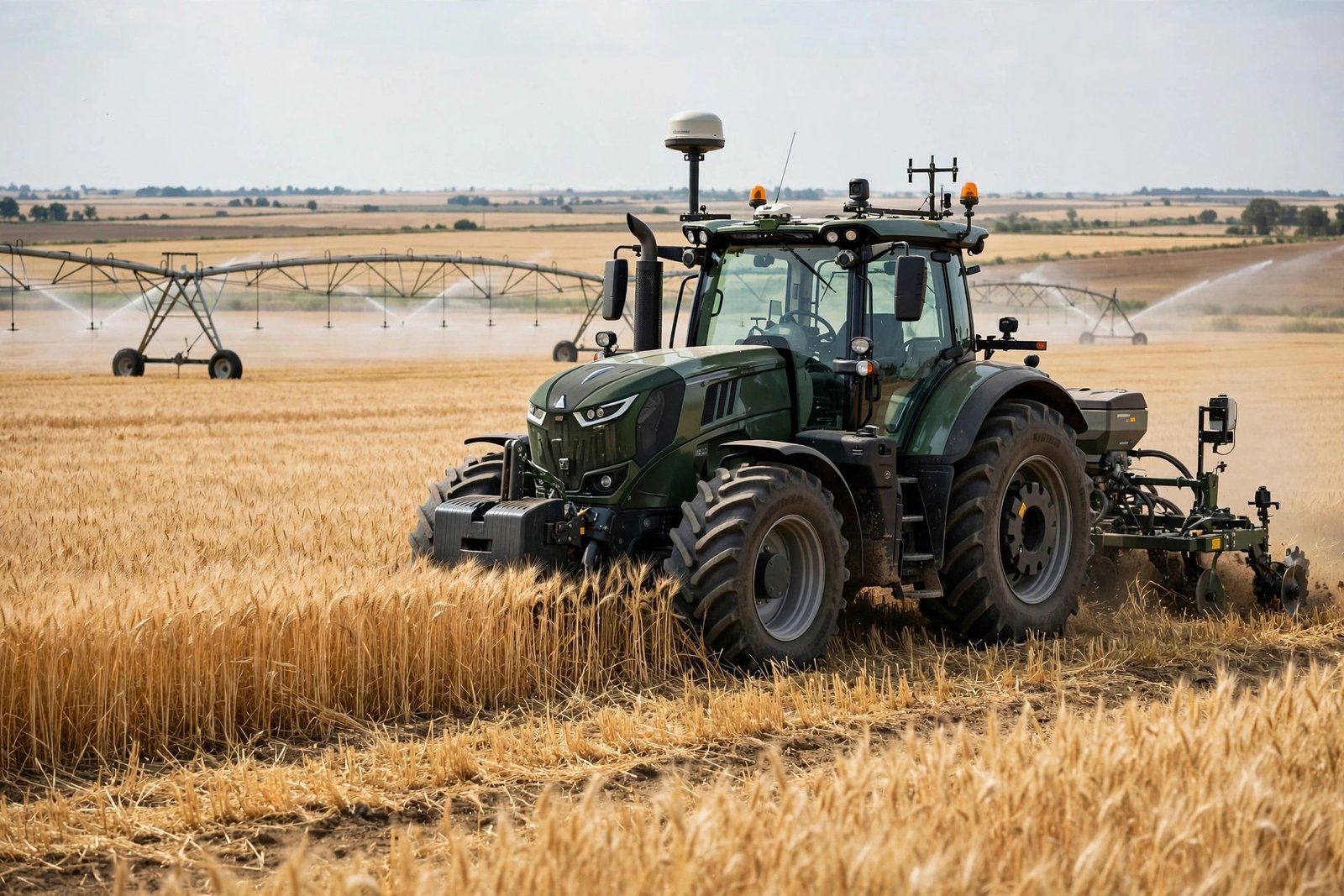
Agricultural engineering graduates work in machinery manufacturing, irrigation and water companies, food processing, agri-technology firms, government agencies, research institutes, consulting firms and international development organisations. Typical roles include agricultural engineer, irrigation and drainage engineer, precision agriculture specialist, machinery design and test engineer, post-harvest engineer, environmental engineer for agricultural systems, and research or product engineer in agri-technology. Some graduates move into project management, technical sales, policy or entrepreneurship, particularly after gaining field experience.
Salary data should be read as a benchmark for a broad occupation, not as a promise for any individual graduate. The United States Bureau of Labor Statistics reports that the median annual wage for agricultural engineers was USD 98,590 in May 2025, with the lowest 10 percent earning less than USD 68,060 and the highest 10 percent earning more than USD 166,460. The same source projects employment of agricultural engineers to grow by 7 percent from 2025 to 2035, which it describes as much faster than the average for all occupations, with about 100 openings projected each year on average over the decade. These figures describe the United States occupation as a whole; entry-level pay, pay in other countries, and pay in a specific sector will differ.
For Australia, the University of Southern Queensland career profile for agricultural engineers, drawing on Australian labour-market data, reports an average weekly salary of AUD 2,502 and describes future demand as strong, with a bachelor’s degree as the most common education level. That weekly figure is useful for orientation, but it is not a graduate starting salary and it should not be annualised into a promise. Employers, location, experience and specialisation all move pay considerably. In other countries, use the equivalent official source for that country, such as national statistics or a government job outlook service, rather than converting a United States or Australian figure into another currency and treating it as local pay.
| Role or benchmark | Official figure | Source and year |
|---|---|---|
| Agricultural engineers, United States, median annual wage | USD 98,590 | U.S. Bureau of Labor Statistics, May 2025 |
| Agricultural engineers, United States, lowest 10 percent | Less than USD 68,060 | U.S. Bureau of Labor Statistics, May 2025 |
| Agricultural engineers, United States, highest 10 percent | More than USD 166,460 | U.S. Bureau of Labor Statistics, May 2025 |
| Agricultural engineers, United States, projected employment growth | 7 percent, 2025 to 2035 | U.S. Bureau of Labor Statistics projection |
| Agricultural engineer, Australia, average weekly salary | AUD 2,502 per week | University of Southern Queensland career profile, Australian labour-market data |
Long-term prospects depend on skills that are hard to automate away: designing systems that work in variable weather, on uneven ground, with biological materials that change by season. Automation changes the job, but it also creates work in sensor calibration, data quality, safety testing and system integration. Graduates who combine engineering fundamentals with data skills, field experience and clear communication tend to have the widest options. Graduates who only know theory, or only know one software tool, tend to have narrower options, so use electives, internships and projects to build breadth deliberately.
Scholarships for this field
Scholarships for agricultural engineering come from several directions. Universities offer merit awards for international master’s students, sometimes automatically on admission and sometimes through a separate application. Governments offer scholarships for study in their country, often with priority fields that include agriculture, food security, water and climate. Foundations and industry bodies support students in agricultural technology, irrigation and rural development. Because deadlines and eligibility differ, start searching at least a year before entry and keep a spreadsheet of deadlines, required documents and whether a separate essay or reference is needed.
Research-based applicants should also ask supervisors about funded projects. A funded research assistantship can be worth more than a partial scholarship because it may cover tuition and provide a stipend, but it usually requires a specific research match and a longer commitment. Taught-programme applicants should check whether a scholarship can be combined with an early-payment discount, and whether it renews in a second year or applies only to the first year. The scholarship finder and the scholarships directory are good starting points, and the career path explorer can help you test whether a specialisation matches the roles you want.
How to choose a programme
Start with your goal, not with a ranking list. If you want to design irrigation systems, prioritise programmes with hydrology, hydraulics and field stations. If you want to work in machinery, prioritise programmes with workshops, testing facilities and manufacturer links. If you want to work in data and precision agriculture, prioritise programmes with remote sensing, geographic information systems and industry data projects. Then check practical matters: total cost, programme length, thesis versus coursework, internship availability, language, visa and post-study work rules, and whether your degree will be recognised by employers or professional bodies in the country where you hope to work.
Contact departments with focused questions. Ask about recent graduate destinations, the size of laboratory groups, fieldwork costs, software taught, and whether international students can join research or industry projects. Ask current students about supervision, workload and support services. A department that answers clearly and promptly is often a better sign than a glossy brochure. Also check the rankings directory for context, but remember that rankings describe universities as a whole, not a single department, and they should never be the only reason to choose a programme.
Finally, plan for life after graduation. In the United States, Optional Practical Training rules, employer sponsorship and licensure pathways vary and should be checked on official government pages. In the United Kingdom, the Graduate Route currently allows eligible graduates to stay and work for a period after study, while an announced change would shorten that period to 18 months from 1 January 2027; treat the announced change as announced, not current, until it takes effect. In Canada, post-graduation work permit rules depend on programme length and institution eligibility. In Australia, post-study work rights depend on qualification level and location. None of these rules is a guarantee, and they can change between application and graduation.
Frequently asked questions
Do I need an agricultural engineering bachelor’s degree to apply?
Not always, but you need a relevant engineering or science background with strong mathematics and physics. Applicants from mechanical, civil, environmental or biological engineering are usually well placed. Applicants from agricultural science may need prerequisite engineering modules, so check the programme’s subject requirements before applying.
Is agricultural engineering the same as agronomy?
No. Agronomy focuses on crops, soils and crop management. Agricultural engineering focuses on the systems that support production: machinery, irrigation, structures, storage, processing and data systems. The two fields work closely together, but the daily work and the core skills differ.
How long does an MS in Agricultural Engineering take abroad?
Typically one to two years full time. One-year taught programmes are common in the United Kingdom. Two-year programmes, including a thesis or internship, are common in the United States, Canada, Germany and Australia. Part-time options take longer and are not available everywhere for international students on a student visa.
Is the GRE required?
It depends on the university and programme. Many programmes have made it optional or removed it, while others still require or recommend it. Check each programme page, and do not assume that a requirement at one university applies at another.
Can I work in agri-technology after this degree?
Yes, if you build the relevant skills. Agri-technology employers value sensor and data skills, automation, testing and field experience alongside core engineering. Choose electives and projects that demonstrate those skills, and seek internships in agri-technology firms where possible.
What salary can I expect after graduation?
No honest guide can promise a salary. As a benchmark, the United States Bureau of Labor Statistics reported a median annual wage of USD 98,590 for agricultural engineers in May 2025. Pay varies by country, sector, experience, location and employer, so compare official statistics for the country where you plan to work.
Is this degree good for international students who want to return home?
Often yes, because irrigation, machinery, storage and food-processing skills transfer across countries, although standards, crops, climates and regulations differ. If you plan to return home, choose projects and electives relevant to your home country’s farming systems, and check professional recognition there.
Should I choose a thesis or a coursework master’s?
Choose a thesis if you may pursue doctoral study or research roles and you want deep experience in one problem. Choose coursework plus a project if you want to enter industry quickly and prefer a broader set of applied modules. Both routes can lead to strong careers when the projects and internships are well chosen.
Sources and verification
Sources consulted for this guide include the U.S. Bureau of Labor Statistics Occupational Outlook Handbook for agricultural engineers, the University of Southern Queensland agricultural engineer career profile, ABET accreditation information for agricultural engineering programmes, and official government maintenance and funding figures summarised in the StudyGraduate guides brief, including United Kingdom Student visa maintenance rates, the German blocked account figure for 2026, the Australian living-cost figure and the Canadian proof-of-funds figure. External sources: BLS Agricultural Engineers, University of Southern Queensland Agricultural Engineer profile, and ABET.
Figures change yearly. Confirm tuition, entry requirements, deadlines and visa rules on the official university and government pages for your intake before you apply. StudyGraduate is an information portal, not an agency, and never promises admission, jobs, salaries or visa or permanent-residence outcomes.