

MS in Telecommunications Engineering Abroad: Eligibility, Fees, Top Universities and Careers
Telecommunications engineering is the discipline behind every call, video stream, satellite link, fibre connection and wireless network you use, and it has never been more central to how societies work. An MS in Telecommunications Engineering abroad trains you to design, build, optimise and secure the networks that carry that traffic: mobile networks from 4G through 5G and towards 6G, fibre-optic and submarine cable systems, satellite communications, data-centre networks, and the Internet of Things systems that connect sensors, vehicles and industrial equipment. It is an electrical and electronic engineering specialism with a strong software and systems component, and it suits students who enjoy signal processing, networks and practical problem-solving at scale.
This guide explains what the degree covers, who it suits, what universities require, what it costs in the main destination countries, where to study it, and what careers follow, for international students planning 2026 or 2027 entry. Salary and employment figures are taken from official statistics and labelled by source and year, so you can judge the field on evidence. If you are still comparing options, start with the Courses & Programs directory, and if you want to test how this field fits your profile, try the career path explorer tool.
The field is changing fast, which is both an opportunity and a warning. Mobile networks are densifying with small cells and massive antenna arrays, fibre is pushing closer to homes and businesses, satellite constellations are bringing connectivity to remote areas, and artificial intelligence is being applied to network optimisation, traffic prediction and security. A good master’s programme therefore teaches durable fundamentals — signals, electromagnetic waves, information theory, protocols and network architecture — alongside current technologies, so that graduates can adapt when the next generation of standards arrives rather than being trained only for today’s equipment.
At a Glance: MS in Telecommunications Engineering
| Feature | Typical position |
|---|---|
| Degree level | Master of Science (MS, MSc or MEng, depending on country and university) |
| Typical duration | 1 year in the UK; 1.5 to 2 years in the USA, Canada and Australia; 2 years (4 semesters) in Germany |
| Usual entry qualification | A bachelor’s degree in electrical, electronics, telecommunications, computer or communications engineering, or a closely related subject |
| Core subjects | Digital communications, signal processing, wireless networks, optical communications, network protocols, antennas and propagation |
| Typical final project | Designing, simulating or testing a communication system, network or signal-processing algorithm, often with an industry partner |
| Best suited to | Students who enjoy mathematics, signals and systems, programming, and understanding how large networks behave under real traffic |
| Key employers | Telecom operators, network equipment vendors, satellite companies, data-centre operators, defence, broadcasting and technology firms |
What You Study in an MS in Telecommunications Engineering
The foundations come first: digital signal processing, communication theory, information theory, probability and random processes, and electromagnetic waves and antennas. These explain how information is encoded, modulated, transmitted through a noisy channel, received and decoded, and why a system has a maximum data rate for a given bandwidth and signal quality. Students who enjoyed signals and systems, probability and electromagnetic theory as undergraduates usually find this core rewarding, while students who disliked the mathematics should think carefully, because the degree does not avoid it — it builds on it.
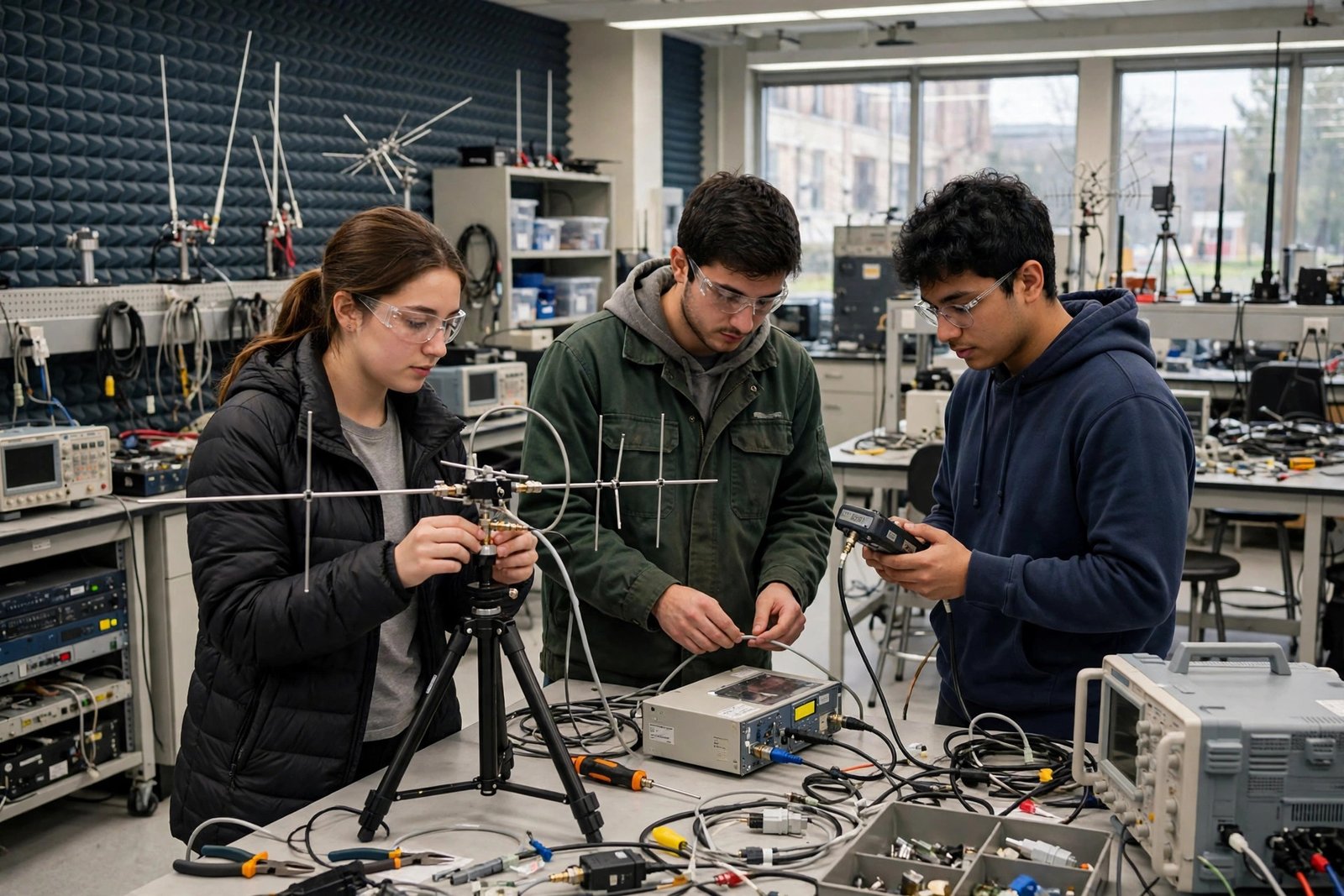
Wireless communications is usually the largest applied strand. You will study cellular network architecture, multiple-access and multiple-antenna techniques, channel modelling and propagation, radio resource management, and the evolution from earlier mobile generations to 5G and research towards 6G. Laboratory work may involve software-defined radios, channel measurements, link simulations and antenna testing, and many programmes include a module on millimetre-wave and terahertz communications, massive MIMO and non-terrestrial networks. The goal is not to memorise a standard but to understand the trade-offs behind it: coverage against capacity, latency against reliability, spectral efficiency against energy consumption.
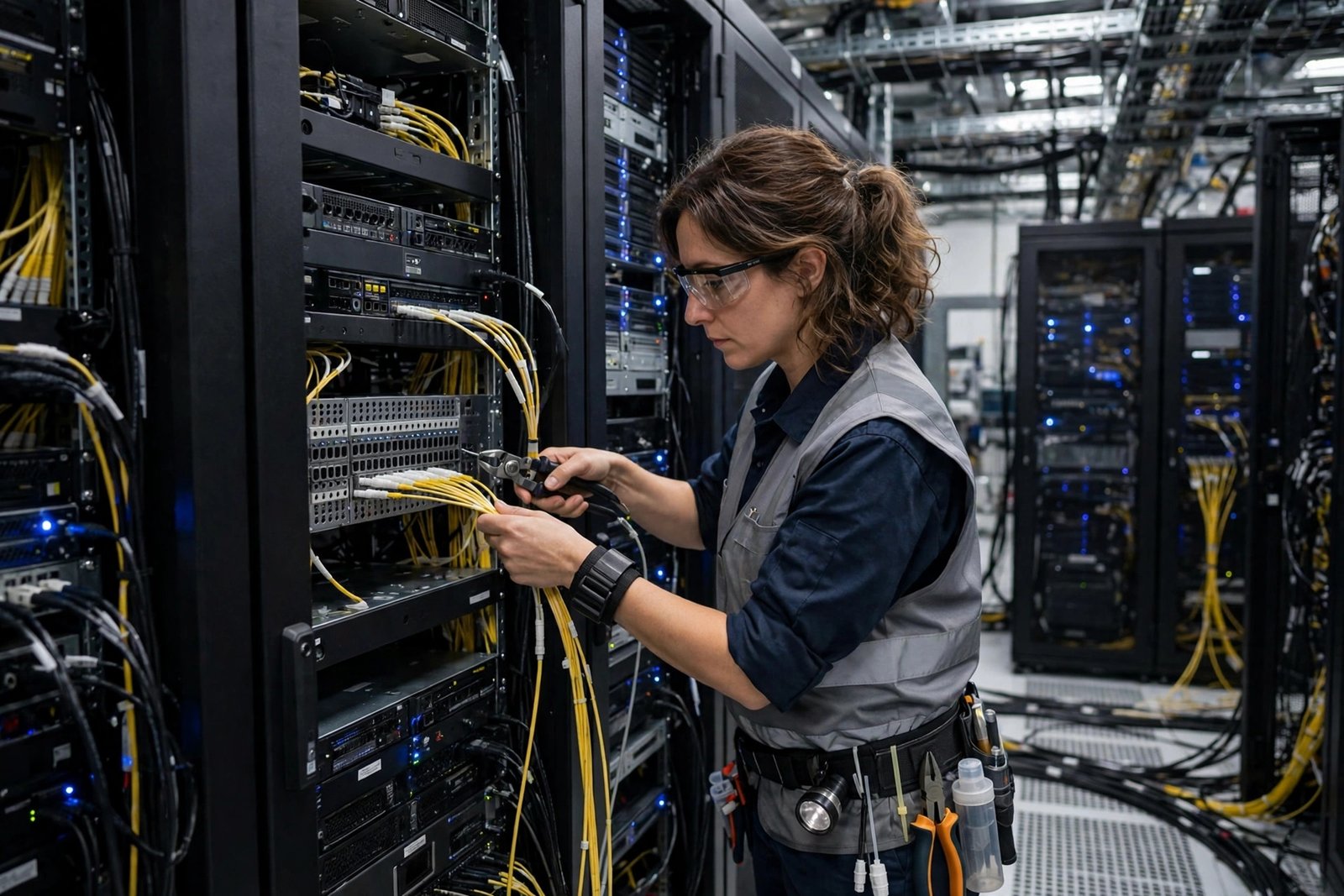
Optical and fixed networks form a second applied strand: fibre-optic transmission, wavelength-division multiplexing, passive optical networks, submarine cable systems and data-centre interconnects. A third strand covers networks themselves: Internet protocols, routing, switching, network security, quality of service, cloud and edge computing, and network function virtualisation. A fourth, increasingly important strand covers satellite communications, including link budgets, orbital mechanics for communications purposes, ground segments and the integration of satellite and terrestrial networks. Specialisation options commonly include wireless systems, optical communications, satellite communications, network engineering and security, and signal processing for communications.
The dissertation or capstone project is where these strands combine. Examples include designing a 5G small-cell deployment for a campus, simulating a satellite link under rain fading, building a software-defined radio receiver, optimising a fibre network for a city, or developing a machine-learning method for detecting network anomalies. Choose a project area by the employers you want to reach: operators and vendors value network planning and optimisation experience, satellite companies value link-budget and ground-segment work, and technology firms value signal processing and software skills. Check that the department has the laboratories and software licences for your chosen area, and that staff publish in it, before you apply.
Eligibility and Entry Requirements
Most programmes ask for a bachelor’s degree in electrical, electronics, telecommunications or communications engineering, with computer engineering and applied physics sometimes accepted where the applicant has strong signals, communications or networks coursework. A grade equivalent to a UK 2:1 or a GPA around 3.0 on a 4.0 scale is typical, with flexibility for applicants with relevant work experience in telecoms, networking or broadcasting. Mathematics preparation matters: linear algebra, calculus, probability and signals-and-systems courses are expected, and applicants whose degrees were light on those topics may be asked to complete preparatory modules or may find the first term demanding.
English language requirements follow the standard pattern: IELTS around 6.5 overall with no band below 6.0, or an equivalent TOEFL score, for English-taught programmes, with some competitive programmes asking for 7.0. English-taught programmes in Germany require IELTS or TOEFL, while German-taught programmes require German proficiency. In the United States, many programmes have made the GRE optional, although a strong quantitative score can still help an applicant with weaker grades or one seeking funding. A clear statement of purpose should name the communications area that interests you, the modules or research groups that attracted you, and the career direction you are aiming for, rather than offering general praise for the university.
Practical experience strengthens an application in this field in a specific way: internships with operators, vendors, broadcasters or network installers, certifications in networking, and personal projects such as a software-defined radio experiment, a network simulation or a home-lab network build all demonstrate genuine interest. Programming skills in Python, MATLAB or C++ are expected for simulation and signal-processing modules, and familiarity with network tools and Linux is an advantage. Use the document checklist tool to organise transcripts, test scores and references, and apply early where scholarships or funded places are involved.
Eligibility at a Glance by Country
| Country | Typical academic requirement | Language requirement | Notes |
|---|---|---|---|
| United States | 4-year bachelor’s in a relevant engineering subject; GPA around 3.0 | TOEFL or IELTS | GRE often optional; strong wireless and satellite research in many universities |
| United Kingdom | 2:1 honours or equivalent in a relevant subject | IELTS around 6.5 overall | Most master’s last 1 year; strong 5G and optical research groups |
| Canada | 4-year bachelor’s with strong grades in final years | IELTS or TOEFL | Research master’s often require a supervisor’s agreement before admission |
| Germany | Recognised bachelor’s in a relevant subject | English or German, depending on programme language | Strong industrial and Fraunhofer-linked communications research |
| Australia | Bachelor’s in a relevant subject | IELTS or equivalent | 1.5 to 2 years; satellite and remote communications are notable strengths |
Tuition Fees and Living Costs
Tuition again varies by country and university rather than by programme title, and the official programme page for your intake year is the only reliable source. In the United States, public universities charge international students more than residents, and private universities charge more again, while assistantships can waive tuition and pay a stipend for research-oriented students. The United Kingdom’s one-year format compresses total living costs. Canada and Australia publish fees per programme and require proof of funds for immigration, so budget the full amount before applying. Germany’s public universities often charge no tuition for consecutive master’s programmes, only a semester contribution, although some states and private or non-consecutive programmes do charge fees.
For living costs, use government figures as a floor and the tuition fee calculator and cost-of-living calculator to build a full budget. The UK student visa maintenance requirement is GBP 1,529 per month in London and GBP 1,171 per month outside London, rising to GBP 1,570 and GBP 1,203 for applications on or after 30 November 2026. Germany’s blocked-account figure is EUR 11,904 for a year under the 2026 rules. Australia’s financial requirement figure is AUD 29,710 for a year, and Canada’s proof-of-funds figure for a single applicant outside Quebec is CAD 23,448, up from CAD 22,895. These are immigration minimums, not comfortable budgets, and telecom hubs such as London, Munich, Toronto and Sydney have rents that can exceed them quickly, so keep a reserve for deposits, insurance and the first month’s expenses.
Top Universities and Countries for Telecommunications Engineering
Each major destination has a distinct telecommunications strength. The United States offers scale and research depth in wireless, satellite and data-centre networking, with universities closely linked to equipment vendors and technology firms. The United Kingdom has long-standing research in mobile communications, optical networks and signal processing, and its one-year master’s degrees are efficient for students who want to return to industry quickly. Germany combines strong communications research, including Fraunhofer-linked institutes, with industrial employers in automotive connectivity, industrial communications and broadcasting, and its low public-university fees make it a strong value option.
Canada’s telecommunications research is strong in wireless systems, satellite communications and photonics, and its research master’s programmes may offer supervisor funding. Australia’s strengths include satellite and remote-area communications, which matter in a large country with dispersed communities, and optical and wireless research linked to its national broadband and defence sectors. When shortlisting, look for laboratories with software-defined radios, antenna measurement facilities, optical test equipment and network testbeds, and for staff who publish in your chosen area. Browse the universities directory, compare shortlisted institutions with the university comparison tool, and if you are weighing telecommunications against a broader electronics degree, the Bachelor of Engineering profile explains the undergraduate foundations that lead into it.
Post-study work rules must be checked on official government pages at application time, because they change. The United States offers Optional Practical Training, with a STEM extension for designated degrees, which covers many telecommunications programmes. The United Kingdom’s Graduate Route currently allows two years after a master’s, with an announced reduction to 18 months from 1 January 2027. Canada’s Post-Graduation Work Permit can run up to three years depending on programme length, and Australia’s post-study arrangements depend on qualification level and location. Choose the programme for its content and laboratories, and treat work rights as a factor to confirm, not a promise to rely on.
Careers and Salaries After an MS in Telecommunications Engineering
Telecommunications graduates work as telecommunications engineers, network engineers, RF engineers, optical engineers, satellite communications engineers, network architects, systems engineers and signal-processing engineers. Employers include mobile operators, fixed-line operators, equipment vendors, satellite operators, cloud and data-centre companies, broadcasters, defence contractors and large enterprises with their own networks. The work ranges from planning where to place base stations, to designing antennas and optical links, to building the software that routes traffic, monitors performance and defends networks against attack.
Official US statistics describe the closest occupations directly. The Bureau of Labor Statistics reports that the median annual wage for electronics engineers, except computer, was $130,220 in May 2025, and for electrical engineers it was $120,630 in May 2025, with overall employment of electrical and electronics engineers projected to grow 8 percent from 2025 to 2035, much faster than the average for all occupations, and about 16,300 openings projected each year on average over the decade. The Bureau also reports industry detail that is particularly relevant here: in May 2025, the median annual wage for electronics engineers in the telecommunications industry was $109,040, lower than in semiconductor manufacturing at $146,700, which illustrates how industry choice affects pay within the same occupation. New graduates should expect to earn below national medians, which cover all experience levels, while senior network architects and RF specialists in scarce areas can earn well above them.
Skills that raise a graduate’s value include RF design and measurement, antenna design, digital signal processing, network protocols and automation, cloud and virtualisation technologies, Python and MATLAB for simulation, and security fundamentals for networks. Certifications in networking and cloud platforms can complement a degree, but they do not replace it: employers hiring for design and optimisation roles look for the theoretical depth and project evidence that a master’s provides, while certifications are most useful for operations and support roles. A dissertation that includes measured results — a tested antenna, a simulated network under realistic traffic, a working software-defined radio system — is the strongest evidence you can show an employer in this field.
| Role or occupation | Official figure | Source and year |
|---|---|---|
| Electronics engineers, except computer (USA) | Median $130,220 per year | US Bureau of Labor Statistics, May 2025 |
| Electrical engineers (USA) | Median $120,630 per year | US Bureau of Labor Statistics, May 2025 |
| Electronics engineers in telecommunications (USA) | Median $109,040 per year | US Bureau of Labor Statistics, May 2025 |
| Electrical and electronics engineers (USA) | Employment growth 8%, 2025 to 2035 | US Bureau of Labor Statistics, Occupational Outlook Handbook |
For careers outside the United States, use that country’s official statistics rather than converting a US figure: UK Graduate Outcomes and Longitudinal Education Outcomes data, Statistics Canada and the Job Bank, and Jobs and Skills Australia each publish relevant occupation information with their own definitions, and cross-country comparisons need to account for tax, hours, benefits and living costs. If an official figure for your target role and country cannot be verified, describe demand qualitatively and say so, rather than borrowing a number from another market.
Emerging Topics: 5G, Satellite Broadband and Network Security
Three developments are reshaping what telecommunications graduates are asked to do, and a strong master’s programme should address all three. The first is the densification and virtualisation of mobile networks. Instead of a small number of large base stations, modern networks use many small cells, distributed antenna systems and cloud-based radio access networks, with network functions running as software on general-purpose hardware rather than on dedicated boxes. This shift changes the engineer’s job: planning becomes a data problem as much as a radio problem, and engineers must understand virtualisation, orchestration and automation tools alongside propagation and antennas. Students who combine radio fundamentals with network automation skills are therefore well placed, because they can work on both the physical design and the software that operates it.
The second development is the growth of non-terrestrial networks. Low Earth orbit satellite constellations now provide broadband to ships, aircraft, remote communities and disaster zones, and future standards aim to integrate satellite and terrestrial networks so that a device can move between them. This creates demand for engineers who understand link budgets under rain fading and atmospheric loss, Doppler effects from fast-moving satellites, handover between satellite beams, and the ground-segment infrastructure that connects constellations to the wider Internet. It also creates regulatory and spectrum questions, because satellite and terrestrial services must share frequencies without harmful interference, and engineers who understand spectrum policy as well as technology have an advantage in this area.
The third development is security. Telecommunications networks are critical infrastructure, and attacks on them — from signalling fraud and interception to denial-of-service attacks on core networks and supply-chain compromise of equipment — have serious consequences. Security therefore appears in modern programmes not as an optional module but as a thread running through network design: authentication and encryption, secure signalling, intrusion detection, resilience and recovery, and the secure design of Internet of Things deployments, where millions of low-power devices must be authenticated and updated safely. A graduate who can explain how a network fails under attack, and how it recovers, is more valuable than one who can only describe how it works when everything goes well, and dissertation projects in network security, anomaly detection and resilient design are a good way to demonstrate that ability.
Together, these developments point to a practical conclusion for applicants: do not choose a programme only for its coverage of a single current technology, such as one mobile generation, because that technology will evolve during your career. Choose a programme that teaches the fundamentals deeply, gives you laboratory experience with real equipment and software, and exposes you to at least one emerging area through an elective or dissertation. That combination — durable theory, practical measurement and software skills, and one area of genuine depth — is what employers in telecommunications consistently look for, and it is what makes the degree resilient to the next cycle of technological change.
Scholarships for Telecommunications Engineering
Funding follows the usual engineering pattern: university merit scholarships, departmental awards, government scholarships such as Chevening and Fulbright, and supervisor-funded research places in Canada and Australia. Telecommunications is also an area where operators, vendors and satellite companies sometimes sponsor students or offer industry-linked projects, so ask departments about those links directly. Germany’s low public-university fees are a major effective subsidy, and DAAD publishes awards for international engineering students.
Browse the scholarships directory and use the scholarship finder tool to match awards to your nationality, destination and field. Scholarship deadlines often fall months before university deadlines, so start the search at the same time as your university shortlist, and tailor each application to the funder’s priorities, whether those are academic excellence, leadership, development impact or industry relevance.
How to Choose and Apply
Shortlist six to eight programmes across at least two countries, balancing ambition, realism and safety, and record the official fee, length, laboratory facilities, research groups and deadline for each. Contact departments with specific questions: which software-defined radio platforms are used, is there an antenna measurement facility, does the programme cover satellite communications or only terrestrial networks, and what do recent graduates do now? Build a small practical project before applying — a simulation, a radio experiment or a network lab — and document it, because it proves interest and ability in a way that grades alone cannot.
Write your statement around a communications problem you want to solve, name the modules or groups that fit it, and explain your career direction honestly. Give referees time and material, plan your finances before accepting an offer, and keep a reserve for flights, insurance and the first month’s rent. Telecommunications rewards engineers who combine theory with measurement and software, and students who arrive with that combination already started make the fastest progress.
Frequently Asked Questions
Is telecommunications engineering still a good career with 5G already deployed?
Yes. Networks are not finished when a generation launches: they must be densified, optimised, maintained, secured and eventually replaced, while fibre, satellite, data-centre and private networks all continue to expand. The Bureau of Labor Statistics projects 8 percent employment growth for electrical and electronics engineers from 2025 to 2035, which reflects continuing demand across communications and related fields.
Do I need strong mathematics for this degree?
Yes. Signal processing, communication theory, probability and electromagnetic theory all require solid mathematics, and the degree builds on undergraduate signals and systems courses. Students who enjoy that mathematics tend to do well; students who dislike it should consider a more operations-focused networking qualification instead.
Which country is best for telecommunications engineering?
There is no single best country: the USA offers research scale, the UK offers one-year degrees, Germany offers low fees and industrial research links, Canada offers funded research options, and Australia offers satellite and remote-communications strengths. Choose by specialism, laboratory facilities and budget.
How long does the degree take?
Typically one year in the UK, two years in Germany, and 1.5 to 2 years in the USA, Canada and Australia. Research-based programmes and programmes with an internship may run longer.
What is the difference between telecommunications and computer networking?
Telecommunications engineering covers the physical and signal layers as well as networks: antennas, radio propagation, optical transmission and signal processing, in addition to protocols and network design. Computer networking focuses more narrowly on protocols, routing, switching and network administration, and usually requires less electromagnetic and signal theory.
Can I work in satellite communications after this degree?
Yes, particularly if you choose a programme with satellite modules, link-budget and ground-segment teaching, and a relevant dissertation. Satellite employers also value RF, antenna and signal-processing skills, so a strong performance in those core modules matters as much as the satellite label itself.
Do I need a PhD to work in telecoms?
No. Most operator, vendor, network engineering and RF engineering roles are filled by bachelor’s and master’s graduates. A PhD is most valuable for research leadership, university roles and advanced work in areas such as 6G research, information theory and signal processing, and should be chosen for those reasons.
Sources & Verification
- US Bureau of Labor Statistics, Occupational Outlook Handbook: Electrical and Electronics Engineers — median wages $120,630 (electrical) and $130,220 (electronics, except computer) in May 2025; employment projected to grow 8 percent, 2025 to 2035; electronics engineers in telecommunications, median $109,040 in May 2025. BLS: Electrical and Electronics Engineers
- US Bureau of Labor Statistics, Occupational Outlook Handbook: Electrical and Electronic Engineering Technologists and Technicians — industry and occupation context. BLS: Electrical and Electronic Engineering Technologists and Technicians
- ABET accreditation criteria and accredited programme search — what accredited engineering programmes must deliver. ABET: What Programs Does ABET Accredit?
- UK student visa maintenance figures, Germany blocked-account figure (EUR 11,904), Australia financial requirement (AUD 29,710) and Canada proof-of-funds figure (CAD 23,448) — as summarised in the StudyGraduate guides brief; confirm the figure that applies to your application date on the official government page before applying.
Figures change yearly — confirm fees, entry requirements, visa rules and scholarship deadlines on the official university and government pages before you apply. StudyGraduate is an information portal, not an agency, and never promises admission, jobs, salaries or visa or permanent-residence outcomes.