

MS in Robotics Engineering Abroad: Eligibility, Fees, Top Universities and Careers
An MS in Robotics Engineering abroad is a postgraduate degree for students who want to design machines that sense, decide and act in the physical world. A robot is never one discipline: it is mechanics and materials for the body, electronics and sensors for perception, control theory for movement, and software and artificial intelligence for decision-making, all of which must work together in real time and in messy, unpredictable environments. That breadth is what makes robotics exciting, and it is also what makes choosing the right programme important, because different universities emphasise very different parts of the system.
Robotics engineers work on industrial arms and mobile robots in factories and warehouses, surgical and rehabilitation robots in hospitals, agricultural robots in fields, drones and autonomous vehicles, humanoid and service robots, and the automation systems that connect them. Some roles are close to mechanical design, building actuators, grippers and lightweight structures. Others are close to software, writing perception, planning and control algorithms. Others sit in between, integrating hardware and software, testing systems, and taking a robot from a laboratory prototype to a product that works reliably for customers. A good master’s degree teaches you to work across at least two of these layers and to communicate with specialists in the others.
This guide covers the degree for 2026 and 2027 intakes: what you study, who is eligible, what it costs in the United States, the United Kingdom, Canada, Australia and Germany, which countries and universities are strongest, what graduates earn according to official statistics, and which scholarships are worth targeting. It also states an important honesty point about salary data up front: the United States Bureau of Labor Statistics does not publish a separate occupation called “robotics engineer”, so this guide uses the mechanical engineering occupation as the closest official benchmark, explains that choice, and does not invent a robotics-specific salary figure.
Naming varies widely, and it is the single most important thing to check before applying. Common titles include MS in Robotics, MSc Robotics, MS in Robotics Engineering, MS in Mechatronics, MS in Automation and Robotics, and MS in Mechanical Engineering with a robotics concentration. A programme called robotics in a computer science department may be mostly perception and machine learning, with little hardware. A programme in a mechanical engineering department may be mostly mechanisms, dynamics and control, with less software. A mechatronics programme may balance the two but with less depth in artificial intelligence. Read the module list and the laboratory facilities, and ask which parts of a robot the programme actually teaches you to build.
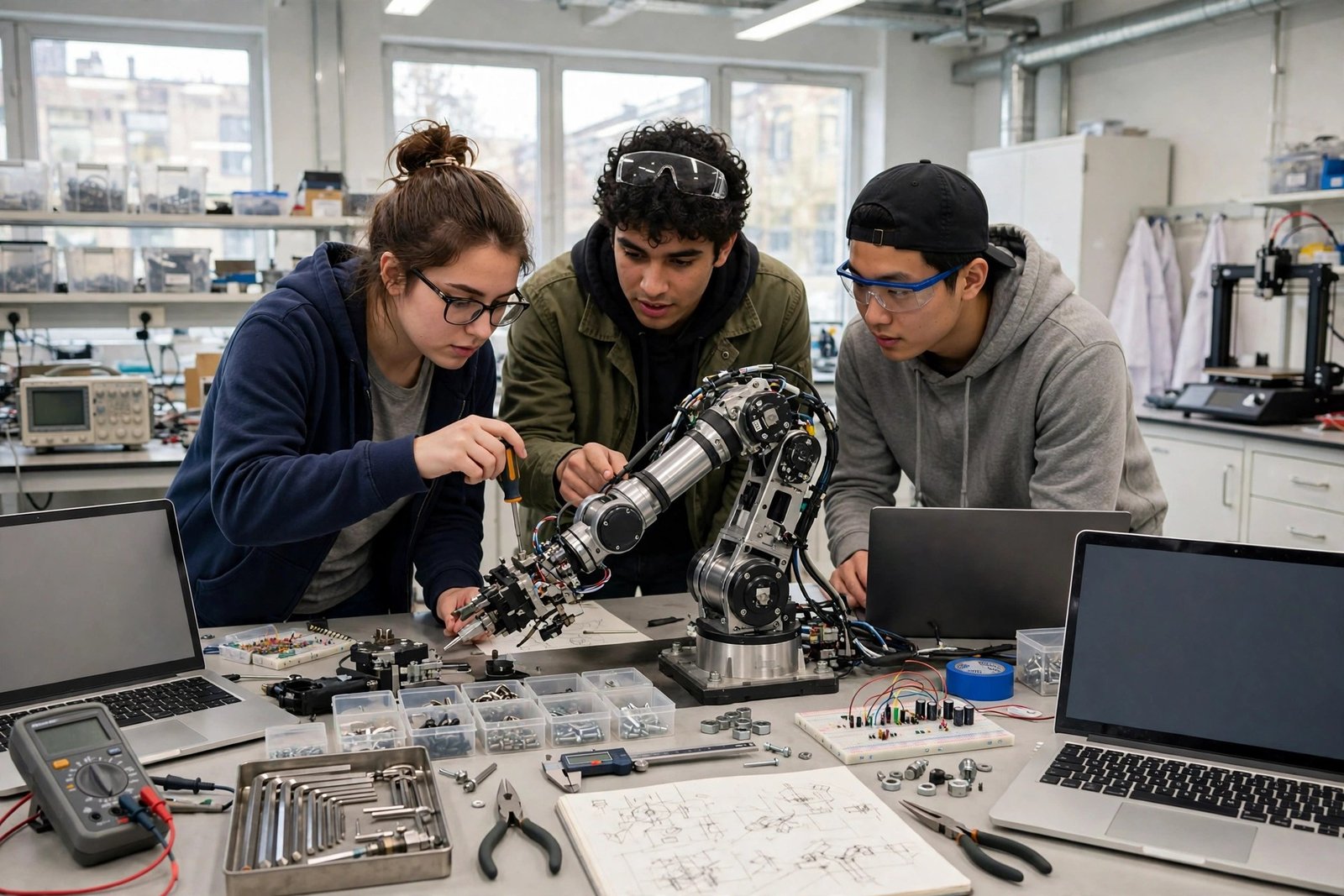
At a glance
| Feature | Typical position |
|---|---|
| Degree level | Master’s: MS, MSc, MEng or Master of Engineering, depending on country and university |
| Typical duration | 1 year full-time in the UK; 1.5 to 2 years in the USA, Canada and Australia; 2 years (4 semesters) in Germany |
| Usual entry qualification | Bachelor’s in mechanical, electrical, electronics, computer, mechatronics or robotics engineering, or computer science with strong mathematics |
| Core subjects | Robot kinematics and dynamics, control systems, sensors and perception, embedded systems, machine learning for robotics, human-robot interaction, robot programming |
| Typical capstone | Build-and-test project, research thesis, or an industry-linked project, often involving a working robot prototype |
| Common employers | Robotics and automation companies, automotive and aerospace firms, medical device companies, logistics and manufacturing firms, research laboratories |
| Professional direction | Less licence-driven than civil or structural engineering; portfolio, publications and demonstrable systems matter most |
What you study in an MS in Robotics Engineering
Robot kinematics, dynamics and control are the foundation. You will learn how to describe where a robot’s hand or wheels are in space, how forces and torques move its joints, and how to design controllers that make it follow a planned path accurately despite friction, backlash and changing loads. This is applied mathematics with immediate physical consequences: a controller that is stable in simulation but oscillates on the real robot has taught you something important about modelling error, and laboratory work is where that lesson lands. Students who enjoy mathematics and physics usually find this block the most satisfying part of the degree, and it is also the part that transfers most directly into jobs in automation, automotive and aerospace engineering.
Perception and sensing form the second major block. Robots perceive the world through cameras, lidar, radar, force and tactile sensors, inertial measurement units and joint encoders, and your job is to turn noisy, incomplete sensor data into a reliable understanding of the environment. You will study computer vision, sensor fusion, simultaneous localisation and mapping, and the probabilistic methods that let a robot act sensibly when it cannot see everything. This block overlaps heavily with machine learning, and many programmes now include deep learning for perception, object detection and grasp planning. If you want to work on autonomous vehicles, drones or service robots, this is the block to prioritise, and you should look for programmes with strong vision and perception laboratories.
Embedded systems, software and integration connect perception to action. You will work with microcontrollers and single-board computers, real-time operating systems, the Robot Operating System, simulation tools such as Gazebo, and the communication protocols that let sensors, controllers and actuators talk to each other. This is often the most practically valuable part of the degree for employers, because many robotics projects fail not on theory but on integration: a sensor that publishes at the wrong rate, a controller that misses its deadline, or a prototype that works on a bench but not on a factory floor. A portfolio of working systems, documented with code, test results and video, is usually more persuasive to a hiring manager than a list of module titles.
Mechanical design and mechatronics complete the physical side. You will study actuator selection, gearing and transmission, lightweight structures, gripper and end-effector design, power and thermal management, and design for manufacturing, because a robot that cannot be built affordably and maintained reliably will not become a product. Around these technical blocks sit subjects that are increasingly central to the field: human-robot interaction and safety, ethics and regulation of autonomous systems, and project management for multidisciplinary teams. Safety deserves emphasis: a robot that shares space with people must be designed, tested and certified to standards that vary by industry and country, and employers in medical, automotive and industrial robotics take this very seriously.
Electives let you aim the degree at the sector you want. A student aiming at industrial automation will add manufacturing robotics, programmable logic controllers and digital twins. A student aiming at medical robotics will add surgical robotics, biomechanics and regulatory affairs. A student aiming at autonomous vehicles and drones will add path planning, navigation and multi-robot systems. A student aiming at humanoid and service robotics will add manipulation, human-robot interaction and artificial intelligence. Choose electives backwards from job advertisements in your target sector, and use your capstone project to build a demonstrable system in that sector: a working prototype with test data is the single strongest asset a robotics graduate can carry into interviews.
Eligibility and entry requirements
Most programmes accept bachelor’s degrees in mechanical engineering, electrical and electronics engineering, computer engineering, mechatronics, robotics or computer science, provided the applicant has a strong record in mathematics, including linear algebra and calculus, and in programming. Applicants from physics, applied mathematics or related sciences are sometimes accepted, particularly for perception and control-oriented programmes, but you may be asked to show programming experience and to complete bridging modules in mechanics or electronics. A degree with neither quantitative depth nor programming experience is rarely sufficient; if that is your position, a preparatory route in programming and mathematics, or a related master’s with a broader entry profile, is a more realistic first step.
Grade thresholds follow the usual pattern for engineering master’s degrees. In the United States, many programmes look for a grade point average around 3.0 on a 4.0 scale, with more competitive programmes expecting higher, and with strong project or research experience able to compensate for a modest average. In the United Kingdom, the usual requirement is a second-class honours degree in a relevant subject, typically a 2:1 for competitive programmes. In Canada and Australia, universities state a minimum average in the final years of the bachelor’s degree and assess international qualifications against their own equivalency tables. In Germany, admission to a consecutive master’s normally requires a relevant bachelor’s degree, and some programmes require specific prior credits in control, mechanics or programming.
English language requirements are standard, typically around IELTS 6.5, with no band below 6.0, or TOEFL iBT around 90, with some universities setting higher thresholds. Waivers for degrees taught entirely in English exist but are specific and should be confirmed in writing. For Germany, many robotics master’s programmes are taught in English, but German is a major advantage for internships and employment with German automation and automotive firms, and some programmes are taught in German and require German certification.
The GRE is optional or not required at many United States programmes, although a strong quantitative score can still help an applicant whose grades do not fully reflect their ability. It is rarely required elsewhere. What matters more in robotics than in almost any other engineering field is a portfolio: a robot you built, a control or perception project with code you can show, a competition entry, an internship with an automation or robotics firm, or a final-year project that involved hardware and software together. Admissions tutors and employers both look for evidence that you can make a physical system work, not only that you can pass examinations. Include links to code repositories, project documentation and short demonstration videos where the application allows it, and make sure the links work.
Standard documents include transcripts, degree certificates, a curriculum vitae, two academic references, a statement of purpose and proof of English proficiency, with proof of funds at the visa stage. Your statement should name the robotics area you want to specialise in, such as manipulation, perception, control or medical robotics, and explain why that university’s laboratories, staff and projects fit it. Start twelve months before your intended start date, because popular programmes and scholarships close early and visa processing for the United States and Canada can take months.
Tuition fees and living costs
Tuition ranges for robotics are similar to those for other engineering master’s degrees, and the same warning applies: these are planning guides, not quotes, and fees vary sharply by university. In the United States, international engineering master’s tuition commonly falls around $30,000 to $65,000 per year, with total cost depending on programme length. In the United Kingdom, a one-year MSc typically costs international students roughly £24,000 to £38,000 for the year. In Canada, international tuition often falls around CAD 20,000 to CAD 45,000 per year for a two-year programme. In Australia, international master’s tuition commonly ranges around AUD 40,000 to AUD 55,000 per year. In Germany, most public universities charge no tuition beyond a semester contribution of a few hundred euros, although Baden-Württemberg charges non-EU students €1,500 per semester and some specialised programmes charge fees.
Living-cost baselines published for visa purposes give a useful planning floor. For a UK Student visa, maintenance is £1,529 per month in London and £1,171 per month outside London, for up to nine months, rising to £1,570 and £1,203 respectively for applications on or after 30 November 2026. For Canada, proof of funds for a single applicant is CAD 22,895, rising to CAD 23,448 under updated guidance, in addition to tuition and travel. For Australia, the financial capacity guideline for living costs is AUD 29,710 per year. For Germany, the blocked account requirement is €11,904 for 2026. Real spending in expensive cities will exceed these minimums, so build a personal budget using the university’s own cost-of-living guidance, with a contingency of at least ten percent.
| Destination | Typical duration | Indicative international tuition | Visa living-cost baseline |
|---|---|---|---|
| United States | 1.5–2 years | About $30,000–$65,000 per year | Varies by university cost-of-attendance estimate |
| United Kingdom | 1 year | About £24,000–£38,000 for the year | £1,529/month London; £1,171/month elsewhere (rising to £1,570/£1,203 from 30 Nov 2026) |
| Canada | 2 years | About CAD 20,000–CAD 45,000 per year | CAD 22,895 (rising to CAD 23,448) plus tuition |
| Australia | 1.5–2 years | About AUD 40,000–AUD 55,000 per year | AUD 29,710 per year |
| Germany | 2 years | Usually no tuition at public universities; Baden-Württemberg non-EU €1,500/semester | Blocked account €11,904 (2026) |
Funding follows the familiar pattern: teaching and research assistantships in the United States and Canada can cover a large part of tuition plus a stipend, and robotics research groups often fund master’s students who work on funded projects; university merit scholarships are the main source in the United Kingdom; and Germany’s low-tuition model shifts the burden to living costs, partly met by part-time work within residence-permit limits. Compare total programme cost, not one year’s tuition, and use the tuition fee calculator and the cost of living calculator to compare offers like for like. If a research group offers you a funded position, weigh that heavily: a funded master’s with a strong laboratory is usually worth more than an unfunded place at a more famous university.
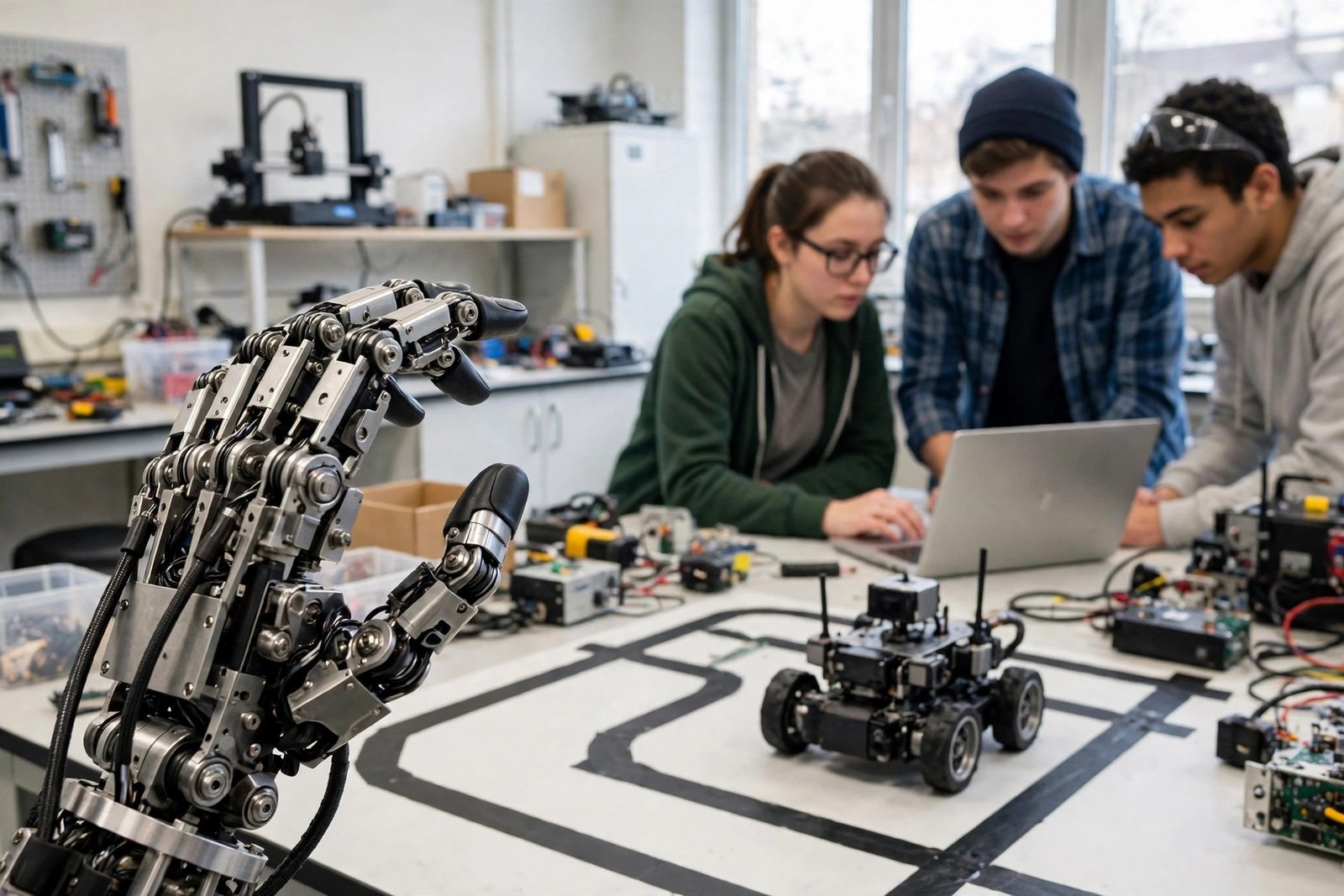
Top universities and countries for robotics engineering
The United States has the largest robotics research ecosystem, with strong programmes in manipulation, perception, field robotics and medical robotics, close links to technology companies, and extensive laboratory facilities. American programmes suit students who want research experience, a thesis, or a specialism tied to a particular laboratory. The United Kingdom offers intensive one-year MSc programmes, many with strong industry links in manufacturing, healthcare and autonomous systems, and a fast route to work; the shorter degree is intensive, so expect a heavy workload from the first week.
Germany is exceptionally strong in industrial robotics and automation, reflecting its manufacturing and automotive sectors, and offers low-cost English-taught programmes plus an 18-month post-study job-seeker residence permit. Learning German greatly improves employment prospects with German firms. Canada combines robotics research in manufacturing, medical and field robotics with comparatively welcoming post-study work routes and a growing automation sector. Australia is strong in field robotics, mining automation, agricultural robotics and marine robotics, reflecting its industries and geography, with close links to research organisations working on robots for remote and harsh environments.
When you compare programmes, the decisive questions are practical: what robots will you actually build and test, what laboratories and equipment exist, which staff work in your specialism, whether the programme includes an industry project or placement, and where graduates work. A programme with a small cohort, good laboratory access and a capstone that produces a working system will usually serve you better than a large lecture-based programme at a famous university. The universities directory and the Courses and Programs directory are good starting points, and the university comparison tool helps weigh fees, duration and specialisms. Students comparing foundations can look at the MSc Computer Science profile and the Bachelor of Engineering profile, and the rankings section gives landscape context without replacing programme-level judgement.
If you already know which sector you want to enter, choose the country and university with the strongest industry links in that sector, because robotics hiring is heavily driven by demonstrations, internships and referrals from laboratories that employers know. A placement or thesis with a robotics company, even a small one, often matters more for your first job than the university’s overall reputation.
Careers and salaries
Graduates work as robotics engineers, automation engineers, controls engineers, perception and computer vision engineers, mechatronics engineers, embedded systems engineers and research engineers. Early-career work usually involves developing, testing and integrating subsystems under a senior engineer: a gripper, a perception module, a controller, or a test rig. With experience, engineers take responsibility for whole robotic systems, lead multidisciplinary teams, and move into product management, technical leadership or research roles. The field rewards breadth with depth: the most valuable engineers are those who understand one layer deeply and can work competently across the others.
Demand is driven by automation in manufacturing and logistics, by medical robotics, by agricultural and field robotics, and by autonomous vehicles and drones, and it is less tied to a single industry cycle than some engineering sectors because the same skills transfer across sectors. The United States Bureau of Labor Statistics projects employment of mechanical engineers, the closest official occupation to robotics engineering, to grow 9 percent from 2024 to 2034, much faster than the average for all occupations, with about 19,700 openings per year on average over the decade. That projection covers all mechanical engineering, not robotics alone, and it should be read as a broad demand signal for the engineering platform that robotics builds on, not as a robotics-specific forecast.
Pay follows the same honest caveat. The Bureau of Labor Statistics reported a median annual wage of $102,320 for mechanical engineers in May 2024. No separate robotics-engineer median is published by BLS, so this guide does not quote one, and any website that gives a precise “robotics engineer average salary” with no source, sample or year should be treated with scepticism. In practice, robotics pay varies widely by sector and by skill mix: roles that combine mechanical design with controls and software, or perception with machine learning, tend to command more than single-skill roles, and roles in medical robotics, autonomous vehicles and defence-adjacent work often pay differently from roles in general manufacturing automation. Location matters too, because robotics clusters in particular cities and regions pay differently from the national average.
| Measure (USA, closest official benchmark) | Official figure | Source and year |
|---|---|---|
| Mechanical engineers, median annual wage | $102,320 | BLS Occupational Outlook Handbook, May 2024 |
| Mechanical engineers, employment growth 2024–34 | 9 percent, much faster than average | BLS Occupational Outlook Handbook, 2024–34 projection |
| Mechanical engineers, openings per year on average | About 19,700 | BLS Occupational Outlook Handbook, 2024–34 projection |
| Robotics engineers, separate BLS occupation | None published; roles sit across mechanical, electrical, computer hardware and “engineers, all other” categories | BLS Occupational Outlook Handbook occupation list |
Two decisions matter more than any salary headline. The first is whether to build depth in hardware, software or integration, and to be honest about which you enjoy, because a career spent mostly on the layer you like least will not last. The second is to keep a living portfolio: code, design files, test results and short videos of systems you have built, updated through your master’s and your early career. Robotics hiring managers routinely ask candidates to explain a system they built, what went wrong, and how they fixed it, and a portfolio lets you answer with evidence rather than claims. The career path explorer can help map this degree into automation, automotive, medical and research roles, and the guides section covers post-study work routes, including the UK Graduate Route, currently two years, with an announced reduction to 18 months for applications on or after 1 January 2027.
Scholarships for robotics engineering
Funding comes from universities, governments, research organisations and industry. University merit scholarships are the most accessible source for international master’s students and are usually awarded on academic achievement and the strength of the statement and portfolio; apply at the same time as admission. Government scholarships, such as Chevening in the United Kingdom and Fulbright in the United States, are larger and more competitive, typically cover tuition and living costs, and usually have deadlines a year before the start date.
Research funding is a distinctive route in robotics: professors with funded projects in manipulation, perception, medical or field robotics sometimes support master’s students as research assistants, and a well-targeted email to a research group, referencing their recent work and your relevant project experience, can open a funded place that a general application would miss. Industry awards and sponsorships also exist, particularly in automotive, manufacturing and medical robotics, and they may come with an internship or project placement. Check the conditions of every award, including any return-home requirement, payment timing and whether it can be combined with other funding.
Use the scholarships directory and the scholarship finder to build a shortlist, and keep a separate calendar for scholarship deadlines, which are usually earlier than admission deadlines.
Frequently asked questions
Do I need to be good at both hardware and software?
You need competence in both and depth in at least one. Most robotics roles lean towards one side, but every robotics engineer must understand enough of the other side to integrate a system and to communicate with colleagues who specialise in it.
Is robotics engineering the same as mechatronics?
They overlap heavily. Mechatronics traditionally emphasises the integration of mechanics, electronics and control in products, while robotics emphasises autonomous and semi-autonomous systems, perception and planning. In practice, many programmes use the titles interchangeably, so read the module list rather than relying on the title.
Which bachelor’s degree is best preparation?
Mechanical, electrical, electronics, computer or mechatronics engineering, or computer science with strong mathematics and programming, are all good preparation, provided you add the missing side: programmers should gain mechanics and electronics experience, and mechanical engineers should gain serious programming experience before or during the master’s.
How long does the degree take?
Typically one year full-time in the United Kingdom, two years in Germany, and one and a half to two years in the United States, Canada and Australia, depending on thesis, project or coursework routes and on full-time or part-time study.
Do I need a portfolio to apply?
It is not always formally required, but it is strongly advantageous. A robot, a control or perception project with code, a competition entry or an internship project, documented with results and video, distinguishes an application far more than grades alone.
Is a PhD necessary for a robotics career?
No, for most industry roles a master’s plus a strong portfolio is sufficient. A PhD is valuable for research roles, for perception and machine-learning research, and for academic careers, but it is not a requirement for building robots in industry.
Can I work while studying?
Most student visas allow limited part-time work during term and more during vacations, but hours and conditions are set by immigration rules and differ by country. Do not rely on part-time earnings to fund tuition without checking the current visa conditions.
What if my programming is weak?
Strengthen it before you start, through courses and a small project that involves a microcontroller or a simulated robot. Robotics master’s programmes assume you can program, and students who arrive without that skill struggle in the first semester regardless of their other strengths.
Sources and verification
Salary and employment figures in this article are from the U.S. Bureau of Labor Statistics, Occupational Outlook Handbook, Mechanical Engineers profile (median $102,320 in May 2024; 2024–34 growth of 9 percent with about 19,700 openings per year). BLS does not publish a separate robotics engineer occupation, so no robotics-specific salary is quoted here; robotics roles sit across mechanical, electrical, computer hardware and “engineers, all other” categories. Visa maintenance and financial-capacity figures are the current published baselines cited in this guide: UK Student visa maintenance £1,529 per month in London and £1,171 elsewhere, rising to £1,570 and £1,203 for applications on or after 30 November 2026; Canada proof of funds CAD 22,895, rising to CAD 23,448; Australia living-cost capacity AUD 29,710 per year; Germany blocked account €11,904 for 2026. The UK Graduate Route is described as currently two years, with an announced reduction to 18 months for applications on or after 1 January 2027. Tuition ranges are indicative planning ranges and must be confirmed on the official programme page. Figures change yearly — confirm fees and requirements on the official university page before applying.
External sources: BLS Occupational Outlook Handbook: Field of degree, Engineering; BLS Occupational Outlook Handbook site map; BLS Occupational Outlook Handbook: Environmental Engineers (for comparison within the architecture and engineering group).
StudyGraduate is an information portal, not an agency. It never promises admission, jobs, salaries or visa or permanent residence outcomes. Use this guide to shortlist programmes, then verify every fee, deadline and requirement with the university and the relevant immigration authority.