
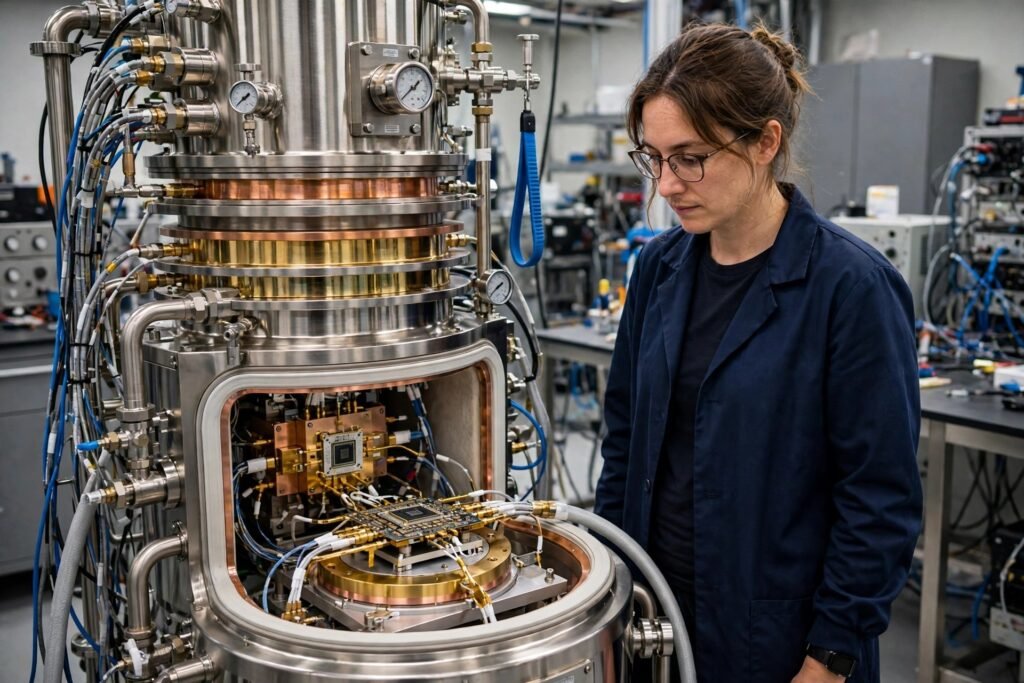
MS in Quantum Computing Abroad: Eligibility, Fees, Top Universities and Careers
An MS in Quantum Computing is a master’s degree for students who want to work with a fundamentally different kind of computation. Classical computers store information as bits that are either zero or one. Quantum computers store information as qubits, which can exist in superpositions of states and can be entangled with one another, so that certain problems can in principle be solved in ways that classical machines cannot match. That sentence is easy to write and hard to understand deeply, which is exactly why the degree exists. It teaches the mathematics, physics and computer science behind quantum algorithms, quantum hardware, quantum error correction and quantum software, and it gives you hands-on experience with real quantum systems through simulators and cloud-accessible devices.
Quantum computing is not a mature consumer technology, and an honest guide should say so at the start. Today’s quantum computers are noisy, limited in size, and useful only for specific problems and research tasks. The field is nevertheless attracting serious investment from governments, universities and large technology companies, because the long-term prize is large: new methods for optimisation, simulation of molecules and materials, cryptography and machine learning. A master’s degree in this field is therefore a research-facing, technical qualification. It suits students who enjoy abstract mathematics and physics, who are comfortable with uncertainty, and who want to enter research, advanced engineering or a PhD, rather than students looking for a quick route into a standard software job.
This guide explains who the degree suits, what you will study, what universities ask for, what it costs, where to study it, what careers follow, and how to fund it. It is written for 2026 and 2027 intakes. Fees, deadlines and visa rules change every year, so confirm every figure on the official university page before you apply. StudyGraduate is an information portal, not an agency, and nothing here guarantees admission, a job or a visa.

At a Glance: MS in Quantum Computing
| Feature | Typical position |
|---|---|
| Degree level | Master’s degree, usually MSc, MS or MEng; some programmes sit in physics, others in computer science or engineering |
| Typical duration | 1 year in the UK; 1.5 to 2 years in the USA, Canada, Australia and much of Europe |
| Background expected | Physics, computer science, mathematics, electrical engineering, or a related field with strong linear algebra |
| Core subjects | Quantum mechanics, quantum algorithms, quantum information theory, error correction, quantum hardware, quantum programming |
| Key skills on graduation | Linear algebra and complex numbers, quantum circuit design, Python and quantum software frameworks, experimental methods |
| Thesis or project | Usually a substantial research project, often linked to a research group or a company laboratory |
| Common destinations | Quantum research, quantum software, photonics and hardware engineering, cryptography, PhD study |
The department that hosts the programme shapes its character. A physics-hosted programme will go deeper into quantum mechanics, optics and experimental methods. A computer-science-hosted programme will go deeper into algorithms, complexity theory and software. An engineering-hosted programme will go deeper into devices, control electronics and systems integration. All three are legitimate, but they lead to different daily work and different PhD options. Read the module list and the host department before you decide, and check where recent graduates went next.
What You Study in an MS in Quantum Computing
The foundation is linear algebra, taught at a level that goes beyond a standard undergraduate course. Quantum states are vectors in a complex vector space, operations on them are unitary matrices, and measurement is described by projection. If you are comfortable with eigenvalues, eigenvectors, tensor products and Dirac notation, the first semester will feel challenging but navigable. If those ideas are new, you will need to work hard in the opening weeks, because almost every later topic builds on them. A short preparatory course in linear algebra and complex numbers before you start is one of the highest-value steps an applicant can take.
Quantum mechanics follows, focused on what a computing student needs rather than a full physics degree. You will study superposition, entanglement, measurement, the uncertainty principle in its operational form, and the postulates of quantum mechanics as they apply to information processing. You will learn why entanglement is a resource, why measurement disturbs a quantum state, and why quantum computers cannot simply copy data the way classical computers do. These are not philosophical asides; they determine which algorithms are possible and which are not.
Quantum algorithms are the centre of the computer science side. You will study the famous early algorithms that showed quantum advantage in principle, including search and factoring algorithms, and then move to nearer-term algorithms for optimisation, simulation and machine learning, such as variational methods that run partly on quantum hardware and partly on classical computers. Complexity theory matters here: you will learn which problem classes quantum computers are believed to help with, and which claims of advantage are hype. That critical judgement is one of the most valuable outcomes of the degree, because the field is full of exaggerated claims.
Quantum error correction and fault tolerance are where the degree becomes sober and practical. Real qubits are fragile. They lose coherence, they interact with their environment, and every operation introduces error. You will study how information can be encoded redundantly across many physical qubits to protect a smaller number of logical qubits, and why fault-tolerant quantum computing will require far more physical qubits than today’s devices offer. Students who understand error correction understand why timelines for useful quantum computers are measured in years and why hardware progress is as important as algorithm design.
Hardware is the other half of the field, and programmes differ in how much of it they teach. You will typically survey the main approaches: superconducting circuits, trapped ions, photonics, neutral atoms and silicon spin qubits. Each has different strengths in coherence time, connectivity, operating temperature and scalability. Some programmes add laboratory work in optics, cryogenics or electronics, while others keep hardware at survey level and focus on software. If you want a hardware career, laboratory experience and electronics skills matter enormously, so prefer programmes that offer them.
Quantum programming is the practical skill that ties the degree together. You will write circuits in Python-based frameworks, run them on simulators, and submit jobs to real devices through cloud services where available. You will learn to optimise circuits for limited connectivity and noisy hardware, to interpret results statistically, and to benchmark honestly against classical methods. A portfolio for this field looks different from a graphics portfolio: it is a set of well-documented notebooks, repositories and a thesis or project report that shows you can design an experiment, run it, analyse the results and state the limitations clearly. Employers and PhD supervisors value that honesty.
Eligibility and Entry Requirements
Most programmes ask for a bachelor’s degree in physics, computer science, mathematics, electrical engineering or a closely related subject, with a good grade average. The acceptable background is broader than for many specialised degrees, because the field itself draws from several disciplines, but the mathematics requirement is non-negotiable. Applicants from computer science should show physics or quantum mechanics preparation, whether through modules, online courses with certificates, or self-study backed by projects. Applicants from physics should show programming ability, ideally in Python, with evidence of substantial code. Applicants from engineering should show both.
Grade thresholds follow the usual country patterns. In the United Kingdom, a 2:1 or equivalent is typical, with some programmes accepting a 2:2 alongside strong evidence of relevant preparation. In the United States, a grade point average around 3.0 on a 4.0 scale is a common baseline, with competitive programmes expecting more. In Canada, Australia and Germany, universities apply their own conversions, so check the official conversion for your degree. Research experience, even a short undergraduate project in quantum information, optics or algorithms, strengthens an application considerably, because most programmes are research-facing and supervisors look for students who can work independently.
Your statement of purpose should be precise. State which part of quantum computing interests you, whether algorithms, error correction, hardware, photonics, cryptography or quantum software, and connect it to what you have already studied or built. A statement that could apply to any computing degree will not help you here. Mention specific modules, research groups or faculty whose work interests you, and explain why that programme, not just that country, fits your plan. Recommendation letters should come from academics who have seen your mathematical or experimental work and can comment on specific projects, not from general character references.
English language requirements follow the standard pattern for English-taught programmes, with IELTS, TOEFL or equivalents and thresholds set by each university. Some United States programmes ask for the GRE, but many computer science and physics programmes have moved away from requiring it, so check each programme rather than assuming. If your degree was taught in English, check whether a waiver applies and get it confirmed in writing. Apply early, because quantum programmes are often small, with limited places, and scholarship deadlines fall well before programme deadlines.

Tuition Fees and Living Costs
Tuition fees for quantum computing master’s degrees vary widely, and the programme’s host department and country matter more than any average. Public universities in Germany commonly charge no tuition for many programmes, with a semester contribution instead, while private and public universities in the United States charge per year at levels that differ sharply by institution. International fees in the United Kingdom, Canada and Australia sit between those extremes but still vary widely within each country. Build your shortlist first, then record the official 2026 or 2027 fee for each programme from the university’s own page, and note whether the fee covers the whole programme or one year.
Living costs and visa financial requirements are separate from tuition. The table below uses financial-proof figures from our verified guides, which give you a comparable floor across countries. Real costs in London, Zurich, Boston or Sydney will exceed the floor, and rent is usually the largest item. Model your own total with the tuition fee calculator and the cost of living calculator, and remember that a two-year programme doubles the living-cost exposure of a one-year programme even if tuition per year looks similar.
| Country | Financial proof or maintenance figure to note (2026) | What it means for your budget |
|---|---|---|
| United Kingdom | GBP 1,529 per month in London; GBP 1,171 per month outside London for a Student visa | Maintenance floor only; real London costs are higher |
| Germany | EUR 11,904 blocked account for one year | Low-cost route at public universities, but funds must be locked in advance |
| Australia | AUD 29,710 living costs figure for a student visa | A floor for the visa; Sydney and Melbourne rents run higher |
| Canada | CAD 22,895 rising to CAD 23,448 for a study permit financial requirement | Check which figure applies to your application date; tuition is additional |
| United States | Varies by university; the I-20 form states the total you must show | Read the I-20 figure; it bundles tuition, living costs and insurance |
Funding deserves special attention in this field because research assistantships are common and valuable. In the United States and Canada, a research assistantship in a quantum group can cover tuition and pay a stipend, and it also gives you the research experience that PhD programmes look for. In Europe, some programmes are linked to national quantum initiatives or research institutes that offer funded positions. University merit scholarships, government scholarships and industry-linked awards are also worth pursuing, but read their conditions: some require a return to your home country, some restrict the programmes you can choose, and some cannot be combined with an assistantship. Start the funding search alongside the programme search.
Top Universities and Countries for Quantum Computing
The United States has the largest quantum ecosystem, with university groups, national laboratories and company laboratories concentrated in California, Massachusetts, New York, Maryland and Illinois, among others. Programmes there often offer access to real hardware, industry internships and research groups working at scale. The trade-off is cost and competition for funded places. When you compare United States programmes, look at the research groups, the hardware access, the thesis options and the record of graduates moving into PhD programmes or quantum companies, rather than the general reputation of the university alone.
Canada has a strong and distinctive quantum presence, with research institutes and university groups in Ontario and Quebec and a supportive post-study work system. Germany and the wider European Union offer low-cost public education, strong physics and engineering traditions, and national quantum programmes that fund research and training. The Netherlands, Switzerland, France and the United Kingdom also host notable quantum groups. In the United Kingdom, one-year master’s degrees offer a fast route into the field, and the Graduate Route currently allows a period of work after study, although an announced change would shorten that route to 18 months from 1 January 2027, so check the rules that will apply when you graduate.
Australia has growing quantum research, particularly in Sydney, and offers English-taught programmes with strong physics departments. When you compare countries, weigh three things: the research group, the hardware and laboratory access, and the post-study options. A programme in a country with a large quantum industry but no group in your subfield is a weaker choice than a programme in a smaller ecosystem with a group that matches your interests exactly. Browse the directory at universities, compare options with the university comparison tool, and keep ranking providers separate on rankings, since QS and THE use different methods and a university’s position can differ between them.
For neighbouring degrees, the MSc Computer Science profile is a useful comparison, and the Courses and Programs directory places quantum computing alongside related computing and physics degrees. If you are unsure whether you want the physics or the computer science version of the field, comparing module lists across two or three programmes will usually settle the question faster than any general advice.
Careers and Salaries After an MS in Quantum Computing
Career paths in quantum computing are narrower and more research-facing than in general software engineering, and applicants should understand that before committing. The most direct routes are quantum software engineering, quantum algorithm research, quantum error correction research, photonics and hardware engineering, control electronics, and cryptography, including post-quantum cryptography, which prepares classical systems for a future in which quantum computers could break current encryption. Many graduates continue to a PhD, because the deepest research roles still expect doctoral training. A master’s degree is a strong preparation for a PhD and a credible entry point for industry research teams, but it is not a guarantee of either.
Because there is no official occupational category called quantum computing engineer in the United States Bureau of Labor Statistics data, this article does not invent a salary for that title. Instead, the table below gives medians for the closest official occupations, so you can see the pay context for the research and software roles that quantum graduates actually enter. Every figure is labelled with its source and year, and none of them should be read as a promised salary for a quantum graduate, whose pay will depend on role, employer, country and whether the job is in research, hardware or software.
| Closest official occupation (USA) | Median annual pay | Source and year |
|---|---|---|
| Computer and information research scientists | $140,300 per year | BLS Occupational Outlook Handbook, May 2025 median |
| Software developers, quality assurance analysts and testers | $134,040 per year | BLS Occupational Outlook Handbook, 2025 median |
| Physicists and astronomers (combined category) | $166,880 per year; physicists alone $172,250 in May 2025 | BLS Occupational Outlook Handbook, May 2025 median |
Growth projections for the broader research occupation are strong: the Bureau of Labor Statistics projects employment of computer and information research scientists to grow 22 percent from 2025 to 2035, much faster than the average for all occupations, with about 2,900 openings per year on average over the decade, mostly from replacement as well as growth. Physicists and astronomers are projected to grow 7 percent over the same period. Those projections describe broad occupations, not quantum computing alone, and quantum-specific hiring remains a small subset of both. Treat them as context for the value of research and software skills, not as a forecast for quantum jobs specifically.
A realistic career plan has stages. During the master’s degree, produce a thesis or project that you can explain clearly, contribute to an open-source quantum framework if you can, and present your work at a student workshop or conference where possible. In the first years after graduation, aim for a research assistant, quantum software engineer or hardware engineer role in a group whose work you understand, rather than chasing a job title. If you want a research career, plan for a PhD application during or soon after the master’s degree, and choose a master’s programme whose supervisors can write informed references and whose research fits the PhD groups you will apply to. If you want an industry career, build software and experimental skills that transfer to adjacent fields, such as photonics, control systems, high-performance computing or cryptography, so that your options stay open if quantum hiring slows.
Explore roles with the career path explorer, and be wary of marketing that promises immediate high salaries in quantum computing. The field rewards depth, patience and honest benchmarking. A graduate who can say what a quantum device did, what it did not do, and why, is more valuable to a serious employer than a graduate who repeats slogans about quantum advantage.
Scholarships for Quantum Computing Students
Funding in quantum computing often comes through research groups rather than through generic scholarships, so the application strategy differs from other fields. First, check each programme for departmental scholarships and for research assistantships, and contact potential supervisors early with a short, specific message about their work and your preparation. Second, check national quantum initiatives and government scholarships in your destination and home countries, including DAAD, Commonwealth, Chevening and Fulbright-style schemes where eligible. Third, check industry-linked awards from companies with quantum programmes, and read their conditions carefully.
Use the scholarship finder and browse scholarships for the wider list. A strong scholarship application in this field looks like a strong research application: a clear statement of interest, evidence of mathematical and programming preparation, and a project idea that is specific and feasible. Keep a spreadsheet of deadlines, because research funding and scholarship deadlines often fall months before programme deadlines, and a missed funding deadline can change the whole affordability of a programme.
How to Choose and Apply: A Practical Plan
Start twelve to eighteen months before your intended start date. In the first months, strengthen linear algebra and Python, work through an introductory quantum computing course with programming exercises, and shortlist eight to twelve programmes across at least two countries. In the middle months, sit any required language tests, request references from academics who know your technical work, and draft a statement of purpose tailored to each programme’s host department. In the final months, submit applications in order of scholarship and funding deadlines, and prepare financial documents early.
When offers arrive, compare them on the same basis: total cost for the whole degree, the research group and supervisor options, hardware and laboratory access, thesis options, and graduate destinations. Ask current students what the workload is like, how much programming versus theory the programme involves, and whether graduates moved into PhD programmes or industry roles. A programme with a smaller name but a group in exactly your subfield, with funded research and hardware access, can be a better choice than a famous university where you would be one of many students with no supervisor match.
Frequently Asked Questions
Do I need a physics degree to study quantum computing?
No, but you need physics preparation. Computer science, mathematics and engineering graduates are admitted to many programmes if they show quantum mechanics and linear algebra preparation through modules, certified courses or projects. Physics graduates, conversely, need to show programming ability. The strongest applications show both sides.
Is quantum computing a good choice if I want a standard software job?
Not as a direct route. A general computer science master’s degree is a better choice for standard software engineering. Quantum computing suits students who want research, quantum software, hardware or a PhD, and who accept a narrower, more uncertain job market in exchange for depth in a frontier field.
Will quantum computers replace classical computers?
No, not in any realistic planning horizon. Quantum computers are expected to complement classical computers for specific problems, such as certain simulations and optimisation tasks, while classical computers remain the general-purpose platform. Programmes teach this distinction carefully, and you should be sceptical of any source that claims otherwise.
Do I need a PhD to work in quantum computing?
Not for every role. Quantum software engineering, photonics engineering, control electronics and post-quantum cryptography roles are open to master’s graduates with the right skills. Research scientist roles in universities and many company laboratories still usually expect a PhD, so plan your master’s degree with that distinction in mind.
Which quantum hardware approach should I specialise in?
Do not specialise too early. Learn the principles that apply across superconducting, trapped-ion, photonic and neutral-atom systems, then specialise through your thesis and laboratory work in the approach your programme and supervisor work on. The field is still evolving, and transferable understanding matters more than loyalty to one platform.
Is mathematics really that important, or can I rely on software frameworks?
Mathematics is essential. Frameworks let you build and run circuits, but they do not tell you whether an algorithm is correct, whether an error-correction scheme will work, or whether a claimed advantage is real. The graduates who progress are the ones who can read the mathematics behind the framework and debug at that level.
Can I study quantum computing in Germany or Europe at low cost?
Yes, many public universities in Germany charge no tuition for many programmes, with a semester contribution instead, and other European countries offer English-taught programmes with strong physics groups. Check the language of each module, the funding available, and the research groups, because low tuition alone does not make a programme the right fit.
What should I do before starting to prepare?
Revise linear algebra and complex numbers, learn Python, and complete an introductory quantum computing course with programming exercises. Read one accessible textbook chapter on quantum algorithms and one on error correction, and try running a small circuit on a simulator and on a cloud device. That preparation will make the first semester far more productive.
Sources & Verification
Salary and employment figures come from the United States Bureau of Labor Statistics, Occupational Outlook Handbook: Computer and Information Research Scientists, Software Developers, and Physicists and Astronomers, all cited with their May 2025 medians and, for research scientists, the projected 22 percent growth from 2025 to 2035. No official salary figure exists for a standalone quantum computing engineer occupation, so none is invented here; the table gives the closest official occupations instead. Visa maintenance and financial-proof figures follow the verified figures used across StudyGraduate guides for the United Kingdom, Germany, Australia and Canada. University fees, grade conversions, language thresholds and module lists must be confirmed on the official university page for the intake you are applying to. Figures change yearly — confirm fees and requirements on the official university page.
StudyGraduate is an information portal, not an agency. This article does not promise admission, jobs, salaries or visa or permanent residence outcomes. Verify every requirement, fee and deadline with the university and the relevant government authority before you apply or pay any fee.