

MS in Nuclear Engineering Abroad: Eligibility, Fees, Top Universities and Careers
Nuclear engineering is a small, exacting and unusually consequential field. Nuclear engineers research, design and operate the systems that release, control and use nuclear energy, and they manage the waste those systems produce. Their work spans power reactors, research reactors, medical and industrial isotopes, radiation protection, nuclear materials, and the decommissioning of plants that have reached the end of their operating lives. An MS in Nuclear Engineering abroad is therefore not a generic engineering master’s: it is a specialist qualification for students who want to work in one of the most regulated, safety-critical industries in the world, and it is judged by employers on the strength of the department, its facilities and its safety culture as much as on the degree title.
This guide explains what the degree covers, who should apply, what universities abroad require, what it costs, where the strongest programmes are, what graduates earn according to official statistics, and how to fund your studies. It is written for international students planning 2026 or 2027 entry. Salary figures are taken from official statistics and labelled with source and year, and visa finance figures are labelled the same way. Fees and entry rules change every year, so confirm every detail on the official university page before you apply.
What is an MS in Nuclear Engineering?
Nuclear engineering applies nuclear physics, thermodynamics, materials science and systems engineering to practical problems: how to sustain a controlled chain reaction, how to remove heat safely, how to shield people and equipment from radiation, how to choose materials that survive decades of neutron bombardment, and how to store or dispose of radioactive waste for timescales far beyond a human career. At bachelor’s level, students typically study general engineering with some nuclear content. At master’s level, the nuclear content becomes the degree: reactor physics, thermal hydraulics, radiation transport, nuclear materials, fuel cycle and waste management, safety analysis and nuclear regulation.
Programmes go by several names — MS or MSc in Nuclear Engineering, Master of Nuclear Engineering, Nuclear Science and Engineering, and sometimes Nuclear Technology or Nuclear Energy within a broader energy department. The title matters less than the content and the facilities. A serious programme should offer reactor physics and thermal hydraulics as core modules, access to radiation laboratories or a research reactor where available, and teaching in safety analysis and regulation. Some universities run their own research reactors, and students at those institutions can carry out experiments that students elsewhere can only simulate. If your ambition is reactor operations or reactor design, that access is a real advantage; if your ambition is policy, regulation or medical applications, a programme with strong links to regulators, hospitals or national laboratories may matter more.
Typical durations mirror other engineering master’s degrees: one year in the United Kingdom, one to two years in Canada and Australia, and around two years in the United States, where thesis-based MS programmes are common. Some programmes offer a professional, coursework-based track aimed at industry and a research track aimed at a PhD. A few are delivered jointly with national laboratories or industry partners, with placements at power stations, research centres or regulatory bodies built into the degree. Those partnerships are worth seeking out, because nuclear employers recruit from a small pool and they notice where a graduate trained.
Who is this degree for? It suits graduates in mechanical, chemical, electrical, materials or nuclear engineering, and physics graduates with strong mathematics, who want a career in nuclear power, research, medicine or regulation. It also suits working engineers in the power, defence or medical sectors who want to move into nuclear work. It demands comfort with mathematics and physics, patience with regulation and documentation, and a genuine respect for safety culture. Students who want fast-moving, lightly regulated work will be happier elsewhere; nuclear engineering rewards precision, patience and accountability, and its best practitioners take pride in exactly that.
At a glance
| Feature | Typical position |
|---|---|
| Degree level | Postgraduate master’s (MS, MSc, MEng or equivalent) |
| Typical duration | 1 year (UK) to 2 years (USA, Canada, Australia) |
| Entry qualification | Bachelor’s in nuclear, mechanical, chemical, electrical, materials engineering or physics |
| Core subjects | Reactor physics, thermal hydraulics, radiation transport and shielding, nuclear materials, fuel cycle, safety analysis, regulation |
| Key facilities | Radiation laboratories, research reactors where available, thermal-hydraulics rigs, simulation and modelling suites |
| Typical capstone | Research thesis or industry project, sometimes with a national laboratory or utility partner |
| Main employers | Utilities and plant operators, reactor vendors, national laboratories, regulators, medical isotope producers, decommissioning firms, consultancies |
What you study: curriculum and specialisations
The core curriculum of an MS in Nuclear Engineering is built around five blocks. Reactor physics covers neutron transport, criticality, reactor kinetics and core design. Thermal hydraulics covers heat transfer, fluid flow, boiling and accident transients — the physics that determines whether a reactor can be cooled under every credible condition. Radiation protection and shielding covers interaction of radiation with matter, dose, shielding design and the regulatory limits that govern exposure. Nuclear materials covers how steels, zirconium alloys, graphite and fuels behave under irradiation, temperature and corrosion. The fuel cycle and waste block covers enrichment, fuel fabrication, reprocessing, storage and geological disposal. Around these blocks sit safety analysis, probabilistic risk assessment, nuclear regulation and non-proliferation, which together form the professional spine of the degree.
Specialisations usually emerge in the second half of the programme. Reactor design and analysis suits students aiming at vendors and utilities. Nuclear materials and fuel suits students drawn to laboratories and research. Radiation protection and medical physics suits students interested in hospitals, isotope production and regulatory work, although dedicated medical physics programmes exist separately and may be the better route for a purely clinical career. Decommissioning and waste management is a growing specialisation as early generations of reactors retire, and it combines engineering, environmental science and project management. Fusion is offered at a small number of institutions and suits students aiming at research, with the honest caveat that fusion power remains a research endeavour rather than a commercial industry. Small modular reactors are a newer focus at several schools, reflecting vendor and government interest in factory-built, smaller-scale plants.
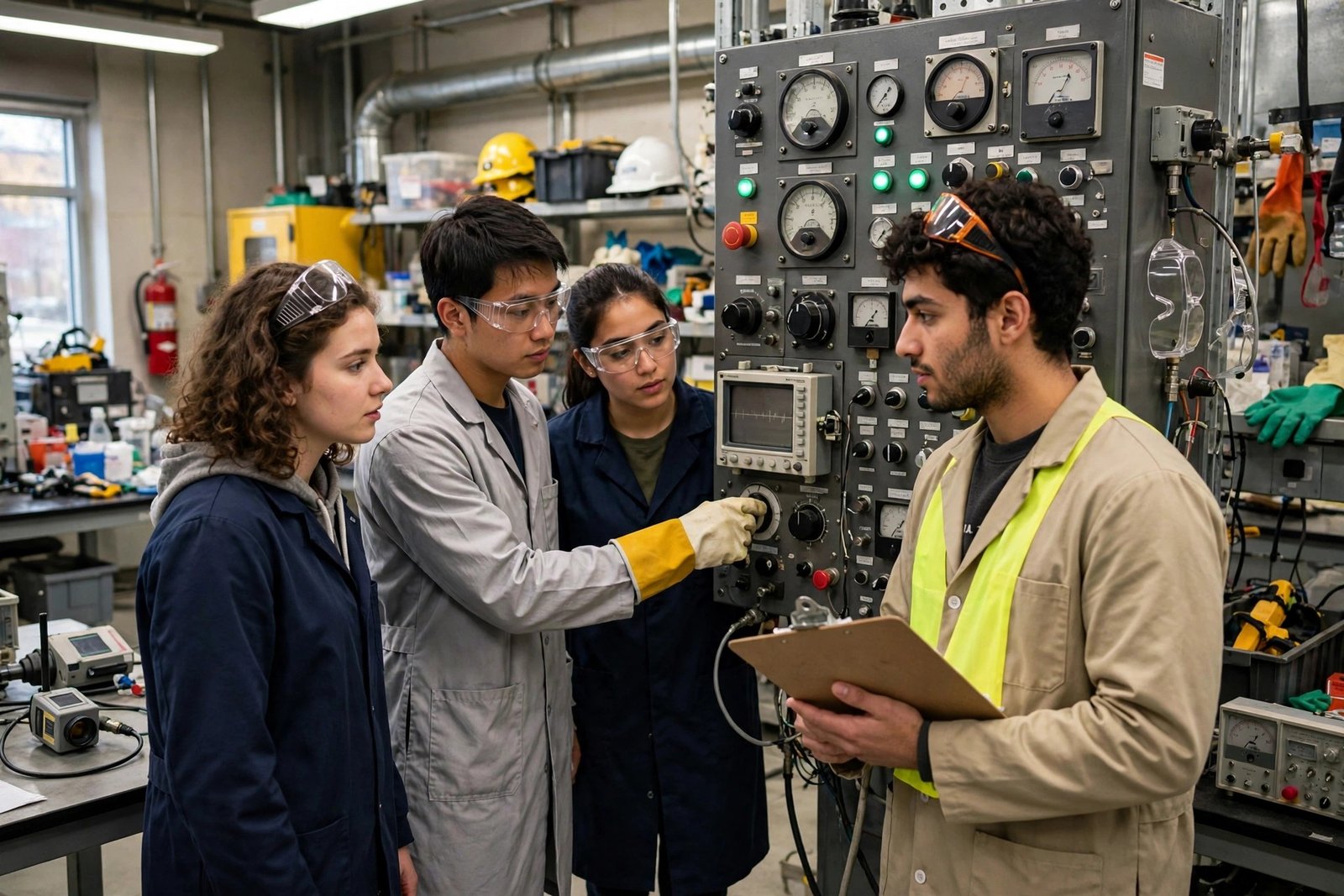
Practical training is central and distinctive. Expect laboratory exercises in radiation detection and measurement, computational laboratories in reactor simulation codes, and, where the university operates a research reactor, hands-on reactor operation training under strict supervision. Safety training is not an administrative hurdle in this field; it is part of the curriculum, and employers will ask about it. When you compare programmes, ask which simulation codes students learn, whether students operate or visit a research reactor, and whether the department collaborates with a national laboratory or a utility. The answers reveal how close the programme sits to real practice.
Research students should examine faculty specialisations before applying. Nuclear engineering departments are small, and a department’s strength in one area — say, thermal hydraulics or materials — may be far greater than in another. If you intend to continue to a PhD, apply to departments where at least two faculty members work in your area, and use your master’s thesis to build a relationship with a future doctoral supervisor. If you intend to enter industry, prioritise programmes with utility, vendor or regulator placements and a strong record of graduate employment in operating plants.
Eligibility and entry requirements
Admission to nuclear engineering master’s programmes is competitive precisely because cohorts are small and facilities are limited. The table below summarises the usual requirements; individual programmes vary, and some require a security or background check for access to certain facilities, which international students should ask about early.
| Destination | Academic requirement | English requirement (typical) | Notes |
|---|---|---|---|
| United States | Four-year bachelor’s in engineering or physics; GPA typically 3.0/4.0 or above; GRE required by some programmes | TOEFL or IELTS as set by the university | ABET-accredited undergraduate programmes are the norm; research assistantships common for thesis students |
| United Kingdom | Upper second-class honours (2:1) or equivalent in engineering or physics | IELTS typically 6.5 overall, with no band below 6.0 | One-year programmes; some include a placement or industry project |
| Canada | Four-year bachelor’s with a strong average; research programmes usually require a supervisor’s agreement before admission | IELTS or TOEFL as set by the university | Strong links to national laboratories and the CANDU reactor programme |
| Australia | Bachelor’s in engineering or physics; some programmes sit within broader energy or materials degrees | IELTS typically 6.5 overall, with no band below 6.0 | No domestic nuclear power industry; strengths in research, mining of uranium, medicine and regulation |
| France and Europe | Bachelor’s in engineering or physics; some programmes are taught in English, others require French or another language | IELTS or TOEFL for English-taught programmes | France has a large nuclear fleet and several dedicated institutes; check language requirements carefully |
Three elements make a nuclear engineering application stand out. The first is mathematical and physical preparation: strong grades in mathematics, thermodynamics, fluid mechanics and modern physics, and any prior coursework in nuclear physics or radiation. The second is relevant experience, even brief: an internship at a utility, laboratory or hospital physics department, a research project in materials or thermal hydraulics, or work in the power industry. The third is a statement of purpose that shows you understand what nuclear work actually involves — regulation, documentation, safety cases and long project timescales — and that you want it for those reasons, not despite them. Admissions tutors in this field are alert to applicants attracted only by the word “nuclear”; a statement that discusses a specific technical interest, a reactor type, a materials problem or a waste challenge will stand out.
International students should also ask, early and politely, about access restrictions. Some nuclear facilities and some research topics are subject to export-control or security rules, and a small number of placements may be limited by nationality or clearance requirements. This is not a reason to avoid the field, but it is a reason to confirm, before you accept an offer, that you will be able to complete the programme’s practical components. Programme coordinators deal with these questions routinely and will answer them plainly.
Tuition and living costs
Tuition for nuclear engineering master’s programmes varies widely by country and institution, and international fees at leading American, British and Canadian universities are substantial. No honest single average exists, so the correct approach is to take the official fee from each programme page, confirm whether it covers one year or the whole programme, and check for additional charges for laboratory access, safety training or field visits. Some programmes charge a supplementary fee for reactor training or for placements at external facilities. In Europe, several public universities charge low or no tuition, which can make a European programme dramatically cheaper overall even after living costs are counted — but check the language of instruction and the visa position before assuming a bargain.
For living costs and visa finance, governments publish the figures you must plan around. The table below collects the most commonly needed official figures for the main English-speaking destinations and Germany.
| Destination | Official living / visa finance figure | Basis |
|---|---|---|
| United Kingdom | GBP 1,529 per month in London; GBP 1,171 per month outside London | Student visa maintenance requirement, current figure |
| Germany | EUR 11,904 per year | Blocked account amount for the student visa (2026 figure) |
| Australia | AUD 29,710 per year | Student visa living-cost requirement (October 2026 figure) |
| Canada | CAD 23,448 (raised from CAD 22,895) | Proof-of-funds requirement for living expenses, updated figure |
Funding is a brighter story than in many fields. Nuclear engineering students can access university scholarships, government scholarships for priority science and engineering subjects, and industry funding from utilities, vendors and national laboratories. In the United States and Canada, thesis-based master’s students are often funded through research assistantships tied to faculty grants, which may cover tuition and pay a stipend; these are competitive and usually arranged after admission, sometimes after a supervisor agrees to take you on. Government and industry scholarships in the nuclear field sometimes include a service or employment expectation, so read the terms carefully. Start the funding search alongside the programme search, because the best awards close months before the intake. The scholarships directory, the scholarship finder tool, the tuition fee calculator and the cost of living calculator will help you build a realistic total budget.
Top universities and countries for nuclear engineering
The strongest countries for nuclear engineering reflect the shape of their nuclear industries. The United States has the world’s largest fleet of operating reactors, several national laboratories and a deep bench of university departments, including programmes whose bachelor’s degrees carry ABET accreditation — Penn State’s nuclear engineering programme, for example, is accredited by the Engineering Accreditation Commission of ABET under the nuclear and radiological programme criteria. The United Kingdom combines operating plants, a major new-build programme and decommissioning work, with compact one-year master’s degrees that suit international students. France operates a large fleet and hosts dedicated nuclear institutes and research centres, and several of its programmes are taught in English. Canada’s distinctive CANDU technology, its national laboratories and its uranium industry give its programmes a particular strength in reactor physics, materials and fuel. South Korea, Japan and China also have major programmes, though language and access questions need checking for international applicants.
When you compare departments, weigh facilities and partnerships above headline reputation. Does the department operate or have access to a research reactor? Does it collaborate with a national laboratory, a utility or a regulator? Do its graduates work in operating plants, and does the department publish employment outcomes? A department with a research reactor, a utility placement scheme and a visible safety culture will serve most students better than a more famous university where nuclear engineering is a small sideline. Also consider the regulatory environment of the country: graduates who train under one regulator’s regime can move, but local licensing and experience requirements mean that your first job is most often in the country where you studied.
Build a shortlist of four to six programmes across at least two countries, and record for each the programme director, the deadline, the fee, the scholarship deadlines and whether a supervisor must be secured before admission. Use the universities directory, the rankings pages and the university comparison tool to organise the comparison, and browse the Courses and Programs directory for related energy and engineering programmes. If you are also considering a broader engineering route, the Bachelor of Engineering programme profile explains how engineering degrees are structured on this site, although your master’s shortlist should be built from departmental pages, not directory summaries.
Careers and salaries
Nuclear engineering careers divide into several streams. Reactor operations and engineering covers plant engineers, reactor engineers, shift technical advisors and operations managers at utilities. Design and vendor work covers reactor designers, thermal-hydraulics analysts and safety analysts at the companies that build plants. Research covers national laboratory scientists, university researchers and specialists in materials, fuel and fusion. Regulation covers inspectors, licensing engineers and safety reviewers at national regulators. Medical and industrial applications cover isotope production, radiotherapy physics support and industrial radiography. Decommissioning and waste covers engineers planning and executing plant retirement and waste disposal. A master’s degree is often the expected entry credential for design, safety analysis and research roles, while operations roles may additionally require plant-specific licensing and experience that comes after graduation.
Official salary data for nuclear engineers is strong, reflecting the small, highly qualified workforce and the safety responsibility of the work. The figures below come from the US Bureau of Labor Statistics and should be read alongside its employment outlook, which is unusually candid: the occupation is not growing, but replacement demand still creates steady openings.
| Occupation / measure | Figure | Source and year |
|---|---|---|
| Nuclear engineers, median annual wage, USA | USD 133,970 | US Bureau of Labor Statistics, Occupational Outlook Handbook, May 2025 |
| Nuclear engineers in scientific research and development, median, USA | USD 146,760 | US Bureau of Labor Statistics, Occupational Outlook Handbook, May 2025 |
| Nuclear engineers in engineering services, median, USA | USD 136,400 | US Bureau of Labor Statistics, Occupational Outlook Handbook, May 2025 |
| Nuclear engineers in nuclear electric power generation, median, USA | USD 134,250 | US Bureau of Labor Statistics, Occupational Outlook Handbook, May 2025 |
| Nuclear engineers in federal government, median, USA | USD 118,440 | US Bureau of Labor Statistics, Occupational Outlook Handbook, May 2025 |
| Employment outlook, USA | 0% change, 2025–35; about 800 openings per year; 16,600 jobs in 2025 | US Bureau of Labor Statistics, Occupational Outlook Handbook, 2025–35 projections |
The honest reading of that outlook matters for your decision. The Bureau of Labor Statistics projects little or no change in nuclear engineering employment from 2025 to 2035, attributing the flat outlook to limited construction of new plants and the increased focus on renewable energy, while noting that existing plants still need engineers to operate and maintain them and that about 800 openings a year arise from replacement needs. That is not a reason to avoid the field — replacement demand in a small, high-paid profession is real, and decommissioning, life extension, small modular reactors and medical applications create work that a simple headcount projection may understate — but it is a reason to enter with a clear specialisation, a placement record and a willingness to work where the plants are. Nuclear engineering rewards the well-prepared and the geographically flexible.
Post-study work routes follow the usual pattern for engineering master’s graduates: the UK Graduate Route (currently two years for master’s graduates, with an announced shortening to 18 months for applications from 1 January 2027 — announced rules and current rules are different things, so check for your intake), Canada’s post-graduation work permit of up to three years for eligible master’s graduates, Australia’s Temporary Graduate visa, and US Optional Practical Training with a possible STEM extension for eligible programmes. Security and licensing requirements in the nuclear industry can add an extra step after graduation, and some roles require citizenship or clearance; ask employers and departments about this before you commit, not after you graduate.
Scholarships for nuclear engineering
Nuclear engineering attracts dedicated funding because governments regard it as a strategic skill. National scholarship schemes in the United Kingdom, Canada, Australia, France and Germany fund international students in priority science and engineering subjects, and nuclear engineering usually qualifies. Utilities and vendors run their own bursaries and graduate schemes, sometimes tied to a placement or a future job offer. National laboratories fund research students through assistantships and fellowships. Professional and industry bodies in nuclear science also offer student awards that are smaller but far less competitive than the headline government schemes.
Apply broadly and early. The largest awards close earliest, and several require a separate application with its own references and essays. If you are applying for a thesis-based programme, contact potential supervisors before the scholarship deadline: a supervisor’s support can be decisive, and a supervisor who knows your name will write a stronger reference. Keep a single tracker of deadlines, documents and reference requests, and use the career path explorer to check that the specialisation you are funding is the one that leads to the career you want.
How to choose and apply: a practical timeline
Begin twelve to eighteen months before entry. First, research departments and facilities, confirm your eligibility, and take your English test if required. Next, shortlist four to six programmes, contact coordinators about access or supervisor requirements, and secure referees. Submit applications six to twelve months before entry, and run scholarship applications in parallel because their deadlines are often earlier. Once you hold an offer, confirm funding, accommodation and visa arrangements, and use the waiting months well: revise reactor physics and thermal hydraulics, learn a simulation tool used by your department, and read the safety literature of the country where you will study. Arriving with that preparation will make your first semester far easier.
When offers arrive, compare them on substance: the module list against your specialisation, access to reactors and laboratories, placement and employment records, total cost, and the visa and post-study position. Speak to current students and recent graduates if you can; they will tell you how the department really handles safety training, supervision and industry links. A programme that matches your specialisation and gives you real facility access is worth more than a famous name with no reactor and no placement record.
Frequently asked questions
Do I need a nuclear engineering bachelor’s to apply?
No. Mechanical, chemical, electrical and materials engineering graduates and physics graduates are commonly admitted, provided their mathematics and physics preparation is strong. Some programmes add bridging modules in reactor physics for students from other backgrounds.
Is nuclear engineering a growing career?
In the United States, the Bureau of Labor Statistics projects 0% employment change for nuclear engineers from 2025 to 2035, with about 800 openings per year from replacement needs. Demand is steadier in decommissioning, life extension, medical applications and small modular reactor development than in large new-build construction, and prospects vary by country.
Can international students access nuclear facilities?
Usually yes for university teaching and research, but some facilities and topics are subject to export-control or security rules, and some placements may have clearance requirements. Ask the programme coordinator before accepting an offer whether you can complete all practical components.
What do nuclear engineers earn?
In the United States, the median annual wage for nuclear engineers was USD 133,970 in May 2025 (US Bureau of Labor Statistics), with industry medians of USD 146,760 in scientific research and development, USD 136,400 in engineering services and USD 134,250 in nuclear electric power generation. Pay varies by country, sector and experience.
Is a thesis or coursework MS better?
A thesis MS suits students aiming for research or a PhD, and it is the usual route to a funded research assistantship. A coursework MS suits students aiming directly for industry roles in design, operations or safety analysis. Choose based on your destination career, not on which sounds more prestigious.
Can I move into nuclear engineering from another engineering field?
Yes, and many nuclear engineers do. Mechanical and chemical engineers are particularly well placed, because thermal hydraulics, materials and process engineering are central to nuclear work. A master’s in nuclear engineering is precisely the conversion route for such a move.
What about fusion?
Fusion is an exciting research field offered at a small number of institutions, but it is not yet a commercial power industry. If fusion is your passion, choose a research-oriented programme with fusion faculty and be prepared for a research career rather than an operations career in the near term.
Sources and verification
- US Bureau of Labor Statistics, Occupational Outlook Handbook: Nuclear Engineers — median annual wage USD 133,970 in May 2025; industry medians USD 146,760 (scientific research and development), USD 136,400 (engineering services), USD 134,250 (nuclear electric power generation), USD 118,440 (federal government); employment projected to show little or no change, 2025–35, with about 800 openings per year and 16,600 jobs in 2025.
- Penn State University, Nuclear Engineering undergraduate accreditation — the baccalaureate programme is accredited by the Engineering Accreditation Commission of ABET under the nuclear and radiological programme criteria.
- UK Home Office student visa maintenance figures: GBP 1,529 per month in London and GBP 1,171 per month outside London.
- German student visa blocked account requirement: EUR 11,904 per year (2026).
- Australian student visa living-cost requirement: AUD 29,710 per year (October 2026).
- Canadian proof-of-funds requirement: CAD 23,448, raised from CAD 22,895.
Figures change yearly — confirm fees and requirements on the official university page before you apply. StudyGraduate is an information portal, not an agency, and this guide never promises admission, jobs, salaries or visa or permanent residence outcomes. Verify every figure against its official source, and choose the programme whose facilities, specialisation and industry links match the career you actually want.