

MS in Marine Engineering Abroad: Eligibility, Fees, Top Universities and Careers
Marine engineering is the engineering of everything that makes a ship work, apart from the shape of the hull itself. Naval architects design the hull and its stability; marine engineers design, install, operate and maintain the propulsion, power, auxiliary and control systems inside it: engines, gearboxes, shafting, propellers, generators, pumps, fuel systems, ballast systems, automation and, increasingly, batteries, fuel cells and alternative-fuel systems. An MS in Marine Engineering abroad trains you for that world, whether you want to design ships in an office, supervise their construction in a yard, keep them running at sea, or move into offshore energy, where the same skills serve wind farms, platforms and subsea systems. It is a degree for people who like large machines, harsh environments and problems where failure is not an academic inconvenience but a real safety and environmental risk.
This guide is for international students considering a 2026 or 2027 intake in the United States, the United Kingdom, Canada, Australia, Germany or the Netherlands and Scandinavia. It explains what the degree teaches, how it differs from naval architecture, what universities ask for, what it costs, where the strongest programmes are, and what graduates do afterwards. Salary figures come only from official statistics and are labelled with source and year. In the United States, marine engineers are counted together with naval architects in official statistics, so this guide reports that combined category honestly rather than inventing a marine-only figure. Fees and requirements change yearly, so confirm every figure on the official university page before applying.
The distinction between marine engineering and naval architecture confuses many applicants, and universities themselves blur it, so it is worth settling early. Naval architecture covers hull form, stability, structures, seakeeping and resistance: the ship as a floating structure. Marine engineering covers machinery and systems: propulsion, power generation, auxiliary systems, control and maintenance. Many master’s programmes combine both under titles such as Naval Architecture and Marine Engineering, and that combination is often a strength, because employers in ship design, shipbuilding and classification societies want engineers who understand both sides. If you are certain you want machinery and systems, choose a programme whose modules lean that way; if you want ship design as a whole, a combined programme is the better choice. Either way, read module lists rather than trusting titles, and look for the balance of hydrodynamics, structures, machinery and systems content.
Marine engineering is also changing faster than its traditional image suggests. Decarbonisation is reshaping propulsion: liquefied natural gas, methanol, ammonia and hydrogen are all in serious discussion, alongside batteries, hybrid systems, wind assistance and shore power. Digitalisation is reshaping operations: sensors, digital twins, predictive maintenance and autonomous vessel technology are moving from research to practice. Offshore wind has created a large new employer for marine engineers, because installing and maintaining turbines at sea uses the same hydrodynamics, structures, mooring and vessel skills as shipbuilding. A good master’s programme will teach the classical fundamentals thoroughly while giving you a serious introduction to these new systems, because the graduates who combine both will have the widest choice of careers. You can compare marine engineering with other engineering options in the Courses and Programs directory and with the Bachelor of Engineering profile.

At a Glance
| Item | Typical detail |
|---|---|
| Degree level | Master’s: MS or MSE in the USA; MSc in Marine Engineering or Naval Architecture and Marine Engineering in the UK and Europe |
| Typical duration | 1 year full-time in the UK; 1.5 to 2 years in the USA, Canada and Australia; 2 years in much of Europe |
| Usual entry qualification | Bachelor’s in marine, mechanical, naval architecture, electrical or a related engineering field |
| Core subjects | Marine propulsion, power systems, hydrodynamics, ship structures, marine control, materials and corrosion, offshore systems |
| Typical project work | Design project, laboratory and towing-tank work, simulation, and a dissertation or thesis, often with industry input |
| Who it suits best | Students who like large machinery, ships, the sea and hands-on, safety-critical engineering |
What You Actually Study
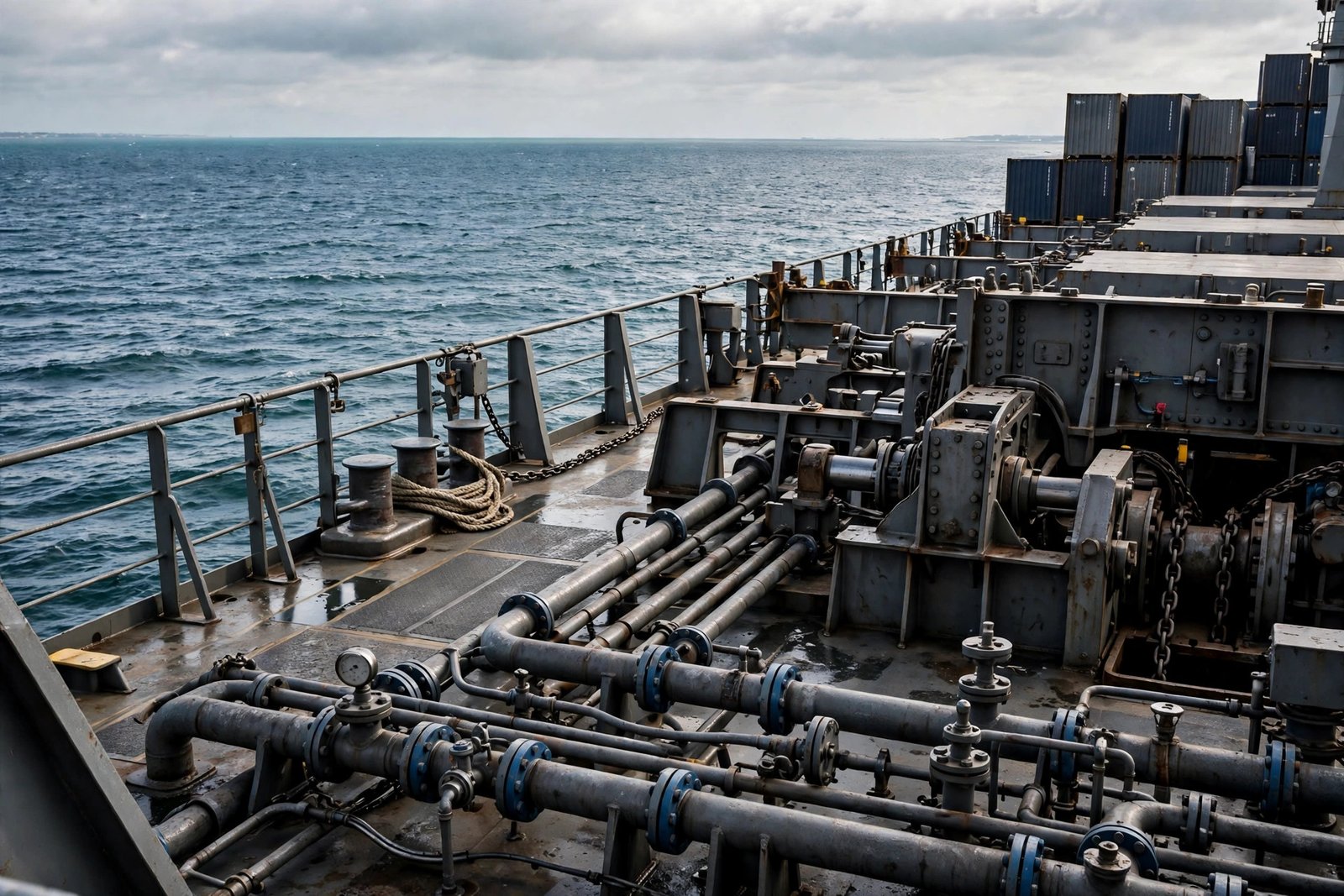
Propulsion and power are the core. You study diesel and gas-turbine engines, electric propulsion, shafting and propellers, fuel systems and emissions control, and increasingly alternative fuels and hybrid and battery systems. The engineering is demanding because a ship’s power plant must run for weeks without a workshop, in corrosive salt air, under vibration and load changes, and with safety and environmental consequences if it fails. You learn to size a propulsion system for a given hull and service profile, to match engine, gearbox and propeller, to estimate fuel consumption and emissions, and to judge the trade-offs between competing fuel and propulsion options. Laboratory work on engines, simulators and test rigs matters here, and programmes with strong engine laboratories or industry-linked test facilities have a real advantage.
Auxiliary systems, control and materials complete the machinery picture. Auxiliary systems include pumps, compressors, refrigeration, steering gear, ballast and bilge systems, fire-fighting systems and cargo handling equipment: unglamorous, essential, and a large part of what a marine engineer actually maintains. Control modules cover automation, sensors, alarm and monitoring systems and the integrated bridge and engine-room systems of a modern ship. Materials modules cover corrosion, fatigue, coatings and the behaviour of steels and composites in seawater. Together these subjects produce an engineer who can look at a ship’s system diagram and see not just components but failure modes: what happens when a pump fails, a sensor lies, a fuel is contaminated or a control system loses power, and what redundancy and maintenance regime prevents that failure from becoming an incident.
Hydrodynamics, structures and offshore systems give the degree its maritime breadth. Even in a machinery-focused programme, you will typically study resistance and propulsion interaction, seakeeping basics, ship stability and structural loading, because a propulsion engineer who does not understand what the hull demands will design the wrong system. Offshore modules cover floating structures, moorings, risers, installation and maintenance, and the particular demands of offshore wind, where marine engineers work on installation vessels, service operation vessels and turbine foundations. Autonomous and smart-ship content is increasingly common: the University of Strathclyde, for example, offers a marine engineering specialisation in autonomous marine vehicles covering intelligent sensing, hydrodynamics of underwater vehicles and digital twins, aimed at graduates in naval architecture, mechanical and marine engineering. If autonomous or offshore work interests you, look for programmes with that explicit content rather than assuming every marine degree covers it.
Regulation and professional practice are woven through the degree, because shipping is one of the most regulated industries in the world. You will encounter the International Maritime Organization framework, classification society rules, safety of life at sea requirements, pollution prevention rules and the certification regimes that govern seagoing engineers. This matters for your career in two ways. First, employers in ship design and classification value engineers who can work within rules rather than around them. Second, students who want to go to sea must understand a separate track: seagoing marine engineers need certificates of competency under the Standards of Training, Certification and Watchkeeping convention, earned through sea time and examinations, which is different from an academic master’s. A master’s strengthens the design, shore-based and management routes; it does not by itself qualify you to sail as a chief engineer. Keep that distinction clear when you plan.
Eligibility and Entry Requirements
Most marine engineering master’s programmes ask for a bachelor’s degree in marine engineering, naval architecture, mechanical engineering or a closely related field such as electrical, offshore or ocean engineering. Mechanical engineers are usually welcome, because propulsion, thermodynamics, fluids and materials transfer directly, although you may need to show some maritime or fluids background. Electrical engineers are welcome for power and control specialisations. Applicants from unrelated degrees are rarely accepted, because the degree builds on mechanics, thermodynamics and fluid mechanics from the first term. Relevant experience, such as shipyard work, seagoing experience, offshore work or a strong final-year ship design project, strengthens an application considerably and should be described concretely: the vessel type, the system you worked on, and what you measured or improved.
English requirements follow the usual engineering pattern. In the UK, IELTS 6.5 overall with no component below 6.0 is common, with some programmes asking for 6.0 or 7.0. In the USA and Canada, TOEFL iBT scores around 80 to 90 and IELTS 6.5 to 7.0 are typical. In the Netherlands, Scandinavia and Germany, English-taught programmes usually ask for IELTS 6.5 or TOEFL iBT 90. Some programmes, particularly in the UK, ask for a statement of purpose that shows genuine maritime interest rather than a generic engineering statement. Write about ships, systems or offshore problems that you have actually studied or worked on, and name the modules, laboratories or research groups that attract you at that university. In a small field, admissions tutors notice specific applications and remember them.
| Country | Typical academic requirement | Typical English requirement | Notes |
|---|---|---|---|
| United States | Engineering bachelor’s; GPA around 3.0/4.0 | TOEFL iBT 80–90 or IELTS 6.5–7.0 | Combined naval architecture and marine engineering degrees common |
| United Kingdom | 2:1 or equivalent in marine, mechanical or naval architecture | IELTS 6.5 overall, no band below 6.0 | 1-year MSc; RINA and IMarEST accreditation worth checking |
| Canada and Australia | Engineering bachelor’s; credit average or higher | IELTS 6.5–7.0 | Strong on offshore and ocean engineering links |
| Netherlands, Scandinavia, Germany | Relevant engineering bachelor’s | IELTS 6.5 for English-taught programmes | Strong maritime industry clusters; check tuition and language for daily life |
Accreditation is worth checking in this field. In the United Kingdom, programmes accredited by the Royal Institution of Naval Architects and the Institute of Marine Engineering, Science and Technology on behalf of the Engineering Council, as at Strathclyde, support the path towards chartered engineer status. In the United States, ABET accreditation supports professional licensure routes. If you plan to work in classification, ship design or offshore engineering, accredited status and a strong design project portfolio will matter more than a marginal difference in university ranking. Keep your project reports, drawings and simulation work, because employers in this industry often ask to see them.
Tuition Fees and Living Costs
Fees follow the familiar country pattern, but marine programmes have some distinctive features. In the United States, international tuition for an engineering master’s at a public university is commonly in the tens of thousands of dollars per year, with private universities higher. In the United Kingdom, a one-year MSc means a single year of international tuition, often in the range of twenty to thirty-five thousand pounds; Strathclyde’s MSc in Marine Engineering has been listed at around GBP 31,900 per year for international students in agent listings, but you must confirm the current official figure for your intake, because agent listings change and are not official quotes. In Canada and Australia, international engineering tuition commonly falls in the twenty to fifty-five thousand dollar range depending on country and university. In the Netherlands, Scandinavia and Germany, tuition is often lower than in the Anglophone countries, with Germany’s public universities charging little or no tuition for consecutive master’s programmes, although living costs remain the main expense everywhere.
Budget living costs with verified planning figures: UK student visa maintenance of GBP 1,529 per month in London and GBP 1,171 outside London, rising to GBP 1,570 and GBP 1,203 for applications on or after 30 November 2026; Germany’s blocked account figure of EUR 11,904 for 2026; Australia’s AUD 29,710 living-cost figure; and Canada’s proof-of-funds figure of CAD 23,448 for a single applicant. Model your own total with the tuition fee calculator and the cost of living calculator. Funding comes from university merit awards, government scholarships such as Chevening and Fulbright, and maritime-specific awards where they exist, including classification society and industry scholarships in some countries. Search current awards through the scholarships directory and the scholarship finder tool, and apply early: maritime scholarships are few, and their deadlines are often earlier than general awards.
Top Universities and Countries for Marine Engineering
The United States offers strong combined naval architecture and marine engineering programmes. The University of Michigan’s Department of Naval Architecture and Marine Engineering offers a Master of Science in Engineering in Naval Architecture and Marine Engineering as a 30-credit coursework degree, with options including an autonomous systems sub-plan and combined MSE and MBA routes, and a thesis-based Master of Science option. Other strong American options include the Massachusetts Institute of Technology, Virginia Tech, Texas A and M, the University of New Orleans and the Webb Institute, each with different strengths in ship design, hydrodynamics, offshore systems and marine robotics. When comparing American programmes, check towing-tank and laboratory facilities, industry links with shipyards and classification societies, and whether graduates go into design, offshore or government service.
The United Kingdom has one of the deepest marine traditions in the world. The University of Southampton is renowned for ship science, hydrodynamics and marine engineering, with excellent towing-tank and laboratory facilities. The University of Strathclyde’s Department of Naval Architecture, Ocean and Marine Engineering offers MSc programmes in marine engineering, including the autonomous marine vehicles specialisation, accredited by the Royal Institution of Naval Architects and the Institute of Marine Engineering, Science and Technology. Newcastle University, the University of Plymouth and University College London also offer relevant marine and naval architecture programmes. Because UK degrees last one year, they are intensive, and they suit students who arrive with solid mechanics and fluids knowledge and want a fast route into design, classification or offshore work.
Europe’s maritime clusters are a major attraction. Delft University of Technology in the Netherlands is internationally known for marine technology, offshore engineering and ship design. The Norwegian University of Science and Technology in Trondheim is strong in marine technology and offshore systems, reflecting Norway’s offshore industry. Chalmers University of Technology in Sweden, Hamburg University of Technology in Germany and the Technical University of Denmark all offer relevant master’s content. In Canada, Memorial University of Newfoundland is well known for ocean and naval architectural engineering, reflecting its offshore and Arctic links, while Dalhousie and British Columbia offer related strengths. In Australia, the Australian Maritime College at the University of Tasmania is the specialist institution, and Sydney and Western Australia offer relevant programmes. Explore options through the universities directory and compare shortlisted institutions with the university comparison tool.
Careers and Salaries
Marine engineering graduates work across a wider set of industries than the word ship suggests. Ship design and shipbuilding employ engineers to design propulsion and auxiliary systems, supervise construction and test new vessels. Classification societies employ surveyors and plan-approval engineers who check designs and ships against rules. Ship owners and operators employ superintendent engineers who manage fleets, maintenance and dry-dockings from shore. Offshore energy employs engineers for wind farm installation and maintenance vessels, floating structures and subsea systems. Government and naval organisations employ engineers for naval vessels, coastguard fleets and regulatory work. Ports, consultancies and equipment manufacturers employ specialists in engines, propellers, control systems and alternative fuels. A smaller group goes to sea as certificated engineers, a route that requires sea time and certificates of competency in addition to academic study, and that offers a different lifestyle with long periods away from home.
On salaries, the official United States picture combines marine engineers with naval architects. According to CareerOneStop, which republishes Bureau of Labor Statistics Occupational Employment and Wage Statistics data, marine engineers and naval architects in the United States had a median annual wage of $105,670 in 2024, with a low figure of $79,700 and a high figure of $167,660. That combined figure should not be quoted as a marine-only salary, and it describes the United States only. Pay varies sharply by sector: offshore and specialist design roles often pay differently from general shipyard roles, and seagoing pay includes allowances and rotations that make simple annual comparisons misleading. For the country where you plan to work, check that country’s official statistics rather than converting an American figure.
| Role or combined occupation | Official figure | Source and year |
|---|---|---|
| Marine engineers and naval architects (combined US category) | Median annual wage $105,670; low $79,700; high $167,660 | CareerOneStop / BLS Occupational Employment and Wage Statistics, 2024 |
| Marine engineers alone | No separate official US figure published | Not reported separately by BLS; do not quote the combined figure as marine-only |
| Seagoing engineer pay | Not given here: rotations and allowances make headline figures misleading | Check employer and flag-state terms for the route you intend |
The best career preparation in this degree is a strong design portfolio plus practical evidence. Employers in ship design and classification want to see drawings, calculations, simulation results and a design project you can explain under questioning. Employers in offshore and operations want to see laboratory work, sea or yard experience, and evidence that you understand maintenance, reliability and safety. Learn the software your target sector uses, whether that is hydrodynamic simulation, CAD, machinery modelling or data tools for predictive maintenance, and keep your project work in a form you can show at interview. Communication matters unusually much in this field, because marine engineers coordinate between owners, yards, class societies, suppliers and crews, often across languages and time zones. The engineer who can write a clear technical report and chair a difficult design review will advance faster than a marginally stronger calculator who cannot.
Scholarships for Marine Engineering
Maritime scholarships exist but are scattered, so search broadly and early. University merit awards are the most common source. Classification societies, shipping companies and maritime foundations in some countries offer scholarships for naval architecture and marine engineering students, sometimes tied to a particular university or to a commitment to work in the industry. Government awards such as Chevening, Fulbright and DAAD are open to engineering applicants and reward leadership and a clear plan. In Norway, the Netherlands and Germany, low tuition at public institutions is itself a form of funding, although living costs and, in some cases, proof-of-funds requirements remain. Use the scholarship finder tool and the scholarships directory, and read each award’s conditions: some maritime awards require a particular nationality, a seagoing commitment or a specific programme.
How to Choose and Apply
Choose by facilities, specialism and industry cluster, in that order. First, check the laboratories: towing tanks, hydrodynamics laboratories, engine laboratories, wave flumes and simulator facilities are not decorations in this field; they are where you learn. Second, decide your specialism: machinery and propulsion, ship design, offshore and renewables, or autonomous systems, and shortlist programmes whose modules and staff match it. Third, consider the local industry cluster: studying near shipyards, classification offices, offshore operators or a major port gives you placement, project and employment opportunities that a remote programme cannot match, even if its brochure looks similar. Fourth, check accreditation and total cost, including whether a one-year UK degree or a two-year European degree fits your budget and your visa plans better.
Apply twelve to fifteen months before entry, with a statement of purpose that proves maritime interest: a ship type, a propulsion problem, an offshore challenge or a project you have actually worked on, connected to specific modules, laboratories or staff at that university. Apply to a spread of programmes, because the best-known marine programmes are small and competitive, and keep a spreadsheet of deadlines, documents and scholarship dates. In the UK, the Graduate Route currently allows two years of post-study work for master’s graduates, with an announced shortening to 18 months from 1 January 2027, so confirm the rule that will apply when you graduate. After offers arrive, talk to recent graduates about laboratory access, project supervision and job destinations, and ask employers in your target sector which programmes they recruit from. In a field this specialised, those conversations are worth more than any general ranking.
Frequently Asked Questions
What is the difference between marine engineering and naval architecture?
Naval architecture covers the hull, stability, structures and seakeeping. Marine engineering covers machinery and systems: propulsion, power, auxiliary systems and control. Many master’s programmes combine both, which suits students who want ship design as a whole.
Do I need a marine engineering bachelor’s to apply?
Not always. Marine, naval architecture and mechanical engineering graduates are the most common entrants, and electrical and offshore engineering graduates are accepted for relevant specialisations. Applicants from unrelated degrees are rarely accepted.
Does a master’s qualify me to sail as a ship’s engineer?
No, not by itself. Seagoing engineers need certificates of competency under the Standards of Training, Certification and Watchkeeping convention, earned through approved sea time and examinations. A master’s strengthens shore-based design, classification, offshore and management routes.
How long does an MS in Marine Engineering take?
Typically one year full-time in the UK, one and a half to two years in the USA, Canada and Australia, and two years in much of Europe. Check whether the programme includes a project semester, internship or thesis that extends the duration.
What salary can marine engineers expect?
No honest guide can promise a salary. As an official US benchmark only, marine engineers and naval architects combined had a median annual wage of $105,670 in 2024 according to CareerOneStop and Bureau of Labor Statistics data. Pay varies by sector, country and seagoing versus shore-based work.
Is offshore wind a realistic career after this degree?
Yes. Offshore wind uses marine hydrodynamics, structures, mooring, installation vessels and maintenance skills directly. Choose electives and a dissertation topic in offshore systems if that is your target sector.
Which country is best for marine engineering?
There is no single best country. The USA and UK offer deep combined programmes, the Netherlands and Norway offer strong maritime clusters and offshore links, and Australia offers a specialist maritime college. Choose by facilities, specialism and the industry cluster where you want to work.
Sources and Verification
Sources consulted include the University of Michigan Naval Architecture and Marine Engineering master’s programme pages, which describe the 30-credit Master of Science in Engineering and its autonomous systems sub-plan; University of Strathclyde marine engineering programme descriptions, including accreditation by the Royal Institution of Naval Architects and the Institute of Marine Engineering, Science and Technology; the University of Maryland Department of Fire Protection Engineering degrees page where cross-referenced; CareerOneStop and Bureau of Labor Statistics Occupational Employment and Wage Statistics data for marine engineers and naval architects for 2024; and StudyGraduate’s verified visa and cost planning figures for the UK, Germany, Australia and Canada. Official external references: University of Michigan MSE in Naval Architecture and Marine Engineering and CareerOneStop salary finder for marine engineers and naval architects. Tuition ranges are indicative planning ranges for 2026/2027 entry, not official quotes.
Disclaimer: StudyGraduate is an information portal, not an agency. This article does not promise admission, a scholarship, a job, a salary or a visa or post-study work outcome. Figures change yearly; always confirm fees and requirements on the official university or government page.