
MS in Manufacturing Engineering Abroad: Eligibility, Fees, Top Universities and Careers
Manufacturing engineering is the discipline that turns a design on a screen into a product that can be made reliably, safely and profitably at scale. An MS in Manufacturing Engineering abroad takes that idea seriously: you do not only learn how a part is machined, printed, cast or assembled, you learn how an entire production system is designed, measured, improved and managed. That system includes machines and materials, but it also includes people, schedules, supply chains, quality data, energy use and cost. For students who enjoy both hands-on engineering and organised problem solving, it is one of the most employable engineering master’s degrees available, because almost every physical product in the world passes through a manufacturing system of some kind.
This guide is written for international students planning a 2026 or 2027 intake in the United States, the United Kingdom, Canada, Germany or Australia. It explains what the degree actually teaches, who it suits, what universities typically ask for, what it costs, where the strongest programmes are, and what graduates go on to do. Salary figures in this article come only from official statistics, and each figure is labelled with its source and year. Where a figure cannot be verified from an official source, this guide says so rather than inventing a number. Fees and entry requirements change every year, so always confirm the current figure on the official university page before you apply.
It is worth being precise about the name of the degree, because it varies by country and university. In the United States you will most often see an MS or MEng in Manufacturing Engineering, sometimes housed inside a mechanical or industrial engineering department. In the United Kingdom the same ground is often covered by an MSc in Manufacturing Engineering, Advanced Manufacturing, or Manufacturing Systems Engineering, and some programmes sit inside a business or management school with a strong engineering core. In Germany, manufacturing content appears in production engineering, mechanical engineering and industrial engineering master’s programmes, many of which are taught in English at technical universities. In Canada and Australia, look for Master of Engineering or Master of Applied Science titles with a manufacturing, production or industrial specialisation. The title matters less than the curriculum: check whether the programme teaches the processes, systems and data skills described below, and whether it includes a substantial project, laboratory work or industry placement.
Manufacturing engineering also sits close to several neighbouring degrees, and choosing between them is one of the most important decisions in this guide. Industrial engineering leans further towards systems, operations research, logistics and human factors. Mechanical engineering leans further towards design, mechanics and thermal systems. Materials science leans further towards what things are made of and how they behave. Manufacturing engineering sits at the overlap: it asks how a chosen design and a chosen material can be produced, inspected, assembled and delivered, repeatedly and economically. If you love the factory floor, the production line, the quality lab and the question of how to make something better and cheaper without making it worse, this is your degree. If you would rather design the product itself and rarely think about how it is made, a mechanical design programme may fit you better. If you would rather optimise schedules and supply networks than touch a machine tool, industrial engineering may fit you better. You can explore related options in the Courses and Programs directory and compare them with the Bachelor of Engineering profile before you commit.
At a Glance
| Item | Typical detail |
|---|---|
| Degree level | Master’s: MS, MEng, MSc or Master of Engineering, depending on country |
| Typical duration | 1 year full-time in the UK; 1.5 to 2 years in the USA, Canada and Australia; 2 years (4 semesters) in Germany |
| Usual entry qualification | Bachelor’s in mechanical, manufacturing, industrial, materials or a closely related engineering field |
| Core subjects | Manufacturing processes, automation and robotics, quality engineering, production planning, CAD/CAM, materials and digital manufacturing |
| Typical project work | Laboratory modules, a capstone or dissertation project, and often an industry-linked problem |
| Who it suits best | Students who like practical engineering, data, teamwork and seeing physical results |
What You Actually Study
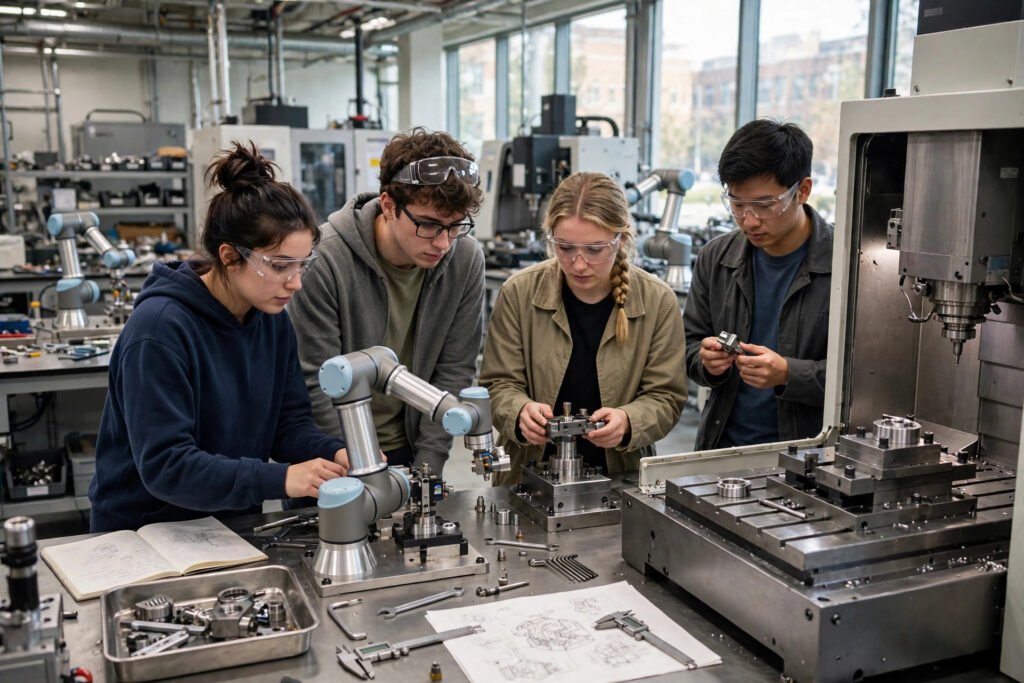
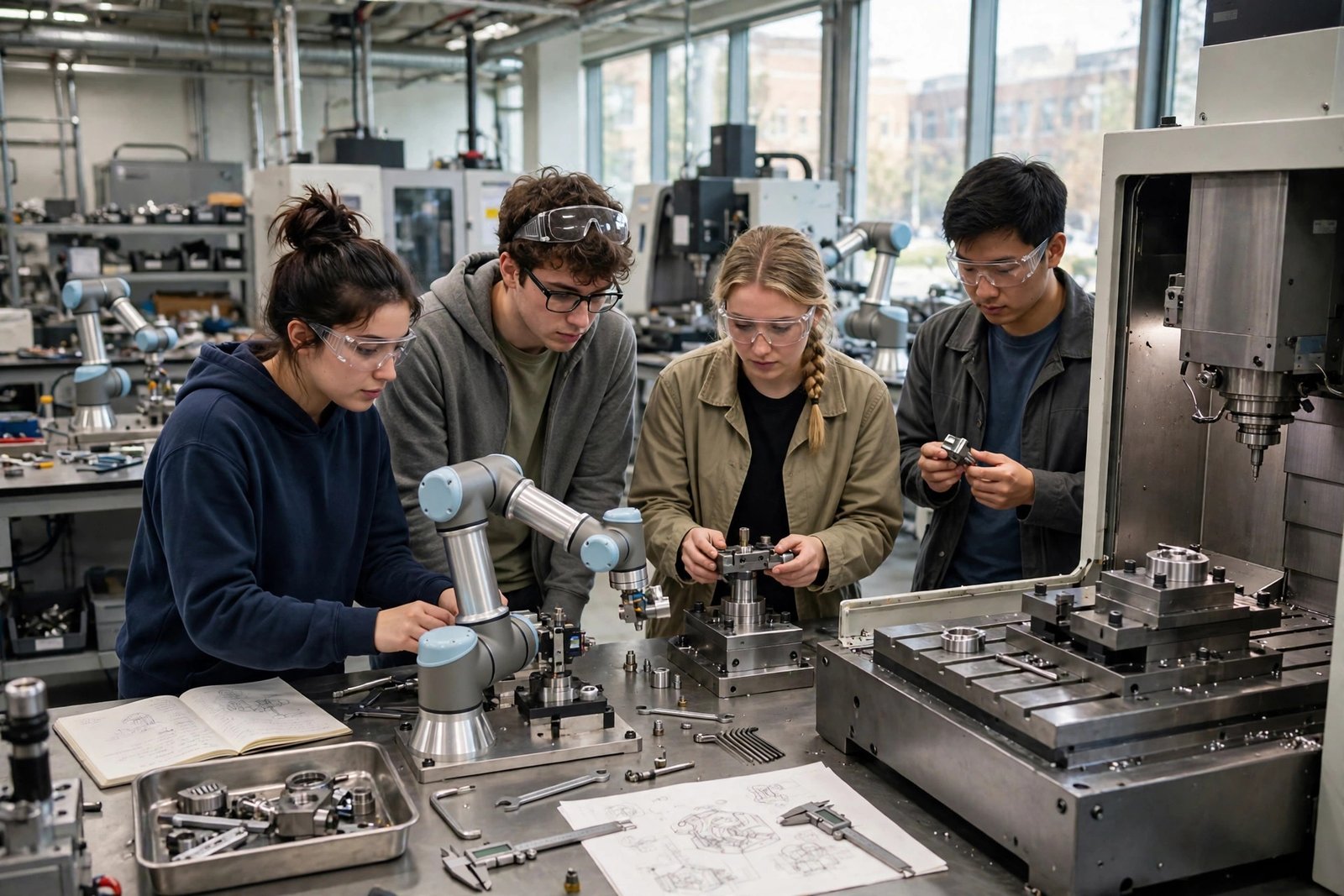
The heart of the degree is manufacturing processes. You study how materials are shaped and joined: machining and CNC programming, casting, forming, welding, moulding, additive manufacturing and finishing. The point is not to memorise a catalogue of processes. It is to learn how to choose between them for a given part, volume, tolerance, material and budget, and how to predict what will go wrong when a process is pushed too far. A good programme puts you in a workshop or laboratory early, so that the theory of cutting forces, heat, tool wear and surface finish is tested against real parts that you measure yourself. Students who have only ever studied engineering on paper often find this the most satisfying part of the degree, because a failed part teaches faster than a perfect lecture slide.
On top of processes sits automation and digital manufacturing. Modern factories are instrumented: sensors record temperatures, vibrations, cycle times and defect rates, and that data feeds scheduling, maintenance and quality decisions. You will typically study robotics and programmable automation, computer-aided design and manufacturing, simulation of production lines, and the ideas grouped under Industry 4.0, including digital twins, connected machines and data-driven process control. This is also where manufacturing engineering meets software. You do not need to become a software engineer, but you do need to be comfortable with data: cleaning it, visualising it, modelling a process with it, and explaining what it means to a manager who has to act on it. Programmes differ here, so look at module lists carefully. A programme heavy on robotics and simulation suits a student heading for automotive or electronics production; a programme heavy on process metallurgy and machining suits a student heading for aerospace or precision engineering.
Quality engineering and production management complete the core. Quality modules cover measurement and metrology, statistical process control, design of experiments, failure analysis and standards such as ISO 9001, taught as working tools rather than as abstract rules. Production modules cover planning and scheduling, inventory, lean manufacturing, Six Sigma thinking, supply chain basics and cost estimation. These are the subjects that turn a good engineer into a person a factory actually wants to promote, because they connect technical decisions to money, time and customer requirements. A change that saves two minutes per part is worthless if it doubles scrap; a tighter tolerance is worthless if no customer will pay for it. Manufacturing engineers are trained to hold both sides of that calculation at once.
Electives let you steer the degree towards an industry. Common directions include automotive manufacturing, aerospace production, medical device manufacturing, semiconductor and electronics manufacturing, sustainable and energy-efficient production, and additive manufacturing. Your elective choices, and especially your dissertation or capstone topic, matter more for your first job than the exact degree title. An employer hiring for a battery plant will notice a project on electrode coating or cell assembly far more than a generic module list. Choose a programme whose staff research and industry links match the sector you want to enter, and ask admissions teams directly what recent dissertation topics and placement employers look like. That single email can tell you more than a glossy brochure.
Eligibility and Entry Requirements
Almost every manufacturing engineering master’s asks for a bachelor’s degree in engineering or a closely related technical subject, usually mechanical, manufacturing, industrial, production or materials engineering. Applicants from mechatronics, aerospace, automotive or chemical engineering are often accepted, especially if their transcript shows mathematics, mechanics, materials and some manufacturing or design content. Applicants from pure science degrees, such as physics, may be accepted if they can show relevant mathematics and engineering coursework, but this is decided case by case and you should ask before applying. Most programmes look for a good undergraduate average, often described as a 2:1 or its international equivalent in the UK, or a GPA around 3.0 on a 4.0 scale in North America, but thresholds vary widely and a strong final-year project or relevant work experience can compensate for a weaker early record.
English language requirements are standard for international applicants. In the UK, an IELTS score of 6.5 overall with no component below 6.0 is the most common requirement for engineering master’s programmes, with some universities asking for 6.0 or 7.0. In the USA and Canada, TOEFL iBT scores around 80 to 90 and IELTS scores around 6.5 to 7.0 are typical, and some universities accept Duolingo or other tests. Australia generally asks for IELTS 6.5 overall. Germany’s English-taught programmes usually ask for IELTS 6.5 or TOEFL iBT 90, while German-taught programmes require German proficiency, typically at B2 or C1 level. Always check the exact requirement for your programme, because a department can set a higher bar than its university’s general minimum, and because some universities waive the test for students whose previous degree was taught entirely in English.
Documents usually include transcripts, a statement of purpose, a CV, and one or two academic references. Your statement of purpose should be specific: name the manufacturing processes or problems that interest you, explain what you have already built, measured or improved, and connect that experience to particular modules or research groups at the university. Generic statements about loving engineering are easy to spot and easy to reject. If you have factory, internship or project experience, describe one problem, what you measured, what you changed and what happened next, with numbers where you honestly have them. That paragraph alone can lift an application from average to memorable, because it proves you already think like a manufacturing engineer.
| Country | Typical academic requirement | Typical English requirement | Notes |
|---|---|---|---|
| United States | Engineering bachelor’s; GPA around 3.0/4.0 | TOEFL iBT 80–90 or IELTS 6.5–7.0 | GRE often optional now; check per programme |
| United Kingdom | 2:1 or equivalent in engineering | IELTS 6.5 overall, no band below 6.0 | 1-year programmes; dissertation in summer term |
| Canada | Engineering bachelor’s; mid-B average or higher | IELTS 6.5–7.0 or TOEFL iBT 90+ | Course-based and thesis-based routes differ |
| Germany | Relevant engineering bachelor’s; check ECTS requirements | IELTS 6.5 for English-taught programmes | Many public universities charge no tuition, only a semester contribution |
| Australia | Engineering bachelor’s; credit average or higher | IELTS 6.5 overall | 2-year programmes common; check Engineers Australia accreditation |
Some programmes also ask for prerequisite knowledge in specific subjects and may offer bridging modules if you are short in one area. If your degree is in a neighbouring field, look for this in the programme description and raise it in your application rather than hoping it goes unnoticed. Admissions tutors would much rather see an applicant who has identified a gap and a plan to close it than one who appears not to have read the curriculum. Work experience is not usually compulsory, but a placement, internship or even a well-documented final-year manufacturing project strengthens an application considerably, and it gives you better stories for interviews and for the job search that follows graduation.
Tuition Fees and Living Costs
Costs vary far more by country and university type than by degree title, so plan with ranges and verify the exact figure for your intake. In the United States, international tuition for a master’s in engineering at a public university is commonly in the tens of thousands of dollars per year, and private universities are usually higher; total programme cost depends heavily on whether the degree takes one year or two. In the United Kingdom, a one-year MSc means you pay one year of international tuition, which is often in the range of twenty to thirty-five thousand pounds, but you also finish sooner and enter work sooner, which changes the total economics in a way headline tuition alone hides. In Canada, international engineering tuition is commonly in the range of twenty to forty thousand Canadian dollars per year. In Australia, international master’s tuition is commonly in the range of forty to fifty-five thousand Australian dollars per year. In Germany, many public universities charge no tuition for consecutive master’s programmes, asking only a semester contribution of a few hundred euros, although some specialised or non-consecutive programmes do charge tuition, and living costs remain your main expense.
Living costs are a second budget, not a footnote. The brief’s verified planning figures are useful here: students in the UK should plan around the student visa maintenance levels of GBP 1,529 per month in London and GBP 1,171 per month outside London, rising to GBP 1,570 and GBP 1,203 respectively for applications on or after 30 November 2026; Germany’s blocked account requirement stands at EUR 11,904 for 2026; Australia’s student visa living-cost figure is AUD 29,710; and Canada’s proof-of-funds requirement for a single applicant moved from CAD 22,895 to CAD 23,448. These are visa planning figures, not promises of what you will actually spend, and your real spending depends on city, housing and lifestyle. Use the tuition fee calculator and the cost of living calculator on StudyGraduate to model your own combination of university, city and programme length before you shortlist.
Funding comes from several directions, and you should pursue them in parallel rather than waiting for one perfect scholarship. University merit scholarships and departmental awards are the most common source for master’s students; some are automatic on application, while others need a separate essay. Government scholarships, such as Chevening for the UK and Fulbright for the USA, are highly competitive and have early deadlines, often a full year before entry. Employer sponsorship suits students already working in manufacturing who can show their employer a return on the investment. Research assistantships and teaching assistantships in North America can cover part of tuition and pay a stipend, but they are more common on thesis-based programmes than on taught professional master’s degrees. Browse the scholarships directory early, and treat every deadline as fixed: scholarship calendars do not move because your application was nearly ready.

Top Universities and Countries for Manufacturing Engineering
The United States offers the deepest bench of manufacturing programmes, because its automotive, aerospace, semiconductor and medical-device industries all hire manufacturing engineers in large numbers. The University of Michigan’s engineering programmes in manufacturing are a classic example: a long-standing manufacturing curriculum, close ties to the automotive industry, and a strong professional master’s route. Purdue, Georgia Tech, the University of Wisconsin-Madison, Texas A and M and Carnegie Mellon are also frequently cited for production, automation and industrial systems strengths, and each has a different flavour, from heavy laboratory work to data-driven operations. When comparing American programmes, look at whether the degree is course-based or thesis-based, whether it includes a co-op or industry project, and whether its graduates go into the sector you want. A programme’s industry advisory board and its list of recent capstone sponsors will tell you more than any league table.
The United Kingdom compresses the degree into one intensive year, which appeals to students who want to return to work quickly. Cranfield University is especially well known for manufacturing and aerospace production, with close industry links and a campus built around applied research. The University of Manchester, the University of Sheffield, the University of Nottingham and the University of Birmingham all run strong manufacturing and advanced production programmes, often with excellent machining, robotics and materials laboratories. Warwick’s Manufacturing Group is another distinctive option, blending engineering with manufacturing management. Because UK master’s degrees are short, the pace is demanding: you will typically complete taught modules in the first two terms and a full dissertation project over the summer, so arrive ready to work at full speed from week one.
Germany rewards students who are willing to learn the system as well as the subject. RWTH Aachen, TU Munich, TU Berlin, the University of Stuttgart and TU Darmstadt are all strong in production engineering and mechanical systems, and many of their English-taught master’s programmes charge little or no tuition. The trade-off is real: you must handle bureaucracy, housing and daily life in German even on an English-taught programme, and internships in German industry are far easier to win with German language skills. Canada offers a middle path, with strong manufacturing programmes at Toronto, Waterloo, McGill, Alberta and British Columbia, plus co-op traditions that give international students Canadian work experience before graduation. Australia’s manufacturing strengths cluster around Melbourne, Sydney, Queensland and Monash, with growing work in advanced materials, medical devices and defence manufacturing. Explore the full list through the universities directory and the rankings pages, and compare shortlisted universities side by side with the university comparison tool.
Careers and Salaries
Manufacturing engineering graduates move into roles with different titles but a shared logic: making production work better. The most direct roles are manufacturing engineer, process engineer, production engineer and quality engineer, where you own a process, a line or a product family and are judged on yield, cost, safety and delivery. Industrial engineer is a close neighbour, with more emphasis on systems, layout and operations research. Automation and controls engineers design and maintain the robots, sensors and control systems that run modern plants. Product and design-for-manufacturing engineers sit between design and production, making sure new products can actually be built. With experience, graduates move into operations management, plant management, supply chain leadership, continuous improvement leadership and technical consulting, where the manufacturing background is valued because you understand what a factory can and cannot do.
Salary data for this field needs care, because no official statistics agency publishes a separate occupation called “manufacturing engineer” in the United States. The closest official proxies are industrial engineers and mechanical engineers, and this guide reports them as proxies rather than pretending they are a perfect match. According to the US Bureau of Labor Statistics, industrial engineers earned a median annual wage of $101,140 in May 2024, and mechanical engineers earned a median annual wage of $102,320 in May 2024. The Bureau also projected employment of industrial engineers to grow by 11 percent from 2024 to 2034, faster than the average for all occupations. Those figures describe the United States only; pay in the UK, Canada, Germany and Australia follows local labour markets, currencies and experience levels, and should never be converted from American figures as if they were global benchmarks.
| Role or proxy occupation | Official figure | Source and year |
|---|---|---|
| Industrial engineers (closest US proxy for manufacturing engineers) | Median annual wage $101,140 | US Bureau of Labor Statistics, May 2024 |
| Mechanical engineers (neighbouring proxy) | Median annual wage $102,320 | US Bureau of Labor Statistics, May 2024 |
| Industrial engineers, employment outlook | Growth of 11% from 2024 to 2034 | US Bureau of Labor Statistics projection |
| Manufacturing, production and quality engineers in other countries | No single global figure used here | Check national statistics for the country where you plan to work |
The strongest career advice for this degree is to build evidence, not just a transcript. Employers hiring manufacturing engineers want to see that you have improved something measurable: reduced scrap, shortened a cycle time, fixed a recurring defect, automated a manual step, or designed a fixture that worked first time. Your dissertation, capstone and any internship should be chosen with that evidence in mind, and your CV should describe each project in the same format: the problem, what you measured, what you changed, and what changed as a result. Learn one CAD package deeply, one simulation or data tool well, and the quality tools that factories actually use, including statistical process control and root-cause analysis. Those three skills, plus clear communication with operators, technicians and managers, will carry you further than a longer list of half-learned software.
Scholarships for Manufacturing Engineering
Scholarship strategy for this degree should start with the university itself, because engineering departments and international offices hold the awards most students actually win. Merit scholarships are often awarded on academic strength and sometimes automatically, so a strong application is itself a funding application. In Germany, the DAAD funds a wide range of master’s students and is worth checking early, because its deadlines and subject lists are specific. In the UK, Chevening and Commonwealth awards cover outstanding applicants but demand leadership evidence and a clear return-home plan. In the USA, Fulbright and departmental assistantships are the best-known routes, while in Canada, university entrance awards and provincial funding vary by institution. Use the scholarship finder tool to match your profile to current awards, and read each award’s conditions carefully: some require a particular nationality, subject or home-country residence, and some cannot be combined with other funding.
How to Choose and Apply
Shortlist by curriculum first, cost second and prestige third. Read the module lists of at least six programmes and mark which ones teach the processes, automation and quality skills you want, and which ones merely mention them. Check the laboratory facilities, the dissertation format, and whether an industry project or placement is built in or merely possible. Check accreditation where it matters: ABET accreditation in the United States and Engineers Australia or Engineering Council recognition elsewhere can matter for later professional registration, especially if you plan to work as a licensed or chartered engineer. Then check the total cost of the whole degree, not one year, including living costs and the opportunity cost of a longer programme. Finally, check the visa and post-study work rules for your destination, because they shape whether you can gain local work experience after graduation. In the UK, the Graduate Route currently allows two years of post-study work for master’s graduates, with an announced shortening to 18 months from 1 January 2027, so confirm the rule that will apply to your graduation date rather than assuming today’s rule will still hold.
A sensible application timeline starts twelve to fifteen months before entry. Begin by shortlisting programmes and checking deadlines, then prepare for English tests, request references early, and draft your statement of purpose with specific module and project references. Apply to a spread of programmes: two ambitious, two realistic and one safer option, all of which you would genuinely be happy to attend. Keep a single spreadsheet of deadlines, document requirements, fees and scholarship dates, because the most common reason strong students miss out is not rejection but a missed deadline. After offers arrive, compare total costs, project options and industry links, and talk to current students or recent graduates if you can. They will tell you honestly about workload, laboratory access and job support in a way no prospectus will.
Frequently Asked Questions
Is manufacturing engineering the same as industrial engineering?
No, although they overlap. Manufacturing engineering focuses on how products are made: processes, machines, quality and production systems. Industrial engineering focuses more broadly on optimising systems, including logistics, operations research and human factors. Many programmes share modules, so compare curricula rather than titles.
Do I need a mechanical engineering bachelor’s to apply?
Mechanical engineering is the most common background, but manufacturing, industrial, materials, mechatronics and aerospace graduates are usually accepted. Applicants from other fields should show relevant mathematics, mechanics and materials content and should ask the department before applying.
Is the degree better in the USA, the UK, Germany or Canada?
There is no single best country. The USA offers depth and industry scale, the UK offers a fast one-year degree, Germany offers low tuition at public universities, and Canada offers co-op experience and post-study work routes. Choose by curriculum, total cost and the labour market where you want to start your career.
How long does an MS in Manufacturing Engineering take?
Typically one year full-time in the UK, one and a half to two years in the USA, Canada and Australia, and two years in Germany. Part-time and online routes take longer. Check the exact structure, because some programmes include a compulsory internship semester.
What salary can I expect after graduation?
No honest guide can promise a salary, because pay depends on country, industry, city and experience. As an official US benchmark only, industrial engineers earned a median annual wage of $101,140 in May 2024 according to the Bureau of Labor Statistics. Use national statistics for the country where you plan to work, and treat any source that promises a salary as unreliable.
Does the degree require coding?
Not software-engineering level coding, but you should expect data analysis, simulation and CAD/CAM work. Comfort with spreadsheets, basic programming for data or automation, and one CAD package will make the degree much easier and make you more employable.
Can I work in automotive, aerospace or medical devices after this degree?
Yes. Those are among the largest employers of manufacturing engineers. Your electives, dissertation topic and any internship should point towards your chosen sector, because employers hire evidence of sector-relevant projects as much as the degree itself.
Sources and Verification
Sources consulted for this article include the US Bureau of Labor Statistics Occupational Outlook Handbook and Occupational Employment and Wage Statistics for industrial engineers and mechanical engineers (May 2024 medians and the 2024 to 2034 projection for industrial engineers); the University of Michigan Naval Architecture and Marine Engineering and manufacturing programme pages for programme structure; official university programme pages for the institutions named; and StudyGraduate’s verified visa and cost planning figures for the UK, Germany, Australia and Canada. Official external references: University of Michigan Manufacturing (MEng) programme and ABET criteria for manufacturing engineering technology programmes. Tuition ranges in this article are indicative planning ranges for 2026/2027 entry, not official quotes: fees change yearly, so confirm the current fee, entry requirement and deadline on the official university page before applying.
Disclaimer: StudyGraduate is an information portal, not an agency. This article does not promise admission, a scholarship, a job, a salary or a visa or post-study work outcome. Figures change yearly; always confirm fees and requirements on the official university or government page.