

MS in Internet of Things (IoT) Abroad: Eligibility, Fees, Top Universities and Careers
The Internet of Things is the unglamorous revolution hiding inside everyday life. It is the sensor in a hospital ward that alerts staff before a patient deteriorates, the soil probe that tells a farmer exactly where to irrigate, the vibration monitor on a factory machine that predicts a breakdown days before it happens, and the traffic system that adapts to real conditions rather than a fixed timetable. An MS in Internet of Things (IoT) abroad trains you to build systems like these: devices that sense the world, networks that carry their data, and platforms that turn that data into action.
IoT is a genuinely interdisciplinary field. It draws on electronics and embedded systems, on computer networks and cloud computing, on data engineering and analytics, and on the domain knowledge of the industry where the system will operate. That breadth is what makes the degree exciting, and it is also what makes choosing a programme harder than choosing a single-discipline degree. This guide explains what the degree covers, who it suits, what universities ask for, what it costs, where graduates work, and what official statistics say about pay, for 2026/2027 intakes. Figures change yearly, so confirm fees and requirements on the official university page before applying. StudyGraduate is an information portal, not an agency, and nothing here promises admission, a job or a visa outcome.
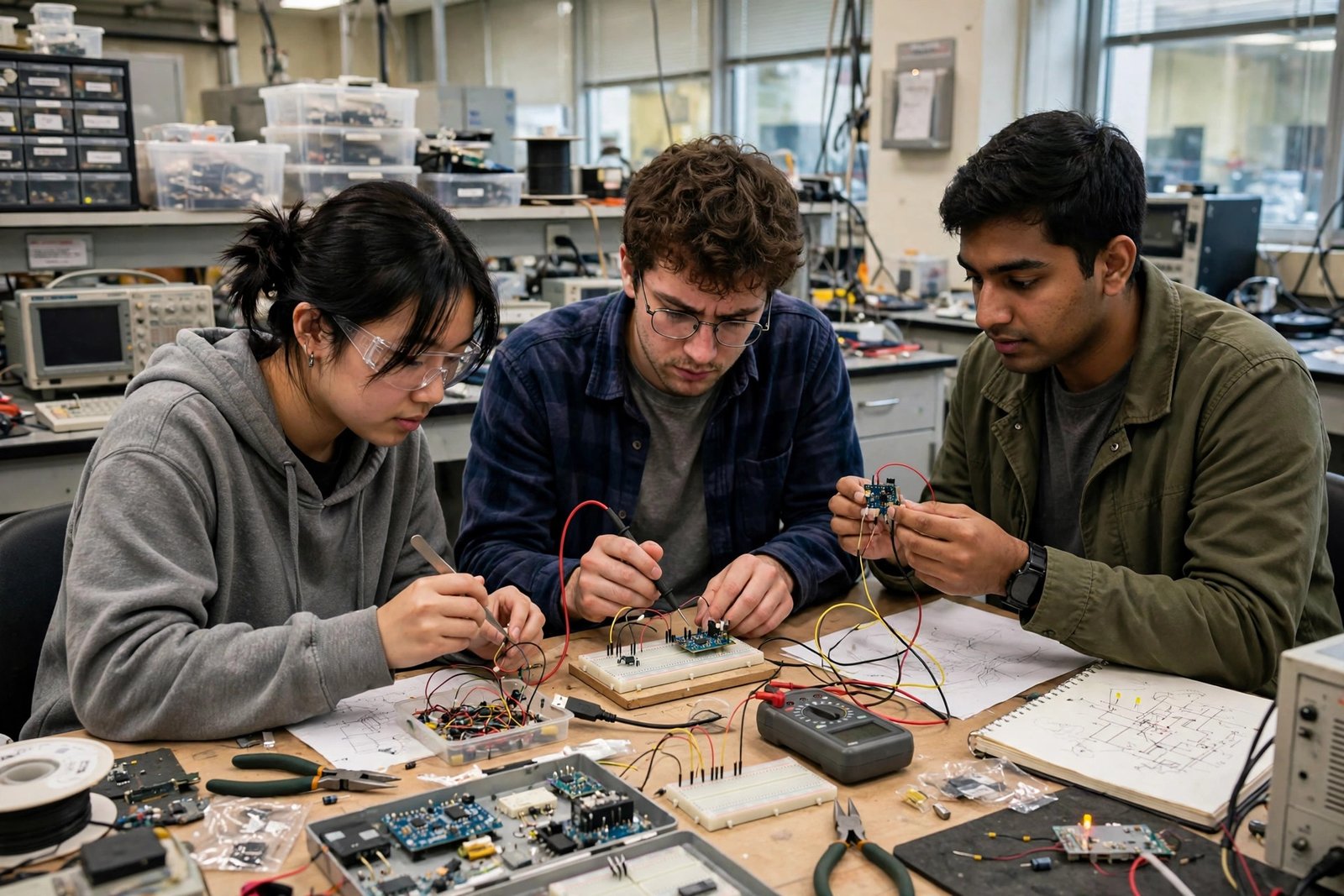
What Is an MS in Internet of Things?
An IoT system has four layers, and a good master’s programme teaches all of them. At the bottom are the devices themselves: sensors, actuators, microcontrollers and embedded software that interact with the physical world. Above them sits connectivity: the wireless and wired networks, protocols and gateways that move data reliably, often from places with poor power or coverage. Above that sits the platform layer: cloud and edge computing systems that store, process and manage data from thousands or millions of devices. And at the top sits the application layer: the dashboards, alerts, automations and analytics that make the system useful to a human being or another machine.
Programmes differ in where they put their weight. Some are rooted in electrical and electronic engineering and emphasise hardware, embedded design and signal processing. Others are rooted in computer science and emphasise networks, distributed systems, cloud platforms and data analytics. Neither emphasis is wrong, but they lead to different careers, and applicants should choose based on whether they would rather design a device or design the system around it. The strongest programmes cover both, with electives that let you specialise, and with project work that forces you to integrate all four layers into something that actually works.
IoT also raises questions that pure software degrees rarely face. A device deployed in a field, a factory or a home must work for years with little maintenance, on limited power, in harsh conditions, and under security threats that can have physical consequences. A compromised sensor network is not just a data breach; it can be a safety incident. Programmes therefore increasingly include modules on IoT security, privacy, reliability engineering and the regulatory standards that govern connected devices in different markets.
MS in Internet of Things at a Glance
| Feature | Typical picture |
|---|---|
| Degree level | Master’s (MSc, MS or MEng, depending on country and faculty) |
| Typical duration | 1 year in the UK; 1.5 to 2 years in the USA, Canada and Australia; 2 years in Germany |
| Who it suits | Electronics, electrical, computer science, telecommunications or mechatronics graduates |
| Core subjects | Embedded systems, sensor networks, wireless protocols, edge and cloud computing, IoT security |
| Key tools you will meet | C and C++, Python, microcontroller platforms, MQTT, LoRaWAN, cloud IoT services |
| Capstone | Working IoT prototype or deployment, often with an industry partner |
| Common next roles | IoT engineer, embedded systems engineer, IoT solutions architect, firmware engineer |
What You Study: Curriculum in Detail
Embedded systems form the foundation. You will study microcontroller architectures, real-time operating systems, interfacing with sensors and actuators, and programming in C and C++ close to the hardware. This is the part of the degree that most separates IoT from pure software programmes: you learn to think about memory measured in kilobytes, about power budgets that determine whether a battery lasts a week or a year, and about debugging a system you cannot simply restart without consequences.
Networking and protocols form the second pillar. IoT devices use a different networking world from office computers: low-power wireless protocols, mesh networks, cellular IoT standards and messaging protocols such as MQTT that are designed for unreliable connections and constrained devices. You will learn to choose a protocol based on range, power, bandwidth, latency and cost, and to design gateways that bridge device networks to the internet. This is practical engineering with real trade-offs, and the wrong choice at this layer is expensive to fix after deployment.
Edge and cloud computing form the third pillar. Not all IoT data should travel to the cloud: some decisions must be made in milliseconds on the device itself, some data is too voluminous or sensitive to transmit in full, and some sites have intermittent connectivity. Programmes therefore teach edge computing, where processing happens near the device, alongside cloud IoT platforms that manage device fleets, ingest telemetry, store time-series data and trigger actions. You will learn to split a system sensibly between edge and cloud, and to manage thousands of devices remotely, including secure firmware updates.
Data, analytics and security complete the picture. IoT systems generate time-series data at a scale that demands specialised storage and analysis, and programmes increasingly cover stream processing, anomaly detection and predictive maintenance: the techniques that turn sensor readings into a warning that a machine needs attention. Security runs through everything, from secure boot and encrypted communication to identity management for devices and the privacy implications of sensors in homes, hospitals and cities. A graduate who can design a system that is both useful and defensible on security grounds is in short supply.
The applied project is often the defining experience of the degree. Building a working prototype — a monitored greenhouse, a predictive-maintenance demo, a smart-energy monitor — forces you to integrate hardware, networking, cloud and application layers, and to confront the integration problems that lectures can only describe. Choose a project with a real user in mind, document your design decisions, and keep the prototype: it is the most persuasive artefact you will carry into job interviews.
Eligibility and Entry Requirements
Most programmes ask for a bachelor’s degree in electronics, electrical engineering, computer science, telecommunications, mechatronics or a closely related field. Applicants from mechanical or other engineering backgrounds are often admitted if they can show programming and electronics experience, and computer science graduates are often admitted to computer-science-rooted programmes even without deep hardware experience. What admissions teams look for, above all, is evidence that you can handle both the hardware and software sides of the subject, so a portfolio of electronics or embedded projects carries real weight.
English-language requirements follow the usual destination pattern: IELTS or equivalent tests in the UK, Australia and Canada, commonly around 6.5 overall, and TOEFL or IELTS in the USA. Germany offers English-taught IoT and embedded-systems programmes, particularly at technical universities, though competition is strong and some German helps with internships and daily life. Some US programmes ask for GRE scores, while many UK, Australian and Canadian programmes do not; check the programme page rather than assuming.
Prior experience with microcontrollers, C programming or networking is not always a formal requirement, but students who arrive without it face a steep first semester. If your bachelor’s degree leaned heavily toward theory, spend the months before departure building a small project with a common microcontroller platform: reading sensors, sending data over a wireless link, and displaying it on a simple dashboard. That single project will teach you more about the field than any amount of reading, and it will strengthen your application at the same time.
| Country | Typical entry pattern | Points to check |
|---|---|---|
| USA | Bachelor’s in electronics, CS or related engineering; transcripts; English test; GRE sometimes required | Whether the programme is STEM-designated, which affects post-study work options |
| UK | Good bachelor’s degree, often 2:1 or equivalent; English test | One-year duration; Graduate Route rules, with an announced shortening to 18 months from 1 January 2027 |
| Canada | Bachelor’s degree; English test; some programmes ask for a project proposal | Provincial attestation letter requirements and PGWP eligibility of the institution |
| Australia | Bachelor’s degree; English test, commonly IELTS 6.5 overall | Post-study work visa settings and the institution’s registration status |
| Germany | Recognised bachelor’s degree; strong technical universities; APS certificate for some nationalities | Tuition position and semester contribution; lab and industry links |
Funding evidence is part of practical eligibility. The UK currently requires Student visa maintenance funds of GBP 1,529 per month in London and GBP 1,171 per month outside London, rising to GBP 1,570 and GBP 1,203 respectively for applications on or after 30 November 2026. Germany’s blocked account requirement is EUR 11,904 for 2026. Australia’s financial capacity figure is AUD 29,710, and Canada’s proof-of-funds figure for a single applicant outside Quebec moved from CAD 22,895 to CAD 23,448. Recheck these against official immigration pages at the time you apply.
Tuition and Living Costs
Tuition for IoT master’s degrees follows the same pattern as other engineering master’s degrees: highest and most variable in the USA, charged for a single year in the UK, and typically low or absent at public universities in Germany beyond a semester contribution. Laboratory-based programmes can carry additional costs for components, kits and project materials, and these are worth asking about directly, because a programme that provides hardware and lab access may be better value than a nominally cheaper one that expects students to fund their own prototypes.
Budget programme by programme using the fee on each official programme page for your intake year, and add living costs from the official immigration figures quoted above. The tuition fee calculator, the cost of living calculator and the study abroad budget planner can help you compare total costs across destinations. Do not plan around part-time earnings you have not secured, and remember that laboratory timetables can limit the hours available for part-time work.
Top Universities and Countries for IoT
Germany is a natural destination for IoT study, given its industrial base in manufacturing, automotive and automation, where connected systems are deployed at scale, and its technical universities’ strength in electronics and embedded systems. The USA offers the largest market for IoT platform and product roles, particularly in industrial IoT, healthcare devices and smart infrastructure. The UK offers one-year programmes and strong research in wireless communications and sensor networks. Canada and Australia combine solid engineering programmes with post-study work settings that many international students value, and Australia’s mining, agriculture and energy sectors are significant adopters of remote sensing and IoT.
When comparing programmes, look for laboratories, not just lectures. A programme with well-equipped embedded labs, industry partnerships and a track record of student prototypes deployed in real settings teaches IoT in a way that a purely theoretical syllabus cannot. Check whether the faculty publish and consult in IoT, whether students can access cloud IoT platforms and hardware, and where recent graduates work. Compare profiles through the universities directory and the Courses and Programs directory, and read the Bachelor of Engineering programme profile to understand how IoT master’s programmes build on undergraduate engineering. Institutions with strong engineering reputations whose profiles are worth comparing include TU Berlin, UNSW Sydney and UC Berkeley. Always verify the exact degree title, language of instruction and entry requirements on the official university page.

Careers and Salaries
IoT graduates typically start as IoT engineers, embedded systems engineers, firmware engineers or network engineers, and progress toward senior engineer, IoT solutions architect and product or platform leadership roles. The work varies enormously by sector: a medical-device IoT engineer works under strict safety and regulatory regimes; an industrial IoT engineer works with legacy machinery and harsh environments; a smart-city engineer works with public infrastructure and procurement constraints; and a consumer IoT engineer works under intense cost and time-to-market pressure. Early-career breadth across these contexts is valuable, because the underlying system skills transfer even when the domain changes.
There is no single official occupation called “IoT engineer” in US statistics, so the table below maps IoT careers to the closest official occupations tracked by the US Bureau of Labor Statistics (BLS) Occupational Outlook Handbook, including the computer and information systems managers profile and the computer network architects profile. The figures are medians: half of workers in each occupation earned more and half earned less. They are US occupation-level benchmarks, not promises for any graduate, and they should not be treated as salaries in other countries.
| Related occupation (USA) | Median annual wage | Source and reference year |
|---|---|---|
| Computer hardware engineers | $161,740 | BLS Occupational Outlook Handbook, May 2025 |
| Computer network architects | $134,050 | BLS Occupational Outlook Handbook, May 2025 |
| Information security analysts | $129,180 | BLS Occupational Outlook Handbook, May 2025 |
| Electronics engineers, except computer | $127,090 | BLS Occupational Outlook Handbook, May 2024 |
| Electrical engineers | $111,910 | BLS Occupational Outlook Handbook, May 2024 |
The spread in that table reflects a real feature of IoT careers: pay depends heavily on whether your role leans toward hardware design, network architecture, security or software platforms, and on the sector you work in. Security and architecture roles, which carry responsibility for whole systems rather than single components, sit at the higher end, while more junior device-level roles start lower and rise with experience and specialisation. Rather than chasing a single salary figure, compare roles on three dimensions: how much of the system you own, how safety- or security-critical the work is, and how scarce the combination of skills is in your target job market.
Long-term progression in IoT rewards people who can bridge disciplines. An engineer who understands hardware constraints, network behaviour, cloud platforms and the business case for a deployment can lead projects that specialists in any single layer cannot. Keep a portfolio of working systems, document your design trade-offs, and learn to explain a system to non-engineers: the person who can tell a factory manager, a clinician or a city official what a sensor network will and will not do is the person trusted to build the next one.
Scholarships for IoT Students
Engineering scholarships are the most relevant funding source for IoT students, offered by universities, governments and industry bodies, and sometimes tied to specific sectors such as telecommunications, manufacturing or energy. University merit scholarships are often assessed automatically on admission, while government awards usually require a separate, earlier application. Some employers and industry associations also fund students in areas where they struggle to hire, which makes IoT a better scholarship bet than many purely academic subjects, though competition remains real.
Check eligibility, coverage and conditions before applying, and note that some awards are restricted by degree title: a programme called “embedded systems” may qualify where one called “IoT” does not, or vice versa. Browse the scholarships directory, use the scholarship finder, and compare options with the university comparison tool and the career path explorer.
How to Choose the Right Programme
Decide first whether you want a hardware-leaning or software-leaning programme, because that single choice shapes everything else. Hardware-leaning programmes suit students who enjoy circuits, signal processing and embedded programming; software-leaning programmes suit students who enjoy networks, platforms and data. If you are unsure, choose a programme with a common first semester and electives that let you specialise later, and use the applied project to test the direction that excites you most.
Then check the practical evidence: laboratory facilities, hardware access, industry partners, placement options and graduate destinations. A programme near employers in your target sector — manufacturing, automotive, healthcare devices, energy or smart infrastructure — offers networking and placement advantages that a remote programme cannot match. Finally, weigh duration and cost honestly: a one-year programme is intense and leaves little room for a long placement, while a two-year programme costs more but allows deeper project work and more time to build local professional connections.
Application Timeline and Common Mistakes
A realistic timeline starts twelve to eighteen months before your intended intake. Begin by shortlisting programmes and checking their exact entry requirements, laboratory facilities and hardware provision, then sit any English test early, because a disappointing score needs time for a retake. Draft your statement of purpose over several weeks, describing any embedded or electronics project you have built in concrete terms, and ask recommenders at least a month before the deadline, giving them your CV and a note about what the programme values. Scholarship deadlines often fall before programme deadlines, so build your funding applications into the same calendar rather than treating them as an afterthought.
The most common mistakes are avoidable. Applicants send the same generic statement to every university, without naming a single module, laboratory or research group that connects to their own experience. They choose a programme by its title alone, without checking whether it leans toward hardware or software, and discover the mismatch only after enrolment. They underestimate the time visa processing, document attestation and, where applicable, academic credential assessment take. They also budget using a single tuition figure copied from a blog rather than the official programme page for their intake year, and they forget to ask about laboratory and component costs. Each of these errors is cheap to fix at the planning stage and expensive to fix later, so treat the application as a project with its own schedule and checklist, and use the application deadline finder and the document checklist to keep it organised.
One further point deserves emphasis for IoT applicants in particular: start building before you apply. A small working prototype, documented with photographs, code and a short explanation of your design decisions, does more for an application than any number of general claims about passion for technology. It also gives you something honest to discuss at interview, and it tests whether you actually enjoy the hands-on, debugging-heavy reality of IoT work, rather than only the idea of it. If you build the prototype and find the process frustrating rather than absorbing, that is useful information too, and it is far better learned before you commit to a degree than during it.
Frequently Asked Questions
Do I need an electronics background for an MS in IoT?
Most programmes prefer electronics, electrical, computer science or telecommunications backgrounds, but computer science graduates are commonly admitted to software-leaning programmes and engineering graduates to hardware-leaning ones. A small embedded project before applying helps any applicant, whatever their background.
Is IoT the same as embedded systems?
No. Embedded systems are one layer of IoT: the devices and their software. IoT adds connectivity, cloud and edge platforms, data analytics and applications on top of embedded systems. An embedded systems degree goes deeper on devices; an IoT degree covers the whole system.
What programming languages are used in IoT?
C and C++ dominate device-level work, Python is widely used for edge and cloud work, data processing and prototyping, and web and dashboard technologies appear at the application layer. Programmes typically teach the languages their labs use, but prior C or Python experience is a strong advantage.
How long does the degree take?
Typically one year in the UK, one and a half to two years in the USA, Canada and Australia, and two years in Germany. Part-time options extend the duration where offered. Confirm the standard duration on the official programme page.
Is IoT a good career choice?
It is a good choice for students who enjoy building systems that interact with the physical world and who are comfortable working across hardware, software and networks. The field spans many sectors, which spreads risk, but it also demands broader skills than a single-discipline degree, and students should be honest about whether that breadth excites or frustrates them.
Can IoT graduates work in cybersecurity?
Yes, particularly in device and network security, where IoT experience is directly relevant. Moving into mainstream cybersecurity usually requires additional study in security operations, penetration testing or governance, depending on the role.
What should my IoT portfolio contain?
At least one complete working system: a device that senses something, a network link, a cloud or edge component, and an application that displays or acts on the data, with documentation of your design decisions. One complete system impresses employers more than several unfinished demos.
Sources & Verification
- US Bureau of Labor Statistics, Occupational Outlook Handbook: Computer Hardware Engineers, Computer Network Architects, and Information Security Analysts — May 2025 median wages as tabulated above.
- US Bureau of Labor Statistics, Occupational Outlook Handbook: Electrical Engineers and Electronics Engineers, except computer — May 2024 median wages as tabulated above.
- UK Home Office / GOV.UK Student visa guidance — maintenance requirements, including the announced rise to GBP 1,570 per month in London and GBP 1,203 outside London for applications on or after 30 November 2026.
- German Federal Foreign Office guidance — blocked account requirement of EUR 11,904 for 2026.
- Australian Department of Home Affairs — financial capacity requirement of AUD 29,710.
- Immigration, Refugees and Citizenship Canada — proof-of-funds figure for a single applicant outside Quebec, CAD 22,895 rising to CAD 23,448.
Figures change yearly — confirm fees and requirements on the official university page. StudyGraduate is an information portal, not an agency — never promise admission, jobs, salaries or visa/PR outcomes. This article provides general information only; it does not guarantee admission, employment, salary levels or any visa or post-study work outcome.