

MS in Geotechnical Engineering Abroad: Eligibility, Fees, Top Universities and Careers
Geotechnical engineering is the branch of civil engineering that deals with the ground beneath every structure we build. It asks a deceptively simple question: what is below the surface, how will it behave when we load it, excavate it, tunnel through it or build on it, and how do we design foundations, retaining structures, slopes, embankments and underground works that remain safe for decades? An MS in Geotechnical Engineering abroad is a specialist postgraduate degree for civil engineering graduates who want to move from general structural and infrastructure design into the soil, rock, groundwater and site-investigation expertise that determines whether a project succeeds or fails.
This guide is for international students considering this degree for 2026 or 2027 entry. It explains what you will study, who is eligible, how entry requirements differ by country, what costs to plan for, which countries and universities are strong in the field, what careers follow, and what official salary data actually says. It does not promise admission, a job or a visa outcome. Fees, deadlines and entry rules change every year, so every figure that matters to your application should be confirmed on the official university and government pages linked in the Sources and Verification section.
If you are still choosing between civil engineering specialisms, start with the Courses and Programs directory and compare this degree with the broader Bachelor of Engineering pathway. Geotechnical engineering suits students who enjoy soil mechanics, geology, fieldwork and careful, evidence-based judgement under uncertainty. The ground is never fully known: a good geotechnical engineer learns to combine site investigation, laboratory testing, numerical modelling and engineering judgement, and to explain risk honestly to clients, contractors and regulators. If you prefer work that is entirely predictable, desk-based or purely computational, other civil specialisms may suit you better.

At a glance
| Item | Typical position for an MS in Geotechnical Engineering |
|---|---|
| Degree level | Postgraduate taught master’s, usually MSc, MEng or MS, depending on the country and university |
| Typical duration | 1 year full-time in the United Kingdom and Ireland; 1.5 to 2 years in the United States, Canada, Australia and much of continental Europe |
| Who it is for | Graduates in civil engineering or a closely related discipline, with soil mechanics, structures and mathematics in their undergraduate degree |
| Core subjects | Soil mechanics, rock mechanics, foundation engineering, slope stability, earth retaining structures, ground improvement, tunnelling and underground construction, site investigation |
| Common tools | PLAXIS, GeoStudio, FLAC, RS2 and similar finite-element and limit-equilibrium software, plus laboratory testing and field instrumentation |
| Typical final project | A research or industry-linked dissertation, often involving site data, laboratory testing or numerical modelling of a foundation, slope, tunnel or excavation |
| Next steps | Roles in geotechnical consultancies, civil contractors, tunnelling and infrastructure projects, mining and energy, and public-sector infrastructure bodies; some graduates continue to a PhD |
What you study in an MS in Geotechnical Engineering
Most programmes begin with advanced soil mechanics. You will revisit effective stress, consolidation, shear strength, permeability and critical-state soil mechanics at a deeper level than an undergraduate course allows, and you will learn how laboratory and field test results are interpreted, what their limitations are, and how uncertainty in a soil parameter affects a design. This is the intellectual core of the subject. A geotechnical engineer who can run software but cannot judge whether a test result is credible, or whether a parameter is appropriate for the stress range in a real problem, is a liability on a real project.
Foundation engineering follows naturally. You will study shallow foundations, deep foundations including driven and bored piles, pile groups, raft foundations and piled rafts, settlement prediction, bearing capacity and the interaction between a structure and the ground beneath it. Case histories matter enormously here: programmes that teach through real projects, including projects that encountered problems, help you understand why site investigation, construction method and monitoring are inseparable from design. Ask prospective programmes how much case-history teaching they include, and whether practitioners from industry contribute to teaching.
Earth retaining structures, slopes and embankments form a third major block. You will design retaining walls, sheet pile and diaphragm walls, anchored and propped excavations, and slopes in soil and rock, and you will learn limit-equilibrium and numerical methods for stability analysis. Groundwater is central to all of this: seepage, pore pressures, dewatering and drainage can change a stable slope into a failure, and a competent geotechnical engineer treats groundwater as a design load, not an afterthought. Temporary works and construction sequence are also important, because many geotechnical failures occur during construction rather than in the finished structure.
Ground improvement, tunnelling and underground construction are specialist areas that many programmes offer as options. Ground improvement covers techniques such as vibro compaction, stone columns, deep soil mixing, grouting and preloading, used to make weak ground suitable for construction. Tunnelling covers tunnel boring machines, sprayed concrete lining, segmental lining, ground movements and their effects on nearby buildings and services. These topics lead to some of the most technically demanding and well-paid work in civil engineering, especially on metro, rail, water and energy projects in growing cities.
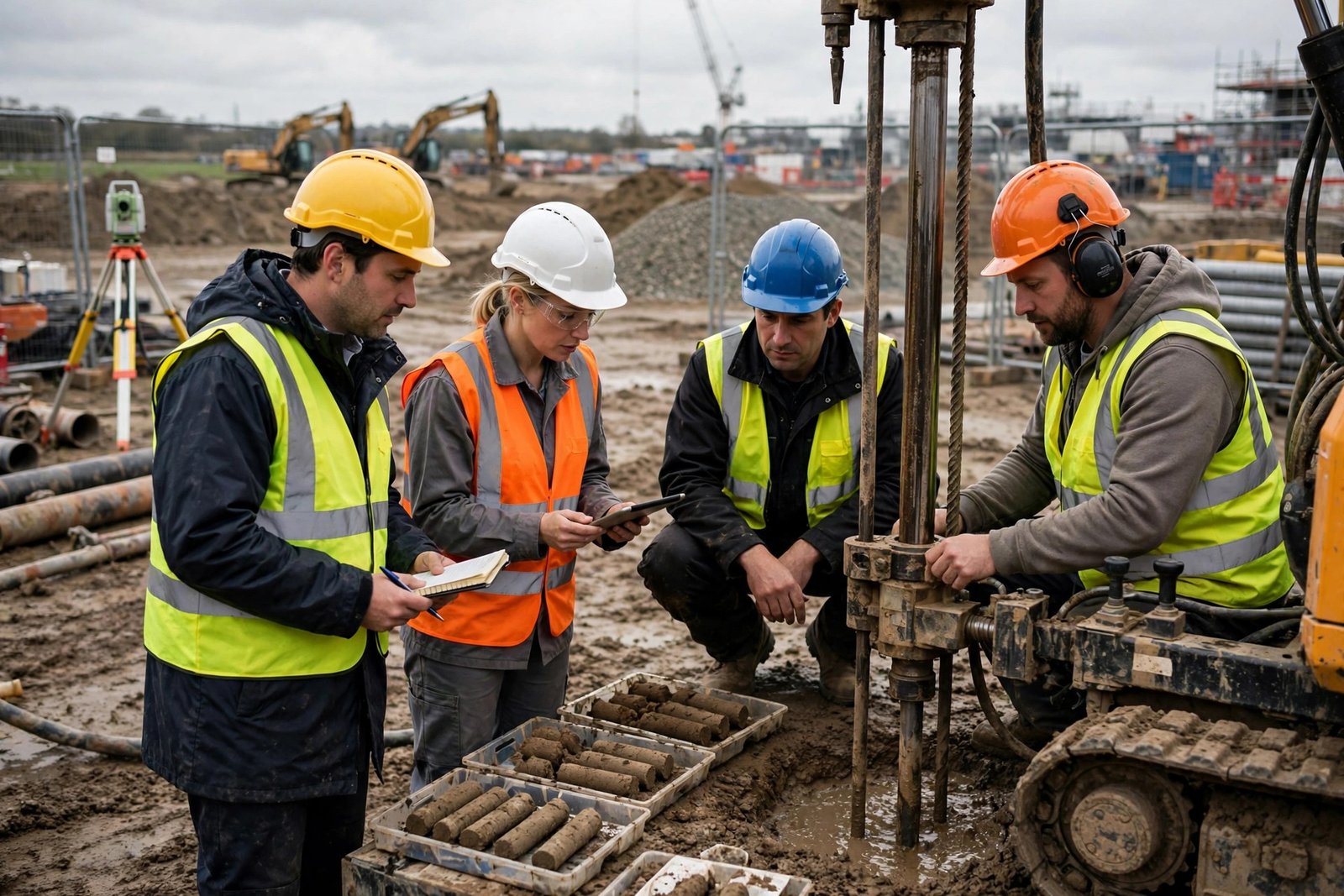
Site investigation, field testing and instrumentation are the practical skills that distinguish a strong graduate. You will learn how boreholes, trial pits, cone penetration tests, pressuremeter tests, geophysical surveys and laboratory programmes are planned, how a ground model is built from incomplete data, and how instrumentation such as inclinometers, piezometers and settlement markers is used to monitor performance during and after construction. Many programmes include fieldwork, laboratory sessions or a site visit, and these experiences are worth more in a job interview than a list of module titles. If a programme is entirely classroom-based, ask how it builds practical judgement.
Across the degree, assessment usually mixes examinations, coursework, laboratory and field reports, numerical modelling assignments and a substantial dissertation or capstone project. Choose a dissertation with real data or a realistic model and a clear engineering question: for example, settlement of a piled raft on variable ground, stability of a cut slope after rainfall, or ground movements from a tunnel in soft soil. A project that shows you can handle data, model a problem, recognise uncertainty and recommend a practical course of action will serve you well with employers in consultancy, contracting and infrastructure ownership.
Eligibility and entry requirements
The standard academic requirement is a bachelor’s degree in civil engineering or a closely related discipline, with strong grades in soil mechanics, structural analysis, geotechnics where offered, and mathematics. Universities publish minimum grade equivalents by country: a first-class or upper second-class honours equivalent is commonly expected in the United Kingdom, while universities in the United States and Canada assess grade point average alongside the full transcript, and German universities often apply their own grade conversion. If your degree is in geology, mining engineering, environmental engineering or a related field, you may be considered, but you should expect questions about your structures and soil mechanics background, and in some cases you may need to complete prerequisite modules.
English language requirements are set by each university and by immigration authorities. Typical requirements for engineering master’s degrees are in the region of IELTS 6.0 to 7.0 overall, with minimum sub-scores, or an equivalent TOEFL, PTE or other accepted test. Some universities waive the test for applicants who studied in English or hold certain qualifications, but a waiver is never automatic: check the exact wording on the university page. If your score is slightly below the requirement, pre-sessional English courses are available at many universities, adding time and cost but offering a route for academically strong applicants.
Standardised tests are rarely central for this degree outside the United States. Many United States programmes no longer require the GRE, but some still recommend or require it, especially for funded or research-oriented places. Programmes in the United Kingdom, Canada, Australia and Germany rarely require the GRE for taught master’s degrees. Letters of recommendation, a statement of purpose and a curriculum vitae matter everywhere: recommenders should be able to comment on your technical ability, ideally in geotechnics, structures or related laboratory and project work, and your statement should name the technical areas you want to specialise in, such as foundations, tunnelling or slope engineering, rather than offering only general enthusiasm for construction.
Work experience is not usually required for a taught MS in Geotechnical Engineering, but relevant experience strengthens an application and helps with employment afterwards. Site experience, internships with consultancies or contractors, laboratory work, surveying, and familiarity with geotechnical software all help. If you have no industry experience, a strong final-year geotechnical project, fieldwork experience and a dissertation or portfolio that shows data handling and modelling are good substitutes, provided you can describe what you did, what the data showed and what you would do differently on a real project.
Entry requirements by country
| Country | What applicants should expect |
|---|---|
| United States | Bachelor’s in civil engineering or a related field; GPA and transcripts assessed; GRE required by some programmes and optional at many others; English test for most international applicants; Professional Engineer licensure pathway varies by state |
| United Kingdom | Usually a good honours degree in civil engineering; IELTS typically around 6.5 overall; one-year master’s is common; check accreditation by the Institution of Civil Engineers or the Joint Board of Moderators where relevant |
| Canada | Four-year bachelor’s in a relevant discipline; GPA thresholds vary by university; English test required unless exempt; course-based and thesis-based master’s options differ in length and funding |
| Australia | Recognised bachelor’s in engineering or a cognate discipline; Engineers Australia accreditation is relevant for professional recognition; English test required unless exempt; two-year master’s is common for international students |
| Germany | Recognised bachelor’s with sufficient civil engineering and mathematics content; many programmes taught in English, with German helpful for internships and local employment; blocked account and other visa finance rules apply |
Licensing and professional recognition deserve a separate check. In the United States, Professional Engineer licensure involves examinations and supervised experience and varies by state, and some states have specific requirements for geotechnical practice. In Canada, provincial regulators govern the Professional Engineer designation. In the United Kingdom, Incorporated Engineer and Chartered Engineer routes run through professional institutions. In Australia, Engineers Australia assesses qualifications for migration and professional purposes. Admission to a master’s degree does not by itself confer any of these titles, and you should read the relevant regulator’s guidance before assuming a particular route.
Tuition fees and living costs
Tuition fees for an MS in Geotechnical Engineering vary widely by country, university and programme length, so a single average would mislead. Public universities in Germany often charge low or no tuition for many master’s programmes, with a semester contribution and living costs to cover, while universities in the United States, the United Kingdom, Canada and Australia typically publish annual international tuition on the programme page. Always compare the total programme cost, not just the annual figure, and confirm whether fees are fixed for the duration or rise each year. Fieldwork, laboratory and site-visit costs should also be checked, because they are sometimes charged separately.
Living costs vary just as much. Capital cities and major infrastructure hubs are usually the most expensive, while smaller university towns can be substantially cheaper. Visa finance rules give a useful floor for planning: for Germany, the blocked account requirement cited in StudyGraduate’s programme briefs is 11,904 euros for 2026, and for Australia the living-cost figure used for student visa planning is 29,710 Australian dollars. For the United Kingdom, student visa maintenance figures verified in the briefs are 1,529 pounds per month in London and 1,171 pounds per month outside London, rising to 1,570 and 1,203 pounds respectively for applications on or after 30 November 2026. These are planning and visa figures, not promises about your actual spending, and they must be rechecked against official immigration pages at the time you apply.
Use the tuition fee calculator and the cost of living calculator to build a personal budget, then test it against the official programme page and the university’s own living-cost guidance. Include health insurance, visa fees, travel, books, field clothing and safety equipment where required, and a contingency for currency movement. If you are comparing a one-year degree with a two-year degree, include the second year of living costs and the extra year of forgone earnings, as well as any placement, internship or research assistant income the longer programme makes possible. Assume at the budgeting stage that you will pay full fees unless a scholarship is confirmed in writing.
Top universities and countries for geotechnical engineering
The United States is strong in geotechnical engineering through its large infrastructure, energy and transportation programmes, its research universities and its specialist consultancies. Look for departments with active geotechnical research groups, centrifuge or advanced laboratory facilities, and links to tunnelling, dam, offshore or earthquake engineering where those match your interests. The UC Berkeley profile in the StudyGraduate universities directory is a useful starting point for exploring a major United States civil engineering school, and the broader universities directory lets you compare institutions by country and field.
The United Kingdom has a long tradition in soil mechanics and geotechnical practice, and many of its one-year master’s degrees are designed with industry input and taught partly by practising geotechnical engineers. The shorter duration can reduce total living costs, but it also means an intense year with limited time for a long internship, so students who need work experience should weigh programmes with industry projects or placement opportunities. The Netherlands, Germany and other European countries also offer strong geotechnical and tunnelling programmes, often with English-taught options and close links to water, port and underground infrastructure.
Canada and Australia combine strong civil engineering schools with large infrastructure, mining and energy sectors that employ geotechnical engineers, and with post-study work routes that many international students value. The length of stay and eligibility rules depend on the programme, the institution and the immigration rules in force when you graduate, so check them on official government pages rather than relying on a university brochure. In every country, use a consistent checklist when comparing universities: the exact module list and how much is geotechnical core versus general civil engineering; laboratory, fieldwork and centrifuge facilities where relevant; dissertation options and industry links; graduate employment destinations where published; total programme cost; and the infrastructure employers near the university.
University rankings can help with a first shortlist, and StudyGraduate’s rankings directory presents QS and THE figures separately by provider, but a rank is not a substitute for reading the curriculum. Two programmes with similar names can differ sharply in how much tunnelling, earthquake geotechnics, offshore geotechnics or ground improvement they actually teach. Choose the programme whose specialisms match the work you want to do, and whose teaching staff are active in that area.
Careers and salaries
Geotechnical graduates work for specialist geotechnical consultancies, multidisciplinary civil consultancies, contractors, tunnelling and infrastructure joint ventures, mining and energy companies, dam and water authorities, and public-sector infrastructure owners. Common job titles include geotechnical engineer, geotechnical design engineer, tunnelling engineer, foundations engineer, site investigation engineer and engineering geologist, where the background allows. With experience, graduates move into senior and principal geotechnical engineer roles, associate and technical director positions, project engineering and specialist advisory work. Some move into risk, insurance or asset management roles where understanding ground risk is central.
Official salary data is best read at the level of the broader occupation, because statistical agencies do not publish a separate median for the narrow specialism of geotechnical engineering, which is grouped with civil engineering in United States and Canadian statistics. In the United States, the Bureau of Labor Statistics Occupational Outlook Handbook reports a median annual wage of 100,840 dollars for civil engineers in May 2025, with employment projected to grow 6 percent from 2025 to 2035, faster than the average for all occupations, and about 22,700 openings projected each year on average over the decade. Those figures describe the whole civil engineering occupation, including experienced engineers, and are not a starting salary or a guarantee for a new graduate.
| Role or benchmark | Official figure | Source and year |
|---|---|---|
| Civil engineers, United States, median annual wage | 100,840 US dollars | US Bureau of Labor Statistics, Occupational Outlook Handbook, May 2025 |
| Civil engineers, United States, projected employment growth | 6 percent, 2025 to 2035 | US Bureau of Labor Statistics, Occupational Outlook Handbook |
| Civil engineers, Canada, median hourly wage | 48.56 Canadian dollars per hour | Government of Canada Job Bank, updated 19 November 2025 |
| Electrical and electronics engineers, United States, median annual wage (for comparison) | 125,040 US dollars | US Bureau of Labor Statistics, Occupational Outlook Handbook, May 2025 |
Salary varies by country, city, project type, experience and licensing. Tunnelling, offshore and major infrastructure projects often pay premiums for site-based and specialist work, including allowances for remote or shift work, while consultancy roles may offer faster technical progression and varied projects. Use the career path explorer to map roles against your interests, and then check current job postings in your target country for the skills employers actually list, such as PLAXIS, GeoStudio, site investigation experience, logging and interpretation of borehole data, or tunnelling experience. A graduate who can show fieldwork, laboratory testing and a modelling project will usually be more competitive than one who can only list software names.
For long-term progression, three investments pay off repeatedly: a portfolio of site, laboratory and modelling work you can explain and defend; experience with a real ground problem, whether through an internship, dissertation or site project; and progress towards professional licensing or chartered status where relevant. Learn the codes, standards and investigation practices that apply in your target country, because geotechnical practice is local: ground conditions, investigation norms, design codes and contracting practices differ between countries, and employers value engineers who understand the local context. Keep your judgement honest: in geotechnical engineering, recognising uncertainty and recommending further investigation is a professional strength, not a weakness.
Scholarships for geotechnical engineering
Scholarships for this field come from universities, governments, industry and foundations, and most are competitive. University scholarships may be merit-based or tied to a specific department or research area, including infrastructure, tunnelling or earthquake engineering. Government scholarships in destination countries and in students’ home countries often cover tuition and living costs but have their own eligibility rules, deadlines and sometimes return or service conditions. Industry scholarships from consultancies, contractors and infrastructure owners sometimes include internships or site placements, which can be as valuable as the funding itself.
Start with the university’s own scholarship pages for each programme on your shortlist, because deadlines often fall months before the programme deadline and some awards require a separate application. Then explore StudyGraduate’s scholarships directory and the scholarship finder for awards relevant to civil engineering and infrastructure. Read the conditions carefully: some scholarships are one-year only, some require a minimum grade to continue, and some restrict the programmes or nationalities eligible. Never pay an agent or third party for a scholarship application that the official provider offers free, and treat any message guaranteeing a scholarship as a warning sign.
How to apply: a practical timeline
Begin twelve to fifteen months before your intended start date if you can. First, shortlist six to ten programmes using the curriculum checklist above, and confirm entry requirements, language requirements and deadlines on official pages. Second, prepare for and book English tests early, because scores take time to arrive and re-sits are common. Third, request recommendation letters with enough notice and give your referees your transcript, statement draft and a list of the programmes, so their letters can be specific. Fourth, draft a statement of purpose for each programme that names the modules, research groups or industry links that attract you, and the technical preparation you bring, including any fieldwork or laboratory experience.
Fifth, submit applications in order of deadline, not preference, and keep a record of every portal login, document uploaded and confirmation received. Sixth, once offers arrive, compare total cost, curriculum, location and conditions, and ask departments direct questions about fieldwork, laboratory access, dissertation supervision and industry links before accepting. Seventh, prepare visa documents, finance evidence and health requirements well before the deadline, because visa processing times vary and finance evidence often has a required holding period. Finally, use the waiting period to revise soil mechanics, practise geotechnical software if you have access, and read case histories of major geotechnical projects, so you arrive ready for postgraduate-level work.
Frequently asked questions
Do I need a civil engineering bachelor’s degree to apply?
In most cases, yes, or a very closely related degree with substantial civil, structures, soil mechanics and mathematics content. Applicants from geology, mining or environmental engineering are sometimes accepted, but you should confirm prerequisites with the programme team and be prepared to show relevant modules.
Is geotechnical engineering the same as structural engineering?
No. Structural engineering designs the structure above ground, while geotechnical engineering designs the foundations and earthworks below and around it, and assesses the ground itself. The two work closely together, and a good engineer in either field understands the interface between structure and ground.
How long does the degree take?
Typically one year full-time in the United Kingdom, and one and a half to two years in the United States, Canada, Australia and much of Europe. Part-time and online options exist at some universities but take longer and may affect visa eligibility, so check the study mode rules for international students.
Will I have to do fieldwork?
Most strong programmes include fieldwork, laboratory work, site visits or industry-linked projects, although the amount varies. Field experience is highly valued by employers, so ask each programme what practical work it includes before you apply.
Do I need the GRE?
It depends on the programme. Many United States programmes no longer require it, while some still require or recommend it. Programmes in the United Kingdom, Canada, Australia and Germany rarely require the GRE for taught master’s degrees. Check each programme page rather than assuming a single rule.
What salary can I expect after graduation?
No honest guide can give you a personal salary figure. Official benchmarks are given in the careers section above: the United States Bureau of Labor Statistics reports a median of 100,840 dollars for civil engineers in May 2025. Your actual pay will depend on country, city, project type, employer, experience and licensing, and tunnelling or site-based roles may include allowances.
Is this degree good for staying abroad after graduation?
Post-study work rules vary by country, programme and graduation date, and they change. The United States, United Kingdom, Canada and Australia all have post-study work routes, but eligibility, duration and conditions must be checked on official immigration pages at the time you graduate. A degree alone does not guarantee a work visa or permanent residence.
What should I look for when choosing between two similar programmes?
Compare the module lists in detail, especially foundations, slopes, retaining structures, tunnelling and ground improvement; laboratory and fieldwork facilities; dissertation and industry links; total cost and duration; and the infrastructure employers near the university. Talk to current students or recent graduates if the university can connect you, and ask what practical experience the programme gave them.
Sources and Verification
- US Bureau of Labor Statistics, Occupational Outlook Handbook: Civil Engineers — median pay, projections and openings, May 2025 and 2025 to 2035.
- US Bureau of Labor Statistics, Occupational Outlook Handbook: Electrical and Electronics Engineers — median pay used for comparison, May 2025.
- Government of Canada Job Bank, Civil Engineer wages — national median hourly wage, updated 19 November 2025.
- Official university programme pages and admissions pages for entry requirements, module lists, fees and deadlines — to be checked for each shortlisted programme.
- Official immigration pages for the United States, United Kingdom, Canada, Australia and Germany for visa finance, English and post-study work rules.
- StudyGraduate programme briefs for verified visa finance figures cited in this guide, including Germany, Australia and United Kingdom maintenance amounts.
Figures change yearly. Confirm fees, entry requirements, scholarship deadlines and visa rules on the official university and government page before you apply. StudyGraduate is an information portal, not an agency, and never promises admission, jobs, salaries or visa or permanent residence outcomes. External links in this guide are to official and authoritative sources only.