

MS in Embedded Systems Abroad: Eligibility, Fees, Top Universities and Careers
An MS in Embedded Systems is a graduate degree for engineers who build the computing that hides inside other products. An embedded system is a computer designed for a specific task inside a larger device: the controller that manages a car’s brakes, the processor inside a medical monitor, the chip that runs a washing machine, the flight computer in a drone, the sensor node that reports soil moisture from a field. Unlike a laptop or phone, an embedded system usually has tight limits on power, memory, size, cost and timing, and it often has to work correctly for years without a user present to restart it. This degree teaches you to design both the hardware and the software of such systems, and to prove that they behave safely and reliably under real conditions. It is aimed at graduates in electronics, electrical engineering, computer engineering, mechatronics and computer science, and at working engineers who want to move into embedded design, firmware, automotive, aerospace, medical device or Internet of Things roles.
This guide explains what the degree covers, who is eligible, what it costs in the main study destinations, which universities and countries are strong choices, what careers it leads to, and how to judge whether it is the right next step. Salary figures in this article come only from official statistics, with the source and reference year stated next to each figure. Statistical agencies do not publish a single occupation called “embedded engineer”, so this article uses the closest official occupations — computer hardware engineers, electrical and electronics engineers, and software developers — and labels them as such. Where an official figure for a narrow embedded job title could not be verified, the number has been omitted rather than estimated. Fees, visa rules and post-study work options change regularly, so always confirm the current position on the official university or government page before you apply.
At a glance
| Feature | Typical position |
|---|---|
| Degree level | Master’s degree, usually an MSc, MS or MEng depending on the country and university |
| Typical duration | 1 year in the United Kingdom; 1.5 to 2 years in the United States, Canada and Australia; 2 years in much of continental Europe, including Germany |
| Who it suits | Electronics, electrical, computer and mechatronics graduates, and engineers moving into firmware, hardware and IoT roles |
| Core subjects | Embedded programming, real-time operating systems, digital hardware, signal processing, control systems, IoT and safety |
| Common outcomes | Embedded software engineer, firmware engineer, hardware engineer, systems engineer, automotive and IoT engineer |
| Capstone options | Hardware and software prototype, industry project, or research thesis with a working demonstrator and evaluation |
What is an MS in Embedded Systems?
Embedded systems sit at the boundary between hardware and software, and that boundary is the whole point of the degree. A pure software graduate may write excellent code for a server but struggle with interrupts, memory-mapped peripherals, power budgets and timing deadlines. A pure hardware graduate may design an excellent circuit but struggle with software architecture, testing and maintainability. An embedded systems graduate is expected to do both: to read a datasheet, choose a microcontroller or processor, design or understand the surrounding circuitry, write efficient firmware, debug with oscilloscopes and logic analysers, and deliver a system that meets its timing, power and safety requirements.
The constraints are what make the field distinctive. A desktop program can usually use more memory or wait a little longer; an embedded system often cannot. A missed deadline in a motor controller, a pacemaker or an anti-lock braking system is not an inconvenience but a safety failure. Power matters because many devices run on batteries or harvested energy. Cost matters because a device may be manufactured in millions, so a small saving per unit is large in total. Reliability matters because the device may be inaccessible, in a vehicle, a factory, a satellite or a patient’s home. The degree teaches you to design within these constraints and to test that your design actually meets them, rather than assuming it does.
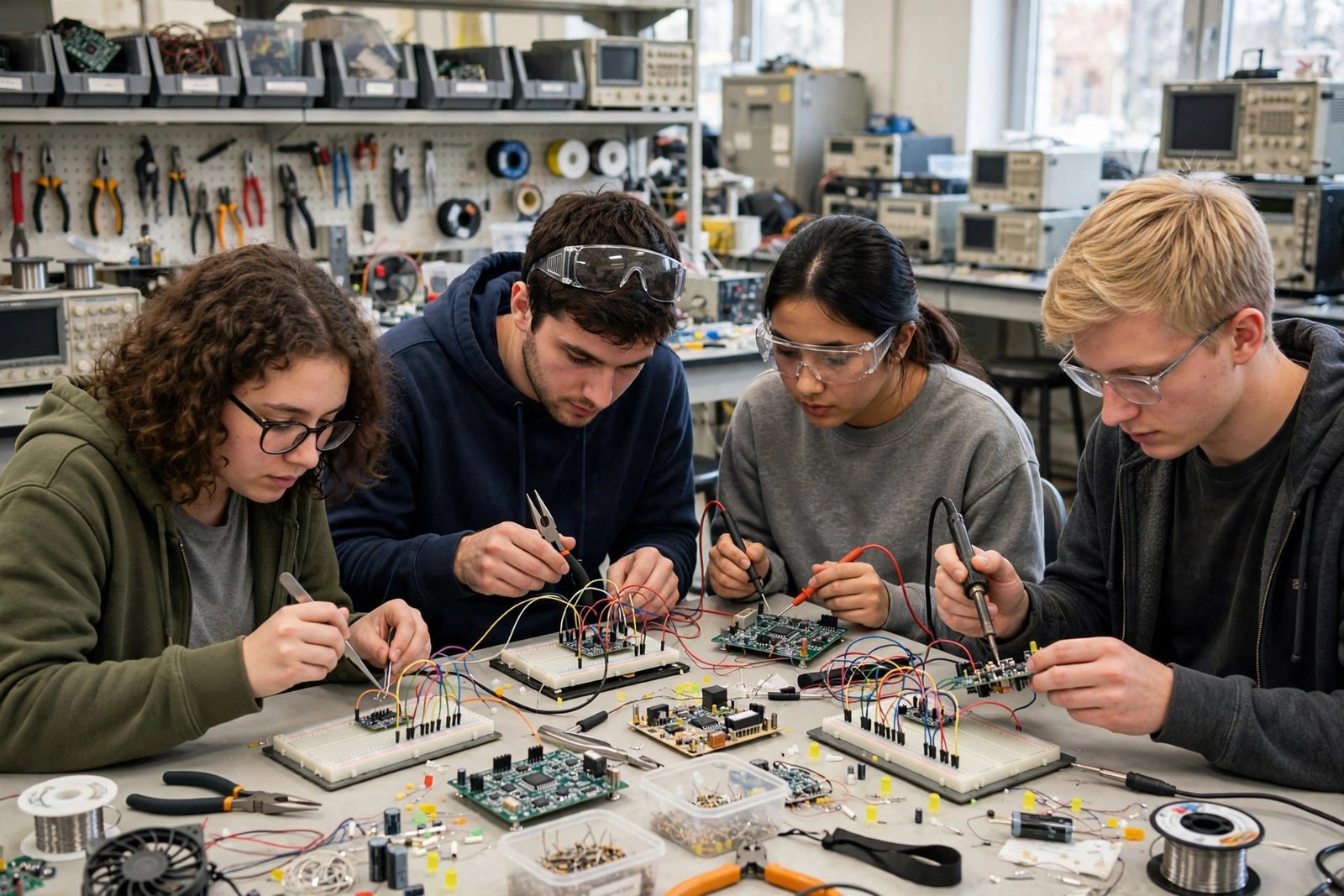
Most programmes combine taught modules with laboratory work and a substantial project. Laboratory work is central: you will program microcontrollers, interface sensors and actuators, work with real-time operating systems, and debug hardware with instruments. The capstone project usually produces a working prototype — a device, a subsystem or a demonstrator — with documentation, test results and an evaluation against the original requirements. If you are choosing between programmes, ask about laboratory access, what hardware platforms students use, whether industry partners set projects, and whether you keep or can document your prototype for a portfolio. A programme without serious laboratory work is a warning sign in this field.
It is worth distinguishing this degree from neighbouring degrees. A general electronics or electrical engineering master’s may cover communications, power or signal processing without the same focus on embedded software. A MSc in Computer Science focuses on software and theory, usually without hardware design. A Bachelor of Engineering is an undergraduate qualification, not a master’s, though it is a common entry route into this degree. A robotics master’s overlaps in control and sensing but is broader in mechanics and autonomy. If your goal is to build the computing inside physical products, embedded systems is the more direct choice. The Courses and Programs directory can help you compare neighbouring programmes.
What you study: curriculum in detail
Embedded programming and firmware
You study programming close to the hardware, usually in C and often in C++, with attention to memory management, pointers, bit manipulation, interrupts, direct memory access and low-level drivers. You learn to write code that is efficient, testable and maintainable, and to use version control, static analysis and unit testing for firmware — practices borrowed from software engineering and adapted to constrained devices. Assembly language appears where it is needed to understand performance, startup code and debugging, rather than as an end in itself.
Real-time systems and operating systems
Real-time operating systems schedule tasks so that deadlines are met predictably. You study scheduling theory, priority inversion, inter-task communication, synchronisation, and how to analyse worst-case timing. You also study bare-metal design, where no operating system is used, and when each approach is appropriate. This is the theoretical core of the degree, and it is what separates embedded engineering from ordinary application programming.
Digital hardware and system design
Hardware modules cover processor architectures, memory systems, buses and interfaces, field-programmable gate arrays where offered, and hardware-software co-design: deciding which functions belong in hardware and which in software. You learn to read schematics and datasheets, to design or evaluate interface circuitry, and to use simulation and prototyping tools. Some programmes include printed circuit board design; others focus on using development boards and modules. Check which applies before you choose.
Signal processing, control and sensing
Many embedded systems sense the world and act on it. You study digital signal processing, filtering, sensor interfacing and calibration, analogue-to-digital conversion, and control theory for systems such as motor control, robotics and process control. These modules connect the mathematics of signals and control to the practical work of making a physical system behave as intended, and they are especially important for automotive, aerospace, robotics and medical applications.
Networking, IoT and security
Connected embedded devices need networking and security designed for constrained hardware. You study embedded networking protocols, wireless communication, Internet of Things architectures, edge computing, over-the-air updates, and security threats specific to devices: physical access, side channels, insecure update mechanisms and weak authentication. Security is increasingly a core module rather than an elective, because connected devices are attractive targets and cannot always be patched easily after deployment.
Safety, verification and electives
Safety-critical modules cover hazard analysis, fault tolerance, redundancy, formal verification where offered, and the standards that govern automotive, aerospace and medical systems. Electives often include automotive systems, aerospace systems, medical devices, robotics, machine learning on embedded devices, and advanced hardware design. Choose electives by the industry you want to enter, because automotive, medical and consumer IoT employers value different specialisations. Your capstone should align with your electives so that your portfolio tells one coherent story to employers in that industry.
Eligibility and entry requirements
Most programmes require a bachelor’s degree in electronics, electrical engineering, computer engineering, mechatronics, computer science or a closely related subject, usually with a good grade. Universities in the United States and Canada commonly ask for a GPA around 3.0 on a 4.0 scale or the local equivalent, though competitive programmes expect more. Universities in the United Kingdom commonly ask for a 2:1 honours degree or equivalent, with some accepting a 2:2 plus relevant experience. German universities typically require a relevant bachelor’s degree and check prior coursework in required subjects such as electronics, digital systems and programming. Australian universities usually require a relevant bachelor’s degree, sometimes with a specified major or credit average.
Applicants from pure software backgrounds are sometimes admitted if they can demonstrate electronics and hardware fundamentals, and applicants from pure hardware backgrounds are sometimes admitted if they can demonstrate programming ability. A portfolio helps considerably in both directions: a working embedded project, documented with schematics, code and test results, is stronger evidence than a statement of interest. Some programmes offer bridging modules for students missing a particular prerequisite. Check the prerequisite list on each programme page, because requirements in mathematics, electronics and programming differ.
English language requirements are standard for English-taught programmes. Typical thresholds are IELTS 6.5 overall with no band below 6.0, or TOEFL iBT around 90, but thresholds vary by programme. Always check the programme page. Other application components usually include transcripts, a statement of purpose, letters of recommendation and a CV. A strong statement for embedded systems describes a device or subsystem you have actually built, the constraints you faced, how you debugged it, and what you want to build at a larger or more safety-critical scale. Photographs, videos or repository links to your project, where the application allows them, can strengthen your case.
Tuition and living costs
Tuition varies enormously by destination, and the ranges below are indicative for 2026 entry; confirm the exact fee on the university page for your intake. In the United Kingdom, one-year master’s tuition for international students is commonly in the range of about £25,000 to £40,000, with London programmes at the higher end. In the United States, international tuition varies widely between public and private universities and by city. In Canada, international graduate tuition varies by province and university. In Australia, international master’s tuition is commonly quoted per year in Australian dollars. In Germany, most public universities charge no tuition for consecutive master’s programmes apart from a semester contribution, although Baden-Württemberg charges non-EU students €1,500 per semester and some universities, such as TU München, have introduced non-EU fees since 2024/25. Germany is a particularly strong destination for this field because of its automotive, industrial automation and engineering industries, and low tuition is an additional advantage.
Living costs are separate from tuition. Governments publish the financial evidence they expect from visa applicants, and those figures are a useful floor for budgeting. For the United Kingdom, Student visa maintenance is £1,529 per month in London and £1,171 per month outside London, for up to nine months, rising to £1,570 and £1,203 respectively for applications on or after 30 November 2026. For Canada, study permit living-cost funds are CAD 22,895 for applications from 1 September 2025 to 31 August 2026, and CAD 23,448 from 1 September 2026, excluding tuition and travel. For Germany, the blocked account requirement is €11,904 per year for 2026. For Australia, financial capacity for living costs is AUD 29,710 per year. Use the tuition fee calculator and the study abroad budget planner to model your own combination of tuition, rent, food, insurance and travel.
| Destination | Typical duration | Tuition note for international students (2026 entry, check official page) | Visa living-cost evidence |
|---|---|---|---|
| United States | 1.5–2 years | Wide range; public vs private matters most | University-issued cost estimate on the I-20 |
| United Kingdom | 1 year | Commonly about £25,000–£40,000 total | £1,529/mo London; £1,171/mo outside (rising 30 Nov 2026) |
| Canada | 1.5–2 years | Varies by province and university | CAD 22,895 to 31 Aug 2026; CAD 23,448 from 1 Sep 2026 |
| Australia | 1.5–2 years | Quoted per year in AUD; varies by university | AUD 29,710 per year living costs |
| Germany | 2 years | Mostly no tuition at public universities; exceptions noted above | Blocked account €11,904 per year (2026) |
Beyond tuition and rent, budget for health insurance, visa fees, flights, books and equipment, and a contingency fund. You may also want a personal development board and basic test equipment for your own projects, though universities normally provide laboratory hardware. Part-time work rights differ by country and visa: the United States limits F-1 students to on-campus work of 20 hours per week in term; Australia allows 48 hours per fortnight in term; Canada allows 24 hours per week off campus. Do not build a budget that depends on part-time earnings you have not yet secured.
Top universities and countries for this programme
Choosing a country is partly a choice about programme length, cost, post-study work rights and proximity to the industries that hire embedded engineers. Germany is strong for automotive and industrial automation, with an 18-month job-seeker residence permit after graduation and low or no tuition at public universities. The United States offers deep semiconductor, aerospace, defence and consumer electronics industries, with Optional Practical Training of 12 months plus a 24-month STEM extension for eligible STEM degrees, giving up to 36 months in total. The United Kingdom offers one-year programmes that reduce total cost, plus the Graduate Route, currently two years and three years for PhD graduates, with an announced reduction to 18 months for applications on or after 1 January 2027. Canada offers post-graduation work permits of up to three years, with master’s and doctoral graduates exempt from the field-of-study rule that applies to some other programmes. Australia offers post-study work under subclass 485, with durations depending on qualification level. None of these options guarantees employment or residence.
For university choice, look beyond headline rankings. Strong embedded programmes are found across the universities directory, and you can compare programmes with the university comparison tool. Useful signals include laboratory facilities and hardware platforms, industry partnerships with automotive, semiconductor or medical device employers, the capstone model, faculty research in embedded and real-time systems, and graduate employment data published by the university itself. Rankings on StudyGraduate are presented per provider — QS and THE figures are shown separately and never merged — and you can explore them in the rankings section. A programme with strong laboratories and industry projects in your target industry may serve you better than a more famous university whose master’s is largely theoretical.
Also consider the region: embedded jobs cluster around automotive manufacturing, semiconductor fabrication, aerospace centres and industrial automation hubs. Proximity matters for internships, industry projects and hiring. Ask admissions teams about placement rates, industry partners and where recent graduates work, and treat vague answers as information. If you already know your target industry — automotive, medical, aerospace, consumer electronics or industrial IoT — let that drive your shortlist more than general reputation.
Careers and salaries
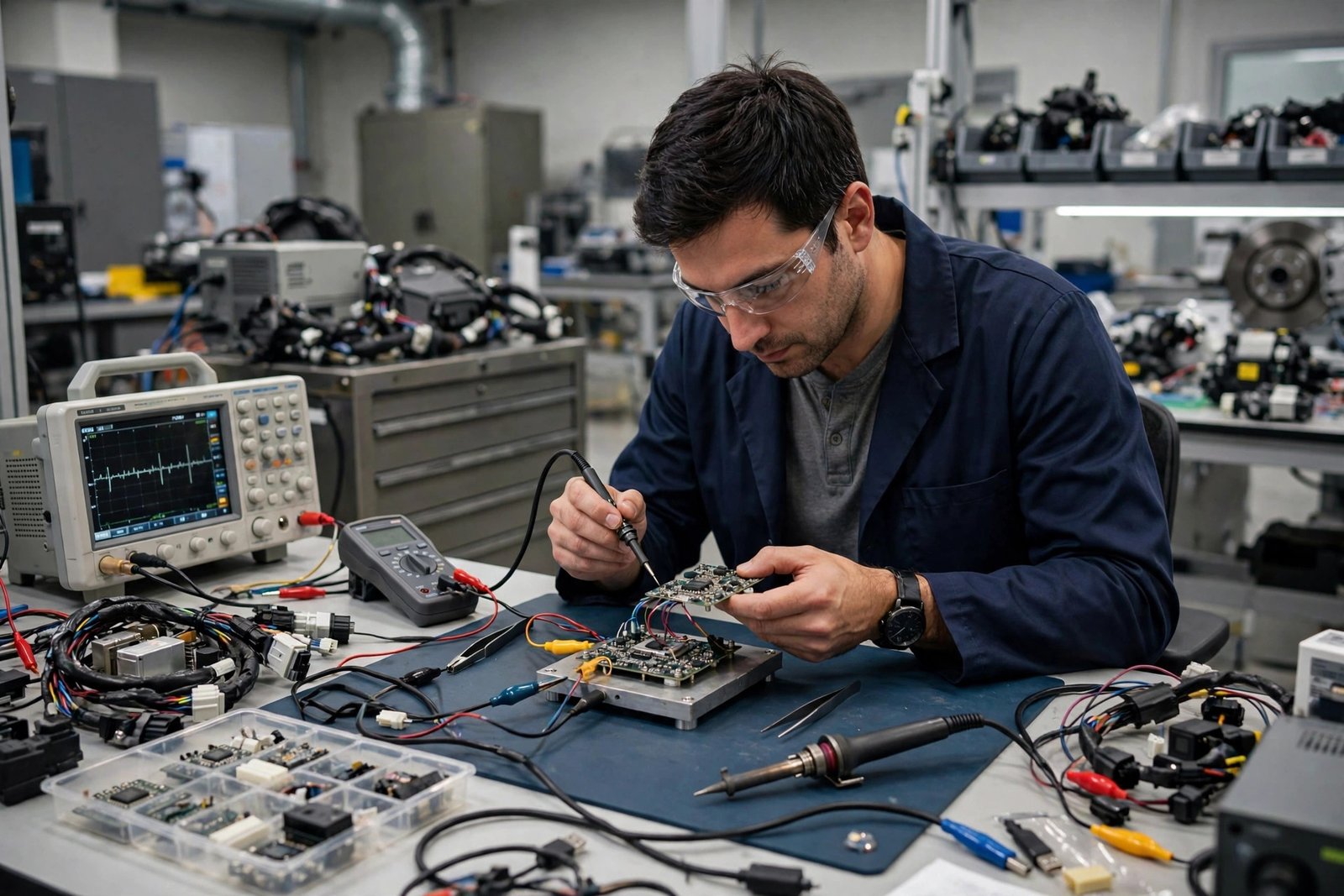
Graduates work as embedded software engineers, firmware engineers, hardware and systems engineers, test and validation engineers, automotive software engineers, IoT engineers, robotics engineers and, with experience, systems architects and engineering managers. Industries include automotive, aerospace, medical devices, consumer electronics, telecommunications, industrial automation, energy and defence. The degree is particularly useful where hardware and software meet and where failure has real consequences: a firmware engineer who understands both the circuit and the code is harder to replace than a specialist in only one side.
Because statistical agencies do not publish an “embedded engineer” occupation, the table below uses the closest official occupations and labels them as such. Do not read these figures as embedded-specific salaries. The United States Bureau of Labor Statistics (BLS) reports a 2025 median pay of $161,740 per year for computer hardware engineers in its similar-occupations table. The BLS Occupational Outlook Handbook reports a 2025 median pay of $134,040 per year for software developers, quality assurance analysts and testers combined, with employment projected to grow 10% from 2025 to 2035. The same BLS release reports a 2025 median pay of $175,140 per year for computer and information systems managers, with employment projected to grow 16% from 2025 to 2035. In Canada, the Job Bank Ontario wage report, reference period 2023–2024 and source Statistics Canada Labour Force Survey, reports a median of CAD $52.88 per hour for computer engineers except software engineers and designers, and CAD $50.00 per hour for electrical and electronics engineers. These figures describe labour markets at all experience levels; a new graduate should not expect the median immediately.
| Closest official occupation | Official median pay | Source and year |
|---|---|---|
| Computer hardware engineers (USA) | $161,740 per year | BLS similar-occupations table, 2025 median pay |
| Software developers, QA analysts and testers (USA) | $134,040 per year | BLS Occupational Outlook Handbook, 2025 median pay |
| Computer and information systems managers (USA) | $175,140 per year | BLS Occupational Outlook Handbook, 2025 median pay |
| Computer engineers except software (Ontario, Canada) | CAD $52.88 per hour (median) | Canada Job Bank, Ontario wages, reference period 2023–2024 |
| Electrical and electronics engineers (Ontario, Canada) | CAD $50.00 per hour (median) | Canada Job Bank, Ontario wages, reference period 2023–2024 |
Use the career path explorer to map these occupations against your interests. When you compare offers or destinations, compare like with like: median pay for an occupation is not a starting salary, and figures from different countries use different currencies, tax systems and benefits. Experience, industry, city and specialisation move pay far more than the degree title alone. In embedded work, industry matters particularly: automotive, aerospace and medical device roles often pay differently from consumer IoT roles, and safety-critical experience commands a premium because it is harder to acquire. The degree’s contribution is to give you the combined hardware and software skills and the portfolio to enter these roles and to progress toward systems architecture, not to guarantee a particular salary.
Scholarships for this field
Funding comes from university merit scholarships, departmental scholarships, government scholarships and external foundations, including industry-linked scholarships in automotive and semiconductor fields where offered. University scholarships are often awarded automatically on academic merit or by separate application with an earlier deadline, so check the funding page at the same time as the programme page. The scholarships directory is the place to browse current opportunities by country and level. Employer sponsorship is another route for working engineers, particularly where the degree is studied part-time, though part-time formats vary in visa eligibility for international students and must be checked carefully.
When you assess a scholarship, read the full terms: what it covers, whether it renews, what grades you must maintain, and whether it can be combined with other awards. A partial tuition scholarship at an expensive university can still leave a larger total cost than a full-fee place at a low-tuition university in Germany. Apply early, because scholarship deadlines commonly fall months before programme deadlines.
How to choose the right programme
Start with your goal and your target industry. If you want automotive embedded work, prioritise programmes with automotive electives, industry partners and safety modules. If you want medical devices, prioritise programmes with biomedical and safety content. If you want IoT and consumer devices, prioritise programmes with wireless, low-power and networking modules. If you want research, prioritise programmes with a research thesis and faculty working in real-time or embedded systems. Then filter by budget, programme length, visa and post-study work rules, and language of instruction. Then compare laboratory facilities, module lists and graduate outcomes, and contact current students where possible.
A practical shortlist method is to list five to eight programmes, score each on curriculum fit, laboratory quality, industry links, total cost, location and post-study options, and then apply to a mix of ambitious and realistic choices. Keep a spreadsheet of deadlines, document requirements, scholarship deadlines and decision dates. If you are applying from a country where document attestation takes time, start early; Bangladesh has operated under the Apostille system since 30 March 2025, which affects how documents are authenticated for use abroad, and you should confirm current requirements with the relevant authority. Before you commit, build one small embedded project of your own if you have not already — it will confirm whether you enjoy this work and strengthen every application you submit.
Frequently asked questions
Do I need an electronics degree to apply?
Most programmes prefer electronics, electrical, computer or mechatronics degrees, but some admit computer science graduates with demonstrated hardware fundamentals, and some admit hardware graduates with demonstrated programming ability. A working embedded portfolio helps considerably in both directions.
Is embedded systems the same as robotics?
No, though they overlap. Embedded systems is the computing inside a product, including its hardware, firmware and real-time behaviour. Robotics is broader, covering mechanics, kinematics, perception and autonomy, and it uses embedded systems as one component.
Which programming languages should I learn first?
C is the most important language for embedded work, with C++ increasingly used for larger firmware systems. Python is useful for tooling, testing and prototyping, but it rarely replaces C or C++ on constrained devices. Learn one language deeply, with real hardware, rather than several superficially.
How long does the degree take?
Typically one year in the United Kingdom, 1.5 to 2 years in the United States, Canada and Australia, and two years in much of continental Europe. Part-time options extend the duration and may affect visa eligibility.
Can I work while studying?
Work rights depend on your visa and country. The United States limits F-1 students to on-campus work of 20 hours per week in term; Australia allows 48 hours per fortnight in term; Canada allows 24 hours per week off campus. Check your visa conditions and do not rely on part-time earnings to fund tuition.
What jobs can I get after graduation?
Common roles include embedded software engineer, firmware engineer, hardware engineer, systems engineer, automotive software engineer and IoT engineer. Official figures for the closest occupations are given in the careers section; no outcome is guaranteed.
Does the degree help with post-study work visas?
Post-study work options depend on the country, not the degree title alone. Examples include United States OPT with a STEM extension where eligible, the United Kingdom Graduate Route, Canada’s post-graduation work permit, Australia’s subclass 485 and Germany’s 18-month job-seeker permit. Confirm current rules on the official immigration page.
Should I choose a one-year or a two-year programme?
A one-year programme costs less in total and returns you to work sooner, but leaves less time for laboratory depth and specialisation. A two-year programme allows deeper laboratory work, a longer capstone and often an internship, at higher total cost. Choose by your budget and prior hardware experience.
Sources & Verification
Sources consulted for this article: United States Bureau of Labor Statistics, Occupational Outlook Handbook — Software Developers, Quality Assurance Analysts, and Testers; United States Bureau of Labor Statistics, Occupational Outlook Handbook — Computer and Information Systems Managers; Canada Job Bank, Ontario wage report (reference period 2023–2024, source Statistics Canada Labour Force Survey); official university programme pages and government immigration pages for the destination rules summarised here. Figures change yearly — confirm fees and requirements on the official university page. StudyGraduate is an information portal, not an agency — we never promise admission, jobs, salaries or visa or permanent residence outcomes. Explore more programmes in the Courses and Programs directory.