
MS in Computer Vision Abroad: Eligibility, Fees, Top Universities and Careers
An MS in Computer Vision is a master’s degree in teaching machines to see. That simple description covers an extraordinary range of work: medical image analysis that helps clinicians detect disease earlier, autonomous vehicles that must understand roads and pedestrians, factory inspection systems that spot defects faster than any human eye, satellite and drone imagery that monitors crops and coastlines, augmented reality that overlays digital information on the physical world, and accessibility tools that describe images for people who cannot see them. If you are fascinated by images, geometry, learning and perception, and you want to build systems that interpret the visual world, this is a degree worth serious consideration.
This guide explains what a computer vision master’s actually covers, how it differs from general artificial intelligence or machine learning degrees, who should apply, what entry requirements look like by country, what costs to plan for, where the subject is strong, and what graduates go on to do. Salary figures come from the United States Bureau of Labor Statistics (BLS), with source and year stated next to each figure. The BLS does not publish a separate occupation called “computer vision engineer”, so this guide uses the nearest official occupations and says so plainly, rather than inventing a salary for a title the statistics do not track.
Computer vision is sometimes described as just applying deep learning to images. That description misses most of the subject. Modern computer vision certainly uses deep learning heavily, and any credible master’s programme will teach convolutional and transformer-based models, detection, segmentation and tracking in depth. But it also rests on geometry, optics, signal processing and statistics: how cameras form images, how three-dimensional structure can be recovered from two-dimensional views, how motion is estimated, how images are enhanced and restored, and how a system can be evaluated fairly when its errors have real consequences. A graduate who understands both the learning and the geometry, and who can reason about failure modes, is far more valuable than a graduate who can only train a model on a clean dataset.
At a glance
| Feature | Typical position for an MS in Computer Vision abroad |
|---|---|
| Degree level | Postgraduate master’s degree (MS, MSc or MEng depending on country and institution) |
| Typical duration | One year full-time in the UK; 18 months to two years in the United States, Canada, Australia and much of Europe, sometimes with a thesis or industry project |
| Core subjects | Image processing, deep learning for vision, object detection and segmentation, 3D vision, video analysis, medical imaging, visual tracking |
| Mathematics load | High: linear algebra, calculus, probability, statistics and optimisation, plus geometry for 3D vision |
| Who it suits | Computing, engineering, mathematics or physics graduates who enjoy visual problems, geometry and rigorous evaluation |
| Common next steps | Computer vision engineer, perception engineer, machine learning engineer, medical imaging scientist, research engineer, or a PhD |
Programme titles vary. Some degrees are called Computer Vision, others Visual Computing, Image Processing, or Artificial Intelligence with a vision specialisation. Some sit in computer science departments, others in electrical engineering, biomedical engineering or robotics departments, and that home department shapes the emphasis. A vision programme in an electrical engineering department may emphasise signal processing, optics and hardware, while one in a medical school or biomedical department may emphasise medical imaging. Read the compulsory modules, the laboratory facilities, the datasets and computing resources, and the thesis topics before assuming that two similarly titled programmes are equivalent.
What you study: the curriculum in detail
Most programmes begin with image processing and the foundations of vision. Expect image formation and cameras, filtering, edge detection, feature extraction and matching, colour and texture, and the mathematics of images as signals. These foundations matter even in an era dominated by deep learning, because they explain what a network is actually learning, why certain architectures work for certain problems, and how to preprocess, augment and debug visual data. Students who skip the foundations often struggle when a model fails on real images that differ from the training set, because they lack the tools to diagnose whether the problem is data, geometry, optics or learning.
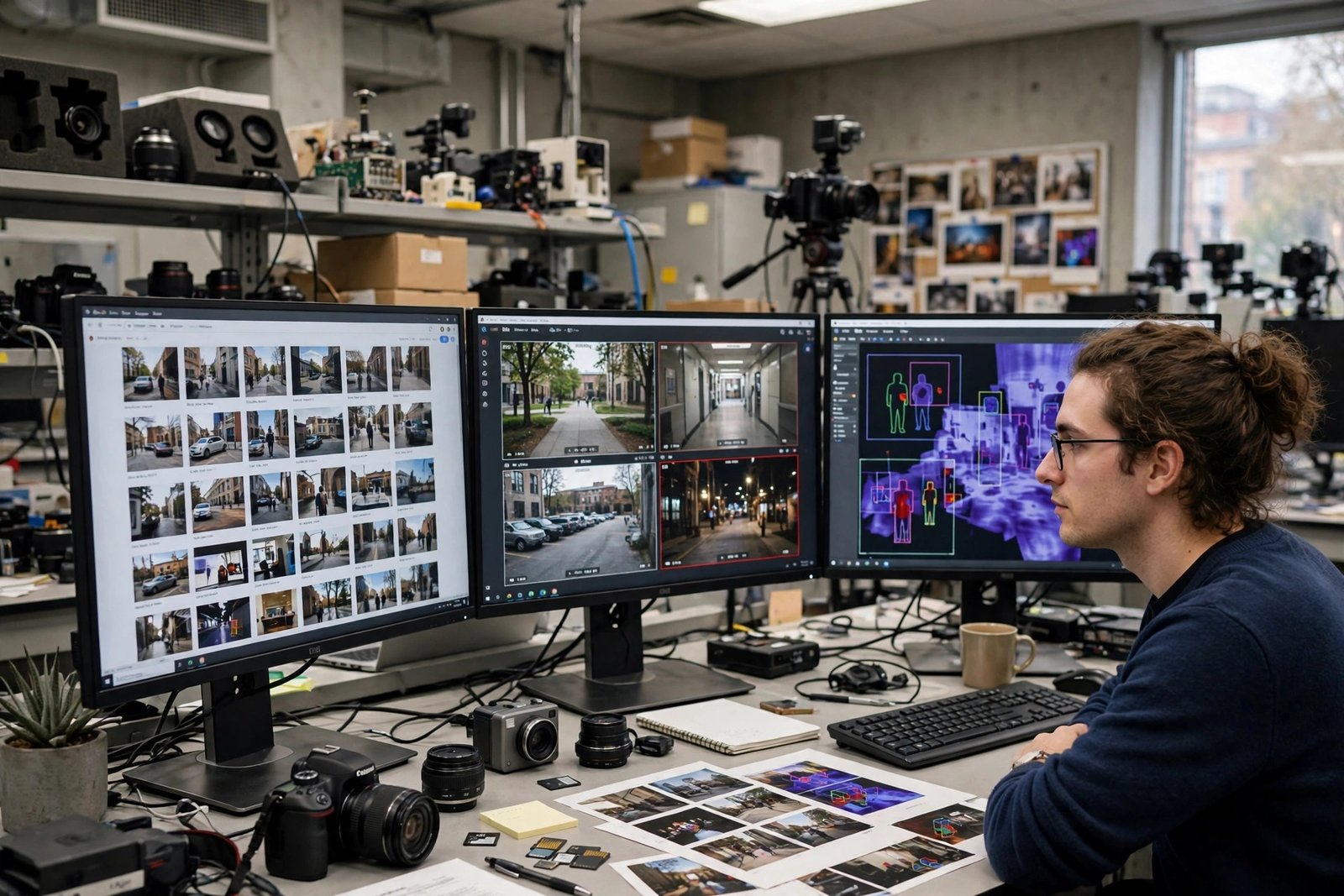
Deep learning for vision forms the next major strand. This covers convolutional networks, vision transformers, object detection, semantic and instance segmentation, pose estimation, tracking, and video understanding, together with training practices: data augmentation, transfer learning, evaluation metrics, and handling class imbalance and limited labelled data. A strong programme teaches evaluation with unusual care, because vision metrics can mislead. A detection system with high average accuracy can still fail systematically on small objects, on people in wheelchairs, or in poor lighting, and those failures matter enormously in medical, automotive and safety-critical applications. Learning to slice evaluation by subgroup, condition and failure mode is one of the most important professional skills in this field.
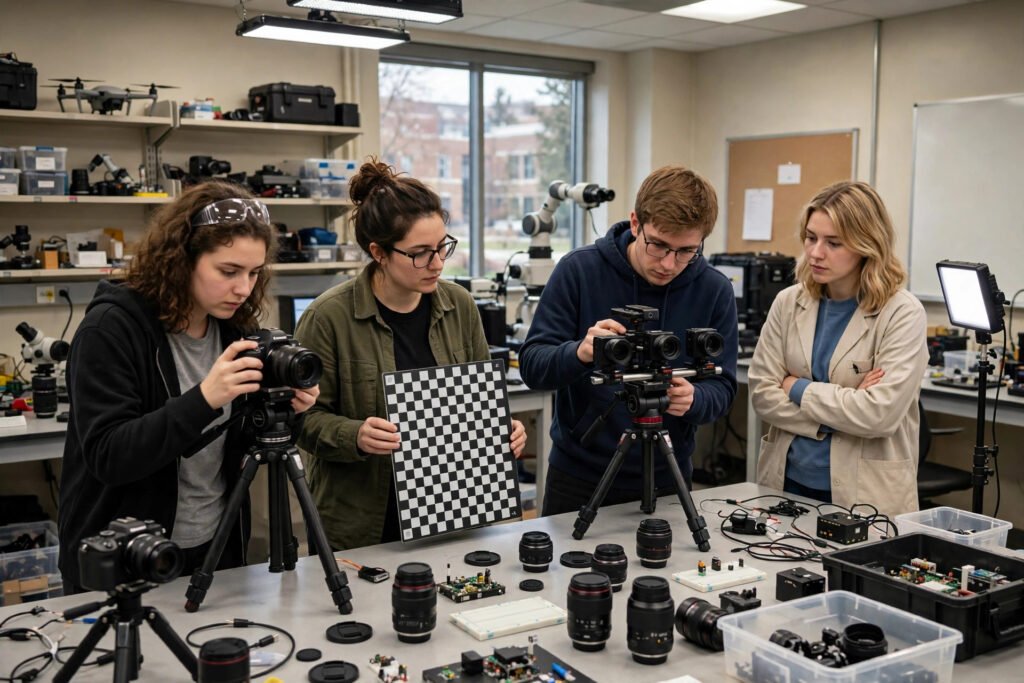
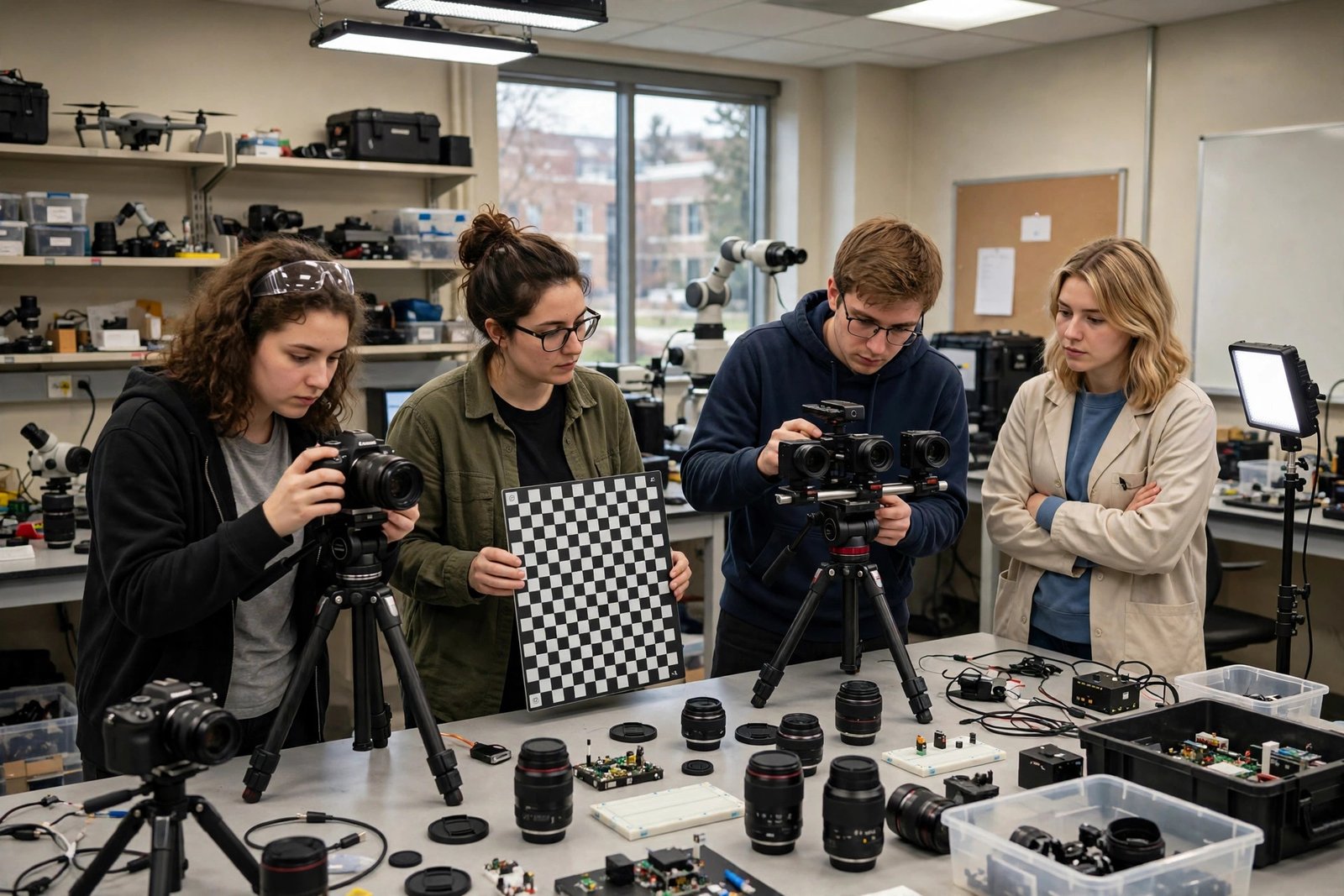
Three-dimensional vision and geometry form a strand that distinguishes computer vision from generic machine learning. Topics include camera calibration, stereo vision, structure from motion, simultaneous localisation and mapping, depth estimation, and 3D reconstruction. These are essential for robotics, autonomous vehicles, augmented reality and industrial inspection, where a system must understand not only what is in an image but where things are in space. Students who enjoy geometry and linear algebra often find this strand the most rewarding part of the degree, and it is an area where a master’s graduate can stand out, because many short courses in deep learning do not cover it at all.
Application strands then allow specialisation. Medical imaging covers radiology, pathology, ophthalmology and related areas, with attention to clinical validation, regulation, privacy and the severe consequences of error. Autonomous perception covers detection, tracking, sensor fusion and safety for vehicles and robots. Remote sensing covers satellite and aerial imagery for agriculture, environment and disaster response. Visual content and media covers retrieval, generation, editing and augmented reality. Each application brings its own data, evaluation standards, ethical questions and domain knowledge, and a good thesis will engage with at least one application deeply rather than skimming several.
Ethics, bias and responsible deployment deserve explicit attention. Vision systems can encode bias from their training data, perform unevenly across populations, and enable surveillance that raises serious privacy questions. A credible programme should require students to consider these issues in their projects: who is represented in the data, who bears the cost of errors, what consent and privacy protections apply, and how a system should be monitored after deployment. These are not optional reflections added at the end of a project. They are part of engineering a system that can responsibly be used in the world, and employers in regulated sectors increasingly expect graduates to be able to discuss them fluently.
The thesis or capstone project is usually the largest component. It may be a research project, an industry project, or a substantial system built and evaluated by the student. Choose a topic that lets you demonstrate a complete pipeline: data, model or geometry, evaluation, and honest discussion of limitations. A project that works on a public dataset but fails on real images, and that honestly explains why, can be more impressive than a project that claims perfect results without scrutiny. Start early, talk to potential supervisors about their groups and datasets, and look at recent theses and publications from the department.
How computer vision differs from neighbouring degrees
| Degree | Main focus | Best fit if you… |
|---|---|---|
| MS in Computer Vision | Interpreting images and video: recognition, geometry, 3D vision, perception | Want visual understanding as your central specialism |
| MSc Computer Science | Broad computing: software, algorithms, systems, theory, applications | Want breadth and flexibility, or are still choosing a specialism |
| MS in Artificial Intelligence / Machine Learning | Learning algorithms and models across data types, not only images | Want modelling breadth across text, tabular, audio and visual data |
| MS in Intelligent Systems / Robotics | Complete systems that perceive, reason and act, including physical robots | Want perception as part of a larger autonomous system |
| MS in Data Science | Data analysis, statistics and modelling across domains | Want data work broadly, rather than visual perception specifically |
These degrees overlap, and many universities allow cross-department electives and shared laboratories. The table is a guide to emphasis, not a barrier. A computer vision graduate can work in broader machine learning roles, and a machine learning graduate can specialise in vision, provided the relevant skills and project experience are demonstrated. What matters is the combination of modules, project work, computing experience and evaluation discipline you accumulate, and your ability to explain that combination to employers and admissions tutors.
Eligibility and entry requirements
Most computer vision master’s programmes require a bachelor’s degree in computer science, computer engineering, electrical engineering, mathematics, physics or a closely related subject, with a strong grade. Some programmes accept graduates from other quantitative disciplines where programming and mathematics preparation can be demonstrated. A few interdisciplinary programmes, particularly in medical imaging or visual arts and technology, may accept a broader range of backgrounds, but these are exceptions, and you should check the stated prerequisites for each programme rather than assuming flexibility.
Mathematics and programming preparation are assessed together. Programmes typically expect calculus, linear algebra, probability and statistics, and programming experience in Python, with familiarity with libraries used for numerical computing and deep learning, and often C++ for performance-critical or embedded vision work. A portfolio can strengthen an application considerably: personal projects involving image classification, detection, tracking or 3D reconstruction, contributions to open-source vision projects, competition results, or relevant work experience. A statement of purpose that names specific research groups, laboratories or faculty, and explains why their work interests you, carries far more weight than a generic statement about loving artificial intelligence. Admissions tutors value specificity, honesty and evidence.
By country, the pattern follows other computing master’s degrees. In the United States, applications usually include transcripts, letters of recommendation, a statement of purpose, a CV, and English proficiency scores where required; GRE requirements vary by institution and programme, and many programmes have made the GRE optional. In the United Kingdom, a good honours degree or equivalent is usual, with English language requirements expressed as an IELTS band or equivalent, and applications made directly to the university. In Canada, a four-year bachelor’s degree with a strong average is standard, and research-based programmes may require identifying a supervisor before admission. In Australia, a recognised bachelor’s degree in a related field is typical, with English proficiency through IELTS or an accepted equivalent. In Germany, many master’s programmes are taught in English, but admission requirements, including specific bachelor’s content and grade thresholds, are set by each programme and must be checked individually.
Plan applications carefully. Deadlines differ by country, programme and funding stream, and scholarship deadlines may fall earlier than admission deadlines. Use the application deadline finder and the document checklist on StudyGraduate, and browse the Courses and Programs directory alongside the universities directory when shortlisting. A spreadsheet of programmes, prerequisites, deadlines, fees and documents will prevent the most common application error, a missed deadline rather than a weak application.
Tuition and living costs: how to budget honestly
Master’s tuition varies so widely by country and institution that a single worldwide average would mislead, so this guide does not invent one. Check the exact fee for each programme on the university’s official page for your intake, and confirm whether the fee is per year or for the whole programme, whether it rises in a second year, and what computing resources are included. A one-year UK master’s degree can look expensive per year but cheaper in total than a two-year degree elsewhere, once living costs for the extra year are included, so compare total cost, not only the headline fee.
| Country | Verified planning figure (use for budgeting, confirm at application) | What to check on the official page |
|---|---|---|
| United Kingdom | Student visa maintenance: GBP 1,529 per month in London, GBP 1,171 per month outside London (current rate; rising to GBP 1,570 / GBP 1,203 for applications on or after 30 November 2026) | Tuition for the full programme, deposit, and GPU or laboratory access included in the fee |
| Germany | Blocked account: EUR 11,904 per year (2026) | Tuition or semester contribution, language of instruction, and any non-EU fee for that institution |
| Australia | Financial capacity for living costs: AUD 29,710 per year (since 10 May 2024; verify at application) | International tuition per year, course duration, and Overseas Student Health Cover |
| United States / Canada | No single verified figure is quoted here; funding proof requirements vary by institution and visa route | Tuition per year, mandatory fees, housing, and assistantship or funding availability |
Funding at master’s level is competitive and often partial. University merit scholarships, government scholarships in the destination country, and subject-specific awards all exist, each with its own deadline and conditions. Research-based programmes may offer teaching or research assistantships, particularly in the United States and Canada, which can include a stipend and a tuition waiver or reduction, but these depend on the supervisor and project. Industry projects may provide funding or a placement, but may also restrict publication, so read conditions carefully. Build your budget from tuition plus housing plus food plus transport plus health cover plus a contingency, and use the tuition fee calculator and the study abroad budget planner to compare total costs across programmes.
Computing resources deserve a specific budget question. Vision work requires substantial GPU access, storage for large image and video datasets, and sometimes specialist cameras or sensors. Ask whether GPU servers, cloud credits, laboratory time and software licences are included in the fee, whether you will need a capable personal machine, and whether the thesis project has a data or equipment budget. A programme with generous, well-managed computing access will allow a stronger thesis than a programme where students compete for scarce resources, whatever the prospectus promises.
Top universities and countries for computer vision
Strength in computer vision is found in universities with active vision research groups, good computing infrastructure, access to real datasets, and links to industry or clinical partners, rather than in any single country. The United States offers depth across vision research, autonomous perception and medical imaging, with large laboratories and technology industry links. The United Kingdom offers one-year master’s degrees with strong vision and graphics groups in several research universities. Canada combines strong machine learning and vision research ecosystems with industry-linked programmes. Australia offers modern facilities and growing vision research, with post-study settings that should be verified at application. Germany offers low-tuition public education, strong engineering and manufacturing links, and an 18-month job-seeker residence permit after graduation, subject to current rules.
When shortlisting, prioritise research groups, datasets and computing resources over overall rankings. Look at faculty pages: who supervises vision theses, what projects are running, what publications have come from the group, and what industry or clinical partners are involved. Look at laboratory and GPU facilities, at whether students work with real-world datasets or only clean teaching datasets, and at graduate destinations where they are published. Compare programmes with the university comparison tool, explore related degrees in the Courses and Programs directory, and use the rankings directory, which keeps QS and THE results separate by provider, as one input among several. Specific profiles that illustrate different strengths include the University of California, Berkeley and TU Berlin.
Consider the ecosystem around the university. Regions with technology, automotive, medical imaging, media or manufacturing clusters offer more placements, more industry projects, more guest lectures and more networking opportunities. A university in a strong cluster, with an active vision group and good computing access, will often serve you better than a more famous university where vision is a small offering within a general programme. Attend virtual open days, contact programme directors with specific questions about datasets, GPU access and thesis supervision, and talk to current students about their project experience where possible.
Careers and salaries
Graduates of computer vision master’s programmes work in roles spanning technology, automotive, healthcare, manufacturing, media and research. Common titles include computer vision engineer, perception engineer, machine learning engineer, image processing engineer, medical imaging scientist, augmented reality engineer and research engineer, with some graduates moving into doctoral research. The key to employability is a portfolio that demonstrates complete vision systems: data handling, model or geometry, evaluation broken down by condition and failure mode, and an honest discussion of limitations. Employers test these skills directly, through technical interviews, coding exercises and project discussion, so a thesis or project you can explain in depth matters more than a list of module titles.
Salary figures below are medians published by the United States Bureau of Labor Statistics for May 2024, for the nearest official occupations. The BLS does not track “computer vision engineer” as a separate occupation, so no figure is invented for that title. A median is a national midpoint across experience levels, not a starting salary and not a promise, and it does not transfer to other countries, where official sources such as the UK Office for National Statistics, Statistics Canada or Jobs and Skills Australia should be consulted instead.
| Nearest BLS occupation (United States) | Median annual wage | Source and reference year |
|---|---|---|
| Computer and information research scientists | $140,910 | US Bureau of Labor Statistics, Occupational Outlook Handbook, May 2024 |
| Software developers | $133,080 | US Bureau of Labor Statistics, Occupational Outlook Handbook, May 2024 |
| Computer hardware engineers | $155,020 | US Bureau of Labor Statistics, Occupational Outlook Handbook, May 2024 |
| Information security analysts | $124,910 | US Bureau of Labor Statistics, Occupational Outlook Handbook, May 2024 |
BLS wages are base wages and generally exclude stock, bonuses and employer benefit costs, so total compensation at some technology employers can differ. Employers also classify similar jobs differently, so the same vision role may be counted under software developers at one company and research scientists at another. Use these figures as a planning anchor, not as a target, and use the career path explorer to map roles to the degree. Related programmes worth comparing include BSc Computer Science for foundations and MSc Computer Science for a broader master’s alternative.
Post-study work options must be verified at the time you apply, because they change. In the United States, F-1 students may be eligible for Optional Practical Training, with a 24-month STEM extension for eligible degrees, up to 36 months in total. In the UK, the Graduate Route currently offers two years, with an announced 18-month duration for applications from 1 January 2027. In Canada, Post-Graduation Work Permit duration depends on programme length and institution eligibility. In Australia, post-study work settings and charges have been revised repeatedly. In Germany, graduates may be eligible for an 18-month job-seeker residence permit. None of these routes is guaranteed for any individual, and they should not be the sole reason for choosing a programme.
Scholarships for computer vision students
Master’s scholarships are competitive and often partial. University merit scholarships, government scholarships in the destination country, and subject-specific awards from computing or engineering bodies all exist, but each has its own deadline, eligibility rules and conditions. Research-based programmes may offer assistantships tied to a supervisor’s funding, which can be more substantial than a scholarship but depend on the supervisor and project. Browse the scholarships directory and use the scholarship finder to shortlist, then verify every detail on the provider’s own page. Apply for admission and funding in parallel, because funding deadlines often fall earlier than admission deadlines, and a missed funding deadline cannot usually be recovered by a strong admission offer.
When comparing funding offers, look beyond the headline amount. A renewable award, a tuition waiver, a stipend, or an assistantship that includes research experience may be worth more over the full degree than a larger one-year grant. Check renewal conditions, such as maintaining a minimum grade or completing assistantship hours, and check whether the award restricts the thesis topic, supervisor or post-graduation employment. Keep certified documents ready and keep a record of every application, deadline and condition.
How to choose: a decision checklist
Ask yourself whether you want vision as a central specialism or as part of a broader AI or robotics degree, because that answer points towards dedicated vision programmes or broader programmes with vision electives. Ask whether the programme teaches both deep learning and geometry, gives access to GPU resources and real datasets, and allows a thesis that is a complete vision system rather than a literature review. Ask who would supervise your thesis and what their group works on. Ask what recent graduates do, where that information is published. Ask what the total cost is over the full programme, what funding is realistic, and what post-study options currently apply in that country, while remembering that those options can change. If a programme cannot answer these questions clearly, treat that as information in itself.
Also weigh the learning environment. Cohort size, laboratory and GPU access, industry and clinical links, student societies, hackathons and vision competitions, and academic support all shape the experience. A programme that encourages rigorous evaluation, honest discussion of failure modes, and attention to bias, privacy and safety will prepare you better for a field where vision systems increasingly affect healthcare, transport, security and daily life. Choose the programme whose projects excite you enough to sustain a year or two of demanding work, because that excitement carries students through the inevitable debugging, failed experiments and revisions.
Frequently asked questions
Do I need to be good at mathematics to study computer vision?
Yes. Linear algebra, calculus, probability and statistics underpin image processing, deep learning and 3D geometry, and programmes expect that preparation. Students who enjoy mathematics and visual, geometric reasoning tend to thrive; students who want to avoid mathematics will struggle with the core modules.
Is computer vision only about deep learning?
No. Deep learning is central, but computer vision also rests on image processing, geometry, optics, signal processing and statistics. A strong programme teaches both, because diagnosing failures on real images requires understanding cameras, geometry and data, not only training models.
Can I work in medical imaging with an MS in Computer Vision?
Yes, medical imaging is a major application area, but clinical work brings additional requirements around validation, regulation, privacy and domain knowledge. Choose a programme with medical imaging modules, clinical partners or relevant thesis opportunities if this is your goal, and check any professional requirements for your target country and role.
How long does an MS in Computer Vision take abroad?
Typically one year full-time in the UK and 18 months to two years in the United States, Canada, Australia and much of Europe. Research-based programmes and those with placements or industry projects may take longer. Confirm the duration on the university’s page for your intake.
What salary can a computer vision graduate expect?
No official salary exists for that exact job title, because the BLS does not track it separately. The nearest BLS medians for May 2024 are $140,910 for computer and information research scientists and $133,080 for software developers in the United States. Treat these as planning anchors for related occupations, not as promises for any individual.
Do I need prior vision experience to apply?
Not necessarily, although it helps. Programmes typically require a computing, engineering, mathematics or physics background with programming and mathematics preparation, and they teach vision during the degree. Personal projects in image processing or deep learning can strengthen an application considerably.
Are computer vision jobs only in big technology companies?
No. Graduates work in technology companies, automotive and robotics firms, healthcare and medical imaging organisations, manufacturing and inspection, media and augmented reality, agriculture and remote sensing, and research institutions. The common requirement is the ability to build systems that interpret images and video reliably.
Should I choose a dedicated vision degree or a general AI degree?
Choose a dedicated vision degree if visual perception is clearly your central interest and you want depth in geometry, 3D vision and vision evaluation. Choose a general AI degree if you want breadth across data types or are still deciding between vision, language and other specialisms. Either path can lead to vision roles, provided your projects demonstrate vision skills.
Sources & Verification
- US Bureau of Labor Statistics, Occupational Outlook Handbook and May 2024 occupational employment and wage data: median annual wages for computer and information research scientists ($140,910), software developers ($133,080), computer hardware engineers ($155,020) and information security analysts ($124,910), May 2024.
- US Bureau of Labor Statistics, May 2024 featured occupational employment and wage data.
- Georgia Tech College of Engineering, accreditation page: ABET accreditation context for engineering programmes.
- UK Government, Appendix Student and related immigration rules: student visa maintenance rates of GBP 1,529 per month in London and GBP 1,171 per month outside London, with higher rates announced for applications on or after 30 November 2026.
- German blocked account requirement: EUR 11,904 per year (2026).
- Australian financial capacity for living costs: AUD 29,710 per year (since 10 May 2024).
- US F-1 Optional Practical Training: 12 months plus a 24-month STEM extension for eligible degrees, up to 36 months in total, subject to current rules.
External sources: BLS May 2024 occupational employment and wage data, BLS Occupational Outlook Handbook, computer occupations, Georgia Tech College of Engineering accreditation.
Figures change yearly — confirm fees and requirements on the official university page before applying. StudyGraduate is an information portal, not an agency, and this guide does not promise admission, jobs, salaries or visa or post-study work outcomes. Salary medians describe the United States in May 2024 and are not guarantees for any individual graduate or any other country.