

MS in Computer Networks Abroad: Eligibility, Fees, Top Universities and Careers
Every video call, cloud application, hospital system, bank transaction and factory robot depends on a network that someone designed, built, secured and keeps running. When that network fails, work stops. When it is designed well, nobody notices it at all, which is the quiet test of the profession. An MS in Computer Networks abroad trains you to be the person who designs those networks, understands how they fail, and can prove, with measurements rather than opinions, that a design will hold up under real traffic.
Computer networks is a field that rewards people who like both theory and hands-on work. You will study protocols and mathematics, and you will also configure routers and switches, break a test network on purpose, find out why it broke, and fix it. This guide explains what the degree covers, who it suits, what universities ask for, what it costs, which countries are strongest, and what careers follow, with salary figures taken only from official statistics and labelled with source and year.
If you are comparing computing master’s degrees, the MSc Computer Science profile and the broader Courses & Programs directory will help you see where a networks degree overlaps with general computer science and where it specialises, because many students apply to both and choose on the strength of the networking laboratories and the industry links.
What an MS in Computer Networks actually is
Computer networks is the study of how computers communicate: how data are divided into packets, addressed, routed, switched, secured and delivered, and how those processes behave when thousands or millions of users share the same infrastructure. A master’s degree in the subject goes far beyond setting up a home router or a small office network. It covers network architecture, protocol design, routing and switching, wireless and mobile networks, network security, cloud and data-centre networking, software-defined networking, network performance analysis and the management of large, distributed systems.
The field has changed substantially in the last decade, and a good programme reflects that. Networks are no longer only cables and boxes in a server room. They are virtualised, automated and software-defined; they run in cloud data centres; they connect sensors, vehicles and industrial equipment; and they are managed through code as much as through a command line. A modern networks degree therefore teaches automation, scripting, virtualisation and cloud networking alongside the classical protocol stack, and it treats security as a property of the whole design rather than a feature added at the end.
Degree titles vary, and again the module list matters more than the title. You will see MS in Computer Networks, MSc Computer Networks, MS in Network Engineering, MSc Network Systems, MS in Telecommunications, and networking tracks or specialisations inside computer science, information technology and electrical engineering degrees. A telecommunications degree may lean further towards signal processing and wireless theory, while a network engineering degree may lean further towards design, deployment and operations. Read the modules, the laboratory facilities and the dissertation options before you decide which shape fits your goals.
The degree also sits next to cybersecurity, cloud computing and systems administration, and students often move between those areas during their careers. Networking knowledge is the foundation for all three: a security analyst who does not understand routing, addressing and protocol behaviour cannot diagnose an attack, and a cloud engineer who does not understand virtual networking cannot design a reliable deployment. That foundation is why a networks degree remains valuable even as job titles change.
Who this degree is for
This degree suits students who enjoy understanding systems end to end and who are comfortable with both abstract thinking and practical troubleshooting. If you studied computer science, information technology, electronics, telecommunications or a related engineering subject, and you found yourself most engaged by the networking modules, the laboratory work and the question of why a system behaved as it did under load, this degree is a natural next step. If you have worked in IT support, network operations or systems administration and want to move from operating networks to designing them, a master’s degree can formalise that move, provided you can meet the academic entry requirements.
It suits students who are patient with debugging. Network problems are rarely solved by a single insight; they are solved by reading logs, measuring traffic, isolating a fault, testing a hypothesis and documenting what changed. If you enjoy that process, you will enjoy the work. If you want every problem to have a clean, immediate answer, you may find the work frustrating, because real networks are distributed systems with many interacting parts, and the fault is often in the interaction rather than in any single device.
It is also a degree for students who are willing to keep learning after graduation. Protocols, vendor platforms, cloud services and security threats change continuously, and employers value graduates who can learn a new platform, read a standard, and evaluate a new technology critically. A master’s degree that teaches you how to learn a network technology, rather than only how to configure one vendor’s equipment, will serve you longer than a degree that is a training course for a single certification, however useful that certification may be in the short term.
At a glance
| Feature | Typical picture |
|---|---|
| Degree level | Master’s (MS or MSc), taught or research-led depending on country |
| Typical duration | 1 year in the UK; 1.5 to 2 years in the USA, Canada, Australia and much of Europe |
| Core subjects | Network architecture, routing and switching, wireless networks, network security, cloud and data-centre networking |
| Common backgrounds | Computer science, information technology, electronics, telecommunications, electrical engineering |
| Capstone | Design project, industry placement or dissertation, often involving a real network design or measurement study |
| Typical next steps | Network engineer, network architect, cloud network engineer, network security engineer |
What you study: the curriculum in detail
The core of almost every programme is the protocol stack, taught properly rather than as a diagram to memorise. You will study the application, transport, network and link layers, how TCP manages congestion and reliability, how IP addressing and routing work at scale, how DNS, HTTP and modern application protocols behave, and how those layers interact when something goes wrong. That foundation is then extended to routing protocols, including interior and exterior routing, to switching, VLANs and spanning tree, and to the design of local area networks, wide area networks and campus networks.
Wireless and mobile networking is a second core area, covering Wi-Fi standards and deployment, cellular networks, mobility management and the particular problems of wireless links, including interference, contention and variable quality. Network security runs through the whole degree: cryptography as applied to networks, authentication, firewalls, intrusion detection, virtual private networks, zero-trust design and the security of routing and DNS themselves. A programme that teaches security as a separate module and never mentions it elsewhere is weaker than one that treats every design decision as a security decision.
Modern programmes add cloud and data-centre networking, software-defined networking and network automation. You will learn how virtual networks are built in a cloud platform, how a data centre network is designed for scale and resilience, how a controller manages a software-defined network, and how network configuration is automated with scripting and infrastructure-as-code tools. Network performance analysis and measurement teaches you to model queues, measure latency, throughput and loss, and to decide whether a network is genuinely congested or merely misconfigured, which is a distinction that saves organisations real money.
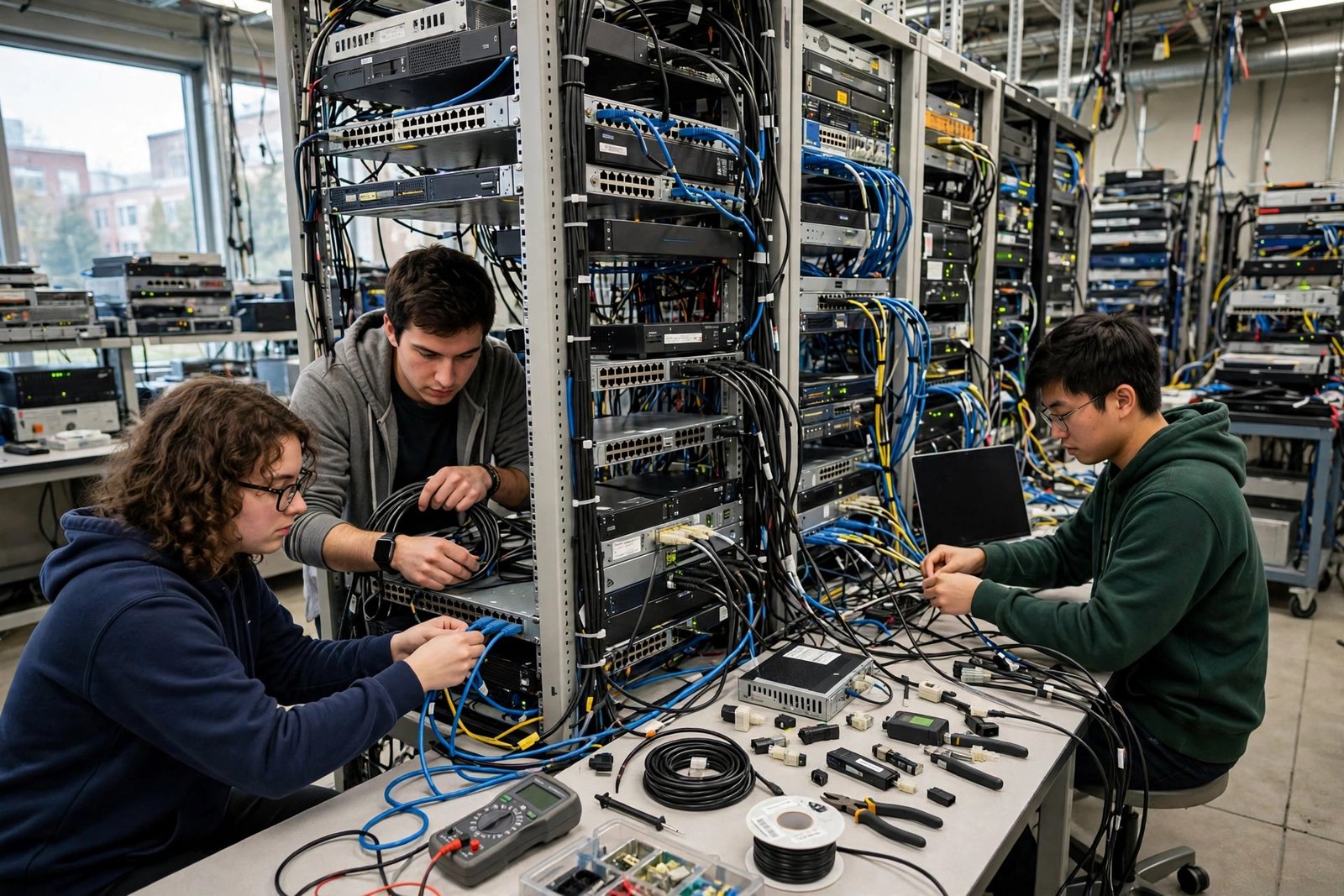
Laboratory work is the heart of the degree, and you should judge a programme by its laboratories. Ask whether students configure real or realistically emulated routers, switches and firewalls; whether they build a multi-site network, break it, and repair it under observation; whether they use network simulation and emulation tools; and whether they work with a cloud platform. A dissertation or capstone that designs a network for a real organisation, measures a real network, or evaluates a new protocol or platform is worth far more than a purely descriptive project, because it gives you evidence of competence that an employer can inspect.
Specialisations worth considering
Network design and architecture is the classical specialisation, focused on designing large, reliable networks for enterprises, service providers and data centres. It leads most directly into network engineering and network architecture roles, and it rewards careful design, documentation and capacity planning. Network security is a second specialisation, focused on securing networks against attack, and it overlaps heavily with cybersecurity degrees; it suits students who enjoy adversarial thinking and who want to work in security operations, security engineering or security architecture.
Cloud and data-centre networking is a third specialisation, focused on the networks inside and between cloud data centres, on virtual networking, and on the automation that makes cloud networks manageable at scale. It suits students who want to work for cloud providers, large technology companies or enterprises that run their own cloud infrastructure. Wireless and mobile networking is a fourth specialisation, focused on Wi-Fi, cellular and emerging wireless technologies, and it suits students interested in telecommunications, smart cities and the Internet of Things.
Finally, network management, automation and observability is a growing specialisation, focused on monitoring, telemetry, automated configuration and the operational practices that keep a large network healthy. It suits students who enjoy operations, scripting and data analysis, and it is increasingly valued because the networks that organisations run are now too large and too dynamic to manage by hand.
Eligibility and entry requirements
Universities normally ask for a bachelor’s degree in computer science, information technology, electronics, telecommunications, electrical engineering or a closely related subject, with a strong grade in the final years. For students from South Asian systems, that typically means a first division or a high second division, depending on the university; in the UK framework, it means the equivalent of a good upper-second-class honours degree. Some programmes accept graduates from other subjects if they have relevant work experience or a strong technical portfolio, but that is decided case by case.
Technical preparation matters more than the degree title alone. Admissions tutors look for evidence of networking knowledge, whether through undergraduate modules, vendor certifications, work experience or a home laboratory project. A student who has built a small network at home, configured a router and a switch, set up a virtual private network, or automated a configuration with a script can demonstrate that preparation clearly, and a short write-up of such a project is a strong addition to an application. Mathematics matters too, particularly for programmes with a strong performance-analysis or research component, where probability, queuing theory and statistics appear.
English language requirements follow the standard pattern: most universities ask for an IELTS overall score around 6.5, with no band below 6.0, or a TOEFL equivalent, with variations by institution. Check the official programme page, because some programmes ask for a higher score, and some waive the test for students whose previous degree was taught in English. Applications normally require transcripts, a statement of purpose, references and a CV. The statement should name the specialisation, explain why networks rather than general computer science, and show that you understand what the programme actually teaches. Generic statements about a passion for technology do not distinguish an applicant in a competitive field.
Vendor certifications such as Cisco’s CCNA or equivalent qualifications are useful but are not a substitute for a degree, and they are not usually a formal entry requirement. They do, however, strengthen an application, particularly for a student whose undergraduate degree did not include strong networking modules, and they help with internships and part-time work. If you hold a certification, list it accurately, with the date and the issuing body, and be prepared to discuss what you actually configured, not only what you studied for an examination.
Eligibility by country: the differences that matter
In the United States, master’s degrees in networks are usually two years and are often offered as a specialisation within computer science or electrical and computer engineering, or as a dedicated professional master’s. Industry links are strong, particularly near technology and telecommunications clusters, and internships during the degree are common and valuable. In the United Kingdom, taught MSc degrees are usually one year, intensive and laboratory-led, which makes them efficient for students who want to enter work quickly, but also demanding.
In Canada, master’s degrees are usually two years and may be coursework-based or research-based, with the research route suiting students who want a PhD or a research career. In Australia, master’s degrees are usually 1.5 to 2 years, with coursework plus a project, and many offer mid-year entry. In Germany and much of continental Europe, master’s degrees are usually two years, many are taught in English, and public tuition is often low, although living costs still apply. The Netherlands, Sweden, Finland and other European countries also host strong English-taught programmes in networks, communications and distributed systems, and are worth shortlisting for their research and industry links.
Visa and post-study work rules differ by country and change frequently, and this guide makes no promise about any outcome. Before you apply, read the official immigration page for your destination, confirm the funds you must show, and confirm the post-study work route that applies to your visa class. The cost table below uses the official planning figures from this article series, but the immigration authority’s page is the authority.
Tuition fees and living costs
Tuition fees for networks master’s degrees vary widely by country and university, and a single worldwide average would be misleading. Public universities in Germany often charge no tuition fee, asking only a semester contribution, while programmes in the USA, UK and Australia charge full international fees set annually by the university. Shortlist three to five programmes, read the official fee page for each, and note whether the fee is per year or for the whole programme, whether it rises in a second year, and whether laboratory or equipment costs are included.
Living costs can be planned from the official maintenance figures. For the United Kingdom, the planning figures in this series are GBP 1,529 per month in London and GBP 1,171 per month outside London. For Germany, the blocked account requirement is EUR 11,904 for the year. For Australia, the financial capacity requirement is AUD 29,710 for the primary applicant. For Canada, the proof-of-funds figure for a single applicant outside Quebec moved from CAD 22,895 to CAD 23,448. Confirm these figures on the official immigration page at the time you apply. Use the study abroad budget planner and the tuition fee calculator once you have real fee offers, so that your budget is built on offers rather than on guesses.

| Destination | Typical duration | Official maintenance or funds figure for planning | Planning note |
|---|---|---|---|
| United Kingdom | 1 year | GBP 1,529/month London; GBP 1,171/month outside London | Short degree, but fees are concentrated into one year |
| Germany | 2 years | EUR 11,904 blocked account | Public tuition often low; living costs still apply |
| Australia | 1.5 to 2 years | AUD 29,710 financial capacity, primary applicant | Check mid-year entry and scholarship deadlines |
| Canada | 2 years | CAD 22,895 rising to CAD 23,448, single applicant outside Quebec | Research degrees may include supervisor funding |
| United States | 2 years | Varies by university; confirm on the official I-20 estimate | Internships during the degree are common and valuable |
Budget also for health insurance or the immigration health surcharge where it applies, for certification examination fees if you plan to sit one during the degree, for a suitable laptop, and for travel to an internship or a placement. Students who plan to work part time should check the work conditions on their visa before relying on that income.
Top universities and countries for computer networks
Judge a networks programme by its laboratories, its industry links and its faculty, not only by a university’s overall reputation. A university with a strong telecommunications research group, a data-centre laboratory, or a partnership with a service provider or a cloud company may offer a better networks education than a more famous university whose strength lies elsewhere. Use the universities directory and the rankings pages to compare institutions, and then read the programme pages and faculty profiles in detail.
The United States is strong across the field, with technology clusters, cloud providers and telecommunications companies that recruit directly from master’s programmes, and with research groups in networking, distributed systems and security. The United Kingdom is strong in taught master’s degrees with intensive laboratory work and close links to telecommunications and finance employers. Germany is strong in communications engineering and distributed systems, with low public tuition and strong research institutes. Canada combines coursework and research master’s degrees with telecommunications and technology employers. Australia combines networking with cloud and cybersecurity programmes and a coursework-plus-project format. The Netherlands, Sweden, Finland and Switzerland also host strong English-taught programmes in networks and communications, and are worth shortlisting.
When you shortlist, ask specific questions: what laboratory equipment and emulation tools do students use, what proportion of the degree is practical work, whether there is an industry placement or a dissertation with a company, and where recent graduates work. A programme that answers those questions with specifics is usually a programme that takes practical training seriously. Avoid programmes that describe their laboratories only in general terms.
Careers and salaries: what the official data say
Graduates work as network engineers, network architects, network administrators, cloud network engineers, network security engineers, systems engineers, telecommunications engineers and, with experience, as infrastructure architects and engineering managers. Employers include technology companies, cloud providers, telecommunications operators, banks and financial firms, hospitals, government agencies, managed service providers and large enterprises in every sector, because every large organisation runs a network it cannot afford to lose.
The United States Bureau of Labor Statistics provides the clearest official picture for this field. The Bureau reported a median annual wage of USD 134,050 in May 2025 for computer network architects, with the lowest 10 percent earning less than USD 79,900 and the highest 10 percent earning more than USD 202,680, and employment projected to grow 8 percent from 2025 to 2035. For the adjacent occupation of network and computer systems administrators, the Bureau reported a median annual wage of USD 99,130 in May 2025. For information security analysts, a common destination for networks graduates who specialise in security, the Bureau reported USD 129,180 in May 2025. For computer systems analysts, another adjacent role, the Bureau reported USD 105,850 in May 2025. These are United States medians, not starting salaries and not promises: pay varies by industry, location, seniority and specialisation, and a network architect role typically requires several years of experience beyond a master’s degree, as the Bureau itself notes.
| Related occupation (USA) | Median annual wage | Source and year |
|---|---|---|
| Computer Network Architects | USD 134,050 | BLS Occupational Outlook Handbook, May 2025 |
| Network and Computer Systems Administrators | USD 99,130 | BLS Occupational Outlook Handbook, May 2025 |
| Information Security Analysts | USD 129,180 | BLS Occupational Outlook Handbook, May 2025 |
| Computer Systems Analysts | USD 105,850 | BLS Occupational Outlook Handbook, May 2025 |
Progression follows a clear pattern. Graduates typically start in network engineering, network operations or support roles, where they configure, monitor and troubleshoot networks under supervision. With experience, they design networks, lead migrations, take responsibility for security or cloud networking, and mentor junior engineers. Senior network architects design the network strategy for an organisation, decide on platforms and standards, and work with vendors and business leaders. Some graduates move into management, some into security architecture, and some into cloud architecture, and the networking foundation supports all three moves. Vendor certifications, cloud certifications and a record of successful migrations or designs help at each step, but they complement rather than replace experience.
One honest caution: the Bureau’s own data show that network administration as a standalone occupation faces automation pressure, while network architecture grows, because routine administration is increasingly automated while design, security and cloud networking become more complex. The practical lesson is to aim your master’s degree and your early career at design, automation, security and cloud networking, not only at routine administration, and to build scripting and automation skills from the start.
Scholarships for networks students
Scholarships for networks students are usually offered as university merit scholarships, country scholarships, or STEM and technology scholarships, rather than as scholarships named for networks alone. Apply across all three categories, and apply early, because scholarship deadlines often fall months before university deadlines. Research-led master’s degrees in Canada, Australia and Europe sometimes include a stipend or an assistantship tied to a supervisor’s grant, and those are worth asking about directly.
Check the scholarships directory and the scholarship finder for current listings, and treat any scholarship page that does not name its funder, deadline and eligibility as unreliable. Never pay for a scholarship application, and never invent a grade, a certification or a reference.
How to choose a programme: a practical shortlist method
Start with the specialisation: design and architecture, security, cloud and data-centre networking, wireless, or automation and operations. Then find programmes whose modules, laboratories and faculty match that choice. Check the practical training in detail: real or realistically emulated equipment, multi-site designs, cloud platforms, and a dissertation or placement with a real organisation. Then check the cost honestly, including maintenance figures and the fee for the full degree. Then check the outcomes the programme can evidence: where recent graduates work, and what dissertations they produced. Finally, check the fit with your background, including whether the programme expects prior networking knowledge or vendor certification, and whether you can meet the English and academic requirements comfortably.
Apply to a spread of programmes, including ambitious and safer choices, and keep a spreadsheet of deadlines, fees, documents and decisions. The application season is long, and the students who succeed are usually the ones who organised it early rather than the ones who wrote the most enthusiastic statement at the last minute.
Application timeline for 2026 and 2027 entry
For September 2026 entry, most applications open in the autumn of 2025 and close between December 2025 and June 2026, depending on country and university, with scholarship deadlines often earlier. For mid-year entry in Australia and some other countries, the timeline shifts by a semester. Shortlist twelve months before entry, sit the English test nine months before, submit applications six to nine months before, and leave at least three months after an offer for a visa, accommodation and travel. Scholarship applicants should start earlier, because scholarship deadlines are usually the binding constraint.
Documents take longer than expected. Transcripts may need to be requested, translated or attested; references need to be requested early; and a statement of purpose needs several drafts. If a programme asks for a portfolio or a project description, treat it as the most important document, because it distinguishes you from applicants with similar grades.
Common mistakes to avoid
The most common mistake is choosing a programme by its title without reading the module list or inspecting the laboratories. The second is treating a vendor certification as a degree: certifications are useful, but they do not teach protocol design, performance analysis or research methods. The third is budgeting only for tuition and forgetting maintenance, insurance and a second year. The fourth is applying only to famous universities, when a strong programme with a telecommunications laboratory and an industry placement would have been a better fit. The fifth is treating a scholarship as a plan rather than a hope: build a budget that works without one.
Finally, do not let anyone promise you an outcome. No university, agent or article can guarantee admission, a scholarship, a job or a visa. A good programme teaches you to design, secure and operate networks, gives you a portfolio that proves it, and puts you in an environment where opportunities arise. Choose the programme that does those things best for your specialisation, and then do the work.
Frequently asked questions
Do I need a computer science degree to apply for an MS in Computer Networks?
Usually a degree in computer science, information technology, electronics, telecommunications or a related engineering subject is expected, but some programmes accept other graduates with relevant work experience, certifications or a strong technical portfolio. Check the official entry requirements for each programme.
Is a vendor certification enough, or do I need a master’s degree?
A certification proves you can configure a platform; a master’s degree teaches you to design networks, analyse performance, understand security and evaluate new technologies. Certifications help with employment and complement a degree, but they do not replace it for design, architecture and research roles.
How long does an MS in Computer Networks take abroad?
Typically one year in the UK, and 1.5 to 2 years in the USA, Canada, Australia and much of Europe. Research-led degrees with a thesis tend to take longer than taught degrees.
What is the difference between a network engineer and a network architect?
A network engineer typically implements, configures and troubleshoots networks, while a network architect designs the overall network, chooses platforms and standards, and plans capacity and resilience. Architecture roles usually require several years of engineering experience, as the Bureau of Labor Statistics notes for computer network architects.
Can I move from networks into cybersecurity or cloud engineering?
Yes, and it is a common move. Networking knowledge is foundational for both fields. A networks graduate who adds security or cloud specialisation, through modules, certifications or work experience, is well placed for security engineering and cloud networking roles.
Do I need work experience to get admitted?
Not usually, but relevant experience helps, especially for competitive programmes. IT support, network operations, an internship or a well-documented home laboratory project all strengthen an application.
Will automation reduce network engineering jobs?
Automation changes the work more than it removes it. Routine configuration and monitoring are increasingly automated, which is why this guide recommends aiming at design, automation, security and cloud networking, where judgement, architecture and troubleshooting remain central.
Is it worth studying computer networks abroad rather than at home?
It depends on the comparison. Studying abroad gives access to laboratories, research groups, cloud infrastructure and employers that may not exist locally, but it costs significantly more. Compare a strong home programme with an abroad programme on curriculum, laboratories, placement and outcomes before deciding.
Sources & Verification
Salary and employment figures in this article come from the U.S. Bureau of Labor Statistics Occupational Outlook Handbook entry for computer network architects and its similar-occupations table (May 2025), including the figures for network and computer systems administrators, information security analysts and computer systems analysts. Maintenance and funds figures for the United Kingdom, Germany, Australia and Canada are the planning figures used across this article series and should be confirmed on the official immigration page for each destination at the time of application. Programme durations, entry requirements and fees vary by university and are stated here as typical patterns, not as a substitute for the official programme page.
- BLS Occupational Outlook Handbook: Computer Network Architects
- BLS Occupational Outlook Handbook: Network and Computer Systems Administrators
- StudyGraduate Courses & Programs directory
- StudyGraduate career path explorer tool
Figures change yearly — confirm fees and requirements on the official university page. StudyGraduate is an information portal, not an agency — it never promises admission, jobs, salaries or visa or PR outcomes, and this article should be read as general guidance, not as advice for any individual application.