

MS in Computer Graphics Abroad: Eligibility, Fees, Top Universities and Careers
An MS in Computer Graphics is a master’s degree for students who want to build the images, simulations and interactive worlds that audiences see on screens. It sits at the meeting point of computer science, mathematics, art and design. Graduates work on film visual effects, video games, animation, scientific visualisation, virtual production, product design and real-time rendering. If you enjoy programming and you also care about how things look, move and feel, this degree is designed for you. It is not a general art degree and it is not a general software degree either. It teaches you to understand why an image looks believable, how light, geometry and motion are computed, and how to turn that understanding into software that runs fast enough for real audiences.
Computer graphics matters because almost every industry now communicates visually. Films and games are the most visible examples, but the same skills power medical imaging, architectural visualisation, automotive design, flight simulation, weather and climate visualisation, robotics vision and data visualisation. A surgeon rehearsing a procedure in a simulator, an architect walking a client through an unbuilt building, and a game player exploring an open world are all using computer graphics. That breadth is one reason the degree travels well across countries and employers. The core mathematics and programming transfer, even when the industry focus changes from country to country.
This guide explains who the degree suits, what you will actually study, what universities ask for, what it costs, where to study it, what careers follow, and which scholarships can help. It is written for 2026 and 2027 intakes. Fees, deadlines and visa rules change every year, so treat every figure here as a starting point and confirm it on the official university page before you apply. StudyGraduate is an information portal, not an agency, and nothing here guarantees admission, a job or a visa.
At a Glance: MS in Computer Graphics
| Feature | Typical position |
|---|---|
| Degree level | Master’s degree, usually MSc, MS or MEng depending on the university |
| Typical duration | 1 year in the UK; 1.5 to 2 years in the USA, Canada, Australia and much of Europe |
| Background expected | Computer science, software engineering, mathematics, physics, engineering, or a related field with strong programming |
| Core subjects | Rendering, geometry processing, animation, physically based simulation, GPU programming, computer vision |
| Key skills on graduation | C and C++, Python, shader programming, linear algebra, real-time engines, 3D modelling and rendering pipelines |
| Portfolio | Often required or strongly recommended; code samples, renders, demos and project write-ups matter more than grades alone |
| Common destinations | Film and visual effects, games, animation, visualisation, simulation, design technology and research |
The one-year UK model suits students who want to enter work quickly and who already have a strong technical base. The two-year model common in the United States, Canada and Australia leaves more room for internships, research assistantships and a substantial thesis or capstone project. Neither is automatically better. A one-year programme demands intense focus and a portfolio that is already taking shape. A two-year programme costs more in living expenses but gives you time to specialise, publish or complete an industry placement. Choose on the basis of your budget, your current skills and whether you want a research route towards a PhD.
What You Study in an MS in Computer Graphics
The first part of most programmes rebuilds the mathematical foundation properly. Linear algebra, vector calculus, probability and numerical methods are not optional extras here; they are the language in which graphics is written. You will learn how a three-dimensional scene is represented as geometry, how transformations move objects and cameras, how light interacts with surfaces, and how a renderer turns all of that into pixels. Students who arrive comfortable with matrices, vectors and basic calculus settle in much faster than students who are meeting those ideas for the first time alongside rendering theory.
Rendering is the heart of the degree. You will study rasterisation, the technique that draws triangles to the screen in real time, and ray tracing, the technique that follows paths of light for photorealistic images. Modern programmes teach both, because games and interactive applications need real-time speed while film and product visualisation need offline quality. You will learn shading models, texture mapping, shadows, global illumination, and physically based rendering, where materials are described by measurable properties rather than by guesswork. Shader programming, usually in GLSL or HLSL, turns that theory into code that runs on the graphics processing unit.
Geometry processing is the second pillar. Meshes, curves, surfaces and volumes have to be created, cleaned, simplified, deformed and animated. You will study subdivision surfaces, mesh optimisation, collision detection and deformation techniques such as skinning and blend shapes. These topics matter far beyond entertainment. A medical visualisation team simplifying a scan, an engineering team simulating airflow over a car body, and a games team deforming a character are all solving geometry problems. Programmes with a strong research culture often let you go deep here, through courses on discrete differential geometry or computational topology.
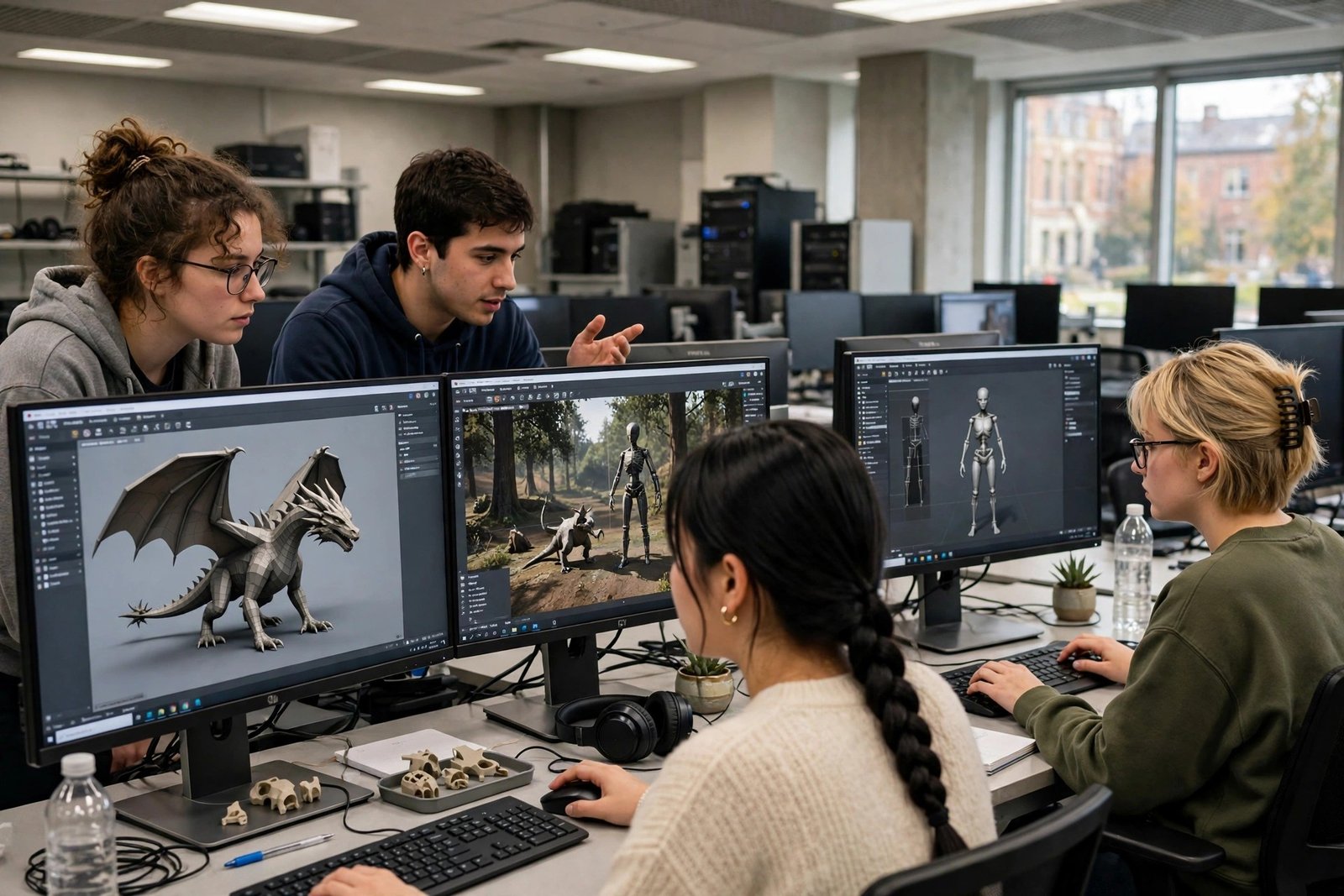
Animation and simulation form the third pillar. Character animation covers keyframing, motion capture, inverse kinematics and procedural animation. Simulation covers rigid bodies, cloth, fluids, smoke and crowds, all governed by physics and solved numerically. This is where the degree becomes visibly exciting: a cloth simulation that drapes believably, a fluid simulation that splashes without exploding, or a crowd that flows around obstacles. Employers notice simulation work because it is hard to fake. A short, clean demo with a written explanation of the numerical method behind it can carry more weight in an application than a long list of tools.
Most programmes also include real-time graphics and engine work. You will build projects in a modern engine or a custom renderer, learn GPU programming, profiling and optimisation, and understand the trade-offs between visual quality and frame rate. Some programmes add virtual and augmented reality, computer vision, machine learning for graphics, or human-computer interaction as electives. Others add production courses in modelling, lighting, compositing and storytelling, taught alongside film or design schools. Read the module list, not just the programme title. Two degrees both called computer graphics can differ sharply: one may be a computer science degree with heavy mathematics, while another may be closer to digital media production.
Assessment is usually a mix of coursework, programming assignments, group projects and a dissertation or capstone. Group projects deserve attention because graphics work in industry is almost always collaborative. A renderer built by one person is a portfolio piece; a game or short film built by a team, with version control, code review and a production schedule, is evidence that you can work in a studio. Keep your code public where you can, document your decisions, and record short videos of your work running. Recruiters and admissions tutors both look at moving images before they read a transcript.
Eligibility and Entry Requirements
Most universities ask for a bachelor’s degree in computer science or a closely related subject, with a good grade average. The exact grade threshold varies by country and institution. In the United Kingdom, that usually means a 2:1 or equivalent, although some programmes accept a 2:2 with a strong portfolio or relevant experience. In the United States, a grade point average around 3.0 on a 4.0 scale is a common baseline for competitive programmes, with stronger programmes expecting more. In Canada, Australia and Germany, universities convert your grades into their own scales, so the number that matters is the one on the official conversion, not a rough guess. Check the country page and the programme page for the conversion that applies to your degree.
Programming ability is the real gatekeeper. Admissions teams look for evidence that you can write, debug and structure substantial code, ideally in C++ or Python, and that you understand data structures and algorithms. A degree in a non-computing subject is not automatically a barrier if you can show that evidence through projects, work experience or additional coursework, but you should expect to explain it clearly in your statement of purpose. Mathematics matters almost as much. Linear algebra and calculus appear in almost every core module, and a weak mathematics background is the most common reason capable programmers struggle in the first semester.
A portfolio is where many applicants win or lose. Some programmes require one formally; many more treat it as decisive even when it is optional. A good portfolio for this degree is not a gallery of finished artwork alone. It should show process: a renderer you built, a shader you wrote, a simulation you tuned, a tool you created, and a short paragraph for each explaining the problem, your approach and what you would improve. Include code links, short videos and still images. Quality beats quantity. Three strong, well-explained projects beat twenty screenshots with no context.
English language requirements are standard for English-taught programmes. IELTS, TOEFL and equivalent tests are the usual routes, with thresholds that vary by university. Some universities waive the test for students who completed a previous degree in English, but the waiver rules are specific and must be confirmed in writing. Standardised tests such as the GRE are required by some United States programmes and not by others, and the trend in recent years has been away from mandatory GRE scores in computer science. Do not pay for a test until you have checked whether your shortlist actually requires it.
Your statement of purpose should be specific to graphics. Admissions tutors read many statements that could apply to any computing degree. A strong statement names the graphics problems that interest you, such as real-time global illumination, character rigging, fluid simulation or geometry processing, and connects them to projects you have done and modules you want to take. Recommendation letters should come from people who have seen your technical work, ideally in programming or mathematics, and who can comment on specific projects rather than offering general praise. Apply early where possible, because popular programmes fill, and scholarship deadlines often fall months before programme deadlines.

Tuition Fees and Living Costs
Tuition fees for an MS in Computer Graphics vary enormously by country and by whether the university is public or private, and any single average would mislead you. Public universities in Germany, for example, commonly charge no tuition for many programmes, with students paying a semester contribution instead, while private universities in the United States can charge several times more per year than a public university in the same state. International fees in the United Kingdom, Canada and Australia generally sit between those extremes, but the range within each country is wide. The only safe approach is to build your shortlist first and then record the official 2026 or 2027 fee for each programme from the university’s own page, including whether the fee is per year or for the whole programme.
Living costs and visa financial requirements are separate from tuition and are just as important in budgeting. Governments set minimum funds that students must show, and those figures are a useful floor, not a comfortable budget. The table below uses financial-proof figures that appear in our verified guides, so you can compare the official floor across countries. Real spending in London, New York, Sydney or Vancouver will be higher than in smaller cities, and rent is usually the largest single item. Use the tuition fee calculator and the cost of living calculator on StudyGraduate to model your own combination of tuition, rent, food, transport and insurance before you commit.
| Country | Financial proof or maintenance figure to note (2026) | What it means for your budget |
|---|---|---|
| United Kingdom | GBP 1,529 per month in London; GBP 1,171 per month outside London for a Student visa | Maintenance floor only; London rent and transport push real costs well above it |
| Germany | EUR 11,904 blocked account for one year | Often the lowest total cost route at public universities, but you must lock the funds in advance |
| Australia | AUD 29,710 living costs figure for a student visa | A floor for the visa; Sydney and Melbourne rents are higher than the national picture |
| Canada | CAD 22,895 rising to CAD 23,448 for a study permit financial requirement | Check which figure applies to your application date; add tuition on top |
| United States | Varies by university; the I-20 form states the total the university expects you to show | Read the I-20 figure carefully; it bundles tuition, living costs and insurance |
Funding usually comes from a mix of sources rather than a single scholarship. Departmental scholarships, merit awards, graduate assistantships and research assistantships are common in the United States and Canada, where a funded assistantship can cover tuition and pay a stipend in exchange for teaching or research work. In the United Kingdom and Australia, full scholarships are rarer and more competitive, so many students combine a partial award with family funds, savings or a student loan. Start the scholarship search at the same time as the programme search, not after you have an offer, because many awards close before programme deadlines. A portfolio that is ready early helps both applications.
Top Universities and Countries for Computer Graphics
The United States is the largest market for graphics employment, with film, games and technology employers concentrated in California, Washington and New York, and with strong graphics research groups at many research universities. Programmes there often combine computer science depth with access to industry studios and internships. The trade-off is cost and a competitive visa and work-authorisation process after graduation. If you choose the United States, weigh the programme’s industry connections and internship record as heavily as its academic reputation, and check the practical training rules that apply to your visa category.
The United Kingdom offers one-year master’s degrees and a strong visual effects and games sector, particularly in London, with studios that work on major international film and television productions. A one-year degree keeps total living costs lower, and the Graduate Route currently allows graduates to stay and work for a period after study, although an announced change would shorten that route to 18 months from 1 January 2027, so check the rules that will apply when you graduate, not only the rules in force today. The United Kingdom is also a good choice if you want a production-flavoured programme taught near working studios, but confirm whether the programme leans technical or production-based before you apply.
Canada combines strong computer science departments with post-study work options and a large games and visual effects presence in Montreal, Toronto and Vancouver. Tuition for international students is generally lower than at comparable private universities in the United States, and the post-graduation work permit system is a major reason many students choose Canada. Germany offers low-cost public education and strong engineering and research traditions, with English-taught programmes available, although you should check the language of each module, not just the programme title. Australia offers strong universities and a growing games and visualisation sector, with Sydney and Melbourne as the main hubs.
When you compare universities, look beyond a single league table. Read the faculty pages: are staff publishing in graphics venues, and do they supervise the topics you care about? Look at student and alumni work, thesis topics and industry partners. A programme whose graduates regularly join visual effects, games or visualisation teams is telling you something useful. You can compare options with the university comparison tool and browse the full directory at universities. For the wider field, the MSc Computer Science profile is a useful companion, and the Courses and Programs directory puts graphics alongside neighbouring degrees so you can see where it overlaps with animation, visualisation and games development.
Do not merge ranking providers when you compare. QS and THE publish separate rankings with different methods, and a university’s position can differ between them. Our rankings section keeps providers separate for that reason. If a university claims a rank in marketing material, check which provider, which year and which subject ranking it refers to. A graphics programme’s real strength is often in a specific lab or research group, which no general ranking captures.
Careers and Salaries After an MS in Computer Graphics
Graduates enter a wider range of roles than the degree title suggests. In film and television, they become visual effects artists, lighting and rendering engineers, pipeline developers and technical directors. In games, they become graphics programmers, engine programmers, technical artists and gameplay engineers with a graphics specialism. In industry and research, they become visualisation engineers, simulation engineers, medical imaging developers, automotive visualisation specialists and research scientists. The common thread is the same: you build software that turns data and geometry into images, and you understand the mathematics well enough to make it fast and believable.
Pay varies by role, country, city, industry and experience, and the figures below are United States medians for the closest official occupational categories, not promises for graphics graduates specifically. They are useful because they come from the same official source, the United States Bureau of Labor Statistics Occupational Outlook Handbook, and they are labelled with their year so you can see how current they are. A new graduate should expect to start below the median for an occupation, because the median describes the midpoint of all workers in that occupation, including experienced staff.
| Closest official occupation (USA) | Median annual pay | Source and year |
|---|---|---|
| Special effects artists and animators | $102,030 per year ($49.06 per hour) | BLS Occupational Outlook Handbook, May 2025 median |
| Software developers, quality assurance analysts and testers | $134,040 per year | BLS Occupational Outlook Handbook, 2025 median |
| Graphic designers | $62,960 per year ($30.27 per hour) | BLS Occupational Outlook Handbook, May 2025 median |
| Computer and information research scientists | $140,300 per year | BLS Occupational Outlook Handbook, May 2025 median |
The contrast between those rows is itself informative. Graphics programming roles, which sit closest to software development and research, carry the higher medians, while pure design roles carry lower medians. That does not mean one path is better; it means the skill mix matters. Students who combine strong programming and mathematics with visual judgement tend to have the widest options, including roles that are harder to automate. The Bureau of Labor Statistics projects employment of special effects artists and animators to show little or no change from 2025 to 2035, with about 51,900 jobs in 2025, which is a reminder to look at openings from replacement as well as growth, and to build skills that transfer across film, games and visualisation rather than betting everything on one studio or one city.
For a realistic career plan, think in stages. In the first one to three years after graduation, aim for a role where you ship real work: a junior graphics programmer, technical artist, pipeline developer or visualisation engineer. Build a habit of documenting your work with short videos and clear explanations. In the following years, specialise: rendering, simulation, engine architecture, lighting, or technical direction. Senior graphics engineers and technical directors are valued because they can diagnose why a frame is slow, why a simulation is unstable, or why a render looks wrong, and they can explain the fix to artists and engineers alike. That diagnostic ability is what a good master’s degree should leave you with, and it is what keeps the degree valuable as tools change.
Freelance and remote work exist in graphics, especially in visualisation, motion graphics and independent games, but they are not a reliable first step for most international graduates. Studios hiring junior staff usually want people on site for mentoring, review and pipeline work, and visa rules may restrict freelance work. Treat freelancing as a later option once you have credits, contacts and a portfolio that clients can judge. Explore roles with the career path explorer and keep your portfolio updated with every shipped project, not only with university assignments.
Scholarships for Computer Graphics Students
There is no single global scholarship for computer graphics, so the search works best in layers. First, check departmental and university merit scholarships at each programme on your shortlist, including awards for international students and for students in computing. Second, check government scholarships in your destination country and your home country, including Commonwealth, Chevening, DAAD and Fulbright-style schemes where you are eligible, and read their subject and nationality rules carefully. Third, check industry-linked awards and assistantships, which are especially relevant in the United States and Canada. Use the scholarship finder to narrow by country and level, and browse scholarships for the wider list.
Scholarship applications reward the same material as programme applications: a clear statement, a strong portfolio and evidence of impact. If an award asks for a project proposal, propose something you can actually build in the time available, and explain its graphics content in plain language. A proposal to build a real-time renderer with a novel lighting technique, with milestones and a demo plan, is more convincing than a vague promise to advance computer graphics. Keep a spreadsheet of deadlines, required documents and reference-letter requests, because the strongest candidates usually lose out through missed deadlines rather than weak profiles.
How to Choose and Apply: A Practical Plan
Start twelve to eighteen months before your intended start date. In the first months, build or refresh your portfolio and shortlist eight to twelve programmes across at least two countries, so that a single rejection or visa delay does not end your plan. In the middle months, sit any required language or standardised tests, request references early, and draft a statement of purpose that you then adapt, not copy, for each programme. In the final months, submit applications in order of scholarship deadline, not programme deadline, and prepare financial documents early, because blocked accounts, bank statements and sponsor letters all take time to arrange.
When offers arrive, compare them on the same basis: total cost for the whole degree, not just the first year; the modules you will actually take; the thesis or capstone options; internship and placement support; and the city and its employers. Talk to current students or recent graduates if you can, and ask what they wish they had known before starting. Ask how much of the teaching is programming and mathematics versus production and theory, because that balance will shape your daily life for a year or two. Finally, keep a backup plan. A strong application to a less famous programme with a good graphics lab and a funded assistantship can be a better outcome than an unfunded place at a famous name that leaves you in debt.
Frequently Asked Questions
Do I need an art background for an MS in Computer Graphics?
No, but visual judgement helps. Most programmes are computer science degrees first, so programming and mathematics matter more than drawing ability. Art skills help you judge composition, lighting and colour, and a portfolio with well-presented renders shows that judgement. If your background is purely technical, include visual work that demonstrates taste as well as code.
Is C++ required, or can I apply with Python only?
Python is a good start and is widely used for tooling, prototyping and machine learning, but most graphics programmes expect you to learn or already know C++, because real-time engines and renderers are usually written in it. If you apply with Python only, show a plan to learn C++ and include at least one substantial C++ or shader project before you start. Admissions teams will notice the effort.
Can I study computer graphics without a computer science bachelor’s degree?
Yes, in some cases, if you can demonstrate equivalent programming and mathematics through projects, work experience or additional courses. Engineering, mathematics and physics graduates often make this transition successfully. Expect to explain your preparation clearly and to complete bridging work in your first semester if the programme requires it.
Is a one-year UK master’s enough for a graphics career?
Yes, for students who arrive with strong programming and a developing portfolio, because the degree is intensive and studio-facing. It leaves less time for internships, so use the summer and any placement support aggressively. If you need more time to build skills or want a research thesis, a two-year programme may suit you better.
What is the difference between computer graphics, animation and game development degrees?
Computer graphics focuses on the algorithms and software behind images: rendering, geometry and simulation. Animation focuses on movement, performance and storytelling. Game development covers the full game pipeline, including design, gameplay programming and production. Graphics gives you the deepest technical base and the widest transfer across industries; the other degrees give you more production specialisation.
Will AI tools replace graphics programmers?
AI tools are changing graphics work, for example in asset generation and denoising, but they do not remove the need for people who understand rendering, geometry and performance. The Bureau of Labor Statistics notes that generative AI may limit demand in some arts, design and media roles, which is a reason to build deep technical skills rather than relying on a single tool. Engineers who can build, debug and optimise graphics systems remain in demand across film, games and visualisation.
Should I choose a programme near film studios or near technology companies?
Choose by the career you want. Programmes near film and visual effects hubs suit students aiming for studio careers, with placement and guest-lecture advantages. Programmes near technology companies suit students aiming for engine, visualisation or research roles. Either can work if the curriculum is strong, so check graduate destinations rather than assuming location alone decides outcomes.
What should my portfolio include?
Three to five strong projects, each with a short video, still images, a code link and a paragraph explaining the problem, your method and what you learned. Include at least one renderer or shader project, one animation or simulation project, and one team project if you have one. Keep it public, keep it updated, and remove weak work rather than letting it dilute the strong work.
Sources & Verification
Salary and employment figures in this article come from the United States Bureau of Labor Statistics, Occupational Outlook Handbook: Special Effects Artists and Animators, Software Developers, Graphic Designers, and Computer and Information Research Scientists, all cited with their May 2025 medians. Visa maintenance and financial-proof figures follow the verified figures used across StudyGraduate guides for the United Kingdom, Germany, Australia and Canada. University fees, grade conversions, language thresholds and programme module lists must be confirmed on the official university page for the intake you are applying to, because they change yearly. Figures change yearly — confirm fees and requirements on the official university page.
StudyGraduate is an information portal, not an agency. This article does not promise admission, jobs, salaries or visa or permanent residence outcomes. Use it to shortlist programmes and plan applications, and verify every requirement, fee and deadline with the university and the relevant government authority before you apply or pay any fee.