

MS in Civil Engineering Abroad: Eligibility, Fees, Top Universities and Careers
Civil engineering is the oldest and broadest engineering discipline, and it is also one of the most visible: every bridge, highway, dam, water system, high-rise and railway you use was designed, built or maintained by civil engineers. An MS in Civil Engineering abroad takes a bachelor’s-level foundation and turns it into specialist expertise in structures, geotechnics, transportation, water resources, construction management or environmental engineering, with the advanced analysis and design skills that senior engineering roles demand.
For international students, this degree has a distinctive appeal. Infrastructure spending is rising in most major economies, driven by urbanisation, climate adaptation and the renewal of ageing assets, and employers in the United States, Canada, Australia, the United Kingdom and Germany all hire civil engineers internationally. At the same time, civil engineering is a licensed profession in many countries, so the degree is only part of the journey: understanding licensing, accreditation and post-study work routes matters as much as choosing a university.
This guide covers what the degree contains, who is eligible, what it costs, which universities and countries suit it best, what careers and salaries follow according to official statistics, and how licensing works in the main destinations. Salary figures come only from official statistics and are labelled with source and year; unverifiable figures are omitted rather than estimated.

At a Glance: MS in Civil Engineering
| Feature | Detail |
|---|---|
| Degree level | Master’s (MS, MSc or MEng, depending on country and university) |
| Typical duration | 1 year (UK), 1.5–2 years (USA, Canada, Australia), 2 years (Germany) |
| Common specialisations | Structural, geotechnical, transportation, water resources, construction management, environmental |
| Typical entry requirement | Bachelor’s in civil engineering or a closely related engineering field |
| English test | IELTS 6.5–7.0 or TOEFL iBT 90–100 at most universities (exact scores vary) |
| Best suited for | Students who want senior technical, design or project roles in infrastructure and construction |
What Civil Engineering Covers — and What a Master’s Adds
Civil engineering divides into several sub-disciplines, and a master’s degree is usually where you specialise. Structural engineering covers the design of buildings, bridges and other structures to resist loads safely and economically, including earthquake and wind engineering. Geotechnical engineering deals with soil and rock: foundations, retaining walls, tunnels and slopes. Transportation engineering covers highways, railways, airports and traffic systems. Water resources and hydraulic engineering covers dams, flood control, water supply and drainage. Construction engineering and management covers how projects are planned, costed, scheduled and delivered. Environmental engineering, which overlaps with civil, covers water treatment, waste and pollution control.
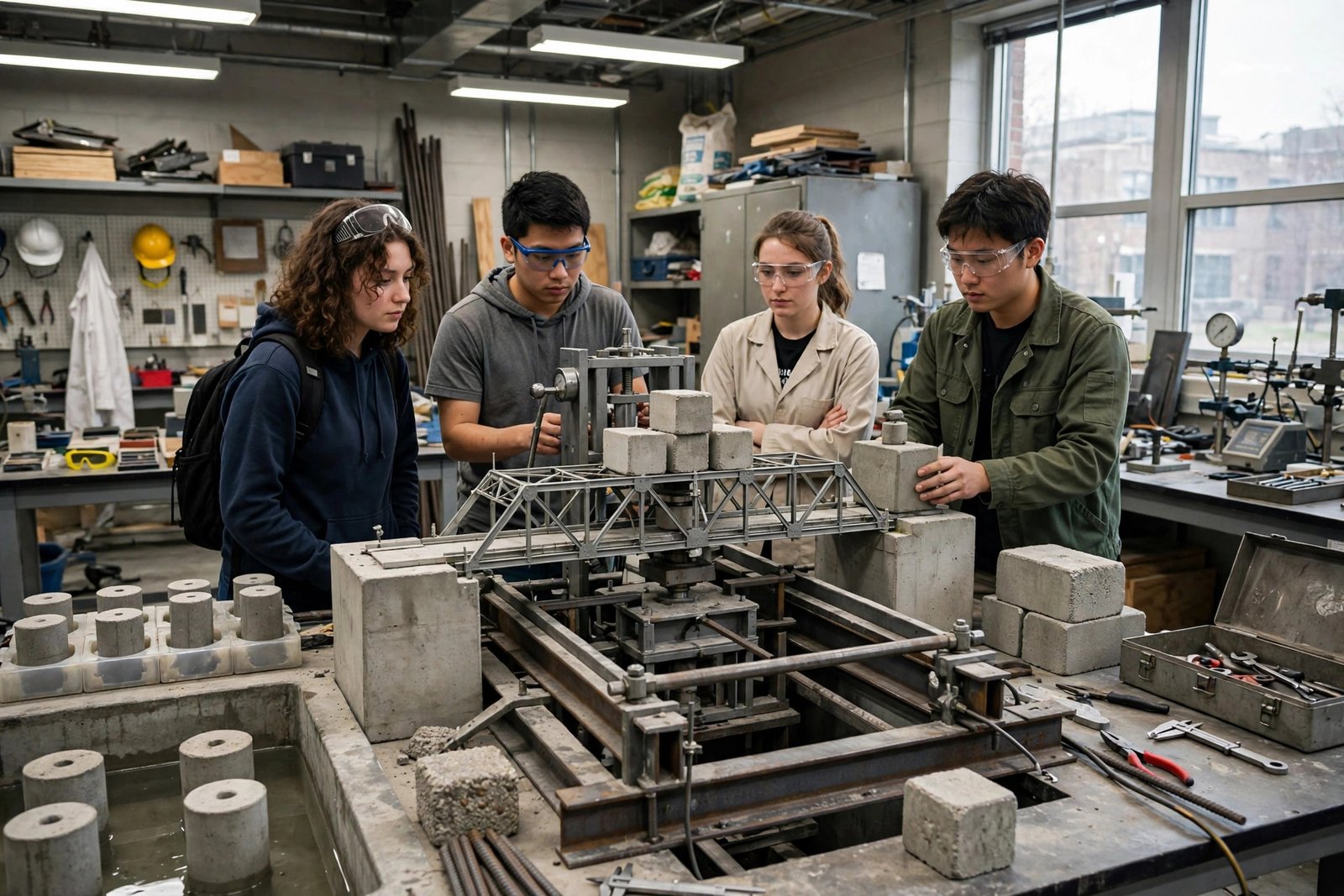
A bachelor’s degree gives you the fundamentals of all of these; a master’s gives you depth in one or two, plus advanced tools: finite element analysis, computational modelling, advanced structural dynamics, soil-structure interaction, transport modelling and project risk analysis. Many programmes also include site visits, laboratory testing and industry-linked design projects, which matter because civil engineering employers value judgement built on real constraints — budgets, codes, ground conditions and safety — not only theory.
One feature that sets civil engineering apart from computing degrees is the role of codes and standards. Structures are designed to national codes — Eurocodes in Europe, ACI and ASCE standards in the United States, and equivalents elsewhere — and a good master’s teaches you to work within them, not just to solve equations. If you plan to work in a particular country after graduating, studying there has a real advantage: you learn its codes, its practice and its professional culture directly.
What You Study in an MS in Civil Engineering
Most programmes begin with advanced core modules — advanced structural analysis, advanced soil mechanics, fluid mechanics or numerical methods — then branch into the specialisation. A structural track adds finite element methods, structural dynamics, earthquake engineering, bridge design and steel and concrete design at an advanced level. A geotechnical track adds foundation engineering, slope stability, ground improvement and tunnelling. A transportation track adds traffic engineering, highway design, pavement engineering and transport planning. A water track adds hydrology, hydraulic structures, flood modelling and water supply engineering. A construction management track adds project planning, cost engineering, contracts and risk.
Many programmes also offer modules that reflect current industry change: sustainable and low-carbon construction, Building Information Modelling (BIM), smart infrastructure and sensor monitoring, climate-resilient design, and digital twins for infrastructure assets. These are worth weighing seriously, because they are where much of the profession’s growth is concentrated, and they differentiate a modern master’s from a purely traditional one.
Typical module topics include:
- Advanced structural analysis and finite element methods
- Structural dynamics and earthquake engineering
- Advanced soil mechanics and foundation engineering
- Transport planning, traffic engineering and pavement design
- Hydrology, hydraulics and water resources engineering
- Construction project management, contracts and cost engineering
- Sustainable construction and Building Information Modelling (BIM)
- Research methods and a major thesis or design project
The thesis or capstone project is a major component of most programmes and a strong talking point in job interviews, especially if it involves a real structure, site or dataset. When comparing programmes, ask whether the project is industry-linked and whether the department has testing laboratories — structures labs, geotechnical labs and hydraulics labs — that students actually use.
Eligibility and Entry Requirements
Entry to an MS in Civil Engineering normally requires a bachelor’s degree in civil engineering or a closely related engineering discipline such as structural, architectural or construction engineering. Some programmes accept mechanical or environmental engineering graduates, particularly for interdisciplinary tracks, but a civil background is the standard expectation, and applicants from other fields may need to complete prerequisite modules.
Grade expectations follow country patterns. US universities often look for a GPA around 3.0 out of 4.0, with stronger programmes expecting more. UK universities typically ask for a 2:1 honours degree or its international equivalent, though some accept a 2:2 with relevant experience. Canadian and Australian universities generally require a bachelor’s degree with a mid-to-high average, and research-oriented programmes may prefer applicants with a thesis or design project background. German public universities require a recognised bachelor’s degree with sufficient civil engineering content, and some set a minimum grade threshold.
English requirements are standard: IELTS 6.5 overall is the most common minimum, with some universities asking for 7.0, and TOEFL iBT equivalents around 90. Applications normally include transcripts, a statement of purpose, recommendation letters and a CV. The strongest statements name a specialisation and explain why — a bridge design interest linked to a structures lab, a water resources interest linked to flood work in your home country — rather than praising engineering in general.
Tuition Fees and Living Costs
Tuition for a civil engineering master’s is in line with other engineering degrees, with the usual country differences. The ranges below are indicative for international students for 2025–26 or 2026–27; confirm exact fees on each university’s official page.
| Country | Typical international tuition per year | Notes |
|---|---|---|
| United States | USD 28,000–65,000 | Public universities cheaper; private universities at the top end |
| United Kingdom | GBP 24,000–38,000 | One-year programmes keep the total cost down |
| Canada | CAD 18,000–42,000 | Varies by province; co-op options exist at some universities |
| Germany | Usually no tuition at public universities | Semester contribution around EUR 150–350; some states charge non-EU fees |
| Australia | AUD 40,000–54,000 | Two-year programmes are common |
Living costs are part of visa evidence as well as a real budget. For the UK, student visa maintenance is GBP 1,529 per month in London and GBP 1,171 per month outside London (gov.uk, Appendix Student, current from January 2025; rising to GBP 1,570 and GBP 1,203 for applications on or after 30 November 2026). Germany requires a blocked account of EUR 11,904 for 2026. Australia’s financial capacity requirement is AUD 29,710 per year for living costs. Canada’s proof-of-funds requirement for a single applicant outside Quebec was CAD 22,895, rising to CAD 23,448 under the 2026 update. Use the tuition fee calculator and the cost-of-living calculator to total your own costs before applying.
Top Universities and Countries for Civil Engineering
Civil engineering strength is widely distributed, which gives applicants real choice. In the United States, the strongest programmes combine large research departments with industry links to major design and construction firms; the UC Berkeley profile in the universities directory is one example of a US programme with deep civil and environmental engineering research. In the United Kingdom, several universities pair one-year MSc programmes with strong structures and geotechnics research, and the UK’s Chartered Engineer pathway gives a clear professional route after graduation.
Germany is a strong value choice: technical universities such as TU Berlin offer rigorous civil engineering education with little or no tuition, and Germany’s construction and infrastructure sector is large. Canada offers moderate tuition, co-op options and a post-graduation work permit of up to three years, which is valuable because licensing and senior roles take time to build towards. Australia combines strong civil programmes with major infrastructure investment and a well-defined skilled-migration framework for engineers. The university comparison tool and the rankings directory can help you compare options, and the Bachelor of Engineering profile is useful background if you are comparing undergraduate and postgraduate routes.
When comparing programmes, weigh specialisation fit above general reputation: a university famous for structures may be ordinary in transportation, and vice versa. Check the department’s research groups, its laboratory facilities, and whether its graduates work for the kinds of firms you want to join — design consultancies, contractors, government agencies or specialist firms.
Careers, Salaries and Licensing After an MS in Civil Engineering
Civil engineering graduates work for design consultancies, contractors, government transport and water agencies, utilities, and specialist firms in geotechnics, structures or tunnelling. Early roles include graduate civil engineer, structural design engineer, site engineer, geotechnical engineer, transport engineer and water engineer. With experience, these lead to senior engineer, principal engineer, project manager, design manager and associate or director roles in consultancies, or to senior positions in public agencies.
The US Bureau of Labor Statistics provides the clearest official salary benchmark for the profession (see the BLS Civil Engineers profile for the full data):
| Occupation (USA) | Median annual wage | Source and year |
|---|---|---|
| Civil engineers | USD 100,840 | BLS Occupational Outlook Handbook, 2025 median pay |
| Civil engineers (May 2024 figure) | USD 99,590 | BLS Occupational Employment and Wage Statistics, May 2024 |
| Architectural and engineering managers | USD 171,270 | BLS Occupational Outlook Handbook, 2025 median pay |
| Environmental engineers | USD 107,110 | BLS Occupational Outlook Handbook, 2025 median pay |
| Project management specialists | USD 102,320 | BLS Occupational Outlook Handbook, 2025 median pay |
These are national medians across all experience levels, not graduate starting salaries, which are typically lower. The BLS also reports that employment of civil engineers is projected to grow 6 percent from 2025 to 2035, faster than the average for all occupations, with about 22,700 openings projected each year on average, mostly from replacement needs. That combination — steady growth plus a large replacement pipeline — is why civil engineering remains a reliable, if rarely spectacular, career choice.
Licensing deserves separate attention because it shapes long-term prospects. In the United States, engineers who offer services directly to the public typically need a state licence (Professional Engineer, PE), which requires an accredited degree, passing the Fundamentals of Engineering and PE exams, and several years of progressive experience under a licensed engineer. In the UK, Chartered Engineer (CEng) status through the Institution of Civil Engineers follows a period of professional development and a professional review. Canada has the Professional Engineer (P.Eng.) designation through provincial regulators, and Australia has Chartered status through Engineers Australia. A master’s degree helps with all of these routes but does not replace them: check the regulator in your target country early, and confirm whether your degree is accredited by the relevant body, such as ABET in the United States.
Post-study work options are also relevant. The United States offers Optional Practical Training, with a STEM extension of up to 24 months for eligible engineering degrees. The UK Graduate Route currently allows two years of post-study work for master’s graduates, with an announced shortening to 18 months from 1 January 2027 — verify current rules before relying on them. Canada’s Post-Graduation Work Permit can run up to three years, and Germany gives international graduates 18 months to find skilled work. Check the visa requirement checker and official government pages for your situation.
Scholarships for Civil Engineering Students
Civil engineering students can apply for the major government scholarships — Fulbright, Chevening, DAAD and Canadian graduate funding — as well as university merit awards and departmental scholarships. Some industry bodies and construction firms also sponsor students, particularly in structures, geotechnics and transportation, sometimes tied to a placement or a thesis topic. Research-assistant positions are available in research-oriented departments and can offset tuition and living costs.
Use the scholarship finder and the scholarships directory early, since major deadlines fall months before programme deadlines. When applying, a statement that connects your specialisation to a real infrastructure need — flood resilience, affordable housing, transport access — tends to read more convincingly than a generic essay, because funders in this field care about public benefit.
How to Choose the Right Civil Engineering Programme
Start from your specialisation, then check three things: accreditation, laboratories and industry links. Accreditation matters because it affects licensing: an ABET-accredited degree in the USA, or a degree accredited by the relevant professional body elsewhere, keeps the most doors open. Laboratories matter because civil engineering is physical — a structures lab, a soils lab and a hydraulics lab you actually use will teach you things lectures cannot. Industry links matter because site experience, placements and industry-linked projects are what convert a degree into a first job.
Also weigh location honestly. Studying near major infrastructure activity — a city building a metro, a region investing in flood defences, a country renewing its highways — gives you site visits, guest lectures and employers nearby. And compare total cost, not just tuition: a no-tuition German degree over two years and a one-year UK degree can end up surprisingly close once living costs are counted. The Courses and Programs directory and the career path explorer can help you weigh the options systematically.
Application Timeline for 2026 and 2027 Intakes
A well-planned application timeline starts twelve to fifteen months before entry. In the first phase, shortlist eight to twelve programmes by specialisation — structures, geotechnics, transportation, water or construction management — rather than by general reputation, since departments differ sharply by sub-discipline. Check each programme’s accreditation status, laboratory facilities and industry links, and note the separate deadlines for admission and for scholarships, which often close months earlier. Sit your English test early so that a missing score never blocks an otherwise complete application.
Six to nine months before entry, submit applications in waves and refine your statement of purpose as you go. Ask referees early, giving them your CV and a note about your chosen specialisation, so their letters can speak to it specifically. If a programme interviews applicants or reviews a portfolio, be ready to discuss a design or site project you have worked on, including the constraints you dealt with — ground conditions, codes, budgets or safety — because civil engineering interviewers value judgement under real constraints more than textbook answers.
When offers arrive, compare total cost including living expenses, and weigh accreditation and licensing implications alongside tuition: a degree that keeps your licensing route open in your target country is worth more than a marginally cheaper one that does not. Confirm your visa financial evidence early, since maintenance figures, proof-of-funds thresholds and blocked-account rules change periodically, and late paperwork is a common cause of deferred entry. Track every programme’s deadline, fee, funding decision and visa requirement in one spreadsheet, updated weekly through application season.
Common Mistakes Applicants Make
The first mistake is choosing a programme by general reputation rather than specialisation fit. A university famous for structures may be ordinary in transportation, and a programme with weak laboratories will leave you short of the practical judgement employers test for. Read research group pages, check lab facilities, and look at where graduates work before shortlisting.
The second mistake is ignoring codes, standards and licensing. Civil engineering is a regulated profession, and the country where you study shapes which codes you learn and which licensing route opens to you. Check the relevant regulator — for example, the path to Professional Engineer status in the USA or Chartered Engineer status in the UK — before enrolling, and confirm whether your degree is accredited by the relevant body.
The third mistake is underestimating language and local practice. Infrastructure work is local by nature: site communication, client meetings and regulatory submissions all happen in the host country’s language and professional culture, even when the degree itself is taught in English. Students who invest in the local language and in understanding local practice do markedly better in the job market. Finally, do not treat post-study work rules as a detail: check official government pages for the current rules before committing, since licensing takes years and a short post-study window may not be enough to start it.
Building Your Profile While You Study
A civil engineering degree opens doors, but the portfolio and experience you build alongside it determine how quickly you walk through them. Site experience is the single most valuable addition: vacation placements, internships with consultancies or contractors, and even short site visits arranged through your department all give you stories and judgement that interviewers recognise immediately. Keep a record of every project you touch — the structure type, the codes used, the ground conditions, the decisions you contributed to — because a specific project account impresses far more than a list of module titles.
Software competence is the second pillar. Beyond the analysis packages taught in your programme, familiarity with BIM tools, CAD, and at least one structural or geotechnical analysis package used in industry will set you apart. Student membership of a professional body such as the Institution of Civil Engineers or Engineers Australia is also worth taking up: it gives you access to technical lectures, networking events and guidance on the path to chartered or licensed status, and it signals professional seriousness to employers. Finally, use your university’s careers service early, since graduate scheme applications at major consultancies open many months before graduation, and the students who secure the best offers are usually those who applied first.
Frequently Asked Questions
Is an MS in Civil Engineering worth it?
For students aiming at senior technical or project roles, yes: the degree deepens specialist knowledge, supports licensing routes, and sits in a profession with steady official growth projections. It is less necessary for general site roles, where a bachelor’s plus experience may be enough.
Can I become a licensed engineer abroad after this degree?
Possibly, but licensing is separate from the degree and takes years: exams plus supervised experience in the USA, professional review in the UK, and provincial or national processes in Canada and Australia. Check the regulator in your target country before enrolling, and confirm your degree’s accreditation status.
Which specialisation pays best?
Official statistics do not publish reliable medians by civil sub-discipline, so beware of articles that claim precise figures for structures versus geotechnics. In general, senior and managerial roles pay more than junior design roles, and specialisms tied to scarce skills — tunnelling, seismic design, major-project management — tend to command premiums, but the honest answer is that experience and responsibility matter more than the label.
Is civil engineering a good choice for international students?
Yes, with a caveat: infrastructure work is local by nature, so language skills, local codes and local licensing matter more than in computing. Students who invest in the host country’s language and professional system do best; those who expect the degree alone to open doors may be disappointed.
Which country is best for civil engineering study?
It depends on your goals: Germany offers low tuition and strong technical education, the USA offers a large market and the PE route, the UK offers one-year degrees and the CEng route, Canada offers co-op and long post-study work rights, and Australia offers major infrastructure investment. Match the country to your licensing and career plans.
Do I need work experience to apply?
Not usually for taught master’s programmes, though relevant experience strengthens an application and is essential for some management-oriented tracks. Research-oriented programmes may prefer applicants with a thesis or project background.
What is BIM, and should I learn it?
Building Information Modelling is the digital process of creating and managing information about a built asset across its lifecycle. Yes, learn it: BIM competence is increasingly expected in design and construction roles, and programmes that teach it give you a practical advantage.
Sources & Verification
- US Bureau of Labor Statistics, Occupational Outlook Handbook: Civil Engineers (2025 median pay USD 100,840; employment projected to grow 6 percent from 2025 to 2035; about 22,700 openings per year), Architectural and Engineering Managers, Environmental Engineers.
- US Bureau of Labor Statistics, Occupational Employment and Wage Statistics, May 2024 (civil engineers median USD 99,590).
- UK Home Office / gov.uk, Appendix Student: student visa maintenance rates GBP 1,529 (London) and GBP 1,171 (outside London), rising to GBP 1,570 and GBP 1,203 for applications on or after 30 November 2026.
- German Federal Foreign Office: blocked account requirement EUR 11,904 for 2026.
- Australian Department of Home Affairs: student visa financial capacity AUD 29,710 per year.
- Immigration, Refugees and Citizenship Canada: proof-of-funds requirement CAD 22,895, rising to CAD 23,448 under the 2026 update.
Figures change yearly — confirm fees and requirements on the official university page before applying. StudyGraduate is an information portal, not an agency — we never promise admission, jobs, salaries or visa or permanent-residency outcomes, and nothing on this page should be read as a guarantee of any of them.