

MS in Chemical Engineering Abroad: Eligibility, Fees, Top Universities and Careers
Chemical engineering is the discipline that turns chemistry into industry: it designs the processes that make fuels, plastics, medicines, food, fertilisers, semiconductors and clean water at a scale no laboratory bench can match. An MS in Chemical Engineering abroad adds advanced process design, safety engineering and scale-up skills to a chemistry or engineering background, and it opens doors in pharmaceuticals, energy, specialty chemicals, food processing and environmental technology. This guide explains what the degree involves, who is eligible, what it costs in the USA, UK, Canada, Australia and Germany, which universities and countries suit different goals, what graduates earn according to official statistics, and how to fund the degree.
It is written for students planning 2026 or 2027 intakes. Every cost and salary figure here is labelled with its source and year, and you should confirm the current figure on the official university or government page before you apply. Nothing here promises admission, a job, a salary or a visa outcome: those decisions belong to universities, employers and immigration authorities, not to any guide.
Chemical engineering is often confused with chemistry, so the distinction is worth stating plainly. Chemistry discovers reactions and molecules; chemical engineering designs, builds, operates and improves the plants that run those reactions safely, economically and at industrial scale. A master’s in chemical engineering therefore teaches much more than advanced chemistry: thermodynamics and transport phenomena, reactor design, separation processes, process control, process safety, and plant economics. Students with a pure chemistry bachelor’s can often enter chemical engineering master’s programs, but they should expect bridging coursework in engineering mathematics, fluid mechanics and process design, and should check each program’s requirements carefully.
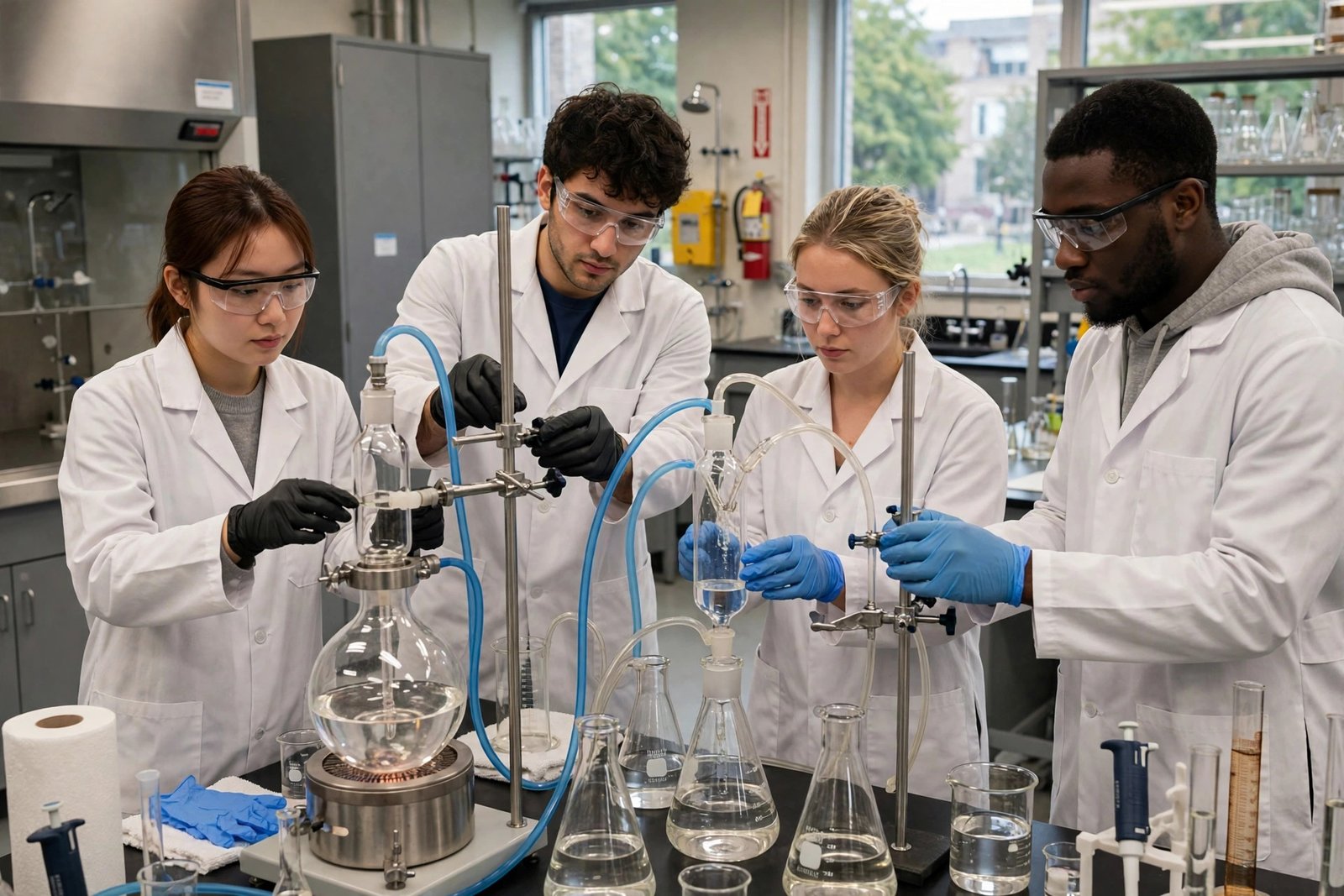
MS in Chemical Engineering at a Glance
| Item | Typical detail |
|---|---|
| Degree level | Master’s (MS, MSc, MEng or MASc depending on country) |
| Typical duration | 1 year (UK, some Australian programs); 1.5–2 years (USA, Canada, Australia, Germany) |
| Entry qualification | Bachelor’s in chemical engineering, chemistry, or a closely related science or engineering field |
| Core subjects | Transport phenomena, thermodynamics, reaction engineering, separation processes, process control, process safety |
| Thesis or project | Most programs include a research thesis, design project, or industry placement |
| Common specialisations | Process design, pharmaceuticals and biotechnology, energy and sustainability, polymers and materials, food processing, environmental engineering |
| Post-study work routes | USA OPT including STEM extension; UK Graduate Route; Canada PGWP; Australia Temporary Graduate visa; Germany 18-month job-seeker permit |
What You Study in an MS in Chemical Engineering
The core of most chemical engineering master’s programs is built on three pillars. Transport phenomena covers the movement of momentum, heat and mass — the equations that describe how fluids flow, how heat exchangers work, and how mixtures separate. Reaction engineering covers reactor design, catalysis and kinetics: how to choose and size a reactor, how to control selectivity and yield, and how to scale a reaction from a flask to a vessel holding thousands of litres. Separation processes covers distillation, absorption, extraction, membranes and crystallisation: the operations that purify products and, in many plants, consume most of the energy.
Around that core, programs offer tracks that map closely onto industries. A process design track teaches flowsheet simulation, equipment design, plant economics and the capstone plant design project that is the signature assessment of many chemical engineering degrees. A pharmaceuticals and biotechnology track covers bioreactors, downstream processing, good manufacturing practice and regulatory affairs. An energy and sustainability track covers carbon capture, hydrogen, biofuels, battery materials and process intensification. A polymers and materials track covers polymer reaction engineering, rheology and materials characterisation. A food processing track covers food engineering operations, preservation and safety systems. An environmental track covers water treatment, waste minimisation and emissions control.
Process safety is a distinctive and non-negotiable part of the discipline. Chemical engineers are responsible for plants where a design error can injure people, so master’s programs teach hazard identification, relief system design, risk assessment and the investigation of incidents. Employers treat safety competence as a hiring criterion, not an optional extra, and a strong safety component in your degree is worth highlighting in applications. Simulation software is equally central: Aspen Plus or Aspen HYSYS for flowsheet simulation, MATLAB or Python for modelling, and computational fluid dynamics tools for equipment design. A program that teaches only theory, with no substantial simulation or laboratory component, will leave you at a disadvantage; check module descriptions and assessment methods, not just the degree title.
Laboratory and project work is where a master’s abroad earns its value. Expect pilot-scale rigs for distillation, heat exchange and reaction, analytical laboratories, and the plant design project, which typically asks a team to design a complete process — from raw materials to purified product — with equipment sizing, safety analysis and an economic evaluation. The thesis or design project is usually the most important part of the degree for employment: it is the work you will discuss in interviews, and it is often done with an industry partner or research group. Choose a project in the industry you want to enter, and ask prospective programs how projects are allocated and whether industry co-supervision is possible.
Eligibility and Entry Requirements
The baseline requirement is consistent almost everywhere: a bachelor’s degree in chemical engineering, or in chemistry, applied chemistry, biochemical engineering, materials science or another closely related field, with strong grades in mathematics, physical chemistry, thermodynamics and, where available, fluid mechanics and heat transfer. Chemistry graduates are commonly admitted but should expect bridging modules in engineering fundamentals. Applicants from unrelated fields usually need a different program or substantial preparatory coursework. A three-year bachelor’s degree can be an issue in Germany and at some Canadian universities, so check this early rather than after you have paid an application fee.
Grade expectations differ by destination. In the USA, competitive programs typically look for a GPA around 3.0 or above on a 4.0 scale, with the strongest programs higher; the GPA converter on this site can help you translate your grades into the 4.0 scale. In the UK, the usual requirement is a 2:1 honours degree or its international equivalent. In Canada, a B average or better in the final two years is a common threshold. In Germany, admission is often governed by a minimum grade in the German system and by whether your bachelor’s covers the required subject content; some programs are restricted and some are open admission. In Australia, requirements are usually expressed as a recognised bachelor’s degree with a specified GPA or percentage.
English language requirements are broadly similar across destinations: IELTS 6.5 overall with no band below 6.0 is the most common threshold, with some programs requiring 7.0, and TOEFL iBT equivalents accepted in the USA, Canada and Australia. Note that TOEFL iBT scores have been reported on a 1–6 scale since January 2026, so confirm how your target university reads the new format. The GRE is now optional or not required at many US chemical engineering programs, though a strong quantitative score can still help an application with a weaker GPA or a less well-known bachelor’s institution. Two academic references, or one academic and one professional reference for applicants with work experience, are standard, and a statement of purpose that names a specialisation and connects it to a project or work experience is worth more than a generic essay.
| Destination | Typical academic requirement | Typical English requirement | Notes |
|---|---|---|---|
| USA | 4-year bachelor’s in chemical engineering or related science/engineering; GPA ~3.0+ | IELTS 6.5–7.0 or TOEFL equivalent | GRE often optional; funding often tied to research assistantships |
| UK | 2:1 honours or international equivalent | IELTS 6.5 overall, no band below 6.0 (varies) | 1-year MSc common; Graduate Route currently 2 years |
| Canada | 4-year bachelor’s; B average in final years | IELTS 6.5–7.0 | Thesis-based MASc often funded; course-based MEng usually self-funded |
| Australia | Recognised bachelor’s in engineering or related field | IELTS 6.5 overall | 2-year master’s common; check Engineers Australia accreditation |
| Germany | Bachelor’s with required subject content; grade threshold varies | IELTS 6.5 for English-taught programs; German needed for German-taught ones | Most public universities charge no tuition; blocked account required for visa |
Tuition Fees and Living Costs
Costs vary far more by country than by university, so choose the country first and the university second. In the USA, international master’s tuition in engineering is typically the highest of the five destinations, and total costs depend heavily on whether the program is at a public or private university and on the state. Funding changes the picture: research assistantships and teaching assistantships at US universities commonly include a tuition waiver and a stipend, and thesis-based students are far more likely to receive them than course-only students. Ask departments directly about assistantship availability before accepting an offer.
In the UK, a one-year MSc compresses the total cost into a single year, which is attractive even though annual tuition is high; the trade-off is an intense schedule with little room for part-time work during term. For a UK Student visa, you must show maintenance funds of £1,529 per month in London or £1,171 per month outside London for up to nine months, and these rates rise to £1,570 and £1,203 for applications on or after 30 November 2026. In Canada, average tuition for international graduate students was CAD 24,028 in 2025/26 according to Statistics Canada, and study permit applicants must show living funds of CAD 22,895 for applications between 1 September 2025 and 31 August 2026, rising to CAD 23,448 from 1 September 2026. In Australia, the student visa financial capacity requirement for living costs is AUD 29,710 per year, and the visa application charge is AUD 2,500 from 1 July 2026.
Germany remains the lowest-cost option for many students: most public universities charge no tuition, with the notable exception of Baden-Württemberg, which charges non-EU students €1,500 per semester, and some universities which have introduced non-EU fees. You will still need a blocked account of €11,904 for 2026 to satisfy the visa’s proof of funds, plus a semester contribution of a few hundred euros. The tuition fee calculator and cost of living calculator can help you compare total budgets across destinations, but always replace their estimates with the official figures from your offer letter and the relevant immigration authority.
Beyond tuition, budget for health insurance, books and software, laboratory and project costs, travel, and the visa itself. In the USA, budget for the SEVIS fee of $350 and the visa application fee of $185, plus a Visa Integrity Fee of at least $250 at issuance. In the UK, the Student visa fee is £558 and the Immigration Health Surcharge is £776 per year. Small costs accumulate: application fees, credential evaluations, English test fees and document certification can easily add several hundred dollars before you even receive an offer.
Top Universities and Countries for Chemical Engineering
The USA offers the deepest market for chemical engineers: Gulf Coast petrochemicals, pharmaceuticals, specialty chemicals and, increasingly, battery and semiconductor materials. Germany offers low tuition, the world’s largest chemical industry cluster, and an 18-month post-study job-seeker residence permit. The UK offers one-year degrees and strengths in pharmaceuticals, formulation science and sustainable process engineering. Canada offers a post-study work permit of up to three years and strong oil, gas, mining and clean-technology sectors. Australia offers two-year master’s programs and demand in mining and minerals processing, energy and water treatment.
Rather than chasing a single league table, shortlist universities by specialisation strength and industry links. For pharmaceuticals and biotechnology, look at departments with good manufacturing practice training, bioprocessing pilot facilities and industry placements. For energy and sustainability, look at research groups in carbon capture, hydrogen and process intensification. For process design, look at programs whose capstone design project is assessed by practising engineers. The universities directory and the rankings pages on this site let you compare institutions, and individual profiles such as UC Berkeley, TU Berlin and UNSW Sydney show the kind of program detail to look for. For a broader view of engineering degrees, see the Courses and Programs directory and the Bachelor of Engineering program profile.
Accreditation deserves a check before you apply. In the USA, ABET accreditation of the underlying bachelor’s program matters for later licensure; the ABET accreditation pages explain which programs are accredited. In Australia, Engineers Australia accreditation supports recognition and migration pathways. In the UK, Engineering Council accreditation matters for Chartered Engineer status. In Canada, Engineers Canada accreditation of the bachelor’s degree matters for licensure. A master’s degree does not automatically confer professional registration anywhere; registration is a separate process with its own experience requirements. Chemical engineering also has a professional identity worth noting: institutions such as IChemE in the UK accredit degrees and support Chartered Chemical Engineer status, which is relevant if you plan a long career in process industries.

Careers and Salaries for Chemical Engineering Graduates
Chemical engineering graduates work as process engineers, process design engineers, production engineers, process safety engineers, pharmaceutical process engineers, energy engineers, environmental engineers, and, with experience, plant managers and engineering managers. The field is smaller than mechanical or electrical engineering, which has two consequences worth understanding: salaries are comparatively high, but jobs are geographically concentrated — in the USA, for example, along the Gulf Coast and in chemical and pharmaceutical hubs — so being willing to relocate widens your options considerably.
Official salary data gives a realistic anchor. In the United States, the Bureau of Labor Statistics Occupational Outlook Handbook for chemical engineers reports a median annual wage for chemical engineers of $125,040 in May 2025, with the lowest 10 percent earning less than $79,420 and the highest 10 percent more than $182,880. Industry matters: the May 2025 median was $133,050 in the federal government excluding postal service, $127,090 in engineering services, $124,540 in research and development in the physical, engineering and life sciences, and $112,300 in chemical manufacturing. Employment of chemical engineers in the USA is projected to grow 5 percent from 2025 to 2035, faster than the average for all occupations, with about 1,100 openings projected each year — a small field, so most openings come from replacement demand rather than rapid expansion.
| Role or industry (USA) | Figure (BLS, May 2025) | Note |
|---|---|---|
| Chemical engineers, all industries (median) | $125,040 per year | Median: half earn more, half less |
| Lowest 10 percent | Less than $79,420 | Typically early-career or lower-paying regions |
| Highest 10 percent | More than $182,880 | Senior and specialist roles |
| Federal government, excluding postal service | $133,050 | Highest-paying major industry listed |
| Engineering services | $127,090 | Industry median |
| Research and development | $124,540 | Industry median |
| Chemical manufacturing | $112,300 | Industry median; largest employer |
Outside the USA, salary levels differ and should be checked in the official statistics of the destination country rather than converted from US figures. The career path explorer can help you compare roles, but treat any non-official salary figure you find online with scepticism. Post-study work rules also differ: US graduates in STEM-designated programs can use OPT for 12 months plus a 24-month STEM extension; UK graduates currently receive a 2-year Graduate Route visa, with an announced reduction to 18 months for applications on or after 1 January 2027; Canadian graduates can receive a Post-Graduation Work Permit of up to 3 years; Australian graduates use the Temporary Graduate visa, with a base charge of AUD 5,750 from 1 July 2026; German graduates can take an 18-month job-seeker residence permit and, after two years of qualified employment, may qualify for settlement.
Licensure is a longer-term consideration. In the USA, engineers who offer services to the public must be licensed, which involves the Fundamentals of Engineering exam, supervised experience, and the Professional Engineering exam; most industry roles do not require a licence, but it matters in consulting and public infrastructure. Similar registration systems exist in Canada, Australia and the UK. If you plan to seek registration, choose programs and early jobs that keep that path open.
Scholarships for Chemical Engineering
Funding for a chemical engineering master’s comes from four main sources: university scholarships and assistantships, government scholarships, industry sponsorships, and external foundations. University merit scholarships are the most common, and many are awarded automatically on the basis of the admission application, so apply early and check whether a separate scholarship application is needed. In the USA, research and teaching assistantships are often the largest source of funding and are worth asking about directly when you contact a department. In Germany, DAAD scholarships and university-specific awards exist alongside the low-tuition model. In the UK, Australia and Canada, faculty and departmental scholarships, Commonwealth scholarships and country-specific awards are worth a systematic search.
Start your funding search in the scholarships directory and compare offers with the university comparison tool. Treat any scholarship that asks for payment to apply as a scam, and verify every award on the official university or government page. Note also that many scholarships have earlier deadlines than admission itself, sometimes by several months, so build a separate deadline list for funding and track it with the application deadline finder.
How to Choose the Right Program
Start from the job you want, not from a ranking. Write down three roles you would be happy in after graduation, then work backwards: which specialisation, which software, which project topic and which employers connect to those roles. Then shortlist six to eight programs across at least two countries, so that a rejection or a funding shortfall in one destination does not end your plan. Compare them on specialisation fit, laboratory and project quality, industry links and placement or co-op options, total cost after funding, and post-study work rules. Contact current students or recent graduates through departmental channels and ask about the project allocation process, the availability of assistantships, and how many graduates found engineering work in their field.
Prepare your application documents in parallel: transcripts, references, statement of purpose, CV, English test results, and, where needed, evidence of laboratory or plant experience. Chemical engineering applicants benefit from describing specific processes, equipment or safety work they have handled, even at laboratory scale. Finally, check visa rules early: the visa requirement checker gives a starting overview, but the immigration authority’s own website is the only authoritative source for your application. If you need to prepare for English or admissions tests, see the test preparation resources.
Frequently Asked Questions
Is an MS in Chemical Engineering worth it abroad?
It is worth it when it buys you a specialisation, pilot-plant or design-project experience, or labour-market access you cannot get at home — particularly in pharmaceuticals, energy or process design. It is less clearly worth it if you choose a program with no simulation or design component and high tuition purely for the degree title. Compare total cost after funding against the official salary medians for your target country before deciding.
Can I study chemical engineering with a chemistry bachelor’s?
Often yes, but expect bridging coursework in engineering mathematics, fluid mechanics, heat transfer and process design. Some programs admit chemistry graduates directly into a master’s with additional modules; others prefer a dedicated conversion route. Check the subject-content requirements of each university, since they differ.
Is the GRE required for MS in Chemical Engineering in the USA?
Many programs have made the GRE optional or removed it entirely, but some still require or recommend it. A strong quantitative score can help a borderline application. Check each department’s current requirement rather than assuming a single rule.
Which country is cheapest for MS in Chemical Engineering?
Germany is usually cheapest overall because most public universities charge no tuition, although you must still show €11,904 in a blocked account for 2026 and cover living costs. The UK’s one-year format reduces total living costs, while the USA and Australia are typically the most expensive before funding.
Can I work while studying chemical engineering abroad?
Yes, within visa limits: 20 hours per week in term time in the USA on campus and in the UK; 24 hours per week off campus in Canada; 48 hours per fortnight in Australia; and 140 full days or 280 half days per year in Germany. Work rights do not guarantee a job, and engineering study is demanding, so do not rely on part-time earnings to cover tuition.
What is the salary of a chemical engineer in the USA?
The median annual wage for chemical engineers was $125,040 in May 2025 according to the US Bureau of Labor Statistics, with the lowest 10 percent below $79,420 and the highest 10 percent above $182,880. New graduates typically earn below the median, and pay varies by industry, location and experience.
Can I stay and work after an MS in Chemical Engineering?
Post-study routes exist in all five destinations covered here: OPT with a STEM extension in the USA, the Graduate Route in the UK, the Post-Graduation Work Permit in Canada, the Temporary Graduate visa in Australia, and the 18-month job-seeker permit in Germany. Each has eligibility conditions, fees and deadlines — confirm them on the official immigration website before you choose a destination.
Sources and Verification
Sources: US Bureau of Labor Statistics, Occupational Outlook Handbook, Chemical Engineers (median pay, industry medians and 2025–35 projections); Statistics Canada (average international graduate tuition 2025/26); UK Home Office / GOV.UK (Student visa maintenance rates); Immigration, Refugees and Citizenship Canada (study permit funds requirements); Australian Department of Home Affairs (Subclass 500 financial capacity and Subclass 485 charges); German Federal Foreign Office and DAAD (blocked account and tuition rules); ABET (accreditation of engineering programs). Figures change yearly — confirm fees, funds requirements and entry requirements on the official university page and the official immigration website before applying. StudyGraduate is an information portal, not an agency: it never promises admission, jobs, salaries or visa or permanent residence outcomes.