

MS in Bioinformatics Abroad: Eligibility, Fees, Top Universities and Careers
Bioinformatics sits exactly where modern biology meets modern computing. Every genome sequenced, every protein structure predicted, every clinical trial that sorts patients by genetic markers, and every public-health team tracking a pathogen in near real time depends on people who can handle biological data at scale, understand what the data mean, and build tools that other scientists can trust. An MS in Bioinformatics abroad is designed for students who want that combination: enough biology to ask the right scientific question, enough statistics to avoid fooling themselves with a large dataset, and enough programming to turn an analysis into a reproducible pipeline rather than a one-off script.
This guide explains the degree in plain terms, who it suits, what you will actually study, what universities typically ask for, what it costs, which countries are strongest for the field, and what careers follow. It is written for students planning 2026 or 2027 entry. Where a salary figure appears, it comes from an official statistical source and is labelled with that source and year. Where a figure could not be verified from an official source, it has been left out rather than estimated, and you are directed to the official university or government page that holds the current number.
If you are still comparing computing degrees, the broader Courses & Programs directory and the MSc Computer Science profile are useful companions to this guide, because many bioinformatics programmes share modules, employers and application timelines with general computer science degrees.
What an MS in Bioinformatics actually is
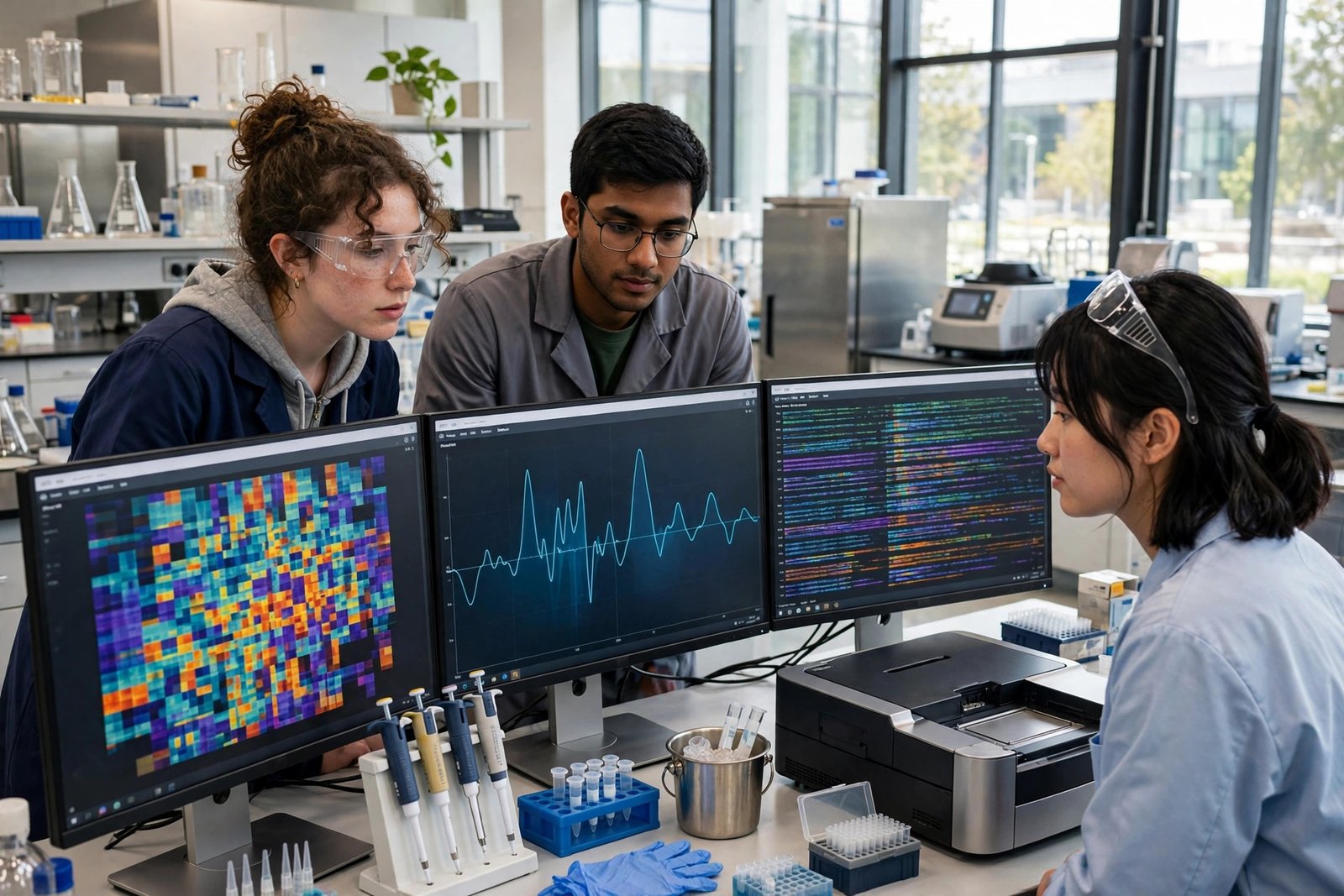
Bioinformatics is the science of storing, retrieving, analysing and interpreting biological data. The data themselves have grown faster than any single researcher’s ability to read them. A single human genome contains roughly three billion base pairs; a modern sequencing run can produce hundreds of gigabytes of raw reads; a drug-discovery programme may screen millions of compounds against a protein target. Without computational methods, that information is unusable. With them, it becomes diagnosis, drug design, crop improvement, conservation genetics and personalised medicine.
A master’s degree in the subject therefore teaches two literacies at once. The first is biological: molecular biology, genetics, genomics, proteomics, structural biology and systems biology, so that you know what a sequence, a variant, an expression value or a phylogenetic tree actually represents. The second is computational: programming in Python or R, statistics and probability, machine learning, database design, algorithms for sequence alignment and phylogenetics, and high-performance or cloud computing. The strongest programmes refuse to let either side become decoration. Biology students are pushed to write production-quality code; computing students are pushed to understand experimental design, sampling bias and the limits of a statistical test.
Degrees carry several names, and the name matters less than the curriculum. You will see MS in Bioinformatics, MSc Bioinformatics, MS in Computational Biology, MSc Computational Biology, MS in Biomedical Data Science, MS in Genomics and Bioinformatics, and bioinformatics tracks inside broader data science or biotechnology degrees. A computational biology degree often leans further towards modelling and theory, while a biomedical data science degree often leans further towards clinical and health data. Read the module list before you judge a programme by its title, and check whether the degree is taught by a biology department, a computing department, a medical school or a joint institute, because that home shapes the electives, the supervisors and the employers who recruit from it.
The degree also differs from a pure data science degree in one important respect: domain knowledge is not optional. A generic machine learning model applied to genomic data without understanding population structure, linkage disequilibrium, batch effects or clinical annotation will produce confident, publishable-looking errors. Employers in pharmaceuticals, genomics and clinical diagnostics hire bioinformaticians precisely because they can spot those errors before they reach a patient, a regulator or a publication.
Who this degree is for
This degree suits students who enjoy both sides of the work and are honest about which side needs more development. If you studied biology, biotechnology, biochemistry, medicine, pharmacy or a related life science and taught yourself programming along the way, bioinformatics gives your coding a professional structure and a research direction. If you studied computer science, mathematics, statistics or engineering and became interested in health, genetics or the life sciences, it gives your technical skills a domain where they are scarce and valued. Students from either background succeed, but they succeed by different routes, and the best programmes run bridging modules in the first semester precisely for that reason.
It is a poor fit if you dislike either programming or biology. A student who wants to work at the bench and never touch a command line will be frustrated, and a student who wants to build consumer software and has no interest in how a cell works will find the biology modules a chore. It is also a degree that rewards patience with messy data. Real biological datasets are incomplete, inconsistently labelled, collected on different instruments and full of technical artefacts. If you enjoy cleaning, validating and documenting data as much as modelling it, you will enjoy the work. If you only enjoy the modelling, you will still need the cleaning, because in this field the cleaning is most of the job.
Career changers should also think about the end point. Bioinformatics is a research-adjacent profession: many roles sit inside research institutes, hospitals, pharmaceutical companies and genomics firms, and many graduates later pursue a PhD. That is a strength if you want a research career, but it means you should check whether your target employers expect a master’s alone or a master’s plus a doctorate for the roles you want. The careers section below separates those paths honestly.
At a glance
| Feature | Typical picture |
|---|---|
| Degree level | Master’s (MS or MSc), postgraduate taught or research-led depending on country |
| Typical duration | 1 year in the UK and Ireland; 1.5 to 2 years in the USA, Canada, Australia and much of Europe |
| Core subjects | Genomics, programming for biology, statistics, machine learning, sequence analysis, structural bioinformatics |
| Common backgrounds | Biology, biotechnology, biochemistry, computer science, mathematics, statistics, medicine, pharmacy, engineering |
| Capstone | Research project, industry placement or dissertation, often with a real dataset from a lab or company |
| Typical next steps | Bioinformatician, computational biologist, genomics analyst, data scientist in life sciences, PhD |
What you study: the curriculum in detail
Almost every reputable programme begins with a shared core, even if the module titles differ. Expect a module in molecular biology and genomics that covers DNA, RNA and protein structure, gene regulation, variation and the central dogma, pitched at a level that lets computing graduates follow a research seminar. Expect a programming module in Python, with R introduced for statistics and visualisation, and expect version control, reproducible workflows and Unix command-line skills to be taught as professional practice rather than assumed. Expect statistics and probability taught through biological examples: hypothesis testing, multiple-testing correction, regression, clustering and classification, with a strong emphasis on what a p-value does and does not mean when you test twenty thousand genes at once.
The middle of the degree is where programmes diverge, and this is where you should compare them carefully. Sequence analysis covers alignment, assembly, variant calling and annotation, and is the backbone of genomics work. Structural bioinformatics covers protein structure prediction, molecular docking and the interpretation of structures, increasingly important as predicted structures become routine. Systems biology and network analysis cover pathways, gene regulatory networks and multi-omics integration. Machine learning for biology covers the adaptation of general methods to biological data, including the handling of small sample sizes, class imbalance and the need for interpretable models in clinical settings. Health informatics and clinical genomics modules cover electronic health records, variant interpretation, privacy and the regulatory context of patient data. Single-cell and spatial omics, metagenomics and microbiome analysis, and population genetics appear as electives or specialisations in stronger programmes.
Practical work matters more than lecture content in this field, and you should judge a programme by its practicals. Ask whether students work on real, messy datasets rather than cleaned teaching files; whether they build a pipeline end to end, from raw reads to a report; whether they use a high-performance computing cluster or a cloud platform; and whether the dissertation is supervised by an active research group. A dissertation with a genomics company, a hospital genetics laboratory or a research institute is worth more than a classroom project, because it gives you a reference, a portfolio piece and a realistic sense of how the work is done under deadlines.
Soft skills are built into the work whether programmes advertise them or not. Bioinformaticians write for biologists who do not code and code for biologists who do not want to read a methods section. You will learn to explain a result in a figure, to document an analysis so that another person can rerun it a year later, and to say clearly when the data do not support a conclusion. Those habits are what separate a graduate who can run a tool from a graduate who can be trusted with a project.
Specialisations worth considering
Genomics and clinical bioinformatics is the largest and most visible specialisation. It covers human genome analysis, rare-disease diagnostics, cancer genomics and pharmacogenomics, and it leads most directly into hospital laboratories, diagnostic companies and national genomics programmes. It also carries the heaviest responsibility, because a variant call can influence a clinical decision, so programmes in this area rightly emphasise quality control, validation and data governance.
Drug discovery and structural bioinformatics covers target identification, molecular docking, virtual screening and the analysis of high-throughput screening data. It suits students who enjoy chemistry and three-dimensional thinking, and it leads into pharmaceutical and biotechnology companies. Computational systems biology covers modelling of pathways, cells and tissues, and suits students with a mathematical bent who want to build models rather than only analyse data.
Agricultural, environmental and microbial bioinformatics is a smaller but growing area. It covers crop genomics, livestock genetics, microbiome analysis, pathogen surveillance and conservation genetics. It suits students who want to work outside human health and who are willing to go where the funding and the field sites are, including government research institutes and international agricultural research centres. Finally, biomedical data science and health informatics covers the analysis of clinical, imaging and wearable data at population scale, and overlaps heavily with general data science, which makes it a flexible choice if you want to keep industry options open.
Eligibility and entry requirements
Entry requirements vary by country and university, but the pattern is consistent. Universities normally ask for a bachelor’s degree in a relevant subject, usually with a strong grade in the final years. For students from India, Bangladesh and similar systems, that typically means a first division or a high second division, depending on the university; for students from other systems, it means the equivalent of a good upper-second-class honours degree in the UK framework. Some programmes accept a lower grade if the applicant has relevant work experience, a strong programming portfolio or research experience, but that is decided case by case and should never be assumed.
Programming and quantitative preparation is where applications succeed or fail. A biology graduate with no programming experience can still be admitted, but will face a steep first semester, and some programmes require evidence of prior programming, statistics or mathematics, either through coursework or an online certificate with a portfolio. A computing graduate with no biology background faces the mirror-image problem, and should show genuine engagement with the life sciences, whether through a module, a project, a short course or work experience. The strongest applications, from either side, include a short project: an analysis of a public dataset, a small pipeline on a public repository, or a contribution to an open-source bioinformatics tool. That project tells an admissions tutor more than a statement of interest.
English language requirements are standard for international students. Most universities ask for an IELTS overall score around 6.5, with no band below 6.0, or a TOEFL equivalent, although the exact requirement varies by institution and should be checked on the official programme page. Some universities waive the test for students whose previous degree was taught in English, and some accept alternative tests, but a waiver is never automatic. Research and professional master’s degrees may ask for a higher writing score, because the dissertation is a substantial piece of scientific writing.
Other application elements are familiar: academic transcripts, a statement of purpose that names the specialisation and explains why this programme, one or two academic references, and a CV that lists programming languages, tools and projects honestly. Research-led programmes and funded places may ask for a research proposal or an interview. Applications for the USA often use a centralised or university portal and may ask for GRE scores, although many programmes have made the GRE optional; check the current requirement rather than assuming it. Canadian, Australian and European applications are usually direct to the university and are assessed on grades, background and statement.
Eligibility by country: the differences that matter
In the United States, master’s degrees are usually two years, often with a thesis or capstone option, and many are housed in medical schools, schools of public health or joint institutes. Funding is competitive, and teaching or research assistantships can reduce costs substantially, but they are not guaranteed and should not be budgeted as certain. In the United Kingdom, taught MSc degrees are usually one year, intensive and dissertation-led, which makes them efficient but demanding; the shorter duration also reduces living costs compared with a two-year degree, although tuition is concentrated into a single year.
In Canada, master’s degrees are usually two years and are often research-led, with a thesis and a supervisor, which suits students who want a PhD later and who want to work closely with a research group. In Australia, master’s degrees are usually 1.5 to 2 years, with coursework plus a research project, and many universities offer mid-year entry. In Germany and much of continental Europe, master’s degrees are usually two years, many are taught in English, and public universities often charge no tuition fee or only a semester contribution, although living costs and the blocked account requirement still apply. In the Netherlands, Scandinavia and Switzerland, English-taught bioinformatics and computational biology programmes are well established, but admission is competitive and quantitative preparation is examined closely.
Visa and post-study work rules differ by country and change frequently, so this guide does not promise any outcome. As a planning starting point, check the official immigration page for your destination before you apply, confirm the maintenance funds you must show, and confirm the post-study work route that applies to your visa class. The costs section below gives the official maintenance figures that are currently used for planning in the brief for this series, but the immigration authority’s page is the authority, not this article.
Tuition fees and living costs
Tuition fees for bioinformatics master’s degrees vary enormously, by country, by university and by whether the programme is taught or research-led, and any article that quotes a single worldwide average is misleading you. Public universities in Germany often charge no tuition fee, asking only a semester contribution that covers administration and transport, while private and highly ranked programmes in the USA, UK and Australia charge full international fees that are set each year by the university. The only safe approach is to shortlist three to five programmes, read the official fee page for each, and note whether the fee is per year or for the whole programme, whether it rises in the second year, and what it includes.
Living costs are easier to plan, because governments publish the maintenance figures they expect students to show. For the United Kingdom, the current planning figures in this series are GBP 1,529 per month in London and GBP 1,171 per month outside London. For Germany, the blocked account requirement is EUR 11,904 for the year. For Australia, the financial capacity requirement is AUD 29,710 for the primary applicant. For Canada, the proof-of-funds figure for a single applicant outside Quebec moved from CAD 22,895 to CAD 23,448. These are the figures to use when you build a budget, but you should confirm them on the official immigration page at the time you apply, because they are revised regularly. Use the study abroad budget planner and the tuition fee calculator to turn those figures into a personal budget once you have real fee offers.

| Destination | Typical duration | Official maintenance or funds figure for planning | Planning note |
|---|---|---|---|
| United Kingdom | 1 year | GBP 1,529/month London; GBP 1,171/month outside London | Short degree, but tuition is concentrated into one year |
| Germany | 2 years | EUR 11,904 blocked account | Public tuition often low; living costs still apply |
| Australia | 1.5 to 2 years | AUD 29,710 financial capacity, primary applicant | Check mid-year entry and scholarship deadlines |
| Canada | 2 years | CAD 22,895 rising to CAD 23,448, single applicant outside Quebec | Research-led degrees often include supervisor funding |
| United States | 2 years | Varies by university; confirm on the official I-20 estimate | Assistantships can reduce cost but are not guaranteed |
Beyond tuition and rent, budget for health insurance or the immigration health surcharge where it applies, for a laptop capable of running analyses, for conference travel if your programme encourages it, and for the possibility that a research project runs into a second summer. Students who work part time should check the work conditions on their visa before relying on part-time income, because the hours and the type of work allowed differ by country and by visa class.
Top universities and countries for bioinformatics
Judging a bioinformatics programme by a university’s overall reputation is a common mistake. A university can be world-famous and still have a small bioinformatics group, while a less famous university can host a national genomics institute, a major sequencing centre or a pharmaceutical research hub next door. Judge the programme by the research groups, the datasets, the computing facilities and the employers who recruit from it, and use the universities directory and the rankings pages to compare institutions on the measures that matter to you, rather than on a single league table.
The United States is strong across the whole field, with large genomics institutes, hospital systems and biotechnology clusters, and with master’s programmes housed in medical schools and schools of public health as well as in computing departments. The United Kingdom is strong in genomics and clinical bioinformatics, with national sequencing infrastructure and a one-year taught master’s format that suits students who want to enter work quickly. Germany is strong in computational biology and systems biology, with low public tuition and strong research institutes, and it suits students who want a two-year research-led degree. Canada combines research-led master’s degrees with genomics and health research institutes and a post-study work route that many students value. Australia combines genomics, agricultural and medical research with a coursework-plus-project format. The Netherlands, Switzerland, Sweden and Denmark also host strong English-taught programmes, particularly in computational biology and systems biology, and are worth shortlisting even though they are less discussed in general study-abroad guides.
When you shortlist, read the faculty pages. Look for supervisors who publish in the area you want, who release software or datasets, and whose students go on to the roles you want. Email a programme coordinator with a specific question about the curriculum or the dissertation, and judge the reply: a programme that answers a specific question well is usually a programme that supports its students well. Avoid programmes that cannot tell you what software, datasets or computing facilities students actually use, because in this field those details are the programme.
Careers and salaries: what the official data say
Bioinformatics graduates work as bioinformaticians, computational biologists, genomics analysts, clinical bioinformatics scientists, data scientists in life-science companies, research software engineers and, after further study, as independent researchers. Employers include pharmaceutical and biotechnology companies, genomics and diagnostics firms, hospitals and clinical laboratories, government research institutes, universities, agricultural research organisations and health-technology companies. The work itself ranges from building and maintaining analysis pipelines, to interpreting genomic results for clinicians, to developing new algorithms, to managing the data infrastructure that a research programme depends on.
There is no single official occupation called “bioinformatician” in the United States Bureau of Labor Statistics handbook, so honest salary reporting uses the nearest official occupations and says so. The Bureau of Labor Statistics Occupational Employment and Wage Statistics series for Biological Scientists, All Other, which is the closest broad category covering many bioinformatics roles, reported an annual median wage of USD 93,330 in 2024. For adjacent life-science roles, the Bureau of Labor Statistics reported a median annual wage of USD 127,410 in May 2025 for biochemists and biophysicists, with employment projected to grow 12 percent from 2025 to 2035, and USD 87,990 in May 2025 for microbiologists. For the data side of the field, the Bureau of Labor Statistics reported a median annual wage of USD 120,230 in May 2025 for data scientists, with employment projected to grow 35 percent from 2025 to 2035. Those figures describe the United States, they are medians rather than starting salaries, and they vary by industry, location and seniority. A graduate in a university research group will typically earn less than a graduate in a pharmaceutical company, and a graduate in a high-cost city will typically earn more in nominal terms than one elsewhere.
| Related occupation (USA) | Median annual wage | Source and year |
|---|---|---|
| Biological Scientists, All Other (closest broad category) | USD 93,330 | BLS Occupational Employment and Wage Statistics, 2024 |
| Biochemists and Biophysicists | USD 127,410 | BLS Occupational Outlook Handbook, May 2025 |
| Microbiologists | USD 87,990 | BLS Occupational Outlook Handbook, May 2025 |
| Data Scientists | USD 120,230 | BLS Occupational Outlook Handbook, May 2025 |
Progression is real but not automatic. A graduate typically starts as a bioinformatics analyst or junior bioinformatician, maintaining pipelines and analysing datasets under supervision. With experience, they take ownership of projects, design analyses, supervise junior staff and work directly with clinicians or research leaders. Senior bioinformaticians lead teams, set data standards and decide which methods a programme will use. A PhD opens independent research and senior scientific roles, and many employers treat a PhD as the entry requirement for leading a research group, while a master’s plus industry experience is often enough for senior pipeline, product and team-lead roles in companies. Certifications in cloud computing, clinical data handling or specific platforms can help, but they do not substitute for a portfolio of real analyses.
Portfolios matter more in this field than in many others, because employers can read them. A public repository with a documented pipeline, a reproducible analysis of a public dataset, and a short write-up of what you found and what you could not conclude will do more for an application than a list of tools. Keep your code clean, document your decisions, and be ready to explain why you chose a method and what would change your conclusion. That is the interview in this field, in miniature.
Scholarships for bioinformatics students
Scholarships for bioinformatics exist, but they are rarely labelled “bioinformatics” alone. Most are country scholarships, university scholarships, or subject scholarships for life sciences, health, data science or STEM more broadly, and the winning strategy is to apply across all three. University merit scholarships are the most common, and they are usually awarded on grades and statement rather than on a separate application, although some require one. Government scholarships in the destination country, and home-country scholarships for students from Bangladesh and other countries, are worth applying for early, because their deadlines often fall months before university deadlines.
Research-led master’s degrees in Canada, Australia and Europe sometimes include a stipend or a research assistantship tied to a supervisor’s grant, and those are worth asking about directly when you contact a programme. A supervisor who has funding for a master’s student will usually say so, and a supervisor who does not will usually say so too, which saves everyone time. Check the scholarships directory and the scholarship finder for current listings, and treat any scholarship page that does not name its funder, deadline and eligibility as unreliable. Never pay an agent or a website for a scholarship application, and never invent a publication, a grade or a reference to strengthen one.
How to choose a programme: a practical shortlist method
Start with the specialisation, not the country. Decide whether you want genomics and clinical work, drug discovery, systems biology, agricultural or microbial work, or biomedical data science, and then find programmes whose modules, faculty and dissertations match that choice. A programme that is excellent for systems biology may be a poor fit for clinical genomics, and no league table will tell you that. Next, check the practical training: real datasets, pipeline building, computing facilities and an industry or research dissertation. Then check the cost and the funding honestly, including the maintenance figures above and the fee for the full degree, not just the first year.
Then check the outcomes that programmes can actually evidence: where recent graduates work, what dissertations they produced, and whether the programme publishes those outcomes. If a programme cannot show you recent graduate destinations, treat that as information. Finally, check the fit with your own background: whether the programme bridges your weaker side in the first semester, whether it expects prior programming or prior biology, and whether you can meet the English and academic requirements without a last-minute scramble. Apply to a spread of programmes, including one or two ambitious choices and one or two safer choices, and keep a spreadsheet of deadlines, fees, documents and decisions, because the application season is long and the details blur.
Application timeline for 2026 and 2027 entry
For September 2026 entry, most applications open in the autumn of 2025 and close between December 2025 and June 2026, depending on the country and the university, with scholarship deadlines often earlier. For January 2026 or mid-year entry in Australia and some other countries, the timeline shifts by a semester. A sensible timeline is to shortlist programmes twelve months before entry, sit the English test nine months before, submit applications six to nine months before, and leave at least three months for a visa, accommodation and travel after an offer. Students who need a scholarship should start earlier, because scholarship deadlines are the binding constraint, not university deadlines.
Documents take longer than students expect. Transcripts may need to be requested from a university, translated, or attested; references need to be requested politely and early; and a statement of purpose needs several drafts, not one evening. Build that time into the plan, and keep copies of everything you submit. If a university asks for a portfolio or a research proposal, treat it as the most important document in the application, because it is the one that distinguishes you from applicants with similar grades.
Common mistakes to avoid
The most common mistake is choosing a programme by its title or its university’s overall ranking without reading the module list. The second is underestimating the programming requirement, especially for biology graduates who have used point-and-click tools but never written a pipeline. The third is budgeting only for tuition and forgetting maintenance, insurance, travel and the cost of a second year. The fourth is applying only to famous universities and receiving only rejections, when a strong programme at a less famous university with a genomics institute next door would have been a better fit and a better outcome. The fifth is treating a scholarship as a plan rather than a hope: apply for scholarships, but build a budget that works without one, and treat a scholarship as a bonus.
Finally, do not let anyone promise you an outcome. No university, agent or article can guarantee admission, a scholarship, a job or a visa. What a good programme can do is teach you skills that employers need, give you a portfolio that proves it, and put you in a research or industry environment where opportunities arise. Your job is to choose the programme that does those three things best for the specialisation you want, and then to do the work.
Frequently asked questions
Do I need a biology or a computing degree to apply for an MS in Bioinformatics?
No, either background can work, but you need to show preparation in the other side. Biology graduates should show programming and statistics, and computing graduates should show engagement with biology, ideally through a project, a module or relevant work. Programmes that run bridging modules in the first semester are a good fit for students crossing over.
Is bioinformatics the same as data science?
No. Data science is the broader discipline; bioinformatics is data science applied to biological data, where domain knowledge about genetics, experimental design and clinical context is essential. A bioinformatics graduate can often move into general data roles, but a general data graduate cannot automatically do clinical genomics work without that domain knowledge.
How long does an MS in Bioinformatics take abroad?
Typically one year in the UK, and 1.5 to 2 years in the USA, Canada, Australia and much of Europe. Research-led degrees with a thesis tend to take longer than taught degrees, and part-time options, where offered, take longer still.
Can I do a PhD after an MS in Bioinformatics?
Yes, and for independent research roles a PhD is often expected. A research-led master’s with a strong dissertation and a publication or a conference presentation is the best preparation, but taught master’s graduates also enter PhD programmes, particularly where they have a strong project and a supervisor’s support.
What programming languages should I learn before applying?
Python first, then R for statistics and visualisation, plus Unix command-line skills and version control. SQL and a workflow language are useful additions, and familiarity with a high-performance computing environment or a cloud platform will help, but Python and R are the foundation.
Are bioinformatics jobs only in research?
No. Research institutes and universities are major employers, but pharmaceutical and biotechnology companies, genomics and diagnostics firms, hospitals, government agencies and health-technology companies all employ bioinformaticians, and the balance between research and industry roles varies by country.
Do I need work experience to get admitted?
Not usually, but relevant experience helps, especially for competitive programmes. A research internship, a laboratory placement, a data project or an industry internship all strengthen an application, and a portfolio project using a public dataset can serve the same purpose for students without formal experience.
Is it worth studying bioinformatics abroad rather than at home?
It depends on what is available at home and what you want. Studying abroad gives access to sequencing infrastructure, large datasets, research groups and employers that may not exist locally, but it costs significantly more. Compare a strong home programme with an abroad programme on curriculum, dissertation and outcomes before deciding, rather than assuming that abroad is automatically better.
Sources & Verification
Salary and employment figures in this article come from the U.S. Bureau of Labor Statistics: the Occupational Employment and Wage Statistics series for Biological Scientists, All Other (2024), and the Occupational Outlook Handbook entries for biochemists and biophysicists, microbiologists and data scientists (May 2025). Maintenance and funds figures for the United Kingdom, Germany, Australia and Canada are the planning figures used across this article series and should be confirmed on the official immigration page for each destination at the time of application. Programme durations, entry requirements and fees vary by university and are stated here as typical patterns, not as a substitute for the official programme page.
- BLS Occupational Employment and Wage Statistics: Biological Scientists, All Other, 2024
- BLS Occupational Outlook Handbook: Biochemists and Biophysicists
- BLS Occupational Outlook Handbook: Data Scientists
- StudyGraduate Courses & Programs directory
- StudyGraduate career path explorer tool
Figures change yearly — confirm fees and requirements on the official university page. StudyGraduate is an information portal, not an agency — it never promises admission, jobs, salaries or visa or PR outcomes, and this article should be read as general guidance, not as advice for any individual application.