
MS in Aerospace Engineering Abroad: Eligibility, Fees, Top Universities and Careers
An MS in Aerospace Engineering is a postgraduate degree for students who want to design, test and improve aircraft, spacecraft, satellites, launch systems and the propulsion, structures and control systems that make flight possible. It sits at the meeting point of mechanical engineering, materials science, fluid dynamics, electronics and computing, and it is one of the most mathematically demanding engineering masters available. If you enjoy physics, you are comfortable with calculus and programming, and you want to work on problems where a small error can have very large consequences, this degree is a serious and rewarding choice.
This guide explains what the degree actually covers, who it suits, what universities expect from international applicants, what it costs in the United States, the United Kingdom, Canada, Australia and Germany, where the strongest programmes are, and what graduates do afterwards. It is written for 2026 and 2027 intakes, and every salary figure below is tied to an official source and year. Fees and entry requirements change every year, so treat the ranges here as planning figures and confirm the current figure on the official university page before you apply.
At a glance
| Item | What to expect |
|---|---|
| Degree level | Master of Science (MS, MSc or MEng, depending on the country and university) |
| Typical duration | 1 year in the UK; 1.5 to 2 years in the USA, Canada and Australia; 2 years in Germany |
| Usual entry degree | A bachelor’s degree in aerospace, mechanical, electrical, civil or a closely related engineering field, or in physics or applied mathematics with strong engineering preparation |
| Core subjects | Aerodynamics, flight mechanics, propulsion, structures, control systems, computational fluid dynamics and aerospace materials |
| Thesis or project | Most programmes require a substantial research project, design project or thesis, often with an industry or laboratory partner |
| Best suited to | Students with strong mathematics and physics, an interest in aircraft or space systems, and patience for detailed design, testing and verification work |
What is aerospace engineering, and how is it different from mechanical engineering?
Aerospace engineering is the branch of engineering concerned with vehicles that operate in the atmosphere and in space. The word covers two overlapping fields. Aeronautical engineering focuses on aircraft that fly within the Earth’s atmosphere, from commercial airliners and business jets to helicopters, drones and military aircraft. Astronautical engineering focuses on spacecraft, satellites, launch vehicles and systems that operate beyond the atmosphere. Most master’s programmes cover both, then allow you to specialise.
Mechanical engineering is broader. A mechanical engineer may work on cars, manufacturing plants, heating systems, robots or medical devices. An aerospace engineer applies many of the same principles — mechanics, thermodynamics, materials and control — but to problems defined by extreme conditions: very high and very low temperatures, very high speeds, very low weight budgets, vibration, noise, radiation and the vacuum of space. Weight is a constant constraint in aerospace design in a way it rarely is elsewhere. Every kilogram saved on an aircraft or spacecraft can change its range, payload or fuel consumption, so aerospace engineers spend an unusual amount of time on lightweight structures, composite materials and efficient propulsion.
That specialisation is both the attraction and the risk of the degree. It gives you deep, distinctive expertise that employers in aviation, defence and space value highly. It also means your first job search is narrower than that of a general mechanical engineer. A good master’s programme therefore keeps your options open: it teaches transferable skills in simulation, systems engineering, data analysis and project management alongside the aerospace specialism, so you can move into adjacent industries if you need to.
What you study in an MS in Aerospace Engineering
Programmes differ, but the core is remarkably consistent around the world, because the physics does not change by country. You will usually begin with advanced mathematics and computational methods, then move into the four classic pillars of the subject: aerodynamics, propulsion, structures and flight dynamics and control. Around those pillars you will find electives that let you follow an interest towards space systems, unmanned aerial vehicles, hypersonics, sustainable aviation, avionics or manufacturing.
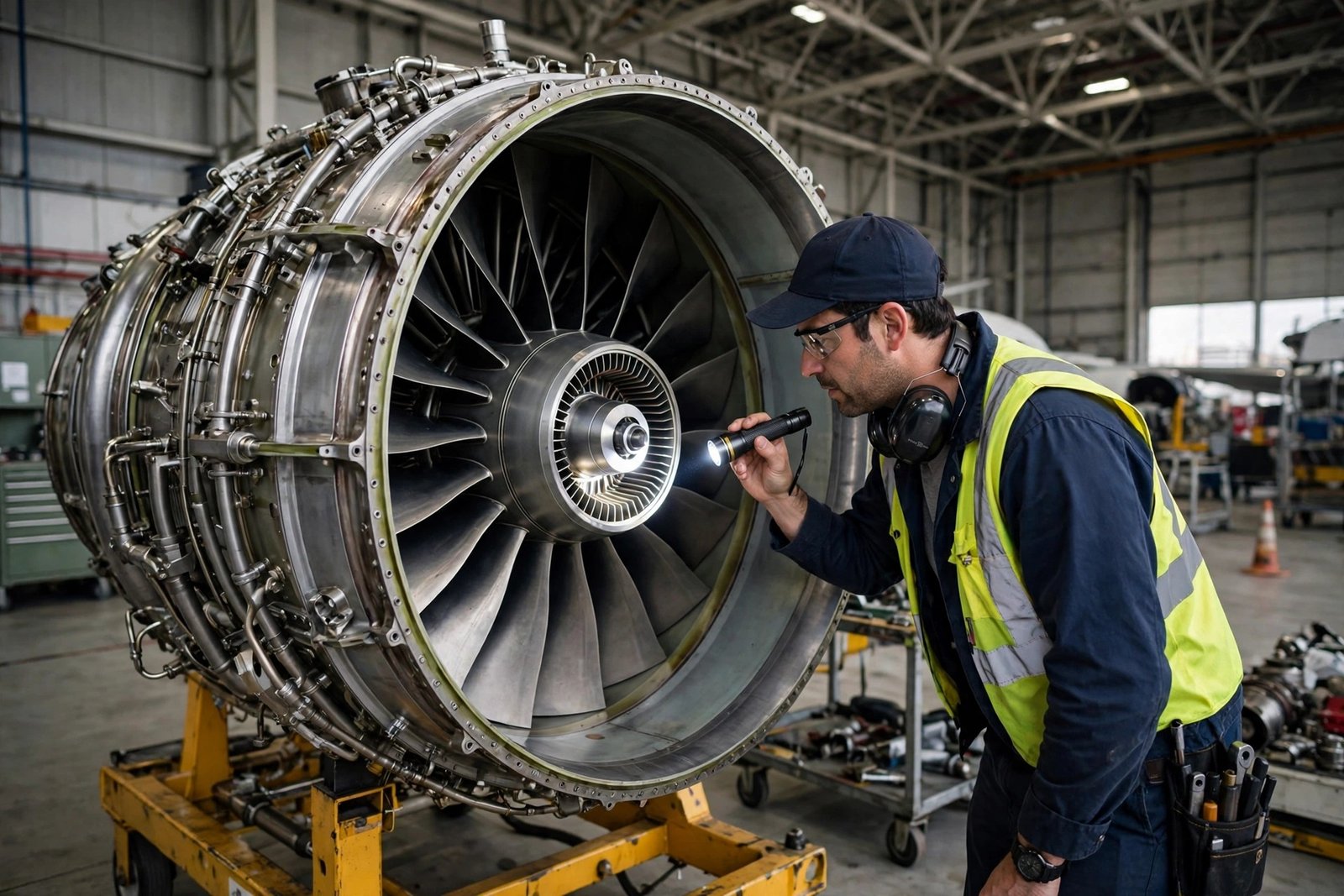
Aerodynamics covers how air flows around wings, fuselages and engine inlets, how lift and drag are produced, and how aircraft behave at subsonic, transonic and supersonic speeds. You will learn to use wind-tunnel data and computational fluid dynamics software, and to judge when a simulation can be trusted and when it cannot. Propulsion covers gas turbines, rocket engines, electric propulsion and, increasingly, hybrid and hydrogen systems. Structures covers how airframes carry loads, how composite materials behave, how fatigue and fracture develop over thousands of flight cycles, and how to design a structure that is both light and safe.
Flight dynamics and control covers how an aircraft or spacecraft moves, how it stays stable, and how autopilots, guidance systems and navigation systems are designed. This is where control theory, sensors and software meet the physical vehicle. Avionics and systems engineering cover the electronics, software and integration work that holds a modern aircraft together: communications, navigation, flight management, health monitoring and the certification evidence that regulators require before a design can fly with passengers.
Space-focused tracks add orbital mechanics, spacecraft design, satellite subsystems, thermal control in space, and mission design. Unmanned aircraft tracks add autonomy, sense-and-avoid systems, regulation of drones and the particular safety case for vehicles that fly without a pilot on board. Sustainability tracks, which have grown quickly, cover sustainable aviation fuels, more efficient airframes, electric and hybrid-electric propulsion, noise reduction and the lifecycle emissions of aircraft. These are not soft options: they require the same rigorous aerodynamics and propulsion knowledge, applied to a new set of constraints.
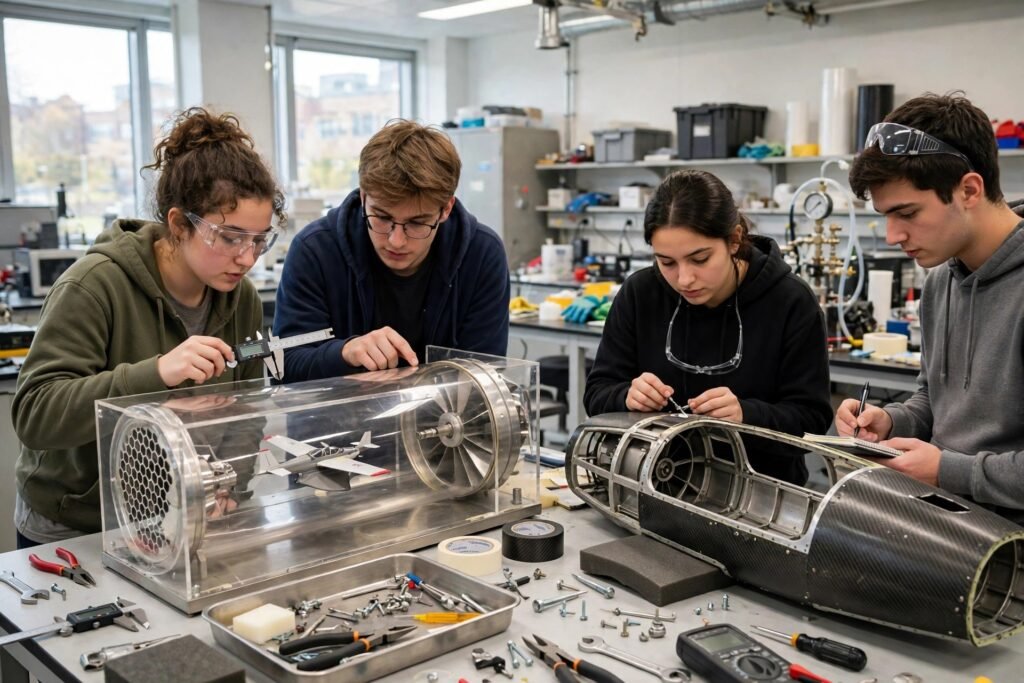
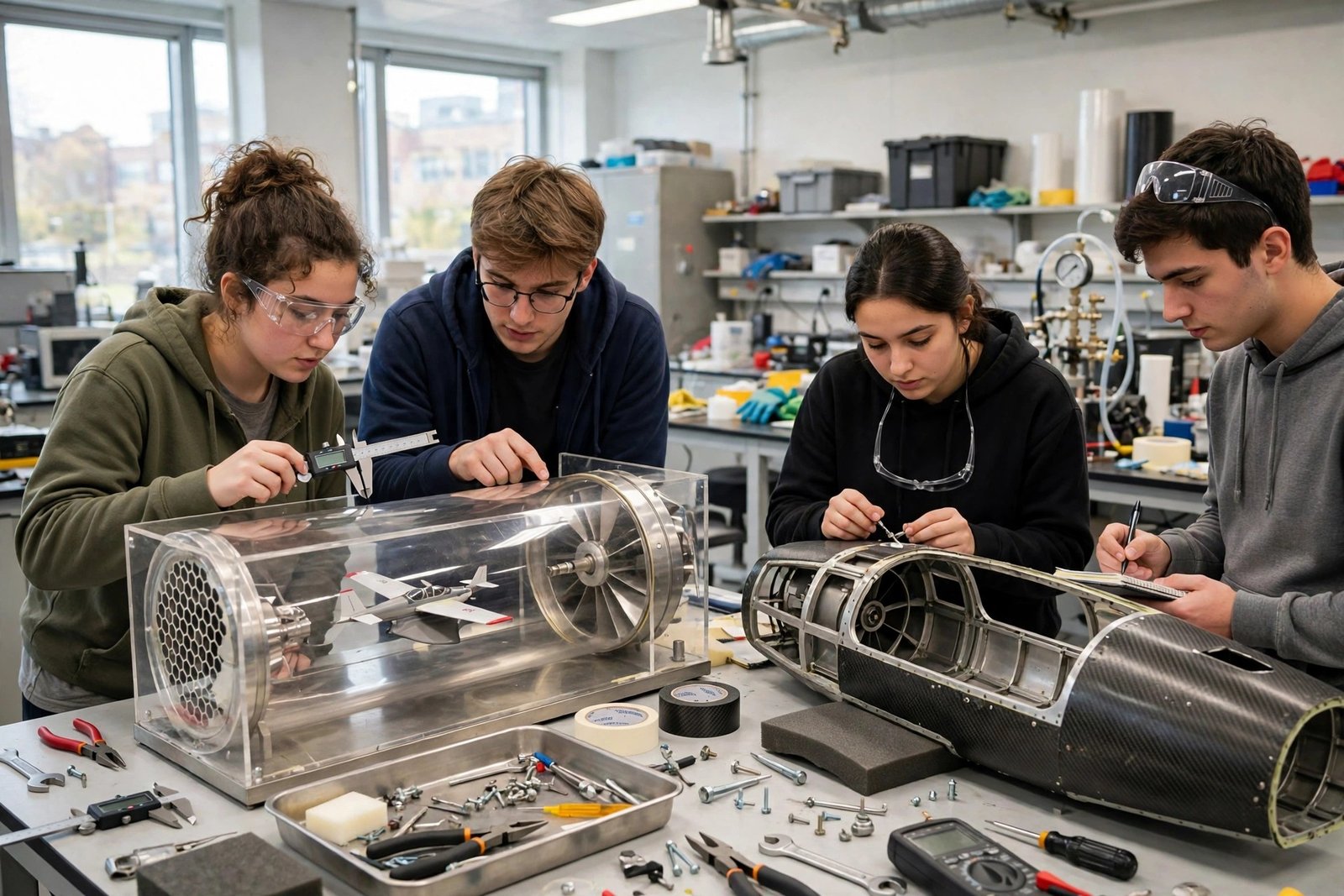
Teaching is rarely lecture-only. Expect laboratory work, wind-tunnel or simulation experiments, group design projects in which a team designs an aircraft or mission to a specification, and a major individual project. The group design project is often the part employers ask about first in interviews, because it shows you can work in a team, handle conflicting requirements, meet a deadline and defend your design decisions. Choose a programme whose project work is well supported, with access to laboratories, software licences and staff who have industry experience.
Specialisations worth considering
Before you shortlist universities, decide which specialisation fits your interests and your employment goals, because programmes with the same degree title can be very different. Aerodynamics and computational fluid dynamics suit students who love fluid mechanics and simulation. Propulsion suits those drawn to engines, combustion and energy systems. Structures and materials suit those who like hands-on testing and composite design. Guidance, navigation and control suits students who enjoy mathematics, sensors and software. Space systems suits those who want to work on satellites and missions rather than aircraft.
Two newer areas deserve attention. The first is unmanned and autonomous flight, where demand comes from delivery drones, agricultural monitoring, inspection and defence applications, and where regulation is still evolving. The second is sustainable aviation, where airlines, manufacturers and governments are investing in lower-emission aircraft, new fuels and more efficient operations. Neither replaces the classic pillars, but a programme that lets you combine a classic strength with one of these growth areas gives you a stronger story when you apply for jobs.
Also think about whether you want a taught master’s, a research master’s or a professional master’s. A taught master’s is coursework plus a project and is the most common route for international students entering industry. A research master’s is thesis-heavy and is the better preparation for a PhD. Some universities offer a professional or coursework-only track aimed at working engineers. The degree title alone does not tell you which model a programme follows, so read the curriculum page carefully and ask the department if it is unclear.
Eligibility and entry requirements
Most programmes ask for a bachelor’s degree in aerospace engineering, mechanical engineering or a closely related engineering discipline, with strong grades in mathematics, fluid mechanics, thermodynamics and mechanics of materials. Applicants from physics or applied mathematics are often accepted if they can show relevant engineering coursework, but they may be asked to take bridging modules. Applicants from unrelated degrees are rarely accepted without substantial additional preparation, because the master’s builds directly on undergraduate engineering.
Grade requirements vary. In the United States, universities typically look for a grade point average of around 3.0 on a 4.0 scale, although highly ranked programmes expect more, and a strong final-year project or relevant internship can compensate for a slightly lower average. In the United Kingdom, the usual requirement is a 2:1 honours degree or its international equivalent. In Canada and Australia, universities publish minimum grade equivalents by country, so check the page for your own education system rather than guessing. In Germany, public universities often require a recognised bachelor’s degree in a relevant field and may check that your previous coursework matches their own bachelor’s curriculum closely; a mismatch can lead to a conditional offer with additional modules.
English-language requirements are standard for international students. The most common tests are IELTS Academic and TOEFL, and many universities now also accept other approved tests. Typical requirements are around IELTS 6.5 overall with no band below 6.0, or TOEFL iBT around 90, but the exact requirement varies by university and sometimes by programme. Some universities waive the test if you studied your previous degree in English, but the waiver rules are specific, so confirm them in writing.
Standardised tests such as the GRE are now optional at many United States programmes, and some have dropped the requirement entirely. If a programme says the GRE is optional, a strong score can still help a borderline application, but a weak score is unlikely to help. Letters of recommendation matter more than many applicants realise: two or three letters from academic staff who know your engineering work are far more useful than generic letters from senior figures who barely know you. A statement of purpose should explain why aerospace engineering, why this specialisation, and what project or experience led you to it, in concrete terms rather than general enthusiasm.
For students from Bangladesh and other countries with a four-year bachelor’s degree, the main hurdle is usually documentation and grading equivalence rather than the degree itself. Order transcripts early, check whether the university requires a credential evaluation, and keep certified copies of everything. For students with a three-year bachelor’s degree, some universities require an additional year of study or a master’s-level qualification first, so check this before paying application fees.
Eligibility at a glance by country
| Country | Typical academic requirement | English test (typical) | Notes for international applicants |
|---|---|---|---|
| United States | Four-year bachelor’s in a relevant engineering field, GPA around 3.0/4.0 | TOEFL iBT around 90 or IELTS around 6.5–7.0 | GRE often optional; research experience and internships strengthen applications |
| United Kingdom | 2:1 honours degree or international equivalent in a relevant subject | IELTS 6.5 overall, no band below 6.0 (varies) | One-year programmes; early application matters for popular universities |
| Canada | Four-year bachelor’s with a strong average in the final two years | IELTS 6.5–7.0 or TOEFL iBT around 90 | Research-based programmes may require a supervisor match before admission |
| Australia | Bachelor’s in a relevant engineering field, assessed against Australian standards | IELTS 6.5 overall, no band below 6.0 (varies) | Two-year programmes are common and suit post-study work planning |
| Germany | Recognised bachelor’s in a relevant field with matching coursework | IELTS around 6.5 for English-taught programmes; German may be needed for daily life | Many public programmes charge no or low tuition; application deadlines are strict |
Tuition fees and living costs
Tuition is the largest variable in this decision, and it differs far more by country than by programme quality. In the United States, a master’s in aerospace engineering at a public university typically costs international students in the region of USD 25,000 to USD 55,000 per year in tuition, while private universities can charge considerably more. You should budget for two years unless the programme is explicitly a shorter professional master’s. In the United Kingdom, one-year master’s tuition for international students in engineering is commonly in the region of GBP 25,000 to GBP 40,000 for the year, with London programmes at the higher end.
In Canada, international tuition for a master’s in engineering commonly falls in the region of CAD 20,000 to CAD 45,000 per year, with research-based programmes sometimes offering funding, teaching assistantships or research assistantships that reduce the net cost. In Australia, international master’s tuition in engineering is commonly in the region of AUD 40,000 to AUD 55,000 per year. In Germany, many public universities charge no tuition or only a semester contribution, which is why Germany remains so attractive, but you must still prove you can support yourself: the blocked account requirement for 2026 is EUR 11,904, and living costs in Munich, Stuttgart or Hamburg are higher than in smaller cities.
Living costs must be planned separately and honestly. The United Kingdom’s student visa maintenance figures are GBP 1,529 per month in London and GBP 1,171 per month outside London, rising to GBP 1,570 and GBP 1,203 respectively for applications on or after 30 November 2026. Australia’s student visa living-cost figure is AUD 29,710 per year. Canada’s proof-of-funds figure for a single applicant has risen from CAD 22,895 to CAD 23,448. These are visa figures, not budgets: your real spending on housing, food, transport, insurance and study materials may be higher, especially in cities with expensive housing. Use the tuition fee calculator and the cost of living calculator on StudyGraduate to model your own combination of university, city and lifestyle before you commit.
Do not choose a programme on tuition alone. A low-tuition programme with no laboratory access, no industry links and no career support can cost more in lost opportunity than a more expensive programme with strong placement outcomes. Equally, a very expensive programme is not automatically better. Compare the curriculum, the project work, the staff, the laboratory facilities and the employment destinations of recent graduates, and weigh those against the total cost of the degree, including living costs and any loss of earnings while you study.
Top universities and countries for aerospace engineering
The United States has the deepest aerospace ecosystem in the world, with large manufacturers, space companies, research laboratories and defence organisations, and universities that work closely with them. The Massachusetts Institute of Technology, Stanford University, the California Institute of Technology, the University of Michigan and Georgia Tech are among the names most often associated with aerospace research, and each has a distinct strength, from propulsion and aerodynamics to space systems and controls. The advantage of the United States is scale and industry access; the disadvantage is cost and, for some defence-related roles, citizenship or security-clearance restrictions that international graduates must understand before they enrol. Not every aerospace job is open to every nationality, and universities and employers are generally frank about this if you ask.
The United Kingdom offers strong one-year master’s programmes at universities including Imperial College London, Cranfield University, the University of Bristol and the University of Southampton, with particular strengths in aerodynamics, propulsion, unmanned systems and space. Cranfield is unusual in that it is a postgraduate-only university with its own airport and flight-test facilities, which suits students who want intensive practical work. The UK’s advantage is time: a one-year master’s gets you back into work sooner, which matters when tuition is high. Its disadvantage is that one year leaves little time for a long internship, so you must be ready to apply for jobs and placements from the first term.
Germany is strong in aerospace through its universities and its industry, including Airbus operations and a large supplier network, and through research organisations. The Technical University of Munich, RWTH Aachen and the University of Stuttgart are prominent, and English-taught master’s programmes are available, although daily life and some internships are easier with German. Canada offers aerospace strength concentrated in Montreal, Toronto and Vancouver, with universities such as the University of Toronto, McGill University and Concordia University connected to a significant aerospace cluster in Quebec. Australia’s aerospace programmes, including at the University of Sydney, RMIT University and the University of New South Wales, are smaller but growing, with strengths in unmanned systems, space and defence research.
When you compare universities, look beyond league tables. Check the modules actually taught, the research groups, the laboratories, the industry partners named on the programme page, and where graduates from the last two or three years now work. A university that is strong overall may be weak in your chosen specialisation, and a less famous university with a strong propulsion laboratory and close ties to a local manufacturer may be the better choice for you. Browse the universities directory and the Courses and Programs directory on StudyGraduate to compare profiles side by side, and use the university comparison tool to weigh fees, duration and entry requirements.
Careers and salaries after an MS in Aerospace Engineering
Graduates work as aerospace engineers, design engineers, propulsion engineers, structures engineers, flight-test engineers, systems engineers, guidance and control engineers, and mission analysts. Employers include aircraft and engine manufacturers, airlines and maintenance organisations, space companies and agencies, defence contractors, engineering consultancies and research laboratories. Some graduates move into adjacent roles in automotive engineering, renewable energy, robotics or software, where their skills in simulation, systems engineering and safety-critical design transfer well.
Salary figures below come from the United States Bureau of Labor Statistics, because it publishes the most detailed occupational data in this field. They describe the United States labour market, not a promise of what any individual graduate will earn, and pay varies by employer, location, specialisation and experience. The median annual wage for aerospace engineers in the United States was USD 134,830 in May 2024, according to the Bureau of Labor Statistics Occupational Outlook Handbook. The mean annual wage for the same occupation in May 2024 was USD 141,180, according to Bureau of Labor Statistics occupational employment data. The difference between median and mean matters: the mean is pulled upward by very high earners, so the median is the better guide to a typical engineer.
Bureau of Labor Statistics projections describe employment of aerospace engineers growing by 6 percent over the projection period, which is faster than the average for all occupations. That growth reflects continued demand for commercial aircraft, defence systems, satellite services and space exploration, partly offset by productivity gains from better design software. Growth alone does not guarantee a job for any individual graduate: employers hire for specific skills, and graduates who combine a strong technical foundation with simulation experience, a good project portfolio and internship experience are consistently more employable than those with grades alone.
| Role | Typical work | Official pay reference |
|---|---|---|
| Aerospace engineer | Design, test and improve aircraft, spacecraft and related systems | Median USD 134,830, BLS, May 2024 |
| Propulsion engineer | Gas turbines, rocket engines and new propulsion systems | Within the aerospace engineer occupation, BLS, May 2024 |
| Structures engineer | Airframe design, composites, fatigue and certification analysis | Within the aerospace engineer occupation, BLS, May 2024 |
| Systems / avionics engineer | Integration of electronics, software and aircraft systems | Within the aerospace engineer occupation, BLS, May 2024 |
| Flight-test engineer | Planning and analysing flight tests, often with test pilots | Within the aerospace engineer occupation, BLS, May 2024 |
Two cautions belong in any honest careers section. First, some aerospace roles, particularly in defence, require citizenship or security clearance in the country where you want to work. This does not close the field to international graduates — commercial aviation, space, manufacturing and consultancy employ many international engineers — but it does mean you should research the roles you want before you choose a country, not after you graduate. Second, aerospace is cyclical. Aircraft orders, defence budgets and space investment rise and fall, and hiring can pause even when long-term demand is strong. A degree that also builds software, data and systems skills protects you against those cycles.
Post-study work options
Post-study work rights are a major part of the decision for international students, and they differ by country. In the United States, most engineering graduates can use Optional Practical Training, with a possible STEM extension for eligible programmes, but the rules and timelines are specific and you should confirm your programme’s STEM eligibility with the university. In the United Kingdom, the Graduate Route currently allows master’s graduates to stay and work for two years, with an announced shortening to 18 months from 1 January 2027 — an announced change, not yet the current rule at the time of writing, so check the position when you apply. In Canada, the Post-Graduation Work Permit duration depends on programme length, and graduates of two-year programmes are generally in a stronger position. In Australia, post-study work rights depend on the qualification level, location and current policy, which has changed recently, so confirm the current settings on the official immigration website.
Germany offers an 18-month job-seeking residence permit after graduation, which is generous by international standards and is one reason Germany appeals to engineering graduates. Whatever country you choose, start your job search early, use the university careers service, attend industry events, and treat internships and project partnerships as part of your job search, not as an extra. Many aerospace hires come through internships, research projects and referrals rather than open applications alone.
Scholarships for aerospace engineering
Scholarships rarely cover the full cost of an aerospace master’s, but they can reduce it materially, and they are worth applying for systematically. University scholarships are the most common source: many universities offer merit scholarships for international master’s students, sometimes automatically on application and sometimes through a separate form with an earlier deadline. Departmental scholarships tied to a research group or a specific specialisation are less well known and less competitive than headline university awards, so ask departments directly.
Government and external scholarships include the Chevening Scholarship for the United Kingdom, the Fulbright programme for the United States, DAAD scholarships for Germany, and Australian Government and university awards for Australia. Each has its own eligibility rules, deadlines and obligations, and most close many months before the programme starts. Industry scholarships from aerospace companies and professional bodies also exist, although they are smaller and more specialised. Explore the scholarships directory and use the scholarship finder tool to shortlist awards that match your nationality, destination and field. Apply to several, keep copies of every application, and never pay anyone who promises a scholarship.
How to choose the right programme
Start with your specialisation, then your budget, then your post-study goals. A student who wants to work on commercial aircraft should weigh programmes with strong industry links and internship opportunities more heavily than a student who wants a PhD, who should weigh research groups, publications and supervisor fit more heavily. A student with a limited budget should weigh Germany and Canada more heavily, or a one-year UK programme against a two-year programme elsewhere, on total cost rather than annual tuition alone.
Visit programme pages, not just university home pages. Read the module list, check who teaches the modules you care about, look at the laboratory facilities, and search for recent graduate destinations. Email the programme coordinator with two or three specific questions — about project supervision, internship support or a particular module — and judge the reply. A programme that answers specifically is usually better organised than one that replies with a generic brochure. If you can, speak to a current student or recent graduate through the university’s student ambassador scheme or an alumni group, and ask what they wish they had known before they started.
Finally, be realistic about the workload. An aerospace master’s is intense, particularly in a one-year UK programme where the pace is relentless. The students who do best are not necessarily those with the highest undergraduate grades, but those who arrive with solid mathematics, some programming experience, good time management and a clear sense of what they want from the degree. If your mathematics or programming is rusty, use the months before you start to revise: it will pay off far more than arriving early and hoping to catch up.
Application timeline for 2026 and 2027 intakes
A sensible timeline starts twelve to fifteen months before your intended start date. Begin by shortlisting programmes and checking entry requirements and deadlines, then prepare for your English test and, if needed, the GRE. Draft your statement of purpose and request recommendation letters at least two months before the deadline, because academic referees are busy and a rushed letter is rarely a good letter. Submit applications as early as you reasonably can, especially for programmes with rolling admissions or scholarship deadlines that close before the programme deadline.
Once you have an offer, check the conditions carefully: academic conditions, English conditions, deposit deadlines and any pre-sessional English requirement. Apply for your visa only after you understand the financial evidence rules for your destination, and keep your bank statements and sponsorship letters in order. Use the application deadline finder and the document checklist tool to keep track of what each university and each visa application requires, and the visa requirement checker to confirm the current requirements for your nationality and destination.
Frequently asked questions
Do I need a bachelor’s in aerospace engineering to apply?
No, but you need a closely related engineering degree. Mechanical, electrical and civil engineering graduates are commonly accepted, as are physics graduates with strong engineering coursework. Unrelated degrees usually require substantial bridging study first.
Is an MS in Aerospace Engineering worth it for international students?
It can be, if you choose a programme with strong project work, industry links and a realistic employment plan for your target country. The BLS median of USD 134,830 in May 2024 shows the earning potential in the United States, but earnings vary by country, employer and role, and some defence roles have citizenship restrictions, so research your target roles before enrolling.
Which country is best for aerospace engineering?
There is no single best country. The United States offers the largest industry, the United Kingdom offers one-year programmes, Germany offers low tuition, Canada offers a strong aerospace cluster and post-study work options, and Australia offers growing space and unmanned-systems work. The best choice depends on your budget, specialisation and post-study goals.
Can I work in defence after graduating as an international student?
Some defence roles require citizenship or security clearance, and some do not. Commercial aviation, space, manufacturing and consultancy are generally more open to international graduates. Ask employers and universities about specific roles before you commit to a country or programme.
How hard is the mathematics in this degree?
It is demanding. You will use advanced calculus, linear algebra, differential equations, numerical methods and control theory throughout the degree. Students who enjoy mathematics and have a solid undergraduate foundation cope well; students who struggled with undergraduate mathematics should revise thoroughly before starting.
Do I need the GRE for the United States?
Many programmes have made the GRE optional or dropped it entirely. Check each programme individually: if it is optional, a strong score can help a borderline application, but it is rarely decisive on its own.
What is the difference between aeronautical and astronautical engineering?
Aeronautical engineering concerns aircraft flying in the atmosphere; astronautical engineering concerns spacecraft and systems operating in space. Most master’s programmes cover both at first and then let you specialise.
Can I switch to a PhD after this master’s?
Yes, particularly if you choose a research-oriented programme and produce a strong thesis. Talk to potential supervisors during your master’s, publish or present your work if you can, and keep your grades strong in research-related modules.
Sources and Verification
Sources consulted for this article: United States Bureau of Labor Statistics, Occupational Employment and Wage Statistics, May 2024 (aerospace engineers); ABET, the accreditor of engineering programmes in the United States; official university programme pages for the universities named; and official government visa and immigration pages for the United Kingdom, Canada, Australia and Germany for the maintenance and post-study figures cited.
Figures change yearly — confirm fees, entry requirements, visa rules and scholarship deadlines on the official university and government pages before you apply. StudyGraduate is an information portal, not an agency, and never promises admission, jobs, salaries or visa or permanent-residence outcomes. The salary figures in this article describe the United States labour market in May 2024 and are not a guarantee of any individual’s earnings.