
BSc Multimedia Computing Abroad: Eligibility, Fees, Top Universities and Careers
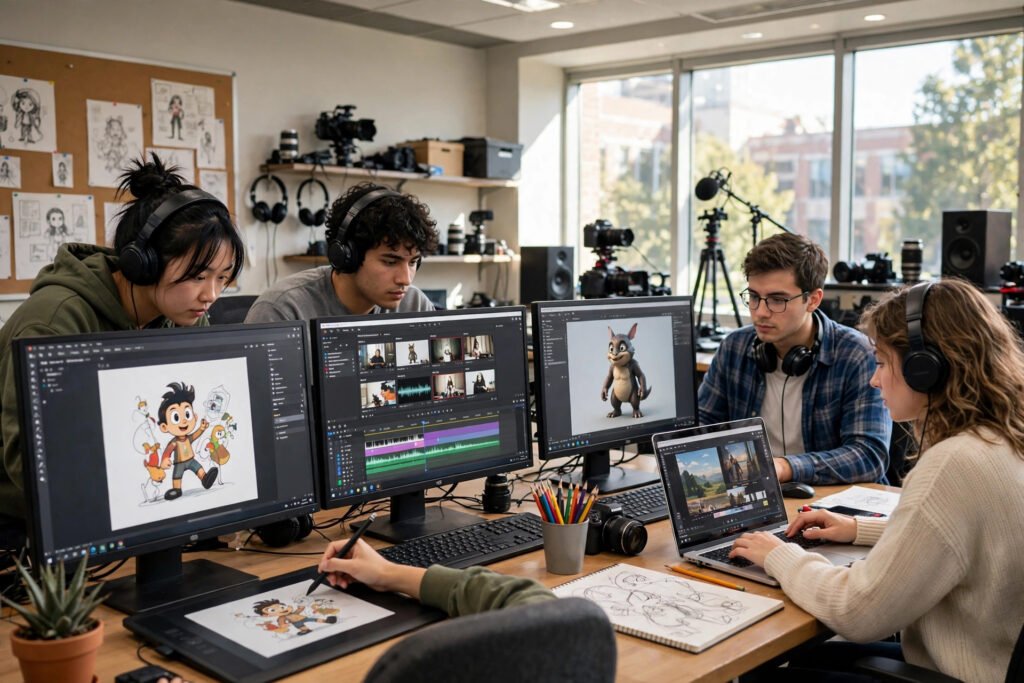
Multimedia computing is the degree for students who want to build the things people actually see, hear and touch on screens: websites, apps, games, interactive exhibits, animations, video platforms, virtual and augmented reality experiences, and the digital media that fills modern life. It sits at the meeting point of computing and creativity. You learn to program, but you also learn design, user experience, animation, audio and video production, and how people perceive and interact with digital media. If a pure computer science degree teaches you how computers work, and a pure design degree teaches you how things should look, multimedia computing teaches you how to make interactive media that works — technically, aesthetically and for real users.
That combination is rarer than it sounds, and it is genuinely employable, because most digital products fail not for lack of code but for lack of attention to the experience. A website that is slow, confusing or inaccessible loses users no matter how elegant its backend. A game that is technically impressive but unplayable will not survive its first reviews. An educational app that ignores how people learn will not teach anyone. Multimedia computing graduates are the people who are trained to care about both sides of that equation: the code that makes media run, and the human experience of using it.
This guide explains the degree in full for international students planning 2026 and 2027 intakes: what you study, who is eligible, what it costs in the main destinations, which universities and countries are strongest, what careers it leads to and what official statistics say those careers pay, and how to fund it. Salary figures come only from official sources — the United States Bureau of Labor Statistics and Canada’s official Job Bank — with the source and year stated beside each figure. Multimedia computing has no single official occupational category, so this guide uses the closest published categories — web developers, web and digital interface designers, and software developers — and says so plainly, rather than inventing a multimedia salary.
At a glance
| Feature | What to expect |
|---|---|
| Degree level | Bachelor’s degree, usually BSc, sometimes BA or BEng depending on the technical emphasis |
| Typical duration | 3 years in the UK and Australia; 4 years in the USA and Canada; some programmes include a placement year |
| Who it suits | Students who enjoy both technology and creativity, who like making things people can use, and who are comfortable learning new tools constantly |
| Core subjects | Programming, web development, user experience design, animation, digital media production, graphics, audio and video, databases |
| Typical entry requirement | School-leaving qualifications with good grades, usually including mathematics; a portfolio helps at many universities |
| English requirement | Usually IELTS 6.0 to 6.5 overall, or an equivalent TOEFL or PTE score |
| Common careers | Web developer, front-end developer, UX and UI designer, multimedia developer, motion designer, game developer, digital media producer |
| Closest official salary benchmarks (USA) | Web developers: median $92,650; web and digital interface designers: median $104,000, both May 2025 (BLS) |
What you study in multimedia computing
A multimedia computing degree is built from three strands that are taught together rather than in isolation. The computing strand covers programming — usually starting with a language such as Python or JavaScript and moving into web technologies, databases and, in more technical programmes, graphics programming and mobile development. You learn how the web actually works, how to build responsive and accessible interfaces, how to work with application programming interfaces, and how to manage media assets efficiently so that a page loads quickly on a phone as well as on a desktop. Performance and accessibility are not optional extras in this strand; they are part of what makes a multimedia product professional.
The design strand covers visual design principles, typography, colour, layout, user experience research, interaction design and usability testing. You learn to research users, to prototype quickly, to test a design with real people, and to revise it in response to evidence rather than taste. This is the strand that most self-taught developers miss, and it is the reason multimedia computing graduates are often hired into product and design teams rather than purely into engineering teams. A portfolio piece that shows a design problem, a prototype, user testing and a revised solution is far more persuasive to an employer than a finished website with no explanation of how it got there.
The media production strand covers the creation and manipulation of digital media itself: image editing, animation, motion graphics, video production and editing, audio recording and editing, and increasingly three-dimensional modelling and interactive media for games and virtual reality. You learn the tools of the trade, but more importantly you learn the underlying principles — compression, resolution, frame rates, colour spaces, file formats — so that you can move to a new tool when the industry inevitably changes. That adaptability matters, because the specific software that is fashionable in your first year may be superseded by your final year, while the principles behind it will not.
Most programmes bring the three strands together in team projects and a final-year project. You might build a complete interactive website for a real client, develop a small game, create an interactive exhibition piece, or produce a multimedia campaign. These projects are the heart of the degree and the core of your portfolio, so choose them strategically: pick projects that let you show both technical skill and design judgement, that involve real users or a real client where possible, and that you can explain clearly in an interview. A portfolio with three strong, well-documented projects will serve you better than ten unfinished experiments.
Multimedia computing versus computer science versus digital design
Choosing between neighbouring degrees is the hardest decision for many applicants, so it is worth being precise. A BSc in Computer Science is broader and more theoretical: algorithms, data structures, operating systems, artificial intelligence, and a wide choice of specialisations. It prepares you for the widest range of computing careers, but it may give you little formal training in design, user experience or media production. A degree in graphic or digital design is primarily a design degree: visual communication, branding, typography and studio practice, with less programming and less systems knowledge. Multimedia computing sits between them, with a deliberate mix of programming, design and media production.
Which is right for you depends on what you enjoy and where you want to work. If you love mathematics and algorithms and want to keep every computing career open, computer science is the safer choice. If you love visual design above all and want to work in a design studio, a design degree may suit you better. If you want to build interactive digital products — websites, apps, games, immersive media — and you enjoy both the code and the experience, multimedia computing is the degree designed for exactly that. Be aware, though, that the mix varies by university: some programmes lean heavily technical, others lean heavily creative. Read module lists carefully, and look at the balance of programming modules against design and media modules before you apply, because two degrees with the same title can feel very different.
Eligibility and entry requirements
Entry to a bachelor’s degree is based on your school-leaving qualifications. In the United Kingdom, universities typically ask for A-levels or an equivalent qualification, often with a good grade in mathematics or a computing subject, though the specific requirements vary widely. In the United States and Canada, admission is based on your high-school diploma and grades, plus standardised tests where required, and is often holistic, taking account of extracurricular activities and personal statements. In Australia, admission is based on your school-leaving results or an equivalent, often through a state-based ranking or an international equivalent. In Germany, admission depends on whether your school-leaving qualification is recognised as equivalent to the German Abitur, and some students need a foundation year.
Mathematics is the subject most commonly required or recommended, because programming, graphics and animation all rest on mathematical ideas, even when the mathematics is not advanced. Some universities also ask for a portfolio, and even where a portfolio is not required, it can strengthen your application considerably. A portfolio for multimedia computing does not need to be professional work: a personal website you built, a short animation, a game prototype, a video you edited, or a design project with an explanation of your process all count. What tutors look for is evidence of curiosity, of having made something, and of being able to reflect on what worked and what did not. A portfolio with a short written explanation of each piece is much stronger than a collection of files with no context.
English requirements for a bachelor’s degree are typically IELTS 6.0 to 6.5 overall in the United Kingdom, Australia and Canada, and a TOEFL iBT score in the region of 80 to 90 in the United States, though the exact requirement depends on the university. Some universities offer a foundation year or an international year one for students whose grades or English scores are slightly below the direct-entry requirement, and these routes can be a good option if they are taught by the university itself and guarantee progression on satisfactory performance. Check the progression conditions carefully, because not all foundation routes guarantee a place on your chosen degree.
| Destination | Typical entry basis | Typical English requirement | Notes |
|---|---|---|---|
| United Kingdom | A-levels or equivalent, often including mathematics | IELTS 6.0–6.5 overall | Three-year degree; optional placement year at many universities; Graduate Route after graduation, with an announced shortening to 18 months from 1 January 2027 |
| United States | High-school diploma and grades; holistic admission | TOEFL 80–90 or IELTS 6.5 | Four-year degree with general education; Optional Practical Training after graduation for eligible students |
| Canada | High-school diploma with good grades, often including mathematics | IELTS 6.0–6.5 overall | Four-year degree; Post-Graduation Work Permit length depends on programme length |
| Australia | School-leaving results or equivalent | IELTS 6.0–6.5 overall | Three-year degree; check current post-study work settings before applying |
| Germany | Recognised school-leaving qualification; foundation year sometimes required | IELTS 6.5 for English-taught programmes; German required for German-taught programmes | Many public universities charge low or no tuition, with a semester contribution |
Tuition fees and living costs
Undergraduate fees for international students vary by country and university, and the total cost depends on the length of the degree as well as the annual fee. A three-year degree in the United Kingdom or Australia may cost less in total than a four-year degree in North America, even if the annual fee looks similar, because of the extra year of living costs. Confirm the exact fee on the official programme page for your intake year, and budget for the full duration, not just the first year.
| Destination | Indicative international tuition per year | Living-cost planning note |
|---|---|---|
| United Kingdom | Commonly in the mid to high tens of thousands of pounds range over a three-year degree in total, with annual fees in the low to mid tens of thousands | Student visa maintenance is GBP 1,529 per month in London and GBP 1,171 per month outside London; for applications on or after 30 November 2026 the figures rise to GBP 1,570 and GBP 1,203 |
| United States | Very wide: public universities are usually cheaper than private ones, and a four-year total is substantial | Budget for housing, health insurance and books on top of tuition; health cover is often mandatory |
| Canada | Commonly in the mid tens of thousands of Canadian dollars per year | Proof of funds is set by Immigration, Refugees and Citizenship Canada and is revised periodically; check the current figure before you apply |
| Australia | Commonly in the tens of thousands of Australian dollars per year | The Australian government requires evidence of living costs of AUD 29,710 per year for a primary student applicant, plus tuition and travel amounts |
| Germany | Often low or no tuition at public universities, with a semester contribution; private programmes charge much more | The blocked account requirement for a student visa is EUR 11,904 per year |
Two cost items are specific to this degree. The first is equipment: a capable laptop is essential, and a machine that can handle video editing, animation or three-dimensional work comfortably costs more than a basic student laptop. Some universities provide high-specification lab machines, which helps, but you will still want a personal machine for coursework. The second is software: many universities provide industry-standard software free or at a student discount, but check what is included before you budget for subscriptions yourself. Use the tuition fee calculator and the cost of living calculator to model your own total, and keep a contingency for exchange-rate movement over a three- or four-year degree, which is a long time for a currency to move against you.
Top universities and countries for multimedia computing
Multimedia computing is taught in many countries, and the best choice depends on whether you want a technical or a creative emphasis, and on the industry you want to enter. The United Kingdom has a strong tradition in this field, with programmes that combine computing with media production, and with a placement year option that many students find transformative. The United States offers the largest media and technology industries, with programmes close to film, games and technology employers in California, New York and other hubs. Canada has growing games, animation and interactive media industries in Vancouver, Toronto and Montreal, and a post-study work route that many international graduates value. Australia has well-regarded programmes in Sydney, Melbourne and Brisbane, and Germany offers strong technical programmes at low tuition, though English-taught undergraduate options are fewer than at master’s level.
When you shortlist, look at the facilities as seriously as the module list. A good multimedia programme needs studios, editing suites, motion-capture or virtual-reality equipment where relevant, and high-specification labs, and it needs staff who are active in the field. Look at recent student work: is it publicly shown, is it of a standard you admire, and does it cover the kind of work you want to do? Look at the placement record, and at whether the programme has links with local studios, agencies and technology companies. A programme in a city with a real media industry gives you internships, freelance work and a professional network that a remote campus cannot match. Browse the universities directory and the Courses and Programs directory, and compare the related BSc Computer Science profile to see how multimedia computing differs from a general computing degree. The rankings directory can help with overall university comparison, but for a creative-technical degree, student work and placement outcomes matter more than a few places in a league table.

Careers and salaries: what official statistics actually say
Multimedia computing graduates work across a wide and genuinely interesting range of roles. Web and front-end development is the largest single destination: building websites, web applications and interfaces for companies, agencies and public bodies. User experience and user interface design is a second major route, in which you research users, design flows and interfaces, and test them. Game development, motion design, animation, video production and digital media production are smaller but real destinations, particularly for graduates whose portfolios show strong creative work. Some graduates move into digital marketing and content production, where their technical and design skills together are valuable, and some become freelance multimedia developers, working for multiple clients. Freelance work offers freedom and variety, but it also means finding your own clients, managing your own taxes and coping with irregular income, and it is usually easier after a few years of employed experience.
On pay, this guide is careful, because multimedia computing has no single official occupational category and the temptation to invent a figure is strong. The closest official American categories are web developers and web and digital interface designers, published by the Bureau of Labor Statistics, and software developers, which covers many front-end and full-stack roles. The table below reports those figures exactly as published.
| Occupation (official BLS category, USA) | Median annual wage | Projected growth | Source and reference |
|---|---|---|---|
| Web developers | $92,650 per year | 4% from 2025 to 2035 (developer component) | U.S. Bureau of Labor Statistics, Occupational Outlook Handbook, May 2025 |
| Web and digital interface designers | $104,000 per year | 6% from 2025 to 2035 (designer component) | U.S. Bureau of Labor Statistics, Occupational Outlook Handbook, May 2025 |
| Web developers and digital designers (combined) | $99,520 per year | 5% from 2025 to 2035, faster than average; about 13,600 openings per year | U.S. Bureau of Labor Statistics, Occupational Outlook Handbook, May 2025 |
| Software developers, quality assurance analysts and testers | $134,040 per year | 10% from 2025 to 2035, much faster than average | U.S. Bureau of Labor Statistics, Occupational Outlook Handbook, May 2025 |
The pattern in that table is worth understanding, because it shapes career advice. The design side of the combined category — web and digital interface designers — earns a higher median than the developer side, and is projected to grow faster. That reflects the market’s willingness to pay for people who can design usable, attractive interfaces, not just build them. At the same time, the broader software developer category earns substantially more than either, which reflects the premium for deeper engineering skills. The practical lesson for a multimedia computing student is to build both: strong design and user-experience skills, and strong enough programming skills to move into software development roles if you wish. Graduates who can do both — design an interface and build it properly — are more employable than graduates who can do only one, and they have more room to move as the market changes.
For Canada, the official Job Bank reports, for the reference period 2023–2024 and sourced from Statistics Canada’s Labour Force Survey, a median wage of CAD 40.00 per hour for web developers and programmers and CAD 33.65 per hour for web designers in Ontario. Those figures are medians across all experience levels, they are not multimedia-specific, and they should be checked against the current Job Bank figure for your target province before you rely on them. They do, however, give a realistic sense of the Canadian market: web work pays solidly, but the highest technology earnings in Canada are in software engineering and related roles, where the Ontario median for software engineers and designers is CAD 56.73 per hour for the same reference period.
One honest warning belongs in this section. The Bureau of Labor Statistics itself notes that better tooling and artificial intelligence for web development may soften growth in web development, because those tools can make workers more productive and can let people in other occupations handle basic web development tasks. That does not mean web development is disappearing — the Bureau still projects growth, and about 13,600 openings a year across the combined category, mostly from people leaving the occupation — but it does mean that basic brochure websites and simple template work are the most exposed parts of the field. The work that is hardest to automate is the work this degree should prepare you for: understanding users, designing complex interactions, building performant and accessible products, integrating systems, and exercising judgement about what to build. Aim your portfolio at that end of the market.
Scholarships and funding
Undergraduate funding for international students is more limited than postgraduate funding, but it exists. University merit scholarships for international undergraduates are the most common source, and many universities automatically consider applicants or offer awards based on school grades. Some universities offer specific scholarships for computing, design or creative-technology students, and a strong portfolio can help in those competitions. Government scholarships for undergraduates are fewer and more competitive than for postgraduates, but they exist in several destinations, and the deadlines are early. Explore the scholarships directory and use the scholarship finder at the start of your search, not after you have applied, and read the conditions of any award carefully, including whether it is renewed annually and what grades you must maintain to keep it.
A placement year, where available, is also a funding mechanism in a practical sense: a paid placement year gives you a year’s earnings, a year’s experience and often a job offer, and it can transform both your finances and your final-year portfolio. Not every programme offers one, and not every placement is paid, so ask specifically about placement rates, typical employers and typical pay before you choose a programme on that basis. Part-time work during term time can help with living costs, but do not rely on it to cover tuition, and check the work conditions of your visa carefully.
How to apply: a realistic timeline
For an autumn intake, start at least a year ahead, and earlier if you need a foundation route or a scholarship. Research programmes and read module lists, paying attention to the balance between programming, design and media production. Build or tidy your portfolio: select your best work, write a short explanation of each piece, and make sure any website or interactive work you link to actually works. Prepare for your English test if you need one, and assemble school transcripts and references in good time. In the United Kingdom, applications go through the central UCAS system with a January deadline for most courses; in the United States, Canada and Australia, you apply directly to each university, with deadlines that vary widely. Use the application deadline finder and the document checklist to keep track, and check visa requirements with the visa requirement checker before you rely on any single source.
Is this degree worth it?
For students who genuinely enjoy both technology and creativity, and who want to build interactive digital products, multimedia computing is a strong choice, with one important condition: you must leave with a portfolio that proves you can do the work. Employers in web development, user experience, games and digital media hire on portfolios and practical tests far more than on degree classifications. A student who graduates with a good classification but a thin portfolio will struggle, while a student with a modest classification and three excellent, well-documented projects will find work. Treat the portfolio as the real output of your degree, and the classification as a secondary signal.
Financially, the official figures support a measured optimism. Web developers in the United States earn a median of $92,650 per year as of May 2025, web and digital interface designers earn $104,000, and software developers — a category many multimedia graduates can move into with strong programming skills — earn $134,040, all according to the Bureau of Labor Statistics. Those are medians across all experience levels, not starting salaries, and your own earnings will depend on your country, city, specialisation and portfolio. If you enjoy making things people use, if you are prepared to keep learning new tools for your whole career, and if the total cost of the degree makes sense against a realistic salary in the market you intend to enter, then a BSc in Multimedia Computing is a degree worth doing, and doing with enthusiasm.
Frequently asked questions
Do I need to be good at art to study multimedia computing?
No, you do not need to be a fine artist, but you do need an interest in design and in how people experience digital products. The degree teaches design principles and user-experience methods; what matters more than drawing skill is curiosity about users and a willingness to test and revise your work.
Is multimedia computing a proper computing degree?
Yes, it is a computing degree with a design and media emphasis, but its balance varies by university. Some programmes are heavily technical, others heavily creative. Read the module list to check how much programming, databases and systems work is included, and compare it with a general computer science degree if you want the broadest computing foundation.
How long does a BSc in Multimedia Computing take?
Three years in the United Kingdom and Australia, and four years in the United States and Canada. Some United Kingdom programmes offer an optional placement year, making four years in total.
What jobs can I get after graduation?
Common roles include web developer, front-end developer, UX and UI designer, multimedia developer, motion designer, game developer and digital media producer. Some graduates work freelance, usually after gaining employed experience first.
What salary can I expect?
No guide can promise a salary. The official American medians for May 2025 are $92,650 per year for web developers and $104,000 for web and digital interface designers, according to the Bureau of Labor Statistics. Your actual pay will depend on location, employer, specialisation and experience.
Will AI replace multimedia and web developers?
AI tools are changing the work, particularly for basic websites and routine tasks, and the Bureau of Labor Statistics notes that better tooling may soften growth in web development. The work least exposed to automation is user research, complex interaction design, performance and accessibility engineering, and judgement about what to build — which is exactly where a good multimedia degree should focus your portfolio.
Should I choose multimedia computing or computer science?
Choose computer science if you want the broadest computing foundation and the widest range of technical careers. Choose multimedia computing if you want to build interactive digital products and you enjoy both programming and design. If you are unsure, compare module lists for both degrees at the same university before deciding.
Sources and verification
- U.S. Bureau of Labor Statistics, Occupational Outlook Handbook: Web Developers and Digital Designers — web developers median $92,650 and web and digital interface designers median $104,000 in May 2025; combined median $99,520; combined growth 5 percent from 2025 to 2035.
- U.S. Bureau of Labor Statistics, Occupational Outlook Handbook: Software Developers, Quality Assurance Analysts, and Testers — median annual wage $134,040 in May 2025; employment projected to grow 10 percent from 2025 to 2035.
- U.S. Bureau of Labor Statistics, Occupational Outlook Handbook: Information Security Analysts — median annual wage $129,180 in May 2025; employment projected to grow 21 percent from 2025 to 2035.
- Government of Canada Job Bank, wage data sourced from Statistics Canada’s Labour Force Survey, reference period 2023–2024 — web developers and programmers median CAD 40.00 per hour and web designers median CAD 33.65 per hour in Ontario; software engineers and designers median CAD 56.73 per hour.
- Official university programme pages for the universities you shortlist — confirm fees, entry requirements, English requirements and module lists for your intake year.
- Official immigration guidance for your destination country — confirm student visa maintenance, proof-of-funds and post-study work rules before you apply, keeping announced changes, such as the United Kingdom’s announced Graduate Route shortening to 18 months from 1 January 2027, separate from current rules.
Figures change yearly — confirm fees and requirements on the official university page before you apply. StudyGraduate is an information portal, not an agency — we never promise admission, jobs, salaries or visa or permanent-residence outcomes, and nothing in this guide should be read as such a promise.