

BSc Information Technology Abroad: Eligibility, Fees, Top Universities and Careers
A BSc in Information Technology is one of the most practical undergraduate degrees an international student can choose. It sits at the meeting point of computing, business and everyday digital life: the networks that carry data, the systems that run organisations, the databases that store information, the cloud platforms that host applications, and the security practices that protect them all. Unlike a purely theoretical computer science degree, a BSc in Information Technology usually emphasises applied skills — configuring systems, supporting users, building and maintaining infrastructure, managing projects and solving real operational problems. That applied character is exactly why employers in almost every sector hire IT graduates, from banks and hospitals to retailers, government agencies, universities and technology companies themselves.
This guide is for students considering a BSc in Information Technology abroad for the 2026 or 2027 intake. It explains what you will study, who the degree suits, what universities typically ask for, what it may cost, where to study it, what careers it can lead to, and which salaries official statistics actually report. It does not promise admission, a job or a visa outcome. Fees, entry requirements and immigration rules change from year to year, so always confirm the current figures on the official university page and the official government immigration page for your destination before you apply.
If you are still comparing computing degrees, the broader Courses and Programs directory puts information technology alongside related options, including the BSc Computer Science profile and the MSc Computer Science profile, so you can see how an applied IT degree differs from a more theory-led computer science route and from postgraduate study.
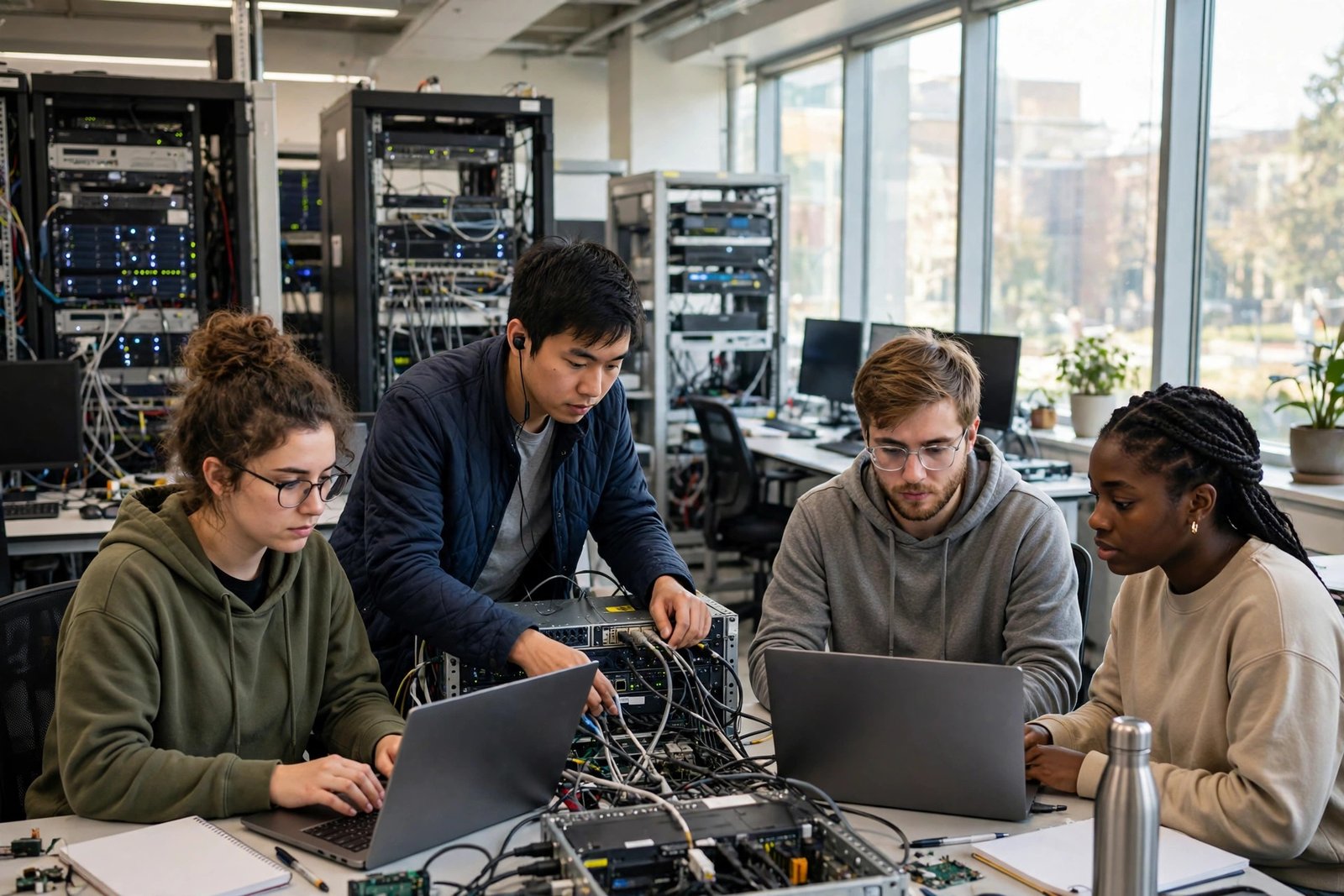
At a Glance: BSc Information Technology
| Feature | Typical position |
|---|---|
| Degree level | Undergraduate bachelor’s degree (BSc, and in some countries BIT, BInfTech or BSc IT) |
| Typical duration | Three years in the United Kingdom, Australia and much of Europe; four years in the United States, Canada and some other systems, often including an optional placement or co-op year |
| Core subjects | Programming, databases, computer networks, operating systems, web technologies, systems analysis and design, cybersecurity fundamentals, cloud computing and IT project management |
| Who it suits | Students who enjoy practical problem-solving, working with both technology and people, and learning by building, configuring and fixing systems |
| Common assessment | Coursework, lab work, group projects, practical examinations, portfolios and a final-year project or capstone, alongside written examinations |
| Typical next steps | Graduate IT roles, graduate schemes, industry certifications, or postgraduate study such as an MSc in computer science, cybersecurity, data science or information systems |
The name of the degree varies by country, and that variation matters when you search. In Australia you may see a Bachelor of Information Technology. In the United Kingdom, universities offer BSc Information Technology, BSc Computing for Business, BSc Information Systems and similar titles. In the United States, comparable bachelor’s programmes may be called Information Technology, Information Systems, Computer Information Systems or Management Information Systems, sometimes housed in a business school rather than a computing department. In Canada, similar programmes appear as Bachelor of Information Technology, Bachelor of Computing or Bachelor of Science with an IT major. The title alone does not tell you the curriculum, so compare module lists carefully: two programmes with similar names can differ sharply in how much programming, networking, mathematics or business they contain.
What You Study in a BSc in Information Technology
The first year of most BSc Information Technology programmes builds a shared foundation. You will normally learn at least one programming language, often Python or Java, together with the logic of algorithms, data structures in outline, and how computers store and process data. Alongside programming, first-year modules usually cover computer systems and architecture, an introduction to networks, databases and web development, and the mathematics or discrete mathematics that underpins computing. Many programmes also include a professional skills module covering teamwork, communication, academic writing and the ethical and legal context of technology, including data protection and accessibility.
In the second year, the applied character of the degree becomes clearer. Networking modules move from general concepts to practical configuration: addressing, routing, switching, wireless networks and network services, often in laboratory sessions where you build and test small networks yourself. Database modules go beyond simple queries into design, normalisation, transactions and administration. Systems analysis and design teaches you to gather requirements from users, model processes and data, and specify a system before it is built — a skill that distinguishes IT graduates from pure programmers, because it bridges the gap between what an organisation needs and what technology can deliver. Operating systems, human-computer interaction and software engineering methods usually appear at this stage as well.
The final year typically combines advanced optional modules with a substantial individual project. Options commonly include cybersecurity, cloud computing and virtualisation, mobile application development, data analytics, artificial intelligence in outline, internet-of-things systems, IT service management and enterprise systems. The final-year project is often the single most valuable part of the degree for employment: you identify a problem, design and build a working solution, test it, document it and present it. Employers and postgraduate admissions tutors read that project as evidence of what you can actually do, not merely what you have studied. Choose a project that produces something demonstrable — a working application, a configured network design, a security audit with remediation, or a data dashboard built on real or realistic data — and keep a portfolio of your work from the first year onwards.
Many programmes also offer a placement year, internship or co-operative education term. A placement year in industry, common in the United Kingdom and available in other systems, usually extends the degree by a year and places you with an employer for nine to twelve months. Co-op programmes in Canada alternate study terms with paid work terms. These experiences are not merely a line on a CV: they frequently determine whether a graduate receives a return offer, they teach workplace tools and habits that lectures cannot, and they help you discover which part of IT you actually enjoy — infrastructure, support, development, analysis, security or project work. If a programme offers a placement, ask how placements are found, whether they are paid, what support the university provides, and what proportion of students secure one.
Certifications sit alongside the degree rather than replacing it. Employers often value vendor and industry certifications in networking, cloud platforms, cybersecurity and IT service management, and some degree programmes embed preparation for them. A degree gives you breadth, theory and a credential that lasts; a certification proves current competence with a specific technology. The strongest graduates combine the two, but do not let short courses distract you from the degree itself, and be wary of any provider that promises a job on the basis of a certificate alone.
Eligibility and Entry Requirements
Entry requirements for a BSc in Information Technology abroad depend on the destination country, the university and the programme, and they are published on each university’s official course page. The summary below describes the usual pattern so you know what to prepare, but it is not a substitute for the official requirements of the university you apply to.
Academically, universities normally require completion of secondary education equivalent to their domestic entry standard, with passes in mathematics and, where specified, a science subject or computing. Some universities accept a general secondary qualification with good grades in mathematics; others specify particular subjects or grade thresholds. If your qualification is not directly recognised, a foundation year or international year one may be offered. Foundation routes add a year and a cost, but they can be a sound route for students whose school system differs from the destination country’s system, or who need additional English or mathematics preparation.
English language requirements are a separate hurdle in English-speaking destinations. Universities commonly require an IELTS Academic score, a TOEFL score or an accepted equivalent, with minimum scores both overall and in each component skill. Typical undergraduate thresholds are often around IELTS 6.0 to 6.5 overall, but competitive programmes and particular universities set higher bars, and some accept alternative evidence such as prior study in English. Always check the exact requirement for your programme, because a general university minimum may be lower than the programme minimum, and because English requirements can change between intakes.
In the United States, many universities use a holistic review that considers grades, test scores where required or submitted, essays, recommendations and activities, and requirements vary widely between institutions. Some universities are test-optional for international applicants; others still expect SAT or ACT scores. In Canada, universities publish required averages by faculty and programme, and some IT programmes require specific senior mathematics courses. In the United Kingdom, offers are commonly expressed as A-level grades, International Baccalaureate points or recognised equivalents, and UCAS is the central application route for most undergraduate study. In Australia, entry is usually based on your secondary qualification assessed against Australian standards, sometimes through a recognised foundation programme. In Germany, many bachelor’s programmes are taught in German, although a growing number of English-taught programmes exist; where German is the language of instruction, proof of German proficiency is required, and the recognition of foreign school qualifications follows the rules published by the relevant authorities.
Documents you will usually need include academic transcripts and certificates, proof of English or German proficiency, a passport, a personal statement or statement of purpose, and sometimes references or a portfolio. A personal statement for IT should be specific: describe a project you built, a problem you solved, a system you configured or a technology you explored, and explain what you learned from it. Admissions tutors read many generic statements about loving computers from childhood; a concrete example of work you have done stands out far more. If you have no prior computing experience, describe transferable evidence — mathematics, logical problem-solving, a self-taught programming course with a finished project, or relevant work experience — honestly and precisely.
Tuition Fees and Living Costs
Tuition fees for international students vary enormously by destination, university and programme, and any single average would mislead. Public universities in Germany generally charge little or no tuition for many bachelor’s programmes, although semester contributions and living costs still apply, and some states and programmes are exceptions. In the United Kingdom, international undergraduate tuition for computing programmes is commonly in the region of twenty thousand pounds per year or more at many universities, with variation by institution. In the United States, annual tuition ranges from comparatively modest figures at some public universities to very high figures at private institutions, and the total cost of attendance also includes housing, food, health insurance and books. In Canada and Australia, international tuition for IT bachelor’s degrees commonly falls in a broad middle range, again varying by institution and province or state.
Because fees change annually, this guide deliberately avoids publishing a single invented average fee. Instead, compare the official course page for each university on your shortlist, and record the fee for your specific programme and intake year, whether it is fixed for the duration or rises annually, and what it includes. Add living costs using official government guidance for your destination: the financial evidence requirements for a student visa usually state a monthly living-cost figure, and those figures are a useful planning floor, not a comfortable budget. For the United Kingdom, the student visa maintenance requirement in the brief for this programme series is GBP 1,529 per month in London and GBP 1,171 per month outside London, rising to GBP 1,570 and GBP 1,203 respectively for applications on or after 30 November 2026. For Germany, the blocked account requirement is EUR 11,904 for 2026. For Australia, the financial capacity guidance figure is AUD 29,710. Treat these as official planning benchmarks and confirm the current figure for your application date on the relevant government page.
Budget for costs beyond tuition and rent: health insurance or a health surcharge where applicable, visa application fees, textbooks and a suitable laptop, and travel. A laptop capable of running development tools and virtual machines is a genuine course requirement for IT study, not a luxury, so include it in your first-year budget. Scholarships can reduce tuition, and part-time work rules for international students vary by visa: check the permitted hours and conditions for your destination rather than assuming you can fund your studies through part-time work, which is rarely sufficient to cover tuition.

Top Universities and Countries for BSc Information Technology
There is no single best country for information technology, because the right choice depends on your budget, language, preferred curriculum, placement opportunities and post-study plans. The United States offers the largest technology labour market and a wide range of programme styles, from large public research universities to smaller teaching-focused colleges. The United Kingdom offers three-year degrees, a strong tradition of placement years, and a compact, well-understood system for international applicants. Canada combines comparatively moderate tuition at many public universities with co-op traditions and post-graduation work options that many students value. Australia offers three-year bachelor’s degrees, a large international student community and strong technology employment in Sydney, Melbourne and other cities. Germany offers low-tuition public study for students who can meet language and qualification requirements, and a strong engineering and applied-science tradition.
When comparing universities, look beyond league-table position. For an applied IT degree, the quality of laboratories, the currency of the curriculum, industry links, placement support and graduate employment outcomes matter at least as much as research reputation. Check whether the programme is accredited or recognised by a relevant professional body where that applies, whether final-year projects involve real clients, what programming languages and platforms are taught, and how often the curriculum is updated. A programme that still teaches only older technologies, or that has no practical laboratory work, is a warning sign however famous the university.
Use the StudyGraduate directories to build a shortlist rather than relying on a single ranking. The universities directory covers the institutions in the programme, and the rankings pages present QS and THE rankings separately by provider, without merging them. If you want a related postgraduate comparison, the MSc Computer Science profile shows what changes at master’s level, while the Bachelor of Engineering profile is useful if you are torn between IT and engineering. For cost planning, the tuition fee calculator and the cost of living calculator help you model total costs before you commit.
Careers and Salaries: What Official Statistics Report
Information technology graduates enter a broad set of occupations, and official statistics describe those occupations rather than the degree itself. That distinction matters: a salary figure for “software developers” describes people working in that occupation, whatever degree they hold, and a new graduate will typically earn less than the median for the whole occupation, which includes experienced workers. Use the figures below as a benchmark for the occupation’s level, not as a promise of a starting salary.
| Occupation (United States) | Median annual wage | Source and reference |
|---|---|---|
| Software developers | $135,980 | U.S. Bureau of Labor Statistics, Occupational Outlook Handbook, May 2025 |
| Computer systems analysts | $105,850 | U.S. Bureau of Labor Statistics, Occupational Outlook Handbook, May 2025 |
| Web developers and digital designers | $99,520 | U.S. Bureau of Labor Statistics, Occupational Outlook Handbook, 2025 median pay |
| Network and computer systems administrators | $99,130 | U.S. Bureau of Labor Statistics, Occupational Outlook Handbook, 2025 median pay |
| Computer programmers | $100,390 | U.S. Bureau of Labor Statistics, Occupational Outlook Handbook, 2025 median pay |
| Computer network architects | $134,050 | U.S. Bureau of Labor Statistics, Occupational Outlook Handbook, 2025 median pay |
| Information security analysts | $129,180 | U.S. Bureau of Labor Statistics, Occupational Outlook Handbook, 2025 median pay |
Typical graduate roles include IT support specialist, systems administrator, network administrator, junior software developer, web developer, database administrator, systems analyst, IT project coordinator and cybersecurity analyst. With experience, IT graduates move into senior engineering, architecture, security, data and management roles; the BLS reports a 2025 median pay of $175,140 for computer and information systems managers, which illustrates the senior end of the pathway rather than a graduate outcome. The BLS also projects employment of computer systems analysts to grow 8 percent from 2025 to 2035, and employment of software developers, quality assurance analysts and testers to grow 10 percent over the same period, both described as much faster than the average for all occupations. Projections are not guarantees, and they describe the United States labour market, not every destination.
Outside the United States, treat salary claims with the same discipline. If a source is not an official statistical agency, do not treat its figure as verified. In this guide, no salary figure for the United Kingdom, Canada, Australia or Germany is stated for IT occupations, because no official figure for those occupations was verified at the time of writing; that omission is deliberate. When you compare destinations, look up the official figure for the same occupation in each country’s statistical publication, note the year and whether it is a median or a mean, and compare like with like. A mean pulled from a job board and a median from a statistical agency are not the same measure, and mixing them produces a misleading comparison.
Your own prospects will depend on factors no article can settle for you: the strength of your portfolio, placement experience, the local labour market where you seek work, your visa status, and the specific skills you develop. Programming ability, cloud and networking competence, security awareness, clear communication and the ability to work in a team are consistently valued. Build evidence for each: a public code portfolio, a placement report, a security or network project you can explain, and references from supervisors who saw your work.
Scholarships for Information Technology Students
Scholarships for international IT undergraduates exist at university, government and external levels, but they are competitive and rarely cover the full cost of a degree. University scholarships commonly take the form of partial tuition reductions awarded on academic merit, sometimes automatically on application and sometimes through a separate application with a deadline earlier than the course deadline. Government scholarships in several destinations support international students, often with specific eligibility criteria by nationality, subject or level. Subject-specific funding for computing is less common at undergraduate level than at postgraduate research level, so most IT undergraduates should plan around partial awards rather than full funding.
Search the scholarships directory for current opportunities, and use the scholarship finder tool to narrow options by destination and level. Read each scholarship’s official terms carefully: whether it renews each year and on what academic conditions, whether it covers tuition only or also living costs, whether it can be combined with other awards, and what happens if you change programme or defer entry. Never pay a fee to apply for a scholarship, and treat any message promising guaranteed funding as a scam warning sign. If a scholarship requires a separate essay, write it about your actual work and goals, not about generic enthusiasm for technology.
How to Choose and Apply: A Practical Checklist
Start with your constraints, not with a ranking list. Set a total budget including tuition, living costs, insurance and travel, and rule out destinations that exceed it even with a plausible scholarship. Decide whether you prefer a three-year or four-year degree, whether a placement year matters to you, and whether you want a broad IT degree or one with a specialism such as cybersecurity or data. Then shortlist six to eight universities whose official module lists match your interests, and compare them on curriculum currency, laboratory facilities, placement support and total cost.
Apply in good time, because international applications involve extra steps: qualification assessment, English testing, financial evidence and visa processing. Keep copies of everything you submit, track each university’s deadlines separately, and do not rely on a single offer. If you receive a conditional offer, read the conditions precisely — a grade threshold, an English score or a document deadline — and plan how you will meet each one. If an offer requires a deposit, check the refund terms before paying. Finally, prepare for the visa stage early: gather financial evidence in the form the destination government requires, and keep it in place for the required period before applying, because financial evidence mistakes are a common and avoidable cause of delay.
Frequently Asked Questions
Is a BSc in Information Technology the same as a BSc in Computer Science?
No, although they overlap. Computer science usually emphasises theory, algorithms, mathematics and the science of computation. Information technology usually emphasises applied systems: networks, databases, infrastructure, support, security and the use of technology inside organisations. Both can lead to software and systems careers, but check module lists, because individual programmes vary and some combine elements of both.
Do I need prior programming experience to apply?
Most undergraduate programmes do not require prior programming experience, although it helps. Universities normally require mathematics and a suitable secondary qualification. If you have taught yourself programming, a small finished project is strong supporting evidence, but it is not usually a formal requirement.
How long does a BSc in Information Technology take abroad?
Typically three years in the United Kingdom, Australia and much of Europe, and four years in the United States and Canada, with an optional placement or co-op year extending the degree in some systems. Confirm the duration on the official course page for each programme, because integrated master’s variants and placement years change the total length.
Can I work part-time while studying?
It depends on your visa and destination. Many student visas permit limited part-time work during term time and more during vacations, while others restrict work more tightly. Check the official immigration rules for your destination and do not assume part-time earnings will cover tuition.
What jobs can I get after a BSc in Information Technology?
Common graduate roles include IT support, systems and network administration, junior software and web development, database administration, systems analysis and cybersecurity analysis. Senior roles in architecture, security, data and IT management usually require experience beyond graduation. Salary benchmarks for the United States occupations are given in the careers table above, with source and year stated.
Is a placement year worth it?
For most IT students, yes, if the placement is well supported and relevant. A placement gives workplace experience, professional contacts and evidence of applied skill that lectures alone cannot provide, and it often leads to a graduate offer. Ask the university what proportion of students secure placements and what support is provided before deciding.
Do I need certifications as well as the degree?
Not to graduate, but industry certifications in networking, cloud or security can strengthen a graduate application. Treat them as a complement to the degree, not a replacement for it, and choose certifications that match the roles you actually want.
Can I study information technology abroad without strong mathematics?
Mathematics is usually an entry requirement and part of the curriculum, particularly discrete mathematics and statistics. If mathematics is a weakness, choose a programme whose mathematics load you can manage, use foundation or preparatory study honestly, and build your skills before arrival rather than hoping the requirement will be waived.
Sources & Verification
Sources consulted for this article: U.S. Bureau of Labor Statistics, Occupational Outlook Handbook — software developers, quality assurance analysts and testers; computer systems analysts; graphic designers (similar-occupations table, including web developers and digital designers). Official government student-visa financial guidance for the United Kingdom, Germany and Australia, as summarised in the programme brief. Official government student-visa financial guidance for the United Kingdom, Germany and Australia, as summarised in the programme brief. Official university course pages should be consulted for programme-specific fees, entry requirements and curriculum, since those details vary by institution and intake.
Figures change yearly — confirm fees and requirements on the official university page. StudyGraduate is an information portal, not an agency — never promise admission, jobs, salaries or visa/PR outcomes. This article provides general information only and does not guarantee admission, employment, salary or any visa or post-study outcome.