
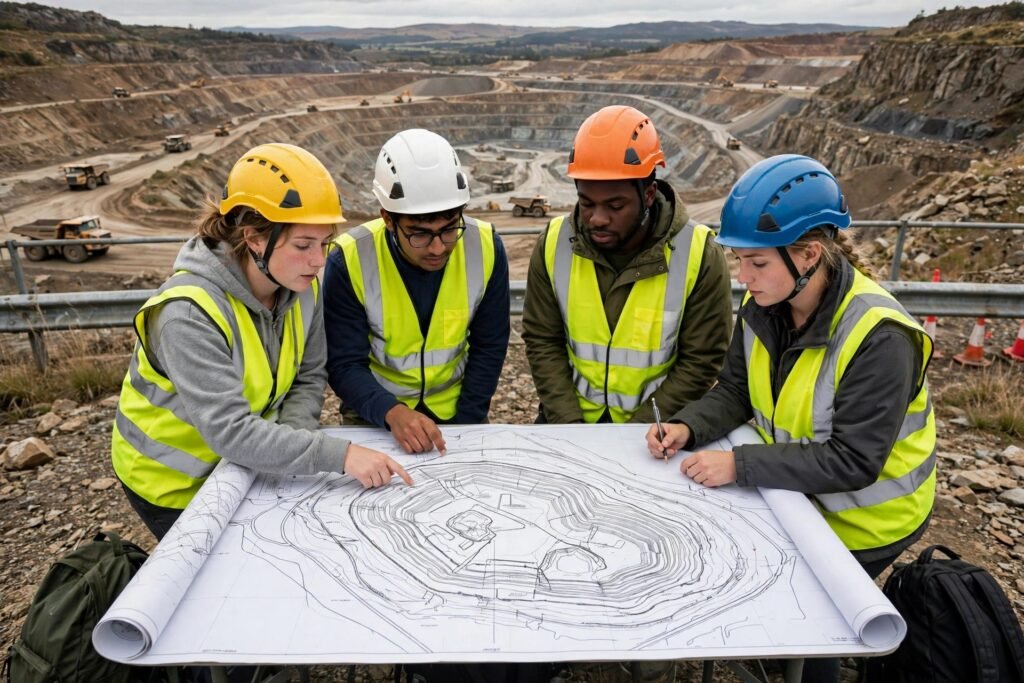
MS in Mining Engineering Abroad: Eligibility, Fees, Top Universities and Careers
A master’s degree in mining engineering is one of the most specialised postgraduate choices in the engineering world, and it is also one of the most directly tied to real places, real geology and real economies. Mining engineers design, plan and operate the systems that extract minerals, metals, coal and aggregates from the earth safely and efficiently, and they increasingly do the same work for the materials that power the energy transition: lithium, copper, nickel, cobalt and rare earth elements. If you studied mining, geological, civil, mechanical or chemical engineering at bachelor’s level, or you work in exploration, mine operations, mineral processing or geotechnical engineering, an MS in Mining Engineering abroad can deepen your technical authority, open up mine planning and management roles, and give you an internationally recognised credential in a field where employers genuinely care where you trained.
This guide explains what an MS in Mining Engineering actually covers, who it is for, what universities abroad ask for, what it costs, which countries and universities are strongest for the subject, what graduates earn, and how to fund it. It is written for international students planning 2026 or 2027 entry. Figures for salaries come from official statistics and are labelled with their source and year, and every cost figure that matters for a visa is labelled the same way. Fees and entry requirements change every year, so treat this guide as your planning map and confirm the details on the official university page before you apply.

What is an MS in Mining Engineering?
Mining engineering sits at the intersection of geology, rock mechanics, mechanical and civil engineering, economics and environmental science. At undergraduate level, students learn the fundamentals: how ore bodies form, how rock behaves under stress, how to drill and blast, how to move material, and how to process ore into a saleable product. At master’s level, the work becomes analytical, computational and managerial. You learn to build a mine plan that is technically sound, economically viable and environmentally defensible, and to defend that plan to regulators, investors, communities and your own operations team.
A typical MS in Mining Engineering is a taught master’s with a major project, thesis or capstone, although some programmes are research-focused and lead more naturally into a PhD. Taught programmes usually run for one to two years depending on the country: one year in the United Kingdom, one to two years in Australia and Canada, and around two years in the United States, where a thesis-based MS is common. Some universities offer both a coursework and a thesis track, and the right choice depends on whether you want to return to industry quickly or move toward research, consulting or a doctorate.
The degree goes by several names, and recognising the aliases matters when you search for programmes. You will see MSc Mining Engineering, Master of Mining Engineering, MS in Mining Engineering, Master of Engineering (Mining), and programmes housed inside departments of earth resources, mineral engineering or energy and mineral engineering. Some universities fold mining into broader degrees such as geological engineering or mineral resources engineering, while others run dedicated mining schools with their own laboratories, pilot plants and field sites. When comparing programmes, look past the title and read the module list: a strong programme should cover mine design and planning, rock mechanics, ventilation, mineral processing, mine economics and environmental management, not just one of those areas.
Who is this degree for? It suits graduates with a bachelor’s degree in mining engineering who want to specialise or move into planning, design and management; graduates from closely related fields such as geology, geotechnical or civil engineering who want to convert into mining; and working professionals in mine operations, exploration or consulting who want a credential that supports promotion to senior engineer, planning manager or mine manager roles. It is less suited to students who want a purely office-based career with no site work, because even the most computational mining roles — mine planning, geostatistics, ventilation modelling — require a working understanding of underground and surface operations, and most programmes include site visits, fieldwork or an industry placement.
At a glance
| Feature | Typical position |
|---|---|
| Degree level | Postgraduate master’s (MSc, MS, MEng or equivalent) |
| Typical duration | 1 year (UK) to 2 years (USA, Canada, Australia, Germany) |
| Entry qualification | Bachelor’s degree in mining, geological, civil, mechanical or a closely related engineering or geoscience field |
| Core subjects | Mine design and planning, rock mechanics, ventilation, mineral processing, geostatistics, mine economics, health and safety, environmental management |
| Key software | Mine planning and scheduling tools, geostatistical modelling, ventilation simulation, and surveying and geological modelling packages used by the host department |
| Typical capstone | Industry project, feasibility study, or research thesis, often with a mine site partner |
| Main employers | Mining companies, engineering and consulting firms, equipment suppliers, government geological surveys and regulators, research institutes |
What you study: curriculum and specialisations
The curriculum of a good MS in Mining Engineering balances four pillars: the earth, the engineering, the economics and the environment. The earth pillar covers applied geology, ore deposit evaluation, geostatistics and resource estimation — the skills that let you judge how much mineral is really there and how confident you can be in that estimate. The engineering pillar covers rock mechanics and ground control, drilling and blasting, surface and underground mining methods, materials handling, mine ventilation and dewatering, and mineral processing. The economics pillar covers mine feasibility, cut-off grade optimisation, scheduling, cost estimation and risk analysis. The environmental pillar covers mine closure and rehabilitation, water management, tailings storage, and the social and regulatory licence to operate.
Most programmes let you specialise in the second half of the degree. Common specialisations include mine planning and optimisation, where you learn to schedule production over the life of a mine and maximise value under geological uncertainty; rock mechanics and geotechnical engineering, which focuses on ground stability, support design and slope engineering; mineral processing and extractive metallurgy, which covers crushing, grinding, flotation and hydrometallurgy; and sustainable mining and mine closure, which deals with rehabilitation, water, waste and community outcomes. A growing number of programmes now offer modules in automation, remote operations and data analytics, reflecting the spread of autonomous haulage, drone surveying and real-time grade control in modern mines. If your goal is a planning or consulting career, weight your choices toward geostatistics, optimisation and economics. If your goal is operations management, weight them toward ventilation, ground control and production engineering.
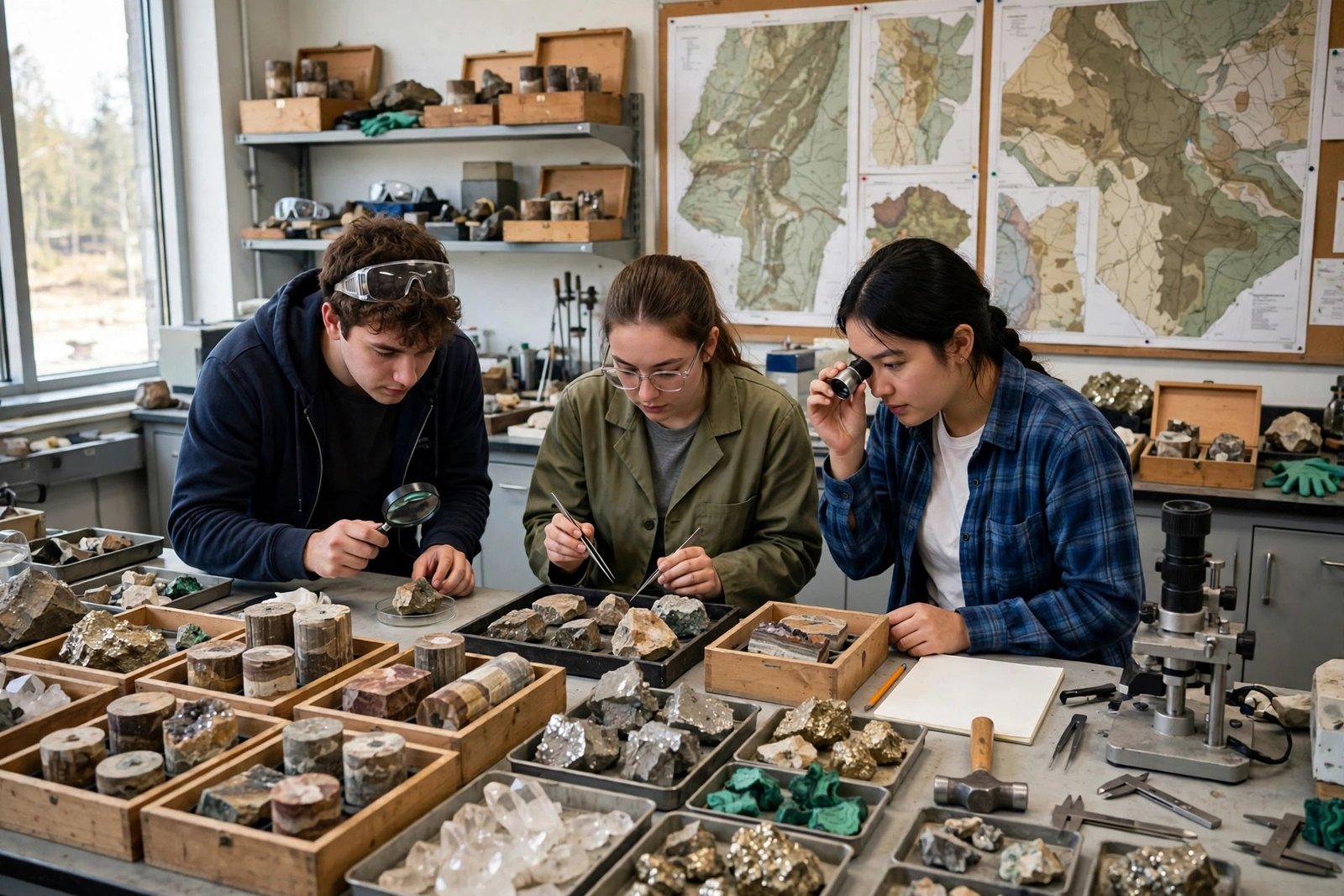
Practical work is a defining feature of the degree and a good reason to choose a mining school rather than a generic engineering department. Expect laboratory work in rock testing and mineral processing, computer laboratory sessions in mine design software, and fieldwork at operating mines or quarries. Many programmes require a placement, an industry-sponsored project or a site-based dissertation, and those experiences often matter as much as grades when employers recruit. When you shortlist universities, ask how many site visits are built into the programme, whether the department runs its own experimental mine or pilot plant, and whether recent dissertations were supervised jointly with industry. The answers tell you more about employability than any brochure.
Research-oriented students should also look at the department’s publication areas: some schools are famous for rock mechanics, others for mineral processing or for automation and digital mining. If you hope to continue to a PhD, choose a programme with a thesis track and supervisors working in your area, and use the master’s dissertation as the foundation for a doctoral proposal. If you plan to return to industry, a coursework programme with a strong applied project may serve you better and finish faster.
Eligibility and entry requirements
Entry requirements for an MS in Mining Engineering abroad are broadly similar across countries, but the details — especially around GPA conversion, English tests and work experience — differ enough to matter. The table below summarises the usual position; always confirm the exact requirement for your chosen programme, because mining schools sometimes set higher thresholds than their university’s general postgraduate standard.
| Destination | Academic requirement | English requirement (typical) | Notes |
|---|---|---|---|
| United States | Four-year bachelor’s in mining or a related engineering field; GPA typically 3.0/4.0 or above for competitive programmes | TOEFL or IELTS as set by the university; GRE required by some programmes, waived by others | Thesis and non-thesis tracks; funding often tied to research or teaching assistantships |
| United Kingdom | Upper second-class honours (2:1) or equivalent in mining, geological or a related engineering subject | IELTS typically 6.5 overall, with no band below 6.0, though requirements vary | One-year programmes; some accept relevant work experience alongside a lower classification |
| Canada | Four-year bachelor’s with a strong average in the final two years; research-based programmes usually need a supervisor’s agreement | IELTS or TOEFL as set by the university | Course-based and thesis-based routes; thesis admission often depends on finding a supervisor first |
| Australia | Bachelor’s in a related engineering or geoscience discipline; some programmes require a recognised engineering qualification | IELTS typically 6.5 overall, with no band below 6.0 | One to two years depending on prior qualification; strong industry links in Western Australia and Queensland |
| Germany | Bachelor’s in mining, geological or a related engineering field; some programmes are taught in English, others require German | IELTS or TOEFL for English-taught programmes; German language proof where required | Low or no tuition at many public universities, but a blocked account is required for the visa (see costs) |
Beyond the headline requirements, three things strengthen a mining engineering application more than anything else. The first is relevant experience: an internship, vacation placement or full-time role at a mine, quarry, exploration company or consultancy, described concretely in your statement of purpose with the commodities, methods and software you actually used. The second is quantitative preparation: strong grades in mathematics, mechanics, geology and any computing or statistics modules, because geostatistics and optimisation are mathematically demanding. The third is a clear, credible statement of purpose that names the specialisation you want, explains why that university’s strengths match it, and states what you intend to do after graduation. Admissions tutors in small, specialist departments read statements closely, and a generic engineering essay is easy to spot.
English test requirements deserve a careful note. Mining programmes sometimes set a higher writing or speaking threshold than the university minimum because of the safety-critical nature of site communication, and some professional registration routes later require demonstrated English competence as well. Check the programme page, not just the university’s general postgraduate page, and book your test early: popular test dates fill up, and a retake can cost you a whole intake. If you already hold a degree taught entirely in English, some universities will waive the test — ask, and get the waiver confirmed in writing.
Students from non-engineering backgrounds should be realistic. A geology graduate with strong mathematics can often enter a mining master’s, sometimes with bridging modules in mechanics or mine design. A graduate from an unrelated field will usually need a conversion route or additional undergraduate study first. If you are unsure, email the programme coordinator with your transcript before you pay an application fee; coordinators in mining schools are used to these questions and will usually tell you plainly whether you are a plausible candidate.
Tuition and living costs
Mining engineering tuition varies enormously by country, university and residency status, and no single average figure would be honest. Public universities in Germany charge low or no tuition for many master’s programmes, while private and some public programmes in the United States, the United Kingdom, Canada and Australia charge full international fees that differ sharply between institutions. The only reliable approach is to check the official fee page for each programme on your shortlist, confirm whether the figure is per year or for the whole programme, and check whether fieldwork, safety training or software licences carry additional charges. Mining programmes sometimes include field trips and site-based modules whose costs are itemised separately.
Living costs and visa financial requirements are easier to pin down because governments publish them. The table below gives the official figures you will most often need for planning. These are the amounts you must be able to show or budget for, not estimates from student forums, and they change periodically — always recheck the government page for your intake.
| Destination | Official living / visa finance figure | Basis |
|---|---|---|
| United Kingdom | GBP 1,529 per month in London; GBP 1,171 per month outside London | Student visa maintenance requirement, current figure |
| Germany | EUR 11,904 per year | Blocked account amount for the student visa (2026 figure) |
| Australia | AUD 29,710 per year | Student visa living-cost requirement (October 2026 figure) |
| Canada | CAD 23,448 (raised from CAD 22,895) | Proof-of-funds requirement for living expenses, updated figure |
On top of these figures, budget for the costs that mining students specifically face: safety boots, high-visibility clothing and personal protective equipment for site visits; travel to field sites, which may be in remote areas; and, in some programmes, a fieldwork or placement module that requires you to live away from campus for several weeks. Some departments subsidise these costs and some do not, so ask. Also budget for health insurance where the destination requires it, for visa application fees, and for the cost of document certification and translation if your transcripts are not in English.
Funding an MS in Mining Engineering is more feasible than many students expect, because the industry itself funds students. Mining companies, equipment manufacturers and industry associations sponsor scholarships, bursaries and research assistantships, particularly in Australia, Canada and South Africa, where the industry is large and skills shortages are a standing concern. University scholarships for international students are usually merit-based and competitive, and departmental assistantships — research or teaching — can cover a large part of tuition in the United States and Canada. Start your scholarship search at the same time as your programme search, not after you have an offer, because many industry awards close months before the academic intake. Our scholarships directory and the scholarship finder tool are useful starting points, and you can compare total costs with the tuition fee calculator and the cost of living calculator.
Top universities and countries for mining engineering
Choosing a country for mining engineering is partly a choice about which mining industry you want to join. Australia is the natural home of iron ore, coal, gold and lithium mining, and its mining schools in Western Australia and Queensland sit close to operating mines and to the consulting firms that serve the Asia-Pacific region. Canada combines a huge mining industry with strong research in rock mechanics, mineral processing and Arctic and deep mining, and its graduates benefit from a well-established route from study to post-graduation work. The United States has a smaller number of dedicated mining schools, but they are deeply connected to industry and to research funding, and they produce graduates for domestic mining, consulting and equipment companies. The United Kingdom offers compact one-year master’s programmes with strong reputations in mineral processing, mine environment and sustainable mining, which suit students who want to return to work quickly. Germany offers low-tuition options with strengths in raw materials, processing and mine surveying, and South Africa remains important for deep-level gold and platinum mining expertise.
Rather than chasing a single league table, compare programmes on the criteria that predict outcomes: the department’s industry partnerships, the number of operating mines within reach for fieldwork, the software and laboratory facilities, the employment record of recent graduates, and whether the programme is accredited by the relevant national body. In the United States, for example, ABET accreditation is the recognised quality mark for engineering programmes, and the ABET-accredited mining engineering bachelor’s at Penn State illustrates the standard that American mining schools are judged against. Accreditation matters less for a master’s than for a first degree, but a department whose undergraduate programme is accredited is usually a department with its quality systems in order.
When you build your shortlist, browse the universities directory and the rankings pages, and use the university comparison tool to weigh programmes side by side. Shortlist four to six programmes across at least two countries: two ambitious choices, two realistic choices and one or two safer choices. For each, record the programme director’s name, the application deadline, the fee, the scholarship deadlines and whether a supervisor or industry placement needs to be arranged before admission. That spreadsheet, kept current, is the difference between a calm application season and a panicked one.
A note on location within a country: mining schools are often in mining regions rather than capital cities. That is a feature, not a drawback. Studying in a mining region puts you near operating mines, consulting offices and alumni networks, and it often means lower living costs than a capital city. The trade-off is a smaller city and fewer non-mining employers, so weigh it against your own preferences and your partner’s or family’s needs if they are moving with you.
Careers and salaries
Mining engineering graduates work in a narrower but often better-paid set of roles than general engineering graduates. The main career paths are mine planning and design, production and operations management, geotechnical engineering, mineral processing, ventilation and safety engineering, consulting, and government regulation. Early-career graduates typically start as graduate mining engineers, planning engineers or process engineers, rotating through underground and surface operations before specialising. Mid-career roles include senior planning engineer, geotechnical engineer, ventilation engineer, processing manager and mine superintendent, and senior roles include mine manager, technical services manager and consulting principal. A master’s degree accelerates this progression, particularly into planning, geotechnical and consulting roles where advanced modelling and economics skills are the entry ticket.
Salary data for mining engineers is unusually strong for a small profession, but it must be read with care: pay varies sharply by commodity, location and roster. Remote and fly-in fly-out roles typically pay more than office-based roles, and boom commodities pay more than depressed ones. The official figures below are the right anchor for expectations.
| Occupation / measure | Figure | Source and year |
|---|---|---|
| Mining and geological engineers, median annual wage, USA | USD 106,220 | US Bureau of Labor Statistics, Occupational Outlook Handbook, May 2025 |
| Mining and geological engineers, employment outlook, USA | 4% growth, 2025–35; about 300 openings per year | US Bureau of Labor Statistics, Occupational Outlook Handbook, 2025–35 projections |
| Mining engineers, median full-time earnings, Australia | AUD 182,900 per year | Jobs and Skills Australia, occupation profile for Mining Engineers, based on ABS Survey of Employee Earnings and Hours, May 2025 |
| Mining and geological engineers, jobs, USA | 6,200 jobs in 2025 | US Bureau of Labor Statistics, Occupational Outlook Handbook |
Two cautions belong with these figures. First, the Australian median covers the whole occupation including experienced staff, so a new graduate should not expect it on day one; graduate pay is lower, and the premium comes with experience, remote work and responsibility. Second, the American occupation is small — only about 6,200 jobs — which means the market is tight-knit and reputation travels fast. In a small profession, your department’s industry links and your placement performance matter enormously, and a master’s from a well-connected mining school can open doors that a generic degree cannot. If you are weighing countries, consider where you want to work after graduation, because mining employers recruit heavily from the schools near their operations, and post-study work rules differ by destination.
Post-study work options are part of the career calculation. In the United Kingdom, master’s graduates can use the Graduate Route, currently two years for master’s graduates, with an announced shortening to 18 months for applications from 1 January 2027 — check the current rules for your intake, because announced and current rules are not the same thing. In Canada, eligible master’s graduates can receive a post-graduation work permit of up to three years. In Australia, the post-study work stream of the Temporary Graduate visa applies to eligible graduates, with durations depending on qualification and location. In the United States, international graduates commonly use Optional Practical Training, with the possibility of a STEM extension for eligible engineering programmes. None of these routes is guaranteed, and none should be treated as a promise of permanent residence; treat them as time to gain the experience that makes you employable anywhere.
Scholarships for mining engineering
Scholarships for mining engineering come from four sources: universities, governments, industry and professional associations. University awards are usually merit-based and may be automatic on admission or require a separate application; always check both. Government awards include the large national scholarship schemes that fund international students in the United Kingdom, Australia, Canada and Germany, and these are fiercely competitive but fully funded where awarded. Industry awards from mining companies and equipment suppliers are the most distinctive feature of this field: they often include a placement or vacation programme, and they sometimes carry an expectation — not always a formal obligation — that you will consider employment with the sponsor. Professional associations in mining and metallurgy also run bursaries and student prizes that are smaller but much less competitive, because fewer students apply.
Your scholarship strategy should be systematic. List every award for which you are eligible, note its deadline and its required documents, and apply for the smaller awards as well as the headline ones. A combination of a partial university scholarship, an industry bursary and a departmental assistantship often covers more than a single large award that you may not win. Keep copies of everything you submit, and ask your referees early: a referee who has written for you before will write faster and better the second time. The Courses and Programs directory and the career path explorer can help you connect a funding plan to the career you actually want.
How to choose and apply: a practical timeline
Start twelve to eighteen months before your intended intake. In the first three months, research programmes, confirm eligibility, and sit your English test if you need one. In the next three months, finalise your shortlist, contact programme coordinators with any eligibility questions, and line up referees. Applications for most programmes open six to twelve months before entry; submit early, because mining schools are small and some fill their cohorts before the formal deadline. Scholarship applications often close earlier than programme applications, so run the two tracks in parallel. Once you hold an offer, arrange funding, accommodation and your visa application, and use the months before departure to build the skills that mining employers value: a mine planning software tutorial, a short course in geostatistics, or a first-aid and safety certificate where relevant.
When you compare offers, look beyond the university’s name. Compare the module list against the specialisation you want, the dissertation options, the placement record, the total cost including fieldwork, and the visa and post-study work position in that country. Talk to current students and recent graduates if the department can connect you; they will tell you things no prospectus contains, such as how much fieldwork really happens, how responsive supervisors are, and where graduates actually went. A programme that fits your goals and your budget is worth more than a famous name in the wrong specialisation.
Frequently asked questions
Do I need a bachelor’s in mining engineering to apply?
Not always. Mining engineering is the ideal background, but geology, geotechnical, civil, mechanical and chemical engineering graduates are commonly admitted, sometimes with bridging modules. Graduates from unrelated fields usually need additional preparation first. Ask the programme coordinator before applying.
Is a one-year UK master’s enough for a mining career?
Yes, for most industry roles. UK one-year MSc programmes in mining are intensive and well regarded by employers, particularly in mineral processing and sustainable mining. A two-year programme may suit you better if you want a research thesis, a placement year or time to build a new specialisation from a different first degree.
What is the difference between a thesis and a coursework MS?
A thesis MS centres on an original research project and suits students heading for a PhD or research roles. A coursework MS centres on taught modules plus an applied project and suits students returning to industry. Some programmes offer both tracks, and some let you switch early in the degree.
How much do mining engineers earn?
In the United States, the median annual wage for mining and geological engineers was USD 106,220 in May 2025 (US Bureau of Labor Statistics). In Australia, Jobs and Skills Australia reports median full-time earnings of AUD 182,900 for mining engineers (May 2025, ABS data). Actual pay varies by commodity, location, roster and experience, and graduate pay is lower than the all-worker median.
Is mining engineering a good choice for the energy transition?
Yes, with eyes open. The energy transition depends on copper, lithium, nickel, cobalt and rare earths, and mining engineers who can deliver those minerals responsibly are in demand. The work also carries environmental and social responsibilities that are now central to the profession, and the best programmes treat sustainability as core content, not an optional extra.
Can I work abroad after graduating?
Post-study work routes exist in the main destinations — the UK Graduate Route, Canada’s post-graduation work permit, Australia’s Temporary Graduate visa and US Optional Practical Training — but durations, eligibility and rules change, and none guarantees permanent residence. Check the current immigration rules for your destination and intake before relying on any route.
Should I choose a mining school in a mining region?
Usually yes. Mining schools in mining regions offer easier access to site visits, placements and industry networks, and often lower living costs. Weigh that against your preference for city life and the needs of anyone moving with you.
Sources and verification
- US Bureau of Labor Statistics, Occupational Outlook Handbook: Mining and Geological Engineers — median pay USD 106,220 in May 2025, 4% employment growth projected 2025–35, about 300 openings per year, 6,200 jobs in 2025.
- Jobs and Skills Australia, occupation profile for Mining Engineers — median full-time earnings AUD 182,900, based on the ABS Survey of Employee Earnings and Hours, May 2025.
- Penn State University bulletin: Mining Engineering B.S. — ABET accreditation of the programme by the Engineering Accreditation Commission of ABET.
- UK Home Office student visa maintenance figures: GBP 1,529 per month in London and GBP 1,171 per month outside London.
- German student visa blocked account requirement: EUR 11,904 per year (2026).
- Australian student visa living-cost requirement: AUD 29,710 per year (October 2026).
- Canadian proof-of-funds requirement: CAD 23,448, raised from CAD 22,895.
Figures change yearly — confirm fees and requirements on the official university page before you apply. StudyGraduate is an information portal, not an agency, and this guide never promises admission, jobs, salaries or visa or permanent residence outcomes. Use it to plan, verify everything against official sources, and choose the programme that fits your background, your budget and the career you want.