

MS in Environmental Engineering Abroad: Eligibility, Fees, Top Universities and Careers
An MS in Environmental Engineering abroad is a postgraduate degree for students who want to design the systems that keep water clean, air breathable, waste safe and cities resilient. It sits at the meeting point of civil engineering, chemistry, biology and data analysis, and it trains you to turn environmental regulation and scientific evidence into working infrastructure. If you studied civil, chemical, mechanical or environmental engineering, or a closely related science, and you want your career to be measured in cleaner rivers, safer drinking water and lower-carbon buildings, this is one of the most directly useful master’s degrees you can choose.
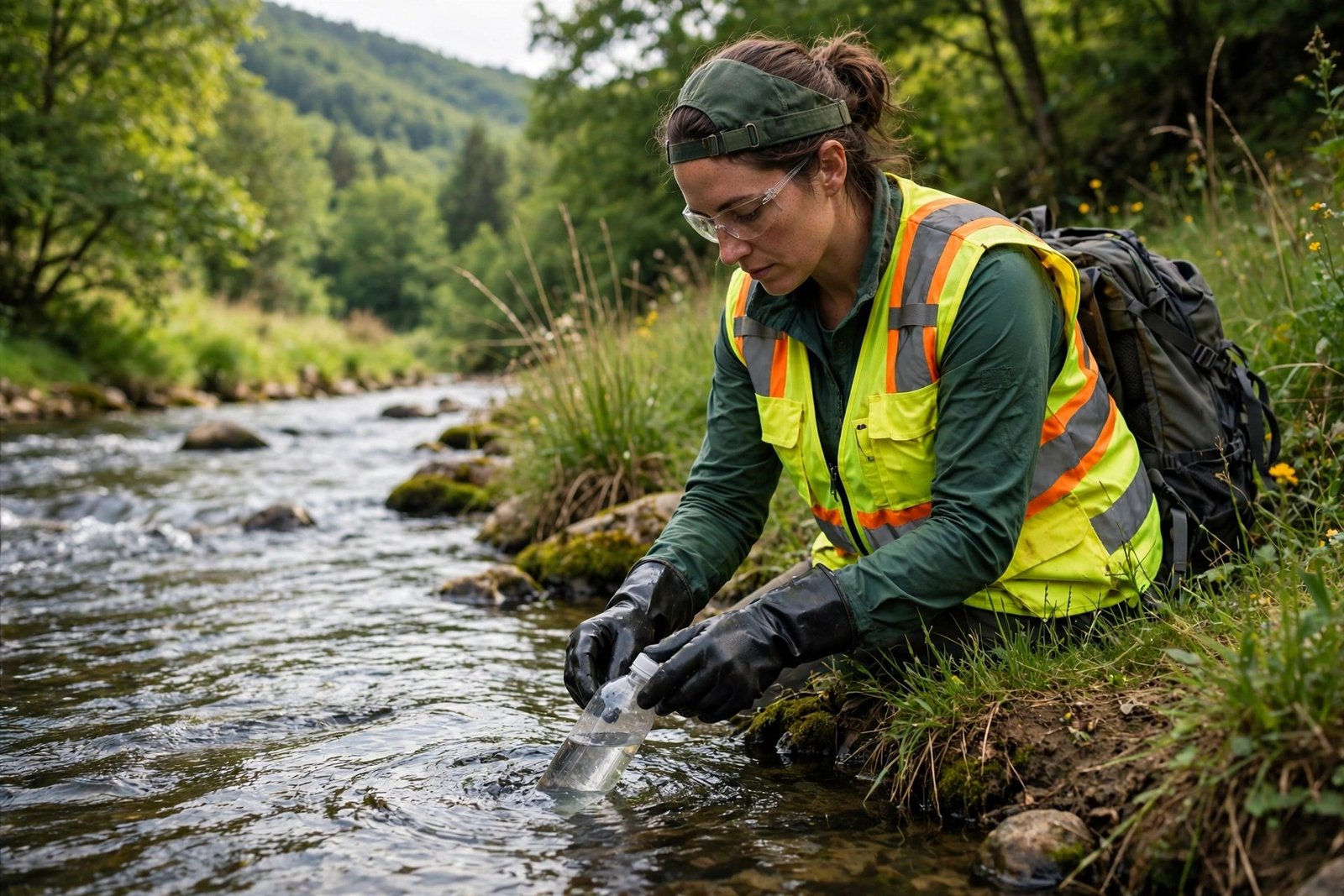
Environmental engineers do not only write reports about problems. They design water and wastewater treatment plants, model how pollutants move through soil and groundwater, plan flood defences, design landfill and recycling systems, assess contaminated land for redevelopment, and help factories and cities meet discharge and emissions limits. The work is split between the office and the field: you may spend one week running a hydraulic model or a life-cycle assessment on a computer, and the next week sampling a river, inspecting a treatment works or supervising a remediation site. Employers value that combination of calculation, regulation and practical judgement, and it is one of the reasons the degree travels well across countries.
This guide explains the degree in practical terms for 2026 and 2027 intakes: what you actually study, who is eligible, what it costs in the United States, the United Kingdom, Canada, Australia and Germany, which universities and countries are strongest for the subject, what graduates earn according to official statistics, and which scholarships are worth targeting. It is written for international students comparing offers, not for a single university, so where figures differ by country or institution, the guide says so and tells you where to verify the current number on the official university page before you apply.
A note on naming first, because it affects your search. Universities call this degree by several names: MS in Environmental Engineering, MSc Environmental Engineering, MEng Environmental Engineering, Master of Environmental Engineering, and sometimes MS in Civil and Environmental Engineering with an environmental track. The curriculum is broadly similar across these titles, but the degree title matters for professional recognition in some countries, so check whether the programme you are considering is accredited by the relevant national body, such as ABET in the United States or the Engineering Council route in the United Kingdom, before you accept an offer.

At a glance
| Feature | Typical position |
|---|---|
| Degree level | Master’s: MS, MSc, MEng or Master of Engineering, depending on country and university |
| Typical duration | 1 year full-time in the UK; 1.5 to 2 years in the USA, Canada and Australia; 2 years (4 semesters) in Germany |
| Usual entry qualification | Bachelor’s in civil, environmental, chemical or a related engineering or science discipline |
| Core subjects | Water and wastewater treatment, air pollution control, hydrology, soil and groundwater remediation, environmental modelling, waste management, environmental impact assessment |
| Typical capstone | Design project, laboratory or field research thesis, or an industry-linked project with a consultancy or utility |
| Common employers | Engineering consultancies, water utilities, government environment agencies, manufacturers, construction firms and research institutes |
| Professional direction | Licensed or chartered engineer routes vary by country; check ABET, Engineers Australia, Engineering Council UK or the relevant provincial regulator |
What you study in an MS in Environmental Engineering
The first semester usually rebuilds the shared foundation that every environmental engineer needs, whatever their undergraduate specialism. You will revisit fluid mechanics and hydrology, but now applied to real catchments, pipe networks and treatment processes rather than textbook problems. Chemistry returns in the form of water chemistry, reaction kinetics and pollutant fate: how a contaminant dissolves, adsorbs, degrades or persists, and what that means for the treatment process you choose. Microbiology matters too, because most wastewater treatment is, at heart, managed biology, and you need to understand the organisms doing the work before you can design the reactor that houses them.
Water and wastewater treatment is the largest single block in most programmes, and it is also the most employable. You will study drinking-water treatment, including coagulation, filtration and disinfection; wastewater treatment, including activated sludge, nutrient removal and sludge handling; and the design calculations that size each unit process. Many programmes pair this with laboratory work on bench-scale reactors and with site visits to operating treatment plants, so you learn not only the design equations but also what a plant looks like when it is running well, and what goes wrong when it is not. If you want a specialism that employers hire for year after year, water is the safest choice in this degree.
Air quality and pollution control forms the second major block. Here you study emission sources, atmospheric dispersion modelling, particulate and gaseous control technologies, and the monitoring networks that tell a city whether its air is improving. Climate-related content increasingly sits alongside this: greenhouse-gas accounting, carbon footprints of infrastructure, and adaptation measures such as urban drainage that copes with heavier rainfall. Some programmes fold sustainability assessment and life-cycle analysis into this block, teaching you to compare options not only on cost but on carbon, water and materials over the whole life of a project.
Soil, groundwater and waste complete the core. Contaminated-land modules cover site investigation, risk assessment and remediation technologies, from pump-and-treat systems to bioremediation and stabilisation. Waste modules cover collection, sorting, recycling, composting, energy recovery and landfill design, including leachate and gas management. Around these technical blocks sit the professional subjects that separate a master’s graduate from a bachelor’s graduate: environmental law and regulation, environmental impact assessment, project economics, risk and uncertainty, and increasingly geographic information systems and data analysis for environmental modelling.
Electives are where you shape the degree towards the job you want. A student aiming at water utilities will add advanced hydraulics, water distribution modelling and asset management. A student aiming at consultancy will add contaminated land, environmental auditing and impact assessment. A student aiming at climate and sustainability roles will add renewable energy systems, circular economy and corporate sustainability reporting. Choose electives backwards from job advertisements in your target country: read twenty current postings for the role you want, list the skills that repeat, and pick the modules that teach them. A thesis or design project then lets you prove one of those skills in depth, and a strong project with a real client is often the most persuasive item in a graduate job interview.
Eligibility and entry requirements
Most programmes ask for a bachelor’s degree in civil engineering, environmental engineering, chemical engineering or a closely related engineering discipline, with a solid record in mathematics and relevant science subjects. Applicants from chemistry, geology, environmental science or biology are often accepted, particularly for programmes with an environmental science leaning, but you may be asked to complete bridging modules in fluid mechanics or engineering mathematics. A degree in an unrelated field with no quantitative background is rarely sufficient on its own; if that is your position, a preparatory or conversion route, or a related master’s with a broader entry profile, is a more realistic path than applying to the most technical programmes.
Grade requirements differ by country and by how competitive the programme is. In the United States, many programmes look for a grade point average around 3.0 on a 4.0 scale, although strong research or work experience can compensate for a lower average at less selective universities, and highly ranked programmes expect considerably more. In the United Kingdom, the usual requirement is a second-class honours degree, typically a 2:1 for competitive programmes and a 2:2 for others, in a relevant subject. In Canada and Australia, universities usually state a minimum percentage or grade average in the final years of the bachelor’s degree, and they assess international qualifications against their own equivalency tables, so two applicants with the same percentage from different education systems may be treated differently. In Germany, admission to a consecutive master’s normally requires a relevant bachelor’s degree, and some programmes set a minimum grade threshold or require specific prior credits in subjects such as hydraulics, chemistry or environmental technology.
English language requirements are standard for international applicants. Most universities accept IELTS, TOEFL or an equivalent test, with typical overall requirements around IELTS 6.5, with no band below 6.0, or TOEFL iBT around 90, although competitive programmes and universities in Australia and Canada sometimes set higher thresholds. Some universities waive the test if your previous degree was taught entirely in English, but the waiver rules are specific and change frequently, so confirm them in writing with the admissions office rather than assuming you qualify. For Germany, many environmental engineering master’s programmes are taught entirely in English, but a programme taught in German will require German language certification, and even English-taught students benefit greatly from learning German for internships and daily life.
Standardised tests are less important than they used to be. The GRE is now optional or not required at many United States programmes, although a strong quantitative score can still help an applicant with a weaker grade record or a degree from a less well-known institution. It is rarely required in the United Kingdom, Canada, Australia or Germany. What matters more everywhere is evidence of relevant experience and motivation: an internship with a consultancy, utility or environmental agency; a final-year project on water, waste or air quality; laboratory or fieldwork experience; and a statement of purpose that names the specialism you want and explains why that university’s modules and research groups fit it. Generic statements that could be sent to any university are easy for admissions tutors to spot, and they weaken an otherwise good application.
Documents you will need in almost every application include academic transcripts, degree certificates, a curriculum vitae, two academic references, a statement of purpose, proof of English proficiency and, for some countries, proof of funds for the visa stage. References should come from lecturers or supervisors who can comment on your technical ability, not from family friends or employers who cannot assess your academic work. Apply early: popular programmes close months before the start date, scholarship deadlines are usually earlier than admission deadlines, and visa processing, especially for the United States and Canada, can take several months. A realistic timeline is to start twelve months before your intended start date.
Tuition fees and living costs
Tuition is the largest cost difference between destinations, and the ranges below are deliberately broad because fees vary sharply by university. In the United States, international master’s tuition in engineering commonly falls in the range of about $30,000 to $65,000 per year, with public universities generally cheaper than private ones and total programme costs depending on whether the degree takes one and a half or two years. In the United Kingdom, a one-year MSc typically costs international students roughly £24,000 to £38,000 in tuition for the year, which is a major reason the UK remains attractive despite high living costs: the degree is shorter. In Canada, international tuition for a two-year master’s often falls around CAD 20,000 to CAD 45,000 per year. In Australia, international master’s tuition commonly ranges around AUD 40,000 to AUD 55,000 per year. In Germany, most public universities charge no tuition, or only a semester contribution of a few hundred euros, although the state of Baden-Württemberg charges non-EU students €1,500 per semester and some specialised programmes charge fees, so always check the specific programme page.
Living costs must be added to tuition, and governments publish the figures they expect students to show for visas, which are a useful planning baseline. For a UK Student visa, the maintenance requirement is £1,529 per month in London and £1,171 per month outside London, for up to nine months, and these rates rise to £1,570 and £1,203 respectively for applications on or after 30 November 2026. For Canada, the proof-of-funds requirement for a single applicant is CAD 22,895, rising to CAD 23,448 under the updated figure cited in current guidance, in addition to tuition and travel. For Australia, the financial capacity guideline for living costs is AUD 29,710 per year. For Germany, the blocked account requirement is €11,904 for 2026. These are minimum visa figures, not comfortable budgets: rent in London, Toronto, Sydney or Munich will push real spending above the minimum, and you should build a personal budget with the university’s own cost-of-living guidance before you commit.
| Destination | Typical duration | Indicative international tuition | Visa living-cost baseline |
|---|---|---|---|
| United States | 1.5–2 years | About $30,000–$65,000 per year | Varies by university cost-of-attendance estimate |
| United Kingdom | 1 year | About £24,000–£38,000 for the year | £1,529/month London; £1,171/month elsewhere (rising to £1,570/£1,203 from 30 Nov 2026) |
| Canada | 2 years | About CAD 20,000–CAD 45,000 per year | CAD 22,895 (rising to CAD 23,448) plus tuition |
| Australia | 1.5–2 years | About AUD 40,000–AUD 55,000 per year | AUD 29,710 per year |
| Germany | 2 years | Usually no tuition at public universities; Baden-Württemberg non-EU €1,500/semester | Blocked account €11,904 (2026) |
Funding changes the calculation more than small differences in headline tuition. Teaching and research assistantships in the United States and Canada can cover a large part of tuition and pay a stipend, but they are competitive and are usually awarded after admission, sometimes only in the second semester. In the United Kingdom, funding for a one-year taught master’s is scarcer, so university scholarships and external awards matter more, and you should apply for them in parallel with admission rather than waiting for an offer. In Germany, the low-tuition model means the main cost is living expenses, which can be partly covered by part-time work within the limits of your residence permit. Wherever you study, compare total cost over the whole programme, not one year: a cheaper one-year degree can cost less overall than a longer degree with lower annual tuition, and the earlier you graduate, the earlier you earn.
Before you accept an offer, use the tuition fee calculator and the cost of living calculator to build a total budget for each offer, and compare them side by side. Students who skip this step are the ones most likely to be surprised by a second-year fee increase, a compulsory field trip charge, or rent in a city they have never visited. A spreadsheet with tuition, rent, food, transport, insurance, books and a contingency of at least ten percent is a small amount of work that prevents the most common financial reason students withdraw from a programme.
Top universities and countries for environmental engineering
The United States offers the deepest bench of environmental engineering programmes, with strong research in water treatment, contaminant hydrology and air quality at large public research universities and at specialist institutes. American programmes tend to be flexible, with a wide elective menu and close links to consulting firms and utilities, and they suit students who want to combine the master’s with research experience or a thesis. The trade-off is cost and duration: two years and high tuition mean you should only choose the United States if the programme offers funding, a specialism you cannot find elsewhere, or a research group you specifically want to join.
The United Kingdom offers the fastest route to the degree, with many one-year MSc programmes that are professionally oriented and closely tied to consultancies and water companies. British programmes are a strong choice if you want to enter the workforce quickly, if you are interested in contaminated land and environmental assessment work, or if you value the UK’s chartered engineer pathway. The shorter duration also means the teaching is intensive, with little slack for a slow start, and you should expect a heavy workload from the first week. Check the current Graduate Route position before you apply: the route currently allows two years of post-study work, with an announced reduction to 18 months for applications on or after 1 January 2027, so the timing of your graduation matters.
Canada combines strong environmental research with comparatively welcoming post-study work options and a large water and natural-resources sector. Canadian programmes often include a co-op or research thesis, and the country’s universities are strong in cold-climate water treatment, mining-related environmental management and freshwater science. Germany is the value choice: English-taught master’s programmes at public universities with little or no tuition, strong technical training, and an 18-month post-study job-seeker residence permit. The trade-off is that you must be comfortable with a more independent, self-directed style of study, and that learning German greatly improves your internship and employment prospects even on an English-taught programme.
Australia is strong in water scarcity, wastewater reuse, coastal engineering and mining-environmental management, reflecting its own climate and industries, and its universities have close ties to water utilities and consulting firms across the Asia-Pacific region. When you compare universities, look beyond headline rankings: check the research groups in your specialism, the laboratory and field facilities, the proportion of graduates employed in environmental roles, and whether the programme includes a placement or industry project. The universities directory and the Courses and Programs directory are useful starting points for building a shortlist, and the university comparison tool can help you weigh fees, duration and specialisms side by side. You can also explore the related Bachelor of Engineering profile if you are comparing undergraduate foundations with this master’s.
A final word on rankings: global rankings measure research output and reputation across a whole university, not the quality of one master’s programme or its employment outcomes. Use the rankings section to understand the landscape, but judge a programme by its curriculum, its staff in your specialism, its industry links and its graduate destinations. A programme ranked lower overall but with a dedicated water research centre and a placement year may serve your career better than a famous university where environmental engineering is a small side-stream of a general civil degree.
Careers and salaries
Graduates work as environmental engineers, water and wastewater engineers, environmental consultants, remediation engineers, air quality specialists, sustainability engineers and environmental health and safety engineers. Early-career roles usually involve design calculations, modelling, site investigation, report writing and project support under a senior engineer. With experience, engineers move into project management, specialist technical leadership, client management and business development, and those who pursue licensure or chartered status can sign off designs and take legal responsibility for projects, which is a significant step in both pay and seniority.
Demand is driven by regulation, infrastructure renewal and climate adaptation, which makes it less cyclical than some engineering sectors. Water infrastructure in particular is long-lived and publicly funded: cities must treat drinking water and wastewater every day regardless of the economic cycle, and ageing networks in many countries need continuous investment. The United States Bureau of Labor Statistics projects employment of environmental engineers to grow 6 percent from 2025 to 2035, faster than the average for all occupations, with about 2,300 openings per year on average over the decade, mostly from replacing workers who retire or change occupation. That is a steady, credible demand signal, not a boom-and-bust story, and it suits students who value stability alongside purpose.
Pay reflects that stability and the technical difficulty of the work. In the United States, the median annual wage for environmental engineers was $107,110 in May 2025, according to the Bureau of Labor Statistics, with the lowest 10 percent earning less than $69,990 and the highest 10 percent earning more than $162,220. Pay varies by industry: the same BLS release reports a May 2025 median of $124,760 in the federal government, $109,040 in engineering services, $104,140 in local government, $102,160 in state government and $101,840 in management, scientific and technical consulting services. These are national medians for the occupation as a whole, not promises for any individual graduate: your pay will depend on location, employer, specialism and experience, and international graduates should also weigh visa constraints and licensing timelines in the country where they plan to work.
| Role or setting (USA) | Official figure | Source and year |
|---|---|---|
| Environmental engineers, all industries (median) | $107,110 per year | BLS Occupational Outlook Handbook, May 2025 |
| Environmental engineers, lowest 10 percent | Less than $69,990 per year | BLS Occupational Outlook Handbook, May 2025 |
| Environmental engineers, highest 10 percent | More than $162,220 per year | BLS Occupational Outlook Handbook, May 2025 |
| Environmental engineers, federal government (median) | $124,760 per year | BLS Occupational Outlook Handbook, May 2025 |
| Environmental engineers, engineering services (median) | $109,040 per year | BLS Occupational Outlook Handbook, May 2025 |
| Environmental engineers, local government (median) | $104,140 per year | BLS Occupational Outlook Handbook, May 2025 |
Outside the United States, pay must be compared with local living costs and tax, not converted at face value. A salary that looks lower in one country may leave more disposable income than a higher salary in an expensive city, and graduate starting salaries are always lower than the all-experience medians quoted above. The most reliable way to research pay in your target country is to use that country’s official statistics and professional body salary surveys, to read current job advertisements for the exact role and city you are targeting, and to ask university careers services for graduate destination data for the specific programme. Avoid websites that quote a single “average salary” for a degree with no source, sample or year: those figures are frequently invented or copied from unrelated occupations.
Two career decisions matter more than your first salary. The first is licensure or chartered status: in the United States, the path runs through the Fundamentals of Engineering exam, supervised experience and the Professional Engineering exam; in the United Kingdom, it runs through incorporated and then chartered engineer status with a professional institution; in Canada, through provincial licensure; and in Australia, through Engineers Australia’s chartered pathway. Start this process during or immediately after your master’s, because the supervised-experience clock only runs once you are in a qualifying role. The second is specialisation depth: the engineers who command the highest pay are rarely generalists. They are the water process specialist, the contaminated-land risk assessor or the air dispersion modeller whose expertise is scarce and whose work clients cannot easily replace.
For students still deciding, the career path explorer can help map how this degree connects to roles in consulting, utilities and government, and the guides section covers visas and post-study work in more detail. If you are weighing this degree against a general civil engineering master’s, the deciding question is simple: do you want to spend your career on environmental systems specifically, or do you want the widest possible range of civil projects? If the answer is environmental systems, this degree’s depth will serve you better; if you are unsure, a civil master’s with environmental electives keeps more doors open.
Scholarships for environmental engineering
Scholarship funding for this field comes from four sources: universities themselves, national governments, international organisations and industry. University scholarships are the most common and the most accessible: many universities offer merit awards for international master’s students, usually awarded on academic achievement and sometimes on the strength of the statement of purpose, and they range from a few thousand pounds or dollars to a substantial tuition reduction. Apply for these at the same time as admission, because many are automatic or have early deadlines, and a strong application for admission is usually also a strong application for a merit award.
Government scholarships are larger and more competitive. Well-known examples include national schemes in the destination country, such as Chevening in the United Kingdom and Fulbright in the United States, as well as development-focused awards for students from eligible countries. These typically cover tuition and living costs, but they have early deadlines, often a year before the start date, and they usually require a clear statement of how your study will benefit your home country or field. Industry and foundation awards exist too, particularly in water, energy and sustainability, and they are worth searching for by specialism rather than by degree title: a water-industry foundation may fund a water engineering student more readily than a general scholarship fund will.
Whatever you apply for, read the conditions carefully: some awards require you to return home after study, some are paid only after enrolment, and some cannot be combined with other funding. Use the scholarships directory and the scholarship finder to build a shortlist, and keep a calendar of deadlines separate from your admissions calendar. A scholarship application that arrives a week late is worth nothing, however strong the candidate.
Frequently asked questions
Do I need a bachelor’s in environmental engineering to apply?
No, but you need a relevant quantitative background. Civil, chemical and mechanical engineering degrees are the most common routes, and science degrees in chemistry, geology or environmental science are often accepted, sometimes with bridging modules. Check the specific programme’s prerequisite subjects before applying.
Is an MS in Environmental Engineering better than an MS in Civil Engineering?
It is better if you want an environmental career, because the depth in water treatment, remediation and air quality is what environmental employers hire for. It is narrower if you later want to work on structures or transport, so choose on the basis of the career you actually want, not on which title sounds broader.
How long does the degree take?
Typically one year full-time in the United Kingdom, two years in Germany, and one and a half to two years in the United States, Canada and Australia, depending on whether you take a thesis, a project or a coursework-only route and whether you study full-time.
Can I work while studying?
Most student visas allow limited part-time work during term and more during vacations, but the hours and conditions differ by country and are set by immigration rules, not by the university. Check the current visa conditions for your destination before relying on part-time earnings to fund your study.
What is the difference between an MS, an MSc and an MEng?
The titles reflect national convention more than a fixed difference in content. In the United States, MS is standard; in the United Kingdom, MSc is the usual taught master’s title and MEng can be either an undergraduate integrated master’s or a postgraduate programme, so read the programme description rather than relying on the letters alone.
Do I need work experience before applying?
Not usually for a taught master’s, although relevant internships or employment strengthen an application considerably, especially at competitive universities. Research-based master’s programmes value prior research experience more highly, including a strong final-year project.
Is this degree good for permanent residence abroad?
Environmental engineering is a skilled occupation in several countries, and post-study work routes exist in the United Kingdom, Canada, Australia, Germany and, through employer sponsorship, the United States. No degree guarantees a visa or permanent residence, and immigration rules change, so treat post-study work as a possibility to research, not a promise.
What should I do if my grades are below the stated requirement?
Consider programmes with lower thresholds, strengthen the application with relevant experience and a strong statement, and consider a pre-master’s or postgraduate diploma route where available. Applying only to the most competitive programmes with grades below their threshold wastes application fees and time.
Sources and verification
Salary and employment figures in this article are from the U.S. Bureau of Labor Statistics, Occupational Outlook Handbook, Environmental Engineers profile (May 2025 median and industry medians; 2025–35 growth projection of 6 percent and about 2,300 openings per year). Visa maintenance and financial-capacity figures are the current published baselines cited in this guide: UK Student visa maintenance £1,529 per month in London and £1,171 elsewhere, rising to £1,570 and £1,203 for applications on or after 30 November 2026; Canada proof of funds CAD 22,895, rising to CAD 23,448; Australia living-cost capacity AUD 29,710 per year; Germany blocked account €11,904 for 2026. The UK Graduate Route is described as currently two years, with an announced reduction to 18 months for applications on or after 1 January 2027. Tuition ranges are indicative planning ranges compiled from typical international fees and must be confirmed on the official programme page, as fees change yearly and differ by university. Figures change yearly — confirm fees and requirements on the official university page before applying.
External sources: BLS Occupational Outlook Handbook: Environmental Engineers; BLS Occupational Outlook Handbook: Field of degree, Engineering; BLS Occupational Outlook Handbook site map.
StudyGraduate is an information portal, not an agency. It never promises admission, jobs, salaries or visa or permanent residence outcomes. Use this guide to shortlist programmes, then verify every fee, deadline and requirement with the university and the relevant immigration authority.