
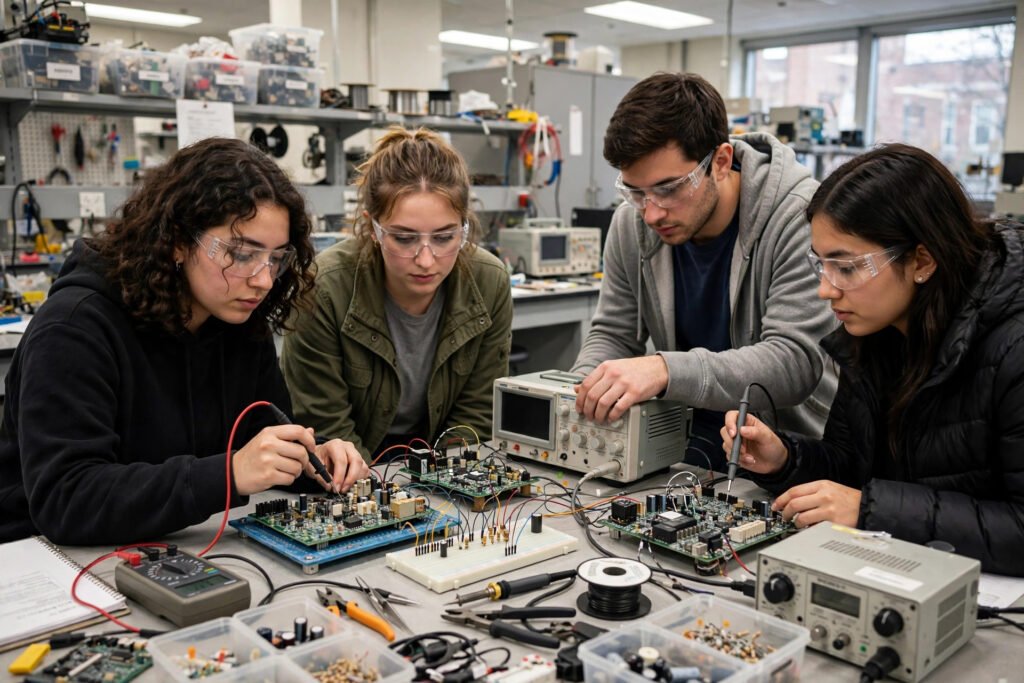
MS in Electrical Engineering Abroad: Eligibility, Fees, Top Universities and Careers
Electrical engineering powers almost everything a modern economy runs on: the grid, the chips inside every device, the communication networks, the control systems in factories and vehicles, and the renewable energy systems replacing fossil fuels. An MS in Electrical Engineering abroad is therefore a degree with unusually broad career options, but also a degree where the specialisation you choose — power systems, electronics, communications, control, or embedded systems — shapes your working life far more than the degree title itself. This guide explains what the degree involves, who is eligible, what it costs in the USA, UK, Canada, Australia and Germany, which universities and countries suit different goals, what graduates earn according to official statistics, and how to fund the degree.
It is written for students planning 2026 or 2027 intakes. Every cost and salary figure here is labelled with its source and year, and you should confirm the current figure on the official university or government page before you apply. Nothing here promises admission, a job, a salary or a visa outcome: those decisions belong to universities, employers and immigration authorities, not to any guide.
One point of terminology matters before you apply. In the USA, “electrical engineering” and “electronics engineering” are tracked as related but distinct occupations, and many universities offer them as separate programs or as tracks within one department. In much of Europe, the field is often called “electrical engineering and information technology.” In the UK and Australia, “electronic and electrical engineering” is a common combined title. Do not assume two programs with similar names teach the same content: read the module lists, especially for the split between power engineering, signal processing, microelectronics and embedded systems.
MS in Electrical Engineering at a Glance
| Item | Typical detail |
|---|---|
| Degree level | Master’s (MS, MSc, MEng or MASc depending on country) |
| Typical duration | 1 year (UK, some Australian programs); 1.5–2 years (USA, Canada, Australia, Germany) |
| Entry qualification | Bachelor’s in electrical, electronics, computer or a closely related engineering field |
| Core subjects | Signals and systems, electromagnetics, power systems, digital design, control theory, communications |
| Thesis or project | Most programs include a research thesis, capstone design project, or industry placement |
| Common specialisations | Power and energy systems, microelectronics and VLSI, embedded systems, signal processing, communications, control and automation |
| Post-study work routes | USA OPT including STEM extension; UK Graduate Route; Canada PGWP; Australia Temporary Graduate visa; Germany 18-month job-seeker permit |
What You Study in an MS in Electrical Engineering
The core of most electrical engineering master’s programs revisits the fundamentals at a level of rigour that undergraduate study rarely reaches: linear systems and signal theory, electromagnetic fields, semiconductor device physics, and the mathematics of estimation, optimisation and control. Around that core, programs divide into tracks. A power and energy track covers power system analysis and protection, power electronics, machines and drives, smart grids, and renewable energy integration. A microelectronics track covers analogue and digital integrated circuit design, VLSI, semiconductor fabrication and device modelling. A communications track covers information theory, wireless systems, antenna design, optical communications and networks. A control and automation track covers modern control theory, robotics control, industrial automation and real-time systems. An embedded systems track blends hardware design with firmware and software engineering.
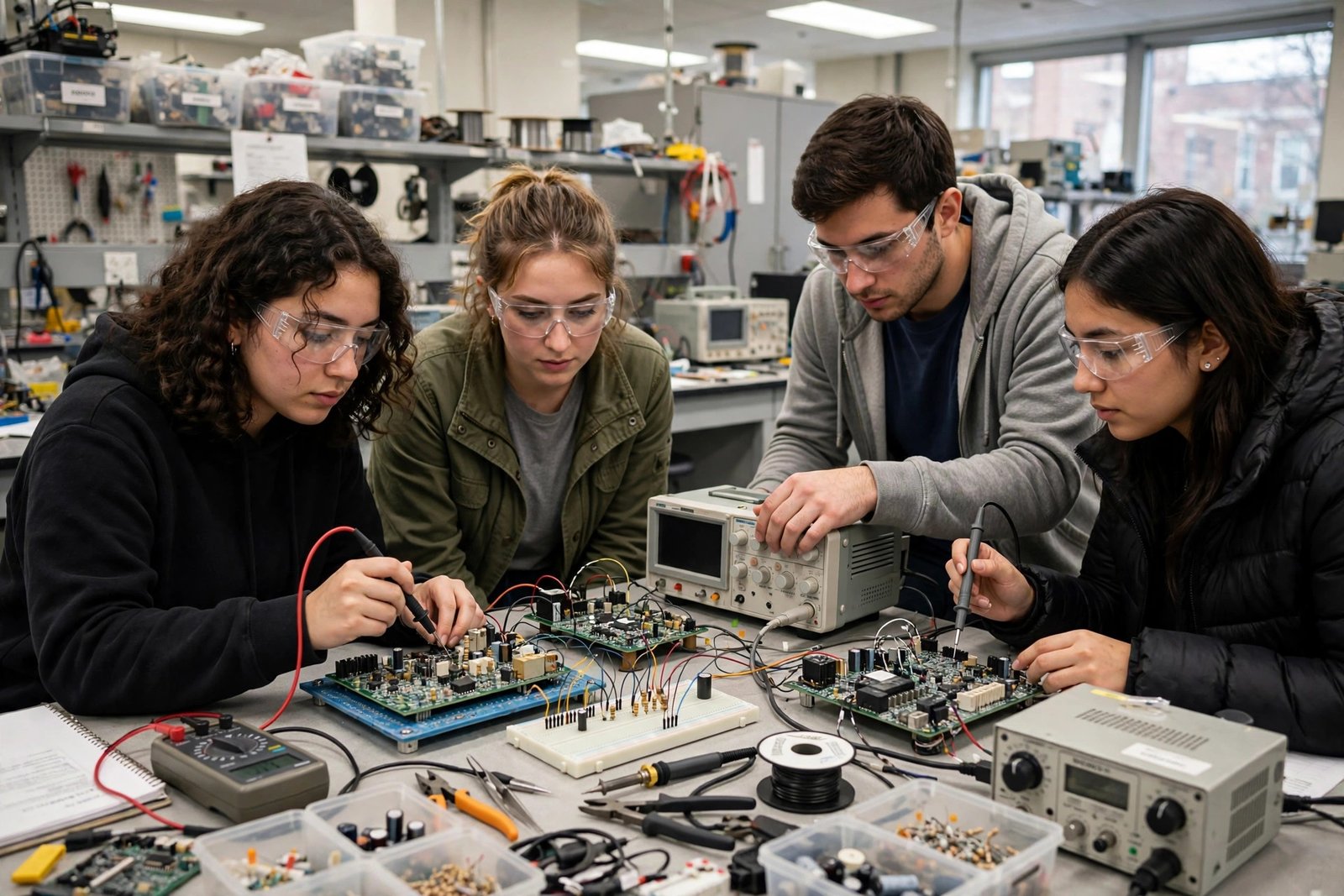
Laboratory work is central, and its quality is one of the best ways to judge a program. Look for power systems laboratories with real-time simulators, electronics laboratories with fabrication or at least tape-out opportunities, communications laboratories with software-defined radio equipment, and embedded laboratories with current microcontroller and FPGA platforms. The capstone or thesis project is usually the most important part of the degree for employment: it is the work you will discuss in interviews, and it is often done with an industry partner or research group. Choose a project in the sub-field you want to work in — a power electronics project if you want to work in renewables, a VLSI project if you want chip design — and ask how projects are allocated before you accept an offer.
Software and hardware tools run through the whole degree. Employers commonly expect familiarity with MATLAB and Python for simulation and signal processing, SPICE-type circuit simulators, hardware description languages such as Verilog or VHDL for digital design, CAD tools such as Cadence for chip design, and power system tools such as PSCAD or PSS/E for power engineers. A program that teaches only theory, with no substantial design, simulation or laboratory component, will leave you at a disadvantage; check module descriptions and assessment methods, not just the degree title.
Electrical engineering also rewards a deliberate choice between breadth and depth. A broad program keeps power, electronics and communications open and suits students who are unsure of their direction or who want to work in systems roles. A deep program in, say, RF engineering or power systems suits students who already know their target industry. Neither is better in the abstract; the right choice is the one that matches the job descriptions you actually want to apply for after graduation.
Eligibility and Entry Requirements
The baseline requirement is consistent almost everywhere: a bachelor’s degree in electrical engineering, electronics engineering, computer engineering or a closely related field, with strong grades in mathematics, circuits, signals and systems, and electromagnetics. Applicants from physics, computer science or other engineering branches are often admitted conditionally, sometimes with bridging modules, especially for embedded systems and signal processing tracks. Power engineering tracks tend to be stricter about prior power and machines coursework. A three-year bachelor’s degree can be an issue in Germany and at some Canadian universities, so check this early rather than after you have paid an application fee.
Grade expectations differ by destination. In the USA, competitive programs typically look for a GPA around 3.0 or above on a 4.0 scale, with the strongest programs higher; the GPA converter on this site can help you translate your grades into the 4.0 scale. In the UK, the usual requirement is a 2:1 honours degree or its international equivalent. In Canada, a B average or better in the final two years is a common threshold. In Germany, admission is often governed by a minimum grade in the German system and by whether your bachelor’s covers the required subject content; some programs are restricted and some are open admission. In Australia, requirements are usually expressed as a recognised bachelor’s degree with a specified GPA or percentage.
English language requirements are broadly similar across destinations: IELTS 6.5 overall with no band below 6.0 is the most common threshold, with some programs requiring 7.0, and TOEFL iBT equivalents accepted in the USA, Canada and Australia. Note that TOEFL iBT scores have been reported on a 1–6 scale since January 2026, so confirm how your target university reads the new format. The GRE is now optional or not required at many US electrical engineering programs, though a strong quantitative score can still help an application with a weaker GPA or a less well-known bachelor’s institution. Two academic references, or one academic and one professional reference for applicants with work experience, are standard, and a statement of purpose that names a specialisation and connects it to a project or work experience is worth more than a generic essay.
| Destination | Typical academic requirement | Typical English requirement | Notes |
|---|---|---|---|
| USA | 4-year bachelor’s in electrical, electronics or related engineering; GPA ~3.0+ | IELTS 6.5–7.0 or TOEFL equivalent | GRE often optional; funding often tied to research assistantships |
| UK | 2:1 honours or international equivalent | IELTS 6.5 overall, no band below 6.0 (varies) | 1-year MSc common; Graduate Route currently 2 years |
| Canada | 4-year bachelor’s; B average in final years | IELTS 6.5–7.0 | Thesis-based MASc often funded; course-based MEng usually self-funded |
| Australia | Recognised bachelor’s in engineering or related field | IELTS 6.5 overall | 2-year master’s common; check Engineers Australia accreditation |
| Germany | Bachelor’s with required subject content; grade threshold varies | IELTS 6.5 for English-taught programs; German needed for German-taught ones | Most public universities charge no tuition; blocked account required for visa |
Tuition Fees and Living Costs
Costs vary far more by country than by university, so choose the country first and the university second. In the USA, international master’s tuition in engineering is typically the highest of the five destinations, and total costs depend heavily on whether the program is at a public or private university and on the state. Funding changes the picture: research assistantships and teaching assistantships at US universities commonly include a tuition waiver and a stipend, and thesis-based students are far more likely to receive them than course-only students. Ask departments directly about assistantship availability before accepting an offer.
In the UK, a one-year MSc compresses the total cost into a single year, which is attractive even though annual tuition is high; the trade-off is an intense schedule with little room for part-time work during term. For a UK Student visa, you must show maintenance funds of £1,529 per month in London or £1,171 per month outside London for up to nine months, and these rates rise to £1,570 and £1,203 for applications on or after 30 November 2026. In Canada, average tuition for international graduate students was CAD 24,028 in 2025/26 according to Statistics Canada, and study permit applicants must show living funds of CAD 22,895 for applications between 1 September 2025 and 31 August 2026, rising to CAD 23,448 from 1 September 2026. In Australia, the student visa financial capacity requirement for living costs is AUD 29,710 per year, and the visa application charge is AUD 2,500 from 1 July 2026.
Germany remains the lowest-cost option for many students: most public universities charge no tuition, with the notable exception of Baden-Württemberg, which charges non-EU students €1,500 per semester, and some universities which have introduced non-EU fees. You will still need a blocked account of €11,904 for 2026 to satisfy the visa’s proof of funds, plus a semester contribution of a few hundred euros. The tuition fee calculator and cost of living calculator can help you compare total budgets across destinations, but always replace their estimates with the official figures from your offer letter and the relevant immigration authority. As an example of a German English-taught program, the DAAD lists a Master of Science in Electrical Engineering at the University of Rostock with no tuition fees and a semester contribution of around €333 per semester.
Beyond tuition, budget for health insurance, books and software, laboratory and project costs, travel, and the visa itself. In the USA, budget for the SEVIS fee of $350 and the visa application fee of $185, plus a Visa Integrity Fee of at least $250 at issuance. In the UK, the Student visa fee is £558 and the Immigration Health Surcharge is £776 per year. Small costs accumulate: application fees, credential evaluations, English test fees and document certification can easily add several hundred dollars before you even receive an offer.
Top Universities and Countries for Electrical Engineering
The USA offers the deepest market for electrical engineers: semiconductor design and fabrication, power and utilities, aerospace and defence, telecommunications and consumer electronics. Germany offers low tuition, a strong industrial base in power, automation and automotive electronics, and an 18-month post-study job-seeker residence permit. The UK offers one-year degrees and strengths in communications, photonics and power systems research. Canada offers a post-study work permit of up to three years and strong hydroelectric and clean-energy sectors. Australia offers two-year master’s programs and demand in power, mining technology and telecommunications.
Rather than chasing a single league table, shortlist universities by specialisation strength and industry links. For semiconductors, look at universities with fabrication facilities or close ties to chip companies and tape-out programs. For power systems, look at departments with real-time simulation laboratories and utility partnerships. For communications, look at research groups in wireless systems, photonics and networks. The universities directory and the rankings pages on this site let you compare institutions, and individual profiles such as UC Berkeley, TU Berlin and UNSW Sydney show the kind of program detail to look for. For a broader view of engineering degrees, see the Courses and Programs directory and the Bachelor of Engineering program profile.
Accreditation deserves a check before you apply. In the USA, ABET accreditation of the underlying bachelor’s program matters for later licensure; the ABET accreditation pages explain which programs are accredited. In Australia, Engineers Australia accreditation supports recognition and migration pathways. In the UK, Engineering Council accreditation matters for Chartered Engineer status. In Canada, Engineers Canada accreditation of the bachelor’s degree matters for licensure. A master’s degree does not automatically confer professional registration anywhere; registration is a separate process with its own experience requirements.

Careers and Salaries for Electrical Engineering Graduates
Electrical engineering graduates work as power systems engineers, electronics and hardware engineers, embedded systems engineers, control and automation engineers, communications engineers, RF engineers, test and validation engineers, and, with experience, engineering managers and systems architects. Semiconductor and power engineering are currently among the most active hiring areas, driven by chip fabrication investment, grid modernisation and renewable energy integration — but hiring is cyclical in semiconductors, so a specialisation that keeps more than one industry open is a sensible hedge.
Official salary data gives a realistic anchor. In the United States, the Bureau of Labor Statistics Occupational Outlook Handbook for electrical and electronics engineers reports a median annual wage for electrical engineers of $120,630 in May 2025, and a median annual wage for electronics engineers, except computer, of $130,220 in May 2025. Overall employment of electrical and electronics engineers in the USA is projected to grow 8 percent from 2025 to 2035, much faster than the average for all occupations, with about 16,300 openings projected each year. These are medians for the whole occupation, not starting salaries: new graduates typically earn less than the median, and senior engineers in high-demand industries earn more. Note that the two BLS categories are reported separately — do not merge them into a single “electrical engineering salary.”
| Occupation (USA, BLS) | Median annual wage, May 2025 | Outlook 2025–35 |
|---|---|---|
| Electrical engineers | $120,630 | 8% growth for electrical and electronics engineers combined; about 16,300 openings per year |
| Electronics engineers, except computer | $130,220 | |
| Electrical and electronics engineers, combined median (Quick Facts) | $125,040 | 297,900 jobs in 2025 |
Outside the USA, salary levels differ and should be checked in the official statistics of the destination country rather than converted from US figures. The career path explorer can help you compare roles, but treat any non-official salary figure you find online with scepticism. Post-study work rules also differ: US graduates in STEM-designated programs can use OPT for 12 months plus a 24-month STEM extension; UK graduates currently receive a 2-year Graduate Route visa, with an announced reduction to 18 months for applications on or after 1 January 2027; Canadian graduates can receive a Post-Graduation Work Permit of up to 3 years; Australian graduates use the Temporary Graduate visa, with a base charge of AUD 5,750 from 1 July 2026; German graduates can take an 18-month job-seeker residence permit and, after two years of qualified employment, may qualify for settlement.
Licensure is a longer-term consideration. In the USA, engineers who offer services to the public must be licensed, which involves the Fundamentals of Engineering exam, supervised experience, and the Professional Engineering exam; most industry roles do not require a licence, but it matters in consulting, building services and public infrastructure. Similar registration systems exist in Canada, Australia and the UK. If you plan to seek registration, choose programs and early jobs that keep that path open.
Scholarships for Electrical Engineering
Funding for an electrical engineering master’s comes from four main sources: university scholarships and assistantships, government scholarships, industry sponsorships, and external foundations. University merit scholarships are the most common, and many are awarded automatically on the basis of the admission application, so apply early and check whether a separate scholarship application is needed. In the USA, research and teaching assistantships are often the largest source of funding and are worth asking about directly when you contact a department. In Germany, DAAD scholarships and university-specific awards exist alongside the low-tuition model, and the DAAD international programmes database is a useful place to search English-taught electrical engineering programs. In the UK, Australia and Canada, faculty and departmental scholarships, Commonwealth scholarships and country-specific awards are worth a systematic search.
Start your funding search in the scholarships directory and compare offers with the university comparison tool. Treat any scholarship that asks for payment to apply as a scam, and verify every award on the official university or government page. Note also that many scholarships have earlier deadlines than admission itself, sometimes by several months, so build a separate deadline list for funding and track it with the application deadline finder.
How to Choose the Right Program
Start from the job you want, not from a ranking. Write down three roles you would be happy in after graduation, then work backwards: which specialisation, which tools, which project topic and which employers connect to those roles. Then shortlist six to eight programs across at least two countries, so that a rejection or a funding shortfall in one destination does not end your plan. Compare them on specialisation fit, laboratory and project quality, industry links and placement or co-op options, total cost after funding, and post-study work rules. Contact current students or recent graduates through departmental channels and ask about the project allocation process, the availability of assistantships, and how many graduates found engineering work in their field.
Prepare your application documents in parallel: transcripts, references, statement of purpose, CV, English test results, and, where needed, a portfolio of electronics or embedded projects. Electrical engineering applicants benefit from a short project portfolio — schematics, PCB layouts, firmware repositories, test results — even when it is not formally required. Finally, check visa rules early: the visa requirement checker gives a starting overview, but the immigration authority’s own website is the only authoritative source for your application. If you need to prepare for English or admissions tests, see the test preparation resources.
Frequently Asked Questions
Is an MS in Electrical Engineering worth it abroad?
It is worth it when it buys you a specialisation, laboratory experience or labour-market access you cannot get at home — particularly in semiconductors, power systems or communications. It is less clearly worth it if you choose a program with no design or laboratory component and high tuition purely for the degree title. Compare total cost after funding against the official salary medians for your target country before deciding.
What is the difference between electrical and electronics engineering?
Electrical engineering traditionally covers large-scale systems: power generation, transmission, machines and drives. Electronics engineering covers smaller-scale systems: circuits, devices, embedded hardware and communications components. Many master’s programs combine them, but the track you choose determines your first jobs, so read module lists rather than relying on the degree name.
Is the GRE required for MS in Electrical Engineering in the USA?
Many programs have made the GRE optional or removed it entirely, but some still require or recommend it. A strong quantitative score can help a borderline application. Check each department’s current requirement rather than assuming a single rule.
Which country is cheapest for MS in Electrical Engineering?
Germany is usually cheapest overall because most public universities charge no tuition, although you must still show €11,904 in a blocked account for 2026 and cover living costs. The UK’s one-year format reduces total living costs, while the USA and Australia are typically the most expensive before funding.
Can I work while studying electrical engineering abroad?
Yes, within visa limits: 20 hours per week in term time in the USA on campus and in the UK; 24 hours per week off campus in Canada; 48 hours per fortnight in Australia; and 140 full days or 280 half days per year in Germany. Work rights do not guarantee a job, and engineering study is demanding, so do not rely on part-time earnings to cover tuition.
What is the salary of an electrical engineer in the USA?
The median annual wage for electrical engineers was $120,630 in May 2025 according to the US Bureau of Labor Statistics, and the median for electronics engineers, except computer, was $130,220 in May 2025. New graduates typically earn below the median, and pay varies by industry, location and experience.
Can I stay and work after an MS in Electrical Engineering?
Post-study routes exist in all five destinations covered here: OPT with a STEM extension in the USA, the Graduate Route in the UK, the Post-Graduation Work Permit in Canada, the Temporary Graduate visa in Australia, and the 18-month job-seeker permit in Germany. Each has eligibility conditions, fees and deadlines — confirm them on the official immigration website before you choose a destination.
Sources and Verification
Sources: US Bureau of Labor Statistics, Occupational Outlook Handbook, Electrical and Electronics Engineers (median pay and 2025–35 projections); Statistics Canada (average international graduate tuition 2025/26); UK Home Office / GOV.UK (Student visa maintenance rates); Immigration, Refugees and Citizenship Canada (study permit funds requirements); Australian Department of Home Affairs (Subclass 500 financial capacity and Subclass 485 charges); German Federal Foreign Office and DAAD (blocked account, tuition rules and the Rostock electrical engineering program listing); ABET (accreditation of engineering programs). Figures change yearly — confirm fees, funds requirements and entry requirements on the official university page and the official immigration website before applying. StudyGraduate is an information portal, not an agency: it never promises admission, jobs, salaries or visa or permanent residence outcomes.