

MS in Augmented and Virtual Reality Abroad: Eligibility, Fees, Top Universities and Careers
An MS in Augmented and Virtual Reality, often shortened to AR and VR, is a master’s degree for students who want to build immersive experiences. Virtual reality replaces your surroundings with a computer-generated world, usually through a headset. Augmented reality overlays digital information onto the real world, through a headset, glasses or a phone. Mixed reality blends the two, letting digital objects interact with real surfaces and spaces. Behind those experiences sits a demanding mix of computer graphics, computer vision, human-computer interaction, design and engineering. This degree teaches you to build systems that are not only visually convincing but also comfortable, usable and reliable for real people.
AR and VR matter well beyond games. Surgeons train in virtual operating theatres. Engineers review full-scale digital prototypes before anything is manufactured. Architects walk clients through buildings that do not yet exist. Factory workers receive step-by-step augmented instructions while keeping their hands free. Students in remote classrooms share a virtual laboratory. Entertainment and social experiences are the most visible uses, but training, healthcare, design, manufacturing and education are where many graduates build steady careers. That breadth is a strength of the degree, provided you choose a programme whose focus matches the sector you want to enter.
This guide explains who the degree suits, what you will study, what universities ask for, what it costs, where to study it, what careers follow, and how to fund it. It is written for 2026 and 2027 intakes. Fees, deadlines and visa rules change every year, so confirm every figure on the official university page before you apply. StudyGraduate is an information portal, not an agency, and nothing here guarantees admission, a job or a visa.
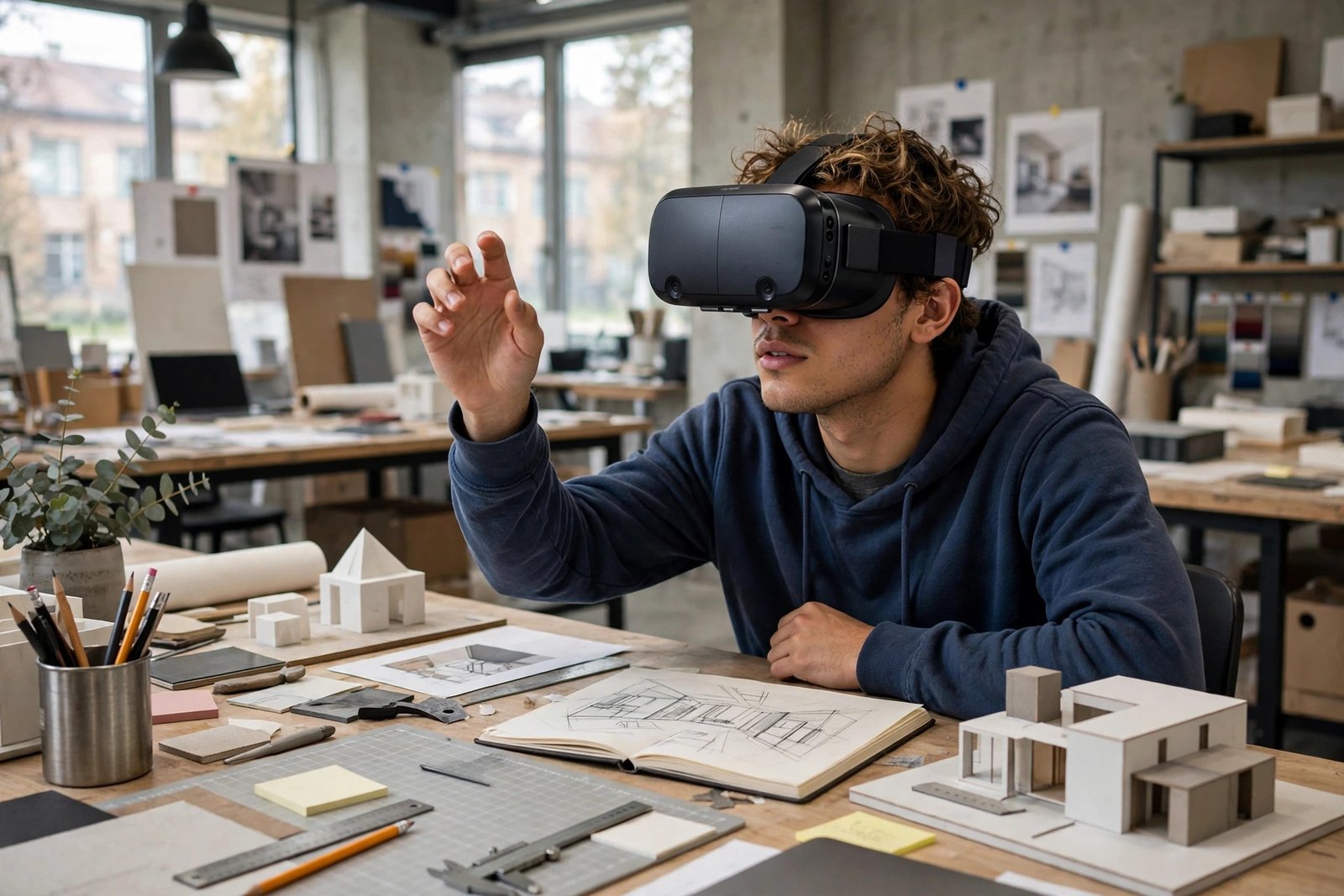
At a Glance: MS in Augmented and Virtual Reality
| Feature | Typical position |
|---|---|
| Degree level | Master’s degree, usually MSc, MS or MA depending on whether the programme leans technical or design-led |
| Typical duration | 1 year in the UK; 1.5 to 2 years in the USA, Canada, Australia and much of Europe |
| Background expected | Computer science, engineering, design, media technology, or a related field with programming or design evidence |
| Core subjects | Real-time graphics, computer vision, tracking, spatial interaction, user experience, 3D design, human perception |
| Key skills on graduation | Unity or Unreal, C# or C++, shader and graphics basics, 3D modelling, interaction design, user testing |
| Portfolio | Very important; working demos, videos and design case studies matter more than grades alone |
| Common destinations | Games and entertainment, training and simulation, healthcare, product design, architecture, research |
The technical versus design balance is the most important distinction between programmes. A computer-science-hosted programme will emphasise graphics, vision, tracking and systems. A design-hosted programme will emphasise experience design, storytelling, spatial design and user research. Both are valid, and many strong programmes combine the two, but they lead to different first jobs. A technical programme leads more naturally to AR and VR engineering roles; a design programme leads more naturally to experience design, interaction design and creative technology roles. Read the module list and the graduate destinations before you choose, and do not assume two degrees with similar titles teach the same thing.
What You Study in an MS in Augmented and Virtual Reality
Real-time graphics is the technical foundation. You will study how three-dimensional scenes are rendered at the frame rates that immersive systems demand, usually 72 frames per second or higher, and why that constraint changes every design decision. A film renderer can take minutes per frame; a VR renderer cannot. You will learn shading, lighting, optimisation, level-of-detail techniques and profiling, so that an experience stays smooth on a headset with limited computing power. Students who arrive with graphics or engine experience settle in quickly; students without it should expect a steep first semester and should prepare with introductory graphics and engine tutorials before starting.
Computer vision and tracking are what make AR and VR feel grounded in the real world. A headset must know where it is, where your hands are, and where real surfaces lie, all in real time and without noticeable delay. You will study simultaneous localisation and mapping, object recognition, hand and eye tracking, and sensor fusion, which combines cameras, inertial sensors and depth sensors into a single consistent estimate of position. These topics draw on linear algebra, geometry and probability, and they are where the degree becomes genuinely engineering rather than purely creative. A demo that tracks well in a controlled room but fails in a bright, cluttered workshop has not yet solved the real problem.
Human perception and interaction design are what separate a usable immersive experience from a tech demo. You will study how people perceive depth, motion and scale, why some users feel motion sickness in VR and how to reduce it, and how interaction techniques such as gaze, gesture, voice and controllers compare for different tasks. You will learn to prototype quickly, test with real users, observe where they struggle, and iterate. This user-centred loop is essential, because immersive design has fewer established conventions than web or mobile design. A programme that teaches you to test honestly, including reporting negative results, is teaching you a professional skill, not just an academic one.
Spatial design and 3D content creation form the creative core. You will learn 3D modelling, texturing, lighting and animation, sound design for spatial audio, and narrative or instructional design for immersive spaces. Sound deserves emphasis: in VR, spatial audio tells users where things are and what to attend to, and poor audio breaks immersion faster than a slightly imperfect texture. Some programmes add courses in virtual production, digital twins, haptics, or wearable and display hardware. Others add entrepreneurship, project management or ethics, including privacy, data protection and accessibility in immersive systems, which matter because headsets collect unusually sensitive data about movement, gaze and surroundings.
Assessment is usually project-based, with individual and group projects, a portfolio and a dissertation or capstone. Group projects are particularly important because AR and VR work is collaborative by nature: engineers, designers, artists and domain experts, such as clinicians or engineers, must work together. A strong capstone is a working immersive application with a video demo, a design rationale, user-testing evidence and a code or design repository. Keep your demos short, clear and honest. A two-minute video that shows a real user completing a real task is more convincing than a ten-minute showreel of untested features.
Eligibility and Entry Requirements
Most programmes ask for a bachelor’s degree in computer science, engineering, design, media technology or a related field, with a good grade average. The acceptable background is broader than for many technical master’s degrees, because AR and VR teams themselves are interdisciplinary. What matters is evidence in one of the two main directions: programming ability, shown through code and engine projects, or design ability, shown through a design portfolio. Applicants who can show both have an advantage, but few applicants arrive with both fully developed, and programmes expect you to strengthen the weaker side during the degree.
Grade thresholds follow the usual country patterns. In the United Kingdom, a 2:1 or equivalent is typical, with some programmes accepting a 2:2 alongside a strong portfolio or relevant experience. In the United States, a grade point average around 3.0 on a 4.0 scale is a common baseline, with competitive programmes expecting more. In Canada, Australia and Germany, universities apply their own grade conversions, so check the official conversion for your degree. Work experience in games, media, software or design helps, especially for design-led programmes, but it does not replace the portfolio.
The portfolio is decisive in this field. It should show working experiences, not only images. Include videos of people using your applications, links to builds or code where possible, and a short case study for each project: the problem, your role, the design decisions, the user testing and what you would change. If you do not have access to a headset, build for phone-based AR or for desktop 3D first; admissions teams judge the thinking and the execution, not the price of your hardware. Include at least one project that involved real users, even if the testing was informal, because user testing is central to the degree.
English language requirements follow the standard pattern for English-taught programmes, with IELTS, TOEFL or equivalents and thresholds set by each university. Some United States programmes ask for the GRE, but many have moved away from requiring it in computing and design, so check each programme. Your statement of purpose should name the kind of immersive work you want to do, whether games, training, healthcare, design or research, and connect it to projects you have built and modules you want to take. Recommendation letters should come from people who have seen your technical or design work and can comment on specific projects.

Tuition Fees and Living Costs
Tuition fees for AR and VR master’s degrees vary widely by country, institution and whether the programme is hosted by a computer science, engineering or design school. Public universities in Germany commonly charge no tuition for many programmes, with a semester contribution instead, while universities in the United States charge per year at levels that differ sharply between public and private institutions. International fees in the United Kingdom, Canada and Australia sit between those extremes but still vary widely within each country. There is no reliable single average, so build your shortlist first and record the official 2026 or 2027 fee for each programme from the university’s own page, noting whether it covers one year or the whole programme.
Living costs and visa financial requirements are separate from tuition. The table below uses financial-proof figures from our verified guides, giving a comparable floor across countries. Real costs in London, San Francisco, Sydney or Vancouver will exceed the floor, and rent is usually the largest item. Model your own total with the tuition fee calculator and the cost of living calculator. Also budget for hardware if your programme expects you to own a headset or a capable computer, and check whether the university provides lab access instead.
| Country | Financial proof or maintenance figure to note (2026) | What it means for your budget |
|---|---|---|
| United Kingdom | GBP 1,529 per month in London; GBP 1,171 per month outside London for a Student visa | Maintenance floor only; London costs run higher |
| Germany | EUR 11,904 blocked account for one year | Low-cost route at public universities, but funds must be locked in advance |
| Australia | AUD 29,710 living costs figure for a student visa | A floor for the visa; Sydney and Melbourne rents run higher |
| Canada | CAD 22,895 rising to CAD 23,448 for a study permit financial requirement | Check which figure applies to your application date; tuition is additional |
| United States | Varies by university; the I-20 form states the total you must show | Read the I-20 figure; it bundles tuition, living costs and insurance |
Funding comes from the usual mix: university merit scholarships, government scholarships, departmental awards and, in the United States and Canada, graduate assistantships. Industry-linked scholarships and internships are also relevant in this field, because games, technology and manufacturing companies run immersive teams and sometimes sponsor students or offer paid placements. Start the scholarship search alongside the programme search, because many awards close before programme deadlines. Use the scholarship finder and browse scholarships for the wider list.
Top Universities and Countries for Augmented and Virtual Reality
The United States has the largest AR and VR industry presence, with technology companies, games studios and research groups in California, Washington and other technology hubs, and with university programmes that combine graphics, vision and interaction research. The trade-off is cost and a competitive post-study work process. When you compare United States programmes, look at industry connections, internship records, laboratory facilities and graduate destinations, not only at general reputation. A programme with a working immersive lab and regular industry projects is worth more than a programme that teaches AR and VR only in lectures.
The United Kingdom offers one-year master’s degrees and a strong games, media and creative technology sector, with London and other creative hubs hosting studios and research groups. The Graduate Route currently allows a period of work after study, although an announced change would shorten that route to 18 months from 1 January 2027, so check the rules that will apply when you graduate. Canada offers strong computer science and design programmes, a large games presence in Montreal, Toronto and Vancouver, and a post-graduation work permit system that many students value. Germany offers low-cost public education and strong engineering, with English-taught programmes available, although you should check the language of each module.
Australia offers strong universities and a growing games and creative technology sector, centred on Sydney and Melbourne. When you compare countries, weigh the programme’s laboratory access, the sectors its graduates enter, and the post-study options. A programme near games studios suits a student aiming for entertainment; a programme linked to hospitals, engineering firms or architecture practices suits a student aiming for applied immersive work. Browse the directory at universities, compare options with the university comparison tool, and keep ranking providers separate on rankings, since QS and THE use different methods.
For neighbouring degrees, the MSc Computer Science profile and the Courses and Programs directory are useful comparisons. If you are torn between AR and VR and computer graphics, compare their module lists: graphics goes deeper into rendering algorithms, while AR and VR goes deeper into tracking, interaction and user experience. The right choice depends on whether you want to build the rendering engine or the experience that runs on it.
Careers and Salaries After an MS in Augmented and Virtual Reality
Graduates enter roles that span engineering, design and applied sectors. AR and VR engineers build applications and systems in engines such as Unity or Unreal. Interaction designers and UX designers for immersive systems design how users move, select, manipulate and learn in three-dimensional spaces. Technical artists bridge engineering and art, optimising assets and building tools. In applied sectors, graduates become simulation and training developers in healthcare, aviation, manufacturing and defence, visualisation specialists in architecture and product design, and creative technologists in media and marketing. Research roles in universities and company laboratories are also open to strong graduates, often as a route towards a PhD.
There is no official occupational category called AR and VR engineer in the United States Bureau of Labor Statistics data, so this article does not invent a salary for that title. The table below gives medians for the closest official occupations, all from the same official source and labelled with their year. Use them as pay context for the software, design and research roles that AR and VR graduates enter, not as promised salaries for AR and VR graduates specifically. A new graduate should expect to start below the median for an occupation, because the median describes all workers in that occupation, including experienced staff.
| Closest official occupation (USA) | Median annual pay | Source and year |
|---|---|---|
| Software developers, quality assurance analysts and testers | $134,040 per year | BLS Occupational Outlook Handbook, 2025 median |
| Special effects artists and animators | $102,030 per year ($49.06 per hour) | BLS Occupational Outlook Handbook, May 2025 median |
| Graphic designers | $62,960 per year ($30.27 per hour) | BLS Occupational Outlook Handbook, May 2025 median |
| Computer and information research scientists | $140,300 per year | BLS Occupational Outlook Handbook, May 2025 median |
The spread in that table reflects the skill mix again. Engineering-heavy roles sit closest to software development and research medians, while design-heavy roles sit closer to design medians. Graduates who combine both, for example an engineer who can prototype an experience and test it with users, or a designer who can build a working prototype in an engine, tend to have the widest options. The Bureau of Labor Statistics projects little or no change in employment of special effects artists and animators from 2025 to 2035, which is a reminder to build transferable skills and to judge a sector by its openings from replacement as well as growth.
A realistic career plan starts with shipping. During the degree, build two or three working experiences that real users have tried, and document them with videos, case studies and code or design repositories. In the first years after graduation, aim for a role where you ship regularly, whether in games, training, healthcare or product design, and keep learning the engine, graphics and interaction skills that underpin the work. Specialise later, whether in interaction design, technical art, simulation, or immersive systems engineering. Explore roles with the career path explorer, and treat freelance immersive work as a later option once you have shipped work and contacts, rather than as a first step for most international graduates.
Scholarships for Augmented and Virtual Reality Students
Scholarships in this field come from universities, governments and industry, and the strongest applications show working projects. Check departmental and university merit scholarships at each programme on your shortlist, including awards for international students and for computing or design students. Check government schemes where you are eligible, and check industry-linked awards from games, technology and manufacturing companies. A portfolio with working demos and user-testing evidence helps scholarship applications as much as it helps programme applications, because it shows that you can deliver, not only that you can describe an idea.
Keep a spreadsheet of deadlines, required documents and reference requests, and submit in order of scholarship deadline rather than programme deadline. If an award asks for a project proposal, propose something you can build and test in the time available, with a clear user, a clear task and a clear evaluation plan. Vague proposals about the future of the metaverse are less convincing than a specific plan to build and test a training application for a defined task.
How to Choose and Apply: A Practical Plan
Start twelve to eighteen months before your intended start date. In the first months, build or refresh your portfolio with at least one working AR or VR project, even a small one, and shortlist eight to twelve programmes across at least two countries. In the middle months, sit any required language tests, request references early, and draft a statement of purpose that you adapt for each programme’s technical or design leaning. In the final months, submit applications in order of scholarship deadline and prepare financial documents early, because blocked accounts, bank statements and sponsor letters take time.
When offers arrive, compare them on the same basis: total cost for the whole degree, laboratory and headset access, the modules you will actually take, group project and capstone options, internship support, and graduate destinations. Ask current students whether they built working experiences, whether they tested them with real users, and where graduates work now. A programme that leaves you with three tested, documented projects is a stronger outcome than a programme that leaves you with lecture notes alone, whatever its name.
Frequently Asked Questions
Do I need a headset to apply for an AR and VR master’s degree?
No. Admissions teams judge your thinking and execution, not your hardware. Phone-based AR, desktop 3D and engine projects without a headset all count as evidence. If you can borrow a headset for one project, that helps, but it is not a requirement, and many strong applicants build their first projects without one.
Should I learn Unity or Unreal?
Learn one well and understand the other at a basic level. Unity, with C#, is widely used for AR, mobile and training applications and has a lower entry barrier. Unreal, with C++, is widely used for high-end games and virtual production and offers powerful graphics features. Check which engine your shortlisted programmes use, and align your portfolio accordingly.
Is AR and VR a good choice if I am more interested in design than programming?
Yes, if you choose a design-led programme and build a design portfolio with working prototypes and user-testing evidence. You will still need to understand engines and technical constraints, because immersive design without technical understanding produces concepts that cannot be built. The strongest designers in this field can prototype their own ideas.
What causes motion sickness in VR, and can it be designed around?
Motion sickness in VR is linked to mismatches between visual motion and the body’s sense of movement, as well as to frame rate, latency and locomotion design. Designers reduce it through comfortable locomotion options, stable frame rates, rest frames, vignetting during movement and careful camera control. Programmes teach these techniques and expect you to test them with users rather than assume they work.
Can AR and VR graduates work outside games and entertainment?
Yes. Training and simulation, healthcare, architecture, manufacturing, education and product design all hire immersive developers and designers. Applied sectors often offer steadier work than entertainment, although they may require domain knowledge, such as clinical workflows or engineering processes, which you build on the job and through project work.
Is a one-year UK master’s enough for an AR and VR career?
Yes, for students who arrive with a portfolio and relevant skills, because the degree is intensive and project-based. It leaves less time for internships, so use placement support and the summer aggressively. If you need more time to build technical or design skills, a two-year programme may suit you better.
Will AI replace AR and VR designers and developers?
AI tools are changing asset creation and prototyping, but they do not replace the judgement needed to design comfortable, usable immersive experiences or to build systems that track reliably in the real world. Graduates who understand graphics, tracking, interaction and user testing, and who can ship working systems, remain valuable as tools change.
What should my portfolio include?
Two or three working projects, each with a short video of a real user completing a task, a case study explaining the problem, your role, design decisions and user testing, and a code or design link where possible. Include at least one team project if you have one, and remove weak work so that the strong work stands out.
Sources & Verification
Salary figures come from the United States Bureau of Labor Statistics, Occupational Outlook Handbook: Software Developers, Special Effects Artists and Animators, Graphic Designers, and Computer and Information Research Scientists, all cited with their 2025 or May 2025 medians. No official salary figure exists for a standalone AR and VR engineer occupation, so none is invented here; the table gives the closest official occupations instead. Visa maintenance and financial-proof figures follow the verified figures used across StudyGraduate guides for the United Kingdom, Germany, Australia and Canada. University fees, grade conversions, language thresholds and module lists must be confirmed on the official university page for the intake you are applying to. Figures change yearly — confirm fees and requirements on the official university page.
StudyGraduate is an information portal, not an agency. This article does not promise admission, jobs, salaries or visa or permanent residence outcomes. Verify every requirement, fee and deadline with the university and the relevant government authority before you apply or pay any fee.