
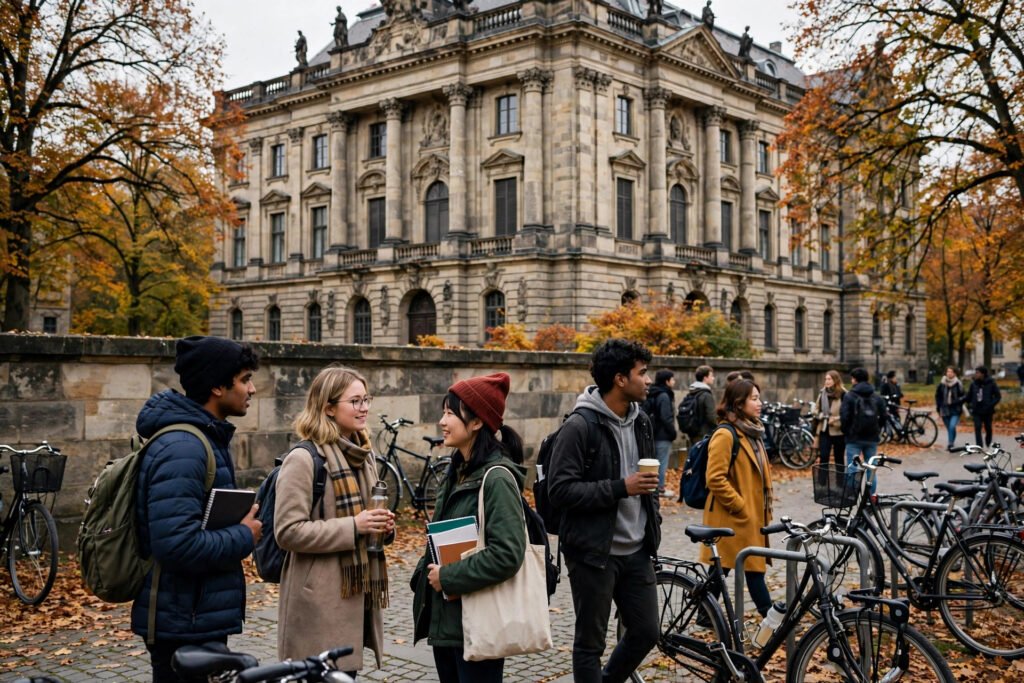
Germany vs Canada for International Students 2026: Low Tuition vs PR Pathway
Germany and Canada attract international students for almost opposite reasons. Germany’s appeal is price: most public universities charge no tuition, and a well-prepared student can complete a respected degree for little more than living costs. Canada’s appeal is pathway: an English-taught degree, a Post-Graduation Work Permit of up to three years, and a permanent residence system that openly rewards Canadian study and work experience. Comparing them honestly means comparing two different strategies — minimise what you spend while you study, or invest more for a clearer settlement route afterwards. This guide sets out the verified 2026 figures for both: tuition and semester costs, the German blocked account versus Canadian proof of funds, visa and permit processes, language realities, work rights, and post-study options, so you can decide which strategy fits your budget and your goals.
This comparison is for students planning 2026 and 2027 intakes, including applicants from Bangladesh, India, Pakistan, Nepal, Nigeria and Indonesia. A warning before the detail: both countries changed important rules recently. Canada ended its Student Direct Stream (SDS) in November 2024, introduced and then refined attestation-letter requirements, and set a national study permit cap; Germany’s low-tuition model still has exceptions, including fees for non-EU students in Baden-Württemberg and at TU München. Any comparison that ignores those updates is out of date. You can shortlist institutions in both countries through our university directory and check how they place in our rankings explorer as you read.

Germany vs Canada at a Glance
| Factor | Germany | Canada |
|---|---|---|
| Tuition at most public institutions | No tuition (semester contribution only); exceptions apply | Average undergraduate CAD 41,746/year; average graduate CAD 24,028/year (Statistics Canada, 2025/26) |
| Key tuition exceptions | Baden-Württemberg: €1,500/semester for non-EU students; TU München charges non-EU fees since 2024/25; private universities charge full fees | Fees vary by institution and programme; colleges generally cheaper than universities |
| Proof of living funds | Blocked account €11,904 for one year (2026) | CAD 22,895 living funds (applications to 31 Aug 2026); CAD 23,448 from 1 Sep 2026 — plus tuition |
| Permission to study | Student visa / residence permit; blocked account is the standard funds evidence | Study permit, fee CAD 150; PAL/TAL required for most applicants, with exemptions |
| 2026 volume control | No national cap | National cap of 408,000 study permits for 2026 |
| Work during study | Permitted within residence-permit limits for students (commonly 140 full days or 280 half days per year — confirm your permit) | Off-campus work up to 24 hours/week during term |
| Post-study route | 18-month job-seeker residence permit, then a work permit route | PGWP up to 3 years; then PR routes including Express Entry / Canadian Experience Class and PNPs |
| Language of instruction | Many master’s in English; most bachelor’s in German; daily life needs German | English (or French) throughout study and daily life |
The single most important line in that table is tuition. A two-year master’s at a tuition-free German public university can cost less in total tuition than a single semester in Canada. But the single most important line for settlement-minded students is the post-study row: Canada’s PGWP plus Express Entry is a structured, points-based pathway, while Germany’s route runs through finding qualified employment and converting your permit — entirely achievable, but it rewards German language ability far more. Neither advantage cancels the other; they suit different students.
Tuition and the Real Cost of the Degree
Germany: low tuition, not no cost
Most German public universities charge no tuition fees for consecutive bachelor’s and master’s programmes, including for international students. What you pay instead is a semester contribution (Semesterbeitrag) — typically a few hundred euros per semester — which covers administration and often a public transport ticket. The exceptions matter and must be checked course by course: the state of Baden-Württemberg charges non-EU/EEA students €1,500 per semester; Technische Universität München introduced tuition fees for non-EU students from 2024/25, with amounts varying by programme; non-consecutive and continuing-education master’s may charge fees anywhere in Germany; and private universities charge market-rate tuition in both countries’ terms. A profile such as TU Berlin on StudyGraduate shows the standard Berlin model — no tuition, semester contribution only — but always confirm the fee status of your exact programme on the university’s own page, because the exception list is growing.
Living costs are the real German budget. The blocked account figure of €11,904 per year (equivalent to €992 per month) is the amount the authorities require you to evidence; students in expensive cities such as Munich, Hamburg or Frankfurt may spend more, while smaller university towns can be cheaper. Rent is the swing factor in both Germany and Canada, so price your specific city, not the national figure.
Canada: high tuition, priced in advance
Canadian tuition is substantial and programme-specific. Statistics Canada’s published averages for 2025/26 are CAD 41,746 per year for international undergraduates and CAD 24,028 per year for international graduate students — averages, not quotes: professional programmes sit well above them and some colleges and universities sit below. A two-year Canadian master’s can therefore carry tuition alone in the region of CAD 48,000 at the average graduate rate, before living costs. The counterweight is that you study entirely in English (or French), graduate into a labour market that recognises your credential without a language conversion problem, and become eligible for the PGWP. Use our study abroad budget planner to model both degrees over their full length before you compare headlines.
Visas, Permits and Proof of Funds
Germany: admission, blocked account, residence permit
The German route has three pillars: a recognised qualification and admission (often assessed through uni-assist for international applicants), proof of funds — normally a blocked account holding €11,904 for the first year — and a student visa and then residence permit. The blocked account releases your money to you monthly after arrival; it is your own money, not a fee. Funds can in some cases be evidenced by other official means (such as a formal obligation declaration by a sponsor in Germany or certain scholarships), but the blocked account is the standard route most applicants from outside the EU use. Our step-by-step Germany student visa guide walks through the documents and interview, and the DAAD’s official DAAD website is the authoritative starting point for programme search and requirements. Note: do not rely on older DAAD financing pages that still show outdated blocked-account amounts — the 2026 figure is €11,904.
Canada: study permit, attestation letters and the cap
Canada’s study permit application fee is CAD 150. For living expenses (in addition to your first year of tuition and travel), Immigration, Refugees and Citizenship Canada (IRCC) requires CAD 22,895 for applications up to 31 August 2026, rising to CAD 23,448 for applications from 1 September 2026. Most applicants also need a Provincial or Territorial Attestation Letter (PAL/TAL) confirming their place within the cap allocation — but from 1 January 2026, master’s and doctoral students at public designated learning institutions are fully exempt from the PAL/TAL requirement. Canada’s national cap for 2026 is 408,000 study permits, so undergraduate and college applicants should apply early in their province’s allocation cycle. The SDS ended in November 2024: there is no longer a separate fast stream with different funds rules, and any service still selling “SDS applications” is describing a closed programme. Full rules are on the official IRCC study permit pages on Canada.ca.
Costs and Fees Table
| Cost item | Germany | Canada |
|---|---|---|
| Tuition (typical public route) | €0 (semester contribution only, a few hundred euros/semester) | UG average CAD 41,746/yr; graduate average CAD 24,028/yr (2025/26) |
| Known tuition exceptions | Baden-Württemberg €1,500/semester (non-EU); TU München non-EU fees; private universities full fees | Professional and high-demand programmes above average; college programmes often below university averages |
| Permission fee | Visa/residence permit fees are modest; check your consulate and local foreigners’ office | Study permit CAD 150 |
| Living funds to evidence | Blocked account €11,904 (one year) | CAD 22,895 (to 31 Aug 2026) / CAD 23,448 (from 1 Sep 2026), plus first-year tuition |
| Application-stage extras | uni-assist fees where applicable; document translation/certification; blocked account setup | Biometrics, medical exam where required, PAL/TAL process where applicable |
| Scholarship landscape | DAAD scholarships (competitive, mostly postgraduate/research); limited university aid | University entrance scholarships and awards; government schemes are limited and competitive — see our scholarship directory |
Read the table as two philosophies. Germany asks you to prove you can support yourself (€11,904 locked in advance) but then charges almost nothing to teach you. Canada charges you heavily to teach you, requires similar living-funds proof on top of tuition, but then gives you a defined work-permit bridge into its immigration system. Students with limited upfront capital usually find Germany the only realistic of the two; students funded by family savings or loans who prioritise settlement often judge Canada’s total cost against lifetime earnings in Canada, not against Germany’s fees.

Language: The Hidden Decider
Germany’s English-taught offering is real but uneven by level. At master’s level, especially in engineering, computer science, natural sciences and business, there is a wide choice of English-taught programmes. At bachelor’s level, most public-university programmes are taught in German, and applicants usually need German at a high level (commonly C1 for direct entry, with preparatory routes through a Studienkolleg for recognised-but-not-equivalent school qualifications). Even on an English-taught programme, German determines your daily life: tenancy contracts, registration appointments, part-time jobs outside the university bubble and, above all, the graduate job market. Many international graduates in Germany will tell you the same thing — the degree was in English, but the career was in German. Treat German study as part of the degree, starting before you arrive, and the low-tuition advantage compounds. Ignore it, and you may graduate qualified but unemployable in your host country.
Canada has no equivalent catch. Instruction is in English or French, part-time and graduate jobs expect the language you already study in, and immigration rewards official-language ability you can demonstrate through standard tests. For students whose long-term plan requires working in English from day one — and who cannot invest two to three years in reaching professional German — this is a genuine, rational reason to pay Canada’s higher price.
Work Rights During Study
In Canada, eligible study permit holders may work off campus up to 24 hours per week during the academic term (and full-time during scheduled breaks, under the conditions on their permit). Work must not begin before your programme starts, and you must remain a genuine full-time student at a designated learning institution. In Germany, international students’ employment is governed by their residence permit; the standard student allowance is commonly expressed as 140 full days or 280 half days per year, with student-assistant jobs at the university treated separately — but you must confirm the exact condition attached to your own permit, because your employment rights are printed there, not in a guide. In both countries, part-time earnings should be treated as a contribution to living costs, never as the funding plan your visa was granted on, and in both countries exceeding your permitted work is a status violation with consequences far beyond the extra income.
Post-Study Work and Permanent Residence
Canada: PGWP, then a points-based PR system
The Post-Graduation Work Permit allows eligible graduates to work in Canada for up to 3 years, with the length depending on your programme and level: master’s graduates can qualify for a 3-year PGWP even from shorter programmes under current rules, while other programmes generally map PGWP length to programme length. Two refinements matter for 2026 applicants. First, the field-of-study requirement applies only to non-degree college programmes for applications on or after 1 November 2024 — bachelor’s, master’s and doctoral graduates are exempt from it. Second, language thresholds apply at PGWP stage: CLB 7 for degree graduates and CLB 5 for other college graduates. After gaining skilled Canadian work experience, many graduates become competitive for permanent residence through the Canadian Experience Class within Express Entry or through a Provincial Nominee Program. None of this is automatic — you still need qualifying employment, language scores and enough points at the time you apply — but the pathway is explicit and designed for former students. Our dedicated Canada PGWP guide explains eligibility in full, and IRCC’s official PGWP pages carry the current rules.
Germany: 18 months to find qualified work
After graduating in Germany, you can obtain an 18-month residence permit to seek employment appropriate to your qualification. During that period you may work in any job while you search. Once you secure a position matching your degree, you convert to a work residence permit (including the EU Blue Card where salary and qualification thresholds are met), and time on those permits builds towards settlement eligibility under German law. There is no points competition and no cap on conversions — the bottleneck is the job offer itself, which loops back to language: engineering and IT roles in international firms may operate in English, but the wider German labour market, including the Mittelstand companies that hire heavily outside the big cities, works in German. Germany also offers a separate points-based opportunity card (Chancenkarte) for jobseekers who have not studied in Germany; it is not a substitute for the graduate route, but it shows the direction of German policy — qualified migration is wanted, and German graduates are well placed within it.
Admissions Practicalities
German admission turns on recognition: whether your school-leaving or bachelor’s qualification is judged equivalent, whether you need a Studienkolleg year or subject tests, and whether your programme requires German, English or both. Apply early — credential evaluation through uni-assist and visa appointments in high-demand consulates both take time, and a tuition-free place you cannot reach because your visa appointment came after enrolment is worth nothing. Canadian admission turns on capacity: with a national cap of 408,000 permits for 2026 and PAL/TAL allocations managed by province, timing and province choice affect your chances for undergraduate and college study, while master’s and doctoral applicants at public institutions benefit from the PAL/TAL exemption from January 2026. In both countries, scholarships exist but will not fund the median student: DAAD awards are prestigious and competitive, and Canadian university awards typically reduce rather than remove tuition. Search both routes in parallel, but fund your plan on money you actually have.
Student Life and Working Culture
Daily experience differs as much as the paperwork. German student life is independent and city-based rather than campus-based: most universities do not operate large residential campuses, students rent rooms in shared flats (Wohngemeinschaften, or WGs) or student residences run by the local Studierendenwerk, and the semester ticket makes regional transport simple and cheap. Canteens (Mensen) serve subsidised lunches, and student status brings discounts across cultural life — but you arrange almost everything yourself, in German, through offices and appointments. Students who thrive in Germany are self-organised and comfortable building a social life beyond the university.
Canadian student life is more campus-centred, especially at larger universities: residences, meal plans, clubs societies and varsity sport are built into the institution, and part-time campus employment is common. Winters are a genuine practical factor in most provinces — budget for proper clothing and expect transport and heating costs to shape your monthly spending — while Germany’s winters are milder but its rental markets in cities such as Munich, Berlin and Hamburg are intensely competitive, so housing searches should start the moment you accept an offer in either country. In both destinations, the students who settle fastest join structured communities early: university societies, faith and cultural associations, sports clubs and volunteering. Neither country requires you to use an agent for any of this, and you should be wary of anyone charging for access to ordinary student housing lists or public immigration information.
Common Mistakes
Assuming “Germany is free” means no money is needed. You still need €11,904 in a blocked account, plus setup, travel, deposits and the gap between the official monthly figure and real rents in major cities.
Missing Germany’s tuition exceptions. Baden-Württemberg’s €1,500 per semester and TU München’s non-EU fees catch students who researched only national headlines. Check your exact university and programme.
Applying to Canada under SDS rules. SDS closed in November 2024. Funds evidence, processing expectations and documentation now follow the regular study permit route.
Misreading the PGWP field-of-study rule. It applies to non-degree college programmes, not to bachelor’s, master’s or doctoral graduates. College applicants must check that their programme’s field is eligible; degree applicants should not wrongly rule themselves out.
Choosing Canada for PR without checking points reality. A PGWP is time to qualify, not a PR grant. Model your likely Express Entry score with realistic language results and one year of skilled work before you commit to the cost.
Choosing Germany without a German-language plan. Budget time and money for language courses from semester one; your post-study 18 months is far more valuable at B2–C1 German than at A2.
Practical Tips
- Run a four-year honest budget for both. Include tuition, living costs, permit fees, insurance and flights, and compare total cash required before graduation, not per-year headlines. Our guides hub links the full cost guide for each country.
- If funds are tight, start German now. Even six months of language study before applying widens your programme choice (including German-taught bachelor’s) and improves your visa credibility.
- If settlement is the priority, protect your PGWP. Study full-time, keep your programme and institution eligible, and plan your language test for the CLB threshold that applies to your level.
- Apply earlier than feels necessary in both systems. Germany: credential checks and visa appointments. Canada: cap allocations and PAL/TAL processing. Early, complete applications beat late, perfect ones.
- Keep documents consistent across countries if you apply to both. Funds narratives, study gaps and programme choices that contradict each other damage credibility in both systems.
Frequently Asked Questions
Is studying in Germany really free for international students?
At most public universities, tuition is zero and you pay only a semester contribution. But there are exceptions: Baden-Württemberg charges non-EU students €1,500 per semester, TU München charges non-EU fees, and private universities and some non-consecutive master’s charge full fees. You must also fund living costs, evidenced by a €11,904 blocked account.
How much money do I need for a Canadian study permit in 2026?
On top of your first-year tuition, IRCC requires living funds of CAD 22,895 for applications up to 31 August 2026, rising to CAD 23,448 from 1 September 2026. The study permit fee itself is CAD 150. Most applicants also need a PAL/TAL, though master’s and doctoral students at public DLIs are exempt from 1 January 2026.
Can I still apply to Canada through SDS?
No. The Student Direct Stream ended in November 2024. All applicants now use the regular study permit process, with the funds figures and attestation rules described in this guide. Anyone advertising an SDS application in 2026 is describing a closed programme.
How long can I stay after graduating in each country?
In Canada, the PGWP lasts up to 3 years depending on your programme and level. In Germany, graduates receive an 18-month job-seeker residence permit, converting to a work permit once they find a job matching their qualification. Canada’s route then connects to Express Entry and PNP permanent residence; Germany’s connects to work permits and settlement through employment.
Does the PGWP field-of-study rule affect master’s students?
No. The field-of-study requirement applies only to non-degree college programmes (applications on or after 1 November 2024). Bachelor’s, master’s and doctoral graduates are exempt, though language thresholds still apply: CLB 7 for degree graduates and CLB 5 for other college graduates.
Do I need German to study in Germany?
For many master’s programmes, no — they are taught in English. For most bachelor’s programmes, yes, at a high level. And for daily life, part-time work and the graduate job market, German is a decisive advantage in almost every case. Plan to learn it even for an English-taught degree.
Which country is better if my budget is very limited?
Germany, provided you can fund the €11,904 blocked account and your living costs. Canada’s average tuition alone (CAD 41,746 undergraduate / CAD 24,028 graduate per year) puts it out of reach for most low-budget students without substantial funding. Compare funded offers, not list prices, if you receive a major Canadian scholarship.
Sources & Verification
- DAAD (German Academic Exchange Service) — official information on studying in Germany, programme search and scholarships.
- German Federal Foreign Office and university programme pages — blocked account amount (€11,904 for 2026), Baden-Württemberg and TU München fee rules, 18-month post-study job-seeker permit.
- Immigration, Refugees and Citizenship Canada (Canada.ca) — study permit fee, proof-of-funds figures and dates, PAL/TAL rules and exemption, 2026 cap, PGWP eligibility, field-of-study and language rules.
- Statistics Canada — 2025/26 average international tuition fees.
Figures and rules change — always confirm on the official government and university websites before applying.
Disclaimer: StudyGraduate is an information portal, not a visa agency, consultancy or education agent. This guide is general information only and is not immigration or financial advice. We never promise or guarantee admission, a scholarship, a job or a visa or permanent-residence outcome. Check your eligibility on the official sources above and consider regulated professional advice for your individual circumstances.