

Most In-Demand Courses to Study Abroad in 2027: Subjects With the Strongest Job Demand
“In demand” is the most abused phrase in study-abroad marketing. It is used to sell almost any course, usually without a source, a country, a date or a definition. This guide uses the phrase strictly. A course is treated as in demand here only where an official source supports the claim: a U.S. Bureau of Labor Statistics (BLS) employment projection with a percentage and a period, a BLS count of projected annual openings, or an official shortage-occupation framework such as Jobs and Skills Australia’s Occupation Shortage List and Australia’s Core Skills Occupation List. Where no official evidence is cited, the article says so and describes the field qualitatively instead of inventing demand.
That discipline matters because demand has three different meanings that are often blurred. Fast percentage growth can belong to a small occupation with few actual jobs. A large number of annual openings can belong to a slower-growing occupation with a huge workforce and heavy replacement need, such as nursing. And a shortage listing can reflect regional or licensing bottlenecks rather than national abundance. A smart applicant for 2027 reads all three signals together, then asks the personal questions: Am I eligible for this course, can I complete it well, is the occupation regulated, and will my post-study work permission in that country give me time to enter it?
This guide is built around the BLS 2025–35 projections, the most recent complete set published in the Occupational Outlook Handbook at the time of writing, with May 2025 medians. Those are United States projections. They are a strong signal of where a large advanced economy expects demand, and many of the drivers — ageing populations, digitalization, cyber risk, data growth, automation and health-system pressure — operate in Canada, the UK, Australia and Germany as well. They are not a forecast for any other country, and this article does not present them as one. For Australia, it adds the official shortage-list context qualitatively. For other countries, verify demand on the official source for that country before you decide.
Start from the full Courses and Programs directory, compare the demand evidence below with the salary and tuition analysis in our guide to the highest-paying degrees in 2026/2027, and use the career path explorer to map a subject to the occupations it actually feeds.

At a Glance: The Strongest Official Demand Signals for 2027 Entry
| Course area | Occupation used as evidence | Projected growth, BLS 2025–35 | Projected openings per year, BLS | Median annual wage, BLS May 2025 |
|---|---|---|---|---|
| Nursing and advanced practice nursing | Nurse practitioners | 41% for nurse practitioners specifically; 36% for the combined APRN group in the Handbook summary | About 29,400 for nurse practitioners in BLS fastest-growing tables | $132,300 for nurse practitioners; $134,920 for the combined nurse anesthetists, midwives and practitioners group |
| Data science and statistics | Data scientists | 35% | About 24,800 | $120,230 |
| Health management and public health leadership | Medical and health services managers | 24% | About 62,300 | $123,860 |
| Cyber security | Information security analysts | 21% | About 14,100 | $129,180 |
| Computer and information research / AI research routes | Computer and information research scientists | About 22% in BLS fastest-growing tables for 2025–35 | About 2,900 — a small occupation | $140,300 |
| Engineering (mechanical example) | Mechanical engineers | 11% | About 17,800 | $104,110 |
| Software development | Software developers, QA analysts and testers | 10% for the group | About 106,100 for the group | $135,980 for software developers |
| Nursing (registered) | Registered nurses | 6% | About 180,800 | $97,550 |
| Accounting and audit | Accountants and auditors | 5% | About 115,300 | $83,680 |
Two lessons fall straight out of that table. First, percentage growth and openings tell different stories: registered nursing grows at only 6%, yet BLS projects about 180,800 openings a year because the workforce is about 3.5 million strong and replacement need is large. Computer and information research science grows fast in percentage terms but projects only about 2,900 openings a year because the occupation is small and usually requires a master’s degree. Second, every median in the right-hand column is a median for all workers in the occupation in May 2025, not a starting salary for a 2027 graduate.
1. Data Science, Statistics and AI-Related Master’s Degrees
Data science carries the clearest technology demand signal in the official data. BLS projects employment of data scientists to grow 35% from 2025 to 2035, much faster than the average for all occupations (3%), with about 24,800 openings per year and a median annual wage of $120,230 in May 2025. BLS explains the growth by increased demand for data-driven decisions and by firms integrating AI-based systems into their workflows, which increases the need for people who can build, validate and explain models and analyses. That is why data science, applied statistics, business analytics with a serious quantitative core, and machine-learning specializations belong at the top of a 2027 demand list — with a condition. The occupation’s typical entry route is at least a bachelor’s in mathematics, statistics, computer science or a related field, and some employers require or prefer a master’s or doctorate, according to BLS. A master’s in data science is therefore most powerful for students whose first degree already contains real mathematics and programming, or for conversion students who do the preparatory work honestly.
For program choice, look at the curriculum before the title. You want probability and statistical inference, linear algebra, programming, databases, machine learning, experimental design, and a substantial project with real data and external scrutiny. Our field guide to the MS in Data Science abroad works through eligibility, fees and careers in that detail, and the MSc Computer Science profile is the adjacent route for students whose strength is computing rather than statistics. AI-specific master’s degrees should be judged even more harshly on fundamentals: a program heavy on tool demonstrations and light on mathematics may age badly by the time you graduate.
2. Cyber Security
Cyber security is in demand on a specific, sourced basis. BLS projects information security analysts to grow 21% from 2025 to 2035, with about 14,100 openings per year and a May 2025 median of $129,180. BLS attributes the demand to the growth in frequency of cyberattacks and to organizations needing to secure new technologies, including increased use of AI and e-commerce. In Australia, cyber security roles such as Cyber Security Engineer have appeared with “Shortage” ratings across states in the Jobs and Skills Australia Occupation Shortage List material — a separate, country-specific signal that should be checked on the current official list for the year you apply, because ratings change and some related roles have moved on and off shortage status.
Entry reality matters. BLS says information security analysts typically need a bachelor’s in a computer science field along with related work experience, and employers may prefer professional certification. So the strongest 2027 courses are those that build the underlying computing first — networks, operating systems, programming, databases — and then specialize, ideally with a lab, internship or placement component. A short, purely theoretical cyber course for a student with no IT background is a weak preparation for an analyst job, whatever its marketing claims.
3. Nursing, Public Health and Health Management
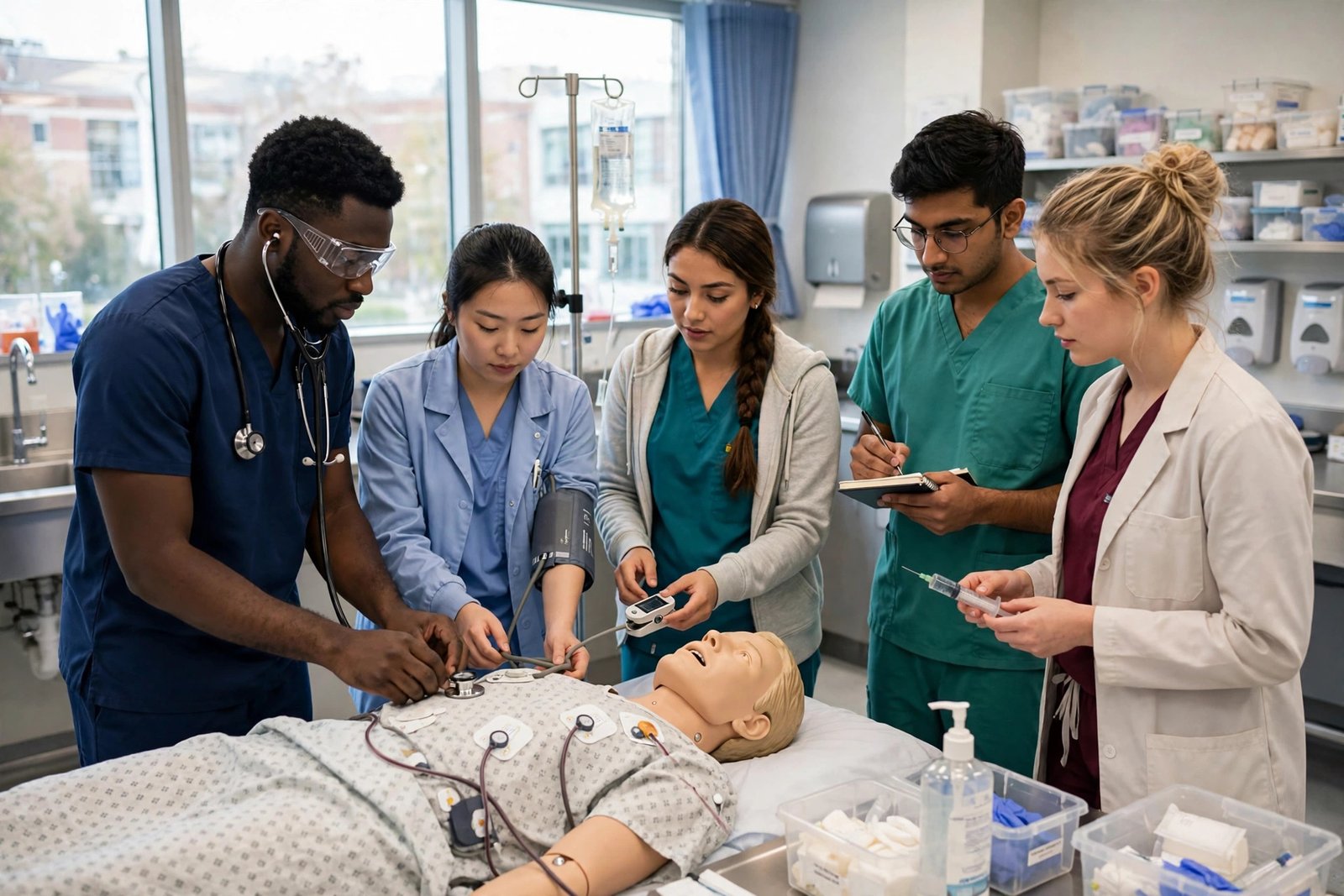
Health is the other great demand engine, and it is driven by demography rather than fashion. For registered nurses, BLS projects 6% growth from 2025 to 2035 but about 180,800 openings per year — the largest absolute openings figure in this article — with a May 2025 median of $97,550. For nurse practitioners, BLS fastest-growing data show 41% projected growth and a 2025 median of $132,300, reflecting expanded roles in team-based care and primary care; advanced practice routes require graduate preparation and licensure. For medical and health services managers, BLS projects 24% growth, about 62,300 openings per year and a median of $123,860 in May 2025.
Public health sits inside this picture in a more specific way. A Master of Public Health does not by itself make you a clinician or guarantee a management job. Its demand value comes from the functions health systems keep needing: epidemiology and outbreak analysis, biostatistics and health data, program evaluation, health policy, and service planning and management. Students with a clinical background, quantitative strength, or health-administration experience can position an MPH toward those growing functions, including the health-management occupation above, which BLS says typically requires a bachelor’s plus experience in an administrative or clinical role. Students without any of those should choose specializations deliberately — data-heavy tracks travel better internationally than purely generalist ones — and should check professional recognition in the country where they hope to work.
Regulation is the governing fact for all clinical courses. Nursing and allied health degrees must satisfy the regulator of the country of intended practice, clinical placement capacity can limit admission, and recognition of an overseas qualification is never automatic. Verify the regulator’s requirements before paying a deposit.
4. Software Development and Computer Science
Software remains a large-demand field even though its headline growth rate is lower than data science. BLS projects overall employment of software developers, quality assurance analysts and testers to grow 10% from 2025 to 2035, with about 106,100 openings per year for the group, and reports a median of $135,980 for software developers in May 2025. BLS expects demand to be driven by continued expansion of software development for AI, the Internet of Things, robotics and other automation applications, and by investment in security software. That combination — large absolute openings, high median, and a bachelor’s as the typical entry level — is why computer science remains one of the most defensible bachelor’s and master’s choices for 2027, provided the program teaches fundamentals that survive tool changes: programming, data structures and algorithms, systems, databases, networks, and software engineering practice, plus internship experience.
5. Engineering: Mechanical, Civil, Electrical and Renewable-Energy Routes
Engineering demand is broad rather than explosive in the BLS data used here. Mechanical engineers are projected to grow 11% from 2025 to 2035, with about 17,800 openings per year and a May 2025 median of $104,110, with BLS linking growth to automation and innovation in manufacturing. Renewable-energy occupations show very high percentage growth in BLS fastest-growing lists — solar photovoltaic installers at about 37% and wind turbine service technicians at about 30% for 2025–35 — but those are primarily technician occupations, not bachelor’s-degree occupations, and their total openings are small. Do not let a university borrow a technician growth rate to sell an engineering degree, and do not dismiss the signal either: it tells you energy systems, power, and sustainability specializations sit inside a growing policy and investment area. For degree choice, the Bachelor of Engineering profile outlines the undergraduate formation, and accreditation in your intended country of work remains the decisive check, because engineering titles and licensure are regulated differently by jurisdiction.
6. Accounting, Finance and Actuarial Science: Steady Openings, Credential Value
Business demand is steadier and is best proved by openings rather than growth rate. Accountants and auditors are projected by BLS to grow 5% from 2025 to 2035, with about 115,300 openings per year and a May 2025 median of $83,680 — a large, replacement-driven market. Actuaries carry a 2025 BLS median of $130,000, and financial analysts $103,570, both from BLS Handbook tables. The demand story for 2027 applicants is therefore not “business is booming” but “regulated finance functions keep hiring, and the credential is the differentiator”: CPA or equivalent licensure pathways for accounting (BLS notes CPA candidates must complete 150 semester hours in the U.S. system), actuarial examinations for actuarial science, and demonstrable modelling and data skills for finance. An MBA should be judged as an acceleration degree for experienced professionals, not as an entry ticket that manufactures demand where none exists.
Courses Where Demand Claims Need Extra Scrutiny in 2027
Three patterns deserve suspicion. First, generic business and marketing master’s degrees sold on “global demand” with no occupational evidence, no credential and no internship structure. Second, fashionable-title programs — in AI, data, sustainability or health — whose curricula contain very little of the named subject. Read module lists, contact hours and assessment types. Third, any course sold on a migration outcome. Shortage lists, including Australia’s Core Skills Occupation List, are labour-market and migration-policy instruments that governments revise; being related to a listed occupation does not guarantee a visa, an invitation, sponsorship or a job. Treat migration as a possible context, never as the product being bought. If a demand claim cannot name its source, occupation, country, percentage and period, discount it entirely and go back to the official tables in this guide.
Entry Requirements for the In-Demand Routes
| Route | Typical entry requirement (verify per university) | Experience / licence note |
|---|---|---|
| Data science master’s | Bachelor’s in mathematics, statistics, computer science or a related field; strong quantitative background | Some employers require or prefer a master’s or doctorate (BLS); programming evidence helps |
| Cyber security master’s / bachelor’s | Bachelor’s in computing or related field for analyst roles; master’s routes vary | Related IT work experience typically expected for analyst jobs; certification often preferred (BLS) |
| Nursing bachelor’s | School-leaving qualification with sciences; program must be regulator-approved | Licensure is mandatory; clinical placements are integral and capacity-limited |
| MPH / health management | Bachelor’s in health, science, social science or related field, depending on program | Health manager roles typically need administrative or clinical experience as well (BLS) |
| Engineering bachelor’s | Mathematics and physics (or equivalent) at school-leaving level | Accredited program normally required for professional licensure routes |
| Accounting / finance | Bachelor’s in accounting, finance, business or related field | CPA licensure in the U.S. requires 150 semester hours (BLS); local rules differ elsewhere |
Costs and Post-Study Context for 2027 Applicants
Demand does not pay your tuition. Keep the cost facts beside the demand facts. Statistics Canada reports international tuition averages for 2025/26 of CAD 41,746 per year at undergraduate level and CAD 24,028 per year at graduate level — national averages that screen options but never replace a program fee. Canada’s study-permit living-funds figure is CAD 22,895 for applications to 31 August 2026 and CAD 23,448 from 1 September 2026, tuition excluded. The UK Student visa maintenance requirement is £1,529 per month in London or £1,171 outside, up to nine months, rising to £1,570 and £1,203 for applications on or after 30 November 2026. Germany’s blocked account is €11,904 per year and most public universities charge no tuition, except Baden-Württemberg non-EU fees of €1,500 per semester and non-EU fees at TU München. Australia’s living-cost financial capacity is AUD 29,710 per year. Model your own total with the budget tools linked earlier in this guide, and read the country cost detail in our cost of studying in Germany guide if the low-tuition route is central to your plan.
Post-study time determines whether demand is reachable. In the USA, F-1 OPT is 12 months plus a 24-month STEM extension for eligible STEM degrees. The UK Graduate Route is currently two years (three for PhD), fee £937 plus Immigration Health Surcharge £1,035 per year, with an announced reduction to 18 months for applications on or after 1 January 2027. Canada’s PGWP can be up to three years, and the field-of-study rule applies only to non-degree college programs — degree graduates are exempt, with CLB 7 language level for degree graduates. Germany offers an 18-month post-study job-seeker permit. Australia’s Subclass 485 durations are two years for a bachelor’s, two for master’s coursework, three for master’s research and three for a PhD, with an age limit of 35 subject to exceptions. None of these is a job guarantee, and each must be checked at application time.
Best Countries and Universities for In-Demand Subjects
Choose the country by the interaction of demand, recognition and post-study rules, not by demand alone. The USA offers the deepest BLS-documented labour market and the strongest medians in this article, with a shorter standard OPT window unless your degree is STEM-eligible. Canada combines degree-level PGWP access of up to three years with graduate tuition averages well below its undergraduate average. Germany offers the lowest tuition cost for many engineering and computing programs, with an 18-month job-seeker period and, for many roles, a real premium on German language. The UK offers many one-year master’s degrees, which shorten time out of work, with the Graduate Route change announced for 2027 applicants to price in. Australia publishes explicit shortage evidence through Jobs and Skills Australia, which is useful for checking — not assuming — demand for nursing, engineering and cyber roles. For institutions, browse the university directory, verify accreditation and curriculum on official university pages, and consult rankings separately by provider on the rankings pages if rankings matter to you. A highly ranked program that does not meet a regulator’s requirements is the wrong program for a licensed occupation.
How to Choose Among In-Demand Courses
Use a five-question filter. One: which exact occupation does this course feed, and what is its official projection — percentage, period, openings and median, with source? Two: what is the typical entry education for that occupation, and does this course meet it, including accreditation or licensure? Three: what experience does the occupation expect, and does the course build it through placements, labs, internships or projects that an employer can inspect? Four: in the country where I will study, how long may I stay to look for work after this exact degree, and is my degree level or subject treated specially? Five: if demand cools or I change my mind, what adjacent occupations does this curriculum still serve? Data and computing curricula tend to travel across sectors; narrow, title-only programs tend not to. The companion framework on best degrees for the future in the AI era is a useful second read on durability.
Frequently Asked Questions
What is the most in-demand course to study abroad in 2027?
On official U.S. evidence, data science has one of the strongest combinations: 35% projected growth from 2025 to 2035, about 24,800 openings per year, and a $120,230 median in May 2025 (BLS). Nursing has far more annual openings in absolute terms, and health management and cyber security also show strong growth. “Most” depends on whether you value growth rate, total openings, pay or licensure certainty.
Are AI courses automatically in demand?
No. BLS demand attaches to occupations such as data scientists and computer and information research scientists, not to a course title containing “AI”. Judge an AI program by its mathematics, computing fundamentals, project work and the occupations its graduates can credibly enter.
Is cyber security a good choice for a student with no IT background?
It can be, but the route is longer than marketing suggests. BLS says information security analysts typically need a computing bachelor’s plus related work experience. Build IT fundamentals first and expect stepping-stone roles before an analyst title.
Does studying a shortage-listed subject guarantee a visa or PR?
No. Shortage and Core Skills lists are government policy instruments that change, and meeting an occupation listing is only one element of any migration process. Study choice should be justified by education and employment, with migration treated as uncertain.
Why is nursing listed if its growth rate is only 6%?
Because BLS projects about 180,800 openings per year for registered nurses, the largest absolute figure here. Growth rate measures expansion; openings measure hiring opportunity, including replacement of workers who leave.
Which in-demand courses are best at bachelor’s level?
Computer science, engineering, nursing and accounting all have a bachelor’s as a typical entry route in BLS data and substantial openings. Our companion guide to bachelor’s degrees compares them in detail for undergraduate applicants.
How current are the projections in this article?
They are the BLS 2025–35 projections published in the Occupational Outlook Handbook, with May 2025 wage data — the latest complete set available at the time of writing in October 2026. Projections are estimates, not guarantees, and BLS revises them in later cycles.
Should I pick a course I dislike because it is in demand?
No. Demand helps only if you complete the course well and can do the work. A moderate-demand subject you excel in usually produces a stronger application, better grades and better references than a high-demand subject you struggle through.
Sources & Verification
- U.S. Bureau of Labor Statistics, Occupational Outlook Handbook — Data Scientists (35% growth, 2025–35; median $120,230, May 2025; about 24,800 openings per year).
- U.S. Bureau of Labor Statistics, Occupational Outlook Handbook — Information Security Analysts (21%; $129,180); Software Developers, QA Analysts and Testers (10% group growth; developers $135,980); Registered Nurses (6%; $97,550; about 180,800 openings per year); Mechanical Engineers (11%; $104,110); Accountants and Auditors (5%; $83,680; about 115,300 openings per year).
- U.S. Bureau of Labor Statistics, Occupational Outlook Handbook — Medical and Health Services Managers (24%; $123,860; about 62,300 openings per year) and Most New Jobs / fastest-growing tables (nurse practitioners 41% and $132,300; computer and information research scientists $140,300; actuaries $130,000; financial analysts $103,570; 2025 data).
- Jobs and Skills Australia — Occupation Shortage List and Australian Government Core Skills Occupation List (qualitative shortage context for Australia; check the current official list for ratings by occupation and state).
- Statistics Canada, The Daily — Tuition in Canada 2025/2026 (CAD 41,746 undergraduate, CAD 24,028 graduate international averages).
- Verified visa and cost facts from the StudyGraduate guides brief: UK, Canada, Germany, Australia and USA figures as stated in the costs section above.
Official sources to check directly: BLS Occupational Outlook Handbook — Data Scientists; BLS — Software Developers; BLS — Information Security Analysts; BLS — Registered Nurses; BLS — Mechanical Engineers; BLS — Accountants and Auditors; Statistics Canada — Tuition in Canada 2025/2026.
Figures change yearly — confirm fees, entry requirements, shortage ratings and visa rules on the official university and government pages before you apply. StudyGraduate is an information portal, not an agency. We never promise admission, jobs, salaries or visa or permanent-residence outcomes.