

Canada PGWP Guide 2026/2027: Eligibility, Duration and How to Apply
Finishing a degree in Canada is only half the plan. The other half is what happens next: can you stay, can you work, and for how long? For most international graduates, the answer runs through one document — the Post-Graduation Work Permit, usually shortened to PGWP. It is an open work permit, which means it is not tied to a single employer. You can work for almost any employer in Canada, change jobs, move provinces, work full time or part time, or even be self-employed while you hold it. That flexibility is exactly why the PGWP is also one of the most misunderstood parts of studying in Canada: the rules changed significantly in November 2024, and older advice circulating on forums and agency websites is now partly wrong.
This guide is written for international students planning 2026 and 2027 intakes — including students from Bangladesh, India, Pakistan, Nepal, Nigeria and Indonesia — who want the current rules in one place. It explains who is eligible, how the language requirement works, when the field-of-study rule does and does not apply, how long a PGWP lasts, what it costs, and how to apply step by step inside the 180-day window. If you are still at the study permit stage, read our Canada study permit step-by-step guide first, because several PGWP rules now depend on decisions you make before you ever arrive in Canada.
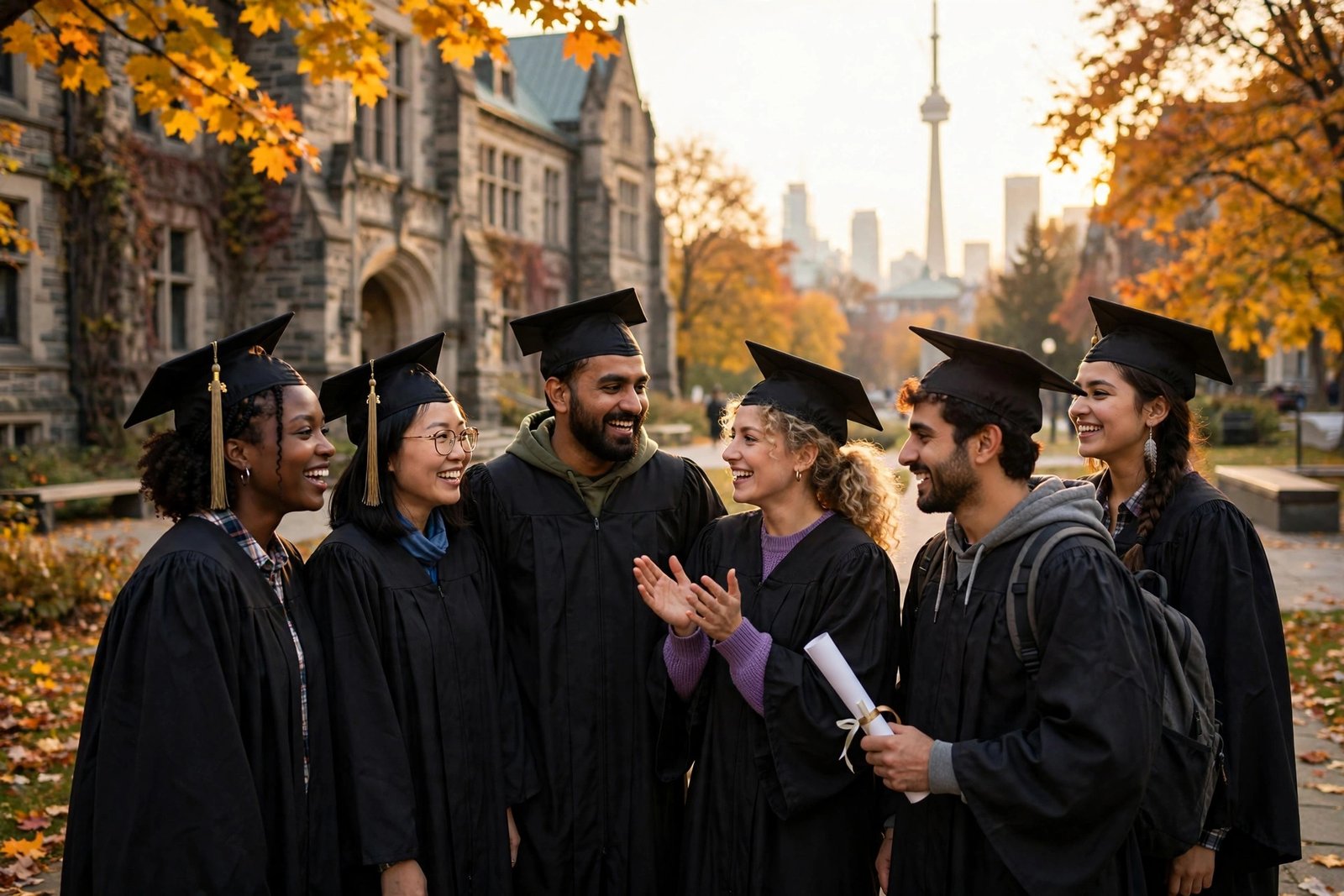
Canada PGWP at a Glance
| Feature | Current rule (verified October 2026) |
|---|---|
| Permit type | Open work permit — work for almost any employer, anywhere in Canada |
| Maximum duration | Up to 3 years, based on the length of your program |
| Minimum program length | 8 months (900 hours for Quebec vocational programs) |
| Application window | Within 180 days of receiving written confirmation of program completion |
| Application fee | CAD 255 (CAD 155 work permit fee + CAD 100 open work permit holder fee) |
| Language requirement | CLB 7 for degree graduates; CLB 5 for other college graduates (PGWP applications on/after 1 November 2024) |
| Field-of-study requirement | Only for non-degree college programs where the study permit application was submitted on/after 1 November 2024 |
| How often | Generally once in a lifetime — you cannot get a second PGWP |
| Job offer needed? | No |
What the PGWP Actually Is — and What It Is Not
The PGWP is part of Canada’s International Mobility Program. It exists because Canada wants international graduates to gain Canadian work experience, and because that experience is valuable inside the immigration system: skilled work in Canada can support a later application for permanent residence, for example through the Canadian Experience Class under Express Entry or a Provincial Nominee Program. Our guide to PR pathways after studying abroad explains how those routes fit together. But be precise about what the PGWP itself is: a temporary work permit with a fixed end date. It is not permanent residence, it does not guarantee a job, and time on a PGWP does not by itself settle you in Canada.
Three features define the permit. First, it is open: no Labour Market Impact Assessment (LMIA), no employer sponsorship, no job offer. Second, its length is earned by your program: a short program produces a short permit. Third, it is essentially one-shot: IRCC’s position is that you can normally only ever hold one PGWP, so using it on a short, low-value program can close a door you cannot reopen later. That is why program choice — institution, credential type and length — matters so much, a point we return to in the practical tips.
Eligibility: The Core Requirements
To be eligible for a PGWP, you must meet all of the following core conditions, as set out by Immigration, Refugees and Citizenship Canada (IRCC):
- You completed an eligible program at a designated learning institution (DLI). The institution must be PGWP-eligible, not merely a DLI. Some DLIs — including certain private institutions and some public-private partnership programs — do not lead to a PGWP. Check your institution against IRCC’s DLI list, which shows PGWP eligibility, before you enrol and again before you apply.
- Your program was at least 8 months long (in Quebec, vocational programs must be at least 900 hours) and led to a degree, diploma or certificate.
- You maintained full-time student status in Canada during each academic session of your program, with narrow exceptions: an approved leave of no more than 150 days, or studying part time only in your final academic session.
- You apply within 180 days of receiving written confirmation from your institution (for example a completion letter or final transcript notification) that you have completed your program.
- You held a valid study permit at some point within those 180 days.
- You have not previously held a PGWP (narrow passport-validity extensions aside).
- You meet the language requirement and, where it applies to you, the field-of-study requirement described below.
Distance learning deserves a warning. Time spent studying online from outside Canada generally does not count toward PGWP eligibility or toward the length of the permit, apart from specific COVID-era special measures that have now ended. If your program includes a large online component delivered while you are abroad, verify with IRCC’s current guidance before assuming the time counts.
The Language Requirement: CLB 7 or CLB 5
For PGWP applications submitted on or after 1 November 2024, you must prove your English or French ability with an approved test, and your results must meet the minimum in all four skills — listening, reading, writing and speaking:
- CLB 7 (or NCLC 7 in French) if you graduated from a university degree program — bachelor’s, master’s or doctoral — and also for graduates of university programs that do not result in a degree.
- CLB 5 (or NCLC 5 in French) if you graduated from any other college, polytechnic or non-university program that does not result in a bachelor’s, master’s or doctoral degree.
Your test results must be less than two years old when you apply. Approved tests include IELTS General Training, CELPIP General, PTE Core and their French equivalents (TEF Canada, TCF Canada). Note that IELTS Academic is not the version IRCC lists for this purpose — check IRCC’s language testing page for the exact accepted tests and the score conversions, and use our visa requirement checker tool as a planning aid alongside the official pages. Graduates of flight schools, people who applied for their PGWP before 1 November 2024, and certain extension applicants are exempt from the language requirement.
The Field-of-Study Requirement: Who It Actually Applies To
This is the rule most often reported wrongly, so read it carefully. The field-of-study requirement applies only to graduates of non-degree college programs (and certain other non-degree programs) whose study permit application was submitted on or after 1 November 2024. If that is you, your program must fall within an eligible field of study linked to occupations in long-term shortage — IRCC publishes the list of eligible CIP (Classification of Instructional Programs) codes, grouped around areas such as agriculture and agri-food, healthcare, STEM, trades and transport.
Bachelor’s, master’s and doctoral graduates are exempt from the field-of-study requirement entirely, whatever they studied. So are students whose study permit application was submitted before 1 November 2024. In plain terms: a master’s graduate in marketing, history or any other field does not need her program to appear on the eligible-fields list; a new college diploma student starting a generic business program in 2026 very likely does need to check the list — and if the program is not on it, the PGWP may not be available at all. If you are choosing between programs now, browse the Canadian institutions in our university directory and treat PGWP eligibility as a filter, not an afterthought.
How Long Will Your PGWP Last?
The length of your PGWP follows the length of your program, up to a maximum of three years:
| Program length | PGWP you can receive |
|---|---|
| Less than 8 months | Not eligible |
| 8 months to less than 2 years | Up to the same length as your program |
| 2 years or longer | Up to 3 years |
| Master’s degree program of at least 8 months | Up to 3 years (master’s graduates have received the full 3 years since February 2024, even for programs under 2 years) |
| More than one program | Permits can be combined — the total reflects the combined program lengths, up to 3 years, if each program was PGWP-eligible and at least 8 months |
One mechanical point catches people out: a PGWP cannot be issued beyond the validity of your passport. If your passport expires in 14 months, your permit will be capped at 14 months even if you qualify for three years. Renew your passport before you apply if it has less than three years to run; otherwise you will need a later paper-based extension application to claim the remaining time, which is slower and entirely avoidable.

Step by Step: How to Apply for a PGWP
- Get your completion documents. Wait for written confirmation from your institution that you have completed your program — a completion letter, an official letter, a transcript or a notification of graduation. Your 180-day clock starts from when you receive this confirmation, not from your last exam and not from your graduation ceremony.
- Check your study permit status. If your study permit is still valid, apply straight away: applying from inside Canada while your permit is valid lets you start working full time immediately under maintained status conditions while IRCC processes the application, provided you meet the conditions IRCC sets out. If your study permit has already expired and you did not change your status to visitor, you have up to 90 days after it expires to apply for the PGWP and restore your student status at the same time — but you cannot work until the permit is approved, and restoration adds a fee.
- Prepare your documents. Typically: your passport, your study permit, your completion letter and final transcript, and your language test results if the requirement applies to you. IRCC generates a personalised document checklist when you start the online application — follow that checklist, not a list from a forum.
- Apply online through your IRCC account. Complete the eligibility questionnaire, fill in the application to change conditions or extend your stay as a worker (form IMM 5710 for in-Canada applicants), upload your documents and answer every question consistently with your study permit history.
- Pay the fees. CAD 255 in total (CAD 155 work permit processing fee plus the CAD 100 open work permit holder fee). Biometrics cost CAD 85 if IRCC requires them and yours are not already on file and valid.
- Submit and keep proof. Save your submission confirmation and, if you applied in Canada before your study permit expired, the letter IRCC issues confirming you may work while waiting. Employers routinely ask for it.
- Wait for a decision and check your account. Processing times change with volume; check IRCC’s processing-time tool rather than relying on anecdotes. If IRCC asks for additional documents, respond by the deadline given.
Costs and Fees
| Cost item | Amount |
|---|---|
| PGWP application (work permit fee CAD 155 + open work permit holder fee CAD 100) | CAD 255 |
| Biometrics (if required) | CAD 85 per person |
| Restoration of student status (only if your study permit already expired) | Additional restoration fee — check IRCC’s fee list at the time you apply |
| Language test (if you still need one) | Varies by test and country — see official test providers |
| Study permit (context, for the stage before) | CAD 150 |
| Proof of living funds for a study permit (context) | CAD 22,895 for applications to 31 August 2026; CAD 23,448 from 1 September 2026 (single applicant, outside Quebec, excluding tuition) |
Budget honestly for the months around graduation as well. Rent, food and transport continue while your application is processed, and if you applied after your study permit expired you may not be able to work during that period. Our breakdown of the cost of studying in Canada and the cost-of-living calculator can help you model that gap. While studying, remember the current off-campus work limit is 24 hours per week during regular academic sessions — earnings above what that allows are not a plan.
Family Members and Spouses
Your spouse or common-law partner may be able to apply for an open work permit of their own, but the rules tightened in January 2025. Spouses of international students are now generally only eligible while the student is in a master’s program of 16 months or longer, a doctoral program, or certain professional programs — and there are separate rules for spouses of PGWP holders, which turn on the PGWP holder’s own skilled employment. Do not assume a partner’s work rights follow automatically from yours: check the current IRCC pages for your exact situation, and read our comparison of student dependent visas across five countries before making family plans around a Canadian study route.
Common Mistakes and Refusal Reasons
- Missing the 180-day deadline. There is no discretion to accept a late PGWP application. Diarise the date your completion confirmation arrives and count forward.
- Studying part time in a non-final term. An unauthorised drop below full-time status can make you ineligible, even if you graduate with good grades.
- Choosing a program that was never PGWP-eligible. Students still enrol in private college and public-private partnership programs assuming a PGWP follows. Since 2024, many such programs no longer qualify.
- Ignoring the field-of-study list. Non-degree college students who applied for their study permit on or after 1 November 2024 must graduate from an eligible field. Finding out after graduation is too late.
- Weak language results. Meeting the CLB benchmark in three skills but missing it in one means the requirement is not met. Retest early enough to apply inside your window.
- Applying with a short-validity passport. Your permit is capped at your passport’s expiry, cutting a three-year entitlement down unnecessarily.
- Working when not authorised. If you applied after your study permit expired, you generally cannot work until the PGWP is issued. Unauthorised work creates problems far bigger than a few weeks of lost income.
- Letting your study permit lapse without a plan. If the 90-day restoration window also passes, your options narrow sharply and you may have to leave Canada and apply from abroad — where applying is still possible within 180 days of completion, but without the ability to work in Canada in the meantime.
Practical Tips
- Choose the program for the permit you want. A two-year program (or a master’s) is the reliable route to a three-year PGWP. A one-year program buys roughly one year of work rights — plan the job search accordingly.
- Bring your language test forward. If you will need CLB 7 or CLB 5, sit the test during your final term, not after graduation, so a retest still fits inside the 180 days.
- Apply while your study permit is valid. It preserves your right to work full time during processing and avoids restoration fees and stress.
- Keep every academic record. Transcripts for every term, enrolment letters and any approved-leave documentation — IRCC can ask, and institutions are slow to produce old records.
- Use your PGWP years deliberately. Skilled, full-time Canadian experience is what later supports Express Entry or provincial nomination. A three-year permit spent entirely in survival jobs that do not match your occupation classification is a weaker PR foundation.
- Look for funding as well as work. Scholarships do not end at graduation for everyone — research awards and fellowships are listed in our scholarships directory.
- Compare before you commit. If you are still choosing a country, our Australia vs Canada comparison puts post-study work and PR pathways side by side.
Planning Backwards: From Study Permit to PGWP
The graduates who run into PGWP trouble usually made the decisive mistake one or two years earlier, at the program-choice stage. It is worth setting out the timeline as a single chain, because each link depends on the one before it. First, your study permit application date decides which rulebook applies to you: applications submitted on or after 1 November 2024 brought the language requirement and, for non-degree college students, the field-of-study requirement into play. Second, your institution and program decide whether a PGWP exists for you at all — a designated learning institution is not automatically a PGWP-eligible institution, and this distinction has closed the door on many private-college graduates since 2024. Third, your conduct during the program matters: full-time enrolment in every regular term, any leave formally approved and no longer than 150 days, and off-campus work kept within the 24-hours-per-week limit during academic sessions. Fourth, your documents at the end — completion letter, final transcript and, where required, a language test result less than two years old — must all be ready inside a fixed 180-day window that does not pause for holidays, job searches or family events.
Context figures also help you budget the full journey. The study permit itself costs CAD 150 to apply for. For the permit you must show living funds of CAD 22,895 for a single applicant outside Quebec under the rates applying to 31 August 2026, rising to CAD 23,448 from 1 September 2026 — on top of first-year tuition and travel. Most applicants now also need a Provincial or Territorial Attestation Letter (PAL/TAL), although master’s and doctoral students at public DLIs are fully exempt from that requirement from 1 January 2026, and Canada is operating under a national cap of 408,000 study permits for 2026. Note, too, that the old Student Direct Stream (SDS) ended in November 2024: any website still presenting SDS as a live fast-track route is out of date. Reading the chain this way makes the central lesson obvious — the PGWP is won or lost long before graduation day, and the students who treat it as an afterthought are the ones who lose it.
Frequently Asked Questions
1. How long do I have to apply for a PGWP after graduating?
You have up to 180 days from the day you receive written confirmation from your institution that you have completed your program. Your study permit must have been valid at some point during those 180 days. If your study permit has expired and you did not switch to visitor status, you have up to 90 days after its expiry to apply for the PGWP together with restoration of status — and you cannot work while that application is processed.
2. How much does a PGWP cost?
The application costs CAD 255 in total: a CAD 155 work permit processing fee plus the CAD 100 open work permit holder fee. Biometrics, if IRCC requires them, cost CAD 85. Restoration of status, if you need it, adds a further fee — confirm the current amount on IRCC’s official fee list before you apply.
3. Does the field-of-study rule apply to master’s students?
No. Bachelor’s, master’s and doctoral graduates are exempt from the field-of-study requirement, whatever subject they studied. The rule applies only to non-degree college and similar programs where the study permit application was submitted on or after 1 November 2024. Degree graduates must still meet the language requirement — CLB 7 in all four skills for PGWP applications submitted on or after 1 November 2024.
4. Can I work full time while my PGWP application is being processed?
Yes, if you applied from inside Canada before your study permit expired and you met IRCC’s conditions, including having been authorised to work off campus during your studies and not having worked more than permitted. If you applied after your study permit expired (with restoration), you must wait until the PGWP is actually issued before working.
5. Can I get a second PGWP if I study again?
Generally, no. A PGWP is a once-in-a-lifetime permit. A later program does not create a second entitlement, apart from a narrow extension where your first PGWP was cut short only because your passport expired. This is why sequencing matters: completing a longer, higher-value program first protects your one entitlement.
6. Can I apply for a PGWP from outside Canada?
Yes. You can apply from abroad within the same 180-day window after completion, as long as you meet all the eligibility rules, including having held a valid study permit within that period. You will not be able to work in Canada until the permit is approved and you return.
7. What happens if my passport expires soon?
Your PGWP cannot be valid beyond your passport’s expiry date. Renew your passport before applying if it has less than three years remaining. If a PGWP was already shortened only because of passport validity, you can apply on paper to extend it for the remaining period you were entitled to.
8. Does a PGWP guarantee permanent residence?
No. A PGWP gives you time and Canadian work experience, which can strengthen an Express Entry or provincial nomination application, but permanent residence is a separate process with its own points, draws and eligibility rules. No one can guarantee its outcome.
Sources & Verification
- IRCC / Canada.ca — Post-graduation work permit: Who can apply (eligibility, language and field-of-study rules)
- IRCC / Canada.ca — Post-graduation work permit: How to apply (180-day window, CAD 255 fee, restoration rules)
- IRCC operational guidance — PGWP program delivery instructions
Figures and rules change — always confirm on the official government website before applying. Fees, language benchmarks and the eligible field-of-study list in this guide were checked against IRCC sources in October 2026.
Disclaimer: StudyGraduate is an information portal, not a visa agency, immigration consultancy or law firm. This guide is general information only and is not immigration advice. We never promise visa approval, a job or permanent residence. For advice on your individual circumstances, consult a licensed Canadian immigration professional or check IRCC directly.