
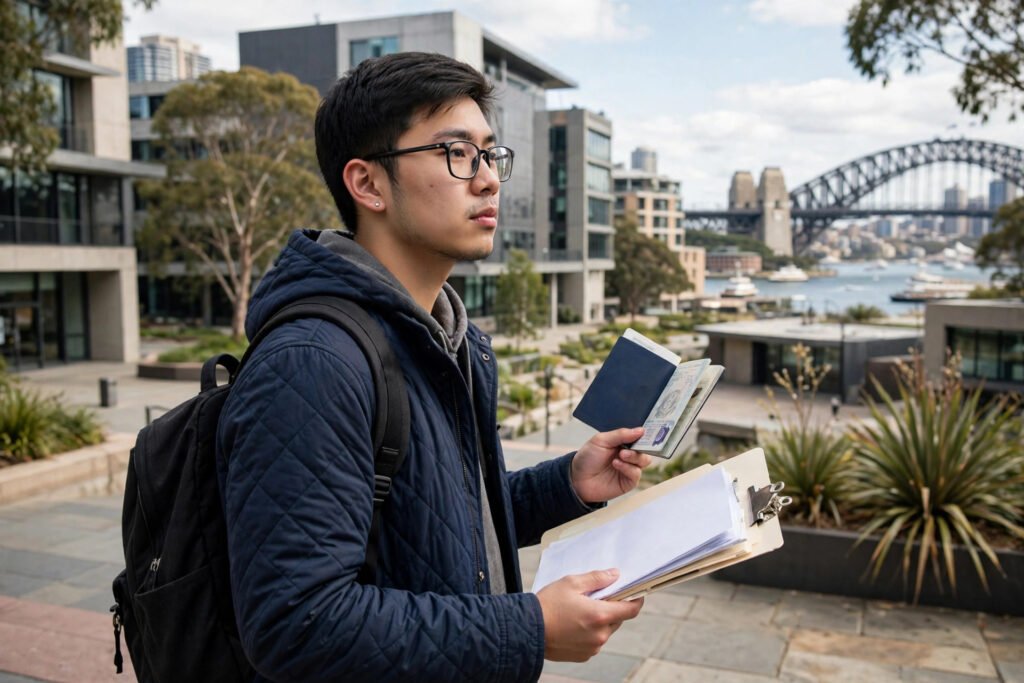
Australia Student Visa (Subclass 500): Step-by-Step Application Guide 2026
Planning to study in Australia in 2026 or 2027? Almost every international student who studies in Australia does so on one visa: the Student visa (Subclass 500). Whether you are enrolling in a bachelor’s degree in Sydney, a master’s in Melbourne, a diploma in Brisbane, a PhD in Perth or an English course packaged with a degree, the Subclass 500 is the visa that lets you live in Australia for the duration of your course — and it is the visa this guide walks you through, step by step.
This guide is written for international students — including the many applicants from Bangladesh, India, Pakistan, Nepal, Nigeria and Indonesia who make up a large share of Australia’s student cohort — who want to understand exactly what the Department of Home Affairs asks for, how much money they must show, what the Genuine Student requirement really means, and how to avoid the mistakes that lead to refusals. You will find the current financial figures, the current visa application charge, the document list, the work rules that will apply while you study, and an honest explanation of what happens after you lodge.
One warning before we start: Australian student visa settings have changed repeatedly since 2024, and they changed again in 2026. Fees rose, the Genuine Student test replaced the old Genuine Temporary Entrant statement, and processing priorities were reorganised. Anything you read in an older blog post — including fee figures from 2024 or 2025 — should be treated as out of date until you have checked it against the official Department of Home Affairs Subclass 500 page. This guide uses the figures verified at the time of writing and tells you, at each step, where to re-check them before you pay anything.

Australia Student Visa (Subclass 500) at a Glance
| Item | Current setting (verify before lodging) |
|---|---|
| Visa | Student visa (Subclass 500), all education sectors in one subclass |
| Where you apply | Online, through ImmiAccount on the Department of Home Affairs website |
| Essential document | Confirmation of Enrolment (CoE) from a CRICOS-registered provider for a registered course |
| Genuine Student requirement | Targeted questions in the application form — replaced the Genuine Temporary Entrant (GTE) statement in March 2024 |
| Living-cost funds to show | AUD 29,710 per year for the student (in place since 10 May 2024) |
| Partner / child funds | Only where family members are eligible under the October 2026 exemptions (see “What changed” below): add AUD 10,394 per year for a partner and AUD 4,449 per year for each child, plus schooling costs for school-age children |
| Visa application charge | AUD 2,500 for most primary applicants from 1 July 2026 — confirm your exact charge in the official Visa Pricing Estimator before lodging |
| Health cover | Overseas Student Health Cover (OSHC) for the full period of your stay |
| Work limit in term time | 48 hours per fortnight while your course is in session; unrestricted during scheduled course breaks |
| Stay length | Generally up to 5 years, aligned to your enrolment |
If you have not yet secured your university place, read our companion guide on how to apply to universities in Australia first — the visa process cannot begin until you hold an offer and a CoE. If money is your main question, our dedicated guide to proof of funds for a student visa compares the Australian figures with the UK, Canada, the USA and Germany side by side.
For an overview written for students by the Australian Government itself, keep the Study Australia official portal bookmarked alongside the Home Affairs pages — it is the government’s own starting point for course search, costs and student life, and it links through to the visa information you will rely on.
Who Can Apply for a Subclass 500 Visa?
You can apply for a Subclass 500 if you have been accepted into a full-time course registered on CRICOS — the Commonwealth Register of Institutions and Courses for Overseas Students — and you can meet the health, character, English, financial and Genuine Student requirements. There is no general upper age limit for the student visa itself (the age limit you may have heard about applies to the Temporary Graduate visa afterwards, not to the Subclass 500), but applicants under 18 must have approved welfare arrangements in place. Your course must be a registered full-time course: a degree, a diploma, a certificate, an English-language (ELICOS) course, primary or secondary schooling, or a non-award course can each sit under Subclass 500, but a short recreational course cannot.
You will normally apply from outside Australia. Onshore applications are possible in some circumstances, but note that since 2024–2025 the government has progressively restricted “visa hopping”: holders of Visitor visas and Temporary Graduate visas are among those who generally cannot switch to a Student visa while onshore. If you are already in Australia on another visa, check your specific eligibility on the Home Affairs website before assuming you can apply from inside the country.
What changed on 2 October 2026: Australia’s student visa integrity reforms have now taken effect, as confirmed in the Ministerial media release “Student visa integrity reforms take effect today” (Assistant Minister Julian Hill). Most temporary visa holders — including Working Holiday Maker and Skills in Demand visa holders — can no longer apply for a Student visa onshore. The restriction on transferring to a new provider has been extended from 6 to 12 months as a transition measure until 30 June 2027, ahead of a new transfer stream from 1 July 2027, and onshore transfers from higher education to VET are no longer permitted. The same reforms also removed the right for most students to include a partner or children on a Subclass 500 — see the family-members FAQ below.
Step 1: Choose a CRICOS-Registered Course and Get Your CoE
Everything starts with the course. Only CRICOS-registered providers can enrol the overseas students who need this visa, and your Confirmation of Enrolment (CoE) — issued electronically by the provider after you accept your offer and pay the required deposit — is the foundation document of your visa application. Without a CoE you cannot lodge a valid Subclass 500 application.
Choosing well matters for the visa as well as for your education. Home Affairs looks at the provider and the course when assessing whether you are a genuine student: a course that logically follows your previous study or work, at a level that makes sense for your stage, is far easier to explain than a sudden, unrelated downgrade. Browse and compare providers in our university directory — profiles such as the University of Melbourne and UNSW Sydney show course areas, location and ranking context — and check international rankings if you are weighing similarly priced options. Then cross-check that your exact course appears on the official CRICOS register before you pay any deposit.
Step 2: Understand the Genuine Student (GS) Requirement
In March 2024, Australia replaced the old Genuine Temporary Entrant (GTE) statement — a long free-text essay — with the Genuine Student (GS) requirement. Instead of one open-ended statement, you now answer a set of targeted questions inside the visa application form, with word limits, about your circumstances and your reasons for studying in Australia. In substance, decision-makers are assessing whether you genuinely intend to study, whether the course fits your background and future plans, and whether your situation makes sense overall.
Expect to explain, in your own words and with evidence where you can attach it:
- Your current circumstances — your family, community and employment ties, and your economic situation in your home country.
- Why this course and this provider — what you researched, what alternatives you considered, and why this specific program fits you.
- Why Australia — why this course in Australia rather than the same qualification at home or in another country.
- How the course benefits you — the career outcomes, skills or salary prospects it realistically opens up, in your home country or elsewhere.
- Your study and immigration history — previous study, any gaps and their reasons, and any previous visa applications for Australia or other countries.
The single most important GS tip is consistency. Your GS answers, your resume, your financial evidence and your course choice should all tell one coherent story. A master’s application that follows logically from your bachelor’s degree and your job is easy to believe. An application that contradicts the documents — claiming a course will double your salary at home while the financial evidence shows a sponsor who cannot realistically fund it — invites refusal. Write specifically, not generically: copied template answers are a known refusal trigger, because they suggest the application was assembled by someone else for someone else.
Step 3: Work Out Your Financial Capacity — the AUD 29,710 Rule
Financial capacity is where Australian applications are won and lost. Home Affairs requires you to show genuine access to enough money to cover your travel, your course fees and your living costs for the first 12 months of your stay (or the full course, if it is shorter than 12 months). The living-cost benchmark for the student is AUD 29,710 per year. That figure has applied since 10 May 2024, when it replaced the previous AUD 24,505 benchmark — if you see 24,505 quoted anywhere, you are looking at an out-of-date source.
The full calculation looks like this:
| Component (first 12 months) | Amount to show |
|---|---|
| Living costs — student | AUD 29,710 |
| Living costs — partner (if accompanying and eligible under the October 2026 exemptions) | AUD 10,394 |
| Living costs — each child (if accompanying and eligible under the October 2026 exemptions) | AUD 4,449 |
| Schooling costs — each school-age child | Allow at least the official annual schooling benchmark used in the Home Affairs calculator (AUD 13,502 in recent settings — verify the current figure) |
| Course fees | Your first 12 months of tuition as shown on your CoE, less any amount already paid |
| Travel | Return travel costs to your home country |
So a single student with AUD 38,000 annual tuition who has paid nothing yet must show roughly AUD 38,000 + AUD 29,710 + travel — around AUD 70,000 in total capacity. If you have already paid a deposit, the amount shown on your CoE as paid reduces the tuition component.
How can you evidence the money? Home Affairs accepts combinations of savings held in financial institutions, education loans from recognised lenders, government or provider scholarships, and sponsorship income evidence. There is also an alternative route: instead of showing the full funds, some applicants can rely on a parent’s or partner’s annual income — the income thresholds in recent settings have been AUD 87,856 for a single student and AUD 102,500 where family members are included (only in cases where family members are eligible under the exemptions described in this guide), evidenced by official tax documents. Because thresholds are indexed and evidence rules differ by applicant, use the official Document Checklist Tool for your passport country and provider before you assemble your file.
Two practical points matter more than students expect. First, source matters: officers look at where the money came from, not just the final balance. A large deposit that appeared last week, with no relationship to your sponsor’s income, will raise questions you may not get a chance to answer. Second, whether you must upload full financial evidence with your application depends on your nationality and your provider’s evidence level under the Simplified Student Visa Framework — but “not required upfront” does not mean “not required”: Home Affairs can request it at any point, and you must genuinely have it.
Step 4: Arrange Overseas Student Health Cover (OSHC)
You must hold OSHC from an approved Australian insurer for the entire period you will be in Australia on the student visa — not just for your course dates. Many universities offer to arrange a policy with a preferred insurer when you accept your offer; you can also buy directly from an approved provider. If your OSHC end date falls short of your expected visa end date, your visa may be granted only up to the cover’s expiry, or your application may be delayed while you extend it. Buy cover for a little longer than you think you need, and enter the policy details exactly as issued when the application form asks for them. OSHC is separate from the AUD 29,710 living-cost figure — budget for it on top, not inside it.
Step 5: Prepare Your Documents
Use the Home Affairs Document Checklist Tool with your passport country and your provider to generate your personalised list, but the core set for most applicants is:
- Valid passport (and previous passports / travel history where requested).
- Confirmation of Enrolment (CoE) for your registered course — check the name spelling matches your passport exactly.
- Academic transcripts and completion certificates for your previous study, with certified English translations if they are not in English.
- English language test results if your checklist requires them (IELTS, PTE Academic, TOEFL iBT or another accepted test, within its validity period). Typical university entry starts around IELTS 6.0–6.5 for degree courses, with lower scores possible when packaged with ELICOS — the exact score is set by your provider and your evidence level. Our test preparation section can help you plan which test to take.
- Financial capacity evidence as described in Step 3.
- OSHC policy details.
- Genuine Student responses, written by you, in the application form.
- For applicants under 18: parental consent and approved welfare arrangements.
- Where applicable: employment records, a resume, and evidence explaining any study gaps.

Step 6: Lodge the Application in ImmiAccount and Pay the Charge
Create an ImmiAccount on the Department of Home Affairs website, start a new Student visa (Subclass 500) application, and work through the form carefully. Enter your CoE details, your OSHC policy dates, your travel history and your GS answers exactly in the fields provided. Attach clear colour scans of your documents — legible, complete, and in English or with certified translations.
At the end you pay the visa application charge. For most primary applicants the charge is AUD 2,500 from 1 July 2026, increased from AUD 2,000 — with different (lower) charges for some passport groups and for standalone ELICOS and non-award courses, and additional charges for each family member included in the application (where that family member is eligible to be included — see the FAQ below). A subsequent temporary application charge can also apply to some onshore applicants. Because charges change on a schedule and depend on your circumstances, always run the official Visa Pricing Estimator immediately before you lodge and budget the figure it gives you. The charge is non-refundable, even if the visa is refused — which is why the preparation steps above matter.
Step 7: Health Examination, Biometrics and the Decision
After lodging, watch your ImmiAccount and email. Many applicants are directed to complete a health examination with an approved panel physician and to provide biometrics at a collection centre. Do these promptly: an application that sits idle waiting for a medical can be decided on the information available, and silence is rarely your friend. If Home Affairs requests further information — more financial evidence, a document explanation, updated test results — respond within the timeframe given and upload through ImmiAccount, not email.
Processing times vary significantly by education sector, by your evidence level, and by how complete your application was at lodgement. Since late 2025, offshore applications have also been processed under ministerial processing-priority directions, which order the queue but do not change the legal criteria. In plain terms: two students with identical courses can wait very different times. Apply as early as your CoE allows — you can lodge up to several months before your course start — and do not book non-refundable flights or resign from a job until the visa is granted.
When the decision arrives, it comes by email with your visa grant number, your visa conditions and your stay period. Check the details immediately in VEVO (Visa Entitlement Verification Online), the official system employers and universities use to confirm your status.
Your Work Rights and Visa Conditions
The Subclass 500 comes with work rights, but they are capped. While your course is in session, you can work up to 48 hours per fortnight — a fortnight is 14 days starting on a Monday. During scheduled course breaks you can work unrestricted hours. Master’s by research and PhD students have historically had different arrangements once they have begun their main course; check the conditions attached to your own grant and the current Home Affairs wording, because this is exactly the kind of setting that changes. Working beyond your limit is a breach of your visa conditions and can lead to cancellation — no part-time wage is worth your degree.
Other key conditions include maintaining enrolment in a registered course, making satisfactory course progress and attendance, keeping OSHC current for your whole stay, notifying your provider of your address in Australia within 7 days of arriving (and updating changes), and — if you want to change provider in the first 12 months (the restriction was extended from six months as a transition measure until 30 June 2027, with a new transfer stream from 1 July 2027 and no onshore transfers from higher education to VET) — meeting the release requirements. Treat these conditions as part of the deal from day one, not as fine print.
Costs Table: What the Whole Application Really Costs
| Cost item | Indicative amount | Notes |
|---|---|---|
| Visa application charge (primary applicant) | AUD 2,500 from 1 July 2026 | Lower charges for some passport groups and ELICOS/non-award courses; extra per eligible family member included; non-refundable |
| Tuition deposit to obtain CoE | Varies by provider — often the first semester or a set deposit | Set by your offer letter; deducted from your first-year fees |
| OSHC | Varies by insurer and duration — budget several hundred AUD per year for a single student | Must cover the full visa period |
| English test | Varies by test and country | IELTS / PTE / TOEFL fees are set locally; check the test provider |
| Health examination | Varies by country and panel clinic | Payable to the clinic, not to Home Affairs |
| Biometrics | Varies — some centres charge a service fee | Only if directed to provide them |
| Document translation / certification | Varies | Certified translations for non-English documents |
For funding help beyond your family resources, see our guide to fully funded scholarships in Australia and the flagship Australia Awards Scholarships — noting the important interaction in the FAQ below about family members and government-funded programs.
Thinking Beyond the Student Visa: the Subclass 485
Many students choose Australia partly for what comes after graduation. The Temporary Graduate visa (Subclass 485) lets eligible graduates stay and work after their course. Under the post-2024 settings you should plan around: a general age limit of 35 at application (with exceptions for Hong Kong and British National (Overseas) passport holders, and for master’s by research and PhD graduates), and durations of 2 years for bachelor’s graduates, 2 years for master’s by coursework, 3 years for master’s by research and 3 years for PhD graduates. Rules for this visa have changed repeatedly and a further fee increase took effect in 2026. Note also that, under the October 2026 integrity reforms, similar restrictions on including family members will apply to Temporary Graduate visas — although families already in Australia as secondary applicants will not be separated. So read our dedicated Subclass 485 guide and the official Home Affairs pages when your graduation approaches — do not build a five-year plan on today’s settings alone.
Common Mistakes That Lead to Refusals
- Template Genuine Student answers. Generic, copied or agent-pasted GS text that does not match your documents is one of the most damaging errors you can make.
- Unexplained money. A sudden large deposit with no source, funds that do not match your sponsor’s income, or money that disappears after lodgement (“genuine access” failures).
- Using the old AUD 24,505 living figure. The benchmark is AUD 29,710. Budgeting to the old number means your evidence falls short on its face.
- Course choices that make no sense. A downgrade or an unrelated field with no convincing explanation undermines your GS case.
- Short OSHC. Cover that ends before your expected visa end date.
- Name and date mismatches. Your CoE, passport, transcripts and test results must agree. Fix discrepancies before lodging, with an explanation attached.
- Lodging late. Applying days before your course start leaves no room to answer a further-information request.
- Undeclared history. Previous visa refusals (for any country) and immigration history must be declared; Home Affairs asks, and omission is treated far more seriously than the refusal itself.
Practical Tips for a Stronger Application
- Build your file backwards from the checklist: generate your Document Checklist Tool list first, then gather to it.
- Let your finances “season”: where possible, keep funds in place with a clear paper trail well before you lodge.
- Write your GS answers yourself, in specific detail, then ask someone to read them against your documents for contradictions.
- Apply for your university place early — popular providers fill allocations under Australia’s managed intake settings, and a late CoE compresses everything else. Start with our study abroad hub to map the full timeline.
- Keep copies of everything you submit, and check ImmiAccount at least weekly while your application is pending.
- Do not pay anyone who promises a guaranteed visa outcome. No agent can guarantee a grant, and in Australia only registered migration agents (or exempt persons) may legally provide immigration assistance for a fee.
Frequently Asked Questions
How much money do I need to show for an Australian student visa in 2026?
For the first 12 months you must show your course fees (less anything already paid), plus AUD 29,710 for your own living costs, plus travel costs. If you are eligible to include family members under the October 2026 exemptions (PhD students; nationals of Pacific and ASEAN member countries; students sponsored by Australian or foreign governments), add AUD 10,394 for an accompanying partner and AUD 4,449 per child, plus schooling costs for school-age children. Confirm the current figures on the Department of Home Affairs website before lodging, as they are indexed periodically.
How much is the Subclass 500 visa application charge?
For most primary applicants the charge is AUD 2,500 from 1 July 2026, up from AUD 2,000. Lower charges apply to some passport holders and to standalone ELICOS and non-award courses, and each additional eligible family member included in the application adds a charge. Always confirm your exact total in the official Visa Pricing Estimator before you pay — the fee is non-refundable even if your application is refused.
What is the Genuine Student requirement, and how is it different from GTE?
The Genuine Student (GS) requirement replaced the Genuine Temporary Entrant (GTE) statement in March 2024. Instead of a long free-text statement, you answer targeted, word-limited questions inside the application about your circumstances, your course and provider choice, why Australia, and how the course benefits your future. Decision-makers use your answers, with your documents, to assess whether you genuinely intend to study.
How many hours can I work on a student visa in Australia?
While your course is in session, up to 48 hours per fortnight. During scheduled course breaks, hours are unrestricted. Check the conditions printed on your own visa grant and the current Home Affairs guidance, especially if you are a research master’s or PhD student, and never exceed your limit — breaches can lead to visa cancellation.
Can my spouse and children come with me on a Subclass 500?
For most students, no. Australia’s student visa integrity reforms took effect on 2 October 2026, and most students can no longer include a partner or children on a Student visa (Subclass 500). Limited exemptions apply only to: PhD students; nationals of Pacific and ASEAN member countries; and students sponsored by Australian or foreign governments. Where an exemption applies, eligible family members must be included at the same time as your own application — the ability to add “subsequent entrants” later has been removed for all students — with extra financial capacity evidence (AUD 10,394 per year for a partner, AUD 4,449 per child, plus schooling costs) and OSHC for each person. Families already together in Australia will not be separated: eligible Student visa holders applying for a new onshore visa may include only family members already in Australia. Read our student dependent visas compared guide and verify the current position on the Home Affairs website before you budget around bringing family.
How long does Subclass 500 processing take?
There is no single timeframe: processing varies by sector, evidence level and application completeness, and Home Affairs publishes updated median processing times on its website. Lodge as early as your CoE allows, complete any health examination or biometrics request immediately, and do not make irreversible travel plans until the visa is granted.
What English score do I need for the visa?
It depends on your provider, course and evidence level. Degree courses commonly require around IELTS 6.0–6.5 overall (or the PTE/TOEFL equivalent), with lower entry possible when you package an ELICOS course first. Your offer and CoE will state what your provider requires; the Document Checklist Tool will tell you whether you must include evidence with the visa application itself.
My visa was refused. Can I apply again?
Usually yes, unless a legal bar applies — but a second application must genuinely fix the reasons for refusal (weak GS answers, financial evidence problems, course-choice logic) rather than repeat the same file. Read the refusal decision record carefully, address each finding with new evidence, and consider advice from a registered migration agent. Note that the application charge is payable again in full.
Sources & Verification
This guide was prepared from official sources, principally: the Australian Department of Home Affairs — Student visa (Subclass 500) pages, the financial capacity and Genuine Student requirement guidance, the Document Checklist Tool and the Visa Pricing Estimator (immi.homeaffairs.gov.au); the Ministerial media release “Student visa integrity reforms take effect today” (minister.homeaffairs.gov.au, Assistant Minister Julian Hill), which confirms the October 2026 dependant, subsequent-entrant, onshore-application and provider-transfer changes described in this guide; and Study Australia, the Australian Government’s official student portal (studyinaustralia.gov.au). Figures and rules change — always confirm the current fee, funds thresholds and requirements on the official government website before applying.
Disclaimer: StudyGraduate is an information portal, not a visa agency, consultancy or migration agent, and this guide is general information only, not immigration advice for your individual circumstances. We can never promise visa or admission approval — decisions rest solely with the Department of Home Affairs and your education provider. For advice about your specific case, consult a migration agent registered with the Office of the Migration Agents Registration Authority (OMARA).