Türkiye Burslari Scholarship 2027 in Turkey: Fully Funded Bachelor’s, Master’s & PhD
Türkiye Burslari Scholarship 2027 in Turkey: Fully Funded Bachelor’s, Master’s & PhD Most major scholarships ask you to do two difficult things in sequence: first win admission to a university, then find the money. Türkiye Burslari — the Türkiye Scholarships programme run by the Presidency for Turks Abroad and Related Communities (YTB) — collapses both ... <a title="Türkiye Burslari Scholarship 2027 in Turkey: Fully Funded Bachelor’s, Master’s & PhD" class="read-more" href="https://studygraduate.com/scholarship/turkiye-burslari-scholarship-2027-in-turkey-fully-funded-bachelors-masters-phd/" aria-label="Read more about Türkiye Burslari Scholarship 2027 in Turkey: Fully Funded Bachelor’s, Master’s & PhD">Read more</a>
📖 Overview
Türkiye Burslari Scholarship 2027 in Turkey: Fully Funded Bachelor’s, Master’s & PhD
Most major scholarships ask you to do two difficult things in sequence: first win admission to a university, then find the money. Türkiye Burslari — the Türkiye Scholarships programme run by the Presidency for Turks Abroad and Related Communities (YTB) — collapses both into a single application. One online file, submitted in one annual window, is simultaneously your scholarship application and your university placement application: if you are selected, the programme places you in one of the university programmes you chose, pays your tuition, pays you a monthly stipend, houses you, insures you, flies you to Türkiye, and teaches you Turkish for a year before your degree begins. No separate university application is needed, and there is no application fee.
That integration is why Türkiye Burslari is consistently among the most applied-to government scholarships in the world, open to citizens of all countries at associate, bachelor’s, master’s and doctoral level. It is also why the application deserves more care than its simple form suggests: your twelve programme choices, your letter of intent, and your academic record must do the work that, in other systems, an entire university admission file would do. This guide explains the 2027 cycle in full — the benefit package as currently published on the official YTB site, the strict age limits and academic thresholds, the single 10 January–20 February window, the interview stage, and the placement logic that decides which of your twelve choices you actually receive.
A note on money before the detail, because Türkiye Burslari figures are widely misquoted. Turkish lira stipend amounts are revised periodically — the official programme pages listed 4,500 TL (undergraduate), 6,500 TL (master’s) and 9,000 TL (PhD) per month for the 2026 cycle, while the official Full-Time Programmes page checked for this guide now lists 6,500 TL, 9,500 TL and 13,000 TL respectively. Both sets of figures are “real” — they belong to different publication moments. Throughout this guide, stipend amounts are labelled with their source so you can verify the current figure on the official Türkiye Scholarships full-time programmes page before you rely on it. If you are comparing Türkiye with other destinations, the StudyGraduate scholarships directory collects the alternatives, the study abroad hub compares systems and costs, and the rankings pages help you judge the Turkish universities behind the names in the application system.
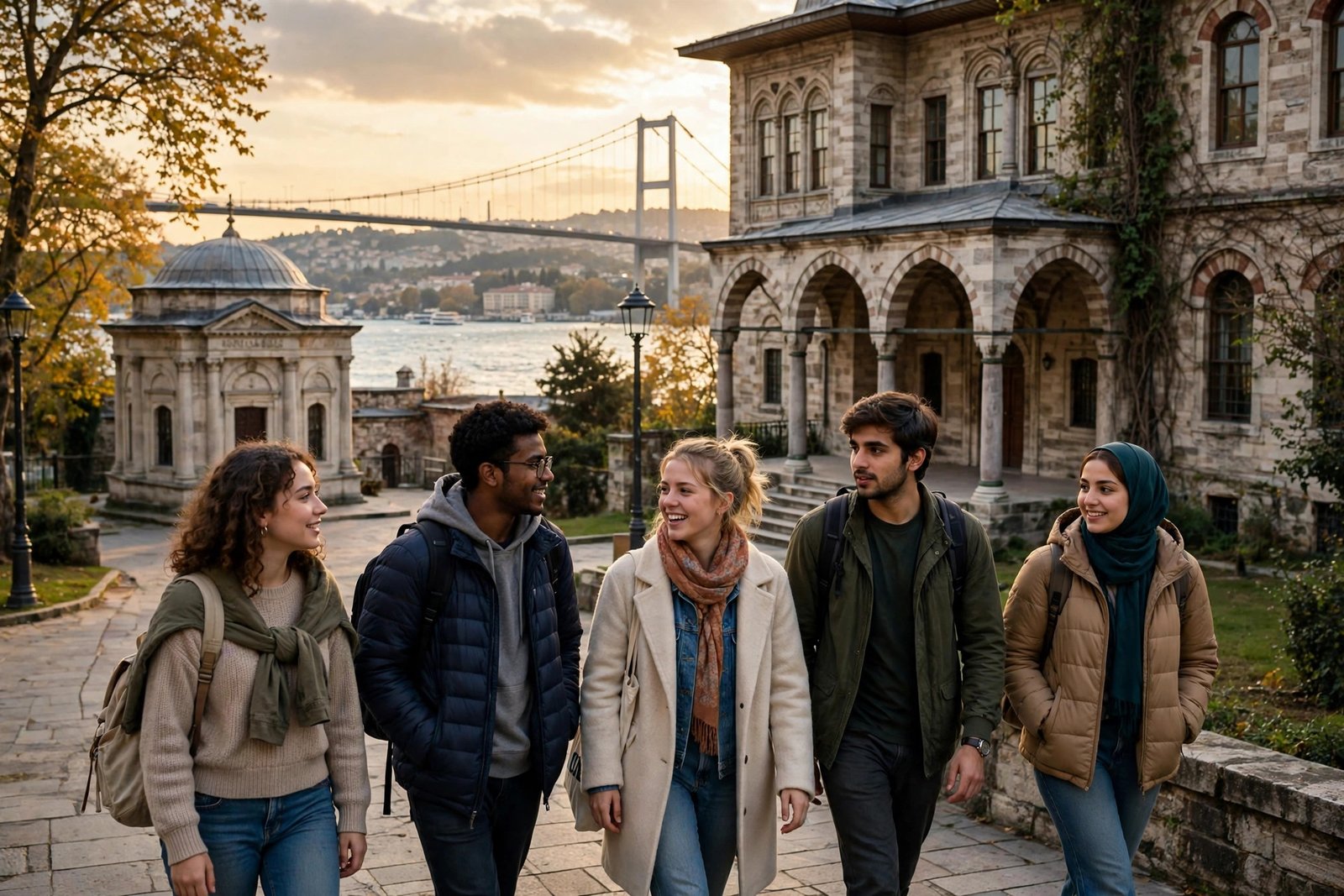
Türkiye Burslari at a Glance
| Item | Türkiye Scholarships — full-time programmes |
|---|---|
| Funding body | Government of Türkiye — Presidency for Turks Abroad and Related Communities (YTB) |
| Levels | Associate, Bachelor’s, Master’s, PhD (plus research and short-term programmes under separate categories) |
| University application | None separate — scholarship application includes placement; choose up to 12 university/programme preferences |
| Tuition | Covered in full for the scholarship period |
| Monthly stipend (official page, checked Oct 2026) | Undergraduate 6,500 TL; Master’s 9,500 TL; PhD 13,000 TL — see the labelling note in the Benefits section |
| Accommodation | Provided (university/state dormitory placement) |
| Turkish language course | 1 year, free; C1 certificate required by the end of the course year — for all awardees without C1, including English-medium students |
| Health insurance | Covered |
| Airfare | Once-off flight ticket at the beginning of studies and on graduation |
| Application window | 10 January – 20 February every year, via the Türkiye Scholarships Application System (TBBS) |
| Age limits | Under 21 (associate/bachelor’s); under 30 (master’s); under 35 (PhD); under 50 (research) |
| Minimum academic achievement | 70% (associate/bachelor’s); 75% (graduate); 90% (health sciences: medicine, dentistry, pharmacy) |
| Application fee | None |
Two rows in that table do more work than all the others. The age limits are hard boundaries — a bachelor’s applicant who has turned 21 is not “slightly over” the limit; they are ineligible, and the system enforces it. And the single annual window means there is no second intake, no rolling admission and no late round: miss 20 February and the next opportunity is eleven months away. Türkiye Burslari rewards applicants who prepare in the autumn, not applicants who discover it in February.
Eligibility in Full
Citizenship. Citizens of all countries may apply. Turkish citizens — including those who hold Turkish citizenship alongside another, and those who have lost or renounced Turkish citizenship — are not eligible for Türkiye Scholarships. This exclusion is stated in the programme’s criteria and enforced at document review, where your identity document and citizenship declarations are checked.
Age. Applicants must be under 21 years of age for associate and bachelor’s programmes, under 30 for master’s programmes, under 35 for PhD programmes, and under 50 for the research programme. Compute your age against the programme’s criteria at the time of application, and if your birthday falls anywhere near a boundary, verify your position against the current announcement before investing in the application — the limits are not discretionary.
Academic achievement. Minimum thresholds are published by level: 70 percent for associate and bachelor’s candidates, 75 percent for graduate (master’s and PhD) candidates, and 90 percent for health sciences — medicine, dentistry and pharmacy. These are minima for eligibility, not competitive averages; selected candidates at popular universities typically present records well above them. Note also the programme’s own nuance on health sciences: the official full-time programmes page states that Türkiye Scholarships does not award scholarships in the field of health sciences within the Graduate Scholarship Programme, while undergraduate health sciences study carries the 90 percent threshold — check the current programme list in the application system for exactly which health programmes are open at your level.
Graduation status. You must be a graduate, or able to graduate by the end of the current academic year (before August of the entry year), for the level you are applying to: a secondary qualification for bachelor’s, a bachelor’s degree for master’s, a master’s degree for PhD. Students who are currently studying in Türkiye cannot apply for the same level of study they are already pursuing. Applicants must also meet the specific criteria of the universities and departments they choose — some programmes require international examination results or language certificates on top of the programme-wide rules.
Language. Many programmes in Turkish universities are taught in Turkish; some departments offer programmes in English or other languages. If you choose a programme taught in a language other than Turkish, you must be able to provide the internationally accepted proficiency evidence it requires (for example TOEFL) when the programme demands it, and programmes may require international admission tests such as GRE, GMAT or SAT. Independently of your degree’s language, every awardee who does not already hold a C1 Turkish proficiency certificate must complete the one-year Turkish language course and attain C1 by the end of that year — a condition the official application guidance applies even to students placed in English-medium programmes.
What the Scholarship Covers
University placement and tuition
The scholarship includes placement at a university and department from among your preferences, and covers the tuition fee for the scholarship period. Because placement is part of the award, there is no separate admission fee, no separate university application and no need to secure an offer letter beforehand — the mechanism that most distinguishes Türkiye Burslari from scholarships such as those requiring prior admission.
Monthly stipend
The official Full-Time Programmes page currently lists the monthly stipend as 6,500 TL for undergraduate, 9,500 TL for master’s and 13,000 TL for PhD students. For transparency: the 2026 application-period announcements listed 4,500 TL, 6,500 TL and 9,000 TL for the same levels, which is why many websites still show those figures. Stipend levels are set by the Presidency and revised over time — including in response to Turkish price levels — and the figure that will govern your award is the one in force for your cycle. Verify the current amounts on the official site when you apply, and budget with the understanding that the stipend is designed to cover a student’s basic monthly costs in combination with the provided accommodation, not a family’s expenses: there is no dependants’ allowance.
Accommodation and health insurance
Accommodation is provided for scholarship holders, typically through university or state dormitory placement, which removes the largest single cost of student life from your monthly budget and is a major part of why the stipend stretches as far as it does. Health insurance is covered for the scholarship period, giving awardees access to care under the programme’s arrangements. During the Turkish language year, accommodation support continues under the same framework.
Turkish language course and airfare
Awardees without a C1 Turkish certificate receive a one-year Turkish language course free of charge, delivered before degree studies begin, and must reach C1 level by the end of that year. Far from being a delay, scholars consistently find the language year decisive for life in Türkiye — for part-time work legality aside, it is what makes internships, bureaucracy, friendships and, for Turkish-medium degrees, the lectures themselves accessible. The scholarship also provides a once-off flight ticket at the beginning of your education and another when you graduate — an arrival ticket and a return ticket, rather than annual home-leave flights.
Programmes and Fields of Study
Full-time Türkiye Scholarships are offered across associate, bachelor’s, master’s and PhD levels in a wide span of fields — engineering, natural and basic sciences, social sciences, humanities, business, education, health sciences at undergraduate level, and arts. Alongside the standard full-time programmes sit named sub-programmes published on the official site, including the Art Scholarship Programme (music, performing arts and fine arts at designated universities such as Ankara Music and Fine Arts University and İstanbul Technical University) and the Merit Scholarship Programme, under which students with outstanding academic achievement and high scores in the international examinations the Presidency specifies receive a monthly stipend at twice the regular rate. Short-term and joint programmes exist under separate categories with their own windows and rules.
The crucial practical point is that you do not browse an open national catalogue and pick freely: within the application system, the universities and departments offered to you depend on your level, your educational background and the system’s rules, and candidates can only choose from the programmes presented to them. Use the programme search engine on the official website before the window opens to research which universities offer your field, in which language, and with what additional requirements — then verify each of your intended choices inside TBBS itself when you apply. Building a preference list of twelve requires that homework: twelve is a maximum, and a thoughtful list mixes ambitious choices with programmes where your record is genuinely competitive, because placement follows your preference order as far as selection results allow.

How to Apply, Step by Step
The official guidance presents the application in five stages, expanded here into the working sequence applicants actually follow:
- Research before the window opens. From October onward, use the official site’s programme search to shortlist universities and departments, note each programme’s language of instruction and any required examinations, and confirm you meet the age and academic thresholds for your level.
- Create your TBBS account. Register in the Türkiye Scholarships Application System (TBBS) with an email address you will keep for years — all communication, interview invitations and results flow through it. Accounts and applications are free; anyone charging you to “register” you is not part of the programme.
- Complete your profile and academic history. Enter personal information, family and contact details, and your full educational background. Every fact here is checked against your uploaded documents later — inconsistencies between the form and the certificates are a classic cause of elimination.
- Upload the required documents. Identity document or passport, recent photograph, diploma or temporary graduation certificate, transcripts, national examination results where applicable, and international examination or language results where your chosen programmes require them. PhD applicants add a research proposal and a written sample of previous research. See the checklist below.
- Choose up to 12 programmes. Rank your university and department preferences in genuine order of preference, checking each programme’s language and requirements as the system presents them. Placement works from this list; you cannot add choices after submission.
- Write the letter of intent. The application includes a letter of intent explaining your academic goals, your reasons for choosing Türkiye and your chosen fields, and your expectations and future plans. Write it specifically: which programmes, why Türkiye for this field, and what you intend to do with the degree. Evaluators read thousands of interchangeable letters; specificity is the entire game.
- Add supporting information. Complete the application’s sections on social activities, certificates, work or volunteer experience and any other achievements the form invites. Türkiye Burslari selects for more than grades — but every claim should be one your documents can support.
- Review and submit before 20 February. Submit well before the deadline; the portal is heavily loaded in the final days of every cycle. A submitted application can be reviewed in the system, and you should keep screenshots or a saved copy of your submission confirmation.
- Evaluation and interview. Applications are evaluated on academic standing, age fit, and the quality of the file; shortlisted candidates are invited to an interview — held at Turkish missions or online depending on country — typically in the months after the window closes. Treat the interview as part of the selection, not a confirmation: you will be asked about your choices, your plans and your motivation.
- Results, placement and arrival. Results are announced in the summer (the 2026 cycle’s calendar pointed to announcements from July onward). Selected candidates complete commitment and visa procedures, travel to Türkiye in September–October, and begin the Turkish language course or, for C1 holders and as the programme directs, their degree studies.
Required Documents
For applications through TBBS, all candidates must upload: a valid identity document, ID card or passport; a photograph taken within the last year; national exam results, if any; a diploma or temporary graduation certificate; transcripts; international exam results (such as GRE, GMAT or SAT) if required by the chosen university or programme; international language test results (such as TOEFL or DELF) if required by the chosen programme; and, for PhD applications only, a proposal for a research topic together with a written example of research already carried out. Undergraduate candidates presenting international qualifications such as SAT or GCSE instead of national examination scores must provide the minimum qualifications those examinations require for completing secondary school. Documents in the application system must be legible and complete; originals are verified at later stages, and any document found to be false ends the candidacy.
Deadlines and Timeline
| Stage | Annual Türkiye Burslari calendar |
|---|---|
| Applications open | 10 January |
| Applications close | 20 February — single deadline for all full-time levels |
| Evaluation period | March–May (indicative, by cycle announcement) |
| Interviews | March–June window in recent cycles, by country |
| Results announced | Summer — from July onward in recent cycles (early August in the 2026 calendar) |
| Visa and travel | August–September |
| Arrival and programme start | September–October: Turkish language course begins for most awardees; degree studies follow after the language year (or directly where the programme so provides) |
The window’s dates — 10 January to 20 February — are stated on the official programme pages as the application period every year, which makes Türkiye Burslari one of the most predictable deadlines in this entire series; the 2027 dates should nevertheless be confirmed on the official announcement when it appears. Because the whole world’s applications arrive inside six weeks, preparation is an autumn project: documents gathered, programmes researched and the letter drafted before TBBS opens. Use the StudyGraduate tools section to keep the deadline and your document checklist in one place, and applicants comparing Türkiye’s single-window model with Korea’s two-track system may find our GKS undergraduate guide a useful contrast.
Selection Criteria — and How to Improve Your Chances
Evaluation weighs your academic record first — grades against the published minima, and the standing of your results within your own education system — then the coherence of the whole file: whether your twelve choices form a believable academic direction, whether the letter of intent explains that direction and your reasons for Türkiye specifically, and how you perform at interview. YTB’s stated mission is to build a network of future leaders committed to cooperation between Türkiye and their home countries, and files that show a credible version of that trajectory — a field that matters at home, a plan that continues after graduation — align with the programme’s purpose in a way generic ambition does not.
The improvements with the highest return: build a preference list with a deliberate spread, because insisting on twelve hyper-competitive programmes in Istanbul and Ankara is a strategy for non-placement; write the letter of intent around your actual first choices rather than around Türkiye in the abstract; present any international examination or language result you hold, even when optional, because the file competes against applicants who do; prepare for the interview by rehearsing, out loud, why this field, why Türkiye, and what afterwards; and submit early with documents that match the form field for field. None of this is secret — which is precisely why failing at it is costly.
Common Mistakes
Applying despite being over the age limit, on the hope the rule is flexible — it is not. Waiting until February to begin, then discovering a missing transcript or an unready passport inside a six-week window. Believing a separate university application is also required — or, the mirror error, believing a direct university admission somehow substitutes for the TBBS application. It does neither: the single TBBS file does both jobs. Choosing twelve programmes without checking their language of instruction or required examinations. Submitting a letter of intent that praises Türkiye generally and names no programme, field or plan. Uploading documents whose names, dates or grades contradict the form. Missing the interview invitation because it sat unread in a spam folder. And relying on an agent: the application is free and entirely online, and no intermediary can improve, submit or guarantee anything in this system.
Frequently Asked Questions
Do I need to apply to a Turkish university separately?
No. University and department placement is part of the scholarship itself. You choose up to 12 programmes inside the TBBS application, and selected candidates are placed in one of them by the programme. There is no separate admission application, and no offer letter is needed before you apply.
How much is the Türkiye Burslari monthly stipend?
The official Full-Time Programmes page checked for this guide lists 6,500 TL per month for undergraduates, 9,500 TL for master’s students and 13,000 TL for PhD students. The 2026 cycle’s announcements listed lower amounts (4,500 / 6,500 / 9,000 TL), and amounts are revised periodically — always confirm the figure for your cycle on turkiyeburslari.gov.tr.
What are the age limits for Türkiye Burslari 2027?
Under 21 for associate and bachelor’s programmes, under 30 for master’s, under 35 for PhD, and under 50 for research programmes. These are hard eligibility boundaries enforced by the programme — if you are over the limit for your level at application, you are not eligible for that level.
Do I have to learn Turkish if my degree is in English?
Yes, in almost all cases. The official guidance states that every awardee who does not already hold a C1 Turkish proficiency certificate must attend the one-year Turkish language course and attain C1 by the end of that academic year — including students placed in English or other language-medium programmes. Holders of a C1 certificate are exempt.
When does the Türkiye Burslari application open and close?
The full-time application period is 10 January to 20 February every year, through the Türkiye Scholarships Application System (TBBS). It is a single window for associate, bachelor’s, master’s and PhD applicants alike, with no second intake — confirm the 2027 announcement on the official site when it appears.
What grades do I need to be eligible?
The published minima are 70 percent for associate and bachelor’s candidates, 75 percent for graduate candidates, and 90 percent for health sciences (medicine, dentistry and pharmacy). Meeting the minimum makes you eligible, not competitive: at popular universities and programmes, selected candidates usually present substantially stronger records, which is why preference-list strategy matters.
Is there an application fee or do I need an agent?
No fee, and no agent. The application is made personally, online and free of charge through TBBS. The programme does not work through paid intermediaries, and no third party can guarantee selection, admission or placement.
Can Turkish citizens or current students in Türkiye apply?
Turkish citizens — including dual citizens and those who have renounced Turkish citizenship — are not eligible. Students currently studying in Türkiye may not apply for the same level of study they are already pursuing. Both rules are checked against your documents during evaluation.
Sources & Verification
This guide was compiled from official sources checked at the time of writing: YTB’s Türkiye Scholarships — Full-Time Programmes page, for the current stipend amounts (6,500 / 9,500 / 13,000 TL), the benefit package, the annual 10 January–20 February application period and the sub-programme structure; the official Application in 5 Steps page, for the required documents list and the C1 Turkish course condition applying to all awardees without a C1 certificate; and the Türkiye Scholarships 2026 application announcement as carried by official and university channels, for the age limits, the 70/75/90 percent academic minima and the earlier 4,500 / 6,500 / 9,000 TL stipend figures — both stipend sets are labelled with their source in the text because the Presidency revises amounts between periods.
Disclaimer: Scholarship details, amounts, quotas and deadlines change yearly — always confirm deadlines and amounts on the official website before applying. StudyGraduate is an information portal, not an agency or a university, and we never promise selection, admission or visa approval to any applicant.
✅ Eligibility Criteria
- Check the official website for full eligibility criteria for your country
🎁 Benefits
- See the official website for the complete list of benefits
⚙️ Application Process
- 1Check your eligibility on the official site
- 2Prepare your documents and statements
- 3Submit the online application before the deadline
- 4Complete interviews or assessments if shortlisted
- 5Await the final selection announcement
📅 Important Dates
Deadlines vary by country and intake. Check the official website for country-specific dates.
📄 Required Documents
- Valid passport
- Academic transcripts & certificates
- Statement of purpose
- Letters of recommendation
- CV / resume
Commonly required — confirm the exact list on the official site.
❓ Frequently Asked Questions

Ready to Take the Next Step?
Explore more scholarships and study opportunities around the world.
Browse Scholarships →