Scholarships in Mexico for International Students 2026/2027
Scholarships in Mexico for International Students 2026/2027 Mexico is one of the most underrated study destinations in the world for scholarship hunters. It has large, well-established public universities, a cost of living that is far lower than the United States, Canada or Western Europe, a rich research culture in fields from public health and engineering ... <a title="Scholarships in Mexico for International Students 2026/2027" class="read-more" href="https://studygraduate.com/scholarship/scholarships-in-mexico-for-international-students-2026-2027/" aria-label="Read more about Scholarships in Mexico for International Students 2026/2027">Read more</a>
📖 Overview
Scholarships in Mexico for International Students 2026/2027
Mexico is one of the most underrated study destinations in the world for scholarship hunters. It has large, well-established public universities, a cost of living that is far lower than the United States, Canada or Western Europe, a rich research culture in fields from public health and engineering to agriculture and Latin American studies, and — most importantly for readers of this guide — a long-running government scholarship that pays a monthly stipend, covers enrolment and tuition, waives the visa fee and even pays for your flight home when you finish successfully. That scholarship is the Excellence Scholarships of the Government of Mexico for Foreigners, administered by AMEXCID, the Mexican Agency for International Development Cooperation, under the Ministry of Foreign Affairs (Secretaría de Relaciones Exteriores, SRE).
This guide explains scholarships in Mexico for international students for the 2026/2027 cycle in full, honest detail. It covers who can apply, what the money actually looks like in Mexican pesos, which parts of the package are generous and which parts have gaps you must budget for, how the application works through the SIGCA online system, what documents you need, and the timeline you should work to. It also looks beyond the flagship government award at university-level funding, because a smart applicant in Mexico never relies on a single route.
A note on honesty before we begin: many listing websites label the AMEXCID award “fully funded” without explaining the details. The reality is strong but nuanced. There is no separate housing allowance — you pay rent from your stipend. Medical insurance through IMSS begins from the seventh month, not the first day. The international flight AMEXCID pays for is the return flight on successful completion for eligible countries, not your arrival flight. None of that makes the scholarship a bad deal — for a master’s degree at a Mexican public university it is genuinely excellent — but you will plan better if you know the gaps in advance, and that is exactly what this guide is for.
If you are comparing destinations, browse our full scholarships directory and our study abroad guides alongside this article, and keep your shortlist organised with the planning resources in our study tools section.
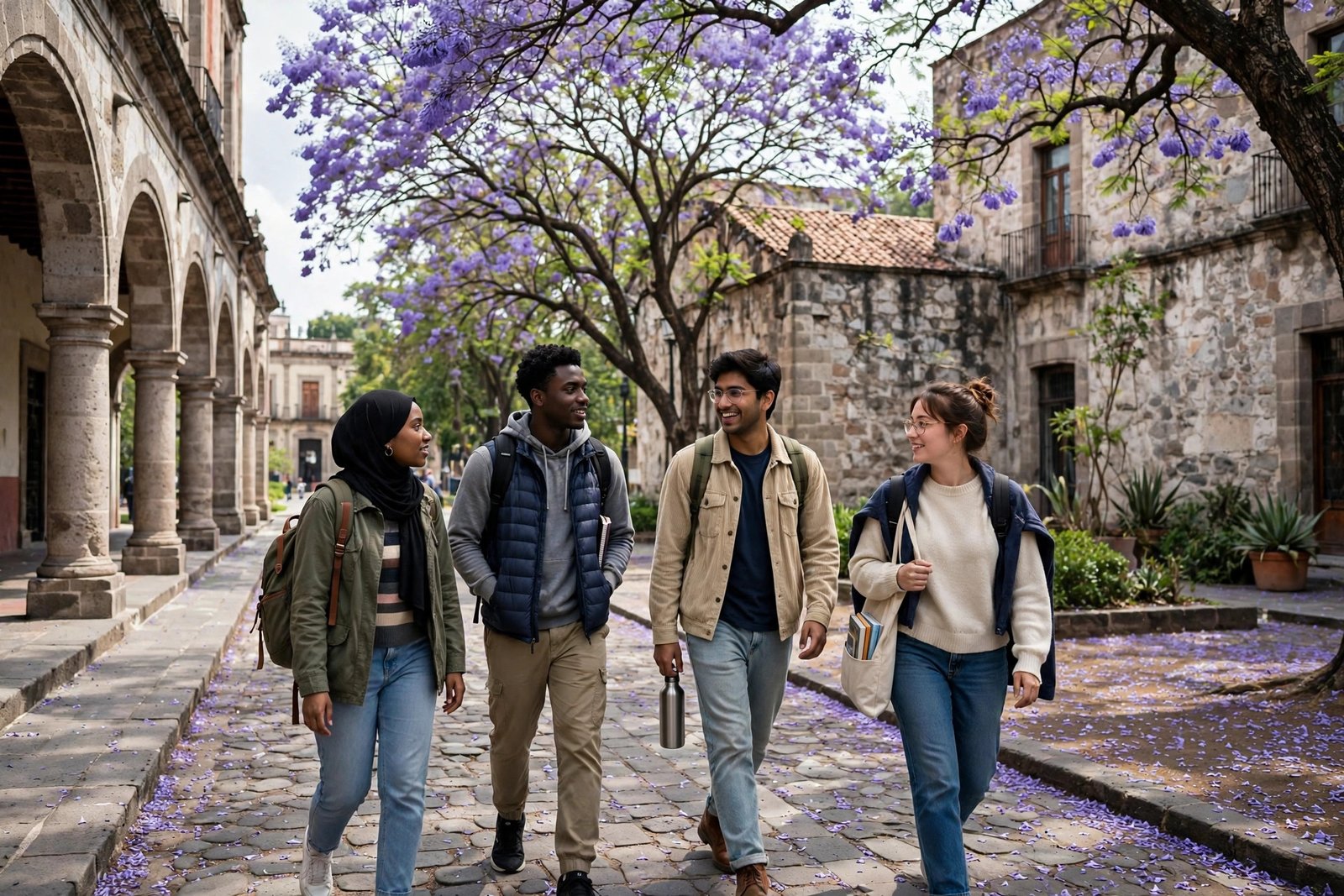
Scholarships in Mexico at a Glance
The table below summarises the flagship AMEXCID Excellence Scholarship as published in the most recent official call. Amounts are tied to Mexico’s UMA index (Unidad de Medida y Actualización), which is updated every February, so the exact peso figure changes each year — the multiples of UMA are the stable part of the offer.
| Item | Details (most recent official call) |
|---|---|
| Scholarship name | Excellence Scholarships of the Government of Mexico for Foreigners |
| Administered by | AMEXCID / Ministry of Foreign Affairs (SRE) |
| Application portal | SIGCA — sigca.sre.gob.mx |
| Who can apply | Foreign nationals from 170+ eligible countries listed in the call’s annexes |
| Levels covered | Undergraduate mobility, master’s mobility, full master’s degrees, doctoral and postdoctoral research stays |
| Monthly stipend — master’s & mobility | 4 × monthly UMA — MXN 14,264.88 per month in the 2026 call |
| Monthly stipend — doctoral & postdoctoral research | 5 × monthly UMA — MXN 17,831.10 per month in the 2026 call |
| Tuition | Enrolment and tuition covered as set out in the host institution’s programme offer |
| Medical insurance | Through IMSS, from the seventh month of the scholarship |
| Visa | Exemption from the Mexican visa fee |
| Travel | Return international flight on successful completion for eligible countries; domestic transport in Mexico where applicable |
| Application language | Spanish — applications and forms must be submitted in Spanish |
| Recent application window | 21 May – 22 June 2026 (2026 call); check the official site for the next cycle |
Beyond AMEXCID, international students in Mexico can also access university-specific support. Large public institutions such as the National Autonomous University of Mexico (UNAM) and the University of Guadalajara, and private institutions such as Tecnológico de Monterrey, run their own scholarship, discount and assistantship schemes, and Mexico’s national science funding system has historically supported postgraduate study at recognised programmes. Those schemes change frequently and are programme-specific, so treat them as supplements to research on each university’s own website rather than as guaranteed funding. The AMEXCID award remains the central, predictable route for a funded master’s degree or research stay in Mexico, and it is the focus of this guide.
Why Study in Mexico as an International Student?
Start with value. Even in Mexico City, a careful student budget — a room in a shared flat, food from local markets and fondas, public transport — can sit comfortably inside the AMEXCID stipend, something that is rarely true of stipends in Northern Europe or North America. Outside the capital, in university cities such as Guadalajara, Monterrey, Puebla, Mérida, Xalapa or Guanajuato, costs fall further. Your stipend stretches, and that breathing room matters over a two-year master’s degree.
Then consider academic breadth. Mexican public universities are comprehensive research institutions with strong traditions in medicine and public health, engineering, agronomy and food science, earth sciences and volcanology, anthropology and archaeology, history, law and the social sciences. If your field touches Latin America — its languages, politics, ecosystems, public health challenges or development questions — there is no substitute for studying it in the region, in Spanish, with Mexican and Latin American classmates. For students from Bangladesh, India, Pakistan, Nepal, Nigeria and Indonesia, Mexico also offers something different from the usual Anglophone destinations: a second global language. Graduating with a master’s degree and professional Spanish opens careers in international development, diplomacy, trade and NGOs across the entire Spanish-speaking world.
Finally, consider the experience itself. Mexico’s cultural depth — its food, festivals, historic cities and regional diversity — makes for a rich two years, and Mexican universities are welcoming places with active international offices used to hosting AMEXCID scholars from more than 170 countries. You will not be the only foreigner on campus, and the SIGCA scholar community is a network in itself.
Eligibility: Who Can Apply for the AMEXCID Scholarship?
Eligibility is defined in detail by each year’s official call (convocatoria), and you must always check the current call on the official AMEXCID call page on gob.mx. The core rules from the most recent calls are as follows.
Nationality. You must be a foreign national of one of the eligible countries listed in the call’s annexes — more than 170 countries in recent calls, spanning Latin America and the Caribbean, Africa, Asia, Europe and the Pacific. If you hold more than one nationality, you must apply under a single eligible nationality. Foreign nationals who also hold Mexican nationality, foreign diplomats accredited in Mexico and their immediate family, and certain other categories named in the call are ineligible.
Residence. Candidates generally cannot be living in Mexico at the time of application, subject to the precise exceptions in the current call (for example relating to a Temporary Resident Student Card). Read that clause carefully if you are already in Mexico.
Academic record. You must hold the degree required for your chosen level — a bachelor’s degree for a master’s programme, a master’s degree for doctoral research — and you must show a minimum grade point average of 80 on a scale of 0 to 100, or the equivalent, for your last completed degree. Some elements of the call, including the acceptance letter requirements, reference a GPA of 85 (8.5 out of 10), so treat 80 as the floor and aim well above it; this is an excellence scholarship and selection is competitive. Technical or commercial titles are not accepted where the call says so.
Acceptance by a Mexican institution. This is the requirement that catches people out. You cannot apply to AMEXCID in the abstract and choose a university later. You must already have an acceptance letter from a participating Mexican higher education institution listed in the call’s Annex 1 — around 90 to 100 institutions in recent calls — for a programme included in that call, and the letter must be recent: issued no more than 60 calendar days before you submit your SIGCA application, showing your programme dates and the required academic average. An acceptance letter from a non-participating institution, or an old letter, will get your application rejected regardless of your grades.
Language. Applications must be submitted in Spanish, and most programmes at Mexican public universities are taught in Spanish. You should expect to demonstrate Spanish proficiency appropriate to your programme. Some programmes are taught partly or wholly in English, but daily life, administration and much of your coursework will run in Spanish, so even English-taught applicants are strongly encouraged to build at least intermediate Spanish before arrival. If your Spanish is currently weak, starting lessons a year before you apply is one of the highest-value things you can do.
Other conditions. Scholarships are not transferable and cannot be deferred to a future year. You apply for a specific programme at a specific institution, and if you win, that combination is fixed — you cannot change university, programme or research project afterwards. Only one application per person is accepted; duplicate applications are automatically disqualified. Applicants who received certain Mexican federal government scholarships in the immediately preceding period may also be ineligible under the current call’s terms.
What the Scholarship Covers — and What It Does Not
Understanding the benefits package precisely is what separates a smooth arrival from a stressful one. Here is each element, as set out in the official call.
Monthly stipend. For master’s scholarships, undergraduate and master’s mobility, and master’s-level research, AMEXCID pays a monthly stipend of four times the monthly UMA — MXN 14,264.88 per month in the 2026 call. For doctoral scholarships and doctoral and postdoctoral research stays, the stipend is five times the monthly UMA — MXN 17,831.10 per month in the 2026 call. In earlier calls the same multiples produced MXN 13,757.84 and MXN 17,197.30 (2025), which shows why you should always quote the multiple and check the current call for the peso figure. Two practical points matter enormously. First, the stipend is paid monthly in arrears — you receive a month’s payment after that month — so AMEXCID itself recommends arriving with enough personal funds to cover at least your first 60 days. Second, there is no separate housing, settling-in or dependants’ allowance: rent, food, transport, books and everything else come out of the stipend.
Enrolment and tuition. AMEXCID covers enrolment and tuition in line with the provisions of each participating institution’s programme, as confirmed in your acceptance letter. At Mexican public universities tuition for postgraduate programmes is generally modest by international standards, which is part of why the overall package works.
Medical insurance. Selected scholars receive medical insurance through the Mexican Social Security Institute (IMSS) — but coverage starts from the seventh month of the scholarship. That six-month gap is real and frequently missed. Arrange private or travel medical insurance for your first six months in Mexico, and budget for it before you fly.
Visa fee exemption. The cost of issuing the Mexican visa is waived for scholarship recipients. You will still need to complete the visa and, after arrival, the temporary resident student process properly and on time — the waiver removes the fee, not the paperwork.
International airfare. For nationals of the countries listed in the relevant annex, AMEXCID provides an economy-class international flight upon successful completion of the scholarship — in other words, your flight home at the end, bought by AMEXCID. Tickets you buy yourself will not be refunded, and changes to the AMEXCID-issued ticket are at your own cost. Your initial flight to Mexico is not covered, so include it in your pre-departure budget.
Domestic transport. If your host institution is outside Mexico City, AMEXCID covers domestic transport from Mexico City to your host city at the start and back at the end. For ground transport, you typically pay the bus fare and claim reimbursement, so keep receipts.

Programmes, Levels and Fields of Study
The AMEXCID call supports several modalities, each with its own maximum duration. Undergraduate mobility is capped at 12 months in the most recent call framework, master’s mobility at up to 12 months, a full master’s degree at up to 24 months, and doctoral and postdoctoral research stays run between a minimum period (typically 3 to 6 months) and 12 months. Full doctoral degrees have been included in some editions of the call with longer durations, so check the modalities table in the current convocatoria carefully — what is offered changes between the general call and specific or regional calls issued during the year.
Fields of study are those offered by the participating institutions in the call’s programme annex. In practice that means a very wide range: engineering and technology, natural sciences, health sciences and medicine, agricultural sciences, social sciences, humanities, law, education, business and public policy. Priority in selection goes to programmes connected to development — the call’s selection criteria reward fields that matter to your home country’s development and that connect to specific projects or needs. A master’s in public health, water resources, renewable energy, agronomy, data science or public policy, with a clear line from your previous studies and work to a development problem at home, fits the scholarship’s purpose far better than a generic choice with no story behind it.
Choosing the institution matters too. UNAM in Mexico City is the country’s flagship research university with enormous breadth. The University of Guadalajara anchors the west, the Autonomous University of Nuevo León anchors Monterrey’s industrial north, and specialised institutes lead in areas such as public health, agriculture and social science research. Because your acceptance letter locks your application to one institution and programme, research two or three options early, confirm they appear in the current call’s annexes, and apply for admission in good time — university admission deadlines fall well before the SIGCA window closes.
While you research programmes, it is worth comparing Mexico with other Spanish- and English-taught destinations in our university directory and checking where Mexican institutions sit in global university rankings.
How to Apply: Step by Step
Step 1 — Read the official call end to end. Download the current convocatoria and its annexes from gob.mx/AMEXCID. Confirm your country is eligible, your target level is offered, and note the exact SIGCA window and document formats. Everything else in the process flows from this document.
Step 2 — Choose your programme and institution. From the call’s Annex 1 list of participating institutions and programmes, pick the programme that best fits your academic history and development rationale. Check the university’s own admission requirements and deadlines.
Step 3 — Secure your acceptance letter. Apply to the Mexican institution and obtain an acceptance letter dated within 60 calendar days of your planned SIGCA submission, showing the programme, start and end dates, and your qualifying average as the call requires. Time your request so the letter is fresh when you submit — a stale letter is a common, entirely avoidable reason for rejection.
Step 4 — Prepare your documents in Spanish. Gather everything listed in the next section, with certified Spanish translations where the call requires them. Applications must be submitted in Spanish, so build translation time into your schedule.
Step 5 — Apply through SIGCA. Register and submit your single application through the Academic Cooperation Management System at sigca.sre.gob.mx within the official window — in the 2026 call, from 21 May until 3:00 p.m. Central Mexico Time on 22 June 2026. Submit well before the deadline; the portal is unforgiving about the closing time and time zones.
Step 6 — Wait for results and formalise. In the 2026 call, results were scheduled for notification in July (the call documents reference 6–10 July), with scholarships beginning between August and early November for a minimum duration of six months. If selected, AMEXCID’s scholarship office will notify you of the formalisation steps, after which you arrange your visa, your arrival flight (at your own cost), your first-six-months medical insurance and your arrival funds.
Required Documents
The exact list is set by the current call and the SIGCA system, but recent calls have required the following core set. Prepare clean scans exactly as specified.
- A copy of your valid passport.
- The signed declaration letter generated or specified in SIGCA.
- A curriculum vitae, completed in a word processor, signed, and no longer than the page limit in the call (four pages in recent calls).
- A medical certificate of good health issued by a public or private health institution, dated no more than three months before submission, with a certified Spanish translation if issued in another language.
- The acceptance letter from the Mexican host institution, meeting the 60-day and content requirements described above.
- A copy of the diploma of your last completed degree, and transcripts showing the required minimum average (mobility applicants at bachelor’s level submit proof of studies for the last completed period instead of a diploma).
- Supporting documents for the studies or research you will carry out — such as a study or research plan — as the call and SIGCA require.
- Any additional forms, photographs or annex documents the current call specifies.
Documents not in Spanish generally need translation into Spanish as the call directs. Keep both the originals and translations, because you may need them again for enrolment and immigration after arrival.
Deadlines and Timeline
| Stage | Timing (based on the 2026 call — confirm for your cycle) |
|---|---|
| Official call published | May 2026 (21 May) |
| SIGCA application window | 21 May – 22 June 2026, closing 3:00 p.m. Central Mexico Time |
| University admission & acceptance letter | Must be obtained before applying; letter dated within 60 days of submission |
| Results notification | July 2026 (call documents reference 6–10 July; other summaries reference early August — always follow the current call) |
| Scholarship start | Between August and early November 2026, per the call |
| Next cycle (2027) | Not yet published at the time of writing — expect a similar spring window and check gob.mx/AMEXCID regularly |
Work backwards from the SIGCA deadline. University admission processes in Mexico run months ahead, Spanish translations take weeks, and a medical certificate must be fresh. A realistic preparation runway is four to six months: shortlist programmes in January, apply to universities in February and March, secure the acceptance letter in May, and submit in SIGCA as early in the window as you can. For a second funded route to compare, see our guide to scholarships in Taiwan for international students, whose government scholarships run on an earlier February–March window that pairs well with Mexico’s spring timeline.
Selection Criteria and How to Improve Your Chances
AMEXCID awards these scholarships on academic excellence, and the call’s selection logic is consistent: your record, the fit between your previous studies and work and the programme you propose, and the relevance of that programme to your home country’s development. Selection committees also consider whether your project connects to specific, real initiatives in your country. To strengthen your application:
- Protect your average. The minimum average is a filter, not a target. Strong transcripts are the foundation of an excellence award.
- Write a development-linked rationale. Explain the concrete problem your studies address at home, the institution or sector you will return to, and why this Mexican programme — specifically — is the right preparation.
- Show continuity. Programmes that grow naturally out of your degree and work experience read as credible. Sudden field changes need explicit justification.
- Invest in Spanish. Demonstrable Spanish progress signals you will succeed in a Spanish-taught classroom and settle well.
- Get the acceptance letter right. Fresh, complete, from a participating institution, with dates and average as required. This administrative detail decides more applications than applicants realise.
- Submit early and once. One clean, complete SIGCA submission, filed days before the deadline, beats a rushed duplicate every time — duplicates are disqualified.
Common Mistakes to Avoid
- Applying without a qualifying acceptance letter, or with a letter older than 60 days, or from a university not in the call’s annexes.
- Missing the Spanish requirement — submitting forms or untranslated documents in English when the call requires Spanish.
- Budgeting as if housing were included. It is not. Rent comes from your stipend.
- Arriving without funds or insurance. The stipend is paid in arrears and IMSS coverage starts in month seven. Arrive with at least 60 days of funds and six months of private medical cover arranged.
- Expecting AMEXCID to pay your arrival flight. The airfare benefit is the return flight on successful completion for eligible countries, purchased by AMEXCID — self-bought tickets are not refunded.
- Submitting duplicate SIGCA applications or applying under two nationalities. One person, one application.
- Assuming the scholarship can be deferred or transferred. It cannot — if you cannot start in the awarded window, you lose the award.
- Trusting last year’s peso figures. The stipend follows the UMA index. Always quote the current call.
Frequently Asked Questions
Is the AMEXCID scholarship fully funded?
It covers tuition and enrolment, a monthly stipend (MXN 14,264.88 at master’s level in the 2026 call), IMSS medical insurance from month seven, the visa fee, domestic transport where applicable and a return flight on successful completion for eligible countries. It does not include a housing allowance, your arrival flight, or medical cover for the first six months, so “fully funded with gaps you must budget for” is the accurate description.
How much is the monthly stipend in Mexico for scholarship students?
Four times the monthly UMA for master’s and mobility awards — MXN 14,264.88 per month in the 2026 call — and five times the monthly UMA for doctoral and postdoctoral research — MXN 17,831.10 per month in 2026. The peso amount changes each February when the UMA is updated.
Do I need to speak Spanish to study in Mexico on a scholarship?
In practice, yes. Applications must be submitted in Spanish and most programmes at Mexican public universities are taught in Spanish. Some programmes offer English-taught elements, but you should plan to reach at least intermediate Spanish, and start learning well before you apply.
Can I apply if I am already living in Mexico?
Generally, candidates cannot be living in Mexico at the time of application, subject to specific exceptions in the current call. Check the residence clause of the current convocatoria carefully before applying.
What GPA do I need for the Mexico government scholarship?
A minimum average of 80 on a 0–100 scale (or equivalent) for your last degree is required, and acceptance letter requirements in the call reference 85 (8.5/10). Because this is an excellence scholarship, successful applicants typically present averages well above the minimum.
When should I apply for scholarships in Mexico for 2026/2027?
The 2026 call ran from 21 May to 22 June 2026 in SIGCA, with studies starting between August and November. For the next cycle, expect a similar spring window, prepare from January, and confirm the exact dates on the official AMEXCID page as soon as the new call is published.
Can I change my university or programme after winning?
No. The scholarship is tied to the institution, programme and period in your application. None of these can be modified after the award, and the scholarship cannot be deferred to a future year.
Does the scholarship cover my flight to Mexico?
No. For eligible countries, AMEXCID provides an economy flight upon successful completion of your studies — your return home. You fund your own travel to Mexico at the start, and AMEXCID will not refund tickets you purchase yourself.
Sources & Verification
This guide was prepared from the following official and institutional sources, checked at the time of writing: the official AMEXCID call page for the Excellence Scholarships on gob.mx/AMEXCID; the SIGCA application portal at sigca.sre.gob.mx; and institutional summaries of the 2026 call, including the Universitas Gadjah Mada Office of International Affairs notice on the 2026 AMEXCID call. Stipend figures are quoted from the 2026 call (4 × UMA = MXN 14,264.88; 5 × UMA = MXN 17,831.10) and will change when the UMA is next updated.
Disclaimer: Scholarship details, amounts, eligible countries and deadlines change with each annual call. Always confirm the current figures, annexes and dates on the official AMEXCID website before applying. StudyGraduate is an independent information portal, not an agency, a university or a government body, and we cannot promise or influence selection, admission or visa approval for any applicant.
✅ Eligibility Criteria
- Check the official website for full eligibility criteria for your country
🎁 Benefits
- See the official website for the complete list of benefits
⚙️ Application Process
- 1Check your eligibility on the official site
- 2Prepare your documents and statements
- 3Submit the online application before the deadline
- 4Complete interviews or assessments if shortlisted
- 5Await the final selection announcement
📅 Important Dates
Deadlines vary by country and intake. Check the official website for country-specific dates.
📄 Required Documents
- Valid passport
- Academic transcripts & certificates
- Statement of purpose
- Letters of recommendation
- CV / resume
Commonly required — confirm the exact list on the official site.
❓ Frequently Asked Questions

Ready to Take the Next Step?
Explore more scholarships and study opportunities around the world.
Browse Scholarships →