Scholarships in Taiwan for International Students 2026/2027
Scholarships in Taiwan for International Students 2026/2027 Taiwan has quietly become one of Asia’s best-value destinations for a funded degree. Its universities are strong in engineering, semiconductors, computer science, medicine, public health, agriculture and business; tuition is moderate by international standards; cities such as Taipei, Hsinchu, Taichung, Tainan and Kaohsiung are safe, efficient and student-friendly; ... <a title="Scholarships in Taiwan for International Students 2026/2027" class="read-more" href="https://studygraduate.com/scholarship/scholarships-in-taiwan-for-international-students-2026-2027/" aria-label="Read more about Scholarships in Taiwan for International Students 2026/2027">Read more</a>
📖 Overview
Scholarships in Taiwan for International Students 2026/2027
Taiwan has quietly become one of Asia’s best-value destinations for a funded degree. Its universities are strong in engineering, semiconductors, computer science, medicine, public health, agriculture and business; tuition is moderate by international standards; cities such as Taipei, Hsinchu, Taichung, Tainan and Kaohsiung are safe, efficient and student-friendly; and the Taiwanese government runs not one but several scholarship systems for international students. If you understand how those systems fit together — the Ministry of Education (MOE) Taiwan Scholarship, the Ministry of Foreign Affairs (MOFA) Taiwan Scholarship, the TaiwanICDF International Higher Education Scholarship, the Huayu Enrichment Scholarship for Mandarin study, and university scholarships on top — you can build a funding package that covers most or all of the cost of a bachelor’s, master’s or doctoral degree.
This guide explains scholarships in Taiwan for international students for the 2026/2027 cycle. It sets out what each government scholarship pays in New Taiwan dollars, who is eligible, how long each award lasts, when applications open and close, and how the two-track application works — because in Taiwan you almost always apply for the scholarship and for university admission separately, at the same time. It also explains, honestly, what these scholarships do not cover, so you can budget for the remainder instead of discovering it after you arrive.
The headline figures, verified from official sources at the time of writing, are these. The MOE Taiwan Scholarship pays a monthly living stipend of NT$15,000 for undergraduate students and NT$20,000 for master’s and doctoral students, plus tuition and miscellaneous expenses of up to NT$40,000 per semester. The MOFA Taiwan Scholarship pays a single monthly stipend of NT$33,000 for degree programmes (NT$28,000 during an optional pre-degree Mandarin Language Enrichment Programme) and provides economy airfare. The TaiwanICDF scholarship, for students from partner countries admitted to specific English-taught programmes, covers airfare, dormitory housing, tuition and credit fees, insurance and textbooks, plus a monthly allowance of NT$15,000 to NT$20,000 depending on level. Each scheme has different eligibility, and choosing the right one is the first real decision of your application.
As you read, keep our broader scholarships directory open for comparisons, browse Taiwanese institutions alongside others in our university directory, and see the companion guide to fully funded scholarships in Taiwan if your goal is a package that covers airfare and housing as well as tuition and living costs.
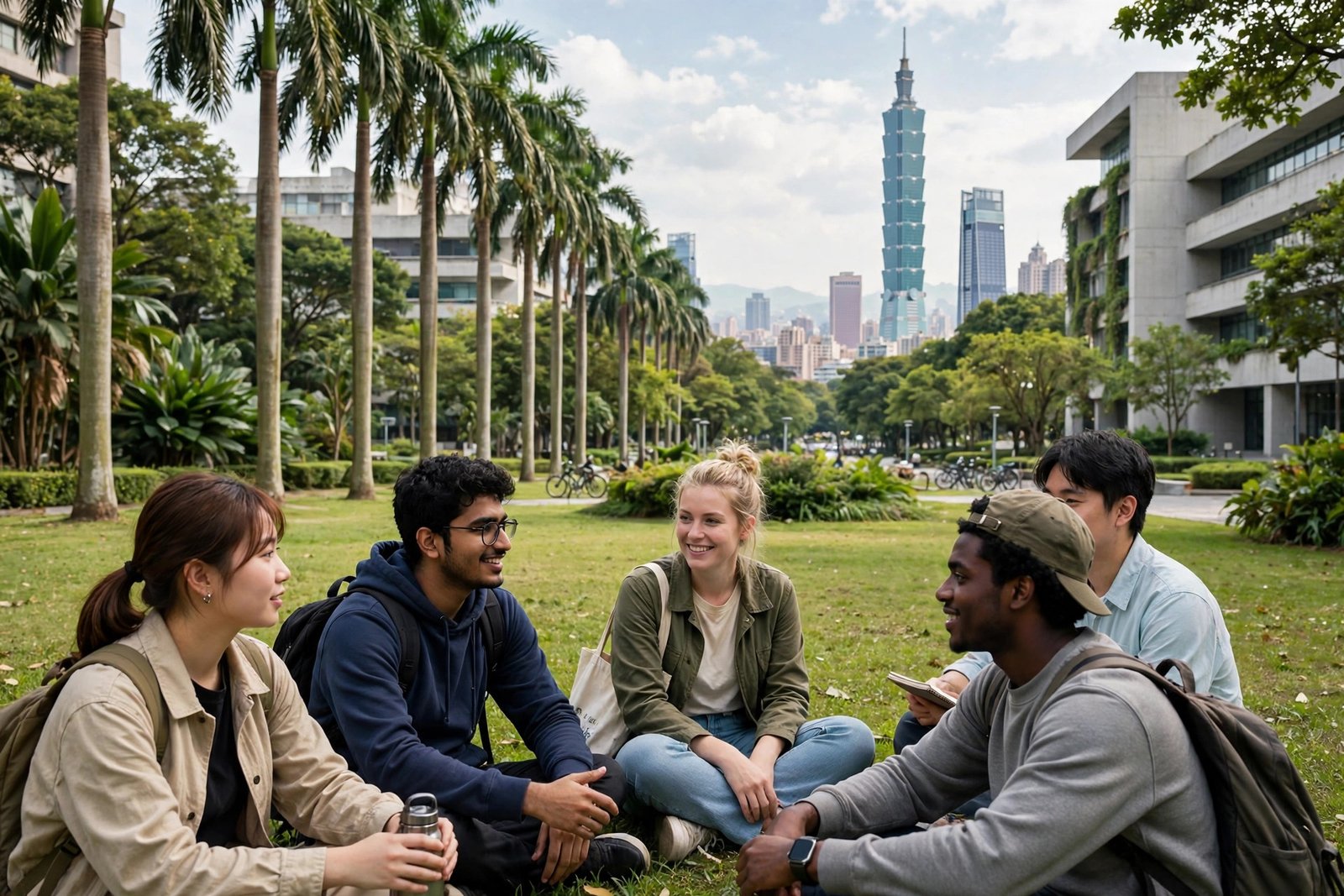
Scholarships in Taiwan at a Glance
| Scholarship | Monthly stipend | Tuition support | Other key benefits | Typical application window |
|---|---|---|---|---|
| MOE Taiwan Scholarship | NT$15,000 (undergraduate); NT$20,000 (master’s & doctoral) | Up to NT$40,000 per semester toward approved tuition and miscellaneous expenses | Some universities add their own fee discounts | 1 February – 31 March |
| MOFA Taiwan Scholarship | NT$33,000 (degree); NT$28,000 (Mandarin LEP) | Paid from the stipend; some universities offer reduced fees | Economy airfare to and from Taiwan provided by MOFA | 1 February – 31 March |
| TaiwanICDF Scholarship | NT$15,000 (bachelor’s); NT$18,000 (master’s); NT$20,000 (PhD) | Full tuition and credit fees for partner programmes | Round-trip airfare, dormitory housing, insurance, textbook costs | Early December – 15 March |
| Huayu Enrichment Scholarship (MOE) | NT$28,000 per month (per the official scholarship comparison table) | Not applicable — language study only | Supports Mandarin study at approved language centres | 1 February – 31 March (varies by office) |
| University scholarships (e.g. NTU) | Varies — NTU examples from NT$8,000 per month at master’s level | Varies — NTU tuition waivers up to NT$65,000 per semester in published schemes | Set by each university; often combined with admission | With university admission rounds |
Two warnings belong right under this table. First, eligibility differs sharply by scheme: the MOFA scholarship is principally for nationals of countries with diplomatic relations with Taiwan or countries recognised by MOFA as friendly, while the MOE scholarship is open much more widely — but neither is open to nationals of the Republic of China (Taiwan), and MOE excludes students from Mainland China, Hong Kong and Macao. Second, no Taiwan government scholarship guarantees university admission. You must win a place at a Taiwanese university separately, and if you are not admitted, the scholarship cannot be used.
Why Study in Taiwan?
Taiwan’s case starts with academic strength in areas the world wants. It is a global centre for semiconductors and electronics, with universities deeply connected to industry in Hsinchu Science Park and beyond; its engineering, computer science and materials programmes feed directly into that ecosystem. Its medical and public health schools are research-intensive, its agriculture and aquaculture programmes are internationally respected — one reason TaiwanICDF funds so many students in those fields — and its business and management schools serve one of Asia’s most dynamic economies. Institutions such as National Taiwan University (NTU) in Taipei, National Tsing Hua University and National Yang Ming Chiao Tung University in Hsinchu, National Cheng Kung University in Tainan and National Sun Yat-sen University in Kaohsiung appear consistently in global university rankings.
Cost is the second reason. Even in Taipei, a student who lives in a dormitory or a shared flat, eats at the inexpensive restaurants and night markets that feed every Taiwanese campus, and uses the metro and bus network will find a monthly budget that a NT$20,000 postgraduate stipend can realistically support — especially with tuition largely covered. Outside Taipei, costs are lower again. Add an excellent public health system, a very safe environment, efficient transport, and a society that is notably welcoming to foreign students, and Taiwan competes with destinations that cost two or three times as much.
The third reason is language and career optionality. Many master’s and doctoral programmes — and all TaiwanICDF partner programmes — are taught in English, so you can complete a degree without prior Mandarin. At the same time, Taiwan gives you the chance to learn Mandarin properly, including through the Huayu Enrichment Scholarship and the MOFA scholarship’s optional language year, and graduates with Mandarin plus a technical degree hold a genuinely scarce combination in the global job market.
The Main Scholarships, Explained One by One
MOE Taiwan Scholarship
The Ministry of Education Taiwan Scholarship is the main route for most international applicants, including students from Bangladesh, India, Pakistan, Nepal, Nigeria and Indonesia. It encourages outstanding international students to undertake undergraduate and postgraduate degree studies in Taiwan. Under the official Taiwan Scholarship guidelines on taiwanscholarship.moe.gov.tw, each recipient receives tuition and miscellaneous expense support of up to NT$40,000 per semester, plus a monthly living stipend of NT$15,000 for undergraduate study or NT$20,000 for master’s and doctoral study. If your programme’s approved tuition and miscellaneous fees exceed NT$40,000 in a semester, you pay the difference yourself — unless your university grants you an additional discount, as some do; National Yang Ming Chiao Tung University, for example, publishes an additional grant for MOE recipients whose fees exceed the MOE ceiling.
Note what the MOE award does not pay: administration fees, thesis supervision fees, insurance premiums, accommodation and internet access are expressly the recipient’s responsibility. Your stipend must therefore cover rent and those extras. Maximum durations are four years for a bachelor’s degree, two years for a master’s and four years for a doctorate, with a total limit of five years of Taiwan Scholarship support across combined studies. The scholarship year runs from 1 September to 31 August, and you must maintain the academic performance your university and the scholarship directions require to keep it.
MOFA Taiwan Scholarship
The Ministry of Foreign Affairs Taiwan Scholarship supports students from countries that have diplomatic relations with Taiwan, or that MOFA has recognised as having friendly relations with Taiwan. That nationality condition is decisive: if your country is not on MOFA’s list, this scholarship is not open to you, however strong your grades are — check the list first, before investing effort. For eligible applicants, the package is simple and comparatively generous. As published by Taiwan’s overseas offices for the 2026 cycle, recipients receive a monthly stipend of NT$33,000 for degree programmes, or NT$28,000 during the optional pre-degree Mandarin Language Enrichment Programme (LEP) of up to one year, and MOFA provides economy-class air tickets for direct flights to and from Taiwan. There is no separate tuition grant: tuition, housing, insurance, books and everything else are paid out of the stipend, although universities may offer MOFA recipients reduced tuition and miscellaneous fees. Durations mirror the MOE pattern — up to four years undergraduate, two years master’s, four years doctoral — with the LEP year counting toward a total award period that cannot exceed five continuous years.
TaiwanICDF International Higher Education Scholarship
The TaiwanICDF scholarship is the most complete package of the three, and also the most restricted. Run by the International Cooperation and Development Fund through the Taiwan International Cooperation Alliance (TICA), it funds citizens of TaiwanICDF partner countries to study on a specific list of English-taught partner programmes — 32 programmes in the 2026 guidebook — at partner universities. In return for that restriction, it covers round-trip economy airfare, student dormitory housing, full tuition and credit fees, insurance, and approved textbook costs, plus a monthly allowance of NT$15,000 for bachelor’s students, NT$18,000 for master’s students and NT$20,000 for PhD students. Students must live in the dormitory provided. Applications for the 2026 cycle ran from 1 December 2025 to 15 March 2026, and the same December-to-March pattern is the one to plan for. Because the eligible country list and programme list are republished each cycle, verify both in the current TaiwanICDF guidebook before assuming you can apply.
Huayu Enrichment Scholarship
If your goal is Mandarin rather than a degree — or you want a language year before a degree — the MOE Huayu Enrichment Scholarship funds study at approved Mandarin language centres affiliated with Taiwanese universities. The official scholarship comparison table lists a monthly stipend of NT$28,000. Terms of two, three, six, nine or twelve months are awarded depending on the office and cycle. It does not fund a degree, and MOFA LEP students cannot also hold Huayu for the same purpose, but as a standalone route into Taiwan and into Mandarin it is excellent, and many degree students first came to Taiwan on Huayu.
University Scholarships
Every major Taiwanese university runs its own international student scholarships, usually awarded through the admission application itself — you tick a box or are automatically considered, rather than filing a separate scholarship application. National Taiwan University’s published schemes illustrate the range: tuition waivers of up to NT$65,000 per semester with monthly stipends that vary by scheme and level (for example NT$8,000 per month in its undergraduate and master’s scholarship summaries, with higher published amounts for some doctoral and college-specific schemes), subject to GPA renewal conditions. Other universities publish similar combinations of full or partial tuition waivers and stipends. University scholarships matter for two reasons: they are a fallback if a government application fails, and they can top up a government award where the rules allow. Always read the scholarship page of the specific university you are applying to — the NTU Office of International Affairs scholarships FAQ is a good model of the detail to look for.
Eligibility: Who Can Apply?
Across the MOE and MOFA schemes, the common eligibility core — set out in the official directions — is that you must be a foreign national with a high school diploma or higher qualification, an excellent academic record, good moral character and no criminal record. You must not be a national of the Republic of China (Taiwan) or an overseas compatriot student; you must not have previously studied in Taiwan at the same degree level you are applying for (with the exceptions the directions specify); you must not be an incoming exchange student under a cooperation agreement while holding the scholarship; and you must not previously have had a Taiwan government scholarship revoked. The MOE scholarship additionally excludes students from Mainland China, Hong Kong and Macao, while the MOFA scholarship adds its diplomatic-relations or friendly-countries nationality condition, and TaiwanICDF restricts eligibility to its partner-country list.
Academic and language requirements sit partly with the scholarship and partly with the university. Your chosen university sets its own entry requirements, English or Mandarin proficiency thresholds and document rules, and you must satisfy them independently. Programmes taught in Mandarin will expect evidence of Chinese proficiency (commonly TOCFL), and English-taught programmes will expect English evidence (such as TOEFL or IELTS, or a medium-of-instruction certificate where the university accepts one). There is no single GPA number in the MOE directions — “excellent academic performance” is the standard, and the representative office in your country, which makes the first selection, will compare you with other applicants from your country. In practice, aim for a strong first-class record and a coherent study plan.
How to Apply: The Two-Track Process
Track one — the scholarship. For MOE and MOFA scholarships, applications are made through the Taiwan representative office (embassy, consulate or Taipei Economic and Cultural Office) serving your country, using the online application at taiwanscholarship.moe.gov.tw/Apply during the window that office announces — for the 2026 cycle, 1 February to 31 March 2026 in most offices. Offices typically require the printed, signed online form plus supporting documents to be delivered or posted to the office by the deadline, and some offices add requirements of their own, such as emailed recommendation letters by a stated date. Your office’s announcement is the controlling document — read it in full.
Track two — university admission. At the same time, apply directly to your chosen Taiwanese university or universities for admission to the degree programme, following each university’s international student application rounds and deadlines, which often fall between November and March for autumn entry. Admission and scholarship are decided separately. The typical sequence is that the representative office notifies preliminary scholarship selections around the end of May, and selected candidates must then submit a copy of their university admission letter to the office by a deadline around the end of June to confirm the award. No admission letter, no scholarship — which is why applying to the university early and, where sensible, to more than one university is essential risk management.
TaiwanICDF is different. You apply online through the TaiwanICDF system and simultaneously to the partner programme, within the December to mid-March window, and you may only choose from the listed partner programmes. The ICDF and the university review in coordination, and the process, documents and medical requirements follow the cycle’s guidebook.
Required Documents
Exact lists come from your representative office and your university, but a complete Taiwan scholarship file typically contains:
- The completed, printed and signed online scholarship application form.
- A copy of your passport and, where requested, household or nationality documentation.
- Your highest diploma and complete transcripts, verified or authenticated as your office requires (offices commonly require authentication by the Taiwan representative office).
- A study plan in Chinese or English, explaining your programme choice and goals.
- Two letters of recommendation, in sealed envelopes or submitted by the route your office specifies.
- Proof that you have applied to a Taiwanese university — and, when issued, your admission letter, by the confirmation deadline.
- Language proficiency evidence appropriate to your programme’s medium of instruction.
- For TaiwanICDF: the additional forms, financial and medical documents the guidebook specifies.
Authentication is the step applicants underestimate. Documents may need verification by your foreign ministry and authentication by the Taiwan office, which takes weeks and cannot be done the night before the deadline. Start it in January at the latest for a March deadline.
Deadlines and Timeline
| Stage | MOE / MOFA scholarships | TaiwanICDF |
|---|---|---|
| Applications open | 1 February | 1 December (previous year) |
| Scholarship deadline | 31 March (most offices — confirm yours) | 15 March |
| University admission applications | Apply in parallel — many rounds close between November and March for autumn entry | |
| Preliminary selection notified | By 31 May (typical) | Per guidebook schedule |
| Admission letter confirmation | By 30 June (typical) | Per guidebook schedule |
| Scholarship year begins | 1 September (MOE); 1 August (MOFA award period) | With the academic year |
For 2026/2027 entry, those dates mean the working season is December to March — uncomfortably close to the New Year holidays in many countries, which is another reason to prepare documents in the autumn. If you are reading this after March, your realistic target is the following cycle, and the best use of the intervening months is university research, document authentication and language study. Our study abroad guides and application tools can help you build that preparation timeline.
Selection: How Decisions Are Made and How to Strengthen Yours
Representative offices review applications, may interview shortlisted candidates, and select principal candidates plus a waiting list, within quotas set for each country. Universities separately decide admission. Selection therefore rewards three things at once: academic excellence, a study plan that makes sense for you and for relations between your country and Taiwan, and a file that is complete, authenticated and on time. Practical ways to strengthen your position: choose a programme that visibly builds on your previous degree rather than restarting your career; name the specific strengths of the Taiwanese university — a laboratory, a research centre, an industry link — that justify studying there; write a study plan with a beginning (preparation and language), a middle (coursework and research) and an end (what you will do with the degree); secure recommenders who know your work in detail; and apply to the university early enough that an admission letter is realistically in hand by the June confirmation deadline. If you are eligible for more than one scheme, apply to the one whose conditions you genuinely meet — MOFA if your country qualifies and you want the higher single stipend and airfare, ICDF if your country and field are on its lists and you want the fullest package, MOE as the broadly open default — rather than scattering weak applications everywhere. Note that you generally cannot hold another ROC government scholarship in the same year as one of these awards; university awards and government awards interact under rules your university can confirm.
Common Mistakes to Avoid
- Applying for the scholarship but not for admission — or applying to the university too late for the June confirmation deadline.
- Assuming MOFA is open to everyone. Its nationality list is limited. Check it first.
- Assuming TaiwanICDF is open to every programme. It funds listed partner programmes for listed partner countries only.
- Missing authentication. Unauthenticated diplomas and transcripts are a leading cause of incomplete files.
- Budgeting as if MOE covered everything. Fees above NT$40,000 per semester, accommodation, insurance, thesis and administration fees are yours.
- Ignoring your own office’s announcement. Deadlines, document delivery and extra requirements (such as where recommendation letters must be sent) are set office by office.
- Waiting for the scholarship result before applying to universities. The two tracks run in parallel by design.
- Planning to combine government scholarships. Holding another Taiwan government scholarship in the same year generally makes you ineligible.
Frequently Asked Questions
How much does the Taiwan Scholarship pay per month?
The MOE Taiwan Scholarship pays NT$15,000 per month for undergraduate students and NT$20,000 per month for master’s and doctoral students, plus up to NT$40,000 per semester toward tuition and miscellaneous expenses. The MOFA scholarship pays NT$33,000 per month for degree programmes. TaiwanICDF pays NT$15,000, NT$18,000 or NT$20,000 per month by level, within a fuller package.
When do Taiwan Scholarship applications open and close?
For MOE and MOFA, most representative offices open applications on 1 February and close on 31 March each year. TaiwanICDF opens in early December and closes on 15 March. Always confirm the exact dates in your own representative office’s announcement for your cycle.
Can I apply for a Taiwan Scholarship without a university admission letter?
You can start the scholarship application with proof that you have applied to a university, but the award is only confirmed once you submit an admission letter by the office’s confirmation deadline, typically the end of June. Scholarship and admission are separate decisions, and both are required.
Do I need to speak Mandarin to study in Taiwan on a scholarship?
Not necessarily. Many master’s and doctoral programmes, and all TaiwanICDF partner programmes, are taught in English. Programmes taught in Mandarin require Chinese proficiency evidence. The MOFA scholarship also offers an optional pre-degree Mandarin year (LEP) at NT$28,000 per month, and the Huayu Enrichment Scholarship funds standalone Mandarin study.
Is the Taiwan Scholarship fully funded?
TaiwanICDF comes closest: airfare, dormitory housing, tuition, credit fees, insurance, textbooks and a monthly allowance. MOE covers tuition up to a semester cap plus a living stipend, but not housing or insurance. MOFA provides a higher stipend and airfare but no separate tuition grant. Our companion guide to fully funded scholarships in Taiwan analyses each package in detail.
Can students from Bangladesh, India, Pakistan or Nigeria apply?
Yes for the MOE Taiwan Scholarship, subject to the general eligibility rules — apply through the Taiwan representative office serving your country. MOFA eligibility depends on its diplomatic and friendly-countries list, and TaiwanICDF depends on its partner-country list, so check those lists for your nationality before relying on either scheme.
How long can I hold a Taiwan Scholarship?
Up to four years for a bachelor’s degree, two years for a master’s and four years for a doctorate, with a maximum total of five years of scholarship support across combined programmes. MOFA’s total, including the optional language year, is likewise capped at five continuous years.
Can I work part-time in Taiwan on a scholarship?
International students in Taiwan may work part-time only with a valid work permit, within the hours the regulations allow, and scholarship recipients must also respect their scholarship’s conditions and academic requirements. Apply for the permit through the proper channel before starting any job, and confirm the current rules with your university’s international office.
Sources & Verification
This guide was prepared from official sources checked at the time of writing: the Taiwan Scholarship and Huayu Enrichment Scholarship guidelines and comparison table on the official scholarship website; the MOE Taiwan Scholarship Program Directions as published in Taiwan’s laws and regulations database; 2026 cycle announcements from Taiwan’s overseas offices, including the Taipei Representative Office in the UK announcement of the 2026 MOFA and MOE scholarships; university-published scholarship details, including those of National Yang Ming Chiao Tung University’s Office of International Affairs and the NTU Office of International Affairs; and the TaiwanICDF scholarship benefit details hosted by Taiwan’s overseas offices. Where secondary summaries of the 2026 TaiwanICDF guidebook were used for the current allowance figures (NT$15,000/18,000/20,000), the text identifies them as current-cycle figures to be confirmed in the official guidebook.
Disclaimer: Scholarship amounts, eligible country lists, programme lists and deadlines change with each annual cycle. Always confirm the current details on the official scholarship website, with your Taiwan representative office, and in the TaiwanICDF guidebook before applying. StudyGraduate is an independent information portal, not an agency, a university or a government body, and we cannot promise or influence selection, admission or visa approval for any applicant.
✅ Eligibility Criteria
- Check the official website for full eligibility criteria for your country
🎁 Benefits
- See the official website for the complete list of benefits
⚙️ Application Process
- 1Check your eligibility on the official site
- 2Prepare your documents and statements
- 3Submit the online application before the deadline
- 4Complete interviews or assessments if shortlisted
- 5Await the final selection announcement
📅 Important Dates
Deadlines vary by country and intake. Check the official website for country-specific dates.
📄 Required Documents
- Valid passport
- Academic transcripts & certificates
- Statement of purpose
- Letters of recommendation
- CV / resume
Commonly required — confirm the exact list on the official site.
❓ Frequently Asked Questions

Ready to Take the Next Step?
Explore more scholarships and study opportunities around the world.
Browse Scholarships →