Scholarships for Indian Students in Germany 2026/2027
Scholarships for Indian Students in Germany 2026/2027 Germany is the most affordable major study destination for Indian students, for a simple structural reason: most public universities charge no tuition fees for consecutive bachelor’s and master’s programs, so a scholarship in Germany mainly has to cover your living costs rather than a large tuition bill. The ... <a title="Scholarships for Indian Students in Germany 2026/2027" class="read-more" href="https://studygraduate.com/scholarship/scholarships-for-indian-students-in-germany-2026-2027/" aria-label="Read more about Scholarships for Indian Students in Germany 2026/2027">Read more</a>
📖 Overview
Scholarships for Indian Students in Germany 2026/2027
Germany is the most affordable major study destination for Indian students, for a simple structural reason: most public universities charge no tuition fees for consecutive bachelor’s and master’s programs, so a scholarship in Germany mainly has to cover your living costs rather than a large tuition bill. The flagship funder is the German Academic Exchange Service (DAAD), whose EPOS program — Development-Related Postgraduate Courses — pays Indian master’s students €992 per month and doctoral candidates €1,300 per month, rising to €1,400 per month from February 2026, alongside insurance, travel support and possible rent and family subsidies. Around DAAD sits a second layer of funding that Indian students often miss: the Deutschlandstipendium (€300 per month, open to all nationalities), Germany’s political and church foundations, DAAD research grants and internships designed for Indian students, and paid research-assistant and industry positions that are a normal part of German student life.
This guide is written for citizens of India applying for 2026/2027 entry. It covers the scholarships Indians are genuinely eligible for, the two India-specific hurdles that shape every application — the APS certificate, mandatory for most Indian qualifications since November 2022, and the blocked account of €11,904 per year used to prove living costs for the visa — and a realistic step-by-step timeline. It also states plainly what scholarships do not do: an APS certificate is still required for most applicants even with funding, and a scholarship letter does not replace the visa process.

Scholarships for Indian Students in Germany at a Glance
| Scholarship / funding route | Level | Value | Open to Indian citizens? | Key condition |
|---|---|---|---|---|
| DAAD EPOS | Master’s and PhD (listed development-related courses only) | €992/month (master’s); €1,300/month doctoral, €1,400/month from February 2026; plus insurance, travel allowance, possible rent and family subsidies | Yes — India is on the DAAD list of eligible developing and emerging countries | Bachelor’s degree (normally within the last 6 years) plus at least 2 years of relevant professional experience |
| DAAD research grants and study scholarships | PhD, postdoc and research stays | Monthly payments set by the current call; check the DAAD scholarship database for the exact rate | Yes | Apply through the DAAD portal for the specific call; separate India-relevant lines are published by DAAD India |
| DAAD WISE (Working Internships in Science and Engineering) | Research internships for enrolled Indian bachelor’s/master’s students | Monthly subsistence payment plus travel contribution, set by the current call | Yes — designed for students at selected Indian institutions | You must be enrolled at an eligible Indian institution and find a German host professor |
| Deutschlandstipendium | Bachelor’s, master’s and PhD at participating universities | €300/month for at least two semesters, renewable | Yes — all nationalities | Apply through your German university after (or alongside) admission; merit plus engagement and personal circumstances |
| Political and church foundations (e.g. Heinrich Böll, Konrad Adenauer, Friedrich Ebert, KAAD) | Master’s and PhD mainly | Monthly stipends broadly aligned with national student funding rates, plus allowances; exact amounts on each foundation’s site | Yes, with conditions — several foundations require German language skills (Böll requires proof of German, B2/DSH-2 level) | Values alignment with the foundation, academic excellence and social or political engagement |
| Erasmus+ (for joint/European programs with a German university) | Master’s mainly | Monthly allowance plus participation costs under the current Erasmus Mundus rules | Yes | Apply to the specific Erasmus Mundus joint master’s consortium |
Shortlist German universities in our university directory — including profiles such as the Technical University of Munich — and compare them in the world rankings before choosing EPOS courses or foundation targets.
Eligibility: What Indian Applicants Must Show
The baseline is academic. For master’s entry, German universities expect an Indian bachelor’s degree in a relevant subject — typically a four-year degree, or a three-year degree plus a master’s, depending on the program and the anabin database assessment of your institution and qualification. For EPOS specifically, DAAD requires an above-average first degree, at least two years of relevant professional experience gained after that degree, and a degree that is normally no more than six years old at the application deadline. Fresh graduates without work experience are therefore not EPOS candidates, however strong their marks; they should target regular admission (which is tuition-free at most public universities anyway), the Deutschlandstipendium once enrolled, and foundation funding where they meet the criteria.
Language depends on the program. English-taught programs usually require IELTS or TOEFL at the level the university sets, commonly around IELTS 6.0–6.5. Foundation scholarships are stricter: the Heinrich Böll Foundation, for example, funds non-EU students only at master’s and doctoral level and requires proven German proficiency at B2/DSH-2 level, because its scholars are expected to participate in German-language academic and civic life. Do not assume an English-taught degree makes German unnecessary for funding — for several foundations it is a hard filter.
Two India-specific requirements sit underneath everything. The first is the APS certificate (see below). The second is proof of living costs for the visa: unless you hold a full scholarship covering your living expenses, you will normally open a blocked account (Sperrkonto) showing €11,904 for one year (2026 figure), from which you can withdraw €992 per month after arrival.
The APS Certificate: India’s Mandatory First Step
Since 1 November 2022, applicants whose school-leaving or degree qualifications were awarded in India generally need a certificate from the Academic Evaluation Centre (APS India), run at the German Embassy in New Delhi in cooperation with DAAD, before a German student visa application will be processed. APS verifies that your Indian academic documents are genuine; it does not decide admission, which remains the university’s decision. Apply through the official APS India website as early as possible — ideally before or in parallel with university applications — because processing takes several weeks and stretches longer in peak season, and the fee (published on the APS India site; recently ₹18,000) is non-refundable.
Not everyone needs APS. Published exemptions include doctoral applicants, applicants whose qualifications are non-Indian (for example an International Baccalaureate or a British bachelor’s degree), and — importantly for this guide — applicants who have received a scholarship or stipend from German or EU public funds. That exemption can help fully funded DAAD scholars, but it does not apply to most master’s applicants, and you should never assume you are exempt without checking the current APS India guidance for your exact category. Universities may also ask to see the APS certificate during admission, separate from the visa. Treat APS as step zero of a Germany application from India, not as a final formality.
DAAD EPOS in Detail
EPOS funds a published list of English-taught (and some German-taught) development-related master’s and doctoral courses at German universities — in fields such as development economics, public health, renewable energy, water management, agricultural sciences, governance and engineering. India is on DAAD’s eligible-country list for the program. You apply directly to the university course, not to DAAD headquarters, and you may apply to a limited number of EPOS courses in one cycle; each course sets its own deadline, many falling between June and October of the year before the course starts, so the 2027/2028 course list and its deadlines should be checked on the DAAD website as soon as they are published.
The funding package for the current cycle pays €992 per month for master’s scholars and €1,300 per month for doctoral scholars, with the doctoral rate rising to €1,400 per month from February 2026 under current calls. It also covers health, accident and personal liability insurance, a travel allowance between India and Germany, and, under conditions, a monthly rent subsidy and allowances for an accompanying spouse and children. Because most EPOS courses are at public universities with no tuition, the stipend is genuinely sufficient to live on in most German cities if you budget normally — Munich and Hamburg are the expensive exceptions where the rent subsidy and early housing applications matter.
Selection is competitive and development-focused. Committees look for a coherent story: relevant work experience, a course that logically builds on it, and a credible plan to apply the qualification in a development-related role afterwards. A generic motivation letter copied across courses is the most common reason strong Indian applicants are rejected; each EPOS course wants to see why that specific curriculum fits your professional trajectory.
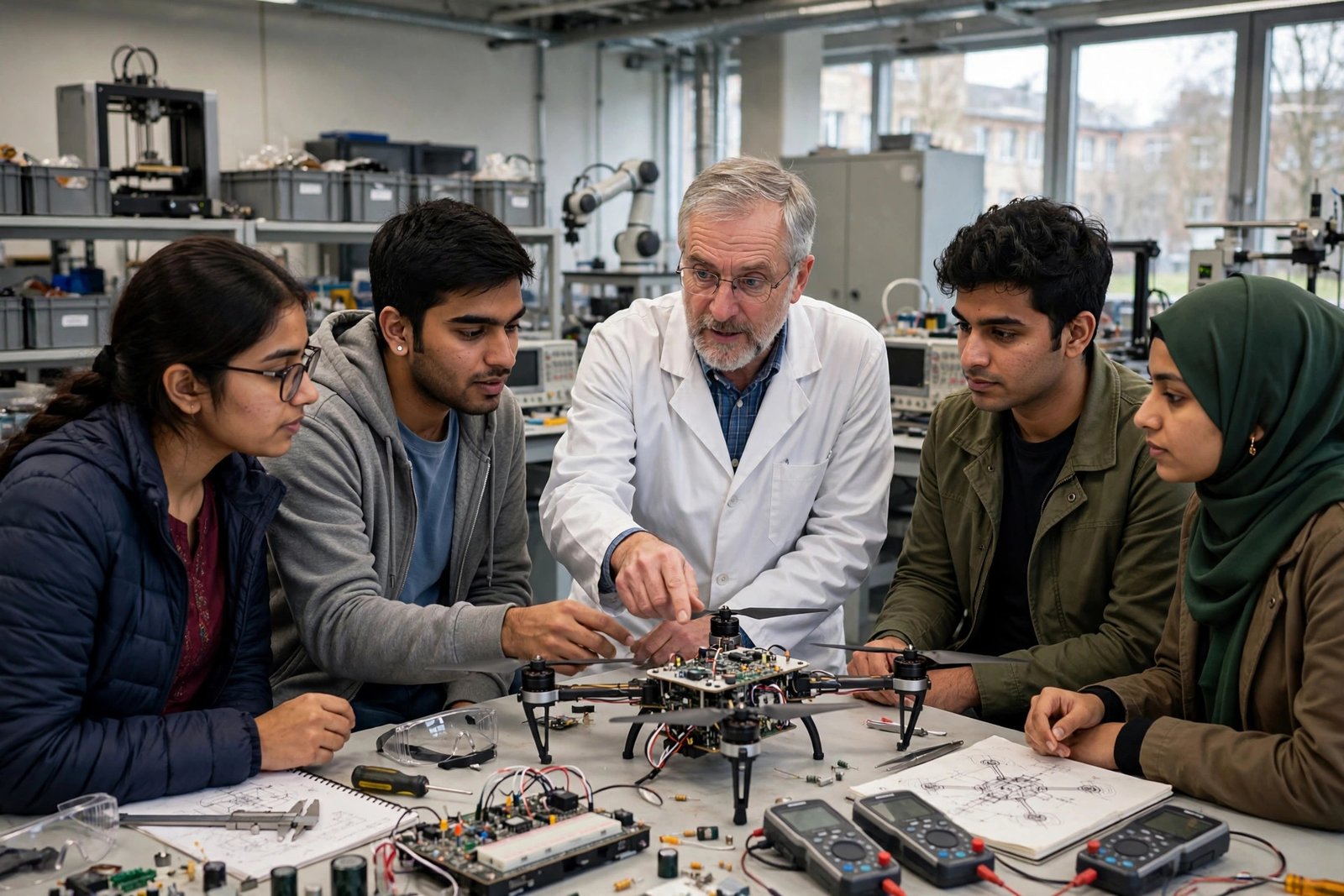
Foundations, Deutschlandstipendium and Other Routes
Germany’s foundation landscape (the Begabtenförderungswerke and related funders) supports students whose profiles match each foundation’s values: the Heinrich Böll Foundation (green politics, ecology and social justice), the Konrad Adenauer Foundation and Friedrich Ebert Foundation (political foundations with their own orientations), the Friedrich Naumann Foundation, the Rosa Luxemburg Foundation, the church-linked KAAD (particularly relevant for postgraduate students from developing countries, including India) and others. Common features: excellent grades, demonstrable social, political or community engagement, and — for most — German language proficiency. Application deadlines typically fall twice a year (Böll’s rounds close on 1 March and 1 September). Read each foundation’s own eligibility pages carefully: some fund non-EU students only from master’s level, and amounts and allowances differ by funder and by whether funding comes from federal education or foreign-ministry budgets, so treat any single stipend figure quoted on third-party sites with caution and verify it on the foundation’s site.
The Deutschlandstipendium is simpler and broader: €300 per month, half from a private sponsor and half matched by the federal government, awarded by your university for at least two semesters based on achievement, engagement and personal circumstances, and open to students of all nationalities including Indians from their first semester. It will not fund a degree on its own, but combined with tuition-free study it meaningfully reduces the blocked-account pressure in later years. Finally, remember the normal German ecosystem: student jobs (including research-assistant “HiWi” positions), the 18-month post-study job-seeker residence permit after graduation, and — for researchers — salaried PhD positions advertised like jobs, which for many Indian doctoral candidates are a better route than any stipend. Explore the full funding landscape through our scholarships directory and the planning guides in our study abroad hub.
What Funding Covers — and the Blocked Account
A full DAAD scholarship covers living costs through the monthly payment, insurance and travel, and DAAD scholars receive a scholarship confirmation that the German missions accept as proof of finances for the visa. Students without a full scholarship prove finances mainly through the blocked account: €11,904 for the first year (2026), released at €992 per month after arrival. Note the arithmetic honestly: €992 per month is DAAD’s and the government’s own benchmark for student living costs, and it is achievable in most university cities with shared housing (a WG), but tight in Munich. Part-time work is permitted within the limits of your residence permit (currently 140 full days or 280 half days per year for non-EU students) and should be treated as a supplement, not as visa proof. Semester contributions (Semesterbeitrag) of roughly €100–€400 per semester are charged even at “tuition-free” public universities and usually include a regional transport ticket; Baden-Württemberg charges non-EU students tuition of €1,500 per semester at its public universities, a real exception Indian applicants targeting Stuttgart, Heidelberg, Freiburg or Tübingen must budget for.
How to Apply: Step by Step for Indian Applicants
- Start APS early. Register on the APS India website, submit your Class 10/12 and degree documents as instructed, and pay the fee — before visa stage, ideally alongside university applications.
- Choose courses strategically. For EPOS, pick courses from the current official EPOS list that match your degree and work experience; for regular admission, apply via uni-assist or directly to the university as each program requires.
- Check anabin status. Confirm how your Indian institution and degree are classified (H+ status) so you know whether your qualification gives direct master’s access.
- Prepare language evidence. IELTS/TOEFL for English-taught programs; German certificates (Goethe-Institut, telc, TestDaF, DSH) where foundations or German-taught programs require them.
- Apply to the course with the scholarship. For EPOS, the scholarship application is part of the course application to the university — complete the DAAD application form and course documents together, before that course’s own deadline.
- Apply to foundations in parallel where you meet the values, engagement and language criteria, observing the March/September-style deadline rounds.
- Arrange finances. Open a blocked account (€11,904) with a recognised provider unless you hold a full scholarship letter that the mission accepts in its place.
- Book and attend the visa appointment through the German mission/consulate and VFS process applicable in India, with APS certificate, admission letter, financial proof, insurance and language certificates complete.
Required Documents
For APS: passport, Class 10 and Class 12 certificates and mark sheets, all semester mark sheets and degree certificates, and translations where APS requires them. For university and EPOS applications: completed application and DAAD forms, Europass-format CV, motivation letter tailored to the course, degree certificates and transcripts, proof of at least two years of relevant work experience (employer letters stating role, period and duties — essential for EPOS), language certificates, and one to two references, including a recent academic reference and, for EPOS, a professional reference from your current or most recent employer. For the visa: passport, APS certificate, admission letter, blocked-account confirmation or scholarship letter, health/travel insurance, photographs, and the mission’s checklist forms. Keep digital scans of everything; German bureaucracy rewards complete, ordered files.
Deadlines and Timeline
| Period | Action for Indian applicants |
|---|---|
| 12–18 months before entry | Begin APS process; research EPOS course list and foundation criteria; start German language study if targeting foundations |
| June–October 2026 | Most EPOS course deadlines for 2027/2028 entry (each course sets its own date — check the DAAD list) |
| 1 September 2026 / 1 March 2027 | Heinrich Böll Foundation application rounds close (typical pattern — confirm on the foundation site) |
| October 2026–January 2027 | Regular winter/summer semester application windows via uni-assist and universities; Deutschlandstipendium rounds at many universities follow admission |
| After admission | Open blocked account, arrange insurance, book visa appointment with APS certificate in hand |
| April / October | Summer semester begins April; winter semester (main intake) begins October |
Track parallel deadlines with our student tools, and use the guides library for blocked-account, uni-assist and visa preparation walk-throughs.
How to Improve Your Chances
For EPOS, the decisive asset is relevant, verifiable work experience connected to a development problem — two years in a state health mission, an NGO program, a renewable-energy firm or a public-sector role will outrank a higher GPA with no experience. Write the motivation letter as a professional argument: the problem you work on, what this specific curriculum adds, and the role you will return to or move into. For foundations, sustained engagement matters more than certificates: years of volunteering, student politics, journalism, environmental or community work, evidenced concretely. For the Deutschlandstipendium, apply even if you think €300 is small — sponsors often fund students in particular faculties, and the award strengthens later applications. Across all routes, learning German to at least B1–B2 widens your options more than any other single investment: it unlocks foundation funding, German-taught programs, HiWi jobs and the post-study job market.
Common Mistakes Indian Applicants Make
The costliest mistake is leaving APS until after admission: visa appointments cannot proceed without it for most applicants, and peak-season processing can consume a whole intake. Second, fresh graduates apply for EPOS without the mandatory two years of professional experience and are screened out automatically. Third, applicants assume “Germany is free” and under-prepare finances — the blocked account (€11,904), semester contributions, Baden-Württemberg’s non-EU tuition and Munich rents are all real. Fourth, students chasing foundation funding ignore the German-language requirement until the deadline. Fifth, applicants use agents who recycle motivation letters across EPOS courses; committees read thousands of these and reject generic files quickly. Everything in this guide can be applied for directly and officially — no agent can issue an APS certificate, a DAAD award or a visa.
Comparing Your Options Beyond Germany
If you are building a multi-country list, compare Germany’s living-cost funding model with the tuition-heavy systems elsewhere using our companion guides to scholarships for Indian students in Canada and scholarships for Indian students in Australia. Germany’s advantage is structural: when tuition is zero, a €992 monthly stipend — or even the €300 Deutschlandstipendium plus part-time work — covers a far larger share of the true cost of a degree than an equivalent award in a high-tuition country.
Frequently Asked Questions
Are Indian students eligible for DAAD EPOS scholarships?
Yes. India is on DAAD’s list of eligible developing and emerging countries for EPOS. You need an above-average bachelor’s degree (normally completed within the last six years), at least two years of relevant professional experience after the degree, and admission to a course on the official EPOS list, applying directly to the university running that course.
How much does DAAD EPOS pay in 2026/2027?
€992 per month for master’s scholars and €1,300 per month for doctoral scholars, with the doctoral rate rising to €1,400 per month from February 2026 under current calls. Insurance, a travel allowance and, under conditions, rent and family subsidies are also covered. Confirm the rate in your specific course call.
Is the APS certificate mandatory for Indian students?
For most applicants with Indian qualifications applying for a German student visa, yes — it has been required since November 2022. Exemptions include doctoral applicants, holders of non-Indian qualifications, and recipients of scholarships from German or EU public funds. Check the current APS India guidance for your category and apply early, as processing takes several weeks.
How much is the German blocked account in 2026?
€11,904 for one year, released at €992 per month after arrival. Students holding a full scholarship that covers living costs may instead present their scholarship confirmation as financial proof, as directed by the German mission.
Do I need German language skills for a scholarship in Germany?
For English-taught degrees and DAAD EPOS, generally no — the course language requirement (usually English) applies. For most political and church foundations, yes: for example, the Heinrich Böll Foundation requires non-EU applicants to prove German at B2/DSH-2 level. German also significantly improves your part-time work and post-study options.
Can I get a scholarship in Germany without work experience?
Yes, but not EPOS. Fresh graduates can target tuition-free regular admission, the Deutschlandstipendium (€300 per month, all nationalities) after enrolment, foundation funding where they meet the criteria, and salaried PhD positions at doctoral level.
Is tuition really free at German public universities?
For most consecutive bachelor’s and master’s programs at public universities, yes — you pay only a semester contribution (roughly €100–€400). The main exception is Baden-Württemberg, which charges non-EU students €1,500 per semester, and private universities, which charge full tuition.
When should Indian students start the Germany application?
Twelve to eighteen months before entry: APS and language preparation first, EPOS course deadlines fall mainly between June and October of the year before the course starts, and visa processing follows admission and financial proof.
Working, Internships and Staying On After Graduation
Scholarship planning should not stop at graduation, because Germany’s post-study rules are part of the financial return on your degree. After completing a German degree, graduates can obtain a residence permit for up to 18 months to look for qualified employment, and during that period may work in any job to support themselves. Once you move into qualified employment, further residence routes open, and time spent studying counts partially toward longer-term settlement calculations under the current rules. During your studies, non-EU students may work 140 full days or 280 half days per year without additional approval; typical student jobs include research-assistant (HiWi) roles in your own department, working-student (Werkstudent) positions with companies — particularly common for engineering, computer science and business students in cities such as Munich, Berlin, Hamburg and the Rhine-Ruhr region — and campus services. Werkstudent roles are especially valuable for Indian students because they pay above typical casual-job rates, build a German employment record and frequently convert into full-time offers after graduation. None of this income should be promised in a visa application, but it is a legitimate part of a realistic second- and third-year budget, and it is one reason a modest award such as the Deutschlandstipendium stretches further in Germany than its €300 headline suggests: combined with tuition-free study and a working-student job, many Indian master’s students cover most of their living costs from the second semester onward. Keep your German language progression going throughout — employers hiring working students and graduates consistently reward B1–B2 German even for English-language roles.
Sources & Verification
This guide was compiled and checked in October 2026 against official sources: the DAAD scholarship database and EPOS program pages (eligible countries including India, €992 monthly master’s rate, doctoral rates of €1,300 rising to €1,400 from February 2026, two-year experience rule), APS India (the certificate requirement in place since November 2022 and its exemption categories), the Deutschlandstipendium official portal (€300 per month, open to all nationalities), the Heinrich Böll Foundation scholarship pages (non-EU master’s/PhD eligibility and German B2/DSH-2 requirement), and the German government’s Make it in Germany portal (blocked account of €11,904 per year). Amounts and deadlines change between cycles, so always confirm current figures on the official website before applying.
Disclaimer: StudyGraduate is an independent information portal, not an agency, university or government body. We do not charge for scholarship applications and cannot promise selection, admission or visa approval. Always verify deadlines, amounts and eligibility on the official scholarship and government websites linked above.
✅ Eligibility Criteria
- Check the official website for full eligibility criteria for your country
🎁 Benefits
- See the official website for the complete list of benefits
⚙️ Application Process
- 1Check your eligibility on the official site
- 2Prepare your documents and statements
- 3Submit the online application before the deadline
- 4Complete interviews or assessments if shortlisted
- 5Await the final selection announcement
📅 Important Dates
Deadlines vary by country and intake. Check the official website for country-specific dates.
📄 Required Documents
- Valid passport
- Academic transcripts & certificates
- Statement of purpose
- Letters of recommendation
- CV / resume
Commonly required — confirm the exact list on the official site.
❓ Frequently Asked Questions

Ready to Take the Next Step?
Explore more scholarships and study opportunities around the world.
Browse Scholarships →