Scholarships for Indian Students in Canada 2026/2027
Scholarships for Indian Students in Canada 2026/2027 Canada remains one of the most popular study destinations for Indian students, and for the 2026/2027 cycle the funding landscape is clearer — and in one important respect, different — than many older guides suggest. The single biggest change is at doctoral level: the famous Vanier Canada Graduate ... <a title="Scholarships for Indian Students in Canada 2026/2027" class="read-more" href="https://studygraduate.com/scholarship/scholarships-for-indian-students-in-canada-2026-2027/" aria-label="Read more about Scholarships for Indian Students in Canada 2026/2027">Read more</a>
📖 Overview
Scholarships for Indian Students in Canada 2026/2027
Canada remains one of the most popular study destinations for Indian students, and for the 2026/2027 cycle the funding landscape is clearer — and in one important respect, different — than many older guides suggest. The single biggest change is at doctoral level: the famous Vanier Canada Graduate Scholarships have been discontinued and replaced by the Canada Graduate Research Scholarship – Doctoral (CGRS-D), worth CAD 40,000 per year for 36 months. At undergraduate level, the University of Toronto’s Lester B. Pearson International Scholarship still covers tuition, books, incidental fees and full residence support for four years, while McGill’s McCall MacBain Scholarships fund master’s and professional degrees in full. Alongside these headline awards sits a large, quieter system of university entrance scholarships, in-course awards and provincial funding such as the Ontario Graduate Scholarship, much of which is awarded automatically on the strength of your admission application.
This guide is written specifically for citizens of India applying from India for 2026/2027 entry. It explains which scholarships Indian students are genuinely eligible for, what each one actually pays, how the Canadian study permit’s financial requirements interact with scholarship funding, and the exact steps — from school nomination deadlines in the autumn to study permit proof of funds — that an Indian applicant needs to plan around. It also corrects two common errors: Vanier no longer exists, and the master’s-level federal award (CGRS-M) is not open to international students at all.
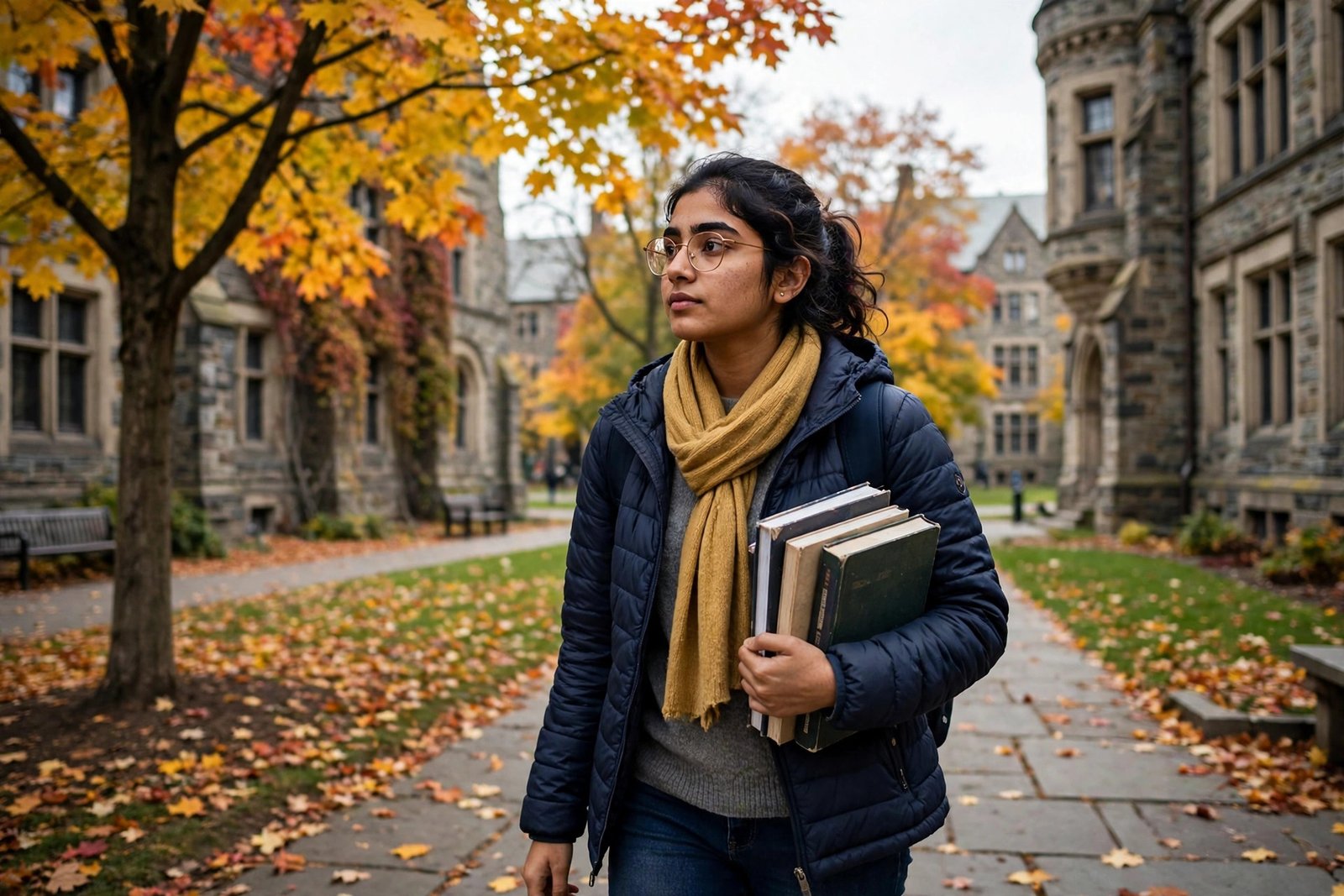
Scholarships for Indian Students in Canada at a Glance
| Scholarship | Level | Value | Open to Indian citizens? | How you are considered |
|---|---|---|---|---|
| Lester B. Pearson International Scholarship (University of Toronto) | Undergraduate | Tuition, books, incidental fees and full residence support for 4 years; about 37 scholars per year | Yes | School nomination required, then a separate scholarship application |
| McCall MacBain Scholarships (McGill University) | Master’s and professional | Full tuition and fees, a living stipend of CAD 2,000 per month during academic terms, and a relocation grant | Yes | Separate application, open before you apply to McGill |
| Canada Graduate Research Scholarship – Doctoral (CGRS-D) | PhD | CAD 40,000 per year for 36 months | Yes, once enrolled in a Canadian PhD (up to 15% of awards go to international students) | Through your Canadian university to CIHR, NSERC or SSHRC |
| Canada Graduate Research Scholarship – Master’s (CGRS-M) | Master’s | CAD 27,000 for 12 months | No — Canadian citizens, permanent residents and protected persons only | Not applicable for Indian applicants |
| Ontario Graduate Scholarship (OGS) | Master’s and PhD | CAD 5,000 per term, up to CAD 15,000 per year | Yes — participating Ontario universities hold an allocation for study-permit students | Application through your university |
| University entrance scholarships (Toronto, UBC, Waterloo, McGill, Alberta and others) | Undergraduate and graduate | Varies widely, from one-time awards of a few thousand dollars to renewable multi-year awards | Yes | Mostly automatic consideration with your admission application |
| UBC International Scholars Program (including the Karen McKellin International Leader of Tomorrow Award) | Undergraduate | Need-based, proportional to demonstrated financial need, up to the full cost of tuition and living | Yes | Separate application with detailed financial information |
You can browse the full Canadian university landscape in our university directory and compare institutions in the global rankings before you shortlist where to apply.
Who Is Eligible? The Rules That Apply to Indian Citizens
Eligibility for Canadian scholarships is rarely based on nationality alone. For an Indian applicant, the checks that matter are these. First, you must meet the academic admission requirements of the Canadian university itself — for Indian qualifications this normally means strong Class 12 results from CBSE, CISCE or a state board for undergraduate entry, or a completed Indian bachelor’s degree (and, for PhD entry, usually a master’s degree) with first-class or high second-class standing for graduate entry. Universities assess Indian credentials against their own published equivalencies, so check the exact requirement for India on your chosen university’s admissions pages rather than relying on conversion tables from agents.
Second, you must be able to obtain a study permit. A scholarship does not replace the study permit, and Immigration, Refugees and Citizenship Canada (IRCC) will still assess whether you have enough money for tuition and living costs. For applications submitted between 1 September 2025 and 31 August 2026, the required living-expense amount for a single applicant studying outside Quebec is CAD 22,895 per year, in addition to first-year tuition and travel costs. From 1 September 2026 that figure rises to CAD 23,448. A confirmed scholarship counts toward this requirement, but only for the amount and duration actually guaranteed in writing — a renewable award that depends on future grades is not the same as guaranteed funding for the full degree.
Third, most provinces require applicants outside Quebec to obtain a Provincial Attestation Letter (PAL) from the province where they will study, issued through the university after an offer of admission. Your university will tell you when and how your PAL is issued; do not apply for a study permit without one if your category requires it. Fourth, language proficiency: most universities require IELTS, TOEFL, Duolingo English Test or an accepted equivalent from Indian applicants, with the exact band scores set by each program. Scholarship committees use the same test results, so a score that only just meets the minimum may satisfy admission while weakening a competitive scholarship application.
The Major Scholarships in Detail
Lester B. Pearson International Scholarship — University of Toronto
The Pearson Scholarship is Canada’s best-known fully funded undergraduate award for international students, and Indian school students are fully eligible. It covers tuition, books, incidental fees and full residence support for four years of first-entry undergraduate study at the University of Toronto, and roughly 37 new Pearson Scholars are named each year. The defining feature of this scholarship is that you cannot simply apply: your school must nominate you, and each school may nominate only one student per year. For September 2027 entry, schools received nomination access from July 2026, the school nomination deadline was 9 October 2026, and nominated students then had to submit their University of Toronto admission application and the separate Pearson application, with the scholarship application deadline falling on 6 November 2026. Those dates have effectively passed for the 2027 cycle by the time many students read round-up articles, which is precisely why Indian students aiming at Pearson must start in Class 11 or at the very beginning of Class 12 — the bottleneck is the school nomination, not the application form.
Selection looks for exceptional academic achievement combined with creativity and recognised leadership within the school community. A student with perfect marks but no evidence of original thinking or contribution is a weaker Pearson candidate than a slightly-less-perfect student who has built something, led something or changed something at school. If your school has never nominated before, it can register to participate, so raise the scholarship with your principal or counsellor early rather than assuming your school is not involved.
McCall MacBain Scholarships — McGill University
The McCall MacBain Scholarships at McGill University in Montreal are Canada’s flagship fully funded awards for master’s and professional degrees, and they are open to international students including Indian citizens. Scholars receive full tuition and fees for the standard duration of their program, a living stipend of CAD 2,000 per month during academic terms, and a relocation grant for moving to Montreal. Up to 30 full scholarships are awarded each year, alongside a larger number of finalist and regional awards for strong applicants who reach the later stages.
Unusually, you apply for the scholarship before — or in parallel with — your McGill program application, and applying for McCall MacBain does not commit you to a single department. Selection emphasises character, community engagement, leadership potential, entrepreneurial spirit and academic strength, assessed through the application, references and interviews. Indian applicants with a strong record of sustained community or professional contribution alongside good academics are exactly the profile this scholarship rewards. Note that because McGill is in Quebec, study permit applicants for Quebec generally need a Quebec Acceptance Certificate (CAQ) in addition to the federal study permit, and Quebec has its own living-expense thresholds — check the current requirements on the official Quebec and IRCC pages.
CGRS-D: The Doctoral Award That Replaced Vanier
Any guide that still tells you to apply for a Vanier Scholarship for 2026/2027 is out of date. Vanier has been discontinued, and its replacement within the Canada Research Training Awards Suite is the Canada Graduate Research Scholarship – Doctoral (CGRS-D), administered jointly by CIHR (health), NSERC (natural sciences and engineering) and SSHRC (social sciences and humanities). The award is worth CAD 40,000 per year for 36 months. The critical eligibility point for Indian students is this: international applicants must already be enrolled in a doctoral program at an eligible Canadian institution by the application deadline, and no more than 15% of CGRS-D awards nationally are allocated to international students. You therefore cannot win a CGRS-D from India before you start your PhD; the realistic route is to secure admission and departmental funding for your first year, enrol, and then apply through your university’s internal competition in the autumn, where your institution ranks and forwards a limited quota of applications to the agencies.
Selection is weighted 50% on research potential and 50% on relevant experience and achievements, and you may apply a maximum of three times, to only one agency per year. By contrast, the master’s-level CGRS-M (CAD 27,000 for 12 months) is restricted to Canadian citizens, permanent residents and protected persons, so Indian master’s students should not build a funding plan around it. For Indian master’s applicants, the realistic funding sources are McCall MacBain, university entrance and departmental awards, research assistantships, and provincial awards such as the Ontario Graduate Scholarship where the university holds study-permit allocations.
University Entrance Scholarships and Need-Based Awards
Most Indian undergraduates in Canada are funded, in part, by entrance scholarships rather than the famous named awards. These are typically automatic: the university assesses your admission application and offers a one-time or renewable award based on your final Class 12 average. Renewable awards usually require you to maintain a specified sessional average, and the renewal condition — not the headline first-year amount — is what determines the real value over four years. Read the renewal terms before comparing offers.
The University of British Columbia’s International Scholars Program is the main need-based route: awards such as the Karen McKellin International Leader of Tomorrow Award are calculated against demonstrated financial need and can, for the highest-need admitted students, cover a very substantial share of tuition and living costs. These awards require a detailed financial declaration, so families should prepare income documentation early and answer honestly — the assessment is based on verified need, not on negotiation. Across all universities, our scholarships directory tracks the major award types, and our study abroad hub explains how to compare total degree cost rather than first-year cost.

What the Funding Actually Covers — and What It Does Not
A fully funded award such as Pearson covers the core costs of the degree: tuition, compulsory fees, books and residence. McCall MacBain covers tuition and fees plus a monthly living stipend during academic terms, which means scholars must budget for the summer months and for costs above the stipend level in Montreal. CGRS-D’s CAD 40,000 per year is a scholarship stipend, not a tuition waiver: doctoral tuition is normally addressed separately through your department’s funding package, so confirm in writing how tuition, the stipend and any teaching or research assistantship fit together. Entrance scholarships are almost always tuition credits — they reduce the tuition bill and do not provide cash for rent, food or flights.
No Canadian scholarship pays for everything around the degree. Budget separately for your study permit application and biometrics fees, medical examination by an IRCC panel physician in India, police certificates where requested, English test fees, credential assessments if your university requires one, your flight to Canada, and settlement costs in your first month. Indian students applying through the regular study permit stream should also be ready for IRCC to ask how the remaining years of the degree will be funded, not just the first year.
How to Apply: Step by Step for Indian Applicants
- Shortlist programs 12–18 months ahead. For September 2027 undergraduate entry, scholarship-linked deadlines begin in autumn 2026. For graduate programs, most application deadlines fall between December 2026 and February 2027, with scholarship consideration built into the same window.
- Secure nominations where required. For Pearson, speak to your school by the start of your final school year and confirm the school will nominate you before the October nomination deadline.
- Take your English test early. Sit IELTS or an accepted equivalent by the summer before applications open, leaving time for one retake.
- Submit admission applications with scholarship sections completed. Many entrance awards are automatic, but awards like UBC’s International Scholars and McCall MacBain have separate forms and earlier deadlines than admission itself.
- Prepare references properly. Give referees at least a month, a copy of your CV and a short note on what the scholarship values; generic Indian school or employer references that only confirm marks and attendance weaken competitive applications.
- Accept your offer and obtain your PAL or CAQ. Your university issues or triggers the attestation process; follow its instructions exactly.
- Apply for the study permit with complete financial evidence. Combine scholarship letters, family bank and income documents, and education loan sanction letters where relevant, showing tuition plus the IRCC living-expense amount (CAD 22,895 for applications up to 31 August 2026; CAD 23,448 from 1 September 2026, outside Quebec).
- Complete biometrics and medical examination promptly at the designated centres in India when IRCC requests them, and keep copies of everything submitted.
Required Documents
For scholarship and admission applications: passport, Class 10 and Class 12 mark sheets and certificates (or predicted/term results where final results are pending), bachelor’s and master’s transcripts and degree certificates for graduate applicants, English test score report, CV, statement of purpose or scholarship essays, and two to three references. For need-based awards, add family income evidence such as salary slips, income tax returns and bank statements, in the format the university specifies. For the study permit: letter of acceptance, PAL or CAQ, passport, photographs, financial documents covering tuition and living costs, scholarship award letters, medical examination receipt after your panel physician appointment, and a study plan explanation where your profile needs one (for example, a change of field or a long study gap). Documents in regional languages should be accompanied by certified English translations where the receiving institution requires them.
Deadlines and Timeline
| Period | Action for Indian applicants |
|---|---|
| July–October 2026 | Pearson school nominations (nomination deadline 9 October 2026 for September 2027 entry); McCall MacBain application window; sit English tests |
| October–November 2026 | Pearson scholarship application deadline 6 November 2026; UBC International Scholars application; early admission deadlines begin |
| December 2026–February 2027 | Main graduate program deadlines; most undergraduate admission deadlines; automatic entrance scholarship assessment |
| January–April 2027 | Offers and scholarship decisions released; OGS university competitions; accept offer and request PAL/CAQ |
| Spring–summer 2027 | Study permit application, biometrics and medical examination; arrange housing and flights |
| September 2027 | Programs begin; enrolled PhD students prepare CGRS-D applications through their university for the autumn competition |
Use our student tools, including deadline tracking and budget planning, to keep these parallel timelines under control, and review test preparation guidance if your English scores still need work.
How to Improve Your Chances
Canadian scholarship selection rewards evidence, not adjectives. For Pearson and McCall MacBain, that means documented leadership and service sustained over years, with outcomes you can quantify. For CGRS-D, it means a focused research proposal, a supervisor whose research program genuinely fits yours, and early research output — a strong master’s thesis, a conference presentation or a publication record appropriate to your field. For automatic entrance awards, the lever is simply your final marks: universities assess the results you actually achieve, so protecting your Class 12 or final-degree performance matters more than adding another certificate course. Apply to a spread of universities rather than only the two or three most famous names; funding rates are often better at slightly less oversubscribed institutions, and a funded offer from a strong program is worth more than an unfunded offer from a famous one.
Common Mistakes Indian Applicants Make
The most expensive mistake is planning around Vanier or CGRS-M, neither of which is available to a new Indian applicant in the way older articles describe. The second is missing the Pearson school-nomination stage entirely — by the time the scholarship is advertised to students in November, the nomination gate has already closed. Third, students routinely under-budget the study permit: IRCC’s living-expense requirement is assessed in addition to tuition, and it rises to CAD 23,448 for applications from 1 September 2026. Fourth, families sometimes present a first-year scholarship as if it funds the whole degree; where an award is renewable on grades, IRCC and the university both treat later years as conditional. Finally, avoid submitting financial documents that cannot be verified, or using an agent who offers to “arrange” funds: misrepresentation to IRCC carries a five-year ban from Canada, which no scholarship is worth.
Comparing Your Options Beyond Canada
Indian students building a multi-country application list should compare like with like. Our companion guides cover scholarships for Indian students in Germany, where public universities generally charge no tuition and DAAD funding dominates, and scholarships for Indian students in Australia, where the Research Training Program is the main fully funded route. Canada’s distinctive strength is the combination of automatic entrance funding, one genuinely full undergraduate award (Pearson) and a doctoral system that opens its national competition to enrolled international students through CGRS-D.
Frequently Asked Questions
Can Indian students still apply for the Vanier Scholarship in 2026/2027?
No. The Vanier Canada Graduate Scholarships have been discontinued. The replacement doctoral award is the Canada Graduate Research Scholarship – Doctoral (CGRS-D), worth CAD 40,000 per year for 36 months, administered by CIHR, NSERC and SSHRC.
Can I apply for CGRS-D from India before starting my PhD?
No. International applicants must already be enrolled in a doctoral program at an eligible Canadian institution by the application deadline, and up to 15% of awards are allocated to international students. Apply through your Canadian university in the autumn competition after you enrol.
Is the Lester B. Pearson Scholarship open to Indian school students?
Yes. Indian citizens in their final year of secondary school (or who graduated no earlier than June 2026, for September 2027 entry) are eligible, but your school must nominate you — each school nominates one student per year — before you can access the scholarship application.
How much money must I show for a Canadian study permit in 2026/2027?
Outside Quebec, IRCC requires first-year tuition plus living expenses of CAD 22,895 for applications submitted from 1 September 2025 to 31 August 2026, rising to CAD 23,448 for applications from 1 September 2026, plus travel costs. Confirmed scholarship funding counts toward these amounts. Quebec applicants follow the CAQ process and Quebec’s own thresholds.
Are Canadian entrance scholarships automatic?
Many are: universities assess your admission application and offer entrance awards based on your final marks without a separate form. However, the largest awards — Pearson, McCall MacBain and UBC’s need-based International Scholars awards — all require separate applications and earlier deadlines.
Can Indian master’s students get federal Canadian scholarships?
Not through CGRS-M, which is restricted to Canadian citizens, permanent residents and protected persons. Indian master’s students should target the McCall MacBain Scholarships, university and departmental awards, research assistantships, and provincial awards such as the Ontario Graduate Scholarship where study-permit allocations exist.
Does a scholarship guarantee my study permit?
No. A scholarship strengthens your financial evidence, but IRCC still assesses your complete application, including the attestation letter, your study plan and whether your overall funding covers tuition and living costs for the program.
Do I need an agent in India to apply for these scholarships?
No. Every award in this guide is applied for directly through the university or the official scholarship portal. Agents cannot nominate you for Pearson (only your school can) and cannot improve CGRS-D outcomes. Never pay anyone who promises a scholarship or a visa.
Funding by Study Level: A Realistic Summary for Indian Families
Pulling the system together by level helps Indian families plan honestly. At bachelor’s level, realistic funding means Pearson for the exceptional few, UBC-style need-based awards for students with documented financial need, and automatic entrance scholarships elsewhere that reduce — but rarely eliminate — tuition; families should budget for the majority of the degree cost from savings, income and education loans. At master’s level, McCall MacBain is the one broad fully funded route, and beyond it the norm is a patchwork: a departmental entrance award here, a research assistantship there, and family funding for the remainder, which is why comparing the net price of offers matters more than comparing sticker prices. At doctoral level, Canada is genuinely generous once you are inside the system: a departmental funding package for the early years, the possibility of CGRS-D at CAD 40,000 per year for 36 months through the national competition, and provincial awards such as OGS on top at participating universities. The pattern to notice is that Canadian generosity increases with study level and with time spent inside a Canadian institution — the longer your track record in Canada, the more competitions open to you. Plan your financing in the same staged way: secure the first year completely, keep grades high enough to protect renewable awards, and treat later competitions as planned applications, not hopes.
Sources & Verification
This guide was compiled and checked in October 2026 against official sources: the NSERC CGRS-D program pages (value of CAD 40,000 per year for 36 months and international eligibility rules), the University of Toronto Lester B. Pearson Scholarship pages (coverage, approximately 37 scholars, nomination process and 2026 deadlines), the McCall MacBain Scholarships website (tuition coverage and CAD 2,000 monthly living stipend), and IRCC’s official proof of financial support pages (living-expense amounts of CAD 22,895 and CAD 23,448 with their effective dates). Amounts and deadlines change between cycles, so always confirm the current figures on the official website before applying.
Disclaimer: StudyGraduate is an independent information portal, not an agency, university or government body. We do not charge for scholarship applications and cannot promise selection, admission or visa approval. Always verify deadlines, amounts and eligibility on the official scholarship and government websites linked above.
✅ Eligibility Criteria
- Check the official website for full eligibility criteria for your country
🎁 Benefits
- See the official website for the complete list of benefits
⚙️ Application Process
- 1Check your eligibility on the official site
- 2Prepare your documents and statements
- 3Submit the online application before the deadline
- 4Complete interviews or assessments if shortlisted
- 5Await the final selection announcement
📅 Important Dates
Deadlines vary by country and intake. Check the official website for country-specific dates.
📄 Required Documents
- Valid passport
- Academic transcripts & certificates
- Statement of purpose
- Letters of recommendation
- CV / resume
Commonly required — confirm the exact list on the official site.
❓ Frequently Asked Questions

Ready to Take the Next Step?
Explore more scholarships and study opportunities around the world.
Browse Scholarships →