Scholarships for Bangladeshi Students in Australia 2026/2027
Scholarships for Bangladeshi Students in Australia 2026/2027 For a Bangladeshi graduate who wants a world-class master’s degree without a lifetime of debt, Australia offers one of the strongest scholarship line-ups in the world — and Bangladesh is firmly on the eligibility list. The Australian Government’s flagship Australia Awards Scholarships are open to citizens of Bangladesh, ... <a title="Scholarships for Bangladeshi Students in Australia 2026/2027" class="read-more" href="https://studygraduate.com/scholarship/scholarships-for-bangladeshi-students-in-australia-2026-2027/" aria-label="Read more about Scholarships for Bangladeshi Students in Australia 2026/2027">Read more</a>
📖 Overview
Scholarships for Bangladeshi Students in Australia 2026/2027
For a Bangladeshi graduate who wants a world-class master’s degree without a lifetime of debt, Australia offers one of the strongest scholarship line-ups in the world — and Bangladesh is firmly on the eligibility list. The Australian Government’s flagship Australia Awards Scholarships are open to citizens of Bangladesh, the government-funded Research Training Program (RTP) supports Bangladeshi master’s by research and PhD candidates at Australian universities, and almost every major Australian university runs its own international scholarships that Bangladeshi applicants can compete for on merit. This guide brings all three routes together in one place, written specifically for applicants applying from Bangladesh.
It matters to get the details right, because the three routes work very differently. Australia Awards is a development-focused government scholarship: for the intake commencing in 2027 it was offered to Bangladeshis for Master’s by Coursework and Master’s by Research only, it is restricted to applicants who are already employed in defined target groups, and it requires an IELTS (Academic) score of 6.5 or higher with no band below 6.0. The RTP, by contrast, is an academic-merit research scholarship administered by individual universities — there is no development plan and no employer category, but you need a strong research proposal and, in practice, a supervisor who wants to work with you. University awards sit in between: they are usually partial tuition discounts or stipend top-ups awarded automatically or competitively when you apply for admission.
This guide explains who can apply for each route, what each scholarship actually pays for, the exact documents Bangladeshi applicants must prepare — including the notarised documents Australia Awards Bangladesh requires — and the timeline you should work to for 2026/2027 entry. If you are also comparing other destinations, read our companion guides to scholarships for Bangladeshi students in the UK and scholarships for Bangladeshi students in Canada, and browse the full StudyGraduate scholarships directory for other funded opportunities.
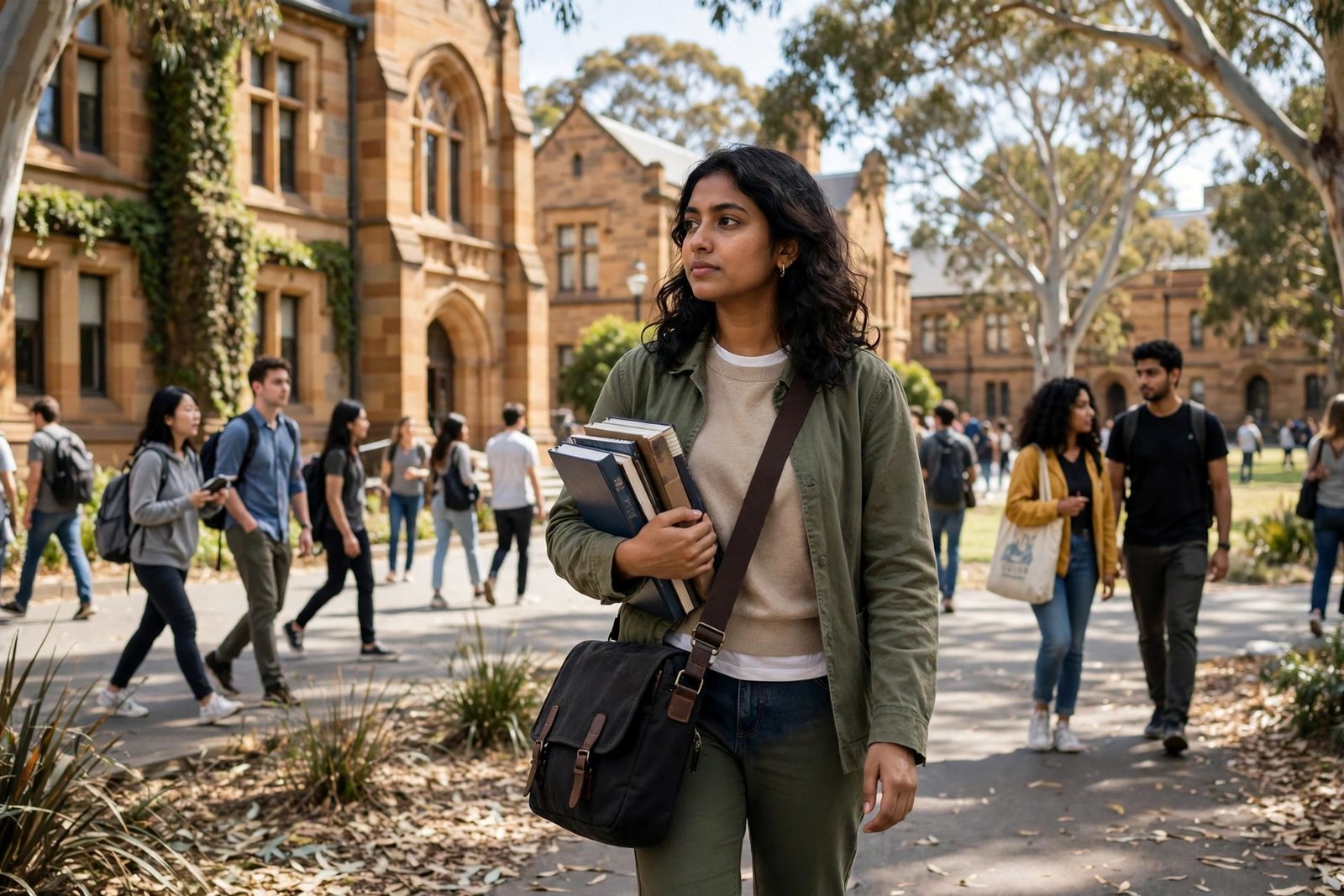
Scholarships for Bangladeshi Students in Australia at a Glance
| Scholarship | Level | Main Coverage | Who It Suits | Typical Window |
|---|---|---|---|---|
| Australia Awards Scholarships (Bangladesh) | Master’s by Coursework; Master’s by Research | Full tuition, return air travel, establishment allowance, living contribution, Overseas Student Health Cover (OSHC) | Employed Bangladeshi professionals in government, NGO, private-sector, research, university, media or cultural organisations | Opened 1 February 2026, closed 30 April 2026 for 2027 commencement — check for the next intake |
| Research Training Program (RTP) | Master’s by Research; PhD | Tuition fee offset plus living stipend — Australian Government base rate AUD 34,315 per year in 2026 and AUD 35,550 in 2027; many universities pay above the base rate | High-achieving graduates with a research proposal | Set by each university; commonly rounds in the second half of the year |
| University international scholarships | Bachelor’s, Master’s, PhD (varies) | Partial tuition reduction, stipend, or both — varies by university | Coursework students with strong grades who do not fit Australia Awards categories | With admission application; varies |
| Destination Australia | — | Closed. Funding ceased on 1 July 2024 and it is not open to new applicants — do not plan around it | — | — |
The table already contains the single most important honesty check in this guide: Destination Australia is closed. Older blog posts still describe it as an easy AUD 15,000 a year for studying in regional Australia. That programme ended for new students when funding ceased on 1 July 2024, and any website still inviting you to apply for it in 2026/2027 is out of date. The genuine routes are Australia Awards, the RTP and university awards — and between them, a well-prepared Bangladeshi applicant has a realistic path at every postgraduate level.
Route 1: Australia Awards Scholarships for Bangladesh
Australia Awards Scholarships are long-term awards administered by the Australian Department of Foreign Affairs and Trade (DFAT). They are part of Australia’s development programme: the stated aim is to develop the skills and knowledge of individuals to drive change and contribute to development in their home country. That purpose shapes everything about the Bangladesh programme — the priority fields, the employer target groups, and the Development Impact and Linkages Plan every applicant must submit.
Priority fields of study for Bangladesh
For the 2027 intake, the Bangladesh country profile listed priority areas including the blue economy (fisheries and aquaculture, marine and maritime studies, seaports and shipping); health (health care management and leadership, global and public health including nutrition, occupational health and safety, geriatric health); sustainable development and environment (agriculture development, climate change adaptation and mitigation, disaster management and risk reduction, water resources management, forestry and environmental management, emergency and humanitarian response); social inclusion (disability inclusion, gender justice, technical and vocational education and skills development); inclusive economic development (financial planning and management, international trade and business, ICT, innovation and entrepreneurship, small and medium enterprise development, sustainable tourism, supply chain management); public policy, governance and power, energy and mineral resources; and infrastructure and science fields including computer science, artificial intelligence and machine learning, data and network management, architecture and transport, and robotics, alongside security studies. The two governments review these areas together, so always confirm the current list on the Australia Awards Bangladesh website before you choose a course — a course outside the priority areas is a weak application no matter how strong your grades are.
Who can apply: the four target groups
Unlike most scholarships, Australia Awards Bangladesh does not accept applications from everyone with a degree. Candidates must be existing employees in one of four target groups:
- Group A: Civil Service Cadre Officials of the Government of Bangladesh, Bangladesh Bank officials, and Judicial Services cadre officials.
- Group B: Workers from development organisations, particularly non-government organisations, civil society organisations, or community-based organisations.
- Group C: Entrepreneurs or employees of private sector organisations.
- Group D: Individuals from research institutions, universities, media, and cultural organisations.
Applications are strongly encouraged from women, people with disability and other marginalised groups. If you are a fresh graduate with no employment history, Australia Awards is not your route this year — build two or more years of relevant work first, or target the RTP and university awards instead. Our guide to government scholarships for Bangladeshi students compares this programme with other state-funded options worldwide.
Eligibility in Detail
For the intake commencing in 2027, Bangladeshi applicants for Australia Awards had to meet all of the following conditions from the official country profile:
- Be a citizen of Bangladesh, residing in Bangladesh, and applying from Bangladesh.
- Be an existing employee in one of the four target groups above.
- Hold a tertiary qualification at least equivalent to an Australian bachelor’s degree. For applicants who completed all degrees in Bangladesh, at least one degree must be from a university recognised by the University Grants Commission (Bangladesh).
- Preference is given to candidates whose course builds on their previous study and who have five years of full-time, relevant and consistent work experience; a study gap of more than 15 years since the last formal degree is discouraged.
- Have IELTS (Academic) 6.5 or higher with no individual band below 6.0, or an equivalent TOEFL or PTE score, valid on 1 January 2027. People with disability, indigenous people and persons from marginalised gender groups could be considered for eligibility with IELTS 6.0 overall and no band below 5.5, but if offered an award they must still meet the general DFAT and university English requirement before the scholarship can start.
- Not be married to, engaged to, or a de facto partner of a person who holds, or is eligible to hold, Australian or New Zealand citizenship or permanent residency during the application, selection or mobilisation phases.
- Not be currently serving military personnel, and be able to satisfy all Department of Home Affairs requirements for a DFAT-supported student visa.
- Be at least 18 years old on 1 February of the commencement year, under the global Australia Awards eligibility rules, and agree to return to Bangladesh for at least two years after completing the award.
For the RTP, eligibility is academic: you must be applying for, or enrolled in, an accredited master’s by research or doctoral degree at the university concerned, meet that university’s English requirements, and not be receiving an equivalent Australian Government stipend for the same purpose. Universities publish their own RTP stipend rates above the government base rate — for example, the University of Melbourne lists its RTP stipend living allowance at a 2027 full-time rate higher than the base, and the University of Sydney publishes its own indexed rates — so compare the actual university figure, not just the base rate. Bangladeshi research applicants can explore supervisors and programmes through the University of Melbourne profile, the University of Sydney profile and the UNSW Sydney profile on StudyGraduate, then confirm scholarship rates on each university’s official scholarship pages.
What the Scholarships Cover
Australia Awards scholarships are offered for the minimum period necessary to complete the academic programme, including preparatory training, and for Bangladesh master’s awards that means not more than two years. Recipients receive:
- Full tuition fees for the scholarship course.
- Return air travel between Bangladesh and Australia.
- A one-off establishment allowance on arrival to help with accommodation, textbooks and study materials.
- A contribution to living expenses, paid while you study.
- An Introductory Academic Program before your course starts.
- Overseas Student Health Cover (OSHC) for the duration of the scholarship.
- Supplementary academic support where required, and a fieldwork allowance for research students and for coursework master’s students whose programme has a compulsory fieldwork component.
The RTP package is structured differently: a tuition fee offset (up to two years for a research master’s and up to four years for a doctorate at Melbourne’s published terms, for example) plus a living stipend. The Australian Government base stipend rate is AUD 34,315 per year in 2026, rising to AUD 35,550 in 2027, but individual universities set their own — often higher — rates, and packages can also include a relocation grant and single OSHC for international students. University coursework awards are the most variable: many are percentage tuition reductions (commonly in the 15–25% range at large universities, though you must verify the current figure and eligible-country list on the university’s own site, because some awards are restricted to named countries and Bangladesh is not always on the list).
One financial figure every Bangladeshi applicant should know even with a scholarship: if you are self-funding any part of your study, the Australian Department of Home Affairs student visa financial-capacity rules require evidence of living costs of AUD 29,710 for 12 months for the student, plus the first year of course fees and travel costs. A full Australia Awards or RTP package satisfies the visa evidence through the scholarship itself, but partial-award holders must show genuine access to the remainder. Use the StudyGraduate study-abroad tools, including cost calculators, to model your real budget city by city, and check destination rankings in our university rankings directory before you finalise a shortlist.

How to Apply for Australia Awards from Bangladesh: Step by Step
- Confirm your target group and priority field. Check that you are an existing employee in Group A, B, C or D and that your intended course sits inside the current Bangladesh priority areas. If either answer is no, redirect your effort to the RTP or university awards.
- Sit IELTS (Academic) early. You need 6.5 overall with no band below 6.0, valid on 1 January of the commencement year. Book through the British Council or IDP in Dhaka or Chattogram months ahead — see our test preparation guides for IELTS planning. Retakes take time, and an expired or low score makes the whole application ineligible.
- Choose up to two course preferences at Australian institutions that match the priority areas and your work history. Preference is given to applications that build directly on previous study and employment.
- Prepare the Development Impact and Linkages Plan using the prescribed template on the Australia Awards Bangladesh website. This document — how your study will produce development outcomes in Bangladesh and how you will maintain links with Australia — is central to selection, not an afterthought.
- Gather and notarise documents. The country profile requires your passport, degree transcripts and certificates, and English test certificate to be attested by a Notary Public (see the documents section below).
- Apply online through OASIS at oasis.dfat.gov.au between the opening and closing dates. For 2027 commencement, applications opened on 1 February 2026 and closed on 30 April 2026 at 11:59 pm AEST; applications or supporting documents received after the closing date are not considered. Dates for the following intake will be published on the same official channels — treat any other date you see on social media as unverified.
- Shortlisting, written test and interview. Applications are shortlisted after eligibility checking; only shortlisted candidates are contacted. The selection process may include a written test and an interview, assessed on academic competence, professional and personal leadership attributes including relevant work experience, and — most importantly — your potential to contribute to development outcomes in Bangladesh.
- Results and mobilisation. For the 2027 intake, successful candidates were to be notified by September 2026. Awardees then attend course counselling and a pre-departure briefing, obtain the DFAT-supported student visa, travel, and complete the university’s Introductory Academic Program before classes begin.
How to apply for the RTP instead
The RTP has no central portal. You apply to the university: identify a supervisor whose research matches your proposal, apply for admission to the research degree, and submit the university’s RTP scholarship application (or tick the scholarship consideration box) by that university’s round deadline. Rounds differ — some universities run one main international round in the second half of the year, others run several — so the supervisor conversation should start six to nine months before you want to begin. A concise, well-referenced two-page proposal and evidence of research output (a strong master’s thesis, publications, conference papers) carry more weight than a generic statement of purpose.
Required Documents for Bangladeshi Applicants
| Document | For | Bangladesh-Specific Note |
|---|---|---|
| Passport (proof of citizenship) | Australia Awards via OASIS | Must be attested by a Notary Public |
| Transcripts and certificates of bachelor’s and master’s (if applicable) degrees | Australia Awards; RTP; universities | Attested by a Notary Public for Australia Awards; at least one degree from a UGC-recognised university if all degrees were completed in Bangladesh |
| IELTS, TOEFL or PTE certificate | Australia Awards; university admission | Attested by a Notary Public for Australia Awards; must be valid on 1 January of the commencement year |
| Development Impact and Linkages Plan | Australia Awards | Use the prescribed template on australiaawardsbangladesh.org; no notarisation required |
| Curriculum Vitae | Australia Awards | Use the prescribed template on australiaawardsbangladesh.org |
| Current employment certificate and proof of previous work experience | Australia Awards | Government applicants also need proof of cadre service and a job confirmation letter |
| Referee reports | Australia Awards | Coursework master’s: two reports (one academic, one professional). Research master’s: three reports (two academic, one professional), on the DFAT referee template |
| Research proposal and supervisor support | Australia Awards (research master’s); RTP | Research master’s applicants need the prescribed proposal template plus written in-principle support (email or letter) from a potential supervisor |
A practical warning on attestation in Bangladesh: build in time. Getting transcripts and certificates from your university, then having the passport, degree documents and English certificate attested by a Notary Public, routinely takes longer than applicants expect in Dhaka, especially around application season. Start document collection the moment you decide to apply — not after the portal opens. Keep clean scans of everything, because OASIS is an online-only application and late supporting documents are not accepted.
Deadlines and Timeline
| Stage | Australia Awards Bangladesh (2027 Commencement) | RTP / University Awards |
|---|---|---|
| Applications open | 1 February 2026 | Varies by university and round |
| Applications close | 30 April 2026, 11:59 pm AEST | Varies — check each university’s scholarship round dates |
| Shortlisting and assessment | After eligibility checking; may include written test and interview | University academic ranking after admission assessment |
| Outcomes | Successful candidates notified by September 2026 | Usually 2–4 months after the round closes |
| Preparation | Course counselling, pre-departure briefing, visa, travel | Visa (subclass 500), OSHC, travel |
| Study begins | 2027, after the Introductory Academic Program | Research period stated in your offer |
Because the 2027 Australia Awards round has closed by the time most readers use this guide, your realistic planning target is the next intake: historically the Bangladesh application window has run from early February to the end of April, and you should verify the exact dates for commencement in 2028 on the Australia Awards Bangladesh website as soon as they are published. Everything in this guide — target groups, IELTS threshold, notarised documents, the Development Impact and Linkages Plan — is what you prepare in the months before that window opens.
Selection Tips: How Bangladeshi Applicants Strengthen an Application
- Make the development case, not just the personal case. Australia Awards assesses your potential contribution to development outcomes in Bangladesh above almost everything else. Name the specific problem — coastal salinity, RMG supply-chain safety, dengue surveillance, port congestion — and show exactly how the course content maps to it.
- Align course, job and plan. Assessors reward consistency: five years of relevant work, a course that builds on it, and a Development Impact and Linkages Plan that returns you to the same sector with new capability. A fashionable course unrelated to your employment history reads as migration intent, not development intent.
- Treat IELTS as a gate, not a target. 6.5 with no band below 6.0 is the eligibility floor, and universities may require more for admission to specific courses. A 7.0+ result removes a whole category of risk.
- Choose referees who can evidence leadership. For coursework applications you need one academic and one professional referee; pick people who have directly supervised work that demonstrates the leadership attributes the panel scores.
- For the RTP, email supervisors properly. A short, specific message — your research question, why their lab, one relevant paper of theirs you have read, your CV and transcripts attached — gets replies. Mass-mailed generic emails do not.
- Use the encouragement provisions honestly. Women, people with disability and marginalised groups are strongly encouraged to apply, and the relaxed initial IELTS threshold (6.0/5.5) exists for eligibility consideration — but you must still reach the full DFAT and university English standard before the award starts, so plan your English preparation accordingly.
Common Mistakes Bangladeshi Applicants Make
- Applying as a fresh graduate. Australia Awards Bangladesh requires existing employment in a target group. Without it, you are ineligible regardless of grades.
- Choosing a bachelor’s or PhD. For the 2027 intake, Bangladesh awards were for master’s by coursework and master’s by research only. Doctoral hopefuls should target the RTP.
- Missing the notarisation requirement. Unattested passport, degree or English documents can fail eligibility checking before any human reads your plan.
- Letting IELTS expire. The score must be valid on 1 January of the commencement year — check the validity date, not just the score.
- Planning around Destination Australia. It closed to new applicants when funding ceased on 1 July 2024. Any agent still selling it is selling a dead programme.
- Paying an agent to “secure” the scholarship. Australia Awards applications are free and made only through OASIS. No agent can influence DFAT selection, and StudyGraduate cannot either — we publish information, not placements.
- Ignoring the two-year return condition. Australia Awards scholars must return home for at least two years after study. If your plan is to stay in Australia permanently, this scholarship is the wrong instrument, and saying otherwise in your plan will damage your credibility with the panel.
Frequently Asked Questions
1. Is Bangladesh eligible for Australia Awards Scholarships?
Yes. Bangladesh is a participating country, and the official Bangladesh country profile for study commencing in 2027 sets out the target groups, priority fields and conditions summarised in this guide. Awards for that intake were for master’s by coursework and master’s by research.
2. What IELTS score do I need for Australia Awards from Bangladesh?
IELTS (Academic) 6.5 or higher with no individual band below 6.0, or an equivalent TOEFL or PTE score, valid on 1 January of the commencement year. A lower threshold (6.0 overall, no band below 5.5) applies at the eligibility stage for people with disability, indigenous people and persons from marginalised gender groups, who must still meet the full requirement before the scholarship begins.
3. Can I apply for Australia Awards straight after my bachelor’s degree?
In practice, no. Bangladeshi applicants must be existing employees in one of the four target groups, and preference goes to candidates with five years of full-time, relevant and consistent work experience. Fresh graduates should look at the RTP (after a research master’s pathway) or university awards, or gain experience and apply later.
4. What does the RTP pay, and can Bangladeshis apply?
Yes — the RTP is open to international students including Bangladeshis, through individual universities. It provides a tuition fee offset plus a living stipend. The Australian Government base stipend rate is AUD 34,315 per year in 2026 and AUD 35,550 in 2027, but many universities pay above base — check the rate on your target university’s official scholarship page.
5. Is Destination Australia still open?
No. Destination Australia funding ceased on 1 July 2024 and the programme is closed to new applicants. Do not include it in your plans for 2026/2027.
6. Do I need to attest my documents, and by whom?
For Australia Awards, the Bangladesh country profile requires your passport, degree transcripts and certificates, and English test certificate to be attested by a Notary Public. The Development Impact and Linkages Plan, CV and employment documents listed in the profile do not require notarisation. RTP and university applications follow each university’s certified-document rules.
7. Can I bring my family on an Australia Awards Scholarship?
The scholarship benefits listed for Bangladesh cover the scholar — including OSHC for the duration of the scholarship. You also may not be married to, engaged to, or a de facto partner of an Australian or New Zealand citizen or permanent resident. Family arrangements, visas and costs beyond the award are your own responsibility and must satisfy Department of Home Affairs rules; check the Australia Awards Scholarships Policy Handbook for current entitlements before planning.
8. When should I start preparing for the next intake?
Now. The Bangladesh window has recently run from 1 February to 30 April. Use the preceding six months to secure your IELTS score, collect and notarise documents, draft the Development Impact and Linkages Plan, and line up referees. For a broader comparison of funded routes, see our overview of fully funded scholarships for Bangladeshi students.
Sources & Verification
- Australia Awards — Bangladesh Country Profile, intake commencing 2027 (official PDF): target groups, priority fields, IELTS requirement, benefits, application dates (1 February – 30 April 2026), document attestation table, selection process.
- University of Melbourne — Research Training Program Scholarship: fee offset duration, stipend structure, relocation grant and OSHC for international students.
- University of Sydney — RTP Scholarships (International): published university stipend and fee-offset rates above the government base.
- Australian Catholic University — RTP Stipend Scholarship: AUD 34,315 per annum 2026 stipend value, confirming the government base rate used in this guide.
- StudyGraduate brief verified facts: RTP base rate AUD 34,315 (2026) / AUD 35,550 (2027); Destination Australia closed (funding ceased 1 July 2024).
Disclaimer: StudyGraduate is an information portal, not an agency. Scholarship amounts, deadlines, priority fields and eligibility rules change every cycle — always confirm the current details on the official Australia Awards Bangladesh website, DFAT and your target university before applying. We never promise selection, admission or visa approval, and no one can guarantee them.
✅ Eligibility Criteria
- Check the official website for full eligibility criteria for your country
🎁 Benefits
- See the official website for the complete list of benefits
⚙️ Application Process
- 1Check your eligibility on the official site
- 2Prepare your documents and statements
- 3Submit the online application before the deadline
- 4Complete interviews or assessments if shortlisted
- 5Await the final selection announcement
📅 Important Dates
Deadlines vary by country and intake. Check the official website for country-specific dates.
📄 Required Documents
- Valid passport
- Academic transcripts & certificates
- Statement of purpose
- Letters of recommendation
- CV / resume
Commonly required — confirm the exact list on the official site.
❓ Frequently Asked Questions

Ready to Take the Next Step?
Explore more scholarships and study opportunities around the world.
Browse Scholarships →