How to Apply for the Gates Cambridge Scholarship 2027: Step-by-Step Guide
How to Apply for the Gates Cambridge Scholarship 2027: Step-by-Step Guide There is no separate Gates Cambridge application form. That single fact is the most important thing to understand before you do anything else, and it is where many otherwise strong applicants go wrong. To be considered for the Gates Cambridge Scholarship for 2027 entry, ... <a title="How to Apply for the Gates Cambridge Scholarship 2027: Step-by-Step Guide" class="read-more" href="https://studygraduate.com/scholarship/how-to-apply-for-the-gates-cambridge-scholarship-2027-step-by-step-guide/" aria-label="Read more about How to Apply for the Gates Cambridge Scholarship 2027: Step-by-Step Guide">Read more</a>
📖 Overview
How to Apply for the Gates Cambridge Scholarship 2027: Step-by-Step Guide
There is no separate Gates Cambridge application form. That single fact is the most important thing to understand before you do anything else, and it is where many otherwise strong applicants go wrong. To be considered for the Gates Cambridge Scholarship for 2027 entry, you apply for your chosen postgraduate course at the University of Cambridge through the Cambridge Applicant Portal, you complete the funding section of that same application, and you submit everything — course materials, references and the Gates Cambridge elements — by your course’s funding deadline. Miss that deadline, even by a day, and you are not considered for Gates Cambridge, however strong your grades are.
The Gates Cambridge Scholarship is one of the world’s most prestigious postgraduate awards. Established in October 2000 with a donation from the Gates Foundation to the University of Cambridge, it funds outstanding students from outside the United Kingdom to study for a PhD, an MLitt or an eligible one-year postgraduate course at Cambridge. The Trust describes its mission as building a global network of future leaders committed to improving the lives of others, and its stated values are Community, Learning, Internationality, Compassion and Change. Around 70 to 80 full-cost scholarships are offered each year, with roughly two-thirds going to PhD students, and the programme counts more than 1,700 alumni from over 110 countries.
This guide walks you through the entire process in order: who is eligible, exactly what the scholarship pays for, how the single combined application works, how to write the 500-word Gates Cambridge statement, how the three references work, what happens after departments nominate candidates, and how the shortlisting and interview stages run in the spring. It is written for the 2027 entry cycle, using the dates and figures published by the Gates Cambridge Trust and the University of Cambridge for that cycle. If you want the broader programme overview first, read our parent guide to the Gates Cambridge Scholarship, and browse the full University of Cambridge profile on StudyGraduate for course and ranking context.
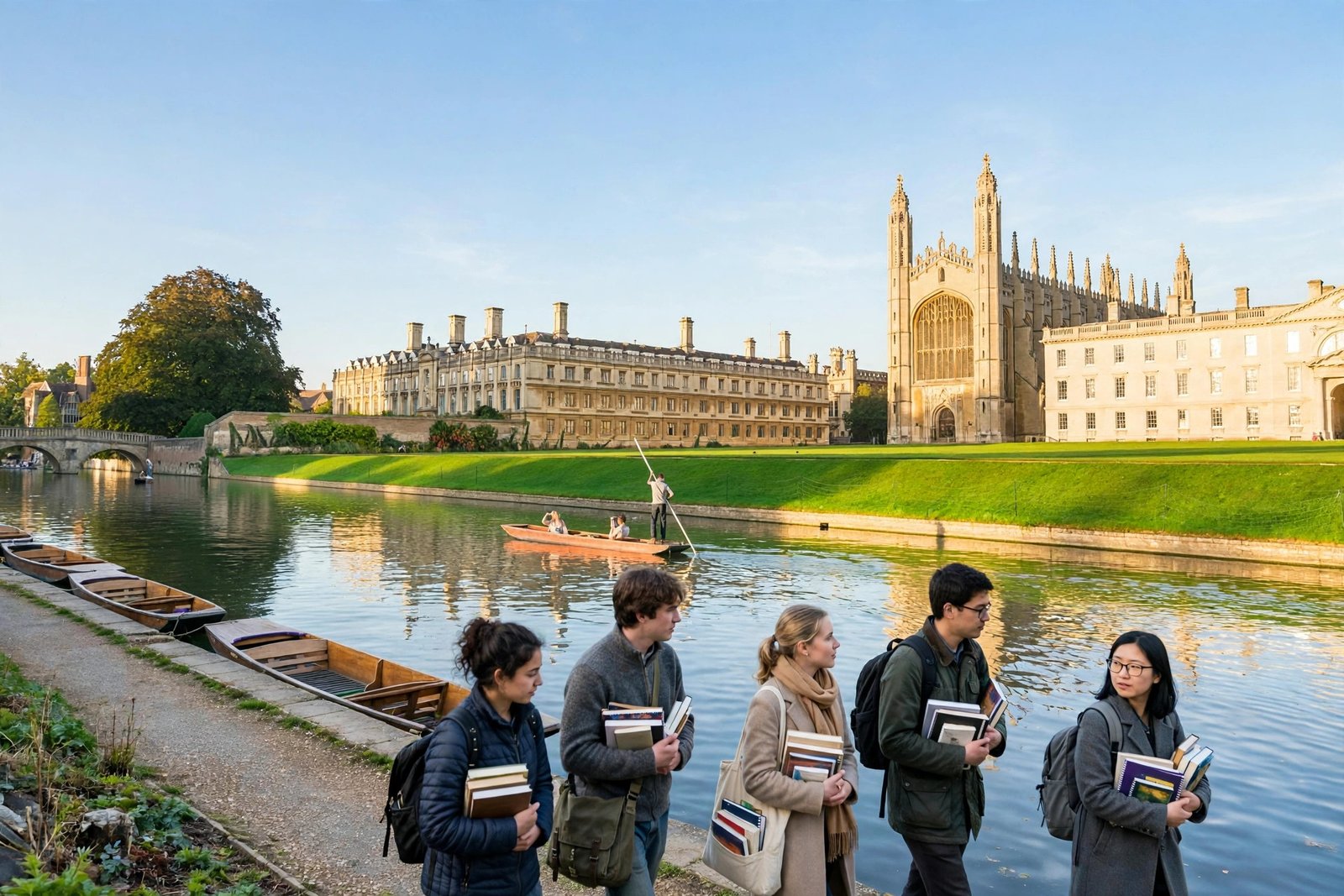
Gates Cambridge Scholarship 2027 at a Glance
| Item | Details for 2027 entry |
|---|---|
| Host university | University of Cambridge, United Kingdom |
| Funded by | Gates Cambridge Trust (established by a Gates Foundation donation in 2000) |
| Who can apply | Citizens of any country outside the United Kingdom |
| Eligible courses | PhD (full-time, or part-time under a pilot), MLitt (full-time), eligible one-year postgraduate courses (full-time) |
| Number of awards | Around 70–80 per year; about two-thirds to PhD students |
| Maintenance allowance | £23,152 for 12 months at the 2026-27 rate, pro rata for shorter courses; up to 4 years for PhD scholars |
| US round deadline | 14 October 2026 (US citizens normally resident in the USA) |
| International round deadlines | 8 December 2026 or 6 January 2027, depending on your course |
| How to apply | One application only: the Cambridge postgraduate application, with the funding section completed |
| Official website | gatescambridge.org |
The headline structure to remember is simple. There are two application rounds. The US round is for citizens of the United States who are normally resident in the USA, and it closes first, in October. Everyone else — including US citizens living outside the USA and current Cambridge students starting a new course — applies in the international (main) round, and your deadline is the funding deadline of your specific course, which falls on one of two dates in December or January. Your course, not your preference, decides which date applies to you, so the very first practical task in this process is finding your course in the Cambridge Course Directory and noting its exact funding deadline.
Eligibility: Who Can Apply for Gates Cambridge?
Eligibility has two layers: the formal rules about citizenship and courses, and the academic reality that you must first be a credible candidate for admission to Cambridge itself. Gates Cambridge does not admit you to a course; the university does. The scholarship selection happens on top of the admissions process, which is why the two are combined into a single application.
Citizenship
You must be a citizen of a country outside the United Kingdom. That is the core nationality rule, and it applies to applicants from Bangladesh, India, Pakistan, Nepal, Nigeria, Indonesia and every other non-UK country on equal terms — there are no country quotas published by the Trust. If you hold dual citizenship including UK citizenship, check the Trust’s current eligibility guidance carefully before relying on your eligibility, because the rule is written around citizenship rather than residence or fee status.
Eligible courses
You must be applying for one of the following at Cambridge: a PhD, full-time or — under a current pilot — part-time; an MLitt, full-time; or a one-year postgraduate course taken full-time, such as many MPhil, MRes and MASt courses. Some courses are excluded even though they are postgraduate courses at Cambridge; historically the exclusions have included business programmes such as the MBA and Master of Finance, the PGCE, and clinical medicine degrees, among others. The definitive list of ineligible courses is published by the Trust and by Cambridge Postgraduate Admissions for each cycle, so check your exact course against it before you invest weeks in an application. Undergraduate courses are never eligible.
Current Cambridge students
If you are already studying at Cambridge, you can apply for Gates Cambridge only to fund a new postgraduate course, not the remainder of a course you have already started. Current Cambridge students apply in the international round regardless of citizenship. Current Gates Cambridge Scholars who want to move on to a further degree can also apply again through the same route.
Academic standing
There is no separate published GPA cut-off for the scholarship itself, but the practical bar is set by Cambridge admissions: departments only nominate applicants they judge to be exceptionally strong. You need an excellent first degree (or to be on track for one) that meets your course’s entry requirements, and for research degrees you usually need a relevant master’s-level preparation or equivalent research experience, depending on the department. English language requirements are those of your course; Gates Cambridge adds no separate language test of its own.
What the Scholarship Covers
Gates Cambridge is a full-cost scholarship, designed so that funding is not the reason a selected scholar cannot take up their place. The package has core components that every scholar receives and discretionary components that the Trust considers case by case.
| Component | What is covered | Notes |
|---|---|---|
| University Composition Fee | Paid in full at the appropriate rate for your course | If you hold a separate public fee award (for example from UKRI), you are expected to accept it and the Trust adjusts its contribution |
| Maintenance allowance | £23,152 for 12 months (2026-27 rate) for a single student | Pro rata for courses under 12 months; PhD scholars funded for up to 4 years |
| Airfare | One economy single airfare at the start and one at the end of the course | Covers travel to and from Cambridge for the course itself |
| Visa and health surcharge | Inbound visa costs and the Immigration Health Surcharge | Removes two significant upfront costs of moving to the UK |
| Academic development funding | Discretionary, roughly up to £750–£4,000 depending on course length | For conferences and courses; applied for separately |
| Dependent children allowance | Discretionary; up to £12,793 per year for one child and up to £18,244 for two or more children at 2026-27 rates | No funding is provided for a partner |
| Fieldwork, maternity/paternity, hardship | Discretionary support in defined circumstances | PhD scholars may retain maintenance during fieldwork; the Trust does not fund other fieldwork costs or bench fees |
Two limits are worth stating plainly. First, the Trust does not pay bench fees or scientific equipment costs; those are expected to be covered by your department through the University Composition Fee arrangements. Second, discretionary awards are not entitlements — they are considered on application and on the circumstances described in the Trust’s guidance. Budget on the core package, and treat anything discretionary as a possible supplement rather than a guarantee.
How to Apply: Step by Step
The application has one portal, one deadline and three layers: admission to your course, admission to a College, and the Gates Cambridge funding section. Work through the steps below in order, and start far earlier than feels necessary — the reference requirements alone justify a two-to-three-month runway.
Step 1: Choose your course and check it is eligible
Start in the Cambridge Postgraduate Course Directory on the official Cambridge Postgraduate Admissions website. Read the course page end to end: entry requirements, whether a research proposal is required, which documents the department wants, and — critically — the course’s funding deadline. For the international round that deadline is either 8 December 2026 or 6 January 2027 for 2027 entry. Write your date down and plan backwards from it. At the same time, confirm the course is not on the Gates Cambridge ineligible list.
Step 2: Prepare your academic case
For PhD and other research courses, this step includes developing a focused research proposal and, where the department encourages it, contacting a potential supervisor whose work genuinely fits your project. For taught courses, it means assembling strong evidence that you meet and exceed the entry requirements. Departments make the first judgement in this competition: they rank and nominate their strongest applicants for scholarship consideration. An application that a department is lukewarm about does not reach the Gates Cambridge panels in a competitive position, so the quality of the course application itself — proposal, statement, writing sample where required — is the foundation everything else sits on.
Step 3: Start the application in the Applicant Portal
Create your application in the Cambridge Applicant Portal for your chosen course. You complete the standard sections: personal details, academic history, course-specific questions and statements, and your College preference (you may also make an open application). You can save and return to the application, so start it early even if your documents are not ready — an open draft makes the remaining work concrete and lets you see exactly which fields and uploads your course requires.
Step 4: Complete the funding section and opt in to Gates Cambridge
This is the step that makes you a Gates Cambridge candidate. In the funding section of the application you indicate that you wish to apply for funding and select the Gates Cambridge Scholarship. Applicants who skip this section, or who submit after the funding deadline, are not considered for the scholarship — there is no late route in and no separate form to rescue the situation. Treat the funding section with the same care as the rest of the application, complete it before you submit, and double-check it after submission in the portal.
Step 5: Write the Gates Cambridge statement (500 words)
Within the funding application you write the Gates Cambridge statement: a statement of up to 500 words explaining why you are applying for the scholarship and how you meet its selection criteria. This is not a repeat of your course statement of purpose. Your course documents argue that you can do the academic work; the Gates statement argues that you are the kind of person the Trust exists to fund — someone of outstanding intellectual ability whose work shows a genuine, evidenced commitment to improving the lives of others and the capacity to lead. The official description of the statement and criteria is on the Gates Cambridge apply pages; read it before drafting, and draft against the four selection criteria discussed below rather than writing a general personal essay and hoping it fits.

Step 6: Arrange three references — two academic plus one Gates reference
Your Cambridge application requires two academic references for admission. Gates Cambridge requires one additional, dedicated reference: the Gates Cambridge reference, written specifically against the scholarship’s criteria. So you need three referees in total, and they do different jobs. The two academic referees speak to your scholarly ability and readiness for the course. The Gates referee — who may be an academic, an employer, or someone who has supervised your service, voluntary or leadership work — should speak directly to your commitment to improving the lives of others and your leadership capacity, with concrete examples. Brief all three people early, give them the criteria their letter needs to address, and make sure they understand that references must be submitted by your funding deadline; a late reference can leave your application incomplete at the moment it matters most.
Step 7: Upload documents and submit before the funding deadline
Upload transcripts and degree certificates, your research proposal or writing sample where your course requires them, your CV where requested, and evidence for English language requirements if your offer conditions will require it. Then submit the complete application — including the funding section — before 11:59pm UK time on your round’s deadline: 14 October 2026 for the US round, or your course’s December/January funding deadline for the international round. Note that there is a Cambridge application fee for most postgraduate applications, with fee waiver routes for eligible applicants described by Postgraduate Admissions; check the current position on the official site rather than assuming.
Step 8: Departmental assessment and nomination
After the deadline, your department assesses your application for admission and ranks its strongest candidates. Departments nominate candidates to the Gates Cambridge Trust, and only nominated applicants move forward. This stage is invisible to you — there is nothing to submit and no form to chase — but it explains why the course application carries so much weight: your department is effectively your first selection panel.
Step 9: Gates Cambridge shortlisting
The Trust’s selection process reviews nominated candidates across Cambridge, shortlisting the strongest for interview. Shortlisted candidates are assessed against the four criteria as a whole: a brilliant academic record with a thin Gates statement and a generic Gates reference rarely survives this stage, because the panels are comparing you with other nominated candidates who are also academically excellent. If you are not shortlisted, you may still receive an offer of admission to Cambridge — admission and scholarship decisions are related but separate, and many admitted students fund their places through other Cambridge and College awards, which is one reason completing the general funding section carefully matters even if Gates Cambridge is your first choice.
Step 10: Interviews in March and April, then results
Shortlisted candidates are invited to interview in the spring — interviews for the 2027 cycle are expected in March/April following the pattern of recent cycles, conducted by panels convened by the Trust, with US-round and international-round interviews scheduled in their respective periods. The interview explores your academic plans, your reasons for choosing the course, and above all the commitment and leadership dimensions of your application: expect to be asked what problem you want your work to address, who it serves, and what you have already done that shows this is real rather than aspirational. Offers are made after interviews conclude, in time for scholars to accept their Cambridge places and arrange visas for an October start. Exact interview and offer dates for the cycle are published by the Trust on its timeline pages, so confirm them there rather than relying on any secondary summary, including this one.
Required Documents Checklist
- Completed Cambridge postgraduate application for one eligible course, including the funding section with Gates Cambridge selected
- Academic transcripts (and degree certificates where you have already graduated)
- Two academic references for admission
- One additional Gates Cambridge reference addressing the scholarship criteria
- The Gates Cambridge statement (up to 500 words) within the funding application
- Research proposal, for PhD and research courses that require one
- Course-specific materials where required, such as a writing sample or CV/résumé
- Evidence relating to English language requirements, where applicable to your course and background
Deadlines and Timeline for 2027 Entry
| Stage | US round | International (main) round |
|---|---|---|
| Applications open | Early September 2026, when the Cambridge postgraduate application opens for 2027 entry | |
| Application deadline | 14 October 2026 | 8 December 2026 or 6 January 2027, depending on your course’s funding deadline |
| Departmental assessment and nomination | Autumn 2026 | Winter 2026-27 |
| Gates Cambridge shortlisting | Late 2026 / early 2027 | Early 2027 |
| Interviews | Spring 2027 (interviews in recent cycles have run across March and April; confirm exact dates on the Trust’s timeline page) | |
| Scholarship offers | After interviews, in time for October 2027 course start | |
| Course begins | October 2027 (Michaelmas Term) | |
One timing warning deserves emphasis: your referees’ deadlines are your deadline. References are submitted through the portal system by your referees, and the application is assessed as submitted. Build in at least two weeks of slack for the Gates referee in particular, because that person is often a busy professional outside academia who has never used the Cambridge system before. Use a tracker — our study-abroad tools directory includes a deadline tracker designed for exactly this multi-deadline problem — and keep your own calendar copy as well.
Selection Criteria and How to Improve Your Chances
The Trust publishes four selection criteria, and every part of your Gates-specific material should map onto them visibly:
- Outstanding intellectual ability — evidenced by your academic record, your proposal, and your academic references.
- Reasons for choice of course — a specific, credible explanation of why this Cambridge course, this department and this moment in your development.
- A commitment to improving the lives of others — evidenced by what you have already done, not only what you intend to do.
- Leadership capacity — evidence that you can mobilise people and ideas, and a plausible account of how you will do so at greater scale.
To strengthen your application: choose a course you can justify in one clear paragraph linking your past work, the Cambridge curriculum or research environment, and your future plans. In the 500-word statement, spend the majority of the words on criteria three and four, with named projects, measurable outcomes and your specific role — “led a team of six volunteers delivering weekly literacy classes to 120 children for two years” persuades; “passionate about helping society” does not. Pick a Gates referee who has directly seen the work your statement describes, so the letter corroborates the statement rather than merely praising your character. And keep the academic core impeccable: no statement rescues a weak research proposal, because departments nominate before the Trust shortlists. You can compare how Cambridge sits among global peers in our university rankings directory when you are deciding between offers and programmes.
Common Mistakes That End Applications Early
- Submitting after the funding deadline. Applying for admission by the later general deadline but missing the funding deadline means no Gates consideration. The funding deadline is the only deadline that matters for this scholarship.
- Forgetting the funding section. If you do not opt in to funding and select Gates Cambridge in the application, you are not in the competition, even if your statement exists in a Word document on your laptop.
- Recycling your statement of purpose as the Gates statement. The Gates statement must address commitment and leadership against the Trust’s criteria; a purely academic essay scores poorly at shortlisting.
- Using a third academic reference as the Gates reference. The Gates referee should evidence service and leadership, ideally from direct supervision of that work.
- Applying for an ineligible course. Check the exclusions list for your exact course before applying.
- Leaving references to the last week. Referee delay is the most common avoidable cause of incomplete applications.
- Overclaiming impact. Panels interview shortlisted candidates and probe claims; inflated numbers unravel quickly and damage credibility across all four criteria.
Frequently Asked Questions
Is there a separate Gates Cambridge application form?
No. You apply once, through the Cambridge postgraduate application for your course, and complete the funding section selecting Gates Cambridge. There is no separate scholarship portal or form, and anything calling itself a standalone Gates Cambridge application should be treated with suspicion.
What happens if I miss the funding deadline but meet the course deadline?
You can still be considered for admission to the course, but you will not be considered for the Gates Cambridge Scholarship for that entry year. The Trust does not accept late scholarship applications, so the funding deadline — 14 October 2026 for the US round, or your course’s December/January date — is absolute.
How much is the Gates Cambridge maintenance allowance?
At the 2026-27 rate it is £23,152 for 12 months for a single student, paid pro rata for shorter courses, with PhD scholars funded for up to four years. Rates are reviewed, so confirm the current figure on the official site when you apply.
How many references do I need?
Three in total: the two academic references required for admission to your course, plus one additional Gates Cambridge reference written specifically against the scholarship’s criteria, particularly your commitment to improving the lives of others and your leadership capacity.
Can UK citizens apply?
No. The scholarship is for citizens of countries outside the United Kingdom. UK citizens should instead look at the other funding routes listed in Cambridge’s funding search and in our scholarships directory.
Can I apply if I am already a Cambridge student?
Yes, but only to fund a new postgraduate course, not a course already in progress. Current Cambridge students apply in the international round regardless of citizenship.
Does Gates Cambridge guarantee my Cambridge admission or UK visa?
No. Admission is decided by the university through the course application, and the scholarship is awarded to nominated, shortlisted candidates; neither admission nor a scholarship award guarantees a visa outcome, which is decided by UK Visas and Immigration under its own rules. The scholarship does cover inbound visa costs and the Immigration Health Surcharge for scholars.
When are interviews and results?
Interviews for shortlisted candidates take place in the spring following application — across March and April in recent cycles — with offers following after interviews conclude, ahead of the October course start. The Trust publishes the exact dates for each cycle on its official timeline pages.
Sources & Verification
This guide was prepared from official sources: the Gates Cambridge Trust website (including its apply and timeline information), the University of Cambridge Postgraduate Admissions course directory (including course and funding-deadline information), and the University of Cambridge’s published postgraduate admissions guidance. Figures quoted — including the £23,152 maintenance allowance and the dependent children allowances — are the published 2026-27 rates at the time of writing.
Disclaimer: Scholarship details, rates and deadlines change yearly, so always confirm deadlines and amounts on the official website before applying. StudyGraduate is an information portal, not an agency, and cannot promise selection, admission or visa approval to any applicant.
✅ Eligibility Criteria
- Check the official website for full eligibility criteria for your country
🎁 Benefits
- See the official website for the complete list of benefits
⚙️ Application Process
- 1Check your eligibility on the official site
- 2Prepare your documents and statements
- 3Submit the online application before the deadline
- 4Complete interviews or assessments if shortlisted
- 5Await the final selection announcement
📅 Important Dates
Deadlines vary by country and intake. Check the official website for country-specific dates.
📄 Required Documents
- Valid passport
- Academic transcripts & certificates
- Statement of purpose
- Letters of recommendation
- CV / resume
Commonly required — confirm the exact list on the official site.
❓ Frequently Asked Questions

Ready to Take the Next Step?
Explore more scholarships and study opportunities around the world.
Browse Scholarships →