Engineering Scholarships in Germany for International Students 2026–2027
Engineering Scholarships in Germany for International Students 2026–2027 Germany is the engineering student’s paradox: it offers some of the strongest technical universities in the world — TU Munich, RWTH Aachen, TU Berlin, Karlsruhe (KIT), TU Darmstadt, Stuttgart, Dresden — inside an economy built on automotive, machinery, chemicals, energy and advanced manufacturing, and at most public ... <a title="Engineering Scholarships in Germany for International Students 2026–2027" class="read-more" href="https://studygraduate.com/scholarship/engineering-scholarships-in-germany-for-international-students-2026-2027/" aria-label="Read more about Engineering Scholarships in Germany for International Students 2026–2027">Read more</a>
📖 Overview
Engineering Scholarships in Germany for International Students 2026–2027
Germany is the engineering student’s paradox: it offers some of the strongest technical universities in the world — TU Munich, RWTH Aachen, TU Berlin, Karlsruhe (KIT), TU Darmstadt, Stuttgart, Dresden — inside an economy built on automotive, machinery, chemicals, energy and advanced manufacturing, and at most public universities it charges no general tuition fee at all. Yet international students still search frantically for “engineering scholarships in Germany”, because free tuition is not the same as free study. You still need roughly a year of living costs proven before your visa is granted — the blocked account figure for 2026 is €11,904 — plus semester contributions, insurance, travel and the reality of Munich or Berlin rents. Scholarships in Germany are therefore best understood as living-cost and top-up funding layered on top of low or zero tuition, with a few genuinely full packages — above all DAAD’s — for the right candidates.
This guide maps every major funding route an engineering student can realistically use in 2026–2027: the DAAD scholarship system including EPOS (€992 per month for master’s students, and the doctoral rates), the Deutschlandstipendium (€300 per month, open to all nationalities at participating universities), the political-foundation scholarships, Erasmus Mundus joint engineering master’s programmes, university-level awards and fee waivers — including the important exception that TU Munich now charges non-EU students tuition (€4,000–€6,000 per semester for master’s programmes) and Baden-Württemberg charges non-EU students €1,500 per semester at its universities, which include Stuttgart and KIT. It also explains the blocked account, working-student rules and the application calendar, because in Germany the money system and the admissions system are inseparable. Start your university shortlist in our universities directory and see the full funding landscape in the scholarships directory.
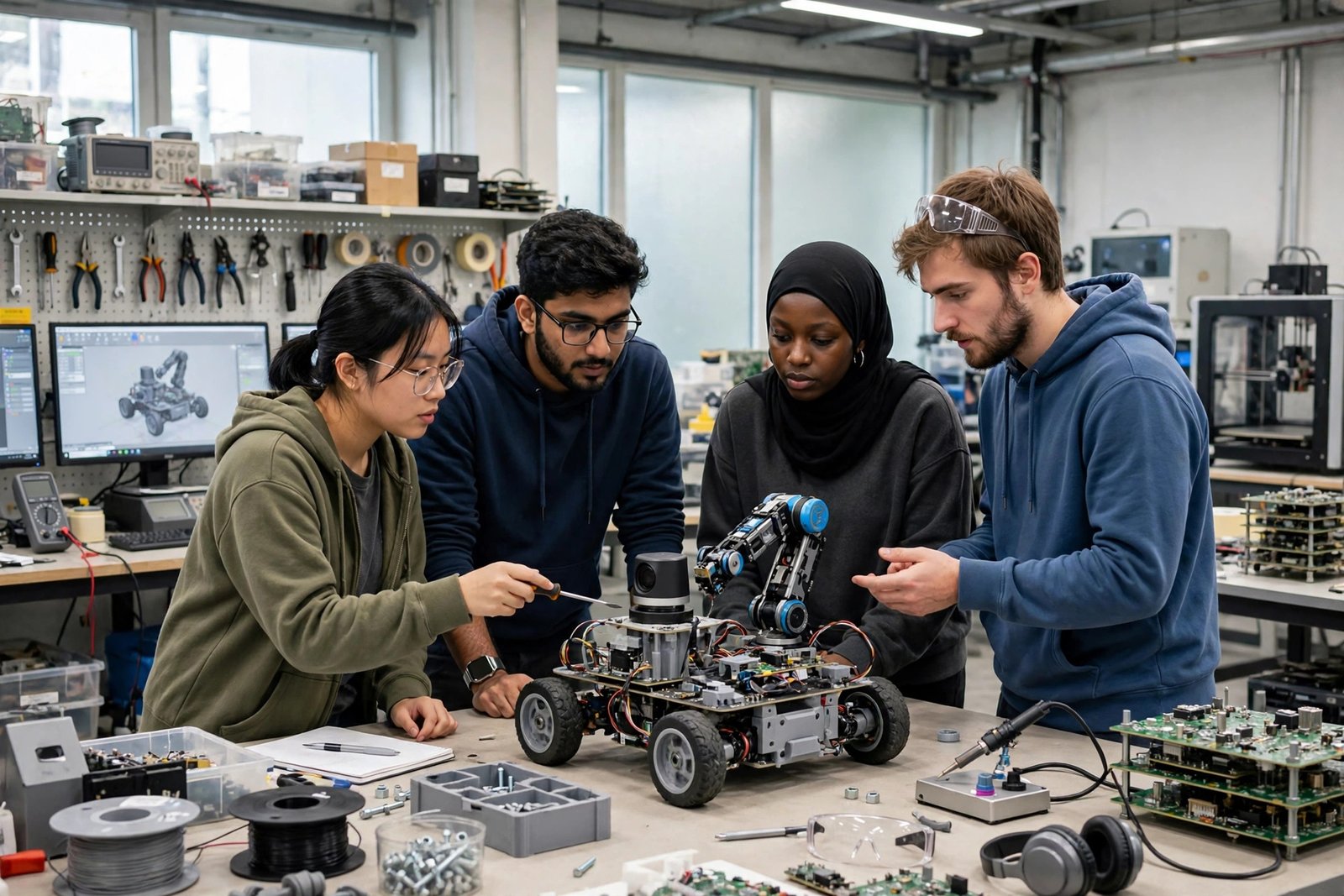
Engineering Scholarships in Germany at a Glance
| Scholarship / route | Value | Who it is for | Engineering relevance |
|---|---|---|---|
| Low / no tuition at public universities | No general tuition in most states; semester contribution only (varies, often a few hundred euros) | All enrolled students | The foundation of every budget — but note TUM and Baden-Württemberg exceptions |
| DAAD EPOS | €992/month (master’s); doctoral €1,300/month, rising to €1,400 from Feb 2026; plus insurance, travel allowance, possible rent/family allowances | Professionals from eligible developing/emerging countries with a bachelor’s + at least 2 years’ relevant work experience | Selected development-related postgraduate courses, including engineering and resource/energy programmes on the EPOS list |
| DAAD research grants / doctoral funding | Doctoral-rate monthly funding under current DAAD calls | Master’s graduates and doctoral candidates with a supervisor/host in Germany | Very strong for engineering PhDs and research stays |
| Deutschlandstipendium | €300/month (€150 federal + €150 private sponsor), usually at least 2 semesters, renewable | Enrolled students of ALL nationalities at participating universities, merit + commitment | Available across engineering faculties; applied for through your university |
| Political foundations (Heinrich Böll, Friedrich Ebert, Konrad Adenauer and others) | Monthly funding modelled on BAföG-style rates plus allowances, per foundation rules | Students whose values/profile match the foundation; German often needed for many, some international programmes exist | General — engineering students do win these, on profile fit |
| Erasmus Mundus Joint Masters | Full participation costs + monthly allowance under programme rules | All nationalities; apply to the consortium | Excellent for specialised engineering master’s across 2–3 European countries |
| University awards & TUM tuition waivers | Varies: merit/need waivers of TUM’s non-EU tuition, faculty prizes, emergency and completion grants | Enrolled or admitted students per university rules | Essential at TUM; modest elsewhere where tuition is already zero |
Two companion guides go deeper on adjacent topics: our general Engineering Scholarships for International Students 2026–2027, the Germany-specific computing guide Computer Science Scholarships in Germany for International Students 2026, and the central DAAD Scholarship hub. Our university profiles for the three most-searched technical universities are here: Technical University of Munich, TU Berlin and TU Darmstadt.
The German Funding Model: Read This Before Any Scholarship
Most German public universities charge no tuition for consecutive bachelor’s and master’s programmes regardless of nationality; students pay a semester contribution (Semesterbeitrag) covering student services and usually a public-transport ticket, set by each university. The exceptions are now significant for engineers. Baden-Württemberg charges non-EU/EEA students €1,500 per semester at its universities — that includes the University of Stuttgart and KIT Karlsruhe, two engineering heavyweights. TU Munich, under Bavarian law, has charged non-EU students since winter semester 2024/25: typically €2,000–€3,000 per semester for bachelor’s and €4,000–€6,000 per semester for master’s programmes, with waiver scholarships available for talented or needy international students under TUM’s own rules (see TUM’s official tuition pages). Private universities charge full tuition and are a different calculation entirely.
The visa system then sets your real funding floor. A non-EU student normally proves living costs with a blocked account (Sperrkonto) holding €11,904 for the first year (2026) — released at €992 per month after arrival — or with an accepted alternative such as a formal obligation declaration (Verpflichtungserklärung) from a sponsor in Germany, or a recognised scholarship award covering the required amount. Notice the symmetry: €992 a month is both the blocked-account release rate and the DAAD EPOS master’s rate — both derive from the same official estimate of student living costs. A DAAD award letter, where it meets the required level, can serve as your financial proof; a €300 Deutschlandstipendium, valuable as it is, cannot do so alone.
Eligibility: Who Can Apply for What
- Admission eligibility first. For a bachelor’s in engineering, your school qualification must be recognised as equivalent to the German Abitur (directly, or via a Studienkolleg preparatory year and Feststellungsprüfung); applicants from several countries, including India, China and Vietnam, also need an APS certificate verifying their documents. For a master’s, you need a relevant bachelor’s — engineering admissions committees look closely at subject match (mathematics, mechanics, thermodynamics, programming cores, depending on the field).
- Language. Many engineering master’s programmes are fully English-taught (typical requirement: IELTS 6.5 / TOEFL equivalents, programme-specific); most bachelor’s programmes are German-taught and require C1-level German (TestDaF/DSH). Do not assume an English bachelor’s in engineering — verify per programme in the DAAD’s official degree database.
- DAAD EPOS: citizenship of a DAAD-listed developing/emerging country; a bachelor’s degree (normally within the last six years) with above-average results; at least two years of relevant professional experience after the bachelor’s; and admission to a specific EPOS-listed course. Fresh graduates without the two years of experience are not eligible, however strong their grades.
- Deutschlandstipendium: enrolment (or an admission place) at a participating German university; all nationalities; judged on achievement plus commitment/personal circumstances under each university’s statutes. It is applied for at your university, typically once a year.
- Foundation scholarships: each political foundation sets its own academic, language and values-fit criteria and deadlines; several expect good German even for English-taught study, because their seminar programmes run in German. Read the foundation’s own pages carefully.
The Main Scholarships in Detail
1. DAAD — the system that matters most
The DAAD (German Academic Exchange Service) is the world’s largest funding organisation of its kind, and its scholarship database — DAAD scholarships (official) — is the single most important page in this article. For engineers, three DAAD routes dominate.
EPOS (Development-Related Postgraduate Courses) funds professionals from eligible countries into a defined list of English-taught postgraduate courses at German universities — a list that includes engineering-adjacent programmes in areas such as renewable energy, water resources, environmental and resource management, infrastructure and development engineering (the exact course list is republished per cycle; not every engineering master’s is an EPOS course, and purely general mechanical/electrical programmes usually are not). Current funding: €992 per month for master’s students; €1,300 per month for doctoral candidates, rising to €1,400 from February 2026; plus health, accident and personal-liability insurance contributions, a travel allowance where no other funder pays it, and possible monthly rent subsidy and family allowances under DAAD rules. You apply directly to the course (up to the small number of EPOS courses the rules allow — the current call sets the limit), not to a generic DAAD portal, and each course sets its own deadline, commonly in the autumn (many close around October–December) for a start the following winter semester.
DAAD doctoral and research funding is the natural route for engineering graduates targeting a PhD or a research stay with a German professor: monthly doctoral-rate funding, insurance and travel support under the specific call. Germany’s structured doctoral programmes and research groups advertise additional fully funded positions (employed researcher contracts, often TV-L E13 positions), which for engineering PhDs are frequently a better package than any scholarship — a funded doctoral position is a job, with salary and social insurance, and it is how a large share of international engineering PhDs in Germany are actually financed. Search university job boards and DAAD’s PhD Germany resources alongside scholarship databases.
DAAD study scholarships for master’s degrees in selected fields and calls appear periodically; eligibility and fields vary by call and by country of origin, and many DAAD offers are country-specific (administered with DAAD offices and partner bodies abroad). The database, filtered by your country and level, is the only reliable way to see what is open to you.
2. Deutschlandstipendium — €300 a month, every nationality, every engineering faculty
The Deutschlandstipendium is Germany’s national merit scholarship: €300 per month, half from the federal government (Federal Ministry of Education and Research) and half from private sponsors — companies, foundations and alumni raised by each university. It is awarded by the universities themselves, normally for at least two semesters and renewable up to the end of the standard study period if performance continues. Official programme information is at deutschlandstipendium.de. Selection weighs academic achievement first, plus social commitment and personal circumstances (first-generation background, obstacles overcome). For engineers it has a hidden extra value: sponsors are frequently engineering employers, and the scholarship’s networking and mentoring events are a soft entry into the German labour market. €300 does not fund a degree — but stacked on zero tuition and a blocked account it closes a real monthly gap, and it is one of the few awards you apply for after arrival/enrolment rather than before admission.
3. Political foundations
Germany’s publicly funded political foundations — Heinrich Böll (Greens-aligned), Friedrich Ebert (SPD-aligned), Konrad Adenauer (CDU-aligned), Friedrich Naumann (liberal), Rosa Luxemburg (Left) and Hanns Seidel (CSU-aligned) — run substantial scholarship programmes for German and international students, including engineers, with monthly support broadly modelled on student-finance rates plus lump sums and allowances, and rich seminar programmes. They select on academic strength and demonstrable social/political commitment aligned with the foundation’s values; most expect solid German. Application windows are typically once or twice a year with long lead times. Treat them as high-value, profile-fit competitions: an engineering student with genuine civic engagement and German at B2+ is a plausible candidate; a purely transactional application is not.
4. Erasmus Mundus Joint Masters in engineering
For specialised engineering master’s study, Erasmus Mundus consortia — several coordinated or co-delivered by German technical universities — offer the most complete packages available anywhere in this guide: participation costs covered plus a monthly allowance for up to 24 months, for study in at least two European countries. Programmes span fields such as renewable energy, advanced robotics, computational mechanics, sustainable energy systems and materials science. You apply to the consortium between roughly October and January for the following autumn. Because the German semesters inside a consortium are tuition-covered by the programme, Mundus neatly solves both the TUM/Baden-Württemberg fee question and the living-cost question for its scholars.
5. University-level money: waivers, prizes and working roles
Where tuition is zero, university money is modest but real: faculty prizes, completion and hardship grants administered with the Studentenwerk, and — most importantly for engineers — paid student roles. Research-assistant (HiWi) jobs in labs and institutes, tutoring, and industry working-student (Werkstudent) positions in engineering firms are a structural part of German student finance for engineers in a way they are not in most countries; they pay real hourly wages, build the CV that German employers hire from, and are legal within your residence permit’s work limits. At TUM, add tuition-waiver scholarships for international students (merit- and need-based under TUM’s published rules) — if TUM is your target, the waiver application belongs on your calendar alongside admission itself. RWTH Aachen, TU Berlin (where only the semester contribution applies), KIT and Stuttgart each publish their own scholarship and funding pages — read them per university, because there is no central application for any of this.
What the Money Covers — and the Budget It Has to Fit
| Item | Typical position for 2026–2027 | Covered by |
|---|---|---|
| Tuition — most public universities | €0 (semester contribution only) | State funding model |
| Tuition — Baden-Württemberg (non-EU) | €1,500 per semester | Student; limited exemption categories per state rules |
| Tuition — TUM (non-EU) | €2,000–€3,000/semester (bachelor’s); €4,000–€6,000/semester (master’s) | Student, unless a TUM waiver scholarship is granted |
| Living costs — visa proof | €11,904 blocked account for year 1 (€992/month) | Student/sponsor, or a qualifying scholarship award letter |
| DAAD EPOS package | €992/month (master’s); €1,300 → €1,400 doctoral; insurance; travel allowance; possible rent/family supplements | DAAD |
| Deutschlandstipendium | €300/month, usually ≥2 semesters | Federal government + private sponsors via your university |
| Health insurance | Mandatory; student rates at public insurers for most under-30 students, or private alternatives | Student (DAAD packages include insurance contributions) |
| Part-time work | Residence permits typically allow 140 full days or 280 half days per year (plus HiWi roles under their own rules) | Student effort — supplement, never the visa proof |
Run your own numbers city by city: Munich rents can consume most of the €992 monthly benchmark on their own, while Aachen, Dresden, Darmstadt or Freiberg leave genuine headroom. The scholarship that makes Munich viable (DAAD, or a TUM waiver plus Deutschlandstipendium plus HiWi income) is a different plan from the one that makes Dresden comfortable — choose the city and the funding stack together. StudyGraduate’s planning tools in the tools directory include budget and cost-of-living calculators to model this, and the DAAD’s official portal Study in Germany publishes current cost guidance.
Engineering Fields and Where They Cluster
Mechanical, automotive and aerospace engineering concentrate around Munich (TUM), Stuttgart, Aachen and Braunschweig; electrical engineering and computer science around Munich, Berlin, Darmstadt, Karlsruhe and Aachen; civil and environmental engineering at Dresden, Hannover, Stuttgart and the Bauhaus/Weimar tradition; energy, process and chemical engineering at Karlsruhe, Dortmund, Erlangen-Nürnberg (FAU) and the Ruhr universities; materials and production at Aachen, Freiberg and Saarbrücken. Match field to cluster when you can — lab capacity, institute HiWi jobs and Werkstudent demand all follow the cluster — and remember that interdisciplinary English-taught master’s (mechatronics, robotics, renewable energy, data engineering) are often the most accessible entry points for international applicants, while German-taught bachelor’s programmes remain the main funded route at undergraduate level for students with C1 German.
How to Apply, Step by Step
- Verify your qualification (12–18 months out). Check recognition of your school/university credentials (anabin / your target university / uni-assist) and start the APS process immediately if it applies to your country — APS delays are a classic missed-intake cause.
- Choose programmes and note their funding pages. Use DAAD’s degree database to filter English-taught engineering master’s; for each shortlisted programme record: tuition status (free / BW €1,500 / TUM fee), deadline, language proof, and whether the course is EPOS-listed.
- Language evidence. Book IELTS/TOEFL for English-taught programmes or TestDaF/DSH for German-taught; German at B1–B2 additionally transforms your HiWi/Werkstudent options later even on English programmes.
- Apply for admission via uni-assist or the university portal by the programme deadline — winter-semester deadlines for international applicants commonly fall between March and 15 July depending on the university and route; summer-semester intakes are fewer in engineering.
- Apply for DAAD EPOS in the same motion if you meet the experience rule — EPOS applications go to the course with its own (usually autumn) deadline, a full cycle earlier than many students expect.
- Set up the blocked account with a recognised provider once admission is in sight, deposit €11,904, and keep the blocking confirmation for your visa file.
- Visa, then arrival tasks: national (D) visa via the consular services portal/embassy; after arrival, address registration, residence permit, bank account activation and health insurance — your university’s international office runs welcome checklists for exactly this.
- After enrolment: apply for the Deutschlandstipendium in your university’s annual round, register with institute job boards for HiWi roles, and (at TUM) file/renew waiver applications on schedule.
Required Documents
- Passport; recognised school-leaving and/or bachelor’s certificates with transcripts (certified translations where required) and APS certificate where applicable
- Proof of language proficiency per programme (IELTS/TOEFL for English-taught; TestDaF/DSH/Goethe for German-taught)
- CV in the format the programme requests (DAAD/EPOS uses its specified application form and Europass-style CV)
- Motivation letter specific to the programme — for EPOS, addressing development relevance and your post-degree plan in your home country is central, not decorative
- For EPOS: employer reference letters and proof of at least two years of relevant professional experience; degree-age and grade rules apply
- Recommendation letters where the programme or scholarship requires them
- Blocked-account confirmation (€11,904) or accepted alternative proof of funds; health-insurance evidence for enrolment/visa
- For foundation scholarships: evidence of social/political commitment and, usually, German-language proof
Deadlines and Timeline
| When | Milestone | Notes |
|---|---|---|
| Autumn 2026 (many courses) | DAAD EPOS course deadlines for 2027 starts | Each EPOS course sets its own date — October-December is common; check the course |
| Oct 2026–Jan 2027 | Erasmus Mundus consortium deadlines | Apply to the consortium, not the German partner university |
| Jan–May 2027 | TUM and many winter-semester master’s application windows | TUM’s non-EU tuition and waiver rules apply from admission — read both together |
| Up to 15 Jul 2027 | Common final deadline for winter-semester applications via uni-assist at many universities | Programme-specific earlier deadlines are frequent; the programme page controls |
| Spring–summer 2027 | Blocked account, visa appointment, housing | Visa appointments are the bottleneck in many countries — book at first eligibility |
| After enrolment (annual round) | Deutschlandstipendium applications at your university | Dates are university-specific; usually tied to the academic year |
| Oct 2027 | Winter semester start | Most engineering intakes are winter-only |
Selection Criteria — How to Improve Your Chances
German selection, for admission and funding alike, is document-driven and subject-specific. Committees reward a clean subject match between your bachelor’s core modules and the master’s curriculum; mathematics and fundamentals grades weigh more than a glossy overall percentage; and a motivation letter that names laboratories, modules and research groups signals an applicant who will finish. For EPOS, add the development logic: two-plus years of relevant professional work, a credible return-and-apply plan, and employer support — EPOS is a development instrument, and applications that read as emigration plans fail its criteria. For the Deutschlandstipendium, your first-semester grades and visible engagement (student teams — Formula Student and rocketry teams are engineering catnip for sponsors — volunteering, mentoring) are the currency. For foundations, values-fit evidence over years beats a statement written for the deadline. And across everything: German language progress is the highest-leverage investment an engineering applicant can make — it multiplies admission options at bachelor’s level, unlocks foundation scholarships, and doubles your student-job market.
Common Mistakes
- Assuming “Germany is free” and arriving without the €11,904 proof. Tuition-free is not cost-free; the blocked account is a visa requirement, not an optional formality.
- Missing the TUM and Baden-Württemberg fees. Two of the most popular engineering destinations for internationals now charge non-EU tuition — budget it or win the waiver.
- Applying to DAAD EPOS as a fresh graduate. The two-years-of-experience rule is absolute; without it, target regular admission plus Deutschlandstipendium and university routes instead.
- Treating every engineering master’s as EPOS-eligible. EPOS covers a defined course list only — check the current list before planning around €992 a month.
- Starting APS or credential recognition late. Verification timelines in peak season can consume an entire intake.
- Choosing Munich on a small-city budget. Rent is the variable that breaks German budgets; match city cost to confirmed funding.
- Ignoring doctoral positions. For PhD-level engineers, an employed researcher contract often beats any scholarship — search job boards as well as scholarship databases. Compare sibling decisions in our guide to CS scholarships in Germany and, for a contrast in systems, Engineering Scholarships in Canada for International Students 2026.
Frequently Asked Questions
Is engineering really tuition-free in Germany for international students?
At most public universities in most states, yes — you pay only a semester contribution. The major exceptions: Baden-Württemberg charges non-EU students €1,500 per semester (affecting Stuttgart and KIT), TU Munich charges non-EU students €2,000–€3,000 per semester (bachelor’s) or €4,000–€6,000 (master’s), and private universities charge full fees. Always check your specific university.
How much is the DAAD EPOS scholarship in 2026–2027?
€992 per month for master’s students. Doctoral EPOS funding is €1,300 per month, rising to €1,400 from February 2026. Insurance contributions, a travel allowance and possible rent and family supplements are added under DAAD rules.
What is the blocked account amount for Germany in 2026?
€11,904 for the first year — the standard proof of living costs for the student visa, released at up to €992 per month after arrival. Confirm the current figure before opening your account, as it is adjusted periodically.
Can I get the Deutschlandstipendium as an international engineering student?
Yes. It is open to students of all nationalities enrolled at participating universities, pays €300 per month, and is awarded by your university on achievement plus commitment and personal circumstances. You apply after admission/enrolment in the university’s annual round.
Do I need work experience for DAAD scholarships?
For EPOS, yes — at least two years of relevant professional experience after your bachelor’s degree, from an eligible country, with a degree normally no older than six years. Other DAAD lines (for example doctoral research grants) have their own criteria; check the specific call in the DAAD database.
Can I study engineering in Germany in English?
At master’s level, widely — many technical universities offer full English-taught engineering master’s. At bachelor’s level, most programmes are German-taught and require around C1 German. Verify the language of instruction per programme in DAAD’s database before applying.
Can part-time work replace a scholarship?
No — and it cannot replace the blocked account for your visa either. Student work (typically up to 140 full or 280 half days a year, with HiWi research-assistant roles treated under their own rules) is a valuable supplement and career builder, especially Werkstudent roles in engineering firms, but your funding plan must stand without it.
Does DAAD funding count as proof of funds for the visa?
A DAAD award that meets the required living-cost level is an accepted form of financial proof — scholarship holders normally present their award letter instead of (or alongside) a blocked account, following the embassy’s instructions for their case. Smaller awards like the €300 Deutschlandstipendium do not, on their own, satisfy the requirement.
Sources & Verification
- DAAD (official) — scholarship database and EPOS programme pages: €992/month master’s rate, doctoral €1,300 rising to €1,400 from February 2026, insurance/travel/rent-supplement rules, two-years-experience and eligible-country criteria.
- Federal Foreign Office / German missions and Study in Germany (DAAD/BMBF portal) — blocked account €11,904 for 2026 and student-visa financial proof.
- Deutschlandstipendium (Federal Ministry of Education and Research) — €300/month structure (€150 federal + €150 private), award through universities, all nationalities.
- Technical University of Munich — official tuition pages: non-EU fees €2,000–€3,000 (bachelor’s) and €4,000–€6,000 (master’s) per semester from winter 2024/25, plus waiver-scholarship rules.
- State of Baden-Württemberg / university pages — €1,500 per semester tuition for non-EU students.
- European Commission / EACEA — Erasmus Mundus Catalogue and scholarship terms.
Disclaimer: Amounts, deadlines and eligibility rules change every cycle. Figures here were checked against official sources at the time of writing in October 2026; always confirm the current terms on the official DAAD, university or programme website before applying. StudyGraduate is an independent information portal, not an agency, university or government body — we cannot promise or influence admission, scholarship or visa outcomes.
✅ Eligibility Criteria
- Check the official website for full eligibility criteria for your country
🎁 Benefits
- See the official website for the complete list of benefits
⚙️ Application Process
- 1Check your eligibility on the official site
- 2Prepare your documents and statements
- 3Submit the online application before the deadline
- 4Complete interviews or assessments if shortlisted
- 5Await the final selection announcement
📅 Important Dates
Deadlines vary by country and intake. Check the official website for country-specific dates.
📄 Required Documents
- Valid passport
- Academic transcripts & certificates
- Statement of purpose
- Letters of recommendation
- CV / resume
Commonly required — confirm the exact list on the official site.
❓ Frequently Asked Questions

Ready to Take the Next Step?
Explore more scholarships and study opportunities around the world.
Browse Scholarships →