Engineering Scholarships in Canada for International Students 2026
Engineering Scholarships in Canada for International Students 2026 Canada is one of the world’s great engineering-education countries. Its flagship programmes — Toronto, Waterloo, UBC, McGill, Alberta, Calgary — are accredited under the Washington Accord through Engineers Canada, feed directly into co-op jobs with real employers, and sit inside a study-permit system that can lead to ... <a title="Engineering Scholarships in Canada for International Students 2026" class="read-more" href="https://studygraduate.com/scholarship/engineering-scholarships-in-canada-for-international-students-2026/" aria-label="Read more about Engineering Scholarships in Canada for International Students 2026">Read more</a>
📖 Overview
Engineering Scholarships in Canada for International Students 2026
Canada is one of the world’s great engineering-education countries. Its flagship programmes — Toronto, Waterloo, UBC, McGill, Alberta, Calgary — are accredited under the Washington Accord through Engineers Canada, feed directly into co-op jobs with real employers, and sit inside a study-permit system that can lead to a post-graduation work permit. They are also expensive: international engineering tuition is among the highest of any bachelor’s degree in Canada, running from roughly CAD 25,000–40,000 or more per year at many universities to substantially higher at the most competitive schools, before living costs.
The good news is that Canada also runs some of the most generous international-student scholarship schemes anywhere — including one award that covers essentially everything for four years. The bad news is that the deadlines are early, several of the biggest rounds for September 2027 entry fall in October and November 2026, and some famous “Canadian engineering scholarships” you will see shared online are not open to international students at all. This guide separates the real opportunities from the myths for the 2026 application season: the Lester B. Pearson Scholarship at the University of Toronto, UBC’s International Scholars Program and entrance awards, the University of Calgary’s renewable $20,000 entrance scholarship, the Mitacs Globalink research internship, graduate funding for MASc and PhD engineers, and the exact proof-of-funds figures Immigration, Refugees and Citizenship Canada (IRCC) will expect in your study permit application.
For the global picture, start with our overview of engineering scholarships for international students, and compare Canadian institutions in our university directory and rankings explorer.
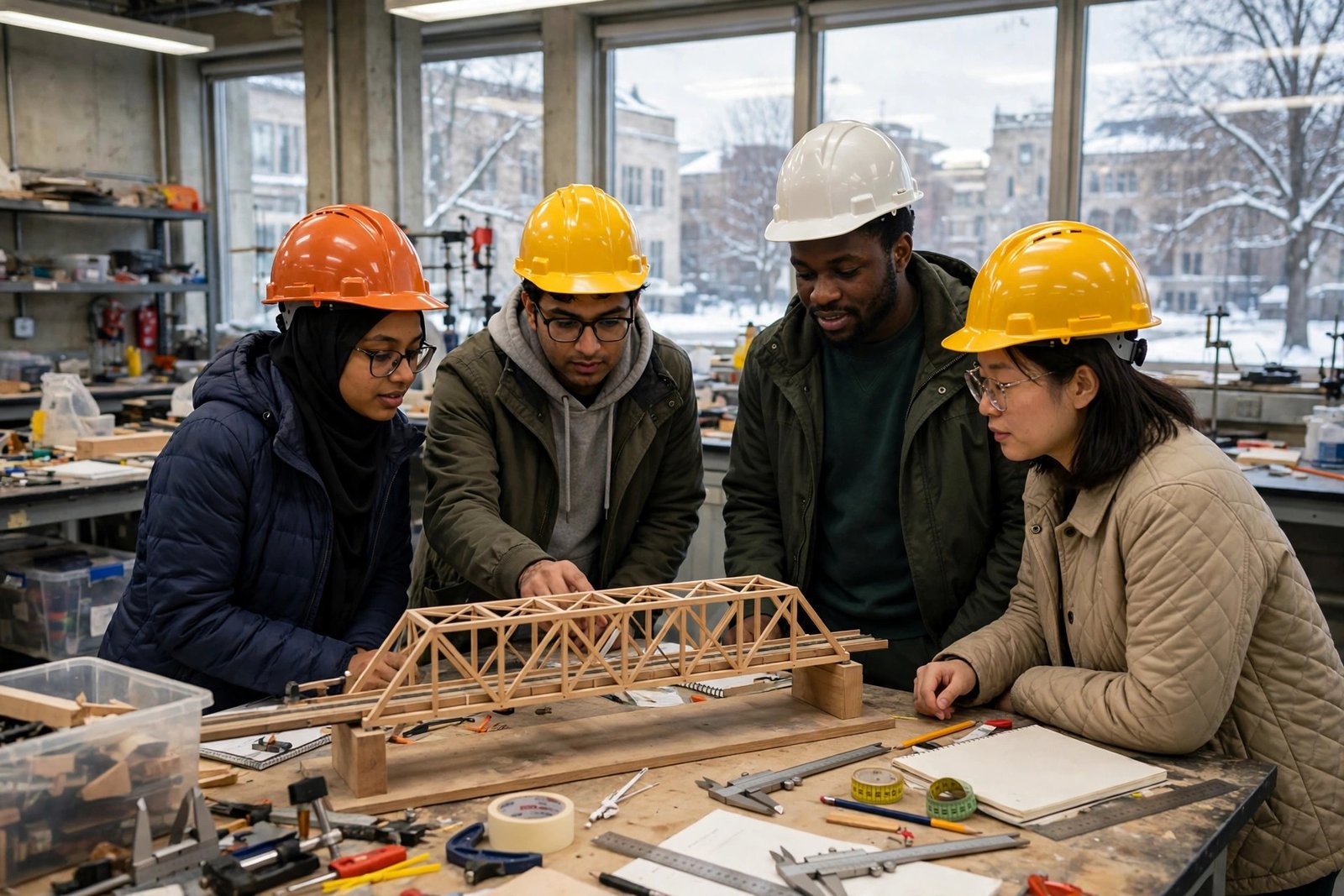
Engineering Scholarships in Canada at a Glance
| Scholarship | University / provider | Level | Value | 2026–27 status / deadline |
|---|---|---|---|---|
| Lester B. Pearson International Scholarship | University of Toronto | Bachelor’s (incl. Engineering) | Tuition, books, incidental fees and full residence support for 4 years | School nomination closed 9 Oct 2026; scholarship application due 6 Nov 2026 |
| International Scholars Program (4 awards) | University of British Columbia | Bachelor’s (incl. Applied Science) | Covers tuition and contributes to living costs, based on need; renewable up to 3 more years | Application deadline 15 November 2026 for September 2027 entry |
| International Major Entrance Scholarship (IMES) | UBC | Bachelor’s | Published values CAD 10,000–25,000 per year, renewable | Automatic consideration; apply to UBC by 15 January 2027 |
| International Entrance Scholarship | University of Calgary | Bachelor’s (incl. Schulich School of Engineering) | CAD 20,000 per year, renewable up to 4 years (up to CAD 80,000) | Admission application by 1 December 2026; prestige-awards application required |
| Mitacs Globalink Research Internship | Mitacs / Canadian universities | Undergraduate research internship (12 weeks) | Airfare contribution, housing and food stipends, health insurance | Summer 2027 call closed 16 September 2026; next call expected late summer 2027 |
| Canada Graduate Research Scholarship – Doctoral (CGRS-D) | Federal tri-agencies | PhD | CAD 40,000 per year for 36 months | Via university quotas; replaced the discontinued Vanier programme |
| P.E.O. International Peace Scholarship | P.E.O. Sisterhood | Graduate (women) | Up to USD 12,500, need-based | Eligibility forms 15 September – 15 December 2026 |
| Schulich Leader Scholarships | 20 partner universities | Bachelor’s STEM / Engineering | CAD 120,000 (engineering) over 4 years | Not open to international students — Canadian citizens graduating in Canada only |
Eligibility: Who Can Apply for What
Undergraduate awards (Pearson, UBC Scholars, Calgary). All three flagship schemes target students entering a bachelor’s degree directly from secondary school. Pearson requires you to be an international student (a non-Canadian who will need a study permit), in your final year of senior secondary school in 2026/27 or graduated no earlier than June 2026, and beginning studies at the University of Toronto in September 2027 — and, critically, you must be nominated by your school; you cannot apply directly. UBC’s International Scholars Program requires the same direct-from-secondary-school profile (graduation no earlier than June 2026 for the 2027 intake), demonstrated financial need, and a school nomination supported by a counsellor and a teacher reference. Calgary’s entrance scholarship is open to any international student entering first year full-time who pays international differential fees and meets the university’s English requirements; it is merit-based rather than need-based.
Graduate funding. For master’s and PhD study, the money works differently. Research-stream degrees (MASc and PhD) at Canadian universities are typically funded through a package of research assistantships, teaching assistantships and internal fellowships arranged by the department at admission — strong applicants routinely receive offers that cover tuition plus a living stipend, though the exact package is set out in your offer letter and varies by university and supervisor funding. Course-based MEng programmes, by contrast, are usually self-funded. On top of departmental packages sit competitive external awards such as the CGRS-D (below).
English and academics. Engineering admission is grade-hungry: top programmes expect excellent mathematics and physics (and usually chemistry) results. Minimum published grades are floors, not targets — successful international applicants to Toronto, Waterloo and UBC engineering typically present results well above them, plus English scores at or above the university’s requirement (commonly IELTS 6.5 with no band below 6.0, or the TOEFL/Duolingo equivalents each university publishes).
The Flagship Awards in Detail
1. Lester B. Pearson International Scholarship — University of Toronto
The Pearson is the most valuable undergraduate award in Canada. Named for a former Canadian prime minister and Nobel Peace Prize laureate, it selects roughly 37 scholars a year from a worldwide pool of school-nominated candidates and covers tuition, books, incidental fees and full residence support for four years — the complete cost of a Toronto engineering degree, including the Faculty of Applied Science and Engineering. The University of Toronto’s official Pearson page sets out the 2027 cycle: schools had to nominate by 9 October 2026, nominees had to complete their U of T admission application by 16 October 2026, and the scholarship application and documents are due by 6 November 2026. If you are reading this after the nomination deadline, you cannot join the 2027 cycle — your route is the 2028 cycle, for which nominations open in the summer of 2027. Ask your school early: each school may nominate only one student, and schools that have never participated must first register with U of T. Our dedicated guide to the Lester B. Pearson International Scholarship 2027 explains the nomination process step by step.
2. UBC International Scholars Program and entrance awards
The University of British Columbia runs a two-layer system. The International Scholars Program is need-and-merit based and is among the very few Canadian schemes that can fund an international student’s full cost of attendance: it covers tuition and contributes to living costs beyond what you and your family can pay, and it is renewable for up to three additional years if you keep satisfactory standing, continue to show need, and hold a valid study permit. One application puts you in consideration for four awards — the Karen McKellin International Leader of Tomorrow Award, the Donald A. Wehrung International Student Award (for students from impoverished or war-torn regions), the International Impact Award, and the Vantage One Excellence Award. Around 50 scholars are selected each year. For September 2027 entry the deadline is 15 November 2026, and you need a school counsellor as nominating official plus a teacher reference — start those conversations now, not in November.
Separately, UBC’s merit-only entrance awards — the International Major Entrance Scholarship (IMES) and the Outstanding International Student (OIS) Award — are awarded automatically on admission with no separate application, with recently published values in the CAD 10,000–25,000 range (IMES renewable per year; OIS a one-time first-year award). Values are updated annually, so confirm the current figures on UBC’s awards pages. Apply to UBC by its 15 January deadline to be considered. UBC’s Bachelor of Applied Science (engineering) is an eligible degree for these awards.
3. University of Calgary International Entrance Scholarship — CAD 20,000 a year
Calgary’s Schulich School of Engineering (not to be confused with the Schulich Leader Scholarships below) is a major destination for international engineers, and the university’s International Entrance Scholarship is one of the most straightforward big awards in the country: CAD 20,000 per year, renewable in the second, third and fourth years if you maintain a GPA of at least 2.60 over a minimum of 24 units in the previous fall and winter terms and continue to pay international fees — up to CAD 80,000 across a degree. Only two are awarded each year, so treat it as competitive, not automatic: a strong admission average (the university publishes strong academic merit, around a 3.20 GPA equivalent, as the competitive zone) matters. Apply for admission by 1 December 2026 for Fall 2027 and complete the High School Prestige Awards application through the student portal; documents follow by mid-December. Read the current terms on the University of Calgary’s awards pages before relying on any figure.

4. Mitacs Globalink — the research internship that builds a graduate pathway
Mitacs Globalink Research Internship is not a degree scholarship; it is a funded 12-week research placement at a Canadian university between May and October each year, working in a professor’s lab — frequently on engineering projects. The package typically includes a contribution towards round-trip airfare, airport transfer, housing and food stipends, student enrolment fees and emergency health insurance, with amounts varying by country and host. For an engineering undergraduate planning a future Canadian MASc or PhD, a Globalink summer is gold: it produces Canadian research experience, a supervisor relationship, and eligibility for the follow-on Globalink Graduate Fellowship. The official Mitacs Globalink page confirms the Summer 2027 call has now closed (student applications ended 16 September 2026). Note the country list: the 2027 call covered applicants studying in countries including India, Pakistan, Germany, France, the UK and the USA — but not Bangladesh, Nepal, Nigeria or Indonesia. If your country is not listed, watch for the next call (expected late summer 2027) and check the list again, as partners change.
5. Graduate awards: CGRS-D and the end of Vanier
Doctoral engineers should know that the famous Vanier Canada Graduate Scholarship has been discontinued. Its replacement in Canada’s restructured federal system is the Canada Graduate Research Scholarship – Doctoral (CGRS-D), worth CAD 40,000 per year for 36 months, awarded through university quota allocations with agency deadlines in the autumn. (The companion CGRS-M for master’s students is restricted to Canadian citizens and permanent residents, so international master’s students should focus on departmental funding instead.) Women engineers at graduate level can also apply for the P.E.O. International Peace Scholarship — a need-based grant of up to USD 12,500 for graduate study in Canada or the USA, open to women who are not US or Canadian citizens; eligibility forms for the 2027–28 cycle run from 15 September to 15 December 2026. It is deliberately partial funding, designed to sit on top of a departmental package.
The Myth to Avoid: Schulich Leader Scholarships
Schulich Leader Scholarships are Canada’s most publicised undergraduate engineering awards — 100 scholarships a year, worth CAD 120,000 each for engineering (CAD 100,000 for science, technology and mathematics) across 20 partner universities. They are also closed to you. Eligibility requires Canadian citizenship and graduation from a Canadian high school or CÉGEP: as the University of Waterloo’s awards directory states, the award is restricted to Canadian citizens, and partner universities describe the same rule. International students on study permits cannot apply, whatever scholarship-aggregator sites claim. Do not waste application time here; put that energy into Pearson, UBC and Calgary.
What You Must Still Budget: Tuition and Study-Permit Funds
| Cost item (single student, outside Quebec) | Figure | Notes |
|---|---|---|
| IRCC living-cost requirement — applications 1 Sep 2025 to 31 Aug 2026 | CAD 22,895 | In addition to first-year tuition and return travel |
| IRCC living-cost requirement — applications from 1 Sep 2026 | CAD 23,448 | IRCC updated the amount to CAD 23,448 on 1 September 2026 |
| International engineering tuition | Roughly CAD 25,000–40,000+/year at many universities; higher at Toronto and Waterloo | Indicative planning range — always use your university’s official fee schedule |
| Pearson Scholarship | Full tuition, books, fees and residence for 4 years | The only route here that removes the proof-of-funds problem almost entirely; an official scholarship letter is itself accepted financial evidence |
Two process points matter as much as the money. First, most undergraduate applicants need a Provincial Attestation Letter (PAL) from their province before IRCC will process a study permit — your university issues or arranges it after admission, but it adds weeks, so apply for admission early. (IRCC has announced that master’s and doctoral students at public institutions are exempt from the PAL requirement from 1 January 2026 — verify your category on canada.ca.) Second, a scholarship award letter is recognised proof of funds: Pearson and UBC Scholars winners can evidence much of their requirement through the award itself, which is one more reason these schemes are so contested.
How to Apply: Step by Step
- Decide your entry point. Bachelor’s after school, research master’s/PhD after a degree, or a Globalink internship during your current degree — each has a different calendar.
- Start the school-nomination conversation first (undergraduates). Pearson and UBC Scholars both depend on your school: one nominee per school for Pearson, a counsellor nomination and teacher reference for UBC. If your school has never nominated, it may need to register — that takes time you cannot recover in October.
- Apply for admission on the scholarship calendar, not the admission calendar. Pearson nominees had to apply to U of T by 16 October 2026; UBC Scholars applicants must complete everything by 15 November 2026; Calgary prestige-award candidates should apply by 1 December 2026. Ordinary admission deadlines are later — and useless for scholarship purposes.
- Write field-specific essays. Engineering selectors look for hands-on evidence: robotics, design projects, olympiads, repairs, code, community infrastructure work. Generic “I love technology” statements lose.
- Prepare the financial documents. UBC Scholars is need-based: gather family income and asset evidence early, because counsellors and parents must verify figures. For the study permit, assemble bank statements, sponsor letters or a GIC, and your scholarship letters.
- For graduate study, contact supervisors before applying. MASc/PhD funding follows the supervisor’s research grants. A short, specific email — your background, the lab’s recent paper, a research idea — sent in September–November is how funded offers happen.
- Submit, then manage the permit timeline. Admission offer → PAL (if required) → study permit with CAD 23,448 living funds (for applications from 1 September 2026) plus tuition evidence → biometrics and medicals where required.
Required Documents
- Secondary-school transcripts and predicted/final grades (with certified translations if not in English or French)
- Proof of English proficiency (IELTS/TOEFL/Duolingo as accepted by each university)
- School nomination (Pearson; UBC Scholars) and teacher/counsellor references
- Personal profile / essays — UBC and U of T both assess written responses as part of admission
- Financial-need documentation (UBC Scholars): family income evidence and counsellor verification
- For Calgary: admission application and the separate High School Prestige Awards application
- For graduate funding: CV, transcripts, statement of research intent, supervisor correspondence, reference letters
- For the study permit: letter of acceptance, PAL where required, passport, proof of funds (CAD 23,448 living costs from 1 Sep 2026 plus first-year tuition and travel), and any country-specific IRCC documents
Deadlines and Timeline
| Date | Milestone |
|---|---|
| 16 September 2026 | Mitacs Globalink Research Internship — Summer 2027 student call closed |
| 15 September – 15 December 2026 | P.E.O. International Peace Scholarship eligibility window (2027–28) |
| 9 October 2026 | Pearson — school nomination deadline (closed) |
| 16 October 2026 | Pearson — U of T admission application deadline for nominees (closed) |
| 6 November 2026 | Pearson — scholarship application and documents due |
| 15 November 2026 | UBC International Scholars Program application deadline (September 2027 entry) |
| 1 December 2026 | University of Calgary — admission application deadline for prestige awards (Fall 2027) |
| 15 January 2027 | UBC general application deadline (for automatic IMES/OIS consideration) |
| Winter–spring 2027 | Graduate funding offers issued with admission decisions; CGRS-D university competitions conclude |
| September 2027 | Classes begin |
How to Improve Your Chances
Win the nomination before you chase the application. For Pearson and UBC, the real competition starts inside your own school. Brief your counsellor in August with a one-page summary of your grades, projects and achievements — make their job easy.
Build engineering evidence, not just grades. A bridge you helped design for a village, a solar charger you built, a robotics prize, an internship in a workshop — selectors fund future engineers, and artefacts beat adjectives.
Apply across the value ladder. Pearson (full ride), UBC Scholars (need-based full support), Calgary ($20,000/yr) and automatic entrance awards (IMES/OIS) can be pursued simultaneously. Most winners of big awards also hold smaller ones elsewhere.
For graduate funding, fit beats fame. A mid-ranked university whose lab works exactly on your topic will fund you sooner than a famous department where no supervisor shares your interests.
Respect the money paperwork. Need-based and permit decisions fail on documentation more than on merit. Consistent figures across school forms, bank statements and sponsor letters are non-negotiable.
Common Mistakes to Avoid
- Applying for Schulich Leader Scholarships as an international student. Citizenship and Canadian-school graduation are hard requirements; aggregator sites that list it as “open to all” are wrong.
- Treating Vanier as a live option. It is discontinued; the doctoral replacement is the CGRS-D at CAD 40,000 per year for 36 months.
- Missing nomination mechanics. Self-nominating for Pearson, or discovering in November that your school never registered, ends more candidacies than weak essays do.
- Using last year’s proof-of-funds figure. IRCC raised the living-cost amount to CAD 23,448 for applications from 1 September 2026; showing CAD 22,895 after that date is a refusal risk.
- Assuming an MEng will be funded like an MASc. Course-based master’s degrees in Canada are normally self-funded; only research-stream programmes routinely carry funding packages.
- Believing “fully funded” marketing for Calgary’s award. CAD 20,000 a year is generous, but it is a tuition contribution — you still need living costs and the balance of fees.
Frequently Asked Questions
What is the best fully funded engineering scholarship in Canada for international students?
The Lester B. Pearson International Scholarship at the University of Toronto: it covers tuition, books, incidental fees and full residence support for four years, and engineering is an eligible field. Around 37 scholars are chosen each year from school-nominated candidates worldwide, so it is also one of the most competitive awards anywhere.
Can I apply for the Pearson Scholarship myself?
No. Your school must nominate you — one nominee per school — and unregistered schools must apply to participate first. For the 2027 cycle, nominations closed on 9 October 2026 and the scholarship application is due 6 November 2026. For the 2028 cycle, approach your school in the summer of 2027.
Are Schulich Leader Scholarships open to international students?
No. Despite their CAD 120,000 value for engineering, Schulich Leader Scholarships require Canadian citizenship and graduation from a Canadian high school or CÉGEP. International students on study permits are not eligible.
How much money must I show for a Canadian study permit in 2026–27?
For a single student outside Quebec: CAD 22,895 in living funds for applications between 1 September 2025 and 31 August 2026, and CAD 23,448 for applications from 1 September 2026 — in both cases plus first-year tuition and return travel costs. Quebec sets its own amounts. Always confirm the current table on canada.ca before applying.
Does UBC’s International Scholars Program cover engineering?
Yes — the Bachelor of Applied Science is an eligible degree for the International Scholars Program and for UBC’s merit entrance awards (IMES and OIS). The Scholars deadline for September 2027 entry is 15 November 2026; IMES/OIS consideration is automatic for those who apply to UBC by 15 January 2027.
Is the Mitacs Globalink internship open to students from my country?
Only if your country of study is on Mitacs’s partner list for that year. The Summer 2027 list included India, Pakistan, Germany, France, the UK and the USA, among others, but not Bangladesh, Nepal, Nigeria or Indonesia. The Summer 2027 call closed on 16 September 2026; check the official Mitacs page for the next call and the updated country list.
Can I get funding for a master’s in engineering in Canada?
Yes, if you choose a research-stream MASc: departments fund admitted students through assistantships and fellowships, usually covering tuition plus a stipend, arranged at admission. Course-based MEng programmes are normally self-funded. The federal CGRS-M is restricted to Canadian citizens and permanent residents, so international students rely on departmental packages and awards such as the P.E.O. International Peace Scholarship (women, up to USD 12,500).
What replaced the Vanier Canada Graduate Scholarship?
Vanier has been discontinued. The replacement doctoral award in the restructured federal system is the Canada Graduate Research Scholarship – Doctoral (CGRS-D), worth CAD 40,000 per year for 36 months, allocated through universities.
Sources & Verification
Figures in this guide were checked in October 2026 against: the University of Toronto’s official Pearson Scholarship pages (coverage of tuition, books, incidental fees and residence; 2027 deadlines of 9 October, 16 October and 6 November 2026); UBC’s International Scholars Program and entrance-award information published for the 2027 intake (programme deadline 15 November 2026; IMES/OIS values as most recently published, CAD 10,000–25,000); University of Calgary award terms (CAD 20,000 per year, renewable with a GPA of 2.60 over 24 or more units, two awards annually); Mitacs’s official Globalink Research Internship page (Summer 2027 call closed; 12-week internships, May–October 2027); the University of Waterloo awards directory entry for Schulich Leader Scholarships (restricted to Canadian citizens; CAD 120,000 for engineering); P.E.O. International Peace Scholarship information for the 2027–28 cycle (maximum USD 12,500; eligibility window 15 September–15 December 2026); and IRCC’s proof-of-financial-support table as reported from canada.ca (CAD 22,895 for applications 1 September 2025–31 August 2026; CAD 23,448 from 1 September 2026). Tuition figures are indicative planning ranges only — your university’s official fee schedule governs.
Disclaimer: StudyGraduate is an independent information portal, not an agency, university or government body. Scholarship values, deadlines and eligibility rules change every cycle — always confirm details on the official university, Mitacs and canada.ca websites before applying. Nothing here is a promise or guarantee of selection, admission, or study-permit approval.
✅ Eligibility Criteria
- Check the official website for full eligibility criteria for your country
🎁 Benefits
- See the official website for the complete list of benefits
⚙️ Application Process
- 1Check your eligibility on the official site
- 2Prepare your documents and statements
- 3Submit the online application before the deadline
- 4Complete interviews or assessments if shortlisted
- 5Await the final selection announcement
📅 Important Dates
Deadlines vary by country and intake. Check the official website for country-specific dates.
📄 Required Documents
- Valid passport
- Academic transcripts & certificates
- Statement of purpose
- Letters of recommendation
- CV / resume
Commonly required — confirm the exact list on the official site.
❓ Frequently Asked Questions

Ready to Take the Next Step?
Explore more scholarships and study opportunities around the world.
Browse Scholarships →