Dentistry Scholarships for International Students 2026–2027
Dentistry Scholarships for International Students 2026–2027 Dentistry is the hardest degree in this entire scholarship series to fund, and this guide will not pretend otherwise. A Bachelor of Dental Surgery (BDS), Doctor of Dental Surgery (DDS) or Doctor of Dental Medicine (DMD) is a four-to-six-year clinical degree with small cohorts, expensive simulation and clinic facilities, ... <a title="Dentistry Scholarships for International Students 2026–2027" class="read-more" href="https://studygraduate.com/scholarship/dentistry-scholarships-for-international-students-2026-2027/" aria-label="Read more about Dentistry Scholarships for International Students 2026–2027">Read more</a>
📖 Overview
Dentistry Scholarships for International Students 2026–2027
Dentistry is the hardest degree in this entire scholarship series to fund, and this guide will not pretend otherwise. A Bachelor of Dental Surgery (BDS), Doctor of Dental Surgery (DDS) or Doctor of Dental Medicine (DMD) is a four-to-six-year clinical degree with small cohorts, expensive simulation and clinic facilities, and strict national licensing at the end of it. International tuition fees for dentistry sit among the highest of any undergraduate subject in the UK, Australia, Canada and the United States, and — unlike medicine in some countries — there is no large global government scheme whose purpose is to fund foreign dental undergraduates. Students and parents searching for dentistry scholarships deserve the truth first: for a first dental degree abroad, funding is almost always partial, competitive and assembled from several sources; full funding becomes realistic mainly at postgraduate level, for qualified dentists taking specialist or research degrees, and for dental researchers at PhD level. Everything in this guide follows from that reality, and every amount below was verified against official or university sources at the time of writing in October 2026.
That is not a counsel of despair. It is a strategy brief. If you are a school leaver who wants to become a dentist, the winning model is usually: win the largest university scholarship you can at an accredited dental school, close the remaining gap with family funding or a carefully sized education loan, and choose the country by where you intend to register and practise — because dental licences do not travel freely. If you are already a qualified dentist, your options open up dramatically: one-year master’s degrees funded by Chevening, Commonwealth and GREAT in the UK; research funding through Australia’s Research Training Program, Canada’s CGRS-D, DAAD and MEXT; and specialist clinical training whose funding varies by country and specialty. If you are a dental researcher, the standard life-sciences funding systems apply to you in full. This guide covers all three profiles separately, names the real awards — including small but genuine ones, such as the University of Dundee’s Dow Memorial Trust Scholarship for dentistry students (£2,000–£2,500 per year, rising to £2,700 in year 5 including help with the GDC registration fee) — and explains the registration examinations, from the UK’s Overseas Registration Exam to North America’s board examinations, that decide whether your degree lets you practise where you plan to live.
Use this guide with our scholarships directory, compare dental schools through the universities directory and rankings pages, and read the neighbouring clinical guides — Medicine Scholarships for International Students 2026–2027 and Pharmacy Scholarships for International Students 2026–2027 — because many funding rules are shared across the clinical professions while the licensing details differ.
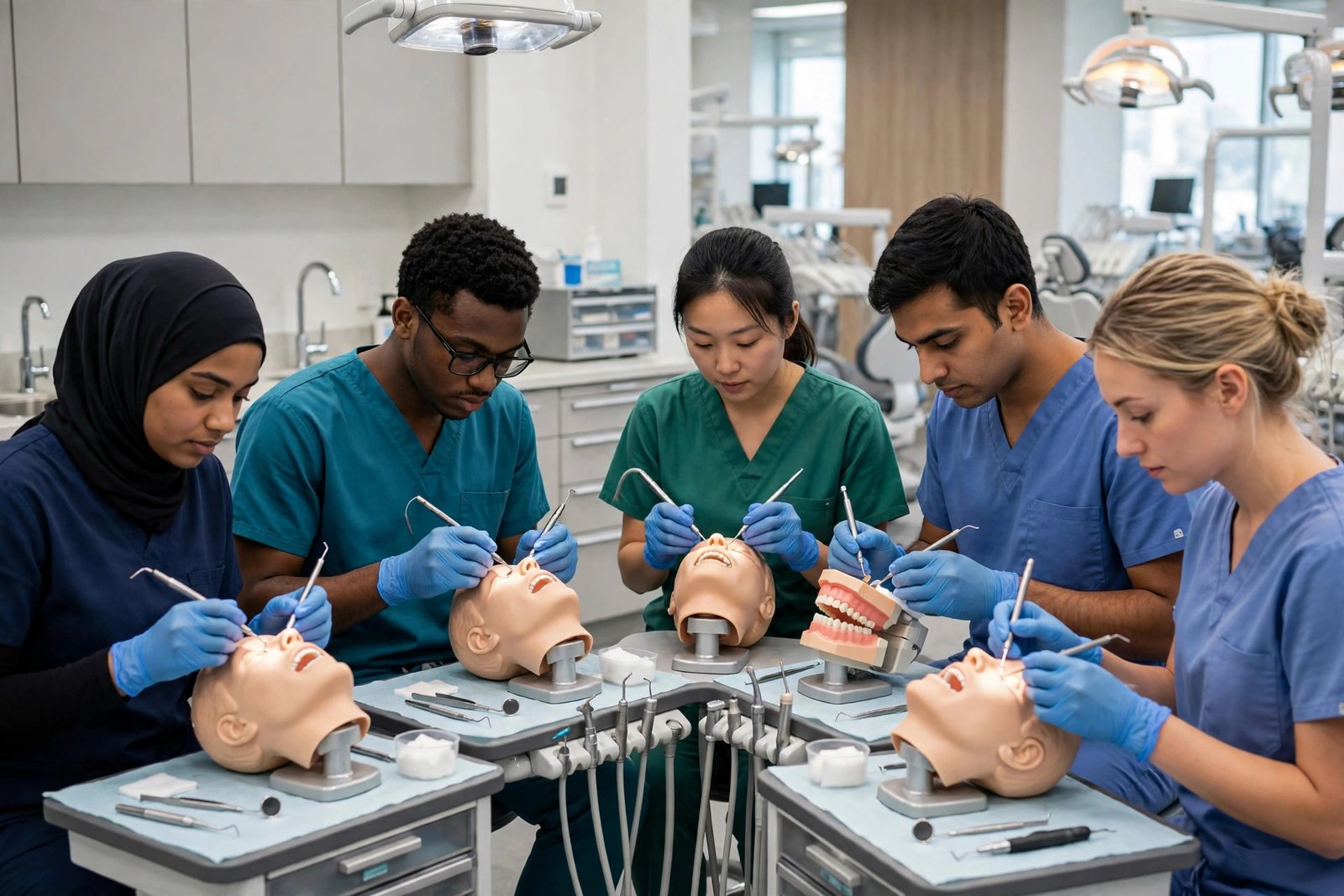
Dentistry Scholarships at a Glance
| Programme / route | Where | Level | Coverage | Headline value (verified) |
|---|---|---|---|---|
| University dental-school scholarships & bursaries | UK, Australia, USA, Canada & others | BDS / DDS / DMD (first degree) | Partial only | Typically fixed annual discounts or bursaries; e.g. Dundee Dow Memorial Trust Scholarship £2,000–£2,500/yr (£2,700 in year 5) |
| MEXT | Japan | Bachelor’s (incl. dentistry field where offered), Master’s & PhD | Fully funded | Tuition exempt; ¥117,000/month undergraduate; ¥144,000 master’s; ¥145,000 doctoral at 2027 published rates; examinations apply |
| Home-government scholarships (varies) | Destination varies | First degree & postgraduate | Varies | Some governments fund citizens for dentistry abroad; check your own government’s scheme — no global list exists |
| Chevening Scholarship | UK | Master’s (1 year) — for qualified dentists | Fully funded | Tuition, monthly stipend, airfare, visa costs |
| Commonwealth Master’s / PhD / Shared Scholarships | UK | Master’s & PhD — for qualified dentists & researchers | Fully funded | Full tuition, airfare, stipend £1,712/month (£2,000 London) for Shared at current published levels |
| GREAT Scholarships | UK | Master’s (1 year) | Partial | Minimum £10,000 towards tuition |
| Research Training Program (RTP) | Australia | Master’s by research & PhD in dental/oral sciences | Fully funded research package | Base stipend AUD 34,315 (2026) / AUD 35,550 (2027) plus tuition fee offset |
| Canada Graduate Research Scholarship – Doctoral (CGRS-D) | Canada | PhD (international applicants must already be enrolled in Canada) | Doctoral stipend | CAD 40,000/year for 36 months via CIHR/NSERC/SSHRC; up to 15% of awards to international applicants |
| DAAD (EPOS listed courses & research grants) | Germany | Master’s & PhD | Fully funded stipend model | EPOS €992/month master’s; doctoral €1,300/month rising to €1,400 from February 2026 |
| France Excellence Eiffel | France | Master’s & PhD | Stipend + services; tuition NOT covered | €1,200/month master’s; €2,100/month doctoral from January 2026; biology and health is an eligible field |
| Fulbright Foreign Student Program | USA | Master’s & PhD / research (country-dependent) | Fully funded per country programme | Tuition, living allowance, airfare, health cover as set by your country programme |
| Australia Awards | Australia | Postgraduate mainly (country-dependent) | Fully funded | Full tuition, return air travel, establishment allowance, living contribution, OSHC |
Notice what is not in this table: any scheme promising full funding for an international BDS or DDS as a first degree in the UK, USA, Canada or Australia. If a website or agent shows you one, treat it as a red flag and verify it on the university’s own site before proceeding. The realistic first-degree strategy and the genuinely funded postgraduate strategy are explained in the next sections.
The Three Applicant Profiles
Profile 1 — the school leaver seeking a first dental degree. Your targets are accredited BDS/DDS/DMD programmes and the funding stack is: university entrance scholarships (merit-based, assessed with admission), faculty bursaries after enrolment (the Dundee Dow Memorial Trust model — need-based, £2,000–£2,500 per year for dentistry undergraduates who demonstrate financial need), your home government’s outbound schemes where they exist, MEXT’s undergraduate route in Japan if you are prepared for its examinations and preparatory year, and family or loan funding for the balance. You must also pass each dental school’s own admissions hurdles — in the UK, dentistry applicants typically sit the UCAT aptitude test and interviews; in North America, the DAT; everywhere, chemistry and biology at high grades — and scholarships never waive admissions tests.
Profile 2 — the qualified dentist seeking a postgraduate degree. This is where the flagship money is. A BDS holder with clinical experience can compete for Chevening (one-year UK master’s; at least two years of work experience required), Commonwealth Master’s and Shared Scholarships (strongest when your plan serves dental public health, oral health policy or services in underserved communities), GREAT Scholarships (£10,000 towards a one-year UK master’s), Fulbright (where the country programme funds master’s study), Australia Awards (where oral health matches country priorities) and university specialist-training scholarships. Popular funded subjects include dental public health, oral epidemiology, implantology and restorative research degrees, orthodontics research, oral surgery research, paediatric dentistry research and health-professions education. Be careful with clinical specialty training (such as multi-year orthodontics or oral surgery residencies): in several countries these posts are employment-based, restricted by registration status, or charged at premium clinical fees with little scholarship support — verify the exact funding model of the specific programme.
Profile 3 — the dental researcher. PhD and master’s-by-research applicants in oral biology, dental materials, cariology, periodontology research, oral microbiology, craniofacial research and dental public health compete inside the general research-funding systems: RTP in Australia (base AUD 34,315 in 2026; AUD 35,550 in 2027, plus fee offset), CGRS-D in Canada (CAD 40,000/year for 36 months; international applicants must already be enrolled at a Canadian institution and are capped at 15% of awards), Commonwealth PhD Scholarships, DAAD research funding, MEXT research scholarships (¥144,000/month master’s; ¥145,000/month doctoral at 2027 published rates) and university studentships advertised with specific projects. Your currency is a supervisor match and a feasible research proposal, not clinical seniority alone.
Eligibility: What You Will Need
- First degree: top school grades with chemistry and biology (and often a third science or mathematics), the admissions test your target schools require (UCAT in the UK; DAT in the USA/Canada), interviews including, in the UK, multiple mini interviews, and English proficiency at the high level dental schools set for clinical communication. Manual dexterity evidence and dentistry work-experience or shadowing are expected by many schools and strengthen scholarship personal statements.
- Postgraduate flagships: a recognised BDS or equivalent dental degree; clinical experience (Chevening requires at least two years of work experience — 2,800 hours); current registration or licence in your home country where the course expects qualified dentists; and for Commonwealth and Australia Awards, a credible development case — oral health is an under-served field in most low- and middle-income countries, and applicants who document that need (workforce shortages, rural access, school oral-health programmes) compete well.
- Research degrees: a strong first degree or master’s, a research proposal, and a supervisor. For CGRS-D, the additional hard rules: no more than 36 months of full-time doctoral study completed by 31 December of the application year, one application per year to one agency, and — for international applicants — enrolment at an eligible Canadian institution by the deadline. Vanier Canada is discontinued; do not build a plan on it. CGRS-M is domestic-only.
- Fitness to practise and health requirements: dental students and postgraduate clinicians face occupational health screening (including blood-borne virus requirements), immunisations, criminal-record checks and fitness-to-practise standards in every destination country. A scholarship does not override any of these, and offers can be withdrawn if requirements are not met.
- Language for clinical work: postgraduate clinical programmes and any route involving patient contact set higher language bars than lecture-based degrees; Germany’s and Japan’s own dentist-qualifying degrees are taught in German and Japanese respectively, so DAAD and MEXT value for most international applicants sits at master’s-research and PhD level, or in English-taught research programmes, rather than in qualifying as a local dentist from scratch.
Benefits: What Funding Covers — and the Costs It Never Covers
For the fully funded postgraduate schemes, coverage follows the standard flagship pattern. Chevening pays tuition, a monthly stipend (rate depending on London or non-London study and reviewed annually), economy airfare, an arrival and a departure allowance, your visa application cost and up to £75 towards TB testing where required. Commonwealth Shared Scholarships pay full tuition by agreement with the university, approved airfare, and a stipend of £1,712 per month (£2,000 in London) at current published levels, plus a warm clothing allowance where applicable, thesis and study-travel grants. Erasmus Mundus — relevant where a current joint master’s touches dental or oral-health research — pays €1,400 per month for up to 24 months with participation costs covered. DAAD EPOS pays €992 per month at master’s level and €1,300 per month for doctoral candidates, rising to €1,400 from February 2026, plus insurance and travel support, but only for courses on the current EPOS list. Eiffel pays €1,200 per month (master’s) or €2,100 per month (doctoral) from January 2026 within its seven fields, which include biology and health — but tuition is not covered, and nomination is by the French institution (institutional submission by 6 January 2027 for the 2027 campaign). RTP pays a base stipend of AUD 34,315 (2026) / AUD 35,550 (2027) with a tuition fee offset; CGRS-D pays CAD 40,000 per year for 36 months; MEXT exempts tuition and pays ¥117,000–¥145,000 per month by level plus airfare.
Now the other ledger — costs dentistry applicants routinely forget and scholarships almost never pay: admissions tests (UCAT, DAT) and application fees across multiple dental schools; dental equipment, instruments, scrubs and loupes that some schools require students to buy; clinic and laboratory fees charged by some programmes; professional indemnity for clinical placements where the school does not provide it; regulatory examinations after graduation (the UK ORE, North American board and licensure examinations, Australian ADC examinations) and the registration fees themselves; and, for self-funded elements, visa proof-of-funds thresholds such as Canada’s CAD 22,895 for study-permit applications from 1 September 2025 to 31 August 2026, rising to CAD 23,448 from 1 September 2026, or Germany’s blocked account of €11,904 for 2026. Dundee’s dentistry bursary is a helpful exception that proves the rule: its year-5 award includes an additional amount specifically to help with the GDC registration fee, precisely because registration costs otherwise fall on the student.

Registration: The Section That Decides Your Country Choice
A dental degree is a licence to practise in the system that accredited it, and only there automatically. The United Kingdom registers dentists through the General Dental Council (GDC): UK BDS graduates register directly after graduation and foundation arrangements, while dentists who qualified outside the UK generally must pass the Overseas Registration Exam (ORE) — or hold a recognised qualification under the applicable route — before registering. The United States licenses dentists state by state, normally requiring a DDS/DMD from a CODA-accredited programme plus the Integrated National Board Dental Examination and state clinical requirements; overseas-qualified dentists usually complete a two-to-three-year advanced-standing DDS/DMD programme, which is charged at full international fees and is one of the most expensive pathways in world education — scholarship support for it is minimal, and any source claiming otherwise needs verification on the dental school’s own site. Canada licenses through provincial regulators with the National Dental Examining Board of Canada (NDEB) processes for overseas graduates. Australia assesses overseas dentists through the Australian Dental Council examination pathway. The practical conclusions: (1) choose your first-degree country by where you most want to live and register; (2) if you plan to return home, confirm with your home regulator — for example your national dental council — that the foreign school and degree are recognised for registration at home before you enrol; recognition lists change and some countries restrict which foreign schools they accept; (3) postgraduate scholarships are the flexible money, because a master’s or PhD does not pretend to be a licence, and employers in academia, public health, industry and policy value it without a registration exam.
How to Apply: Step by Step
- Decide your profile (1, 2 or 3) and your registration country. Everything else — schemes, tests, budgets — follows from these two decisions.
- Verify school recognition. For a first degree, confirm the school is accredited in its own country and recognised by the regulator where you intend to practise. For postgraduate study, confirm the degree title and whether any clinical component requires temporary registration.
- Book admissions and language tests early. UCAT registration and testing run in a fixed summer–autumn window for UK dentistry; DAT runs year-round in North America; English tests should be taken with retake time to spare using our test preparation resources.
- Build the funding stack in writing. List every realistic source with its verified value: university entrance scholarship, faculty bursary (check each faculty’s page — the Dundee example at the University of Dundee Dow Memorial Trust Scholarship page shows the format), flagship scheme (postgraduate), home-government scheme, family contribution, loan. If the stack does not reach the full cost of attendance for every year, change the plan now, not after an offer arrives.
- Prepare scholarship applications around impact. For postgraduate flagships, document your clinical record, the oral-health problem you will work on, and why this specific programme — its modules, clinics or research groups — is the route. For research degrees, secure a supervisor’s support before the studentship deadline.
- Apply on separate clocks. Dental school admission, scholarship nomination and visa finances each have their own deadlines; Eiffel candidates must be nominated by an institution weeks before its 6 January 2027 submission date, and EPOS applicants apply to the listed course itself.
- Complete occupational health and checks promptly. Vaccination records, blood tests and police clearances take weeks in many countries and can delay enrolment if left late.
- Keep a registration file. Save every syllabus, transcript and clinical-hours record: overseas registration processes years later will ask for exactly these documents.
Required Documents
- Passport and identity documents
- School certificates with chemistry/biology grades (first degree) or BDS degree certificate and transcripts (postgraduate), with certified translations
- Admissions test scores where required (UCAT, DAT) and English language results at the dental school’s stated level
- Evidence of dentistry work experience, shadowing or clinical employment, with referees who observed it
- Manual dexterity and personal statement evidence as the school’s application requires
- CV including clinical experience, procedures/settings, research and publications (postgraduate)
- Dental registration licence and certificate of good standing from your home regulator (qualified dentists)
- Research proposal and supervisor correspondence (research degrees)
- Two references in the format each scheme specifies
- Occupational health, immunisation and criminal-record documentation at offer stage
- Proof of funds for every self-funded element, in the visa authority’s required format
Deadlines and Timeline for 2026–2027
| Programme / stage | Typical / confirmed window | Notes |
|---|---|---|
| UK dentistry admission (UCAS + UCAT) | UCAT testing in the summer–early autumn; UCAS dentistry deadline in mid-October of the year before entry | Dentistry has an early UCAS deadline — confirm the exact date on UCAS for your cycle |
| Chevening | Autumn application; unconditional offer by July 2027 per cycle rules | Qualified dentists only in practice — requires a first degree plus two years’ experience |
| Commonwealth Scholarships | Shared applications typically close in December; Master’s/PhD via nominating agencies | Check cscuk.fcdo.gov.uk for scheme and country dates |
| Erasmus Mundus | Mostly October 2026 – January 2027 | Per consortium; search the current catalogue |
| DAAD EPOS | Per-course deadlines, many August – November 2026 for 2027/28 | Official course list governs; no single deadline |
| France Excellence Eiffel | Institutions submit by 6 January 2027; results week of 12 April 2027 | Stipend only — tuition not covered |
| Australia Awards | Country rounds typically February – around 30 April | Country programme sets levels and priorities |
| RTP (Australia) | University rounds; many close September – October | Apply with your research-degree application |
| CGRS-D (Canada) | Agency deadline 17 October; institutional deadlines earlier | International applicants must already be enrolled in Canada |
| MEXT | Embassy route typically April – May, with examinations following | Undergraduate dentistry availability and exams are country-specific |
| GREAT Scholarships | Set by each university, commonly spring | Apply through the university after an offer |
Selection Criteria — and How to Improve Your Chances
Dental admissions and scholarship selection reward overlapping qualities. Academic ceiling: dentistry cohorts are selected from the top of the grade distribution in chemistry and biology, and merit money follows rank. Demonstrated commitment to dentistry: shadowing, dental-assistant work, oral-health volunteering and reflective understanding of the profession — panels distinguish applicants who know what clinical dentistry involves from those attracted only by income. Manual dexterity and professionalism: evidenced through the admissions process and interviews rather than essays alone. For postgraduate flagships, a development and service record: community oral-health programmes, school dental services, rural postings, research or audit — the Chevening and Commonwealth panels fund dentists who will change oral-health systems, not only individual careers. For research funding, a feasible, supervisor-backed proposal in an area where the host university is genuinely strong. And across all routes, a credible financial plan: because dentistry funding is usually partial, the applicants who succeed are those whose written plan covers every year of the degree, not just the first.
Common Mistakes Dentistry Applicants Make
- Believing in a fully funded BDS that does not exist. No flagship scheme funds international dental undergraduates in full in the UK, USA, Canada or Australia. Verify any such claim on the university’s official site — or walk away.
- Choosing a school your home regulator does not recognise. Recognition lists decide whether you can register at home. Check before enrolment, in writing.
- Ignoring the ORE / licensure pathway. Qualifying in one country and practising in another means examinations (UK ORE, NDEB processes, ADC exams, US advanced-standing programmes) that cost years and money no scholarship in this guide covers.
- Missing the early dentistry admissions deadline. UK dentistry applications close months before most other subjects, and UCAT must be sat in its window; a missed test is a lost year.
- Applying for master’s flagships to fund a first degree. Chevening, Commonwealth Master’s and GREAT fund postgraduate study for people who already hold a degree.
- Treating Eiffel as full funding. The stipend is real (€1,200/€2,100 per month from January 2026) but tuition is excluded.
- Planning around closed schemes. Vanier Canada is discontinued (CGRS-D, CAD 40,000/year for 36 months, is the doctoral replacement, and its master’s sibling CGRS-M is domestic-only), and Destination Australia is closed to new applicants — funding ceased 1 July 2024 — so neither belongs in a 2026–2027 dentistry budget.
- Under-budgeting clinical costs. Instruments, clinic fees, indemnity, health screening and registration examinations are real, recurring and mostly unscholarshipped.
- Paying agents for “guaranteed dental seats with scholarship.” Dental admissions are controlled by universities and regulators; no agent can guarantee either a seat or an award.
For the full planning picture, work through our study abroad hub, budget with the study abroad tools, and compare this guide with Pharmacy Scholarships for International Students 2026–2027, Nursing Scholarships for International Students 2026–2027 and Public Health Scholarships for International Students 2026–2027 — the postgraduate funding routes overlap heavily, and many qualified dentists find their funded master’s sits naturally inside public health or health-systems programmes.
Frequently Asked Questions
Is there any fully funded scholarship for a BDS for international students?
In the UK, USA, Canada and Australia, no major scheme fully funds a first dental degree for international students; funding there is partial (university scholarships and bursaries such as Dundee’s Dow Memorial Trust Scholarship at £2,000–£2,500 per year) and must be combined with other resources. MEXT in Japan is a genuine fully funded exception that can include undergraduate study, subject to its examinations, preparatory requirements and country-specific field availability — verify dentistry availability with your Japanese embassy. Some home governments also fund their own citizens for dentistry abroad; check your government’s scheme directly.
Can Chevening or Commonwealth fund my dentistry studies?
They fund postgraduate study, not a first BDS. A qualified dentist with a BDS and at least two years of work experience can apply for Chevening for a one-year UK master’s (for example dental public health or a research master’s), and Commonwealth Master’s, Shared and PhD Scholarships fund qualified dentists and dental researchers, with Shared Scholarships paying full tuition, airfare and a stipend of £1,712 per month (£2,000 in London) at current published levels.
I qualified as a dentist in my country. Can I practise in the UK after a scholarship-funded master’s?
No — a master’s degree does not confer registration. To practise dentistry in the UK you must register with the General Dental Council; dentists qualified outside the UK generally need to pass the Overseas Registration Exam (ORE) or meet another recognised route. Budget for the examination process separately: scholarships do not pay for it, and timelines are set by the GDC, not by universities.
What funding exists for a PhD in dental or oral sciences?
The standard research systems: Australia’s RTP (base stipend AUD 34,315 in 2026 and AUD 35,550 in 2027, plus a tuition fee offset, awarded by universities); Canada’s CGRS-D (CAD 40,000 per year for 36 months — international applicants must already be enrolled at a Canadian institution and compete for up to 15% of awards); Commonwealth PhD Scholarships; DAAD research funding and EPOS where a course is listed; MEXT research scholarships (¥144,000/month master’s, ¥145,000/month doctoral at 2027 published rates); and project-tied university studentships. A supervisor’s support and a feasible proposal decide these competitions.
How much are typical university dentistry scholarships worth?
Usually a few thousand per year rather than full fees. The University of Dundee’s Dow Memorial Trust Scholarship — a need-based award for dentistry undergraduates, open to international fee-status students among others — pays £2,000 per year in years 1–3, £2,500 in year 4 and £2,700 in year 5, with the final-year amount including help towards the GDC registration fee. Other dental schools offer entrance scholarships and bursaries of similar character; check every target school’s scholarship pages and treat anything larger with verification.
Does DAAD fund dentistry in Germany?
DAAD funds postgraduate study and research — including dental and oral-science research — through EPOS-listed courses (€992/month master’s; €1,300/month doctoral rising to €1,400 from February 2026) and research grants. It does not provide a route to qualify as a dentist in Germany as an international beginner: German dental qualification is a German-language state-examination programme outside the scholarship model described here.
What admissions tests do I need for dentistry abroad?
For the UK, the UCAT is used by most dental schools, with an early UCAS deadline in mid-October of the year before entry — confirm both on UCAS and the UCAT site for your cycle. For the USA and Canada, the DAT is standard. Everywhere, expect interviews and high chemistry/biology grades, plus English results at the level the dental school specifies.
Should I choose my dental school by scholarship size or by registration?
By registration. A smaller scholarship at a school recognised by the regulator in the country where you will practise is worth more than a larger one at a school whose degree leaves you facing years of equivalence examinations. Confirm recognition with the regulator in writing before accepting any offer, and remember that no scholarship guarantees registration, a job or a visa.
Sources & Verification
Key facts were checked in October 2026 against: the University of Dundee — Dow Memorial Trust Scholarship (Dentistry) (£2,000–£2,500 per year; £2,700 in year 5 including GDC registration-fee help; need-based; international fee status eligible); Chevening — scholarship coverage; Commonwealth Scholarship Commission — Shared Scholarships (full tuition, airfare, stipend £1,712/month, £2,000 London); DAAD EPOS programme information via daad.de/epos (€992/month; doctoral €1,300 rising to €1,400 from February 2026; listed-course rule); Campus France Eiffel information (€1,200/€2,100 per month from January 2026, tuition not covered, institutional submission 6 January 2027); the Australian Department of Education — Research Training Program (AUD 34,315 in 2026; AUD 35,550 in 2027); the NSERC Canada Graduate Research Scholarship – Doctoral program (CAD 40,000/year, 36 months, international enrolment condition, 17 October agency deadline); MEXT 2027 guideline summaries via the Study in Japan portal (¥117,000/¥144,000/¥145,000 per month by level, tuition exempt); Australia Awards benefit descriptions via Australian Government pages; the US Embassy Fulbright Foreign Student Program pages; and British Council Study UK — GREAT Scholarships (£10,000 towards tuition). Verified standing facts applied: Canada study-permit funds CAD 22,895 / CAD 23,448 from 1 September 2026; Germany blocked account €11,904 (2026); Vanier discontinued, replaced by CGRS-D; Destination Australia closed (funding ceased 1 July 2024). Registration pathways (GDC/ORE, CODA/state licensure, NDEB, ADC) are summarised from regulator frameworks and must be confirmed on the regulator’s official site for your circumstances.
Disclaimer: Scholarship amounts, eligible countries, course lists and deadlines change every cycle, and dental registration rules are set by national regulators, not by universities or scholarship bodies. Always confirm details on the official scholarship, university and regulator websites before applying or enrolling. StudyGraduate is an information portal, not an agency: we never promise or guarantee selection, admission, registration or visa approval.
✅ Eligibility Criteria
- Check the official website for full eligibility criteria for your country
🎁 Benefits
- See the official website for the complete list of benefits
⚙️ Application Process
- 1Check your eligibility on the official site
- 2Prepare your documents and statements
- 3Submit the online application before the deadline
- 4Complete interviews or assessments if shortlisted
- 5Await the final selection announcement
📅 Important Dates
Deadlines vary by country and intake. Check the official website for country-specific dates.
📄 Required Documents
- Valid passport
- Academic transcripts & certificates
- Statement of purpose
- Letters of recommendation
- CV / resume
Commonly required — confirm the exact list on the official site.
❓ Frequently Asked Questions

Ready to Take the Next Step?
Explore more scholarships and study opportunities around the world.
Browse Scholarships →