

MA in Journalism and Mass Communication Abroad: Eligibility, Fees, Top Universities and Careers
An MA in Journalism and Mass Communication abroad teaches you to find stories, verify facts, and tell them clearly across print, broadcast and digital platforms — and to understand the media industries that carry them. It is a degree for students who care about how information moves through society: who decides what counts as news, how audiences are reached and persuaded, how misinformation spreads, and how a free press holds power to account. Its graduates work as reporters, editors, producers, correspondents, content strategists, public-relations specialists, media researchers and communications managers. But journalism is a field in structural change: traditional newsroom employment has been shrinking in many countries even as demand grows for digital storytelling, audience analysis, multimedia production and strategic communication. This guide gives you the honest picture — the creative excitement, the employment realities, and the skills that keep graduates employable whichever way the industry moves.
Who is this degree for? It suits graduates in journalism, media studies, communications, English, politics or other humanities and social-science subjects who want professional newsroom and production skills, and it suits working journalists and communicators who want a postgraduate qualification, a specialisation — such as investigative, data, broadcast or science journalism — or an international perspective. It also suits career changers with strong writing and curiosity, though they should expect to build a portfolio from scratch: published clips, a campus publication record, a blog with original reporting, or freelance work. Employers in media hire on portfolios and published work far more than on degree certificates alone, so treat everything you produce during the degree as a job application in progress.
MA in Journalism and Mass Communication at a Glance
| Feature | Typical details |
|---|---|
| Degree level | Postgraduate taught master’s (MA; some universities award MSc for data or media-technology tracks) |
| Typical duration | 1 year full-time in the UK and Ireland; 2 years in the USA, Canada, Australia and most of continental Europe |
| Core subjects | News reporting and writing, media law and ethics, broadcast and multimedia production, digital and social media, audience research, media theory |
| Common specialisations | Investigative journalism, data journalism, broadcast journalism, photojournalism, sports journalism, science and health journalism, political journalism, strategic communication and public relations |
| Typical entry requirement | Bachelor’s degree in any subject at many programmes; writing sample or portfolio often requested; English tests such as IELTS or TOEFL for non-native speakers |
| Practical work | Newsroom practice, live reporting projects, multimedia packages, and a final project or dissertation, often a portfolio of published work |
| Internships | Strongly encouraged; placements with newspapers, broadcasters, digital outlets and communications agencies are competitive and rarely guaranteed |
What You Study in an MA in Journalism and Mass Communication
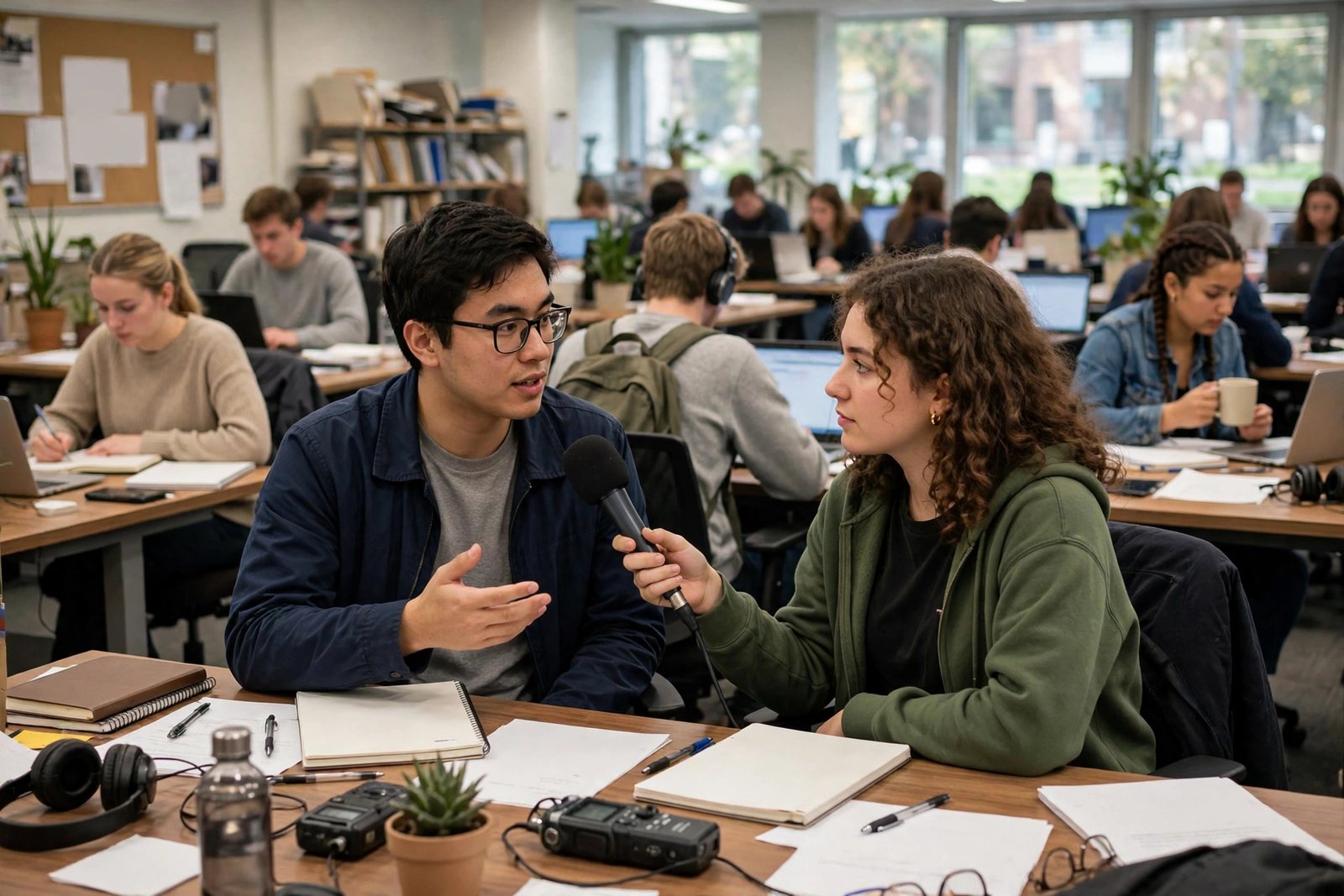
The practical core is reporting: finding stories, cultivating sources, interviewing, verifying claims, writing to deadline and working to a style guide. You will practise news writing, feature writing, and increasingly, writing for search and social platforms without sacrificing accuracy. Broadcast tracks add voice training, camera and audio work, editing, and live presentation. Digital tracks add multimedia storytelling — combining text, video, audio, graphics and interactive elements — plus audience analytics, search optimisation and social-media verification techniques, including how to check images, videos and claims circulating online. Data journalism modules teach spreadsheets, public datasets, basic statistics and visualisation, skills that set graduates apart in any newsroom.
Alongside practice sits the academic core that distinguishes a master’s from a short training course. Media law covers defamation, contempt, privacy, copyright and the legal risks of reporting — knowledge that protects both you and your employer. Media ethics covers source protection, reporting on vulnerable people, conflicts of interest, and the handling of graphic or sensitive material. Media theory and audience research examine how media ownership, regulation, algorithms and audience behaviour shape what the public sees and believes. Mass communication modules broaden the frame beyond news: strategic communication, public relations, advertising, political communication and organisational communication. This breadth is a deliberate employability strategy — a graduate who can report, edit, produce multimedia and run a communications campaign has more doors open than one who can only do one of those things.
The final project is usually the most important piece of work you produce. In many programmes it is a portfolio of journalism — a set of published or publishable stories across platforms — sometimes accompanied by a critical reflection; in others it is a traditional dissertation on a media topic. Either way, choose a project that demonstrates range and originality: an investigative piece with real documents, a data story built from a public dataset, or a short documentary will impress employers far more than a generic essay. Build your portfolio continuously from week one, keep every published clip with its link, and maintain a personal site that showcases your best work. In media hiring, the portfolio is the interview before the interview.
One distinction worth understanding is between journalism and mass communication tracks. Journalism tracks are newsroom-oriented: reporting, editing, production and ethics, with the goal of employment in news media. Mass communication tracks are broader: they cover journalism but also public relations, advertising, corporate communication and media research, and they suit students aiming for communications, marketing or policy roles as well as news. Some programmes combine both, which is often the best choice for international students who want flexibility in an uncertain job market. If you are certain you want to be a reporter, choose the most practical, newsroom-heavy programme you can find, and check its industry links — visiting professionals, newsroom partnerships and placement records — before applying.
Eligibility and Entry Requirements by Country
Journalism master’s programmes are unusually open about undergraduate background: many accept graduates from any discipline, because newsrooms value subject knowledge in politics, economics, science, law or sport as much as media training. What programmes do look for is evidence of writing ability and commitment — a portfolio, published clips, campus media experience, or a strong writing sample. In the United Kingdom, one-year MA programmes typically ask for a second-class honours bachelor’s degree in any subject, with English requirements commonly around IELTS 6.5–7.0 overall; broadcast journalism programmes may additionally assess voice and presentation. In the United States, two-year master’s programmes in journalism or mass communication typically expect a bachelor’s degree, a statement of purpose, recommendation letters and writing samples; professional programmes at well-known journalism schools are competitive and value prior newsroom or media experience, though strong beginners are admitted.
In Canada, Master of Journalism programmes are usually two years, often with a professional, practice-heavy structure and a required internship or practicum; English requirements are commonly IELTS 7.0 or equivalent for journalism, reflecting the language demands of the profession. In Australia, Master of Communication or Master of Journalism programmes typically run for two years, with shorter durations for cognate graduates, and often combine journalism with strategic communication. In Germany, English-taught master’s programmes in media and communication exist, frequently with low or no tuition at public universities, but dedicated English-taught journalism programmes are fewer than in the UK or USA, and German-language skills open far more newsroom opportunities. Across all destinations, a portfolio transforms an application: even three strong, original pieces — a reported feature, an interview, a short video or data story — will do more than a generic personal statement. If you have no clips yet, start now: cover a local story for a campus or community outlet before you apply.
Tuition Fees and Living Costs
Tuition for international students varies widely, and the figures below are indicative published ranges for the 2025/26 and 2026/27 academic years — confirm the exact fee on the university’s official programme page before applying. In the UK, international tuition for a one-year journalism or mass communication master’s typically falls between £20,000 and £32,000 for the full programme, with London at the higher end. In the USA, international tuition commonly ranges from about USD 25,000 to USD 65,000 per year, with well-known professional journalism schools at the top of that range. In Canada, international master’s tuition often falls between CAD 18,000 and CAD 40,000 per year. In Australia, international master’s tuition commonly ranges from AUD 32,000 to AUD 46,000 per year. In Germany, most public universities charge no tuition for consecutive master’s programmes, only a semester contribution of roughly €150–€400 per semester.
Visa financial requirements must be budgeted separately from tuition. For a UK Student visa, the maintenance requirement is £1,529 per month in London and £1,171 per month outside London, rising to £1,570 and £1,203 respectively for applications on or after 30 November 2026. Germany’s blocked account requirement is €11,904 for the year. Australia’s student visa financial capacity requirement is AUD 29,710 for living costs for 12 months. Canada’s study-permit proof of funds is CAD 22,895 for living expenses for one year outside Quebec, rising to CAD 23,448 for applications on or after 1 January 2026. Detailed breakdowns are in our Cost of Studying in the UK 2026/2027 and Cost of Studying in Australia 2026/2027 guides, and the study abroad budget planner and cost of living calculator can help you model your own total. Students preparing for English tests should also see test preparation resources.
| Destination | Typical international tuition (indicative) | Key visa financial requirement |
|---|---|---|
| United Kingdom | £20,000–£32,000 for a one-year master’s | £1,529/month London; £1,171/month elsewhere (rising to £1,570/£1,203 from 30 Nov 2026) |
| United States | USD 25,000–USD 65,000 per year | Proof of funds per I-20; amounts set by the university |
| Canada | CAD 18,000–CAD 40,000 per year | CAD 22,895 living costs, rising to CAD 23,448 from 1 Jan 2026 |
| Australia | AUD 32,000–AUD 46,000 per year | AUD 29,710 living costs for 12 months |
| Germany | Usually no tuition at public universities; ~€150–€400 semester contribution | €11,904 blocked account for the year |
Top Universities and Countries for an MA in Journalism and Mass Communication
Programme quality in journalism is best judged by industry links, not by general rankings alone. Look for programmes with working newsrooms or studios, tutors who are practising journalists, partnerships with newspapers and broadcasters, and a visible record of graduates employed in media. Accreditation can help: in the USA, the Accrediting Council on Education in Journalism and Mass Communications (ACEJMC) accredits professional programmes; in the UK, the Broadcast Journalism Training Council (BJTC) and the National Council for the Training of Journalists (NCTJ) accredit or recognise broadcast and print training. Location matters too: London, New York, Washington and Sydney place you near major news organisations, though they also cost more. Use the universities directory and the rankings pages to compare, and the university comparison tool to weigh fees and duration. Country strengths differ: the UK offers fast, practical one-year programmes with strong industry accreditation; the USA offers the deepest professional schools and the largest media market; Canada offers practice-oriented programmes with post-graduation work options; Australia offers combined journalism and strategic-communication degrees with Asia-Pacific reach; Germany offers low tuition but fewer English-taught newsroom programmes. Related profiles in the Courses and Programs directory, including the MBA for media-management careers, may also be worth comparing.
Careers and Salaries After an MA in Journalism and Mass Communication
Employment in journalism itself is honestly difficult, and any guide that hides this does applicants a disservice. The US Bureau of Labor Statistics reports a median annual wage of $62,200 for news analysts, reporters, and journalists in May 2025, with employment projected to decline 6 percent from 2025 to 2035 — though about 3,400 openings per year are still projected over the decade, almost all from replacement needs. That combination — a shrinking occupation with steady replacement hiring — means entry is competitive but not closed: graduates with multimedia skills, a strong portfolio, data skills and a specialism (business, science, sport, politics) compete best. The wider media and communication field is broader and steadier: the BLS reports a median of $74,250 for media and communication workers overall in May 2025, and adjacent occupations show where many journalism graduates actually build careers — public relations specialists earned a median of $74,750 in May 2025, editors earned $77,920 in May 2025, and technical writers earned $90,390 in May 2025, all from the US Bureau of Labor Statistics. These are occupation medians for people employed in those roles in the USA, not starting salaries and not guarantees for any graduate.
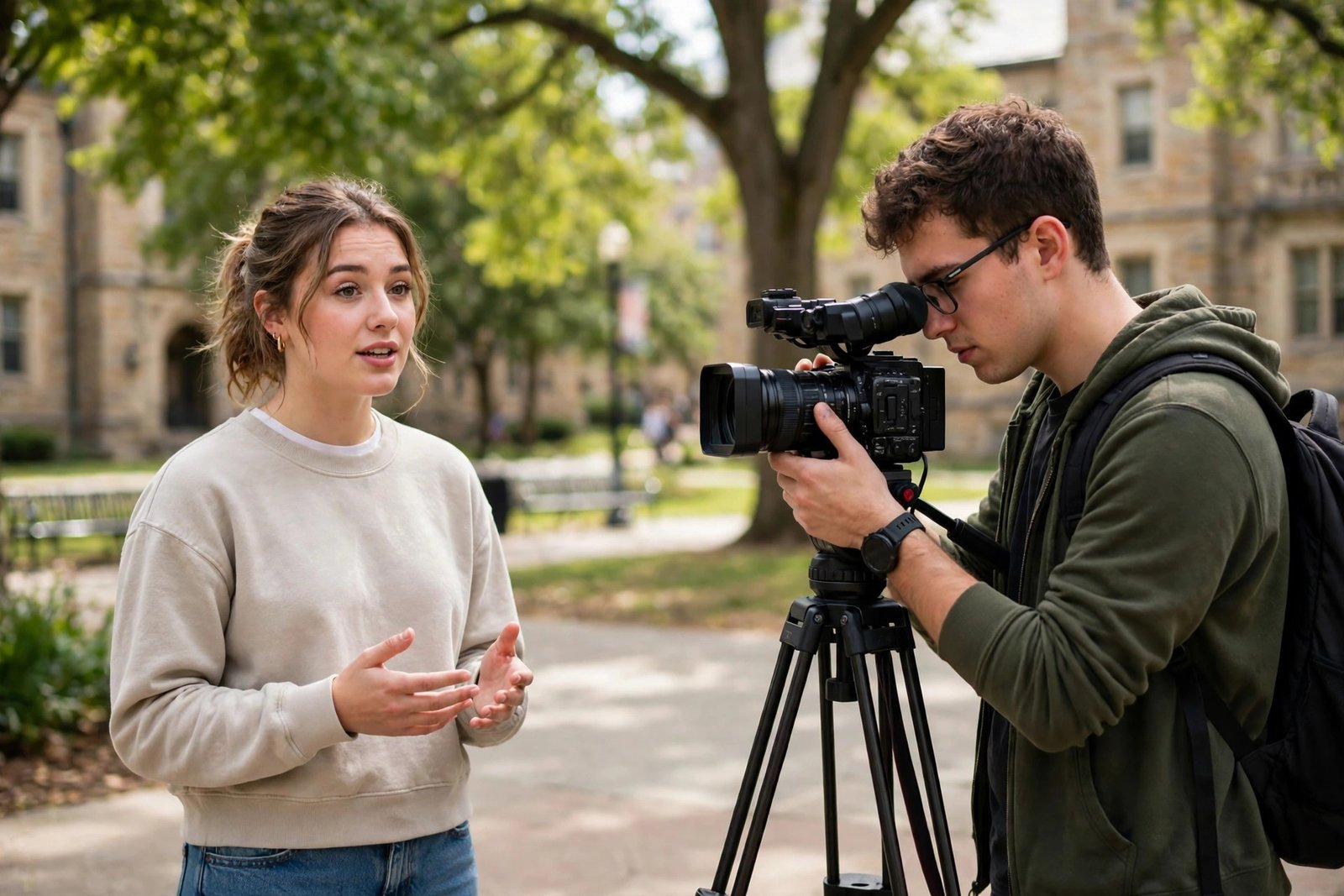
Beyond newsrooms, journalism graduates work in strategic communication and public relations, content strategy, corporate communications, government communications, audience research, podcasting and video production, social-media management, and media-adjacent roles in NGOs and international organisations. Freelancing is a significant path: many journalists build portfolio careers combining reporting, editing, content work and production, which offers freedom but irregular income, especially early on. Two skills most improve employability across all these paths: multimedia production (you can shoot, edit and publish a complete story alone) and data literacy (you can find, clean, analyse and visualise a dataset). A third is specialism: a journalist who understands finance, health, technology or climate policy in depth is hired ahead of a generalist. Finally, protect your reputation from day one: accuracy, fairness and source care are not abstract ethics in this profession, they are your employability, because editors hire people they trust with a story.
| Occupation (USA, BLS) | Median annual wage, May 2025 | Projected change, 2025–35 | Notes |
|---|---|---|---|
| News analysts, reporters, and journalists | $62,200 | −6% | About 3,400 openings per year projected, mostly replacement hiring |
| Media and communication workers (overall) | $74,250 | Little or no change overall | Group median covering PR specialists, news analysts, writers and others |
| Public relations specialists | $74,750 | 2% | Common destination for mass communication graduates |
| Editors | $77,920 | Not stated here | Editing roles in publishing, news and corporate content |
| Technical writers | $90,390 | Not stated here | Adjacent occupation valuing clear explanatory writing |
Scholarships for Journalism and Media Students
Journalism-specific scholarships are fewer than for some fields, but several routes exist. Government scholarships — Chevening (UK), Fulbright (USA), DAAD (Germany) and Australia Awards — fund media and communication master’s degrees; see the Chevening Scholarship 2027 guide and the Fulbright Foreign Student Program 2027 guide for requirements and timelines. Media-specific funding is covered in our Media and Communication Scholarships for International Students 2026–2027 guide. Use the scholarships directory and the scholarship finder tool to search by destination, and note that some journalism schools and media organisations offer their own bursaries, fellowships and paid traineeships — these are often advertised on the school’s own site rather than on general scholarship portals, so check each programme page. Government scholarship deadlines typically fall a year before study begins, so plan early.
Building a Portfolio, Finding Work Experience and Staying Employable
In journalism, your portfolio is your qualification in the eyes of most employers, and the degree should be used to build it deliberately. From the first term, aim to publish regularly: campus publications, community outlets, student radio or television, freelance pitches to local papers, and your own site for work that has nowhere else to go. Variety matters as much as volume — a news report, a feature, an interview, a data story and a short video show range, while ten similar opinion pieces do not. Keep every clip with its link and date, and keep the underlying evidence: notes, datasets, recordings (with consent) and correspondence that prove the work was reported, not invented. Editors hiring junior staff look for accuracy under deadline, clean copy, and the ability to find an original angle; a portfolio that demonstrates all three will beat a higher grade with no published work behind it.
Work experience follows the same logic. Placements with newspapers, broadcasters, digital outlets and communications agencies are competitive, so apply widely and early, and treat smaller outlets seriously: a regional paper or community station where you report real stories every day teaches more than a prestigious placement spent shadowing. While studying, learn the tools newsrooms now expect as standard — audio and video editing, content-management systems, social-media verification, spreadsheets and basic data visualisation — and keep a record of each tool you can use confidently, because job descriptions list them explicitly. The US Bureau of Labor Statistics profile of news analysts, reporters, and journalists sets out entry requirements, working conditions and the outlook for the occupation in plain terms, and the BLS profile of public relations specialists maps the adjacent communications careers many journalism graduates enter. Reading both before choosing electives helps you decide how much of your degree to invest in newsroom craft versus strategic communication, data and production skills.
How to Choose a Programme and Plan Your Application
Judge journalism programmes by their newsroom, not their brochure. Visit — virtually or in person — and ask: do students publish real work during the degree, do tutors still practise journalism, which outlets take the programme’s interns, and where did last year’s graduates actually get hired? Accreditation helps narrow the field: in the USA look for ACEJMC accreditation, and in the UK look for BJTC or NCTJ recognition for broadcast and print training. Compare total costs, not headline tuition: a one-year UK programme can cost less overall than a two-year programme elsewhere once living costs and a year of earnings are counted, while a no-tuition German programme still requires the blocked account and living expenses. Use the tuition fee calculator, the application deadline finder and the career path explorer to structure the comparison. On timing: most programmes for autumn 2026 or 2027 entry open the preceding autumn, competitive programmes close early, and government scholarships close earlier still. Take your English test first, give referees at least a month, and assemble your portfolio before you write your statement of purpose — the statement should point to work you have already done, not merely ambitions you hold. Finally, remember that media careers reward persistence after graduation as much as during study: freelance pitches, short contracts and traineeships are normal first steps, and the graduates who succeed are usually those who keep reporting, keep publishing and keep applying long after the degree ends.
A final word on the early-career reality of journalism: the first year after graduation is often a patchwork of short contracts, freelance commissions, traineeships and part-time work rather than a single permanent staff job, and that is normal in this industry rather than a sign of failure. Budget for it, keep your portfolio updated with every new piece, and stay in touch with editors who have commissioned you before — repeat commissions are how freelance careers stabilise. Protect your professional standing by keeping meticulous records, honouring embargoes, and correcting errors promptly and transparently when they occur; in a small industry, reliability and integrity travel fast. If staff jobs in news prove scarce, remember that the same skills — verified reporting, clear writing, multimedia production and audience understanding — are directly transferable to communications, content and research roles, and many journalists move between news and strategic communication over a career without leaving the media world behind.
Frequently Asked Questions
Do I need a journalism bachelor’s degree to study this master’s?
No. Many programmes accept graduates from any discipline and value subject expertise in politics, economics, science, law or sport. What matters most is evidence of writing ability and commitment: a portfolio, published clips, campus media work or a strong writing sample.
Is journalism a dying career?
Traditional newsroom employment has declined in many countries — in the USA, employment of news analysts, reporters and journalists is projected to fall 6 percent from 2025 to 2035 — but replacement hiring continues (about 3,400 openings per year), and demand has grown in digital media, multimedia production, strategic communication and content roles. Graduates with multimedia, data and specialist skills compete best.
What is the difference between journalism and mass communication?
Journalism focuses on news reporting, editing and production for news media. Mass communication is broader, covering journalism plus public relations, advertising, corporate communication and media research. Combined programmes offer the most flexibility for international students.
How long does the degree take?
One year full-time in the UK and Ireland, and usually two years in the USA, Canada, Australia and continental Europe. Part-time options extend these durations, and programmes with internships or practicums may take longer.
What English score do I need?
Most programmes ask for IELTS 6.5–7.0 overall or a TOEFL iBT equivalent; journalism programmes sometimes set the higher end because of the profession’s language demands. Confirm the exact requirement on the programme page.
Will I get an internship during the degree?
Many programmes encourage or require internships, but placements with major news organisations are competitive and are rarely guaranteed by the university. Start building contacts and clips early, and treat every placement application as seriously as a job application.
What are the post-study work options?
The UK Graduate Route currently allows two years of post-study work for master’s graduates, with an announced shortening to 18 months from 1 January 2027. Canada’s Post-Graduation Work Permit can run up to three years depending on programme length. Australia’s Temporary Graduate visa (subclass 485) and Germany’s 18-month post-study job-seeker residence permit offer further routes. Verify current rules on official government pages before relying on them.
Sources and Verification
Sources consulted for this guide: US Bureau of Labor Statistics, Occupational Outlook Handbook — News Analysts, Reporters, and Journalists; Public Relations Specialists; Media and Communication Occupations; Writers and Authors (median wages May 2025; projections 2025–35); UK government Student visa maintenance requirements; Immigration, Refugees and Citizenship Canada proof-of-funds requirements; Australian Department of Home Affairs student visa financial capacity requirement; German Federal Foreign Office blocked account guidance; Accrediting Council on Education in Journalism and Mass Communications (ACEJMC) and Broadcast Journalism Training Council (BJTC) accreditation information. Figures change yearly — confirm fees, visa amounts and entry requirements on the official university or government page before applying. StudyGraduate is an information portal, not an agency — we never promise admission, jobs, salaries or visa or permanent-residence outcomes.