
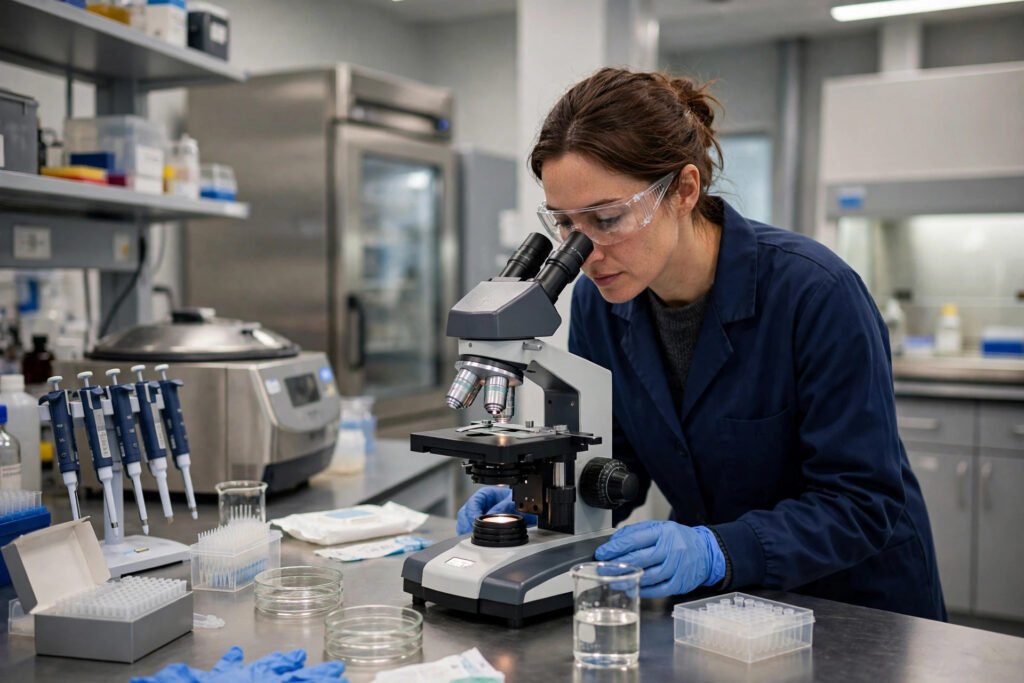
BSc Medical Laboratory Science Abroad: Eligibility, Fees, Top Universities and Careers
Every diagnosis a doctor makes, every infection a hospital treats, and every blood transfusion that saves a life depends on a laboratory result that somebody produced, checked and signed off. The people who do that work are medical laboratory scientists, and the degree that trains them is the BSc in Medical Laboratory Science (also called Medical Laboratory Technology, Clinical Laboratory Science or Biomedical Science in some countries). If you are a science student who loves biology and chemistry, enjoys precise hands-on work, and wants a healthcare career that does not necessarily mean medical school, this degree deserves serious attention.
Studying medical laboratory science abroad adds a second advantage: you train on modern analysers, automated haematology and microbiology platforms, and molecular diagnostics equipment that many home-country laboratories are only beginning to adopt. You also learn the quality systems, accreditation standards and safety culture that international employers expect. This guide explains what the degree covers, who can apply, what it costs in the United States, United Kingdom, Canada, Australia and Germany, which universities are strong in the field, how licensing and certification work, and what graduates actually earn, using official statistics wherever a figure appears.
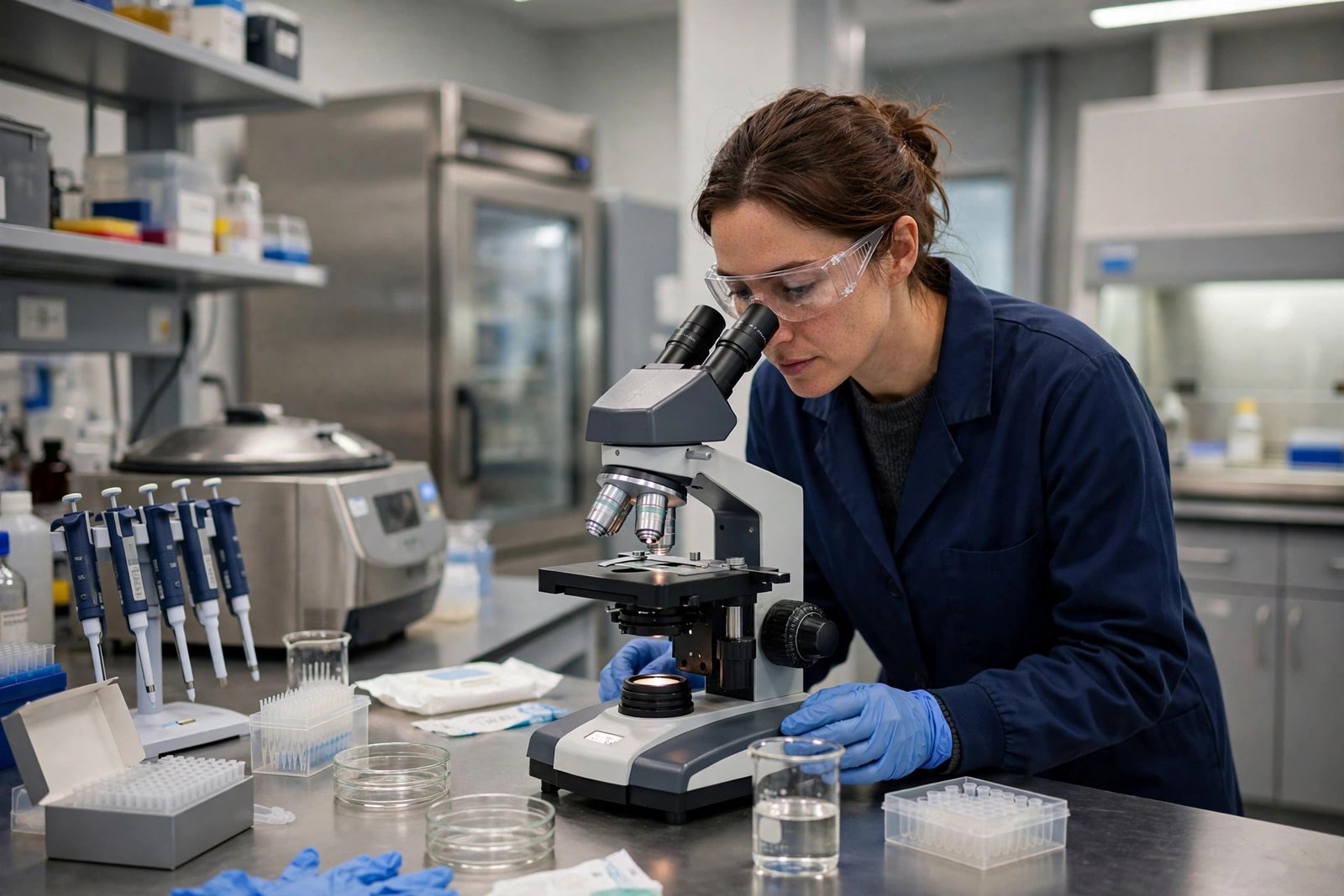
What is a BSc in Medical Laboratory Science?
A BSc in Medical Laboratory Science is an undergraduate professional degree that trains students to perform, interpret and assure the quality of laboratory tests on blood, tissue, urine and other body fluids. Unlike a general biology degree, it is built around clinical practice: you do not only learn why a test works, you learn how to run it safely, what can go wrong, how to recognise a faulty result before it reaches a clinician, and how to document everything so the result stands up to audit.
The degree sits at the intersection of biology, chemistry and medicine. A typical graduate can work across the five classic laboratory disciplines: haematology (blood cells and clotting), clinical biochemistry (chemical markers of disease), medical microbiology (bacteria, viruses, fungi and parasites), transfusion science (blood grouping and safe transfusion), and immunology (the immune system and its disorders). Many programmes add histopathology (tissue examination), molecular diagnostics and laboratory management, reflecting how quickly genetics-based testing has grown.
It is worth understanding the naming differences before you apply, because they cause real confusion. In the United States, the degree is usually called Medical Laboratory Science (MLS) or Clinical Laboratory Science (CLS), and graduates may sit the MLS(ASCP) certification exam. In the United Kingdom, the closest equivalent is Biomedical Science, and the professional title is biomedical scientist, regulated by the Health and Care Professions Council (HCPC). In Australia, the degree is often called Medical Laboratory Science and graduates seek recognition through the Australian Institute of Medical and Clinical Scientists (AIMS). In Canada, programmes are called Medical Laboratory Science and are accredited by Accreditation Canada’s EQual programme, with national certification through the Canadian Society for Medical Laboratory Science (CSMLS). The science is the same; the professional titles, regulators and certification exams differ by country, and you should choose your destination with the licensing route in mind, not only the university ranking.
At a Glance
| Feature | Details |
|---|---|
| Degree level | Bachelor’s degree (BSc), sometimes offered as a Bachelor of Medical Laboratory Science |
| Typical duration | 3 years (UK, Australia) to 4 years (USA, Canada); UK sandwich degrees with a placement year take 4 years |
| Core subjects | Haematology, clinical biochemistry, medical microbiology, transfusion science, immunology, molecular diagnostics, laboratory quality management |
| Clinical training | Supervised laboratory placements or clinical rotations in hospital or diagnostic laboratories, usually in the final year |
| Who it suits | Students strong in biology and chemistry who enjoy precise, detail-oriented laboratory work and want a direct route into healthcare |
| Main destinations | USA, UK, Canada, Australia, Germany (note: German-taught options dominate in Germany; English-taught MLS degrees are rare) |
| Professional recognition | Country-specific: ASCP (USA), HCPC/IBMS (UK), CSMLS (Canada), AIMS (Australia) — see the licensing section below |
What You Study: Curriculum and Subjects
The first year is usually shared with other life-science degrees: cell biology, human anatomy and physiology, general and organic chemistry, biochemistry, genetics, mathematics and statistics, and an introduction to laboratory safety and practice. This foundation matters more than students expect, because second- and third-year laboratory science builds directly on it; a weak grasp of biochemistry makes clinical biochemistry painful, and a weak grasp of statistics makes quality control hard to understand.
In the second year, the curriculum turns clinical. Haematology teaches you to examine blood films, count and classify blood cells, and investigate anaemia, leukaemia and clotting disorders. Clinical biochemistry covers enzymes, hormones, kidney and liver function tests, and the analysers that run hundreds of samples an hour. Medical microbiology introduces bacterial culture and identification, antibiotic susceptibility testing, virology and parasitology. Immunology explains how the immune system recognises threats and how laboratory tests detect antibodies and immune disorders. Transfusion science covers blood groups, cross-matching and the safe issue of blood products, where an error can be fatal, so the teaching is deliberately rigorous.
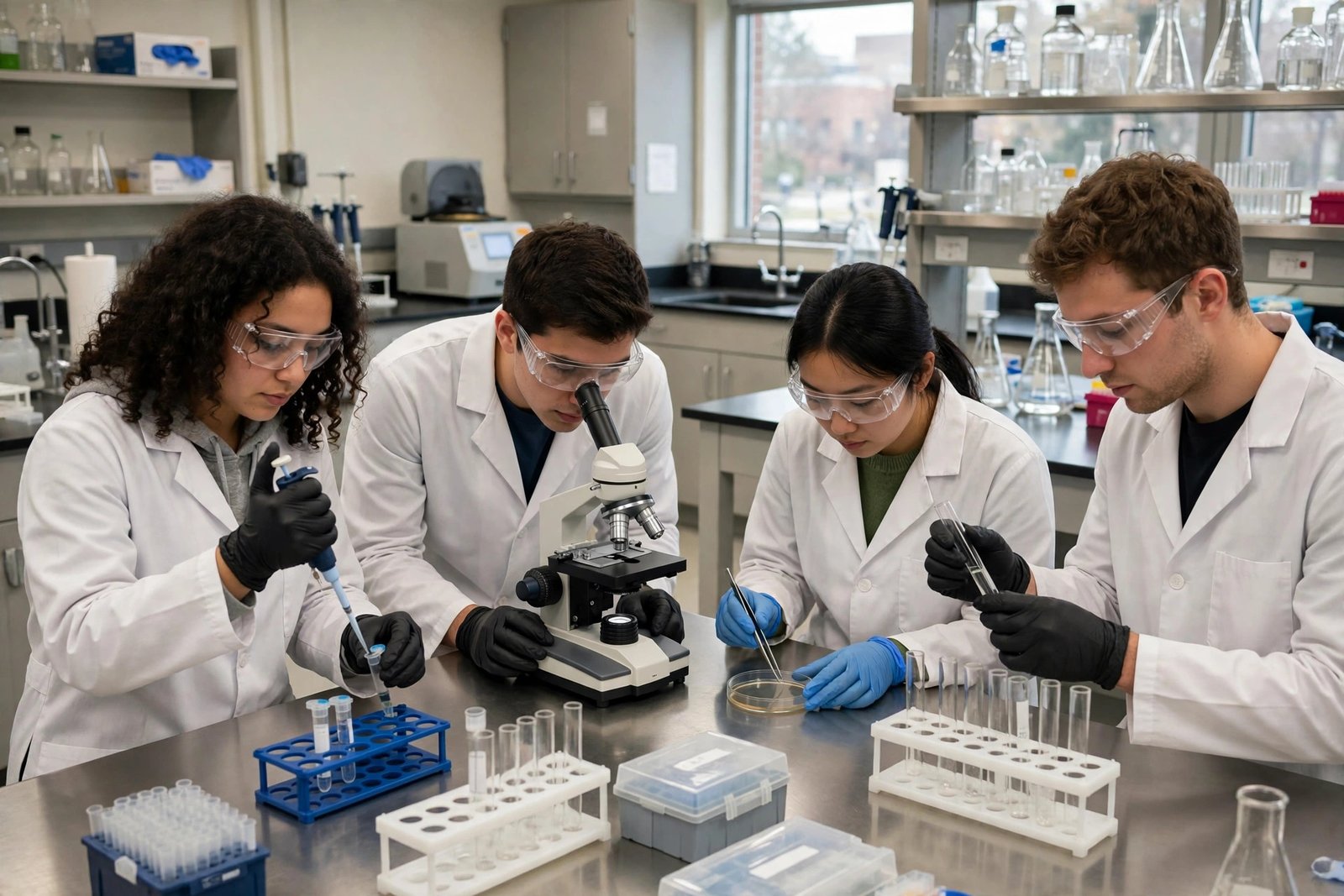
The final year typically combines advanced topics with a placement. Molecular diagnostics and genetics, including polymerase chain reaction (PCR) testing and sequencing, now feature in most programmes because so much modern testing is DNA-based. Laboratory management and quality assurance teach accreditation standards, internal quality control, external quality assessment, audit and the documentation habits that regulators inspect. Many programmes also require a research project or dissertation, which is excellent preparation if you later want a master’s degree or a research role. The clinical placement is the most valuable part of the degree: you work in a real diagnostic laboratory, rotate through departments, and learn the pace, discipline and teamwork of a working lab under supervision.
Beyond technical content, the degree builds habits that employers prize: attention to detail, because a mislabelled sample can harm a patient; time management, because urgent results have strict turnaround times; and calm under pressure, because laboratories run around the clock and emergency samples arrive at any hour. If you enjoy work where accuracy is not a preference but a professional duty, you will feel at home here.
Eligibility and Entry Requirements
Entry requirements vary by country and university, but the pattern is consistent. You need a strong school-leaving qualification with biology and chemistry. In the United States, universities look for a high-school diploma with biology, chemistry and mathematics, plus SAT or ACT scores where the university still requires them, and English proficiency for international students. In the United Kingdom, typical offers for Biomedical Science or Medical Laboratory Science are A-levels (or equivalents) including biology and chemistry, often at grades ABB to BBB at stronger universities, plus IELTS around 6.5 overall with no band below 6.0. Canadian universities generally ask for Grade 12 biology, chemistry and mathematics, with averages that vary widely by institution. Australian universities ask for Year 12 biology and chemistry (or equivalents) and IELTS around 6.5 to 7.0, with some universities requiring 7.0 for health programmes.
For students from Bangladesh, India, Nigeria, Pakistan and similar systems, the usual route is a Higher Secondary Certificate or equivalent with science subjects, plus an English test. Some universities accept strong HSC results directly; others ask for a foundation year or an international year one. Do not be discouraged by a foundation offer: it is a normal route into UK and Australian health degrees, and it often includes the laboratory skills and academic English that make the degree itself easier. What matters most is your science grades, especially biology and chemistry, and a personal statement that shows you understand what laboratory work actually involves. Admissions tutors notice applicants who mention a hospital laboratory visit, a school science project, or volunteer work in a clinic, because it shows the choice is informed rather than generic.
Postgraduate entry is also possible. If you already hold a science bachelor’s degree, some universities offer graduate-entry or master’s routes into laboratory science, though these do not always carry the same professional recognition as the accredited bachelor’s degree, so check the accreditation status of any accelerated route before you commit. For the United States, the most direct professional route remains a bachelor’s degree from a programme accredited by the National Accrediting Agency for Clinical Laboratory Sciences (NAACLS), because NAACLS accreditation is the basis of the simplest ASCP certification route.
Eligibility at a Glance by Country
| Country | School subjects needed | English test (typical) | Duration |
|---|---|---|---|
| USA | Biology, chemistry, maths at high-school level | TOEFL iBT ~79–90 or IELTS ~6.5 | 4 years |
| UK | A-level biology + chemistry (or equivalent) | IELTS ~6.5, no band below 6.0 | 3 years; 4 with placement |
| Canada | Grade 12 biology, chemistry, maths | IELTS ~6.5 | 4 years |
| Australia | Year 12 biology + chemistry (or equivalent) | IELTS ~6.5–7.0 | 3–4 years |
| Germany | Science-heavy school leaving certificate; German language usually required | German C1 for German-taught programmes; IELTS ~6.5 for rare English-taught options | 3–3.5 years (varies) |
Tuition Fees and Living Costs
Tuition varies more by country than by university, and you should always confirm the figure for your intake year on the university’s official fees page, because health-programme fees often sit above the university average. The indicative ranges below are published ranges for international undergraduate students for 2026 entry, given to help you compare destinations, not as a quote for any single university.
In the United States, international tuition for a four-year MLS degree at a public university typically falls in the range of USD 30,000 to 55,000 per year, with private universities higher. In the United Kingdom, international fees for biomedical science and laboratory science degrees typically range from GBP 22,000 to 36,000 per year. In Canada, international tuition commonly ranges from CAD 30,000 to 55,000 per year. In Australia, international fees commonly range from AUD 35,000 to 55,000 per year. Germany remains the low-tuition exception: most public universities charge no tuition, only a semester contribution of roughly EUR 150 to 400, but you must budget for living costs and for German-language study if your programme is German-taught.
Living costs and visa financial requirements are separate from tuition, and governments publish the figures you must be able to show. For the United Kingdom, the student visa maintenance requirement is GBP 1,529 per month in London and GBP 1,171 per month outside London. For Germany, the blocked account requirement is EUR 11,904. For Australia, the living-cost amount used in visa financial-capacity calculations is AUD 29,710 per year. For Canada, the proof-of-funds requirement for a single student outside Quebec is CAD 22,895, rising to CAD 23,448. These are the figures to build your budget around, and you can test your own numbers with the study abroad budget planner and the tuition fee calculator. The cost of living calculator is also useful for comparing cities, because rent in London, Sydney or Toronto can be double the cost in a smaller university city.
Two cost traps deserve a warning. First, clinical placements can add travel, uniform and immunisation costs that are not in the headline tuition figure; ask the university what placement costs students actually pay. Second, certification exam fees, registration fees and any post-graduation bridging or top-up modules are separate from tuition, so budget a few hundred dollars or pounds for the professional stage. Scholarships exist, but full scholarships for undergraduate laboratory science are rare; partial tuition scholarships, country-specific awards and the government programmes linked in the scholarships section below are the realistic targets. Compare the full picture with the cost of studying in the UK and cost of studying in Australia guides before you shortlist.
Top Universities and Countries for Medical Laboratory Science
The strongest choice is not always the highest-ranked university overall; it is the programme with proper professional accreditation, a hospital placement network, and modern laboratory facilities. In the United States, look for NAACLS-accredited MLS programmes, which are offered by a wide range of public universities, including large state universities with their own medical centres, where placements are built into the degree. In the United Kingdom, choose an Institute of Biomedical Science (IBMS) accredited Biomedical Science degree, ideally one with an integrated or sandwich placement in an approved NHS laboratory, because the placement is what makes the registration route straightforward. In Canada, choose programmes accredited through Accreditation Canada’s EQual system, which align with CSMLS certification. In Australia, look for AIMS-accredited Medical Laboratory Science degrees at universities with strong health faculties and teaching-hospital links.
Well-known strengths include the University of Melbourne and the University of Sydney in Australia, the University of Toronto in Canada, and a broad set of UK universities with IBMS-accredited biomedical science degrees and NHS placement links. Rather than chasing a single name, compare programmes on four questions: is the degree accredited by the relevant body, does it include a clinical placement, what analysers and molecular-diagnostics facilities will you train on, and what proportion of graduates pass their certification exam or gain registration on the first attempt? You can compare shortlisted universities side by side with the university comparison tool, and browse the full directory at universities. The Courses and Programs directory also shows related health programmes, including the Master of Public Health, which is a natural postgraduate step for laboratory scientists moving into public health, epidemiology or health management.
Licensing and Certification: The Part Students Most Often Overlook
A degree alone does not automatically let you practise as a laboratory professional in another country. Each destination has its own regulator and its own route, and understanding this before you apply will save you years of frustration. This section describes eligibility routes only; it does not promise registration or practice rights, which are always decided by the regulator on your individual application.
In the United States, the main credential is MLS(ASCP), awarded by the American Society for Clinical Pathology Board of Certification. The simplest route, Route 1, is a bachelor’s degree from a NAACLS-accredited MLS programme. Other routes exist for graduates with a science bachelor’s degree plus qualifying clinical laboratory experience, and an international credential, MLS(ASCPi), exists for internationally educated candidates. Some US states also require a state licence in addition to certification, so check the state where you hope to work. In the United Kingdom, biomedical scientists must register with the HCPC. The usual route is an IBMS-accredited degree plus the IBMS Registration Training Portfolio completed in an approved training laboratory, leading to the IBMS Certificate of Competence and then HCPC registration. Graduates of non-accredited degrees can seek an IBMS degree assessment and complete any top-up modules required, which takes longer. In Canada, graduates of accredited programmes write the CSMLS national certification exam, and some provinces require provincial registration as well. In Australia, AIMS membership and assessment is the usual professional recognition step, and employers commonly expect it. If you plan to return home after studying abroad, check your home country’s recognition rules too; some countries require a local licence exam or a period of supervised practice regardless of where you studied.
The practical lesson is simple: choose an accredited programme in the country where you most want to work, keep every placement record and transcript, and start reading the regulator’s requirements in your second year, not after graduation. Students who discover the licensing route only at graduation often face an extra year of top-up study or supervised experience that a better programme choice would have avoided.
Careers and Salaries
Medical laboratory scientists work in hospital laboratories, public-health laboratories, private diagnostic chains, blood transfusion services, pharmaceutical and biotechnology companies, research institutes, and veterinary and forensic laboratories. The largest employer remains the hospital sector, where laboratories run day and night and staff rotate through shifts, including nights and weekends. Diagnostic companies and reference laboratories offer a different pattern: high-volume automated testing, often in a single specialism. Public-health laboratories focus on infectious disease surveillance, outbreak investigation and reference testing, work that became highly visible during the COVID-19 pandemic and has stayed well funded since.
Career progression is real but structured. A new graduate typically starts as a medical laboratory scientist or biomedical scientist, then moves with experience into senior or specialist roles in one discipline, then into laboratory management, quality management, or a specialist field such as molecular diagnostics or transfusion practice. Some graduates move into sales and technical support for diagnostic equipment companies, where laboratory experience is prized. Others take a master’s degree in a specialism, in public health, or in laboratory management, and a minority move into research or teaching. The degree also keeps a door open to graduate-entry medicine, physician associate programmes and other health professions, though those routes have their own entry requirements.
Salary figures below come from the US Bureau of Labor Statistics (BLS) Occupational Outlook Handbook, using May 2025 medians and 2025–35 projections. These are United States figures for the closest official occupation; they are not a promise of what any individual graduate will earn, and pay varies by country, employer, shift pattern and experience.
| Occupation (BLS, USA) | Median annual wage, May 2025 | Projected growth, 2025–35 | Notes |
|---|---|---|---|
| Clinical laboratory technologists and technicians | $62,930 | 3% (about as fast as average); about 20,800 openings per year | Lowest 10% earned less than $38,910; highest 10% more than $100,990 |
| Clinical laboratory technologists and technicians in general medical and surgical hospitals (private) | $69,190 | — | Hospitals paid above the occupation median in May 2025 |
| Clinical laboratory technologists and technicians in medical and diagnostic laboratories | $58,320 | — | Below the occupation median in May 2025 |
| Biological technicians (related occupation, for comparison) | $57,510 | — | Research-support roles; often a first job for life-science graduates |
The BLS projects employment of clinical laboratory technologists and technicians to grow 3 percent from 2025 to 2035, about as fast as the average for all occupations, with about 20,800 openings per year on average over the decade, many resulting from workers transferring occupations or leaving the labour force. That is a steadier picture than the boom-and-bust pattern of some fields: demand for laboratory testing rises with population growth, ageing, and the expanding range of tests medicine can offer, even when the wider economy slows. In the United Kingdom, Canada and Australia, pay is set by public-sector scales or employer awards rather than a single published median, so compare the relevant NHS, provincial or state award for the year you graduate rather than converting a US figure. Shift allowances for nights, weekends and on-call work can add a meaningful amount to base pay in hospital roles.
Scholarships for Medical Laboratory Science Students
Field-specific undergraduate scholarships for laboratory science are uncommon, so the smart strategy is to apply for broad government and university scholarships and for health-related awards. Start with the scholarship finder tool and the scholarships directory. Government programmes worth checking include the Chevening Scholarship for master’s study in the UK, the Fulbright Foreign Student Program for the USA, the Australia Awards Scholarships, and the DAAD Scholarship for Germany, noting that most of these target postgraduate study, so they are most useful if you plan a master’s after your bachelor’s. Health-specific funding is covered in the public health scholarships guide, and many universities offer their own international merit scholarships that laboratory science students can hold alongside a place on the degree. Apply early, because university scholarship deadlines often fall months before the course deadline, and a strong personal statement that explains why laboratory science matters to your home country’s health system stands out in health-related awards.
Is This Degree Right for You?
Choose medical laboratory science if you are fascinated by how disease is detected, you enjoy practical science more than essay writing, and you want a healthcare career with a clear professional identity and steady demand. Think twice if you dislike shift work, struggle with strict procedures, or want a career built mainly on patient contact, because laboratory scientists mostly serve patients through their results rather than face to face. It is also worth being honest about one trade-off: the work is highly responsible and sometimes repetitive, and the laboratory is a controlled environment with strict safety rules. Students who thrive are those who find satisfaction in getting a difficult result right, in spotting the sample that does not add up, and in knowing that a clinician’s decision rests on their work.
If you are still deciding between laboratory science and neighbouring fields, compare it with a general biology degree, which keeps more doors open but gives no professional credential, and with nursing or medicine, which offer more patient contact but longer and more expensive training. The career path explorer can help you map laboratory roles against other health careers, and the visa requirement checker will help you confirm the visa rules for your chosen destination. For the visa paperwork itself, the proof of funds guide explains what each country asks you to show.
How to Apply: A Practical Timeline
Start twelve to fifteen months before your intended intake. First, shortlist accredited programmes in two or three countries, and check each programme’s accreditation, placement arrangements and international fees on its official page. Second, take your English test early, because a missing IELTS or TOEFL score is the commonest reason for a delayed offer. Third, prepare transcripts, a personal statement and references, and apply through the relevant route: UCAS for the UK, direct application or a central system for most US, Canadian and Australian universities. Fourth, once you hold an offer, arrange your finances, including the visa maintenance or blocked-account requirement, and apply for scholarships in parallel. Fifth, apply for your student visa, complete any immunisation and health checks the university or placement provider requires, and confirm your placement and accommodation before you travel. Students who follow this order rarely miss a deadline; students who start with the visa and work backwards often do.
Frequently Asked Questions
Is medical laboratory science the same as biomedical science?
They overlap heavily but the titles belong to different systems. In the UK, Biomedical Science is the degree that leads to HCPC registration as a biomedical scientist. In the USA, Medical Laboratory Science is the degree that leads to MLS(ASCP) certification. Check which title and regulator applies in the country where you want to work, and choose an accredited programme in that system.
Do I need a placement to become a laboratory scientist?
In most systems, yes, in some form. UK registration requires the IBMS Registration Training Portfolio in an approved laboratory. US certification routes require a NAACLS-accredited programme or qualifying clinical experience. A degree without a placement may still be academically strong, but it can leave you with extra steps before you can practise.
Can international students work in a hospital laboratory after graduation?
It depends on the country, the visa you hold, and whether you meet the regulator’s requirements. Post-study work visas exist in the UK (Graduate Route), Australia (Temporary Graduate visa, subclass 485), Canada (Post-Graduation Work Permit) and Germany (18-month job-seeker residence permit), and the USA offers Optional Practical Training for F-1 students, but none of these guarantees a laboratory job or professional registration. Treat licensing and immigration as two separate applications, both of which you must satisfy.
Is the degree very difficult?
It is demanding in a specific way: the volume of factual knowledge is large, the practical standards are strict, and assessment often includes practical exams and placement competencies as well as written papers. Students with strong biology and chemistry foundations, good organisation and steady study habits do well; students who rely on last-minute revision struggle, because practical competence cannot be crammed.
Can I move into research or medicine after this degree?
Yes. The degree is a strong foundation for master’s degrees in molecular diagnostics, haematology, microbiology, infection science and public health, and for research roles in diagnostic and biotechnology companies. Graduate-entry medicine is possible in some countries, but it is competitive and has its own entrance exams and requirements.
How long does it take to become registered after graduation?
It varies. A UK graduate with an integrated placement can often apply for HCPC registration soon after graduation, while a graduate who still needs a portfolio placement will take longer. A US graduate of a NAACLS programme can sit the ASCP exam promptly after graduation. Allow at least several months for any registration process, and keep your placement evidence safe.
Are there jobs outside hospitals?
Yes. Diagnostic companies, blood services, public-health laboratories, pharmaceutical and biotechnology firms, veterinary and forensic laboratories, and equipment manufacturers all employ laboratory scientists. Some roles are office-based, in quality assurance, regulatory affairs or technical support, which suits graduates who want to move away from bench work later in their careers.
Should I study in Germany if I do not speak German?
Only if you find a genuinely English-taught programme that still gives you a recognised professional route, which is rare for laboratory science in Germany. Most German laboratory training is German-taught and German-speaking workplaces are the norm, so German language skills are usually essential for both study and employment there.
Sources and Verification
Sources consulted for this article: US Bureau of Labor Statistics, Occupational Outlook Handbook, Clinical Laboratory Technologists and Technicians (median annual wage $62,930, May 2025; projected growth 3 percent, 2025–35; about 20,800 openings per year); US Bureau of Labor Statistics, Occupational Outlook Handbook, Biological Technicians (median $57,510, May 2025); American Society for Clinical Pathology Board of Certification, MLS certification routes and NAACLS accreditation; Institute of Biomedical Science, accredited degrees and HCPC registration route; Health and Care Professions Council, biomedical scientist registration standards; UK Government student visa maintenance requirements (GBP 1,529 per month London, GBP 1,171 outside London); German blocked account requirement (EUR 11,904); Australian student visa living-cost amount (AUD 29,710); Canadian proof-of-funds requirement (CAD 22,895, rising to CAD 23,448). Tuition ranges are indicative published ranges for international students for 2026 entry and vary by university; confirm the exact fee on the official university page before applying. Figures change yearly, so confirm fees, entry requirements and licensing rules on the official university and regulator pages. StudyGraduate is an information portal, not an agency, and this article never promises admission, jobs, salaries or visa or permanent-residence outcomes.