
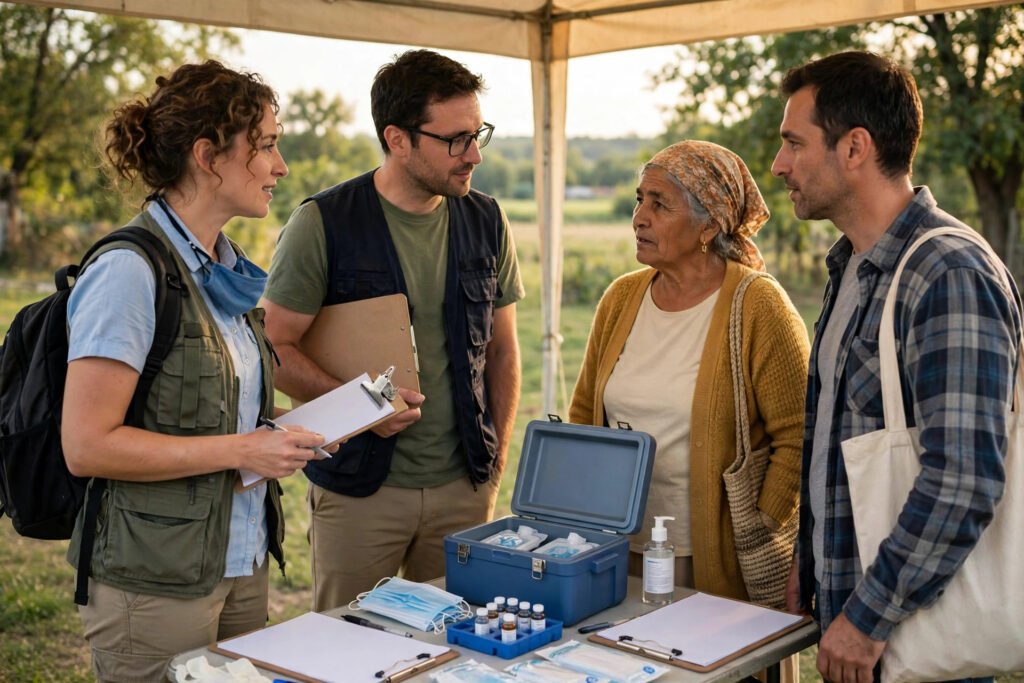
Master of Public Health (MPH) Abroad: Eligibility, Fees, Top Universities and Career Scope
The Master of Public Health (MPH) is the degree for people who want to improve health at the level of populations rather than individual patients: tracking disease outbreaks, designing vaccination and screening programmes, evaluating health policy, cleaning up the environmental and social conditions that make communities sick, and turning health data into decisions. Since the COVID-19 pandemic, governments, hospitals, NGOs, pharmaceutical companies and global agencies have all expanded the kind of work MPH graduates do — but the degree is sold with plenty of vague promises too, so this guide separates the verified picture from the marketing.
Every salary in this article comes from the U.S. Bureau of Labor Statistics (BLS) Occupational Outlook Handbook, quoted as a median with its reference date (May 2025) and its projected growth period. Fees and living costs are anchored to named official sources — Statistics Canada, UK Home Office visa rules, the Australian Government’s financial-capacity requirement and Germany’s blocked-account figure — because public health programmes publish fees per intake and any unsourced “average MPH fee” would mislead you. Where the honest answer is “it varies by university,” this guide says so and tells you where to verify it.
You can start your programme research with the Master of Public Health programme profile and the full Courses & Programs directory, then use this guide to work through eligibility, accreditation, costs and career scope in order.
MPH Abroad at a Glance
| Item | Typical position (verify per university) |
|---|---|
| Degree | Master of Public Health (MPH) — a professional master’s in population health |
| Duration | 1 year in the UK; 1.5–2 years in the USA, Canada and Australia; 2 years in much of Europe |
| First degree | A bachelor’s degree — health, science, social science, statistics and many other backgrounds are accepted; some programmes prefer or require relevant study or experience |
| Work experience | Valued everywhere; formally required by some programmes (especially US schools of public health and executive/online formats), optional at many UK and Australian programmes |
| Admission tests | GRE required by a minority of US programmes and waived or not required by many; English tests (IELTS/TOEFL/PTE) for non-native speakers |
| Accreditation to check | CEPH (Council on Education for Public Health) in the USA; equivalent national quality assurance elsewhere |
| Practicum | A supervised applied practice experience / placement is a core requirement of accredited programmes |
| Headline salary anchor | Epidemiologists — a core MPH occupation — had a US median of $87,220 in May 2025 (BLS), with employment projected to grow 19% from 2025 to 2035 |
| Main employers | Health departments and ministries, hospitals, universities, NGOs and global agencies, insurers, pharma and health-tech firms, consultancies |
What an MPH Covers
Accredited MPH curricula are built around a common spine, whatever the country. The five classic core areas are epidemiology (how disease and injury distribute across populations and why), biostatistics (the quantitative methods for designing studies and analysing health data), health policy and management (how health systems are financed, organised and governed), environmental health sciences (air, water, occupational and climate-related risks), and social and behavioural sciences (how behaviour, inequality and community context shape health). Layered on that spine, students take a concentration — common ones include global health, infectious disease, maternal and child health, health promotion, nutrition, occupational health, health informatics and health economics — and complete an applied practice experience: a real placement with a health agency, hospital, NGO or company, plus an integrative project or dissertation that ties the degree together.
Two practical consequences follow. First, an MPH is not a clinical degree: it does not qualify you to treat patients, and doctors, nurses, pharmacists and allied-health graduates take it to move into population-level, managerial, research or policy roles, not to change their clinical licence. Second, the quantitative core is real. Students from purely clinical or humanities backgrounds sometimes underestimate the biostatistics load; most programmes support it well, but if your first degree contained no statistics at all, expect a steep first term and consider a preparatory statistics course before you enrol.
Formats vary. Full-time campus programmes dominate in the UK (one intensive year), the USA (usually two years, with the practicum often in the summer between them), Canada and Australia. Online and hybrid MPHs — many of them CEPH-accredited in the US — are designed for working professionals and usually take two to three years part-time; they deliver the same curriculum and practicum requirement but a different networking experience, and for international students they normally carry no student-visa or post-study-work rights, a trade-off to price in honestly.
Eligibility for an MPH Abroad
First degree. A recognised bachelor’s degree is the universal entry point. The accepted range of subjects is wider than most applicants expect: alongside medicine, nursing, dentistry, pharmacy, biology and health sciences, programmes routinely admit graduates in statistics, economics, psychology, sociology, geography, anthropology, environmental science and other fields, because public health is an interdisciplinary profession. Grade expectations follow each university’s country-equivalency tables — UK programmes commonly ask for a 2:1 equivalent or above, US schools look at GPA in context, and a GPA converter gives only a rough first translation. A handful of programmes set specific prerequisites — an undergraduate statistics or biology course is the most common — so read the entry page of each target programme rather than a generic list.
Experience. Public health experience strengthens every MPH application and is a formal requirement at some schools — particularly US schools of public health that position the MPH as a mid-career professional degree, and most executive or online formats aimed at clinicians and health managers. Relevant experience includes work or substantial volunteering with health departments, hospitals, NGOs, community-health programmes, laboratories, research projects and health campaigns. Many UK and Australian programmes admit strong recent graduates without experience, but even there, an applicant who can point to a real community-health project writes a far more convincing statement of purpose than one who cannot.
Tests. The GRE is in retreat in public health admissions: many US programmes have dropped it or made it optional, some still require or recommend it, and almost no programme outside the US asks for it. Never assume — check each programme’s page. English proficiency tests are the more universal hurdle for non-native speakers: IELTS, TOEFL iBT or PTE at the level the university publishes (health programmes often sit at IELTS 6.5–7.0 overall), with waivers sometimes available for prior English-medium degrees. For Australia specifically, note the visa-level English floor is separate from university entry: Home Affairs requires IELTS 6.0 overall for direct Student visa entry (with lower packaged thresholds alongside ELICOS study), and Duolingo is not accepted by Home Affairs. Our test preparation section compares the English tests in detail.
Accreditation — the check that protects your degree. In the USA, look for accreditation by the Council on Education for Public Health (CEPH), the independent accreditor recognised by the U.S. Department of Education for schools and programmes of public health. CEPH accreditation is the field-specific quality signal US employers, fellowships and doctoral programmes look for, and CEPH-accredited curricula guarantee the foundational competencies and the applied practice experience described above. Outside the US there is no single global equivalent; instead, verify that the university is a recognised degree-awarding institution in its own country and check programme-level quality marks where they exist. Whatever the country, a cheap unaccredited “MPH” from an institution you cannot find in official registers is a poor purchase at any price.
Fees and Living Costs by Country
MPH tuition is set per university and per intake, and it spans an unusually wide range — from no-tuition public programmes in Germany to premium-priced US schools of public health. The honest way to budget is to take a named anchor for the country you are considering, add the living-cost figure its government requires you to prove, and then verify the exact fee on your target university’s international page for your intake year. Use the tuition fee calculator to model your shortlist.
| Country | Tuition anchor (named source, dated) | Living-cost / visa funds to plan for |
|---|---|---|
| USA | Fees are set per school of public health and vary widely between public and private universities; verify on the school’s published tuition page for your entry year. There is no national MPH fee. | Set by each university’s I-20 estimate; US health schools cluster in high-cost cities, so budget at the university’s own estimate, not a national guess. |
| UK (1 year) | Fees are set per university; London programmes cost more than those elsewhere. The one-year duration is the UK’s structural saving: one year of fees and living costs instead of two. | Student visa maintenance: £1,529/month in London and £1,171/month outside London, up to 9 months (caps £13,761 / £10,539); rising to £1,570 / £1,203 for applications on or after 30 November 2026. Visa fee £558; Immigration Health Surcharge £776/year. |
| Canada | Statistics Canada: average international graduate tuition was CAD 24,028 in 2025/26 across all graduate programmes — MPH programmes sit within a range around this all-programme average; verify per university. | Study permit living funds (excluding tuition): CAD 22,895 for applications to 31 August 2026; CAD 23,448 from 1 September 2026 (IRCC). Master’s students at public institutions are exempt from the Provincial Attestation Letter requirement from 1 January 2026. |
| Australia | Fees are set per university and published on each university’s international course page; verify for your intake year. | Financial capacity for living costs: AUD 29,710 per year (Australian Government). Subclass 500 visa charge AUD 2,500 from 1 July 2026 (AUD 2,050 for some ELICOS/ASEAN/Pacific applicants). |
| Germany | Most public universities charge no tuition — exceptions: Baden-Württemberg non-EU fee of €1,500/semester and TU Munich’s non-EU fees. English-taught MPH-style programmes exist at public and private institutions; private fees vary. | Blocked account: €11,904 per year (2026). |
Funding deserves a realistic paragraph. Public health has more mission-driven funding than business education — universities offer merit and need-based awards, governments fund health-workforce scholarships, and employers (hospitals, health departments, NGOs) sometimes sponsor part-time online students — but fully funded MPH places for international students are competitive and never guaranteed. Research the dedicated listings for public health scholarships for international students alongside each university’s own funding page, and treat graduate assistantships (common at US schools) as a possibility to ask about, not a certainty to budget on.

Careers and Salaries After an MPH
Public health pay is honest but rarely spectacular at entry, and it rises steeply with quantitative skill and management responsibility. The BLS figures below are US medians for everyone working in each occupation — experienced workers included — not starting salaries and not MPH-specific. Read them as the shape of the labour market you are entering: the occupations an MPH feeds, what the middle of each occupation earns, and how fast the US government projects each to grow.
| MPH destination role (USA) | Median annual pay | Projected growth | Source |
|---|---|---|---|
| Medical and health services managers | $123,860 | 24% (2025–35) | BLS Occupational Outlook Handbook, May 2025 |
| Epidemiologists | $87,220 | 19% (2025–35) | BLS Occupational Outlook Handbook, May 2025; BLS notes epidemiologists typically need at least a master’s degree, often an MPH |
| Health education specialists | $64,070 | 6% (2025–35) | BLS Occupational Outlook Handbook, May 2025 |
| Community health workers | $51,850 | 13% (2025–35) | BLS Occupational Outlook Handbook, May 2025 |
The pattern in that table is the single most useful career fact about the MPH: the degree’s value compounds when it moves you toward the top two rows. An MPH with a biostatistics or epidemiology concentration, demonstrable data skills (R, SAS, Stata, Python, GIS) and practicum experience competes for epidemiologist, biostatistician, health-data and programme-evaluation roles; an MPH combined with clinical or administrative experience competes, over time, for the health-services management roles where the BLS median is highest of all. An MPH graduate who takes a community-facing role — vital work, and the right choice for many — should budget on the lower rows and treat management progression as the pay lever. Employers cluster in predictable places: national and local health departments and ministries, hospital systems, universities and research institutes, international agencies and NGOs, health insurers, pharmaceutical and health-technology companies, and consultancies that evaluate health programmes for governments. The career path explorer can help you map concentrations to these destinations before you apply.
Post-study work rights shape where that first job can be. In the USA, MPH graduates use F-1 OPT (12 months; a further 24-month STEM extension applies only where the specific programme is STEM-designated — check yours). In the UK, the Graduate Route currently gives 2 years (fee £937 plus Immigration Health Surcharge at the full adult rate of £1,035 per year), with an announced reduction to 18 months for applications on or after 1 January 2027. Canada offers a Post-Graduation Work Permit of up to 3 years, and degree graduates are exempt from the field-of-study rule that applies only to non-degree college programmes. Australia’s Temporary Graduate visa (Subclass 485) runs 2 years for a master’s by coursework and 3 years for a master’s by research, with an age limit of 35 subject to exceptions. Germany offers an 18-month post-study job-seeker permit. None of these is a guarantee of a job or of permanent residence; they are windows, and the students who use them best line up practicum placements and employer contacts before the window opens.
Top Universities for an MPH
“Top” in public health should mean: accredited or officially recognised, strong in your concentration, connected to the agencies and hospitals where you want your practicum and first job, and priced so the salary table above can carry the debt. In the USA, the schools of public health international applicants most often compare include Johns Hopkins Bloomberg School of Public Health (see the Johns Hopkins University profile), Harvard T.H. Chan School of Public Health, Emory’s Rollins School, the University of Michigan, UNC Gillings and Columbia Mailman — all CEPH-accredited schools with large research portfolios. In the UK, the London School of Hygiene & Tropical Medicine is the specialist institution built entirely around this field, with Imperial College London, King’s College London, Edinburgh and Liverpool among the universities international students compare. Canada offers MPH programmes at universities including Toronto, UBC, McGill and Alberta; Australia at Melbourne, Sydney, Queensland and Monash among others; and Germany and the Netherlands host a growing set of English-taught public health master’s at public-university prices. Browse the full directory on our universities page and compare programmes country by country. StudyGraduate does not merge ranking providers: where you want league-table positions, compare QS and THE separately on our rankings pages, and weight practicum partners and concentration strength above small rank differences.
MPH vs the Alternatives: An Honest Comparison
MPH vs MSc in Public Health / Epidemiology. In the UK and Europe, MSc-titled programmes cover similar ground with a heavier research and dissertation emphasis; the MPH title signals the professional, practice-oriented variant. Employers rarely penalise either title; choose by curriculum and practicum, not by letters. MPH vs MHA/MHM (health administration). If your target is running hospitals and health services rather than population programmes, a health-administration master’s aims more directly at the management row of the salary table — though experienced MPH graduates reach the same roles. MPH vs DrPH. The DrPH is a doctoral-level leadership degree for experienced practitioners, not a next step straight from a bachelor’s; the MPH is the correct first graduate degree for almost everyone reading this guide. MPH vs a second clinical degree. If you want to treat patients, the MPH is the wrong tool entirely — it adds population and management scope to a clinical career, it does not create one.
How to Choose an MPH Programme
Start with the concentration, not the brand: list the two or three occupations from the salary table you are actually aiming at, then shortlist programmes whose curriculum and practicum partners feed them. Verify accreditation or official recognition next (CEPH in the US). Then run the full cost — tuition for your intake year plus the government living-cost figure for that country — against the realistic salary row, not the best one. Check the post-study work window of that country and whether the programme’s format (campus vs online) preserves it. Finally, read the programme’s own graduate-destination information if it publishes any, and contact the admissions office with the questions the website does not answer: practicum placement support, class profile, and how many international students the current cohort holds.
FAQs
Can I do an MPH without a health or science degree?
Often, yes. Public health is interdisciplinary, and programmes admit graduates in social sciences, statistics, economics and other fields alongside health and science graduates. Some programmes require or prefer specific prerequisites such as an undergraduate statistics course, and relevant experience strengthens any application — check each programme’s entry page rather than assuming.
Is work experience required for an MPH abroad?
It depends on the programme. Some US schools of public health and most executive or online formats require or strongly expect professional experience, while many UK and Australian programmes admit strong recent graduates. Experience in health departments, hospitals, NGOs, community health or research is the most valuable kind, including substantial volunteering.
What is CEPH accreditation and why does it matter?
CEPH — the Council on Education for Public Health — is the independent accreditor, recognised by the U.S. Department of Education, for US schools and programmes of public health. CEPH-accredited programmes meet agreed standards for curriculum and applied practice, and US employers, fellowships and doctoral programmes commonly look for the credential. Outside the US, verify the university’s official recognition in its own country instead.
How much does an MPH abroad cost?
Tuition is set per university and ranges from no tuition at most German public universities to premium fees at private US schools of public health. For orientation, Statistics Canada put average international graduate tuition at CAD 24,028 in 2025/26 across all graduate programmes. Always add living costs at the level governments require — for example £1,529/month in London for a UK Student visa, AUD 29,710/year in Australia, or a €11,904 blocked account in Germany — and verify the exact fee for your intake year.
What salary can I expect after an MPH?
It depends on the occupation you enter. US medians in May 2025 (BLS) were $87,220 for epidemiologists, $64,070 for health education specialists, $51,850 for community health workers and $123,860 for medical and health services managers. These are medians for all workers in each occupation, not starting salaries; new graduates typically start below the median and progress toward it.
Does an MPH lead to permanent residence abroad?
No degree guarantees permanent residence anywhere. An MPH can give you access to post-study work windows — such as Canada’s PGWP of up to 3 years, the UK Graduate Route (currently 2 years; announced to fall to 18 months from 1 January 2027), Australia’s Subclass 485 and Germany’s 18-month job-seeker permit — and public health roles appear in several countries’ skilled-occupation frameworks, but residence outcomes depend on immigration rules at the time you apply, not on the degree alone.
MPH or MSc — which title is better?
Neither title is inherently better. The MPH signals a professional, practice-oriented programme with an applied placement; MSc public health and epidemiology programmes often lean more toward research methods and a dissertation. Employers judge the curriculum, accreditation, practicum and your data skills more than the letters.
Can I study an MPH online from my home country?
Yes — many accredited universities, including CEPH-accredited US schools, offer online MPHs designed for working professionals. The trade-offs are that online study normally carries no student visa or post-study work rights, and networking is weaker. If your goal is to relocate, a campus programme in the destination country is usually the route that keeps those options open.
Sources & Verification
- U.S. Bureau of Labor Statistics, Occupational Outlook Handbook (May 2025 medians; 2025–35 projections) — epidemiologists ($87,220; 19% growth; master’s degree typically required); medical and health services managers ($123,860; 24%); health education specialists ($64,070; 6%); community health workers ($51,850; 13%).
- Council on Education for Public Health (CEPH) — accreditation of US schools and programmes of public health.
- Statistics Canada — average international graduate tuition CAD 24,028, 2025/26; IRCC — study permit living funds CAD 22,895 / CAD 23,448 and PGWP rules (degree graduates exempt from the field-of-study rule; PGWP up to 3 years).
- UK Home Office / gov.uk — Student visa maintenance £1,529 / £1,171 per month (rising £1,570 / £1,203 from 30 November 2026), visa fee £558, IHS £776 per year; Graduate Route 2 years, fee £937, IHS £1,035 per year, with the 18-month reduction announced for applications on or after 1 January 2027.
- Australian Government (Home Affairs) — financial capacity AUD 29,710 per year; Subclass 500 charge AUD 2,500 from 1 July 2026; visa English floor IELTS 6.0; Subclass 485 durations (master’s coursework 2 years, research 3 years) and age limit 35 with exceptions.
- German government / DAAD guidance — blocked account €11,904 per year (2026); public-university tuition position and exceptions; 18-month post-study job-seeker permit.
Disclaimer: Figures change yearly — confirm fees and requirements on the official university page before applying. StudyGraduate is an information portal, not an agency: we never promise admission, jobs, salaries or visa/PR outcomes, and the BLS medians quoted here describe whole occupations in the USA, not the earnings of any individual MPH graduate.