
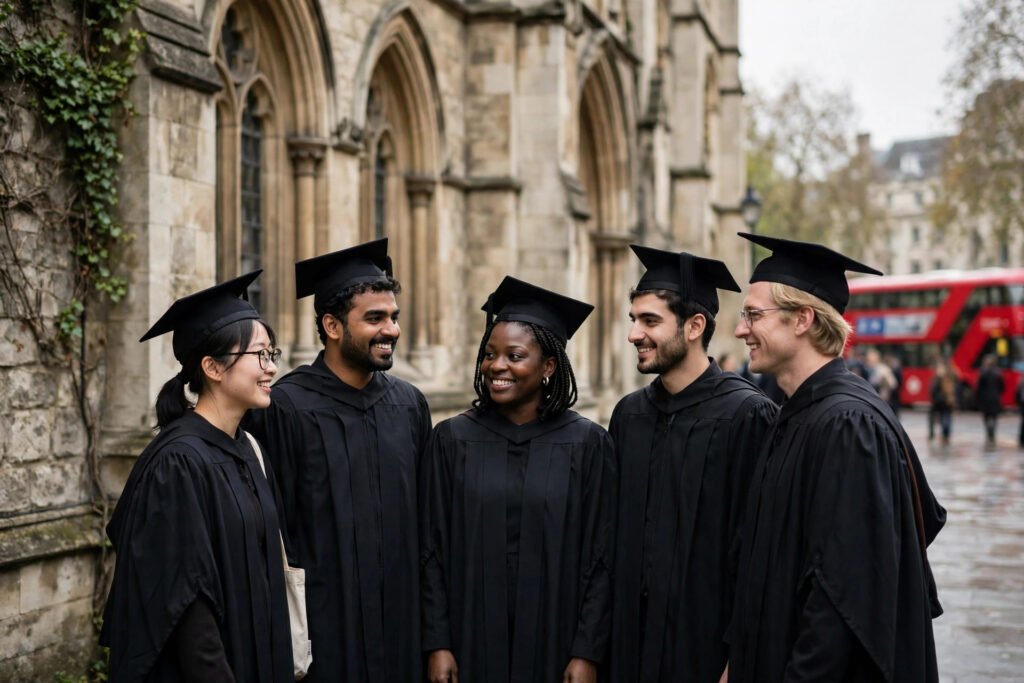
UK Graduate Route Visa Guide 2026: Eligibility, Duration and the Announced 2027 Change
The UK Graduate Route is the unsponsored post-study work visa that lets international students stay on after their degree to work, or look for work, without needing an employer to sponsor them first. For students finishing in 2026 it still offers two years of permission — three years for PhD and other doctoral graduates. But the route is about to get shorter. The UK Government has announced, and GOV.UK now states, that applications made on or after 1 January 2027 will receive 18 months instead of two years for bachelor’s and master’s graduates. The date you apply — not the date you graduate — decides which length you get, so timing is now a real part of the decision.
This guide explains the Graduate Route as it stands in October 2026: who is eligible, which courses count, how long you must have studied in the UK, what the visa costs (including the Immigration Health Surcharge, which is charged at a higher rate than most students expect), how your partner and children are treated, how to apply step by step, and what to do when the Graduate Route ends. If you have not yet applied for your Student visa, start with our UK Student visa step-by-step guide, because Graduate Route eligibility is built entirely on the Student visa that came before it.

UK Graduate Route at a Glance
| Feature | Current rule (verified October 2026) |
|---|---|
| Sponsorship | None — no job offer, employer or salary threshold required |
| Duration now | 2 years if you apply on or before 31 December 2026; 3 years for PhD/other doctoral graduates |
| Announced change | 18 months for applications on or after 1 January 2027 (doctoral graduates keep 3 years) |
| Application fee | £937 per applicant |
| Immigration Health Surcharge | £1,035 per year of permission, paid upfront |
| Total for a 2-year grant | £3,007 (£937 fee + £2,070 surcharge) |
| Where you apply | Inside the UK only, before your Student visa expires |
| Extendable? | No — you must switch to another route to stay longer |
| Leads directly to settlement? | No — but you can switch to routes that do, such as Skilled Worker |
What the Graduate Route Is
The Graduate Route is a single, one-off grant of permission to stay in the UK after successfully completing an eligible course. While you hold it, you can work in most jobs at any skill or salary level, be self-employed, do voluntary work for registered charities and similar bodies, travel in and out of the UK, and study further — as long as the new course is not one that is eligible for a Student visa. You cannot claim most public funds, and you cannot work as a professional sportsperson. There is no cap on numbers and no points test: if you meet the requirements, the visa is granted.
Because it is unsponsored, the Graduate Route functions as a bridge. Its real value is the time it gives you to find a job with a licensed sponsor and switch into the Skilled Worker route, which can lead to settlement after five years. How that longer journey fits together is covered in our guide to PR and settlement pathways after studying abroad. Used passively, two years (or, soon, 18 months) passes quickly; used deliberately, it is long enough to build the UK work history that sponsors look for.
Eligibility: Who Can Apply
According to GOV.UK, you can apply for a Graduate visa if all of the following are true:
- You are in the UK when you apply — the route cannot be applied for from overseas.
- Your current visa is a Student visa or a Tier 4 (General) student visa.
- You studied an eligible UK course with that visa — usually a UK bachelor’s degree, master’s degree or PhD, and also certain professional courses such as the Legal Practice Course, the Bar Practice Course, a PGCE or PGDE, and approved law conversion courses.
- Your education provider has told the Home Office that you successfully completed your course. You do not need to wait for your graduation ceremony or your physical certificate — but you cannot apply until your provider has reported completion. Ask your university’s international office when this report will be made; it is the single most common cause of delay.
- Your provider is a licensed student sponsor with a track record of compliance (shown as “Student Sponsor – Track Record” on the official register of sponsors).
- You meet the “study in the UK” requirement: you must have spent at least 12 months studying in the UK if your course lasted more than 12 months, or the full length of the course if it was 12 months or shorter. Limited COVID-era concessions for distance learning in 2020–2022 still appear in the rules, but they do not help current students.
- You have not previously held a Graduate visa (or its predecessor, the Doctorate Extension Scheme, in most cases).
If you spent your Student visa as a Student Union Sabbatical Officer, you can still apply, provided you completed an eligible course immediately before that visa. If your government or an international scholarship agency paid both your course fees and your living costs in the last 12 months, you will need their written consent to the Graduate application — do not overlook this if you were fully sponsored.
Duration and the Announced 2027 Change
How long you receive depends on your qualification and, from 2027, on your application date:
| Your situation | Permission granted |
|---|---|
| Bachelor’s or master’s graduate, applying on or before 31 December 2026 | 2 years |
| Bachelor’s or master’s graduate, applying on or after 1 January 2027 (ANNOUNCED) | 18 months |
| PhD or other doctoral graduate (any application date) | 3 years |
Be clear about the status of the 18-month rule: it is an announced change with a fixed start date, published on GOV.UK, and it applies to applications submitted on or after 1 January 2027. It is not the current rule for 2026 applicants, and existing Graduate visa holders keep the full length they were granted — nobody’s current visa is shortened retrospectively. The practical consequence falls on students whose courses end in late 2026 or during 2027: if your provider reports your completion in time for you to apply before your Student visa expires and before 1 January 2027, you receive two years; if your application lands on or after 1 January 2027, you receive 18 months and a smaller health surcharge bill (the surcharge is charged per year of permission, so an 18-month grant carries £1,552.50 in surcharge — £937 fee plus surcharge comes to £2,489.50 in total). Your visa starts on the day your application is approved, not the day your course ended.
What It Costs
| Cost item | Amount |
|---|---|
| Graduate visa application fee | £937 |
| Immigration Health Surcharge — 2-year grant | £2,070 (£1,035 × 2 years); total payable £3,007 |
| Immigration Health Surcharge — 3-year doctoral grant | £3,105 (£1,035 × 3 years); total payable £4,042 |
| Each dependant | Same £937 fee plus their own health surcharge for the same period |
| Student visa (context, stage before) | £558 application fee; IHS £776 per year at the student rate |
| Student maintenance (context) | £1,529/month in London / £1,171/month outside London, up to 9 months (caps £13,761 / £10,539); ANNOUNCED rise to £1,570 / £1,203 for Student applications on or after 30 November 2026 |
The surcharge surprises many graduates. As a student you paid the discounted IHS rate of £776 per year; on the Graduate Route you pay the full adult rate of £1,035 per year, and the entire amount for the whole grant is taken upfront in a single payment alongside the £937 fee. There is no instalment option. Budget for the full £3,007 (for a two-year grant) before your Student visa expires, alongside rent and living costs while you job-hunt — our cost of studying in the UK guide and the study abroad budget planner can help you build that number into your overall plan. One partial offset: if you later take a job in public sector healthcare after paying the surcharge, you may be able to claim a refund for the period you work in it, and health and care professionals should check the Health and Care Worker visa, which is cheaper and carries no surcharge — though unlike the Graduate Route, it requires a sponsor.

Partner and Children on the Graduate Route
The Graduate Route does not open the door to new dependants. As GOV.UK sets out, your partner and children can apply as dependants on your Graduate visa only if they were already your dependants on your Student visa (or, for a child, if they were born in the UK during your current Student or Graduate permission). A partner who stayed in your home country while you studied cannot join you for the first time on the Graduate Route, and neither can children who were never your Student dependants — with the exception of a baby born in the UK. Each dependant applies separately, pays the same £937 fee and their own health surcharge, and receives permission ending on the same date as yours. Remember the wider context too: since January 2024, only research postgraduate students (PhD and research master’s) can bring dependants on the Student visa at all, so for most taught master’s graduates the dependant question on the Graduate Route never arises. Our comparison of student dependent visas compared explains how the five main destinations differ before you choose where to study as a family.
Step by Step: How to Apply
- Confirm your completion has been reported. Ask your university whether it has told the Home Office you successfully completed your course. You cannot apply before this happens, and you do not need to wait for graduation day or your certificate.
- Check your Student visa expiry date. You must apply from inside the UK before that visa expires. These two dates — completion report and visa expiry — define your window, and for late-2026 finishers, whether your application falls before or after 1 January 2027 decides two years versus 18 months.
- Gather your documents. You will need a valid passport or travel document and the CAS reference number from your Student visa application. Keep your BRP details available if asked, and a consent letter from your scholarship sponsor if one paid your fees and living costs in the last 12 months. Dependants applying with you need their own documents plus evidence of the relationship and of their previous dependant status.
- Apply online on GOV.UK. Complete the Graduate visa application form, pay the £937 fee and the Immigration Health Surcharge for the full grant length in the same session.
- Prove your identity. Most applicants use the “UK Immigration: ID Check” app to scan their document and create or sign into a UKVI account; others are directed to a UKVCAS service point for biometrics. You will be told which applies to you.
- Stay in the UK while you wait. Do not travel outside the UK, Ireland, the Channel Islands or the Isle of Man before a decision — doing so withdraws your application. GOV.UK says decisions usually come within 8 weeks of applying, proving identity and providing documents.
- Receive your eVisa. Immigration status in the UK is now digital. Your decision email explains how to access your eVisa through your UKVI account, which is what employers will check when you start work.
Use our document checklist tool to keep the paperwork for this and any later switch organised, and browse UK institutions in the university directory if you are still choosing where to study.
Work Rights on the Graduate Route: What Changes From Student Life
The shift from Student to Graduate permission changes your working life in ways worth spelling out. On a Student visa during term time, most higher-education students are limited to 20 hours of part-time work per week. On the Graduate Route there is no hourly cap at all: you can work full time, take a permanent contract, combine roles, or build a business as a self-employed person — including freelance and contract work that would not have been permitted while studying. There is also no requirement that the job be related to your degree, be at graduate level, or pay any minimum salary. A graduate stacking shifts in retail while applying for analyst roles is fully within the rules, as is a graduate who walks straight into a professional job.
Three limits remain. You cannot work as a professional sportsperson (including as a sports coach in that professional capacity). You have no access to most public funds, so your income and savings are your only safety net — one more reason to keep an emergency fund rather than spending the surcharge money last. And further study is restricted: you may only study a course that is not eligible for a Student visa, so short courses, many part-time courses and courses at providers without a student sponsor licence are fine, but a new full degree means switching back to the Student route with its own fee (£558), its own surcharge (£776 per year at the student rate) and its own maintenance evidence (£1,529 per month in London or £1,171 outside, up to nine months for most applicants, with the announced rise to £1,570 and £1,203 for applications on or after 30 November 2026). Weigh that full cost before treating “another course” as a casual way to extend your stay.
When the Graduate Route Ends: Switching
The Graduate visa cannot be extended, and time on it does not by itself count towards settlement. Most graduates who stay switch to the Skilled Worker visa: you need a job offer in an eligible occupation from a Home Office-approved sponsor, a certificate of sponsorship, and a salary meeting the route’s thresholds — GOV.UK lists a standard minimum of £41,700 per year or the job’s going rate, whichever is higher, with reduced rates available in defined cases, including for recent graduates and those under 26 (at least £33,400 and 70% of the going rate under the “new entrant” provisions, though your total time on Graduate plus new-entrant Skilled Worker permission is capped). Read the current rules on the GOV.UK Skilled Worker page before relying on any figure, as thresholds change. Other graduates switch to a further Student visa for a PhD, or to family or other work routes. Whatever your plan, start it months before your Graduate permission expires — sponsorship, certificates and application slots all take time, and an application made after your visa ends is a fundamentally different and riskier situation.
Common Mistakes and Refusal Reasons
- Applying before your provider reports completion. The application will not succeed until the Home Office has been told you passed. Chasing your university’s international office early is not impatience — it is the process.
- Applying after your Student visa expires. There is no grace period built into the route. An expired Student visa usually ends your Graduate Route eligibility.
- Travelling while the application is pending. Leaving the Common Travel Area withdraws the application automatically — and the fee and surcharge are not simply re-usable.
- Budgeting the student IHS rate. Planning around £776 per year instead of £1,035 leaves a £518 hole in a two-year budget at the worst possible moment.
- Assuming new dependants can join. Partners and children who were not dependants on your Student visa cannot become Graduate dependants (UK-born babies aside).
- Studying the wrong next course. On a Graduate visa you may only study courses that are not eligible for a Student visa. Enrolling on a degree course without switching back to a Student visa breaches the route’s conditions.
- Treating the route as settlement time. Two years on Graduate permission does not progress an ILR clock on the five-year routes. Plan the switch, not just the stay.
- Waiting until the final months to job-hunt for sponsored roles. Sponsor hiring cycles, salary thresholds and certificate allocations mean the search should begin in your first months on the route — earlier still for the 18-month grants arriving from 2027.
Practical Tips
- Watch the calendar if you finish in late 2026. Applying on or before 31 December 2026 preserves the full two years. Press your university for an early completion report if your results are finalised, and do not let a slow administrative step cost you six months of permission.
- Save the £3,007 before you graduate. Treat the fee plus surcharge as a fixed cost of finishing in the UK, in the same way you treated your Student visa costs — our UK vs Australia comparison shows how post-study costs differ between destinations.
- Build a sponsor-focused job list from month one. Target employers on the register of licensed sponsors in your field; a Graduate visa lets any employer hire you today, but only a sponsor can keep you after it ends.
- Keep your CAS number and documents. You will need your original CAS reference for the application — it is in your university correspondence from before you arrived.
- Check funding for what comes next. If a PhD is your next step, research scholarships and studentships are listed in our scholarships directory; a doctorate also restores a three-year Graduate grant afterwards.
Frequently Asked Questions
1. How much does the Graduate Route cost in total?
The application fee is £937, plus the Immigration Health Surcharge at £1,035 for each year of permission, paid upfront. A two-year grant therefore costs £3,007 in total; a three-year doctoral grant costs £4,042; and an 18-month grant (applications on or after 1 January 2027) costs £2,489.50. Each dependant pays the same fee and surcharge separately.
2. Is the Graduate Route really being cut to 18 months?
The UK Government has announced the change and GOV.UK states it directly: applications made on or after 1 January 2027 receive 18 months instead of two years. It applies by application date, not graduation date, and it does not shorten visas already granted. PhD and other doctoral graduates keep three years. In this guide the 18-month rule is presented as announced, with its 1 January 2027 effective date, because that is its status.
3. Do I need a job offer to apply?
No. The Graduate Route is unsponsored: no job offer, no employer, no salary threshold and no English test at this stage. You can use the time to look for work, work in most jobs, or be self-employed.
4. Can my partner join me on the Graduate Route?
Only if your partner was already your dependant on your Student visa. New dependants cannot join on this route; the exception is a child born in the UK during your Student or Graduate permission. If your partner was never your Student dependant, they would need to qualify for a UK visa in their own right, or join you later if you switch to a route such as Skilled Worker that allows new dependants.
5. Can I extend the Graduate visa or apply twice?
No. The Graduate visa cannot be extended and you cannot hold it twice. To stay longer you must switch to another route — most commonly Skilled Worker — before your Graduate permission expires.
6. Does time on the Graduate Route count towards settlement?
Not on the standard five-year settlement routes. The Graduate Route does not lead directly to indefinite leave to remain. Switching to Skilled Worker starts a route that can lead to settlement after five years on that route, subject to its rules at the time.
7. When exactly should I apply?
After your education provider has told the Home Office you successfully completed your course, and before your Student visa expires. You must be in the UK. You do not need to wait for your graduation ceremony or certificate. Most decisions take up to 8 weeks, and you can stay in the UK while you wait.
8. What documents do I need?
A valid passport or travel document and your CAS reference number from your Student visa application. Depending on your circumstances you may also be asked for evidence of your relationship with any dependants applying with you, and a consent letter if a scholarship sponsor paid both your fees and living costs in the last 12 months. Non-English or Welsh documents need certified translations.
Sources & Verification
- GOV.UK — Graduate visa: overview, eligibility, costs and how to apply (fee £937; health surcharge £1,035 per year; 2 years for applications on or before 31 December 2026, 18 months on or after 1 January 2027; dependant rules)
- GOV.UK — Skilled Worker visa (the main switching route after the Graduate Route)
Figures and rules change — always confirm on the official government website before applying. The fee, surcharge and duration rules in this guide were checked against GOV.UK in October 2026.
Disclaimer: StudyGraduate is an information portal, not a visa agency, immigration consultancy or law firm. This guide is general information only and is not immigration advice. We never promise visa approval, a job or settlement. For advice on your individual circumstances, consult a regulated UK immigration adviser (IAA-registered) or check GOV.UK directly.