Top 20 Fully Funded Scholarships in USA 2026/2027
Top 20 Fully Funded Scholarships in USA 2026/2027 The United States is the most expensive major study destination in the world — and, paradoxically, one of the places where a fully funded degree is genuinely possible. American universities and the US government spend billions of dollars each year on fellowships, need-based financial aid and endowed ... <a title="Top 20 Fully Funded Scholarships in USA 2026/2027" class="read-more" href="https://studygraduate.com/scholarship/top-20-fully-funded-scholarships-in-usa-2026-2027/" aria-label="Read more about Top 20 Fully Funded Scholarships in USA 2026/2027">Read more</a>
📖 Overview
Top 20 Fully Funded Scholarships in USA 2026/2027
The United States is the most expensive major study destination in the world — and, paradoxically, one of the places where a fully funded degree is genuinely possible. American universities and the US government spend billions of dollars each year on fellowships, need-based financial aid and endowed scholarships, and a significant share of that money is open to international students from Bangladesh, India, Pakistan, Nepal, Nigeria, Indonesia and everywhere else. The catch is that “fully funded” in the USA rarely comes from a single national scholarship scheme. It comes from a mix of government fellowships such as Fulbright, university fellowships such as Knight-Hennessy at Stanford, need-based aid at wealthy private universities that meets 100% of demonstrated need, and special full-ride awards at individual institutions.
This guide ranks the 20 strongest fully funded routes into US study for the 2026/2027 cycle. Every programme listed is real and currently operating. Where an award pays a fixed grant rather than the full cost of attendance — the AAUW International Fellowship is the clearest example — we say so plainly, because budgeting on a wrong assumption is worse than not applying at all. Deadlines for 2027 entry fall at different points in the year and several, including Knight-Hennessy for the 2027 cohort, have already closed in October 2026; where a cycle has closed we give the last cycle’s dates and tell you to plan for the next round. Browse the wider StudyGraduate scholarships directory and compare institutions in our university directory as you build your list.
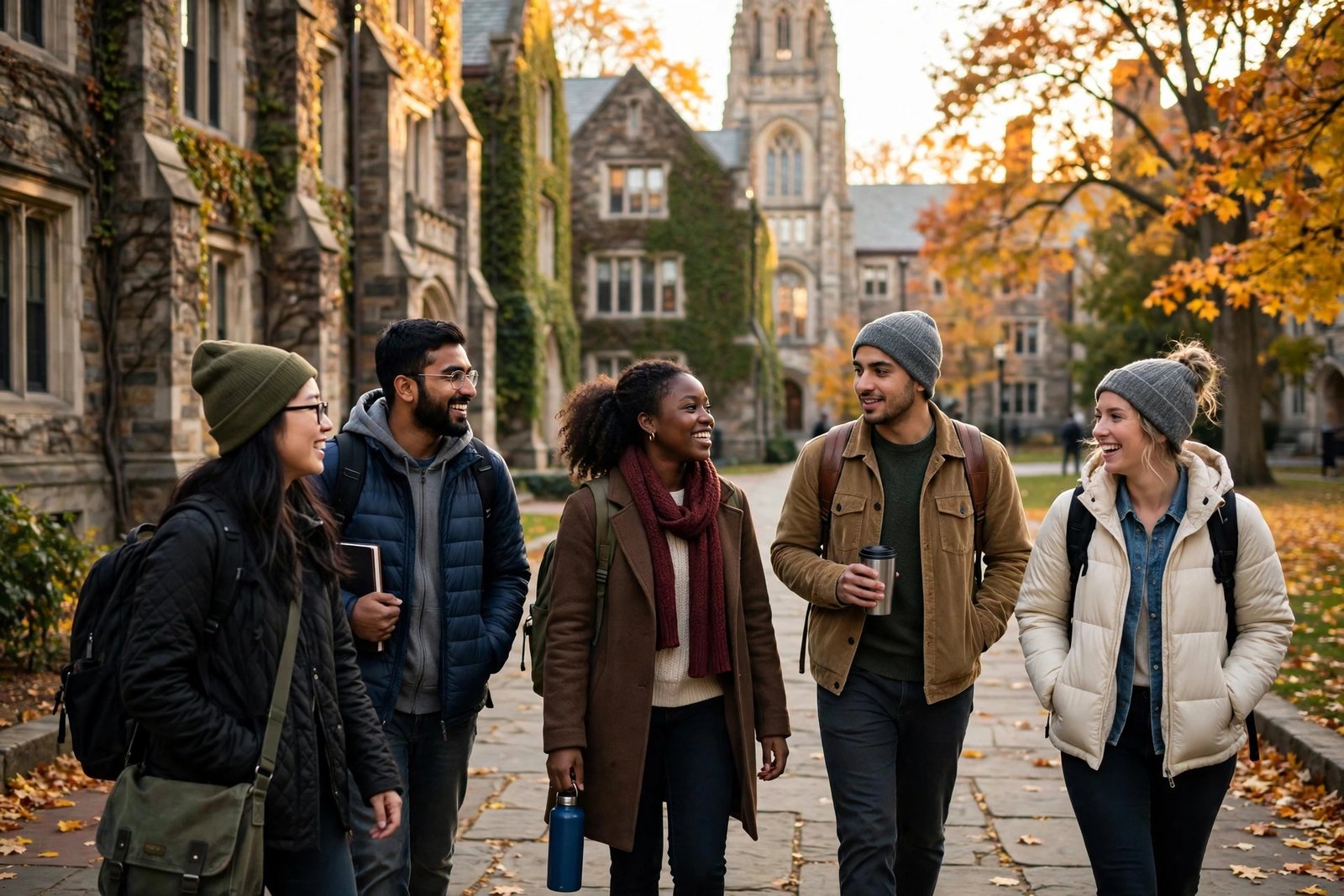
At a Glance: Top 20 Fully Funded Scholarships in the USA
| # | Scholarship | Level | What it covers | Deadline pattern |
|---|---|---|---|---|
| 1 | Fulbright Foreign Student Program | Master’s, PhD, research | Tuition, airfare, living stipend, health insurance | Varies by country, typically Feb–Oct |
| 2 | Knight-Hennessy Scholars, Stanford | Any graduate degree | Tuition and fees, living stipend, annual travel, relocation | Early October (2027 cohort: 6 Oct 2026, closed) |
| 3 | Hubert H. Humphrey Fellowship | Mid-career, non-degree | Tuition and fees, living allowance, airfare, insurance | Varies by country, typically mid-year to October |
| 4 | Harvard University financial aid | Undergraduate | Meets 100% of demonstrated need, need-blind for internationals | With admission application |
| 5 | Yale University financial aid | Undergraduate | Meets 100% of demonstrated need, need-blind for internationals | With admission application |
| 6 | MIT financial aid | Undergraduate | Meets 100% of demonstrated need, need-blind for internationals | With admission application |
| 7 | Princeton University aid and graduate funding | Undergraduate and PhD | Full need met for undergraduates; tuition plus stipend for funded PhDs | With admission application |
| 8 | Dartmouth College need-blind aid and King Scholars | Undergraduate | Full demonstrated need; King Scholars adds leadership support | With admission application |
| 9 | Amherst College need-blind aid | Undergraduate | Meets 100% of demonstrated need, need-blind for internationals | With admission application |
| 10 | Berea College international student funding | Undergraduate | 100% of tuition for four years plus work programme support | Typically late autumn; check Berea |
| 11 | American University Emerging Global Leader Scholarship | Undergraduate | Full tuition, room and board | Typically mid-December / January rounds |
| 12 | Clark University Presidential Scholarship | Undergraduate | Full tuition, room and board for four years | With admission; interview stage |
| 13 | Duke University Karsh International Scholars | Undergraduate | Full cost of attendance based on need | With admission application |
| 14 | Wesleyan University Freeman Asian Scholarship | Undergraduate | Full cost of attendance for students from 11 Asian countries | With admission application, typically 1 January |
| 15 | East-West Center Graduate Degree Fellowship | Master’s, PhD (Hawai’i) | Tuition, housing, stipend, insurance, books | Typically 1 December |
| 16 | Rotary Peace Fellowship (Duke–UNC) | Master’s | Tuition, room and board, travel, internship support | Applications typically Feb–May |
| 17 | Joint Japan/World Bank Graduate Scholarship | Master’s (participating US programmes) | Tuition, monthly stipend, airfare, health insurance | Two windows, typically Jan–Feb and Mar–Apr |
| 18 | Obama Foundation Scholars at Columbia | Non-degree leadership year | Monthly stipend, furnished apartment, tuition for four courses, travel, insurance | Typically mid-December |
| 19 | AAUW International Fellowships | Master’s, doctoral, postdoctoral (women) | Fixed grant: $20,000 / $25,000 / $50,000 — see the honesty note in its profile | Typically November; check AAUW |
| 20 | Funded US PhD programmes (assistantship model) | PhD | Full tuition waiver plus stipend, typically five years | Department deadlines, typically Dec–Jan |
The 20 Scholarships in Detail
1. Fulbright Foreign Student Program
Coverage: Tuition, round-trip airfare, a living stipend and health insurance for the duration of the grant, administered country by country. Eligibility: Citizens of more than 160 participating countries who hold the equivalent of a US bachelor’s degree and are resident in their country of nomination; US citizens and permanent residents are not eligible. Deadline: Set by each country’s Fulbright Commission or US embassy — windows typically fall between February and October, so your country’s date is the only one that matters. Fulbright remains the single most important fully funded route to a US master’s or PhD for students from South Asia, Africa and Southeast Asia. Selection weighs academic merit, leadership and the quality of your study objectives statement far more than raw test scores. Our dedicated guide to the Fulbright Program explains the application in depth, and the official programme site is foreign.fulbrightonline.org. Note the J-1 two-year home-residence requirement that applies to many grantees after the award.
2. Knight-Hennessy Scholars — Stanford University
Coverage: A fellowship applied directly to tuition and associated fees, a stipend for living and academic expenses, an annual travel stipend for one economy trip to and from Stanford, a one-time relocation stipend, and possible enrichment funding in years two and three — for up to three years of graduate study. Eligibility: Citizens and residents of all countries applying to an eligible full-time Stanford graduate programme (MA, MS, MBA, JD, MD, MFA, MPP, PhD and others), with a bachelor’s degree earned in January 2020 or later for the 2027 cohort (earlier for applicants with military service). Deadline: The 2027 cohort closed on 6 October 2026 at 1:00 pm Pacific Time, with a separate Stanford programme application due by that programme’s own deadline and no later than 1 December 2026. If you missed it, the next cycle will typically open the following summer. Full funding details are on Stanford’s official Knight-Hennessy funding page, and our profile of the award is at Knight-Hennessy Scholars.
3. Hubert H. Humphrey Fellowship Program
Coverage: Tuition and fees at the host university, a monthly maintenance allowance, accident and sickness coverage, book and computer allowances, and international and domestic travel, for a ten-month non-degree programme. Eligibility: Mid-career professionals with an undergraduate degree, at least five years of substantial professional experience, demonstrated leadership and limited or no prior experience in the United States. Deadline: Set by US embassies and Fulbright Commissions in each country, commonly between mid-year and October. Humphrey is not a degree scholarship — it is a professional development year for people already established in fields such as public policy, public health, education planning, law and human resources. Because it targets experienced professionals rather than fresh graduates, it is one of the least crowded fully funded doors into the USA for applicants from Bangladesh, Pakistan, Nepal and Nigeria.
4. Harvard University Financial Aid
Coverage: Harvard College meets 100% of demonstrated financial need for every admitted student, including internationals, and admission is need-blind — your ability to pay is not considered when your application is read. Families at lower income levels can expect a zero or near-zero parent contribution, with the package made up of scholarship grant, a term-time job expectation and no required loans. Eligibility: Anyone admitted to Harvard College, at any income level; aid is recalculated each year from your family’s financial documents. Deadline: Financial aid applications are submitted alongside admission, through the CSS Profile and Harvard’s own requirements. Read the student profile for Harvard University and the official Harvard financial aid pages for current income thresholds, which change annually. The honest caveat: admission rates are extremely low, so treat Harvard as a reach application, not a plan.
5. Yale University Financial Aid
Coverage: Yale meets the full demonstrated need of every admitted undergraduate, international students included, with need-blind admission and no loans in the standard aid package. Eligibility: All admitted Yale College students, assessed on family income, assets and circumstances through the CSS Profile and Yale’s financial aid forms. Deadline: With your admission application — Early Action in November or Regular Decision in January in a typical cycle. Yale’s affordability is frequently misunderstood: for a family earning a modest income in Dhaka, Delhi or Lagos, the expected family contribution can be close to zero, making Yale cheaper in practice than a mid-priced university offering a partial “50% scholarship”. Use Yale’s official net price tools and our study-abroad tools to model your own family’s position before assuming any Ivy League school is out of reach.
6. MIT Financial Aid
Coverage: MIT is one of the small group of US universities that is need-blind for international applicants and meets 100% of demonstrated need for all admitted undergraduates. In recent years MIT has also announced expanded affordability for lower- and middle-income families; check the Student Financial Services site for the current thresholds. Eligibility: Admitted MIT undergraduates of any nationality, assessed on documented family finances. Deadline: Financial aid materials follow the admission round deadlines. For STEM-focused applicants, MIT’s combination of need-blind admission and full-need funding is one of the fairest offers in American higher education — but with an international admit rate in low single digits, your application needs genuine distinction: olympiads, research, building things, not just perfect grades.
7. Princeton University — Undergraduate Aid and Funded PhDs
Coverage: Princeton meets full demonstrated need for undergraduates with grants rather than loans, and its graduate school guarantees funding packages for PhD students that combine a tuition award with a living stipend across the normal programme length. Eligibility: Undergraduates of any nationality admitted to Princeton; PhD funding applies to admitted doctoral students in funded programmes, which is the standard model across Princeton’s departments. Deadline: With admission. Princeton is regularly ranked at or near the top of US affordability analyses because its average grant is so large relative to family incomes. If you are a doctoral applicant, read each department’s funding page carefully: the guarantee, its duration and summer support differ by field, and those details matter more than the university’s headline promise.

8. Dartmouth College — Need-Blind Aid and King Scholars
Coverage: Dartmouth extended need-blind admission to international students and meets full demonstrated need. Its King Scholars programme additionally supports students from developing countries who are committed to poverty alleviation, with mentoring and a funded leadership curriculum alongside the degree. Eligibility: Admitted undergraduates; King Scholars are selected from eligible admitted students from developing countries. Deadline: With admission, November (Early Decision) or January (Regular Decision) in a typical cycle. Dartmouth’s smaller size means fewer international places, but also a genuinely close-knit funded community. If your long-term goal is development work at home, the King Scholars framing — service and return — should shape your essays from the first draft.
9. Amherst College Need-Blind Financial Aid
Coverage: Amherst, a liberal arts college in Massachusetts, is need-blind for all applicants including internationals and meets 100% of demonstrated need, typically without loans for lower-income students. Eligibility: Admitted undergraduates of any nationality with documented financial need. Deadline: With admission. Amherst is proof that fully funded US undergraduate study is not only an Ivy League story: a handful of wealthy liberal arts colleges run the same need-blind, full-need policy. The trade-off is scale — each admits a small international cohort — so strong applicants should apply to several colleges in this category rather than pinning everything on one name.
10. Berea College International Student Funding
Coverage: Berea College in Kentucky admits a small cohort of international students each year and covers 100% of tuition for four years; students contribute through the college’s work programme (a paid campus job of around ten hours a week), and the first-year package also addresses room, board and fees under the college’s published terms. Eligibility: Students from low-income backgrounds worldwide who could not otherwise study in the USA; only a limited number are admitted each year, generally one per country. Deadline: Berea’s international application window typically closes in the autumn — confirm the current date on Berea’s official site. Berea is one of the very few US institutions where a student with no family funds at all can realistically complete a degree, which is why competition per place is intense despite the college’s low public profile.
11. American University Emerging Global Leader Scholarship
Coverage: Full tuition, room and board at American University in Washington, DC, renewable for four years of undergraduate study subject to satisfactory performance. It does not cover books, health insurance or travel, so budget a personal reserve for those items. Eligibility: International students (not US citizens, permanent residents or dual US citizens) with an outstanding academic record, leadership in community service, and a commitment to positive change; preference is given to students who have overcome obstacles and come from under-resourced backgrounds. Deadline: Applications have typically run through December–January priority rounds — verify the current round dates with American University. Its DC location makes it especially attractive for applicants aiming at policy, international relations and development careers.
12. Clark University Presidential Scholarship
Coverage: Full tuition plus room and board for four years at Clark University in Worcester, Massachusetts, for a small number of first-year applicants. Eligibility: First-year international and domestic applicants with an exceptional academic record and a demonstrated record of leadership and service; shortlisted candidates are interviewed. Deadline: You are considered through the admission application, with interviews for finalists typically in winter — check Clark’s scholarship pages for the current cycle. Clark’s wider Global Scholars programme offers smaller awards, so read your offer letter carefully to see which tier you have actually been offered; only the Presidential tier is a genuine full ride.
13. Duke University Karsh International Scholars Program
Coverage: Karsh International Scholars at Duke receive financial support covering the full cost of attendance as determined by their demonstrated need, plus access to funded research, internship and service opportunities during summers. Eligibility: International students admitted to Duke who are not US citizens or dual citizens with the US, selected on academic excellence, leadership and need. Deadline: With the Duke admission and financial aid applications. Duke sits just below the need-blind group — admission for internationals is need-aware — but for those admitted with need, the Karsh package closes the funding gap completely, which is what matters once you hold the offer.
14. Wesleyan University Freeman Asian Scholarship
Coverage: The Freeman Asian Scholarship covers the full cost of attendance at Wesleyan University in Connecticut for students from eleven Asian countries and regions, which include Indonesia and other parts of East and Southeast Asia (the list of eligible countries is set by the programme — South Asian applicants should check carefully, as eligibility is country-specific and has historically focused on East and Southeast Asia). Eligibility: Citizens and residents of the listed countries applying for undergraduate admission to Wesleyan. Deadline: Typically aligned with Wesleyan’s 1 January Regular Decision deadline. With roughly one scholar selected per country per year, Freeman is a lottery ticket — but a real one, and the application is simply Wesleyan’s own admission plus the scholarship form.
15. East-West Center Graduate Degree Fellowship — University of Hawai’i
Coverage: Tuition and fees at the University of Hawai’i at Mānoa, housing in East-West Center residences, a monthly stipend, health insurance, and allowances for books and materials, for master’s and doctoral study. Eligibility: Citizens of countries in the Asia-Pacific region (including South and Southeast Asia) and the United States, holding a bachelor’s degree and meeting UH admission requirements. Deadline: Typically 1 December for the fellowship, with the UH graduate application on its own timetable. The East-West Center is routinely overlooked by applicants fixated on the mainland, yet its package is one of the most complete in the Pacific — and its community of Asian and Pacific scholars is a career network in itself.
16. Rotary Peace Fellowship — Duke–UNC Rotary Peace Center
Coverage: Tuition and fees, room and board, round-trip transportation and internship and field-study expenses for a master’s degree at the Duke–UNC centre in North Carolina, one of Rotary’s global peace centres. Eligibility: Professionals with a bachelor’s degree, strong academic achievement, and at least three years of relevant work experience in peace, development or a related field. Deadline: Rotary’s application window has typically run from February to mid-May for study beginning the following year — confirm on Rotary’s official peace fellowships page. Around 130 peace fellowships are awarded globally each year across all centres. If your career is in NGOs, mediation, public health or policy, this fellowship funds both the degree and a ready-made professional community.
17. Joint Japan/World Bank Graduate Scholarship Program (JJ/WBGSP)
Coverage: Tuition, a monthly living stipend, round-trip airfare, health insurance and a travel allowance for development-related master’s programmes at participating universities, which include a set of US programmes on the World Bank’s published list. Eligibility: Nationals of eligible developing countries (Bangladesh, India, Pakistan, Nepal, Nigeria and Indonesia are among the countries that have featured on the Bank’s list) who hold a bachelor’s degree, have recent development-related work experience, and — importantly — already hold an unconditional admission offer from a participating programme. Deadline: Two application windows a year, typically January–February and March–April, depending on the programme. Details are on the World Bank’s official JJ/WBGSP page. The sequencing is the trap: you must secure admission first, so start with the university a full cycle early.
18. Obama Foundation Scholars at Columbia University
Coverage: A monthly stipend for living expenses in New York City, a furnished studio apartment near Columbia (when the programme convenes in person), tuition and fees for up to four Columbia courses, basic medical, dental and life insurance, and air travel to and from the home country and programme activities. Eligibility: Emerging leaders from around the world who have made meaningful contributions in their field, are at a “breakthrough moment” in their careers, are fluent in English and commit to returning to their communities. Deadline: Applications have typically closed in mid-December — see Columbia’s official Obama Scholars FAQ. This is a one-year, non-degree leadership programme, not a master’s scholarship, and it does not fund family members. For the right mid-career applicant it is nonetheless a completely funded year in New York.
19. AAUW International Fellowships for Women
Coverage — read this honestly: AAUW awards fixed grants of $20,000 for master’s/first professional degrees, $25,000 for doctoral study and $50,000 for postdoctoral research, usable for educational and living expenses, dependent childcare and limited conference travel. At an expensive private university that grant alone will not cover the full cost of attendance; at a lower-cost public university, or combined with an assistantship or tuition waiver, it can complete a genuinely fully funded package. We include it because it is one of the oldest, most credible funding sources for international women in the USA — but budget with your eyes open. Eligibility: Women who are not US citizens or permanent residents, holding the equivalent of a US bachelor’s degree, planning full-time graduate study or research at an accredited US institution and intending to return home afterwards. Deadline: The application cycle typically closes in November — confirm the current date and amounts on AAUW’s official site before relying on them.
20. Funded US PhD Programmes — the Assistantship Model
Coverage: Across research universities in the USA, the standard funded PhD offer combines a full tuition waiver with a stipend earned through a teaching or research assistantship, plus student health insurance, typically guaranteed for four to five years subject to satisfactory progress. Eligibility: Admission to the PhD programme itself — funding is not a separate scholarship competition at most universities, though some departments ask for a separate fellowship form. Deadline: Departmental deadlines, concentrated in December and January for autumn entry. This is statistically the largest fully funded route of all: thousands of international students, including very large numbers from Bangladesh, India, Pakistan and Nepal, are funded this way every year, especially in STEM, economics and the social sciences. When you compare offers, compare the stipend against local rents, the teaching load, summer funding and the guaranteed years — not the university’s brand ranking alone. Our rankings explorer and study guides will help you shortlist departments realistically.
Eligibility: Who Can Realistically Win These?
Three patterns run through the list. First, government fellowships (Fulbright, Humphrey, JJ/WBGSP, Rotary) are country-based and mission-based: they fund people who will return home and use the degree there, and they weigh leadership and work experience alongside grades. Second, need-based aid at Harvard, Yale, MIT, Princeton, Dartmouth and Amherst is blind to nationality but brutally selective at the admission stage — the funding is generous precisely because the admission is hard. Third, funded PhDs and university fellowships reward research fit: a supervisor who wants your specific topic is worth more than a generic perfect GPA. Almost every route requires English proficiency evidence (TOEFL or IELTS, unless waived), recognised transcripts, and — for the fellowships — referees who know your work in detail. None of these programmes charges an application fee for the scholarship itself, though universities may charge admission application fees (most need-blind colleges waive them for low-income applicants on request).
How to Apply: Step by Step
- Choose your lanes (12–18 months out). Pick at most two government fellowships, three to six universities and, for doctoral applicants, five to eight departments. Spreading across all 20 entries produces 20 weak applications.
- Check eligibility country by country. Fulbright, Humphrey and JJ/WBGSP rules are set per country; Freeman and East-West Center awards are region-specific. Ten minutes on the official country page saves a wasted month.
- Sit your tests early. Book TOEFL/IELTS (and GRE where your programme still requires it) at least six months before deadlines, leaving time for a retake. Our test preparation section covers score targets by programme type.
- Secure admission where the scholarship requires it. JJ/WBGSP and Knight-Hennessy both require a parallel or prior university application; funded PhDs bundle funding with admission.
- Write programme-specific essays. Fellowship essays must answer that funder’s mission: leadership and return-home impact for Fulbright and Chevening-style awards, research fit for PhDs, demonstrated need documentation for college aid.
- Brief your referees. Give each referee your CV, your draft essay and the selection criteria, at least a month before the deadline.
- Submit before the rush and verify. Portals slow down near deadlines. Submit days early, download the confirmation, and check that transcripts and test scores actually arrived.
- Prepare for interviews. Fulbright, Humphrey, Rotary and several college scholarships interview finalists. Practise aloud, with specific examples, not memorised speeches.
Required Documents
- Passport (valid well beyond your intended start date)
- Academic transcripts and degree certificates, with certified English translations where needed
- English proficiency scores (TOEFL/IELTS) and GRE/GMAT where the programme requires them
- Statement of purpose / study objectives and, for research degrees, a research proposal
- Two to three recommendation letters matched to the programme’s criteria
- CV or résumé emphasising leadership, work experience and service where fellowships ask for it
- Financial documents for need-based aid: CSS Profile, income and asset records, employer letters
- University admission offer letter where the funder requires one (JJ/WBGSP, Knight-Hennessy)
Deadlines and Timeline
| Period | What happens | Programmes in play |
|---|---|---|
| Feb–May 2026/2027 cycle | Rotary Peace Fellowship window; many Fulbright country deadlines | Rotary, Fulbright (country-dependent) |
| Jun–Aug | Knight-Hennessy and McCall-style fellowship applications open; JJ/WBGSP results; test season | Knight-Hennessy (next cycle), AAUW (opens) |
| Sep–Oct | Knight-Hennessy closes (6 Oct 2026 for the 2027 cohort); Humphrey country deadlines; Berea window | Knight-Hennessy, Humphrey, Berea |
| Nov | Early college aid deadlines; AAUW typically closes | Harvard/Yale/MIT early rounds, AAUW |
| Dec–Jan | Main PhD department deadlines; Regular Decision college applications; East-West Center; Obama Scholars (typically mid-Dec) | Funded PhDs, colleges, EWC, Obama |
| Jan–Apr | JJ/WBGSP windows; interviews for fellowships; admission and funding offers arrive | JJ/WBGSP, Fulbright interviews |
| Apr–Aug | Visa interviews (F-1/J-1), pre-departure briefings, travel | All successful applicants |
Missed a deadline? US funding runs on annual cycles. A missed October fellowship deadline usually means preparing a stronger application for the following year — and using the gap for work experience, which Humphrey, Rotary and JJ/WBGSP actively reward. Compare this list with our ranking of the top 50 fully funded scholarships for international students 2027 and the companion lists for the UK and Canada.
How to Improve Your Chances
Match the mission, not just the money. Every funder on this list publishes selection criteria. Fulbright wants cultural ambassadors who will return home; Rotary wants peace practitioners; need-blind colleges want students who will use the campus fully. Mirror those criteria with evidence. Build the record fellowships ask for: two to five years of progressively responsible work transforms Humphrey, Rotary and JJ/WBGSP applications. For PhDs, email supervisors properly: a short, specific message showing you have read their recent papers beats a mass-mailed template every time. Apply to a portfolio: one dream, several realistic, and at least one route (funded PhD or Berea-style) where your profile is genuinely competitive. Document need cleanly: for college aid, inconsistent financial documents are the most common avoidable problem — make sure income figures match across forms, tax records and employer letters.
Common Mistakes
- Treating AAUW or any fixed grant as a full ride without checking the university’s actual cost of attendance.
- Missing the country-specific deadline by relying on a global blog date for Fulbright or Humphrey.
- Applying for Knight-Hennessy but not to Stanford — the two applications are separate and both are required.
- Assuming “fully funded” covers dependents. Most of these awards fund the scholar only; family costs are on you.
- Ignoring the return-home conditions attached to J-1 grants and government fellowships when planning post-study work.
- Paying an agent who promises a scholarship. No one can sell you Fulbright, Knight-Hennessy or a need-blind college place; official applications are free or fee-waived.
Frequently Asked Questions
Are these scholarships really fully funded?
Entries 1–18 and 20 cover tuition plus living costs under their published terms, though each defines coverage differently (Obama Scholars funds a leadership year, not a degree; Berea combines a tuition award with a work programme). Entry 19, AAUW, is a fixed grant of $20,000–$50,000 that completes a full package only at lower-cost institutions or alongside other funding — we flag it in its profile rather than oversell it.
Can I apply for 2027 entry now, in October 2026?
Some windows are still open: most PhD department deadlines fall in December–January, college Regular Decision in January, and several Fulbright country competitions run into 2027. Others — Knight-Hennessy for the 2027 cohort (closed 6 October 2026) — require you to target the next cycle. Check each official page for your exact position.
Do I need IELTS or TOEFL for US scholarships?
Universities set their own English requirements; most require TOEFL or IELTS from international applicants unless you qualify for a waiver. Fellowship programmes such as Fulbright arrange testing through their country processes in many cases. Always confirm on both the funder’s and the university’s pages.
Can undergraduates really study free at Harvard or Yale?
Yes — if admitted and if your documented family finances show high need, the grant package can cover the full cost. The barrier is admission, not a separate scholarship competition: both universities practise need-blind admission and meet full need for international students.
Is a funded PhD easier to get than a named fellowship?
Statistically, yes. Funded PhD offers are made in the thousands every year across US departments, while Knight-Hennessy selects around a hundred scholars and Fulbright numbers vary by country. A strong research fit with a specific department is the most scalable strategy on this list.
Can I bring my spouse or children?
Most awards fund the scholar only. Humphrey explicitly does not fund dependents’ travel, and Obama Scholars covers the scholar’s costs only. F-2/J-2 dependent visas exist, but you must show separate funds for family living costs.
Do these scholarships guarantee a US visa?
No. A funding award supports your visa application — full funding makes the financial part of an F-1 or J-1 interview much easier — but the visa decision always rests with the consular officer, and several fellowships carry a two-year home-residence requirement afterwards.
Should I pay an agent to apply for me?
No. Every programme here accepts applications directly, official guidance is free, and several funders treat paid third-party applications as a red flag. Spend the money on test fees and document translation instead.
Sources & Verification
Facts in this article were checked in October 2026 against official sources, including: the Fulbright Foreign Student Program (US Department of State / foreign.fulbrightonline.org); Knight-Hennessy Scholars at Stanford (funding and eligibility pages — tuition fellowship, living stipend, travel and relocation terms, 2027 cohort deadline of 6 October 2026); the Hubert H. Humphrey Fellowship Program; Columbia World Projects (Obama Foundation Scholars coverage and FAQ); Rotary International (Peace Fellowships); the World Bank (JJ/WBGSP programme pages); Harvard College and Yale financial aid publications; and AAUW (International Fellowships award levels of $20,000 / $25,000 / $50,000). Amounts, country eligibility lists and deadlines change every cycle.
Disclaimer: StudyGraduate is an information portal, not an agency. Scholarship details change yearly — always confirm deadlines, amounts and eligibility on the official website before applying. We never promise selection, admission or visa approval, and no legitimate scholarship charges a fee to apply.
✅ Eligibility Criteria
- Check the official website for full eligibility criteria for your country
🎁 Benefits
- See the official website for the complete list of benefits
⚙️ Application Process
- 1Check your eligibility on the official site
- 2Prepare your documents and statements
- 3Submit the online application before the deadline
- 4Complete interviews or assessments if shortlisted
- 5Await the final selection announcement
📅 Important Dates
Deadlines vary by country and intake. Check the official website for country-specific dates.
📄 Required Documents
- Valid passport
- Academic transcripts & certificates
- Statement of purpose
- Letters of recommendation
- CV / resume
Commonly required — confirm the exact list on the official site.
❓ Frequently Asked Questions

Ready to Take the Next Step?
Explore more scholarships and study opportunities around the world.
Browse Scholarships →