Top 15 Fully Funded Scholarships in UK 2026/2027
Top 15 Fully Funded Scholarships in UK 2026/2027 The United Kingdom runs some of the best-organised government scholarship schemes in the world. Chevening, the Commonwealth Scholarships and the great university endowments at Oxford and Cambridge together fund thousands of international students every year with packages that cover tuition, living costs, flights and visa costs — ... <a title="Top 15 Fully Funded Scholarships in UK 2026/2027" class="read-more" href="https://studygraduate.com/scholarship/top-15-fully-funded-scholarships-in-uk-2026-2027/" aria-label="Read more about Top 15 Fully Funded Scholarships in UK 2026/2027">Read more</a>
📖 Overview
Top 15 Fully Funded Scholarships in UK 2026/2027
The United Kingdom runs some of the best-organised government scholarship schemes in the world. Chevening, the Commonwealth Scholarships and the great university endowments at Oxford and Cambridge together fund thousands of international students every year with packages that cover tuition, living costs, flights and visa costs — the full cost of a UK degree, not a discount on it. For students from Bangladesh, India, Pakistan, Nepal, Nigeria and Indonesia, these schemes are especially important because most of them were designed, explicitly, for applicants from low- and middle-income countries who could not otherwise afford a British degree.
This guide ranks the 15 strongest fully funded routes into UK study for 2026/2027. Timing matters: the Chevening 2027/28 round opened on 4 August 2026 and closed on 6 October 2026, and the Commonwealth Master’s and PhD round for 2027/28 closes on 20 October 2026 — so some readers should apply this week, while others should treat this article as the blueprint for the next cycle. Every programme listed is real and currently operating. Where an award is restricted — Marshall is for US citizens only, Reach Oxford is for low-income countries and undergraduate study — we label it clearly. You can browse all UK opportunities in the StudyGraduate scholarships directory, compare institutions in the university directory and check where universities sit in our rankings explorer.

At a Glance: Top 15 Fully Funded Scholarships in the UK
| # | Scholarship | Level | What it covers | Deadline pattern |
|---|---|---|---|---|
| 1 | Chevening Scholarship | One-year master’s | Tuition, monthly stipend, return flight, visa cost, arrival/departure allowances | Opened 4 Aug 2026, closed 6 Oct 2026 (2027/28) |
| 2 | Commonwealth Master’s Scholarships | Master’s | Tuition, return airfare, stipend £1,712/month (£2,000 London) | 20 Oct 2026, 16:00 BST (2027/28) |
| 3 | Commonwealth PhD Scholarships | PhD (36 months) | Tuition, airfare, stipend at CSC rates, research support | 20 Oct 2026 (2027/28 round) |
| 4 | Commonwealth Shared Scholarships | Master’s (themed courses) | Tuition, airfare, stipend, jointly funded with universities | Typically Nov–Dec; check CSC |
| 5 | Gates Cambridge Scholarship | Master’s and PhD, Cambridge | Full fees, maintenance allowance (£23,152/yr at 2026–27 rate), airfare | Cambridge course deadlines, Dec–Jan |
| 6 | Rhodes Scholarship | Graduate study, Oxford | Fees, stipend (£21,060/yr at 2026–27 rate), travel, visa and IHS costs | Varies by constituency, typically mid-year to autumn |
| 7 | Clarendon Scholarship | Master’s and DPhil, Oxford | Full tuition and college fees, annual living grant | Automatic — Oxford course deadline in Dec/Jan |
| 8 | Weidenfeld-Hoffmann Scholarships | Graduate study, Oxford | Full fees and a living-cost grant | Oxford course deadline in Dec/Jan |
| 9 | Reach Oxford Scholarships | Undergraduate, Oxford | Tuition, living grant, one return airfare per year | Oxford UCAS October deadline; scholarship form in Feb |
| 10 | Cambridge International Scholarship (Cambridge Trust) | PhD, Cambridge | Full fees and maintenance at the Trust’s rate | Cambridge funding deadline, typically early Dec |
| 11 | Imperial President’s PhD Scholarship | PhD, Imperial College London | Full tuition, generous annual stipend, consumables fund | Application rounds, typically Nov / Jan / Mar |
| 12 | Warwick Chancellor’s International Scholarship | PhD, University of Warwick | Full overseas tuition, maintenance stipend for up to 3.5 years | Typically mid-December |
| 13 | UCL Research Excellence Scholarship | PhD, University College London | Full tuition (UK or overseas rate) plus maintenance stipend | Typically late January |
| 14 | UKRI-Funded Doctoral Studentships | PhD, UK-wide | Fees plus UKRI-rate stipend; many universities top up international fees | Project deadlines, typically Dec–Feb |
| 15 | Marshall Scholarship | Graduate study, any UK university — US citizens only | Fees, living stipend, travel and allowances | Typically late September |
The 15 Scholarships in Detail
1. Chevening Scholarship
Coverage: Full tuition for a one-year taught master’s, a monthly stipend (higher in London), economy return airfare, the visa application cost, arrival and homeward departure allowances, a travel top-up allowance and up to £75 towards TB testing where required; MBA tuition is capped (at £22,000 in recent cycles — confirm the current cap). Eligibility: Citizens of Chevening-eligible countries with an undergraduate degree and at least two years (2,800 hours) of work experience, who will return home for at least two years after the award. Deadline: The 2027/28 round opened 4 August 2026 and closed 6 October 2026 at 11:00 UTC; interviews run March–April 2027, results from mid-June 2027, and you must hold an unconditional offer by 8 July 2027. If you missed it, the next round will typically open the following August — use the year to build the work experience and leadership record Chevening actually selects for. Official information is at chevening.org and our full guide is the Chevening Scholarship profile.
2. Commonwealth Master’s Scholarships
Coverage: Approved tuition fees in full, return economy airfare, and a monthly stipend of £1,712 — or £2,000 if your university is in the London metropolitan area — at current CSC rates, plus a study travel grant and, for widowed, divorced or single-parent scholars, child allowances (£622/month for the first child and £154/month for the second and third, under current terms). Eligibility: Citizens or refugees of eligible low- and middle-income Commonwealth countries, permanently resident there, holding a first degree of at least upper second class (2:1) standard — or a 2:2 plus a relevant postgraduate qualification — and unable to afford UK study without the scholarship. Bangladesh, India, Pakistan, Nigeria and other Commonwealth countries in our readership are core eligible nations. Deadline: 20 October 2026 at 16:00 BST for 2027/28 entry — and you must also apply through a nominating body, which may set an earlier date. The CSC’s official page is the Commonwealth Master’s Scholarships page; see also our Commonwealth Scholarship guide.
3. Commonwealth PhD Scholarships
Coverage: Full tuition, return airfare and the same CSC stipend structure (£1,712/month, £2,000 in London at current rates) for 36 months of doctoral study, with additional support for research-related travel and, where applicable, spouse and child allowances under CSC terms. Eligibility: Citizens of the eligible Commonwealth countries listed for the PhD scheme — a shorter list than for the master’s scheme — holding a first degree at 2:1 level or above plus, typically, a relevant master’s degree, and unable to afford UK doctoral study unaided. Deadline: The 2027/28 round runs to the same CSC timetable as the master’s scheme, closing 20 October 2026, with nomination through your country’s nominating agency. A Commonwealth PhD is a development award: your research proposal must show a credible development impact in your home country, and scholars are expected to return home after completing the doctorate.
4. Commonwealth Shared Scholarships
Coverage: Tuition fees, airfare and a monthly stipend on the same model as the main Commonwealth schemes, funded jointly by the CSC and participating UK universities. Eligibility: Citizens of eligible least-developed and low/middle-income Commonwealth countries applying to specific themed master’s courses at participating universities — the course list is published each round and is narrower than the main scheme, focusing on development themes such as access and inclusion, science and technology for development, and strengthening global peace. Deadline: Typically later than the main scheme, in November–December — confirm the current round on the CSC website. Because you apply for a named course at a named university, Shared Scholarships reward applicants who match their experience precisely to the theme of the course they choose.
5. Gates Cambridge Scholarship
Coverage: The full cost of a Cambridge postgraduate degree: university composition fee, a maintenance allowance (£23,152 for 12 months at the 2026–27 rate, pro-rated for shorter courses), one economy return airfare, and inbound visa and Immigration Health Surcharge costs, plus discretionary funding such as academic development grants. Eligibility: Citizens of any country outside the UK applying to an eligible full-time postgraduate course at the University of Cambridge; selection rests on outstanding intellectual ability, reasons for choosing the course, commitment to improving the lives of others, and leadership potential. Around 80 scholars are selected each year. Deadline: There is no separate form — you apply through Cambridge’s graduate application by your course’s funding deadline, typically in December or January. Official details are at gatescambridge.org and our profile is Gates Cambridge.
6. Rhodes Scholarship — University of Oxford
Coverage: All Oxford and college fees, an annual stipend (£21,060 for 2026–27 at the published rate) intended to cover accommodation and living expenses, economy airfare to and from Oxford, and visa and Immigration Health Surcharge costs, normally for two years with a possible third for DPhil study. Eligibility: Citizenship and residency rules are set by each Rhodes constituency — countries including India, Pakistan and several African nations have constituencies, and age limits apply (typically you must be under 24–27 depending on the constituency and when you completed your first degree). Academic excellence, energy to use talents fully, integrity and leadership are the historic selection criteria. Deadline: Varies by constituency, generally between mid-year and autumn — check the Rhodes Trust site for your country well in advance, because institutional endorsement and internal deadlines come first at many universities.
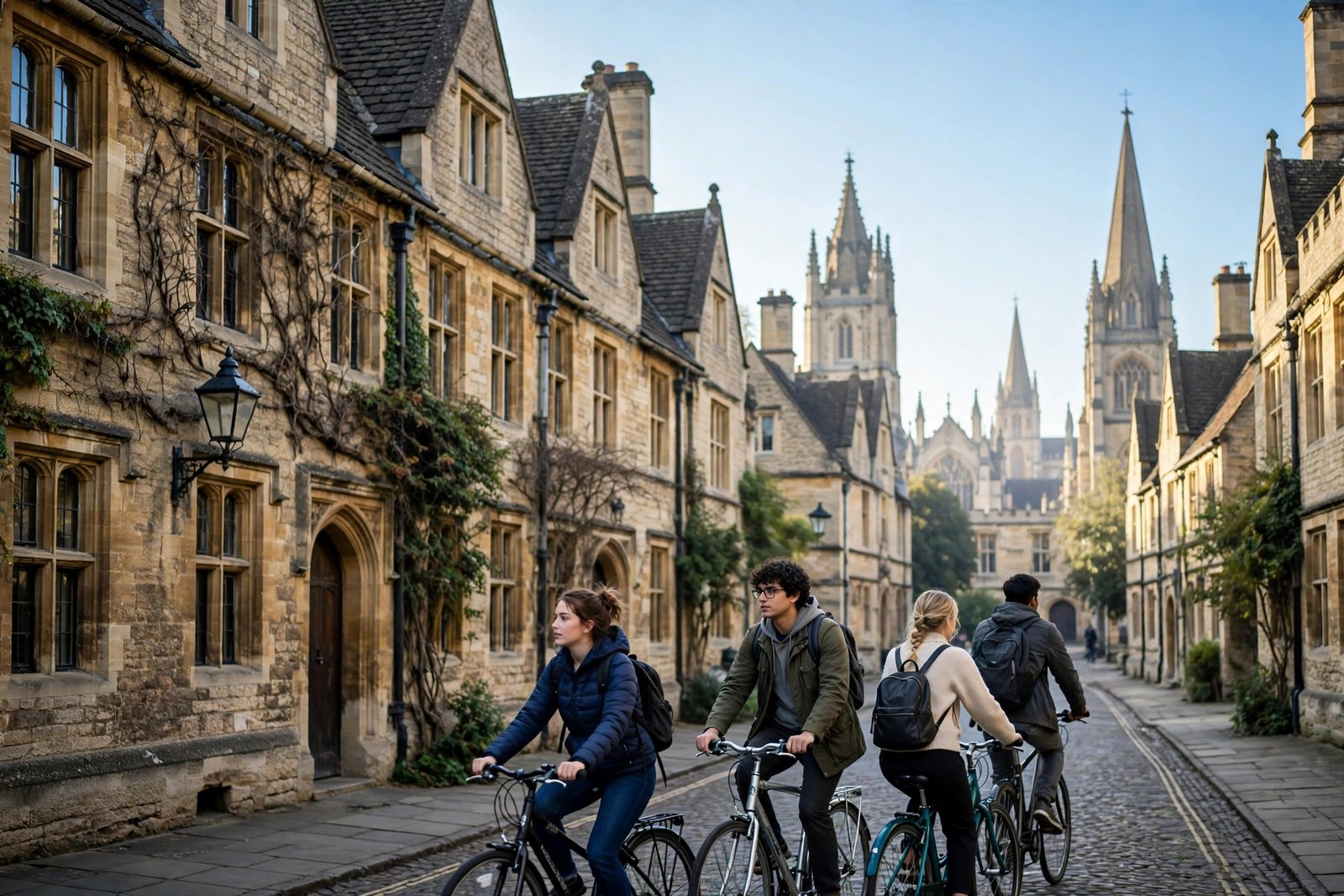
7. Clarendon Scholarship — University of Oxford
Coverage: Tuition and college fees in full, plus an annual grant for living costs for full-time scholars (set with reference to the UKRI minimum doctoral stipend rate; recent published figures have been in the £18,000–£20,000 range — the exact current rate is confirmed in your award letter), for the full fee-liability period of your course. Part-time scholars receive a study support grant instead. Eligibility: Anyone applying to a new full-time or part-time master’s or DPhil at the University of Oxford — all nationalities, all subjects; selection is purely on academic excellence and potential, with roughly 130–140 new scholarships a year. Deadline: None separate: apply by your course’s December or January deadline for graduate entry and you are automatically considered. Clarendon’s official pages are at ox.ac.uk/clarendon. This automatic-consideration model is why a strong Oxford application is always worth filing even if you think you cannot afford Oxford.
8. Weidenfeld-Hoffmann Scholarships and Leadership Programme — Oxford
Coverage: 100% of Oxford course fees plus a grant for living costs (at least the UKRI-rate level in recent cycles), combined with a leadership programme of mentoring, skills training and networking. Eligibility: Graduate applicants from eligible developing and emerging-economy countries — the country list is published each cycle and includes many countries in Africa, Asia and Latin America — applying to specified full-time graduate courses, who intend to return home and contribute to their country’s development. Deadline: Your course’s December/January deadline, with the scholarship statement submitted as part of the Oxford application. Weidenfeld-Hoffmann suits applicants whose story is explicitly about public service and development leadership; a purely private-sector career plan is a poor fit, however strong the grades.
9. Reach Oxford Scholarships
Coverage: Tuition fees, a grant for living expenses and one return airfare per year, for the full duration of an undergraduate degree. Eligibility: Students from low-income countries on Oxford’s published list (which includes Bangladesh, India, Nepal, Nigeria and Pakistan among many others) who, for political or financial reasons or because suitable educational facilities do not exist, cannot study for a degree in their own country. Applicants must intend to return home after their studies. All subjects are eligible except medicine. Deadline: You must apply to Oxford through UCAS by the October deadline and, if offered a place, complete the scholarship application by the February deadline Oxford publishes. Reach Oxford is one of the very few full rides for undergraduates in the UK — and therefore one of the most competitive awards on this page.
10. Cambridge International Scholarship — Cambridge Trust
Coverage: The full cost of a PhD at Cambridge: the university composition fee at the overseas rate plus a maintenance allowance sufficient for a single student, for up to the normal duration of the doctorate. Eligibility: International applicants ranked highest by Cambridge departments in the funding competition; you are considered automatically when you apply for a PhD and indicate you wish to be considered for funding, though the Trust also runs many partial and country-specific awards beneath this flagship. Deadline: Cambridge’s funding deadline, typically in early December for the following October entry — your course’s own deadline may be earlier. For doctoral applicants, Cambridge’s funding competition is department-driven: your prospective supervisor’s and department’s ranking of your file decides your fate, which is why contacting supervisors before applying matters so much.
11. Imperial President’s PhD Scholarship — Imperial College London
Coverage: Full tuition fees (at the overseas rate for international scholars), a generous annual stipend (above £25,000 in recent cohorts — confirm the current rate on Imperial’s site), and an annual consumables fund for research costs, for 3.5 years. Eligibility: Applicants of any nationality with a first-class or equivalent undergraduate/master’s record applying to a PhD at Imperial in science, engineering, medicine or business; you must be among the strongest applicants in your department’s pool. Deadline: Imperial runs several selection rounds a year, typically with deadlines in November, January and March — check the current round dates. For STEM applicants who want London without Oxbridge, this is arguably the strongest single PhD package in the capital.
12. Warwick Chancellor’s International Scholarship
Coverage: Full payment of overseas tuition fees plus a maintenance stipend at the UKRI rate, for up to 3.5 years of PhD study (shorter for students already part-way through). Eligibility: International applicants for a PhD at the University of Warwick in any discipline; there is no separate nationality list, and current Warwick PhD students in their first year may also be eligible under the published rules. Deadline: Typically mid-December, alongside Warwick’s PhD application deadline for scholarship consideration. Warwick awards a substantial number of these scholarships each year across departments, which makes it a realistic target — not just a prestige lottery — for strong doctoral applicants in the social sciences, humanities and sciences alike.
13. UCL Research Excellence Scholarship
Coverage: Full tuition fees — notably, UCL charges the overseas rate where applicable — plus a maintenance stipend at the UKRI rate for the normal duration of the PhD (typically three years, in line with the award’s current terms). Eligibility: Prospective PhD students of any nationality holding or expecting a first-class or strong upper-second honours degree (and usually a master’s), applying to UCL; a small number of awards (around 40 across schemes in recent years) are allocated by faculty competition. Deadline: Typically late January, with a departmental nomination step before it — approach your UCL department by December. UCL’s central London location and breadth of doctoral programmes make this a high-demand award; departmental endorsement is the gate, so the supervisor conversation comes first.
14. UKRI-Funded Doctoral Studentships
Coverage: Fees plus a tax-free stipend at the UKRI national rate (£20,780 per year for 2025/26; the 2026/27 rate is set by UKRI — check its site), typically for 3.5–4 years. For international students, UKRI rules cap the funder’s contribution towards fees, and many universities and doctoral training partnerships now top up the difference to the full overseas fee — but not all do, so confirm the fee treatment in writing for any specific project. Eligibility: Open to home and international applicants within a cap on international places (UKRI sets a proportion limit per programme); advertised through universities, Centres for Doctoral Training and Doctoral Training Partnerships. Deadline: Project and programme deadlines concentrate between December and February. Treat this as a category to search systematically on university “find a PhD” pages rather than a single application.
15. Marshall Scholarship — for US Citizens
Coverage: University fees, a living stipend, annual book and research/travel grants, thesis grant, fares to and from the UK and dependent allowances where applicable, for graduate study at any UK university, normally two years. Eligibility: US citizens only, holding an undergraduate degree from an accredited US institution with a GPA of at least 3.7, within the programme’s recency-of-degree rules. We include it because this guide is read internationally and Marshall is a genuinely full award — but if you are not a US citizen, it is not open to you; Chevening, Commonwealth and the Oxbridge awards above are your equivalents. Deadline: Typically late September through US university endorsement channels. If you are a US reader holding offers from both Marshall and a US fellowship, note that Marshall funds study in the UK specifically and cannot be transferred to a US programme.
Eligibility: The Patterns Behind the List
UK fully funded scholarships fall into four families. Government development schemes (Chevening, Commonwealth Master’s, PhD and Shared) require citizenship of eligible countries, a commitment to return home, and — for Chevening — two years of work experience; Commonwealth awards additionally require that you could not afford the UK without support. University endowments (Gates Cambridge, Rhodes, Clarendon, Weidenfeld-Hoffmann, Reach Oxford) select on academic excellence and leadership, with Rhodes adding constituency citizenship and age rules. Doctoral studentships (Cambridge International, Imperial, Warwick, UCL, UKRI) are won inside departments: supervisor fit and departmental ranking decide. Nationality-specific awards (Marshall) are superb but closed to most readers. Across all families, English requirements are set by the university course, not the scholarship, and none of these schemes charges an application fee for the scholarship itself.
How to Apply: Step by Step
- Fix your level and family (a year ahead). Master’s applicants target Chevening and Commonwealth; PhD applicants target Commonwealth PhD, Oxbridge and studentships; undergraduates target Reach Oxford. Applying in the wrong family wastes a cycle.
- Course first, scholarship second. Every award here hangs on a real course application — three course choices for Chevening, a named course for Commonwealth Shared, a department for studentships. Research courses on university sites and in our study abroad guides.
- Handle nomination and endorsement early. Commonwealth requires a nominating body application alongside the CSC form; Rhodes and Marshall require institutional endorsement in many constituencies. These have their own earlier deadlines.
- Write to the criteria. Chevening’s four essays (leadership, networking, career plan, why the UK courses) and Commonwealth’s development-impact statements are marking schemes in disguise. Answer the question asked, with evidence.
- Line up referees who know your work. Two strong, specific references beat three famous names who barely know you.
- Submit early and keep evidence. The CSC portal warns that the final days are extremely busy and late applications are not accepted for any reason. Submit days ahead and save confirmations.
- Convert the offer. Chevening scholars must turn a conditional university place into an unconditional offer by the July deadline; Commonwealth scholars must accept within CSC timelines. Diarise these conversion dates the day you apply.
Required Documents
- Passport and, for Commonwealth schemes, proof of citizenship and permanent residence in an eligible country
- Degree certificates and transcripts (2:1 or equivalent for most schemes; first-class records for Oxbridge endowments)
- English language test scores where your chosen course requires them
- Personal statements and scheme-specific essays (Chevening’s four essays; development impact statements for Commonwealth)
- Two references — academic and/or professional depending on the scheme
- Research proposal for PhD schemes and studentships
- University offer letters where required at application or conversion stage
- Work-experience evidence for Chevening (2,800 hours) — employment records that match the hours you claim
Deadlines and Timeline
| Period | What happens | Programmes |
|---|---|---|
| Aug–Oct 2026 | Chevening 2027/28 open 4 Aug, closed 6 Oct; Commonwealth Master’s/PhD close 20 Oct 16:00 BST | Chevening, Commonwealth |
| Oct 2026 | Oxford undergraduate UCAS deadline (Reach Oxford route) | Reach Oxford |
| Nov 2026 | Commonwealth Shared window (typical); Imperial President’s round 1 | Shared, Imperial |
| Dec 2026–Jan 2027 | Oxbridge graduate funding deadlines; Warwick, UCL studentship deadlines; UKRI project deadlines | Gates, Clarendon, Weidenfeld, Cambridge International, Warwick, UCL, UKRI |
| Feb 2027 | Reach Oxford scholarship form deadline; Gates Cambridge US-round outcomes begin | Reach Oxford, Gates |
| Mar–Apr 2027 | Chevening interviews at embassies and high commissions | Chevening |
| Jun–Jul 2027 | Chevening results from mid-June; unconditional offer deadline 8 July 2027; Commonwealth results by July | Chevening, Commonwealth |
| Sep–Oct 2027 | Studies begin across the UK | All |
Planning a parallel application elsewhere? Compare this list with the top 20 fully funded scholarships in the USA and the top 15 in Canada, and track everything in one place with the tools in our tools directory.
How to Improve Your Chances
For Chevening and Commonwealth, impact is the currency. Selection panels score what you have already changed — a clinic’s record system, a school’s results, a community programme that survived after you left — and whether your study plan credibly scales it. Quantify outcomes honestly. Choose courses strategically: Chevening lets you name three courses; make them coherent with one career plan, not three different lives. For Oxbridge endowments, the file is academic first: a first-class record, a sharp research or study proposal and referees who can rank you against peers (“top 2% of the 400 students I have taught”) are what panels remember. For studentships, contact supervisors early with a two-paragraph research idea matched to their current projects. Start a cycle early: most winners on this page began preparing documents, referees and essays six to twelve months before the deadline.
Common Mistakes
- Missing the nominator step for Commonwealth — submitting to CSC Central alone is an incomplete application.
- Applying to Chevening without the work experience — the 2,800-hour requirement is checked, and ineligible applications are sifted out before reading.
- Assuming GREAT Scholarships are fully funded. GREAT awards are worth £10,000 towards tuition — valuable, but a partial award; they do not appear in our top 15 for exactly that reason.
- Budgeting on last year’s stipend. Chevening does not publish stipend rates on its website and CSC rates are reviewed; plan with the current published CSC figures (£1,712/£2,000) and confirm your own rate in your award letter.
- Letting a conditional offer lapse. Chevening’s 8 July 2027 unconditional-offer deadline ends awards, however strong the interview was.
- Paying “Chevening agents”. Chevening states that applying is free and it does not work with paid intermediaries who claim they can secure an award.
Frequently Asked Questions
Is Chevening still open for 2027/28?
No — applications opened on 4 August 2026 and closed on 6 October 2026. Interviews run in March–April 2027 and studies begin in September/October 2027. If you missed it, prepare for the next round, which typically opens the following August, and consider Commonwealth (closing 20 October 2026) if you are eligible and can still complete a nominator application in time.
How much is the Commonwealth Scholarship stipend?
At current published CSC rates, £1,712 per month, or £2,000 per month if your university is in the London metropolitan area, plus full tuition and return airfare. Rates are reviewed by the CSC, so confirm the figure in your award documentation.
Do I need IELTS for these scholarships?
The CSC does not require IELTS for the scholarship itself, and Chevening does not set a test score either — but your university course may require English evidence for admission, and you must meet that requirement to convert your place into an unconditional offer.
Can I apply for both Chevening and Commonwealth?
Yes — they are separate schemes and many candidates apply to both. You cannot, however, hold two awards covering the same costs simultaneously; if you win both, you must choose one.
Are there fully funded UK scholarships for undergraduates?
Very few. Reach Oxford is the flagship full undergraduate award on this list, restricted to students from low-income countries who cannot study at home. Most UK fully funded money sits at master’s and PhD level.
Does the Rhodes Scholarship have an age limit?
Yes. Each constituency sets its own rules, but applicants are typically 18–24, or up to 27 if they completed (or are completing) their first degree recently. Check your constituency’s memorandum on the Rhodes Trust website before investing in an application.
Can I stay in the UK after a Chevening or Commonwealth scholarship?
Both schemes are built around returning home: Chevening requires you to return for at least two years after your award, and Commonwealth scholars sign an undertaking to return home. Do not apply to these schemes as a settlement route — that misunderstands what the funders are buying.
Are these scholarships open to students from Bangladesh and Pakistan?
Yes. Both are Commonwealth countries, so their citizens are eligible for Commonwealth schemes; Chevening operates in both countries; and the Oxford and Cambridge endowments (Gates, Clarendon, Weidenfeld-Hoffmann, Reach Oxford) all include Bangladeshi and Pakistani applicants within their country rules. Nigeria and India are in the same position; Indonesia, as a non-Commonwealth country, is eligible for Chevening and the university endowments but not Commonwealth awards.
Sources & Verification
Facts in this article were checked in October 2026 against official sources, including: Chevening (FCDO) — 2027/28 timeline (opened 4 August 2026, closed 6 October 2026, interviews March–April 2027, unconditional offer deadline 8 July 2027) and published coverage (tuition, stipend, airfare, visa cost, TB contribution up to £75); the Commonwealth Scholarship Commission — Master’s and PhD terms including stipend rates of £1,712/month (£2,000 London), child allowances and the 20 October 2026 closing date; Gates Cambridge Trust — coverage and the 2026–27 maintenance rate of £23,152; the Rhodes Trust — 2026–27 stipend of £21,060; the University of Oxford (Clarendon Fund terms and Reach Oxford) and Cambridge Trust publications; and Imperial College London, the University of Warwick, UCL and UKRI studentship pages (UKRI stipend £20,780 for 2025/26). Stipend rates are reviewed annually and several figures are confirmed only in individual award letters.
Disclaimer: StudyGraduate is an information portal, not an agency. Scholarship details change yearly — always confirm deadlines, amounts and eligibility on the official website before applying. We never promise selection, admission or visa approval, and no legitimate scholarship charges a fee to apply.
✅ Eligibility Criteria
- Check the official website for full eligibility criteria for your country
🎁 Benefits
- See the official website for the complete list of benefits
⚙️ Application Process
- 1Check your eligibility on the official site
- 2Prepare your documents and statements
- 3Submit the online application before the deadline
- 4Complete interviews or assessments if shortlisted
- 5Await the final selection announcement
📅 Important Dates
Deadlines vary by country and intake. Check the official website for country-specific dates.
📄 Required Documents
- Valid passport
- Academic transcripts & certificates
- Statement of purpose
- Letters of recommendation
- CV / resume
Commonly required — confirm the exact list on the official site.
❓ Frequently Asked Questions

Ready to Take the Next Step?
Explore more scholarships and study opportunities around the world.
Browse Scholarships →