Singapore International Graduate Award (SINGA) 2027: Fully Funded PhD in Singapore
Singapore International Graduate Award (SINGA) 2027: Fully Funded PhD in Singapore The Singapore International Graduate Award, universally known as SINGA, is one of the very few doctoral scholarships in the world that lets you earn a PhD from a top-ranked university while doing your day-to-day research inside a national research institute. It is a collaboration ... <a title="Singapore International Graduate Award (SINGA) 2027: Fully Funded PhD in Singapore" class="read-more" href="https://studygraduate.com/scholarship/singapore-international-graduate-award-singa-2027-fully-funded-phd-in-singapore/" aria-label="Read more about Singapore International Graduate Award (SINGA) 2027: Fully Funded PhD in Singapore">Read more</a>
📖 Overview
Singapore International Graduate Award (SINGA) 2027: Fully Funded PhD in Singapore
The Singapore International Graduate Award, universally known as SINGA, is one of the very few doctoral scholarships in the world that lets you earn a PhD from a top-ranked university while doing your day-to-day research inside a national research institute. It is a collaboration between the Agency for Science, Technology and Research (A*STAR) and Singapore’s autonomous universities — the National University of Singapore (NUS), Nanyang Technological University (NTU), Singapore University of Technology and Design (SUTD), Singapore Management University (SMU) and, for the Engineering Doctorate, the Singapore Institute of Technology (SIT). Your degree is awarded by the partner university where you register; your research training happens at an A*STAR research institute or a university laboratory under supervisors from both worlds. For an international graduate who wants a research career in biomedical sciences, computing, engineering or the physical sciences, and who wants that career launched from one of Asia’s most concentrated research ecosystems, SINGA is a direct and fully funded route.
This guide explains SINGA exactly as A*STAR publishes it: who can apply, what the award pays — a monthly stipend of S$2,700 that rises to S$3,200 after you pass the PhD Qualifying Examination, full tuition support for up to four years, a one-time airfare grant of up to S$1,500 and a one-time settling-in allowance of S$1,000 — which research areas are covered, how the two annual intakes work, what documents you need, and how selection actually happens. It also tells you honestly what SINGA does not cover, who is not eligible, and the mistakes that quietly end otherwise strong applications. If you are still comparing doctoral destinations, browse our wider scholarship directory and the global university rankings before you commit four years to any single programme.
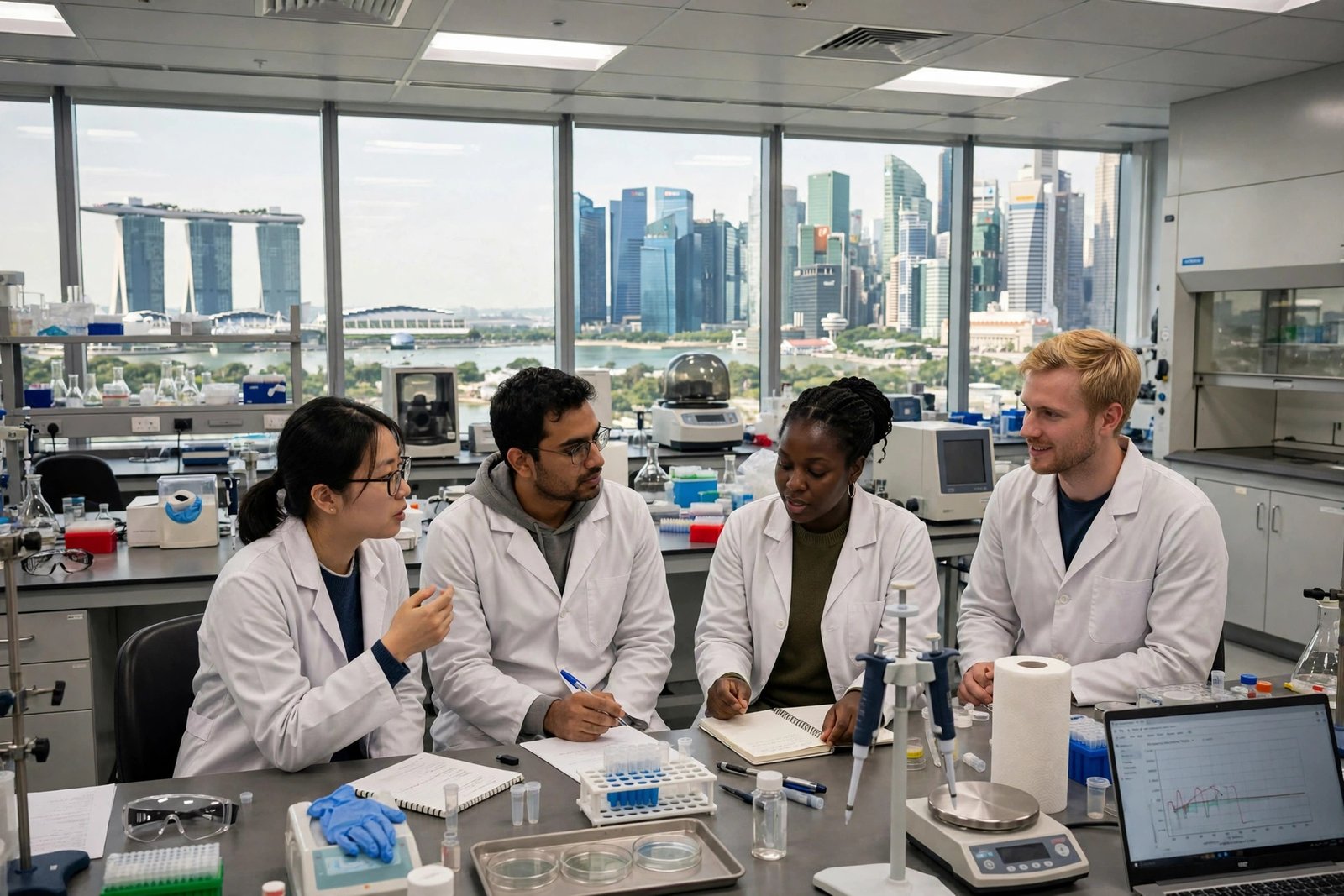
SINGA at a Glance
| Item | Details (as published by A*STAR) |
|---|---|
| Full name | Singapore International Graduate Award (SINGA) |
| Funding body | Agency for Science, Technology and Research (A*STAR), Singapore |
| Partner universities | NUS, NTU, SUTD, SMU; SIT for EngD pathways |
| Degree | PhD; EngD at partner institutions that offer it |
| Duration of support | Up to 4 years |
| Tuition | Full tuition fees supported for the award period |
| Monthly stipend | S$2,700, increasing to S$3,200 after passing the PhD Qualifying Examination |
| Airfare grant | One-time grant of up to S$1,500 |
| Settling-in allowance | One-time S$1,000 on arrival in Singapore |
| Research areas | Biomedical Sciences; Computing and Information Sciences; Engineering and Technology; Physical Sciences |
| Who can apply | International graduates of all nationalities who have not previously studied in Singapore; not open to Singapore Citizens or Permanent Residents |
| Language of training | English |
| Application | Online only, via the A*STAR application portal; no hard-copy documents to the SINGA office |
| Intakes | Two per year — August intake and January intake (January intake limited to A*STAR and NTU projects in recent cycles) |
The single most important thing to understand about SINGA is that it is a research award, not a taught-course scholarship. There is no SINGA master’s degree. You apply for specific PhD research projects and supervisors, you are assessed as a future researcher, and from your first months you are embedded in a laboratory. Coursework exists — partner universities require some modules and, crucially, the Qualifying Examination — but the centre of gravity is the thesis project you choose at application. That is why the project choice, discussed in detail below, matters more in a SINGA application than in almost any taught scholarship you will ever make.
Why Singapore, and Why SINGA in Particular?
Singapore invests in research at a scale out of proportion to its size. A*STAR’s research institutes cluster in places such as Biopolis and Fusionopolis, purpose-built research districts where institutes working on genomics, immunology, materials, infocomm and advanced manufacturing sit within walking distance of each other and of university partners. NUS and NTU both sit in the global top tier of research universities — you can check their current positions in our rankings explorer — and their doctoral graduates publish, patent and spin out companies from exactly the laboratories a SINGA scholar joins. English is the working language of research and teaching, which removes the language barrier that complicates doctoral study in many other high-investment research systems.
SINGA’s particular advantage is the dual mentorship structure. Your candidature is registered at a partner university, which sets your academic requirements and ultimately awards your degree, while your research home is typically an A*STAR institute with facilities, technical staff and project funding that a single university department would struggle to match. In practice many SINGA scholars describe the arrangement as getting a university’s degree with an institute’s resources. The award is also, in recent cycles, bond-free in the sense that A*STAR does not impose a post-graduation service obligation on SINGA scholars — but bond and work-pass conditions can change, so treat that as something to confirm in your own offer letter rather than as a promise, and never as a guarantee of any visa outcome, which is always a decision for Singapore’s immigration authorities.
Eligibility: Who Can Apply for SINGA?
A*STAR states the eligibility criteria plainly, and they are narrower in some respects — and broader in others — than applicants expect. Work through each one before you invest weeks in an application.
Nationality and prior study in Singapore
SINGA is open to international students of all nationalities. It is designed for students applying to study in Singapore for the first time. Singapore Citizens and Singapore Permanent Residents are not eligible, and neither, as A*STAR frames it, are international students who have already pursued tertiary education in Singapore. If you completed your bachelor’s or master’s degree at a Singapore institution, you should not apply for SINGA; look instead at the university’s own graduate scholarships and at A*STAR’s other schemes, which have different nationality rules. Short visits, conferences and exchange weeks are not tertiary study, but if your history is ambiguous, ask the SINGA office before applying rather than discovering an eligibility problem after shortlisting.
Academic qualifications
You need a bachelor’s degree with excellent academic results — A*STAR describes the expectation as a Bachelor’s degree with Honours (Second Class Upper) or the equivalent and above. A master’s degree is welcome and can strengthen an application, particularly where it included a research thesis, but it is not required: SINGA routinely takes strong bachelor’s graduates directly into PhD training. There is no published age limit. What there is, unmistakably, is a results bar. Doctoral admissions at NUS and NTU are competitive in their own right, and SINGA adds a funding competition on top. If your grades sit well below your university’s honours band, a SINGA application is unlikely to succeed until you have added distinguishing research evidence — a strong master’s, publications, or substantial laboratory achievement — and even then there are no guarantees.
No prior PhD, and a genuine research commitment
SINGA funds a first doctorate. You should be applying to begin PhD or EngD training, not to transfer a doctorate already well advanced elsewhere. Just as importantly, A*STAR describes SINGA applicants as graduates with a passion for research. That phrase is not decoration. The selection process — project choice, referee reports, interviews — is built to test whether you have thought like a researcher about the work you propose to join. Applicants who treat SINGA as a generic funding box to tick, with no view about the science, are filtered out early.
English proficiency
PhD training under SINGA is conducted in English, and you need good skills in written and spoken English. SINGA itself does not impose a single named test at the application stage; submission of IELTS, TOEFL, GRE, GATE or SAT results has been treated as optional within the SINGA form, with the partner university able to request satisfactory scores later as part of its own admission requirements. One specific published exception matters: applicants applying to NUS supervisors or projects have been required to submit GRE scores within the SINGA application. Rules like this are exactly the kind that change between cycles, so check the current cycle’s instructions for your chosen projects before assuming any test is optional for you. If your medium of instruction was not English, expect the university to ask for evidence, and be ready to provide it quickly.
Referees
Two academic recommendation reports are required, completed and submitted online by your referees. A*STAR lists good reports from academic referees as part of the eligibility picture, not as an administrative extra. Choose referees who have actually supervised your research or taught you at an advanced level and who can write specifically about your research aptitude. A famous name who barely knows you produces a weaker report than a laboratory supervisor who watched you troubleshoot an experiment for six months.
Benefits and Coverage: What SINGA Pays
SINGA’s financial package, as published by A*STAR on its official SINGA page, has four components, and it is worth understanding each precisely.
Tuition fees
The award supports tuition fees for up to four years of PhD training. Doctoral tuition at Singapore’s autonomous universities for international students is substantial, so this is the largest single component of the award by value even though you never see the money. Support is tied to your candidature: it runs while you are a SINGA scholar in good standing within the award period.
Monthly stipend and the Qualifying Examination increase
SINGA pays a monthly stipend of S$2,700. After you pass the PhD Qualifying Examination — the milestone, usually in your first two years, at which the university confirms your research proposal and your readiness to proceed to the thesis — the stipend increases to S$3,200 per month. That S$500 step is deliberate: it rewards progression and partly reflects the heavier research load of the post-QE years. Plan your first-year budget on S$2,700, not on the higher figure, and treat the increase as something you earn by passing, on your university’s schedule, rather than as an automatic anniversary rise.
One-time grants
Two one-time payments complete the package: an airfare grant of up to S$1,500 toward your travel to Singapore, and a settling-in allowance of S$1,000 paid once on arrival. The words “up to” matter for the airfare grant — it is a capped contribution, not a blank cheque for any routing you choose. The settling-in allowance exists because your first month carries deposits, basic furnishings and administrative costs before your stipend rhythm settles; spend it on those, not on celebrations.
What SINGA does not cover
Honesty about exclusions saves real pain later. SINGA’s published package does not include a family or dependant allowance: there is no additional stipend for a spouse or children, and scholars who bring family do so entirely at their own cost in one of Asia’s more expensive cities. Health insurance is not listed as a SINGA benefit; partner universities typically require students to be covered under their own student health schemes, whose premiums are a cost to budget for. Conference travel, bench fees beyond your host institute’s normal provision, and any costs of a fifth year are not part of the published award. None of this makes SINGA ungenerous — full tuition plus S$2,700–3,200 a month is a complete package for a single scholar living in student accommodation — but it does mean the award is designed for the scholar alone, for four years.
Can the Stipend Actually Cover Life in Singapore?
Yes, with ordinary doctoral discipline, and it helps to see the arithmetic. Published estimates used by Singapore universities commonly place a graduate student’s monthly living costs in the region of S$1,400 to S$2,000, depending mainly on accommodation. On-campus graduate housing, where available, has historically been the cheapest route; a room in a shared private flat costs more; a whole private unit costs far more and is not a realistic first-year choice on a stipend. Food at university canteens and hawker centres is famously good value; cooking some meals stretches the budget further. Transport on the MRT and bus network is efficient and inexpensive compared with most global research cities. On S$2,700 you can cover rent in student or shared accommodation, food, transport, a university health scheme premium and modest personal spending, with a small margin — provided you do not commit to private-condo rent or support dependants from the stipend. After the QE increase to S$3,200, the margin becomes more comfortable. Use our student budgeting and cost tools to model your own figures before you accept any offer, in Singapore or anywhere else.
Research Areas and Partner Universities
SINGA research falls under four broad areas, and every project you can choose sits inside one of them. There is no SINGA funding for humanities, law, business or medicine as a clinical discipline — if your doctorate is in those fields, SINGA is simply the wrong scheme, and our scholarships directory is a better starting point.
Biomedical Sciences
The largest and historically best-known SINGA area, anchored by A*STAR institutes working on genomics, molecular and cell biology, immunology, infectious disease, bioinformatics and translational medicine, with university partners strong in life sciences and medicine-adjacent research. Projects range from fundamental mechanism-of-disease work to platform technologies for diagnostics and therapeutics.
Computing and Information Sciences
Artificial intelligence, data science, cybersecurity, communications, human–computer interaction and computing systems, drawing on A*STAR’s infocomm research and the computing schools at the partner universities — including SMU, whose SINGA participation centres on computing. Demand here is intense because the global applicant pool in AI is enormous; a strong computing application usually shows concrete outputs — code, systems, publications — not only coursework grades.
Engineering and Technology
Advanced manufacturing, materials engineering, robotics, electronics, energy systems, chemical and environmental engineering and related fields. This is also where the EngD pathway sits for candidates whose doctorate is oriented toward industrial research and development, with SIT among the partners for that route.
Physical Sciences
Physics, chemistry, materials science and mathematics-adjacent research, including quantum technologies and photonics, where Singapore has made conspicuous national investments. As with biomedical projects, the work is laboratory-based and supervisor-led, and project descriptions on the portal tell you a great deal about the techniques you would actually learn.
Choosing among NUS, NTU, SUTD and SMU
Your degree-awarding university follows your supervisor and project, so you are choosing a research group first and a university second. Still, the universities differ in flavour: the National University of Singapore is the comprehensive flagship with particular depth in biomedical and physical sciences; NTU is engineering- and materials-heavy with a large, self-contained campus; SUTD is design- and technology-focused and smaller; SMU contributes computing strength in the city centre. All four appear in global rankings, all award internationally recognised doctorates, and a SINGA scholar’s daily life is shaped far more by their institute and laboratory than by inter-university differences. Choose the project and supervisor you would still be glad of in year three.

How to Apply for SINGA, Step by Step
- Confirm your eligibility first. Check nationality and prior-study rules, your honours-level results, and that your field sits inside the four SINGA research areas. Do not start the form hoping an eligibility rule will bend; it will not.
- Browse the research projects and supervisors. On the official A*STAR SINGA pages, explore the project listings by research area. Read beyond titles: look at the institute, the techniques, the supervisor’s recent publications and whether the project is fundamental, translational or industry-linked. In recent cycles applicants have indicated up to three project or supervisor preferences; treat all three as real choices, because you may be considered for any of them.
- Check project-specific test requirements. If any of your choices is an NUS project, confirm the current GRE position; for all projects, note what the host university may later require for admission, such as English test scores.
- Prepare your documents in advance. Gather your passport, a recent passport-sized photograph in the specified format, bachelor’s and any master’s transcripts and degree certificates (with English translations where the originals are not in English), and a certification letter from your university if your degree has not yet been conferred. Everything is submitted online; A*STAR instructs applicants not to mail hard copies to the SINGA office.
- Line up two referees early. Ask permission, share your project choices and your CV, and give referees a deadline well before the official one. Their reports are submitted online by the referees themselves and must arrive by the closing date; an application with a missing report is an incomplete application.
- Complete the online application on the A*STAR portal. The application is submitted through A*STAR’s scholarship application system (the portal linked from the official SINGA page). Fill every field accurately — names exactly as in your passport, results exactly as on your transcripts — and review the whole form before submitting, because amendments after submission have not been permitted in recent cycles.
- Submit well before 23:59 Singapore time on the deadline day. Deadlines are stated in Singapore time (GMT+8). Applicants in South Asia, Africa or the Americas lose hours to the time difference; submit at least 48 hours early to leave room for referee delays and portal congestion.
- Prepare for interview if shortlisted. Shortlisted candidates are invited to interview — in recent cycles, online interviews with the prospective institute and university. A*STAR has advised that shortlisted candidates will be notified within about 12 weeks of the application closing date. Being interviewed means your paper application convinced them; the interview tests whether your understanding of the project and your research thinking match the file.
- Complete university admission and pre-arrival steps if offered. A SINGA offer is followed by formal admission processes at the partner university, medical and student-pass formalities, and housing applications. A scholarship offer is not itself a student pass; immigration approval remains a separate decision by the Singapore authorities, and no guide can promise it.
Required Documents Checklist
- Valid passport (identity page)
- Recent passport-sized photograph in the format specified on the portal (JPEG or PNG in recent cycles)
- Bachelor’s degree academic transcripts — mandatory
- Master’s degree academic transcripts, if you hold a master’s
- Bachelor’s and master’s degree certificates or scrolls, or a letter of certification from your university if the degree has not yet been conferred
- Certified English translations of any transcript or certificate not originally in English
- Two academic recommendation reports, submitted online directly by your referees
- GRE scores where required for your project choices (notably NUS projects in recent cycles)
- Optional test scores (IELTS, TOEFL, GATE and similar) if you choose to include them, understanding the university may request them later regardless
- Your research project and supervisor preferences, selected from the current portal listings
Deadlines and Timeline
SINGA recruits for two intakes a year. The pattern published for recent cycles — including the cycle feeding the August 2027 intake — is an application deadline of 1 December for the August intake, and 1 June for the January intake, with the January intake in recent cycles limited to A*STAR and NTU projects rather than all partners. Always verify the current cycle’s dates and partner scope on the official page before planning around them, because intake scope is one of the details A*STAR adjusts.
| Stage | August intake | January intake |
|---|---|---|
| Application deadline | 1 December (23:59 GMT+8) of the preceding year — e.g. 1 Dec 2026 for August 2027 | 1 June (23:59 GMT+8) of the preceding year — e.g. 1 Jun 2027 for January 2028 |
| Partner scope (recent cycles) | All partner universities | A*STAR institutes and NTU projects only — verify for your cycle |
| Shortlisting notification | Within about 12 weeks of the closing date | Within about 12 weeks of the closing date |
| Interviews | Following shortlisting, typically online | Following shortlisting, typically online |
| Programme start | August | January |
Working backwards from a 1 December deadline, a sensible preparation calendar looks like this: identify projects and supervisors by September; confirm referees and request transcripts and translations by October; sit any test you need, such as the GRE for an NUS project, by early November at the latest; draft and submit the application in November with your referees’ reports chased politely but persistently. The January-intake cycle compresses the same work into the first half of the year. None of this can be done well in the final week, and the applicants who try are usually the ones whose referee reports never arrive.
Selection Criteria: How SINGA Decides, and How to Improve Your Chances
A*STAR does not publish a points formula, but the published criteria and the structure of the process point to four judgements. First, academic excellence: honours-level results from your bachelor’s degree, and a master’s with distinction-level performance where you have one. Second, research aptitude and fit: whether your background genuinely prepares you for the specific projects you named — the techniques, the theory, the prior reading. Third, referee evidence: specific, credible testimony from academics who have seen you do research. Fourth, English and interview performance: whether you can explain your past work and your proposed direction clearly, and answer probing questions about both.
Improving your chances is therefore mostly unglamorous. Choose projects that grow naturally out of what you have already done, and say explicitly, in the application, how your final-year project, thesis or laboratory work connects to each project you name. Read two or three recent papers from each prospective supervisor’s group and be ready to discuss them at interview — what was shown, what remains open, where your skills would fit. If you have any research output — a conference poster, a preprint, a strong thesis, even a well-documented independent project — present it accurately and link it where the form allows. Prepare for the interview as a scientific conversation, not a speech: interviewers will push on the weakest joint in your reasoning to see how you think, and a candidate who can say “I don’t know, but here is how I would find out” beats one who bluffs. Finally, keep perspective: SINGA is highly competitive, a rejection is not a verdict on your worth as a researcher, and the same preparation strengthens applications to university scholarships in Singapore and to doctoral programmes elsewhere — compare related routes in our guide to Australia Awards Scholarships and other fully funded research awards in the region.
Common Mistakes That Sink SINGA Applications
- Applying despite prior study in Singapore or Singapore citizenship/PR status. These are hard eligibility boundaries, not preferences.
- Choosing projects by prestige instead of fit. Naming fashionable AI or genomics projects with no background evidence reads instantly as opportunism.
- Letting referee reports go missing. The application is incomplete without both reports; chasing them is your job, and the deadline does not move for a forgetful referee.
- Missing the Singapore-time deadline. 23:59 GMT+8 arrives many hours earlier than midnight in your own time zone if you are west of Singapore.
- Submitting and then trying to amend. Review everything before submission; in recent cycles amendments after submission were not allowed.
- Ignoring project-specific requirements. An NUS project without the required GRE submission, where the cycle requires it, is an avoidable elimination.
- Mailing hard copies. A*STAR states documents are submitted online; paper sent to the SINGA office does not help and may never be matched to your file.
- Budgeting on S$3,200 from month one. The higher stipend begins only after you pass the Qualifying Examination.
- Assuming the award covers a family. It does not; dependant costs in Singapore are high and entirely yours.
Frequently Asked Questions
Is SINGA fully funded?
For a single scholar, effectively yes: full tuition support for up to four years, a monthly stipend of S$2,700 rising to S$3,200 after the Qualifying Examination, a one-time airfare grant of up to S$1,500 and a one-time settling-in allowance of S$1,000. It does not include family allowances or a stated health-insurance benefit, so budget for the university’s student health scheme and any dependant costs yourself.
Can I apply for SINGA with only a bachelor’s degree?
Yes. A bachelor’s degree with honours-level results (Second Class Upper or equivalent and above, in A*STAR’s framing) is the core qualification. A master’s degree can strengthen your case, especially with a research thesis, but it is not required.
Do I need IELTS or TOEFL for SINGA?
SINGA does not set a single test requirement at application; test scores have been optional within the SINGA form, but the partner university can request satisfactory English (and other) scores for admission. Applicants to NUS projects have additionally been required to submit GRE scores in recent cycles. Check the current cycle’s instructions for your projects.
Can Singapore Citizens, Permanent Residents, or graduates of Singapore universities apply?
No. SINGA is for international students applying to study in Singapore for the first time. Singapore Citizens and Permanent Residents are ineligible, as are those who have already pursued tertiary study in Singapore.
How many research projects can I choose?
In recent cycles applicants have indicated up to three project or supervisor preferences. Treat every preference as a genuine choice you would accept, and make sure your background supports each one.
When will I hear back after applying?
A*STAR has advised that shortlisted candidates are notified within about 12 weeks of the application closing date. If you are not shortlisted, you may receive no interview invitation; plan parallel applications rather than waiting on a single outcome.
Is there an age limit or a bond after graduation?
No age limit is published. SINGA has been presented in recent cycles without a post-graduation service bond, but you should confirm the conditions in your own offer documents, and remember that any right to stay and work in Singapore after graduation is a separate immigration matter that no scholarship can guarantee.
Can I apply for a master’s degree under SINGA?
No. SINGA funds PhD training, and EngD training at partners offering it. There is no SINGA master’s route.
Sources and Verification
This guide was prepared from the official A*STAR SINGA pages (a-star.edu.sg — Singapore International Graduate Award and the A*STAR SINGA overview), which publish the stipend of S$2,700 rising to S$3,200 after the Qualifying Examination, the one-time airfare grant of up to S$1,500, the one-time settling-in allowance of S$1,000, the eligibility rules and the application route, cross-checked against partner-university graduate admissions information from NUS and NTU. Where a detail has varied between cycles — January-intake partner scope, GRE requirements for NUS projects, test-score handling — the guide says so and directs you to the current cycle’s instructions.
Disclaimer: Scholarship amounts, deadlines, intake scope and eligibility rules change between cycles. Always confirm deadlines and amounts on the official A*STAR website before applying. StudyGraduate is an information portal, not an agency, and cannot promise selection, admission or visa approval to any applicant.
✅ Eligibility Criteria
- Check the official website for full eligibility criteria for your country
🎁 Benefits
- See the official website for the complete list of benefits
⚙️ Application Process
- 1Check your eligibility on the official site
- 2Prepare your documents and statements
- 3Submit the online application before the deadline
- 4Complete interviews or assessments if shortlisted
- 5Await the final selection announcement
📅 Important Dates
Deadlines vary by country and intake. Check the official website for country-specific dates.
📄 Required Documents
- Valid passport
- Academic transcripts & certificates
- Statement of purpose
- Letters of recommendation
- CV / resume
Commonly required — confirm the exact list on the official site.
❓ Frequently Asked Questions

Ready to Take the Next Step?
Explore more scholarships and study opportunities around the world.
Browse Scholarships →