Scholarships in Turkey for International Students 2026/2027
Scholarships in Turkey for International Students 2026/2027 Turkey — officially Türkiye — has built one of the most complete scholarship ecosystems available to international students anywhere in the world. At its centre sits a single government programme, Türkiye Scholarships (Türkiye Burslari), that does something very few national schemes attempt: it places you at a university, ... <a title="Scholarships in Turkey for International Students 2026/2027" class="read-more" href="https://studygraduate.com/scholarship/scholarships-in-turkey-for-international-students-2026-2027/" aria-label="Read more about Scholarships in Turkey for International Students 2026/2027">Read more</a>
📖 Overview
Scholarships in Turkey for International Students 2026/2027
Turkey — officially Türkiye — has built one of the most complete scholarship ecosystems available to international students anywhere in the world. At its centre sits a single government programme, Türkiye Scholarships (Türkiye Burslari), that does something very few national schemes attempt: it places you at a university, pays your tuition, pays you a monthly stipend, houses you, insures you, flies you in, and teaches you Turkish for a year before your degree begins. Around that flagship sit university merit scholarships, research fellowships, arts scholarships and success awards that reward students already studying in the country. For students from Bangladesh, India, Pakistan, Nepal, Nigeria, Indonesia and dozens of other countries, scholarships in Turkey for the 2026/2027 cycle are therefore not a single opportunity but a layered system you can enter at several points.
This guide maps that whole system honestly. You will find what Türkiye Burslari actually covers in the current cycle — with the monthly stipend figures published on the official programme page at the time of writing — who is eligible and who is not, how the age limits and minimum grades work in practice, which other Turkish scholarships are real and worth your time, how to apply step by step through the Türkiye Scholarships Application System (TBBS), what documents to prepare months in advance, and the timeline that runs from a January application to a September arrival. Every central figure below was checked against official sources; where a university sets its own amount or a figure changes by year, we say so instead of inventing precision. You can compare Turkey with other destinations in our scholarships directory and study abroad guides, and if you already know Türkiye Burslari is your target, read our dedicated fully funded Türkiye Burslari guide next.
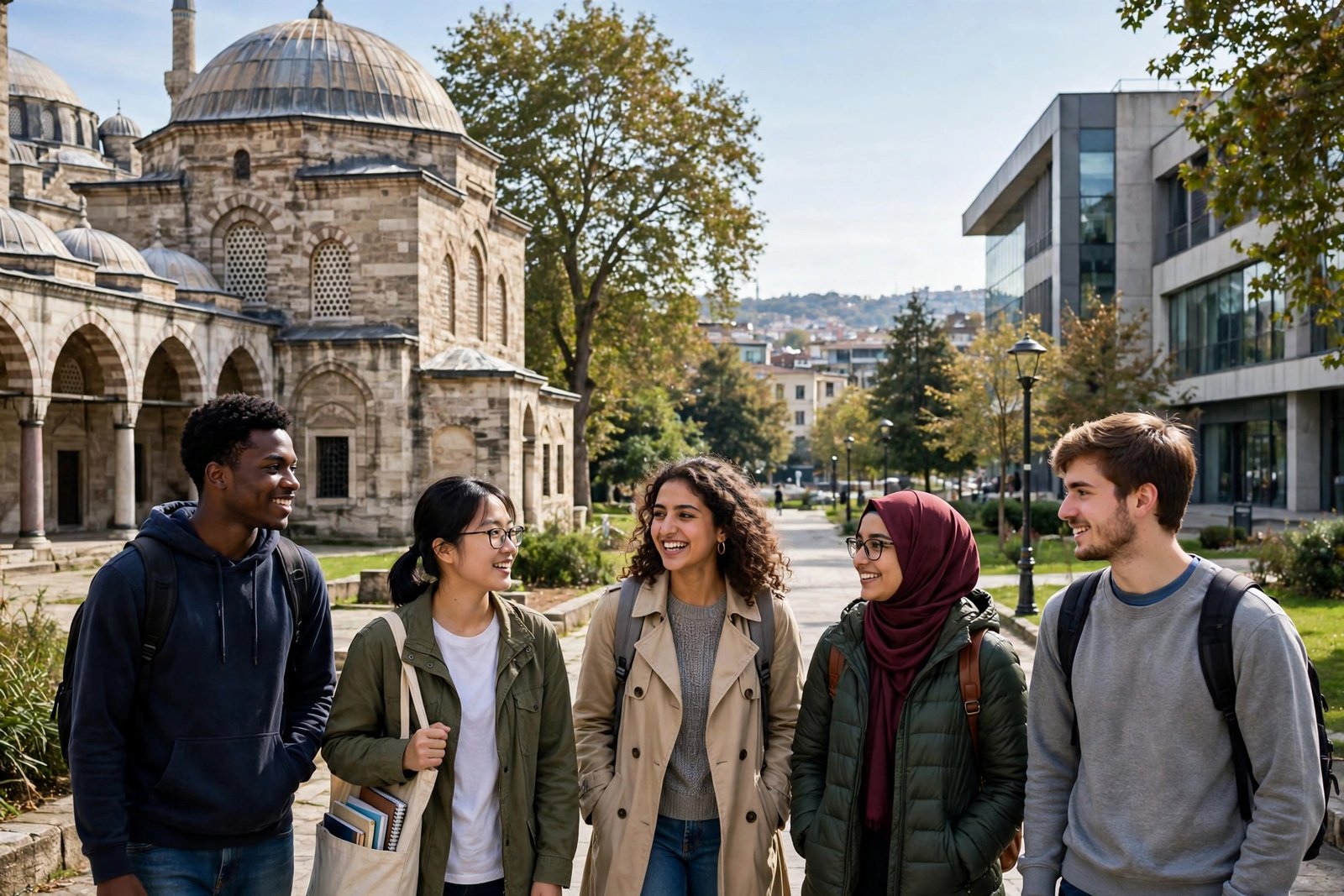
Scholarships in Turkey at a Glance
The table below summarises the main routes. The flagship row matters most: if you qualify for Türkiye Burslari, it will almost always be your strongest option because no university award in Turkey matches its full package. The other rows are genuine alternatives — for students who miss the age limits, miss the January–February window, or are already enrolled in Turkey.
| Scholarship | Levels | Main Coverage | Application Window | Who It Suits |
|---|---|---|---|---|
| Türkiye Scholarships (Türkiye Burslari) — Full-Time Programmes | Associate, Bachelor’s, Master’s, PhD | University placement, full tuition, monthly stipend (see below), accommodation, health insurance, one-year Turkish course, once-off flight ticket | 10 January – 20 February every year | First-time applicants who meet age and grade thresholds |
| Türkiye Scholarships — Merit Scholarship Programme | Bachelor’s, Master’s, PhD | Monthly stipend at twice the regular rate for outstanding achievers | Assessed within the Türkiye Scholarships system; check official criteria per level | Applicants with exceptional grades and international exam scores |
| Türkiye Scholarships — Arts Scholarship Programme | Bachelor’s, Master’s, PhD | Full-time scholarship package for music, performing arts and fine arts at named universities | 10 January – 20 February every year | Musicians, performers and fine-arts students |
| Türkiye Scholarships — Research Scholarship | Research stays | Monthly support for researchers working with Turkish academics; terms set per call | Announced separately; check the official calendar | PhD candidates and academics |
| University merit scholarships (e.g. at foundation/private universities) | Bachelor’s, Master’s, PhD | Partial to full tuition waivers; stipends vary by university | Varies by university | Students applying directly to a specific university |
| Success Scholarship | Students already in Turkey | Monthly support for high-performing self-funded students already enrolled | Announced separately on the official calendar | Current students in Turkey without another government scholarship |
Two facts from the official programme page should shape your planning from day one. First, the application window is short and fixed: full-time applications are received via TBBS between 10 January and 20 February every year, according to the official Türkiye Scholarships full-time programmes page. There is no rolling admission and no late window. Second, the scholarship includes placement: you do not apply to a Turkish university separately first and then seek funding. You rank programme preferences inside TBBS, and placement is part of the award. That single design choice removes the most common failure point in other countries, where students win admission but not money, or money but not admission.
Why Turkey? Cost, Quality and Position
Turkey sits at the meeting point of Europe and Asia, and its higher education system reflects that position: more than 200 universities, degree programmes taught in both Turkish and English, and a large, established international student community drawn from over 170 countries, as the official Türkiye Scholarships site itself notes in its guide to studying in Türkiye. Public university tuition for self-funded international students is comparatively low by Western standards, and private (foundation) universities compete aggressively with merit waivers. Living costs in most Turkish university cities — Ankara, Izmir, Eskişehir, Konya, Bursa and many others — are markedly lower than in Western Europe, and even Istanbul, the most expensive student city, remains manageable on a stipend if you live in a dormitory or share housing.
Quality deserves a sober sentence rather than hype. A small group of Turkish universities — including Middle East Technical University (METU), Boğaziçi University, Istanbul Technical University, Bilkent University, Koç University and Sabancı University — appear in global rankings and run research programmes with international visibility. You can explore how institutions compare in our university rankings section. Below that top tier sits a wide band of solid public universities whose degrees are recognised across the region and, through Turkey’s participation in the Bologna Process, structured to be comparable with European degrees. For scholarship purposes the practical point is simpler: because Türkiye Burslari places students across the whole system, your ranked preferences matter. Research each programme’s language of instruction, city and curriculum before you rank it, not after you are placed.
Eligibility: Who Can Apply for Scholarships in Turkey?
Eligibility for the flagship programme is defined by four filters: citizenship, graduation status, academic achievement and age. Understanding them precisely saves you from building an application that is screened out automatically.
Citizenship and graduation status
Türkiye Scholarships is open to citizens of all countries. Turkish citizens — including people who hold or have lost Turkish citizenship in ways the programme defines as ineligible — cannot apply, and students already receiving another Turkish government scholarship are not the target group. Applicants must have graduated, or be on track to graduate before the August of the application year, from the previous level of study. Final-year students therefore apply in their last year, with their diploma following later.
Minimum academic achievement
The published minimums are: 70% for associate and bachelor’s applicants; 75% for master’s and PhD applicants; and 90% for health sciences — medicine, dentistry and pharmacy. Treat these as floors, not targets. Because applications arrive from around the world, competitive files usually sit well above the minimum, especially for popular programmes in Istanbul and Ankara and for any health-science seat. If your percentage converts from a GPA scale, do not invent your own conversion in the application: enter your grades exactly as your transcript shows them and let the evaluation apply its equivalence, and be ready to explain your institution’s grading scale if asked at interview.
Age limits
Age is a hard filter with no discretion. Applicants must be under 21 for associate and bachelor’s programmes, under 30 for master’s programmes, and under 35 for PhD programmes. Research scholarship age rules are set in that programme’s own call — check the official calendar and call text for the current limit rather than relying on summaries, because published summaries have differed. If you are close to a limit, check how the programme counts age at the application date and plan your cycle accordingly: a student who turns 21 shortly after the deadline may still be eligible in one cycle and ineligible the next, so applying a year earlier is often the smart move.
Language eligibility — and the health sciences exception
You do not need Turkish to apply. Many programmes are taught in English, others in Turkish, and the scholarship itself funds a one-year Turkish language course (see Benefits). What you do need is whatever language certificate your chosen programme requires — some English-medium programmes ask for TOEFL or an equivalent later in the process. One structural exception matters for graduate applicants: the official full-time programmes page states that Türkiye Scholarships does not award graduate scholarships in the field of health sciences. Medicine, dentistry and pharmacy remain bachelor’s-level routes with the 90% threshold; if your plan is a master’s or PhD in a clinical health field, look instead at research scholarships, university funding, or health-adjacent non-clinical programmes as they appear in TBBS, and verify the current rule on the official page before you apply.
Benefits: What Türkiye Burslari Actually Covers
The official scope of the full-time scholarship, as published on the programme page, is: university and department placement; a monthly stipend; tuition fees; a one-year Turkish language course; accommodation; health insurance; and a once-off flight ticket at the beginning of your education and when you graduate. The stipend figures currently published on that official page are 6,500 TL per month for undergraduate students, 9,500 TL for master’s students and 13,000 TL for PhD students. Older guides — including earlier versions of official summary pages — quote lower figures such as 4,500 / 6,500 / 9,000 TL, which is exactly why you should always read the current programme page in your application cycle: stipends are revised, and the figure that matters is the one in force when you are awarded. Under the Merit Scholarship Programme, students with outstanding achievement receive a monthly stipend at twice the regular amount, per the same official page.
| Level | Monthly Stipend Currently Listed (Official Page) | Also Covered |
|---|---|---|
| Associate / Bachelor’s | 6,500 TL | Placement, tuition, accommodation, health insurance, 1-year Turkish course, once-off flight ticket at start and on graduation |
| Master’s | 9,500 TL | Same full package as above |
| PhD | 13,000 TL | Same full package as above |
| Merit Scholarship | Twice the regular stipend for the level | Awarded for outstanding academic achievement under programme criteria |
Read the accommodation line carefully. The scholarship provides accommodation — typically state dormitory housing — which removes your largest living cost. Graduate arrangements and any cash housing support have varied by year and city in past cycles, so treat dormitory placement as the baseline promise and confirm the current arrangement in TBBS and in your award documents. Health insurance is general health coverage for the scholarship period, not a private policy, and the flight benefit is a once-off ticket at the start and a once-off ticket on graduation — it is not an annual home-leave ticket. The one-year Turkish language course deserves emphasis because applicants routinely misunderstand it: awardees who do not already hold a C1 Turkish certificate complete the course before starting their degree programme, and it is funded as part of the scholarship. For English-medium students it is still valuable — daily life, bureaucracy, internships and part-time interaction in Turkey run on Turkish — and in many cycles attendance is treated as a programme requirement rather than an optional extra. Confirm the current requirement for your level on the official site.

Programmes and Fields You Can Study
The bachelor’s programme spans engineering, social sciences, health sciences and basic sciences across numerous departments, per the official page. Graduate programmes are offered in social sciences, humanities, natural sciences and engineering at Turkish universities, with the health-sciences exception noted above. Associate degrees focus on technical and vocational education and training — a two-year route many guides ignore, but a real pathway for students who want a shorter, employment-focused qualification with full funding. The Arts Scholarship Programme covers defined departments at Ankara Music and Fine Arts University, Ankara Hacı Bayram Veli University and Istanbul Technical University, including instrument education, voice training, music technology, music theory and musicology at bachelor’s and master’s level, music sciences at PhD level, and fine-arts fields such as photography and video, painting and visual communication design at bachelor’s level.
Two selection mechanics shape your field choice. First, the universities and departments you can choose depend on your educational background: TBBS shows each candidate the programmes open to them, and you can only rank what the system offers you. Second, equivalence matters: the official page advises candidates to check the equivalence and validity of chosen fields in their own countries before applying. If you intend to return home to a regulated profession — engineering, teaching, health, law — verify that a Turkish degree in that field will be recognised by your home regulator before you rank it first. Browse the wider universities directory and study guides to build your shortlist methodically.
Beyond Burslari: University and Other Scholarships in Turkey
If you miss the Burslari window, exceed an age limit, or want a specific university above all else, direct university scholarships are the second layer. Turkey’s foundation (private) universities — institutions such as Koç, Sabancı and Bilkent are prominent examples — publish their own international scholarship schemes, typically as tuition waivers ranging from partial percentages to full tuition for top files, sometimes with additional support for graduate research assistants. Public universities more often compete on low base tuition, dormitory access and smaller merit reductions. The honest rule for this entire layer is that amounts, percentages and deadlines are set by each university and change by year, so the only reliable source is that university’s own international office page for the current intake. Never pay an agent for access to a university scholarship list, and never trust a percentage quoted on a third-party blog without the university page behind it.
Graduate students should also look at research-assistant and project-funded positions: at research-intensive universities, a supervisor’s funded project can support a master’s or PhD student in ways that resemble a scholarship even when they are advertised as assistantships. These are arranged with departments and supervisors directly, usually after admission, and are competitive in a different way — your research fit and proposal matter more than your nationality. Finally, the Success Scholarship route rewards students already studying in Turkey at their own expense who achieve high grades; its calls are announced separately, so current self-funded students should watch the official Türkiye Scholarships calendar rather than assuming the January window is their only door.
How to Apply, Step by Step
All full-time Türkiye Scholarships applications are made online through TBBS. There is no paper route, no embassy submission for the main programme, and no application fee. The process below reflects the system’s structure; complete each stage fully, because incomplete files are a common reason for early rejection.
- Create your TBBS account early. Register on the Türkiye Scholarships Application System with an email address you check daily and will keep for years. Do this in December, not on 10 January, so account or verification problems do not consume your window.
- Build your profile completely. Enter personal details, contact information, family and education history exactly as your documents show them. Names must match your passport spelling everywhere.
- Upload your documents. Add your ID or passport, recent photograph, diploma or temporary graduation certificate, transcripts, and any national or international exam results and language certificates your programmes require (details in the next section).
- Research and rank your programmes. Use the programme search on the official site before and during the window. Rank preferences in true order of desire, mixing ambitious and safer choices across universities and cities, and check each programme’s language of instruction.
- Write your letter of intent and, for PhD, your research proposal. Answer the system’s prompts directly: why this field, why Turkey, why these programmes, and what you will do with the degree. PhD applicants also outline a research topic with a working method.
- Add references and social/academic activities. Record academic achievements, awards, volunteering, work and extracurricular activity honestly — evaluators see the whole file, not only grades.
- Review, then submit before the deadline. Check every uploaded file opens, every name and date matches, and every preference is in the right order. Submit days before 20 February; the portal is heavily loaded in the final 48 hours every cycle.
- Prepare for interview if shortlisted. Shortlisted candidates are invited to interview in the spring period. Bring original documents, know your own application by heart, and be ready to discuss your study plan and future goals concretely.
Required Documents
Prepare clear scans — and certified translations where a document is not in Turkish or English and the system requires one — of: a valid national ID card or passport; a recent photograph taken within the last year; your diploma or temporary graduation certificate (final-year students use the certificate or student document their institution issues); full academic transcripts for all completed study; national exam results if applicable in your country; international exam results such as SAT, GRE or GMAT if you have them or your programme requires them; language proficiency certificates if required by your chosen programme; and, for PhD applicants, a research proposal and a sample of previous written work. Recommendation letters are requested within the application structure for relevant programmes — ask referees in December, give them your CV and study plan, and never leave a referee request to the final week. Keep a single folder with every file named clearly (Passport.pdf, Transcript-Bachelor.pdf) so uploads under deadline pressure stay error-free. Use our student tools, including deadline tracking, to keep the document checklist and the calendar in one place.
Deadlines and Timeline
| Stage | Typical Period (Official Calendar Pattern) | What Happens |
|---|---|---|
| Application period | 10 January – 20 February | TBBS open for full-time associate, bachelor’s, master’s, PhD and arts programmes |
| Evaluation | March – April | Preliminary screening on eligibility, then expert evaluation of academic file and intent |
| Interviews | April – June | Shortlisted candidates interviewed, in person or online depending on country |
| Results | Early August | Decisions announced; awardees receive placement information |
| Initial procedures | August | Scholarship agreements, visa and document procedures |
| Arrival in Türkiye | September | Travel, dormitory placement, orientation and Turkish course or degree start |
These stages follow the programme’s established annual calendar as reflected on official and programme sources; the binding dates for your cycle are those published on the official Application Calendar at turkiyeburslari.gov.tr. Research, Success and other separate programmes run on their own announced periods — some research calls accept applications at multiple points in the year — so a student who misses February is not necessarily waiting a full year for every route, but is waiting a full year for the main full-time intake.
Selection Criteria and How to Improve Your Chances
Evaluation weighs academic achievement first, then the coherence and quality of the whole file: your letter of intent, your programme choices, your achievements beyond the classroom, your language readiness, and — for shortlisted candidates — your interview. Practical improvements that genuinely matter: keep grades as high as possible in your final year, because transcripts are the file’s foundation; choose programmes that match your background instead of scattering preferences across unrelated fields; write a specific letter of intent that names what you will study, why Turkey is the right place for it, and what problem you want to work on after graduation; secure any international exam score your target programmes value; and treat the interview as a discussion of your own application — candidates who cannot explain their ranked choices or their research idea undermine an otherwise strong file. There is no legitimate shortcut: no agent can sell you a place, no fee improves your odds, and any person promising guaranteed selection is misleading you.
Common Mistakes That Cost Applicants the Scholarship
- Starting in February. Transcripts, translations and referee letters take weeks. The strongest files are assembled in November and December.
- Ignoring age and grade floors. The system screens on them. Check eligibility before investing in an application you cannot pass.
- Ranking only famous universities in Istanbul. A balanced list across cities and institutions is a placement strategy, not a compromise.
- Not checking the language of instruction. A programme taught in Turkish is a different commitment from an English-medium one, even with the funded language year.
- Inconsistent documents. Different name spellings or dates across passport, transcript and application create verification problems. Fix documents at the source, early.
- A generic letter of intent. Text that could be sent to any country convinces no evaluator. Be specific about Turkey, the field and your plan.
- Applying for graduate health sciences without checking the current rule. The official page states graduate health-sciences scholarships are not awarded; verify before you build a plan on them.
- Believing old stipend figures. Amounts are revised between cycles. Budget only from the current official programme page.
Frequently Asked Questions
1. Is Türkiye Burslari fully funded?
Yes, for full-time programmes it is a comprehensive package: placement, tuition, a monthly stipend, accommodation, health insurance, a one-year Turkish language course and a once-off flight ticket at the start and on graduation, as listed on the official programme page. Personal extras beyond the stipend remain your own cost.
2. How much is the Türkiye Scholarships stipend in the current cycle?
The official full-time programmes page currently lists 6,500 TL per month for undergraduates, 9,500 TL for master’s students and 13,000 TL for PhD students, with Merit scholars receiving twice the regular amount. Figures are revised between cycles — always confirm on the official page in your application year.
3. When do applications open and close?
Full-time applications are received via TBBS between 10 January and 20 February every year. Separate programmes such as Research and Success scholarships are announced on their own calendars.
4. Do I need IELTS or Turkish to apply?
Turkish is not required to apply, and the scholarship funds a one-year Turkish course for awardees without C1 Turkish. English tests are not a universal scholarship requirement, but individual programmes may require a language certificate — check the requirements of each programme you rank.
5. Can final-year students apply?
Yes. You may apply in your final year provided you will graduate before the August of the application year, submitting the graduation document your institution issues and your full transcripts to date.
6. Can I apply to a Turkish university separately as a backup?
Yes — direct admission with a university scholarship is a separate route and a sensible backup, especially if you may miss Burslari age limits. It does not harm a Burslari application to understand your direct options.
7. What grades do I need for medicine in Turkey?
Health sciences — medicine, dentistry and pharmacy — carry a 90% minimum academic achievement threshold at bachelor’s level, and competition is intense. Note also that graduate scholarships in health sciences are not awarded under the official full-time programme rules.
8. Does the scholarship guarantee a visa or a job after graduation?
No. The award supports your study and provides placement and documentation for your procedures, but visa decisions rest with the authorities and employment after graduation is never guaranteed. Plan your post-study route separately and honestly.
Sources & Verification
This article was prepared from official sources consulted at the time of writing: the Türkiye Scholarships official full-time programmes page (turkiyeburslari.gov.tr/fulltimeprograms) for the scholarship scope, current stipend figures, application period, programme types and the graduate health-sciences rule; and the official Türkiye Scholarships guide “Discover Türkiye: A Hub for Fully Funded International Scholarships” (turkiyeburslari.gov.tr) for programme context, eligibility summaries and university landscape. University-specific scholarship details were described in general terms because each university sets and revises its own awards — verify any university figure on that university’s official international office page. See also the official Türkiye Scholarships guide to studying in Türkiye and tuition-free routes.
Disclaimer: Scholarship details, stipends, deadlines and rules change yearly. Always confirm deadlines, amounts and eligibility on the official website before applying. StudyGraduate is an information portal, not an agency or a university — we never promise selection, admission or visa approval, and no one acting legitimately can.
✅ Eligibility Criteria
- Check the official website for full eligibility criteria for your country
🎁 Benefits
- See the official website for the complete list of benefits
⚙️ Application Process
- 1Check your eligibility on the official site
- 2Prepare your documents and statements
- 3Submit the online application before the deadline
- 4Complete interviews or assessments if shortlisted
- 5Await the final selection announcement
📅 Important Dates
Deadlines vary by country and intake. Check the official website for country-specific dates.
📄 Required Documents
- Valid passport
- Academic transcripts & certificates
- Statement of purpose
- Letters of recommendation
- CV / resume
Commonly required — confirm the exact list on the official site.
❓ Frequently Asked Questions

Ready to Take the Next Step?
Explore more scholarships and study opportunities around the world.
Browse Scholarships →