Scholarships in Saudi Arabia for International Students 2026/2027: Fully Funded Guide
Scholarships in Saudi Arabia for International Students 2026/2027: Fully Funded Guide Saudi Arabia runs one of the largest government scholarship systems in the world, and almost everything runs through a single front door: the Study in Saudi platform of the Ministry of Education. Through that one portal, international students can apply for scholarships at the ... <a title="Scholarships in Saudi Arabia for International Students 2026/2027: Fully Funded Guide" class="read-more" href="https://studygraduate.com/scholarship/scholarships-in-saudi-arabia-for-international-students-2026-2027-fully-funded-guide/" aria-label="Read more about Scholarships in Saudi Arabia for International Students 2026/2027: Fully Funded Guide">Read more</a>
📖 Overview
Scholarships in Saudi Arabia for International Students 2026/2027: Fully Funded Guide
Saudi Arabia runs one of the largest government scholarship systems in the world, and almost everything runs through a single front door: the Study in Saudi platform of the Ministry of Education. Through that one portal, international students can apply for scholarships at the Kingdom’s public universities — for diplomas, bachelor’s, master’s and PhD degrees — with the strongest awards covering tuition in full, a monthly stipend, university housing, health care, an arrival allowance and annual travel tickets. If you are a student from Bangladesh, India, Pakistan, Nepal, Nigeria or Indonesia looking for a genuinely fully funded degree in 2026/2027, Saudi Arabia belongs at the top of your list. This guide explains how the system actually works, the difference between full, partial and paid study, the official eligibility rules including the age limits, the documents you must prepare, the application windows, and the traps — including unofficial “agents” and invented deadlines — that catch applicants every year.
One clarification before anything else, because the internet gets this wrong constantly: not every place offered through Study in Saudi is fully funded. The Ministry of Education itself divides government-university scholarships into three types — full scholarships, partial scholarships, and paid study — and the funding type is attached to the specific programme listing you apply to. Read the listing, not the headline. Students who understand that distinction, and who apply inside the short official windows with correctly attested documents, are the ones who end up studying in Riyadh, Jeddah, Makkah, Madinah or Dhahran on the Saudi government’s budget. Browse our scholarship directory for alternatives, and compare this guide with our companion piece on scholarships in Qatar if you are applying across the Gulf.
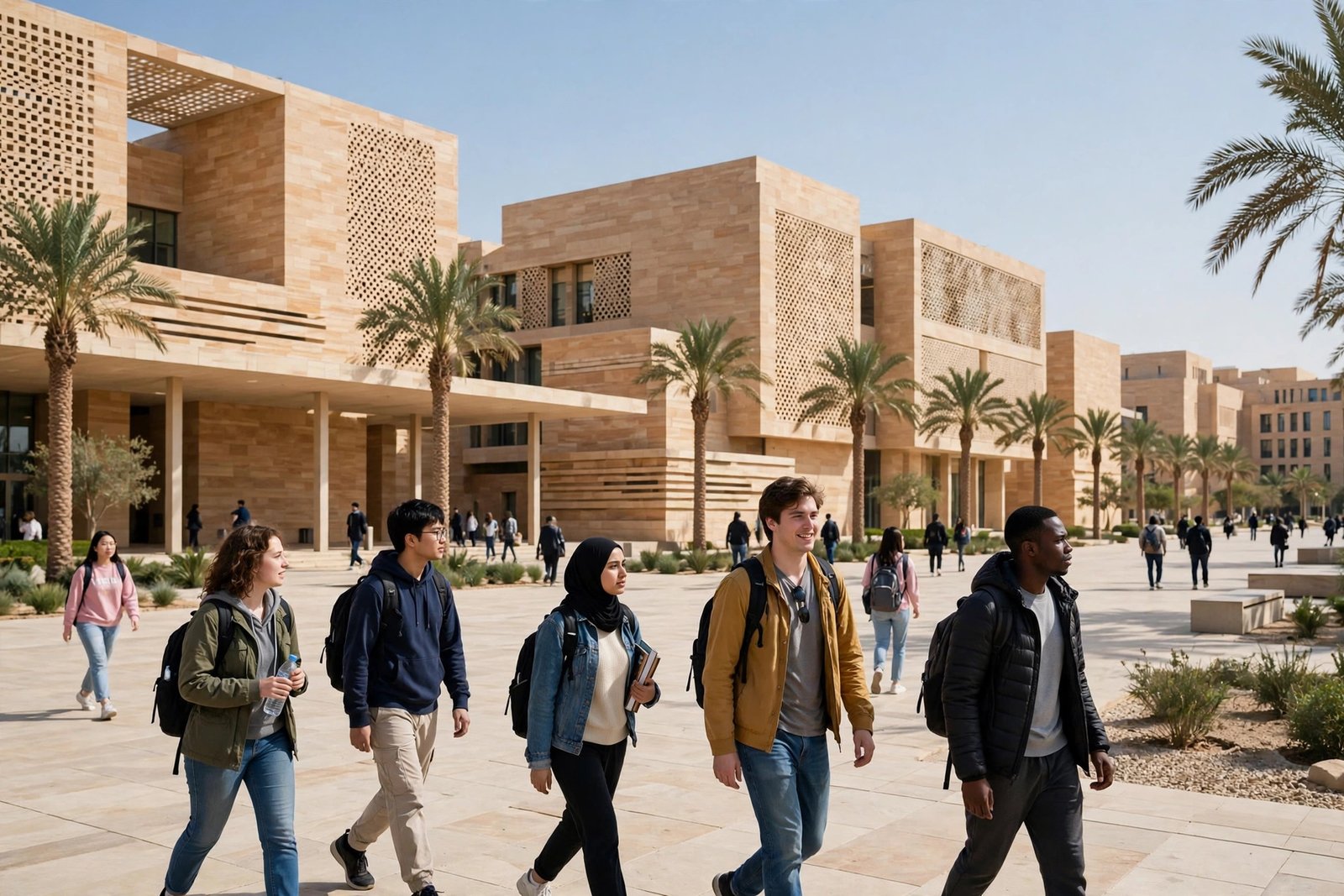
Saudi Arabia Scholarships at a Glance
| Item | Details |
|---|---|
| Official platform | Study in Saudi (Ministry of Education) — one application portal for international students |
| Institutions | Saudi public universities (27 public universities participate in the government scholarship system) |
| Levels | Diploma, Bachelor’s, Master’s, PhD |
| Scholarship types | Full scholarship / partial scholarship / paid study — set per programme listing |
| Tracks | External scholarships (applying from outside Saudi Arabia) and internal scholarships (non-Saudis legally resident in the Kingdom) |
| Full scholarship benefits | Full tuition, monthly stipend, housing, health care, arrival allowance and annual travel tickets, per the Ministry’s scholarship regulations |
| Age limits (general) | Bachelor’s/diploma: 17–25; Master’s: up to 30; PhD: up to 35 |
| Application windows | Set per cycle and university on the platform — recent platform window ran 16 September to 6 October; always check the live portal |
| Application fee | No fee for applying through the official platform |
How the Saudi Scholarship System Works
The Saudi Ministry of Education’s own scholarships in public universities page describes the architecture plainly. Government scholarships for international students come in two tracks: internal scholarships for non-Saudi students already residing in the Kingdom with legal residency, and external scholarships for non-Saudi students applying from outside the Kingdom — the track that concerns almost everyone reading this guide. By funding level, scholarships are of three types: (A) full (“free”) scholarships, where the student receives the full benefits; (B) partial scholarships, where the institution provides some benefits only — the Ministry gives the example of a seat only, or a seat plus housing; and (C) paid study. The exact conditions and benefits are governed by each university’s regulations within the national framework.
Applications can be submitted through the public universities during their announced admission periods for international scholarship students, through the Saudi Cultural Attaché in your country, or — if your country has no Cultural Attaché — through the Embassy of Saudi Arabia. In practice, for most applicants the route is the central Study in Saudi platform, where universities publish their available programmes, each labelled with its funding type. Universities review applications and communicate decisions through the portal, and final admission is completed with the Ministry of Education. Some universities — King Abdulaziz University in Jeddah is a well-known example — list dozens of individual graduate programmes on the platform, each marked as a full scholarship, each with its own window. There is no single national deadline, and anyone who tells you there is one is selling you something.
Eligibility: Who Can Apply?
The general conditions for Saudi government scholarships, applied across public universities, are well established:
- Nationality: open to non-Saudi students of all nationalities. You must not have previously received a Saudi scholarship at the same study level, and you must not have been dismissed from a Saudi educational institution.
- Age limits: for diploma and bachelor’s study, applicants are generally expected to be between 17 and 25 years old; for master’s, not older than 30; for PhD, not older than 35. Individual universities apply these limits in their listings — check yours.
- Academic qualifications: you must meet the same admission requirements as Saudi students at the chosen university — a recognised secondary certificate for bachelor’s entry, a bachelor’s degree for master’s, and a master’s degree for PhD. Certificates must be officially attested by the competent authorities in your country.
- Good conduct and clean record: a police clearance / certificate of good conduct from your home country’s security authorities is a standard requirement.
- Medical fitness: a medical report confirming you are free from infectious diseases is required.
- Home-government approval: where your country requires it, you need your government’s approval to study in Saudi Arabia.
- Language: proof of proficiency in the language of instruction for your programme — Arabic for Arabic-taught programmes (many universities run Arabic language institutes whose diplomas feed into degrees), English for English-taught programmes. Islamic studies and Arabic language programmes are a long-standing strength of the system and are taught in Arabic.
- Female applicants: Saudi scholarship regulations have historically included a mahram (guardian) condition for female scholarship students; the current position is set in the regulations and programme listings — verify the exact requirement for your university on the official platform before applying, as this is an area where rules are applied per current regulation.
- Internal track only: a valid iqama (residency) and your sponsor’s approval to study.
Beyond the general rules, each university adds its own academic conditions — minimum grades, subject prerequisites, and for graduate programmes, research fit. King Saud University, King Abdulaziz University, the Islamic University of Madinah, Umm Al-Qura University in Makkah, Imam Mohammad Ibn Saud Islamic University and King Fahd University of Petroleum and Minerals (KFUPM) in Dhahran all receive large numbers of international scholarship students, but their competitive bars differ widely. A realistic self-assessment matters: the Islamic University of Madinah and Arabic/Islamic studies programmes have historically been more accessible to international applicants than, say, KFUPM’s research programmes. Use our university directory and rankings pages to calibrate your target list.
Benefits: What a Full Scholarship Covers
For external full scholarships, the Ministry of Education lists the benefit framework that universities implement under the scholarship regulations: the student studies without tuition fees, and the package can include housing, health care, a financial allowance paid on arrival, and annual travel tickets, in line with the governing regulations. University listings on the Study in Saudi platform spell out the package per programme, and fully funded listings typically combine: full tuition coverage; a monthly stipend; university accommodation (or a housing arrangement specified in the listing); health insurance/medical care; an annual round-trip airfare; and a one-off arrival/settlement allowance. Some listings differ — for example, a given programme’s listing may include the tuition waiver, stipend and tickets but mark housing as not included — which is precisely why you must read the individual listing rather than trusting summary blogs.
Two honest warnings belong in every benefits discussion. First, this guide deliberately does not quote a single “Saudi scholarship stipend amount,” because the platform does not publish one universal figure: stipends are set under the scholarship regulations and shown in the context of each university and programme. Websites that quote one exact monthly riyal figure for all Saudi scholarships are copying each other, not the Ministry. Second, in the 2026 platform cycle the fully funded listings covered most academic disciplines with the exception of medical fields — if you are targeting medicine, check the funding type on your specific listing with particular care, and look at partial and paid options realistically rather than assuming full funding.
| Funding Type | What It Means | Who Decides |
|---|---|---|
| Full scholarship | Tuition covered plus the scholarship benefits under the regulations — typically stipend, housing, health care, arrival allowance and annual tickets, as specified in the listing | Ministry framework; university implements and lists the package |
| Partial scholarship | Some benefits only — for example a study seat alone, or a seat plus housing — or reduced tuition | The educational institution, per its council’s rules |
| Paid study | You study at the university as a fee-paying international student; no scholarship benefits | University fee schedule for the programme |
Programmes and Fields of Study
Almost every academic field is represented somewhere in the Saudi public university system: engineering and computer science (KFUPM and the big comprehensive universities are particularly strong), medicine and health sciences (funding varies — see above), natural sciences, business and economics, law, education, agriculture, and the humanities. Two areas deserve special mention for this guide’s audience. Arabic language and Islamic studies are the historic core of the scholarship system: universities such as the Islamic University of Madinah, Umm Al-Qura and Imam Mohammad Ibn Saud Islamic University have hosted generations of international scholarship students, often beginning with an Arabic language diploma for non-native speakers before the degree itself. And graduate research programmes — master’s and PhD — are where the largest numbers of full-scholarship listings appear on the platform in recent cycles, with universities like King Abdulaziz University listing programmes individually. KAUST (King Abdullah University of Science and Technology), a graduate-only research university near Jeddah, runs its own separate fellowship admissions outside the public-university scholarship route; it is extremely competitive and should be researched on KAUST’s official site directly.

How to Apply, Step by Step
- Start on the official platform. Go to the Study in Saudi platform and create your account. This is the only application front door you need — bookmark it and ignore look-alike sites.
- Choose your universities and programmes. Browse the live listings, filtering by level and field. For each programme, note the funding type (full, partial or paid), the language of instruction, the age limit and the exact document list.
- Check your eligibility against the general rules — age, previous qualifications, no previous Saudi scholarship at the same level — before investing in attestations.
- Prepare and attest your documents (next section). Attestation through your education board, foreign ministry and the Saudi mission takes time; start months ahead of the window.
- Complete the application carefully. Enter names and dates exactly as they appear on your passport and certificates. Inconsistencies between documents are a common, avoidable cause of rejection.
- Upload clear scans in the required format and submit before the window closes. Platform windows can be short — a recent cycle ran from 16 September to 6 October — so a “nearly ready” application is a failed one.
- Track your application on the portal. Universities review and respond through the platform; approval there can be preliminary, with final admission completed through the Ministry of Education.
- After acceptance, follow the visa route. Scholarship students receive a student (education) visa process linked to the platform and the Ministry of Foreign Affairs: you will receive a visa authorisation, then complete biometrics and stamping at the Saudi embassy or consulate. Complete the required medical examination as instructed.
- Travel only when your visa is stamped and the university confirms your arrival arrangements, including how the arrival allowance and housing allocation will work in your first week.
Required Documents
- Valid passport (keep generous validity beyond your travel date).
- Academic certificates and transcripts for all previous qualifications, officially attested in your home country (and translated into Arabic or English as the listing requires — many universities expect Arabic translation and attestation by the Saudi cultural mission or embassy).
- Medical report confirming freedom from infectious diseases.
- Police clearance / certificate of good conduct from your home country.
- Passport-size photographs to the platform’s specification.
- Proof of proficiency in the language of study, where the programme requires it.
- For graduate programmes: CV, statement of purpose or research proposal, and recommendation letters as listed by the university (for example, King Abdulaziz University’s graduate scholarship route runs through its Deanship of Graduate Studies).
- Home-government approval to study in Saudi Arabia, where your country requires it.
- For internal-track applicants: valid iqama and sponsor approval.
Deadlines and Timeline
There is deliberately no single deadline table for Saudi scholarships, because there is no single deadline. Universities open their scholarship admissions in announced periods, and the platform aggregates live windows. What we can give you honestly is the rhythm: a recent Study in Saudi application period for international students ran from 16 September to 6 October, and graduate scholarship listings at individual universities open and close on their own schedules through the year. The practical consequence is that you should build your timeline backwards from “ready before the window opens,” not from a fixed date.
| Stage | What Happens | Your Move |
|---|---|---|
| 6–9 months before | Programmes for the next cycle are researched; attestation chains in many countries take weeks | Shortlist programmes; start certificate attestation and passport renewal if needed |
| 3–6 months before | Language tests and document translation | Book IELTS/TOEFL if your programme needs it; obtain medical report and police clearance near the window (they can expire) |
| Window open (often 2–4 weeks) | Platform accepts applications for participating universities | Submit in the first days; verify every upload opens correctly |
| Review period | University reviews; Ministry completes final admission steps | Monitor the portal and email; respond to document requests immediately |
| After acceptance | Visa authorisation issued; embassy biometrics and stamping; medical checks | Attend the embassy appointment; book travel only after the visa is issued |
| Arrival | University enrolment, housing allocation, iqama processing, arrival allowance per regulations | Carry originals of all attested documents — you will be asked for them |
How to Improve Your Chances
- Apply to more than one university. The platform exists precisely so you can target several institutions; a spread across competitiveness levels is a rational strategy.
- Consider the Arabic/Islamic studies route seriously. If your goals fit, these programmes have the deepest scholarship tradition and dedicated language preparation — and Arabic fluency is a career asset across the region.
- Make your documents boringly perfect. Matching names, correct attestation order, legible scans. Committees reject messy files before they ever read your statement.
- For graduate study, show research fit. Name the department’s actual research areas and, where the system allows, align your proposal with them.
- Submit early in the window. Short windows plus portal traffic on the final day is a predictable failure mode.
- Use official channels only. The application is free through the platform. Anyone charging you to “submit” a Saudi government scholarship application is charging you for a free process. Plan your overall search with our deadline and budget tools and the study abroad guides.
Common Mistakes to Avoid
- Assuming every Study in Saudi listing is fully funded. Full, partial and paid listings sit side by side. Check the funding type on your programme.
- Believing a universal stipend figure or a universal deadline. Neither exists; both are set per the regulations and the listing.
- Missing the age limits. 17–25 for bachelor’s, up to 30 for master’s, up to 35 for PhD are the general limits — being one year over ends the application regardless of grades.
- Uploading unattested or mismatched certificates. Attestation is not a formality you can fix after selection.
- Letting medical reports and police certificates expire. Time these documents close to the application window.
- Paying agents or buying “guaranteed admission.” Selection is by the universities and the Ministry; no third party can guarantee it, and the official application costs nothing.
Life as a Scholarship Student in Saudi Arabia
Plan for the practical reality, not just the award letter. Scholarship students live in university housing or the housing arrangement named in their listing, study on modern campuses — many Saudi public universities have invested heavily in laboratories, libraries and sports facilities over the past two decades — and follow an academic calendar built around the Kingdom’s climate and religious observances. Teaching is in Arabic or English depending on the programme, and daily life runs in Arabic, so even English-taught students benefit from learning the language; many scholarship students arrive through an Arabic language institute year for exactly this reason. The Kingdom has strict laws and social norms that all residents, including students, are expected to respect — dress codes, alcohol prohibition and rules around public behaviour are enforced — and universities provide orientation for international students on arrival. Weekends, transport options (Riyadh’s metro and intercity buses and trains have expanded rapidly) and the ability to perform Umrah during your stay are part of the experience students consistently value. Financially, the discipline that matters most is the gap between acceptance and the first stipend payment: arrive with enough personal funds to cover your first weeks, keep your documents and iqama process moving with the university’s international students office, and stay in good academic standing, because scholarship continuation everywhere in this system depends on satisfactory progress under the university’s regulations.
Frequently Asked Questions
Are Saudi Arabia scholarships really fully funded?
The full (“free”) scholarships are: under the Ministry of Education’s framework the student receives the full benefits, which universities implement as tuition coverage plus benefits that can include housing, health care, an arrival allowance and annual travel tickets. But the system also contains partial scholarships and paid study, listed side by side on the same platform. The funding type on your specific programme listing is the only version that counts.
How do I apply for a Saudi government scholarship?
Through the official Study in Saudi platform of the Ministry of Education: create an account, choose your university and programme, check the funding type and requirements on the listing, upload attested documents, and submit inside the announced window. Applications can also be lodged through the Saudi Cultural Attaché in your country, or the Saudi embassy if there is no attaché. The application itself is free.
What are the age limits for Saudi scholarships?
The general limits applied across public universities are 17–25 years for diploma and bachelor’s applicants, up to 30 for master’s applicants, and up to 35 for PhD applicants. Individual university listings apply these limits, so confirm the limit on your programme before applying.
How much is the monthly stipend?
There is no single published stipend figure for all Saudi scholarships. Stipends are part of the scholarship benefits set under the national regulations and implemented by each university, and the package for your programme is described in its platform listing and your offer. Be sceptical of any website quoting one exact riyal amount as if it applied to every university and level.
Can I study in English in Saudi Arabia?
Yes — many programmes, especially in engineering, computing, sciences, business and graduate research, are taught in English, and these may require English proficiency evidence. Many other programmes, including Arabic language and Islamic studies, are taught in Arabic; universities run Arabic language institutes for non-native speakers that can precede degree study. The listing for each programme states its language of instruction.
Can female students apply for Saudi scholarships?
Yes — Saudi public universities, including the women’s university Princess Nourah bint Abdulrahman University in Riyadh, admit international scholarship students. Saudi scholarship regulations have historically included a mahram (guardian) condition for female scholarship students; because this is applied under current regulations, verify the exact requirement shown for your university on the official platform before you apply.
Do I need my documents attested?
Yes. Academic certificates must be officially attested by the competent authorities in your country, and universities commonly require translation and further attestation through the Saudi cultural mission or embassy. Start this process months before the application window — it is the step that most often causes otherwise strong applicants to miss a cycle.
When do applications open for 2026/2027?
Windows are announced per cycle and per university on the Study in Saudi platform rather than on one national date; a recent international application period ran from 16 September to 6 October, and individual universities open graduate listings on their own schedules. Create your platform account early, prepare documents in advance, and check the portal regularly so you can submit in the first days of any window.
Sources & Verification
- Saudi Ministry of Education — Scholarships in Public Universities (official): internal and external scholarship tracks; the three types (full, partial, paid); how to apply via universities, Cultural Attachés or embassies; benefits including housing, health care, arrival allowance and annual tickets under the regulations.
- Study in Saudi platform (Ministry of Education) — studyinsaudi.moe.gov.sa: live programme listings with funding types, requirements and application windows.
- King Abdulaziz University — Deanship of Graduate Studies (official): graduate scholarship information for one of the largest listing universities.
Disclaimer: Scholarship regulations, benefits and application windows change, and each university applies the national framework under its own rules. StudyGraduate is an independent information portal, not an agency and not affiliated with the Saudi Ministry of Education or any Saudi university. We never promise selection, admission or visa approval — always confirm the funding type, deadlines and requirements for your programme on the official Study in Saudi platform before you apply, and never pay anyone who guarantees you a scholarship.
✅ Eligibility Criteria
- Check the official website for full eligibility criteria for your country
🎁 Benefits
- See the official website for the complete list of benefits
⚙️ Application Process
- 1Check your eligibility on the official site
- 2Prepare your documents and statements
- 3Submit the online application before the deadline
- 4Complete interviews or assessments if shortlisted
- 5Await the final selection announcement
📅 Important Dates
Deadlines vary by country and intake. Check the official website for country-specific dates.
📄 Required Documents
- Valid passport
- Academic transcripts & certificates
- Statement of purpose
- Letters of recommendation
- CV / resume
Commonly required — confirm the exact list on the official site.
❓ Frequently Asked Questions

Ready to Take the Next Step?
Explore more scholarships and study opportunities around the world.
Browse Scholarships →