Scholarships in Poland for International Students 2026/2027
Scholarships in Poland for International Students 2026/2027 Poland is one of Europe’s best-value study destinations, and for students from eligible countries it can also be one of its best-funded. Through the Polish National Agency for Academic Exchange — NAWA — the Polish government runs scholarship programmes that combine a tuition exemption at public universities with ... <a title="Scholarships in Poland for International Students 2026/2027" class="read-more" href="https://studygraduate.com/scholarship/scholarships-in-poland-for-international-students-2026-2027/" aria-label="Read more about Scholarships in Poland for International Students 2026/2027">Read more</a>
📖 Overview
Scholarships in Poland for International Students 2026/2027
Poland is one of Europe’s best-value study destinations, and for students from eligible countries it can also be one of its best-funded. Through the Polish National Agency for Academic Exchange — NAWA — the Polish government runs scholarship programmes that combine a tuition exemption at public universities with a monthly stipend, a funded Polish language preparatory course in some routes, and a travel allowance. Add low tuition fees for self-funded students (often between EUR 2,000 and EUR 6,000 a year at public universities), affordable living costs by European standards, English-taught degrees across Warsaw, Krakow, Wroclaw, Gdansk and Poznan, and a post-study job market that actively recruits graduates, and Poland deserves a place on every international student’s shortlist for 2026/2027.
This guide covers scholarships in Poland for international students with the honesty the subject requires. Poland’s flagship government scholarships are not open to everyone: the Stefan Banach Scholarship Programme is restricted to citizens of listed countries, and the Gen. Anders Programme is reserved for young people of Polish origin. We explain exactly who can apply for what, what each programme pays using the figures NAWA published in its most recent calls, how doctoral funding works (Poland is unusual in guaranteeing a scholarship to every full-time doctoral school candidate), and what to do if you are not eligible for a government award — because university scholarships, Erasmus+ mobility and sensible self-funding still make Poland one of the most affordable quality options in the European Union. Browse the wider StudyGraduate scholarships directory as you read, to keep Poland in context against other destinations.
Scholarships in Poland at a Glance
| Programme | Who It Is For | Level | Main Benefits (latest published call) | Language |
|---|---|---|---|---|
| Stefan Banach Scholarship Programme (NAWA) | Citizens of listed development-cooperation countries (list changes by call) | Second-cycle (master’s), full-time | Exemption from public university tuition fees; monthly NAWA scholarship of PLN 2,500 in the 2026 call; one-off travel allowance of PLN 2,500; funded preparatory course where applicable | Polish or English |
| Gen. Anders Programme (NAWA) | Young people of Polish origin, Pole’s Card holders, and — in recent calls — Polish dual citizens educated entirely outside Poland | First-cycle, long-cycle and second-cycle, full-time | Monthly scholarship of PLN 1,250–1,700 depending on study level; tuition exemption at public universities; possible funded preparatory year | Polish |
| Doctoral school scholarships | All admitted full-time doctoral school candidates, including internationals | PhD (doctoral schools) | No tuition; a doctoral scholarship paid to every candidate, with the statutory minimum rising after the mid-term evaluation | Polish or English by programme |
| University scholarships and rector’s awards | Enrolled students with strong results, including international students at many universities | Bachelor’s, master’s, PhD | Merit stipends and tuition discounts set by each university; amounts vary | Varies |
| Erasmus+ and exchange grants | Students at partner universities, and Erasmus Mundus applicants worldwide | Exchange semesters; joint master’s | Monthly mobility grant; Erasmus Mundus joint master’s scholarships are comprehensive — check the current catalogue | Varies |
The single most important fact in this table is the eligibility column. Polish government scholarships are instruments of Polish development cooperation and diaspora policy, so they target specific nationalities and communities. Everything in your planning flows from one question: is your citizenship — or your Polish heritage — on the list for the current call? Answer that first, on NAWA’s official site, before you invest months in an application.
Why Study in Poland?
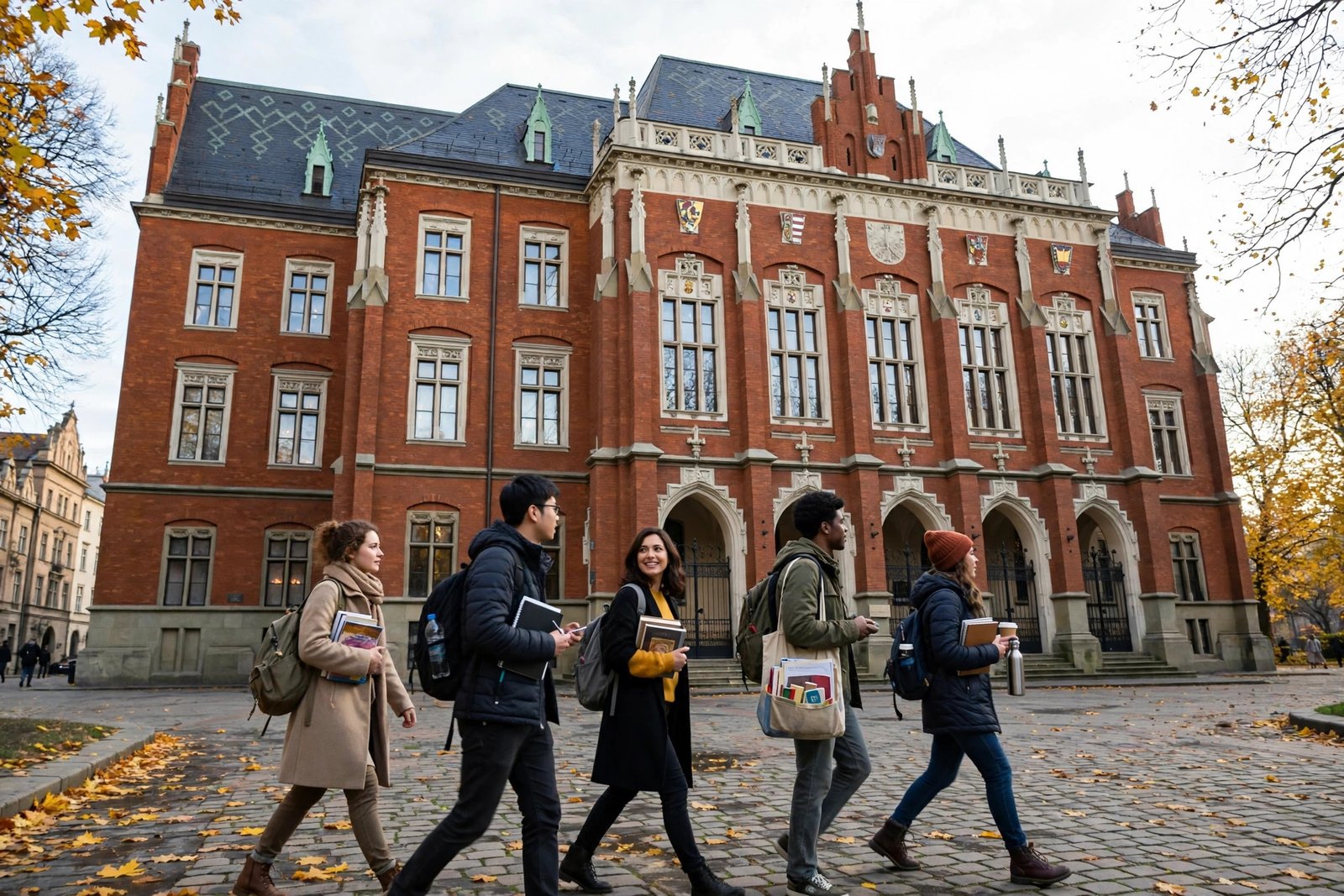
Poland combines three things that rarely come together: EU-recognised degrees, genuinely moderate costs, and large, research-active universities. The University of Warsaw and the Jagiellonian University in Krakow carry centuries of academic history; Warsaw University of Technology, AGH University of Science and Technology in Krakow, and the technical universities of Wroclaw, Gdansk and Poznan anchor a strong engineering sector; and medical universities in English-taught programmes draw students from around the world. For self-funded students, the official Study in Poland portal puts average public-university tuition at around EUR 2,000 per year for first, second and long-cycle studies, with a general range of EUR 2,000–6,000 depending on institution and programme — a fraction of Western European or North American fees. Living costs are equally manageable outside the most expensive Warsaw districts, and students consistently report monthly budgets well below those of Berlin, Amsterdam or Vienna.
Poland is also a practical place to launch a career. Graduates of full-time Polish degree programmes benefit from favourable post-study residence rules for seeking work, the economy has persistent demand in IT, engineering, logistics, finance and shared-services, and a Polish degree travels across the EU under the Bologna framework. If you are comparing Central European options, read this guide alongside our coverage of scholarships in Germany for international students — the two systems reward different applicant profiles, and many students apply to both.
The Stefan Banach Scholarship Programme (NAWA)
The Banach Programme is Poland’s headline scholarship for international master’s students. It is a joint initiative of the Ministry of Foreign Affairs and NAWA, delivered as part of Polish development assistance, and named after Stefan Banach, the great Lviv mathematician who co-founded functional analysis. The programme’s official description is published by NAWA — the Stefan Banach Scholarship Programme, and the call regulations for each year are the document that ultimately governs your application.
What Banach offers
Banach supports full-time second-cycle (master’s) studies at public and non-public universities supervised by the Minister of Science and Higher Education. Beneficiaries are exempt from tuition fees at public universities and receive a monthly scholarship from NAWA for the statutory period of study. In the most recent published call (2026), the monthly scholarship was PLN 2,500, with a one-off travel allowance of PLN 2,500. Candidates who will study in Polish may first complete a funded one-year preparatory language course, also with scholarship support; candidates studying in English proceed directly to their degree. Studies may be undertaken in Polish or English, depending on the programme and pathway. Because NAWA revises amounts and rules between calls, treat PLN 2,500 as the last published figure, not a promise for 2027 — confirm the amount in the call regulations for your cycle.
Who can apply for Banach?
Citizenship is the gate. NAWA’s long-standing programme description addresses the offer to citizens of Eastern Partnership, Central Asian and Western Balkan priority countries — Belarus, Ukraine, Armenia, Azerbaijan, Georgia, Moldova, Kazakhstan, Kyrgyzstan, Uzbekistan, Tajikistan and Turkmenistan, plus Albania, Bosnia and Herzegovina, Montenegro, Kosovo, North Macedonia and Serbia. Recent calls have applied a broader Polish Aid country list: the call publicised for the 2026/27 cycle through Polish government channels listed forty countries, including India, Indonesia, Nigeria, Ethiopia, Kenya, the Philippines, Vietnam, Brazil, Colombia and others, for studies in engineering and technical sciences, agricultural sciences, exact and natural sciences, and life sciences — with a narrower country group also able to choose humanities and social sciences (excluding philology in the applicant’s native language). The lists differ between the standing programme page and individual calls, which is exactly why you must check the current call text: your eligibility is defined by the call open when you apply, not by any summary, including this one.
Beyond citizenship, Banach candidates typically must hold a first-cycle degree (or be in the final semester of one), must not already hold a master’s degree or a previous NAWA scholarship for the same purpose, and must meet language requirements — commonly English at B2 level for English-taught study, Polish at B2 for direct Polish-taught study, or a lower Polish threshold (A2) where the preparatory course pathway is used. Candidates choose their own university and field from the Polish higher education offer and are qualified through a competitive procedure; recent programme descriptions describe assessment by an evaluation committee, including an interview stage. Admission to the university and the NAWA scholarship decision are related but separate processes — you must satisfy both.
The Gen. Anders Programme: For the Polish Diaspora
The Gen. Anders Programme (Anders NAWA) is dedicated to young people of Polish origin who want to take up full-time first-degree, second-degree or uniform (long-cycle) master’s studies in Polish at a Polish university. NAWA’s call announcement states that the programme covers a monthly scholarship of between PLN 1,250 and PLN 1,700, depending on the level of studies, together with exemption from public university tuition fees, and that studies may be preceded by a one-year preparatory course in Poland, likewise with a scholarship, to improve Polish language command and subject knowledge. Historically, applicants had to document Polish origin or hold the Pole’s Card (Karta Polaka); NAWA broadened recent calls so that, for first-degree and uniform master’s studies, holders of Polish and another citizenship who completed their entire secondary education outside Poland may also apply. If you have Polish roots, read the official NAWA Anders call announcement carefully and start early: documenting origin or obtaining a Pole’s Card through a Polish consulate takes months, not weeks. For everyone without Polish heritage, Anders is simply not your programme — focus on Banach (if your country is listed), doctoral schools, or university funding.

Doctoral Schools: Tuition-Free PhD With a Guaranteed Scholarship
Poland’s most under-appreciated funding route is its doctoral school system. Since Poland’s higher education reform, doctoral training takes place in doctoral schools, education is free, and — as the official Study in Poland portal emphasises — every full-time doctoral candidate receives a scholarship. The statutory minimum doctoral scholarship is set by law as a percentage of a professor’s salary and increases after the candidate passes the mid-term evaluation; many universities and research institutes top it up from grants, and supervisors’ projects (for example those funded by the National Science Centre, NCN) can pay additional remuneration. Eligibility is open: you need a master’s degree (or an equivalent recognised qualification), a research proposal that fits a school’s discipline, and success in that school’s competitive recruitment, which typically weighs your grades, research output, proposal quality and an interview. For a strong researcher from Bangladesh, India, Pakistan, Nepal or Nigeria, a Polish doctoral school can be a more realistic fully funded route than a nationality-restricted master’s scholarship — and it is open regardless of whether your country appears on the Banach list.
Tuition Fees and Living Costs if You Self-Fund
If no scholarship covers you, Poland remains comparatively affordable — but only if you understand the fee rules. Full-time studies in Polish at public higher education institutions are free for Polish citizens and for foreigners who study on the same terms as Polish citizens, a category that includes EU/EEA citizens and Pole’s Card holders among others. All other foreigners pay tuition set by each institution. The official portal’s averages are EUR 2,000 per year for first, second and long-cycle studies, EUR 3,000 for postgraduate studies, and EUR 2,000 for a one-year Polish preparatory course, with a general range of EUR 2,000–6,000 per year and MBA programmes at roughly EUR 8,000–12,000. English-taught programmes commonly sit in the EUR 2,000–6,000 range as well, and medicine in English costs considerably more. These figures come from study.gov.pl — the official tuition fees page; your university’s admissions page gives the exact fee for your programme. For living costs, budget roughly PLN 1,500–2,500 per month depending on city and housing, with Warsaw at the top of the range — use the StudyGraduate tools to model your own budget before you commit.
Eligibility Summary for International Applicants
Across Polish routes, expect these common requirements. A recognised prior qualification: a bachelor’s degree for master’s entry, a master’s for doctoral entry, and a school-leaving certificate giving access to higher education for bachelor’s entry — with recognition procedures that, since 2025, include NAWA-issued written information on foreign school certificates for many non-EU/OECD applicants, so verify your document pathway early. Language proficiency at B2 or higher in the language of instruction, now a formal requirement for admission and visa purposes — English B2 for English-taught programmes, Polish B2 for direct Polish-taught entry. No prior degree at the same level where the programme forbids it (Banach excludes applicants who already hold a master’s). Citizenship on the current call’s list for Banach, or documented Polish origin for Anders. And a complete, legalised or apostilled document set submitted by deadlines that are firm — Polish administration is precise, and late or unlegalised documents are the most common reason strong candidates fail.
Benefits Compared
| Benefit | Banach (NAWA) | Anders (NAWA) | Doctoral Schools | Self-Funded + University Awards |
|---|---|---|---|---|
| Tuition at public universities | Exempt | Exempt | Free by law | Typically EUR 2,000–6,000/year |
| Monthly stipend | PLN 2,500 (2026 call) | PLN 1,250–1,700 by level | Statutory scholarship for every candidate; higher after mid-term evaluation | Only if you win a university merit award |
| Travel support | One-off PLN 2,500 allowance (2026 call) | Check current call regulations | Not standard | None |
| Language preparation | Funded one-year preparatory course for the Polish-taught pathway | Preparatory year possible with scholarship | Not applicable | Paid preparatory course about EUR 2,000/year |
| Who decides | NAWA competition + university admission | NAWA competition + university admission | Each doctoral school’s recruitment | University admission office |
Programmes and Fields of Study
Field restrictions are a defining feature of the Banach Programme. Its core eligible fields are engineering and technical sciences, agricultural sciences, exact and natural sciences, and life sciences — the disciplines Poland’s development cooperation prioritises. A defined subgroup of eligible countries may also study humanities and social sciences, with the standing exception of philological studies in the beneficiary’s native language. Anders, by contrast, spans the full university offer in Polish across first, long-cycle and second-cycle studies, from medicine and law to humanities. Doctoral schools recruit across all academic disciplines represented at the host university or institute. For self-funded students, the field choice is unrestricted: Poland is particularly strong value in computer science, engineering, data science, logistics, economics and medicine, and the StudyGraduate universities directory can help you map fields to institutions. Explore also our university rankings when weighing Warsaw and Krakow against smaller, cheaper academic cities such as Lublin, Poznan or Gdansk, where living costs are lower and admission can be less congested.
How to Apply, Step by Step
- Confirm your route and eligibility. Check the current NAWA call for Banach or Anders and confirm your citizenship or heritage qualifies, your prior degree fits, and your field is eligible. Screenshot or save the call regulations — they govern everything.
- Choose universities and programmes. Use the official Study in Poland programme search to shortlist public universities supervised by the relevant minister, confirm the programme runs in your study language, and note each university’s own admission deadline, which is separate from NAWA’s.
- Prepare and legalise documents. Gather degree certificates and transcripts, arrange sworn translations into Polish or English as required, and complete apostille or legalisation. If your school certificate needs NAWA’s written recognition information, apply for it early through the official system.
- Prove your language level. Obtain a recognised certificate at B2 or above in the language of instruction (or the lower threshold specified for the preparatory-course pathway). Book tests months ahead — places fill before NAWA deadlines.
- Apply to NAWA through its ICT system. Complete the scholarship application in NAWA’s online system within the call window, uploading every required attachment in the specified format. In recent cycles, Banach calls have opened in spring with deadlines in late spring — the 2026 call closed on 8 May 2026 — so plan for a spring deadline even though the academic year starts in October.
- Apply for university admission in parallel. Register in each university’s recruitment system, pay any application fee, and upload your documents. Do not assume the NAWA application substitutes for university admission — it does not.
- Attend the interview if your route includes one. Banach qualification has included evaluation by a committee with an interview stage. Prepare to explain your study plan, your field choice, and how the degree serves development in your home country — that is the programme’s stated purpose.
- Apply for your visa with the full evidence pack. Non-EU students need a national type D visa and then a temporary residence permit in Poland. Your NAWA decision letter, university admission, insurance and financial evidence must be consistent across every document.
- Arrive, register, and protect your scholarship. Complete university enrolment, open a Polish bank account for stipend payments, register your address, and learn the renewal and reporting rules — NAWA scholarships are paid for the statutory study period and depend on your student status and progress.
Required Documents
A typical Polish scholarship file contains: a valid passport; degree certificate or diploma with transcript or supplement; school-leaving certificate for first-cycle applicants; certified translations and apostille or legalisation as required; a language certificate at the required level; a CV; a motivation or study-plan statement; the university admission or pre-admission document where the call requests it; a photograph in the specified format; and, for Anders, documentation of Polish origin or the Pole’s Card, or evidence of completing secondary education abroad for dual citizens under the broadened rules. Doctoral school files add a research proposal, list of achievements and publications, and usually references or a prospective supervisor’s opinion, depending on the school. Build this file once, perfectly, and reuse it across NAWA, university and visa stages — inconsistency between stages is a red flag in Polish administrative practice.
Deadlines and Timeline
| When | What Happens | Your Action |
|---|---|---|
| Autumn–winter before entry | Document preparation season; Polish consulates process Pole’s Card and origin documentation for Anders candidates | Start legalisation, translations and language tests |
| Early spring | NAWA calls typically open (Banach and Anders calls are announced on nawa.gov.pl) | Read the call regulations on day one; note your exact deadline |
| Spring (2026 call closed 8 May 2026) | Banach application deadline in NAWA’s ICT system | Submit complete; incomplete files are not rescued later |
| Spring–early summer | Anders deadlines by level (recent cycle: master’s in May, bachelor’s in July — verify for your call) | Track the deadline for your study level specifically |
| April–July | University admission campaigns run; doctoral school recruitment rounds open | Apply to universities and doctoral schools in parallel |
| Summer | NAWA results, visa applications, residence preparation | Apply for the type D visa as soon as admission and scholarship letters arrive |
| Early October | Polish academic year begins; preparatory course cohorts start | Arrive in time for enrolment and NAWA reporting |
If the 2027 call dates are not yet published when you read this, plan to the pattern above: NAWA’s recent calls opened in spring and closed in spring, and the deadline that matters is the one printed in your call’s regulations on nawa.gov.pl.
Selection Criteria and How to Improve Your Chances
NAWA programmes exist to advance the development of partner countries, and selection reflects that mission. Committees weigh your academic record, the coherence of your study plan with the programme’s priority fields, your language readiness, and — where an interview is held — how convincingly you connect a Polish degree to outcomes back home or in your professional field. To compete well: choose a priority field and be able to justify it in development terms without sounding scripted; secure admission interest from a strong public university in that field; present a transcript with upward or consistently strong performance; meet the language bar with margin rather than at the minimum; and submit a flawless administrative file. For doctoral schools, the currency is different — research output, a sharp proposal, and a supervisor whose group genuinely matches your topic. For university merit awards after enrolment, the rule is simple: first-semester grades decide almost everything, so treat your first semester as a scholarship application in itself.
Common Mistakes to Avoid
First, assuming you are eligible because a blog listed your country: Banach country lists change between the standing programme description and individual calls, and only the current call counts. Second, applying to NAWA but not to the university, or vice versa — both tracks are required. Third, choosing a field outside Banach’s eligible list, particularly humanities applicants from countries authorised only for science fields. Fourth, underestimating document formalities: missing apostilles, unsworn translations, and expired language certificates end applications quietly. Fifth, missing the spring rhythm — students who start in June for an October start have usually already missed the NAWA call for that year. Sixth, Anders applicants leaving origin documentation to the last month, when consular processes take far longer. Seventh, budgeting a self-funded plan on Warsaw private rents and capital-city prices when the same degree in a smaller city costs markedly less. Plan around these failure points and Poland’s system becomes navigable.
Frequently Asked Questions
Is the Banach Scholarship fully funded?
It covers the two largest costs: tuition at public universities is waived and NAWA pays a monthly scholarship — PLN 2,500 per month in the 2026 call — plus a one-off PLN 2,500 travel allowance in that call. Whether it covers all your living costs depends on your city and lifestyle; students in smaller cities generally manage more comfortably than students in Warsaw. Check the amounts in the call for your year, because NAWA revises them.
Can Bangladeshi students apply for Polish government scholarships?
Check the current call list carefully. NAWA’s standing Banach description targets Eastern Partnership, Central Asian and Western Balkan countries, while recent Polish Aid calls listed a wider group of countries. Bangladesh has not been a standard Banach country in the lists reviewed for this guide, so Bangladeshi applicants should not assume eligibility — verify on nawa.gov.pl, and in parallel pursue doctoral school funding (open to all nationalities) and university routes. This answer will change if a future call changes the list.
Can Indian, Indonesian and Nigerian students apply for Banach?
Yes — India, Indonesia and Nigeria all appeared in the wider eligible-country list publicised for the recent Banach cycle, for studies in fields such as engineering, agriculture, exact and life sciences. Confirm your country and your field pairing in the regulations of the call open when you apply, because the country-field matrix is part of the call, not a permanent rule.
What is the difference between Banach and Anders?
Banach is a development-cooperation scholarship for citizens of listed countries who want a master’s degree in priority fields. Anders is a diaspora scholarship for young people of Polish origin (and, in broadened recent calls, certain Polish dual citizens educated abroad) who want to study any level in Polish. Different purposes, different eligibility, different application evidence — they are not interchangeable.
How much does it cost to study in Poland without a scholarship?
At public universities, official averages are about EUR 2,000 per year for degree studies, within a general range of EUR 2,000–6,000 per year depending on the institution and programme; medicine in English and MBA programmes cost more. Add living costs of roughly PLN 1,500–2,500 per month. Your university’s page states the exact tuition for your programme.
Do Polish doctoral scholarships really go to every PhD candidate?
Yes — doctoral schools charge no tuition and every full-time doctoral candidate receives a doctoral scholarship set by law, increasing after the mid-term evaluation. The competitive step is admission to the doctoral school itself, which assesses your master’s record, research proposal and interview. Individual universities and grant-funded projects may add further pay on top of the statutory scholarship.
Can I study in Poland in English on a NAWA scholarship?
Yes, under Banach you may study in English where the programme offers it and you hold B2-level English evidence; the preparatory-course pathway, by contrast, prepares you for Polish-taught study. Anders studies are conducted in Polish. In all cases, the language of your specific programme is fixed by the university — confirm it before you apply.
When do NAWA applications open for 2026/2027?
NAWA announces each call on its website. Recent Banach and Anders calls opened in spring, with the 2026 Banach call closing on 8 May 2026 and Anders deadlines falling in spring and early summer by study level. If the next call is not yet published, prepare your documents in autumn and winter so you can submit within the spring window.
Sources and Verification
Sources used: NAWA’s official Stefan Banach Scholarship Programme page and Gen. Anders call announcement (nawa.gov.pl); the Polish government’s Banach programme notice (gov.pl); and the official Study in Poland portal’s tuition fees page (study.gov.pl). Stipend amounts are identified with the call year in which they were published, because NAWA revises programme terms between calls.
Disclaimer: Scholarship details, amounts, eligible-country lists and deadlines change with each call. Always confirm deadlines and amounts on the official NAWA website before applying. StudyGraduate is an information portal, not an agency or a university: we do not promise or guarantee selection, admission, funding or visa approval. For broader planning, see our study abroad guides and StudyGraduate guides section.
✅ Eligibility Criteria
- Check the official website for full eligibility criteria for your country
🎁 Benefits
- See the official website for the complete list of benefits
⚙️ Application Process
- 1Check your eligibility on the official site
- 2Prepare your documents and statements
- 3Submit the online application before the deadline
- 4Complete interviews or assessments if shortlisted
- 5Await the final selection announcement
📅 Important Dates
Deadlines vary by country and intake. Check the official website for country-specific dates.
📄 Required Documents
- Valid passport
- Academic transcripts & certificates
- Statement of purpose
- Letters of recommendation
- CV / resume
Commonly required — confirm the exact list on the official site.
❓ Frequently Asked Questions

Ready to Take the Next Step?
Explore more scholarships and study opportunities around the world.
Browse Scholarships →